The Bee Among the Flowers: Johannes Loccenius and the Making of a Northern European Maritime Law
This report examines the De iure maritimo et navali libri tres (1651), the systematic sea-law treatise by the German-born Swedish jurist Johannes Loccenius, which distilled Roman, Scriptural, and Nordic sources into a single comparative doctrine. Its central wager — elevating the medieval Laws of Wisby to the canonical dignity once reserved for the ancient Rhodian Sea Law — mattered because it built a specifically Northern European maritime jurisprudence at the moment Sweden's naval power was cresting.
ExLatinis
July 17, 2026
This report examines the De iure maritimo et navali libri tres (1651), the systematic sea-law treatise by the German-born Swedish jurist Johannes Loccenius, which distilled Roman, Scriptural, and Nordic sources into a single comparative doctrine. Its central wager — elevating the medieval Laws of Wisby to the canonical dignity once reserved for the ancient Rhodian Sea Law — mattered because it built a specifically Northern European maritime jurisprudence at the moment Sweden's naval power was cresting.
When Johannes Loccenius sat down to compose his De iure maritimo et navali libri tres, he confronted a problem that was as much epistemological as it was juridical: how to fashion a single, authoritative body of sea law out of sources that were plural, dispersed, and radically unequal in their standing. The Roman civil law, the ius gentium, Scripture, and the living positive statutes of the Baltic and North Sea — the laws of Wisby, the Hanseatic ordinances, the Belgic customs, and the Swedish enactments — did not speak with one voice, nor did they claim comparable authority. The intellectual labour of the treatise is the reconciliation of that heterogeneity into definition-driven doctrine, and it is this labour that gives the work its enduring interest for the historian of early modern jurisprudence.
The recurring move by which Loccenius accomplishes this reconciliation is what he himself, following a long humanist commonplace, describes as the method of the bee: he gathers from every flower and distils the best nectar into a coherent whole. In practice this means proceeding by etymology and definition, grounding doctrine in scriptural and historical precedent, and adjudicating the great contested questions of the age — most prominently the freedom versus the closure of the sea that divided Grotius from Selden — by weighing the sources against one another rather than by submission to any single one. The spine that runs through the entire work is this synthetic elevation of living Nordic practice to canonical dignity: repeatedly, and most emphatically in the case of the Wisby laws, Loccenius sets the positive law of the North beside the Roman inheritance and claims for it an authority equal to that of the ancient Rhodian law.
The stakes of this project were at once scholarly and geopolitical. To elevate the Baltic and Nordic positive law to the normative status long reserved for the Rhodian Sea Law was to construct a specifically Northern European maritime-law tradition at the very moment when Sweden's commercial and naval power was ascendant. The confessional and disciplinary reach of the argument is correspondingly broad: Loccenius mobilizes moral theology to license the maritime loan against the canonical usury prohibition, philology to fix the meaning of technical terms, historical geography to locate the scriptural precedents of long-distance trade, and diplomacy to arbitrate the dominion of the sea. Maritime law, in his hands, becomes a comparative discipline that draws Roman law, Scripture, philology, geography, and statecraft into a single frame.
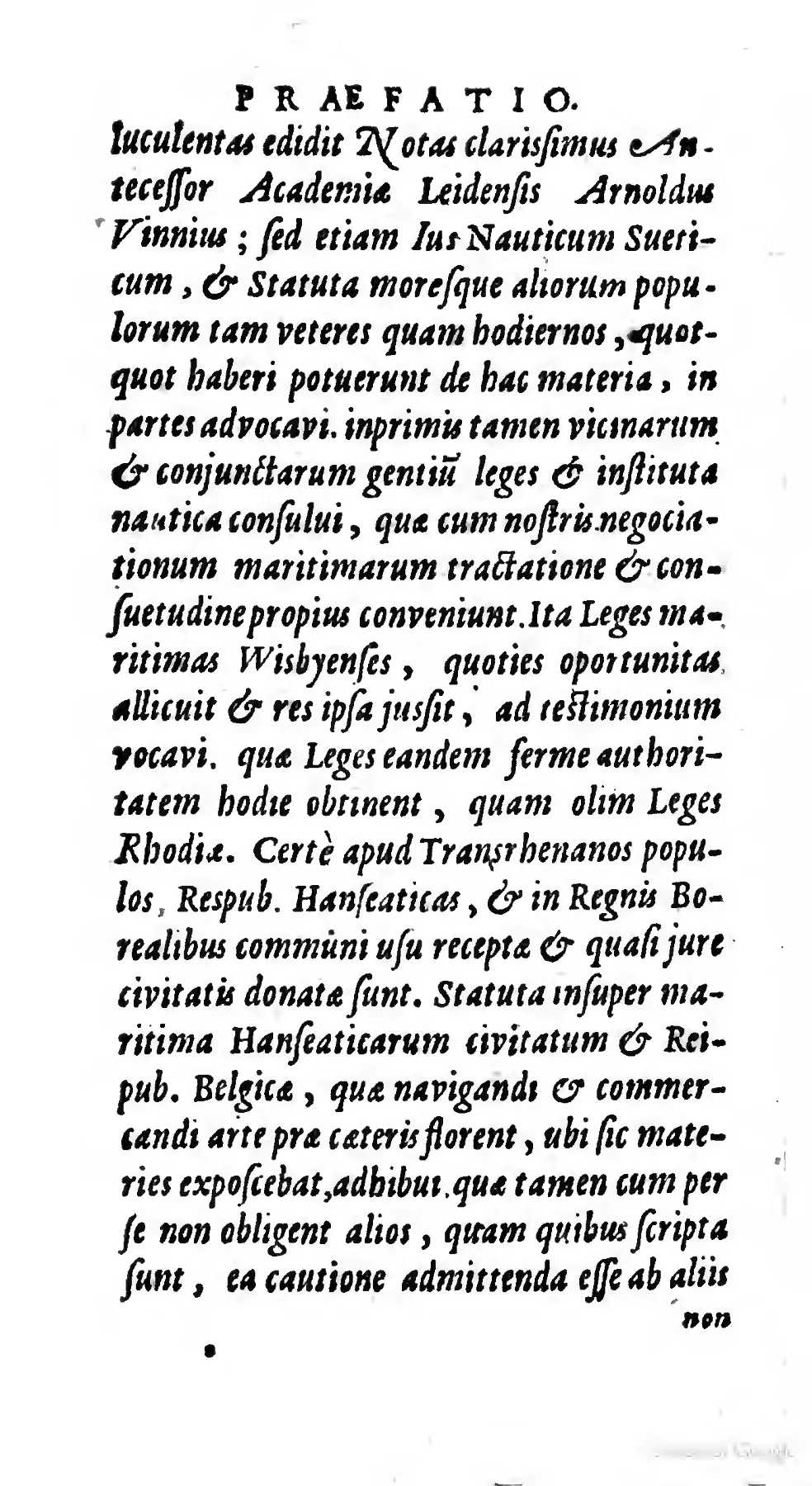
In this continuation of Loccenius's Praefatio, the orderly italic catalogue of Swedish nautical law, Hanseatic and Belgic statutes, Vinnius's learning, and ancient and modern customs gives typographic form to that comparative discipline. Its culminating appeal to the Laws of Wisby as holding nearly the present authority once enjoyed by the Rhodian Sea Law turns that breadth of sources into a pointed claim for Nordic legal parity. Source ↗.
The report that follows tracks this throughline across its several registers. The philological framing in Section 1 examines the conceptually heavy keywords through which Loccenius builds his doctrine — the bifurcated dominion of the sea, the maritime loan, and the fiction of postliminy — each of which carries the synthetic method in miniature. The executive summary and the account of scholarly significance situate the bee-method and the elevation of Wisby within the historiography of the law of the sea and of early modern commercial law. The textual and material history traces how the work was consolidated, through the Janssonius network and later the Heineccius fasciculus, into the canonical corpus of the Northern maritime-law tradition. Throughout, the connective motif is the same reconciliatory move by which a jurist working at the northern periphery of the ius commune claimed for his region's law a place at the center of European maritime doctrine.
A note on confidence is in order. Where the historiography speaks with settled voice — on the work's place in the mare liberum / mare clausum controversy, on its canonization alongside Kuricke and Stypmann — the report carries those findings as established. Where the evidence is thinner — on the dedicatee, on the precise bibliographical relations among the early imprints — the report preserves the uncertainty rather than resolving it.
Explore more on Leo
This text was transcribed and translated as part of the ExLatinis project—an effort by Leo to make English translations of every published text in Latin in early modern Europe (between 1450 and 1750) available to the public for free online.
→ Read the original text and translation on Leo
You can save a copy of this document into your Leo account to run deep text searches, conduct further analysis, or cross-reference it with your own research.
Rendering the Title and Fixing the Philological Keywords
Editorial English Title (provisional): On the Law Maritime and Naval, in Three Books
Following the philological conventions established by Ciara Kennefick, English Law's Encounters with Sweden's Loccenius (2025), the bilingual title-page formula Ioan. Loccenii De iure maritimo et navali libri tres may be rendered as "John Loccenius's Three Books on the Law Maritime and Naval." No settled English title exists in the historiography; the rendering above is supplied editorially and should be cited parenthetically as the De iure maritimo in English-language scholarship.
Loccenius announces his method at the outset in terms that make the synthetic character of the whole explicit: it pleased him here to imitate the bees, which so sip flowers of every kind that they draw the best nectar from them, Imitari / hîc apes placuit, quæ cujuscunque generis / flores ita libant, ut optimum inde / succum hauriant. This programmatic image governs the philological keywords below: each is a technical term whose meaning Loccenius fixes by definition and etymology before reconciling the diverse sources that bear upon it.
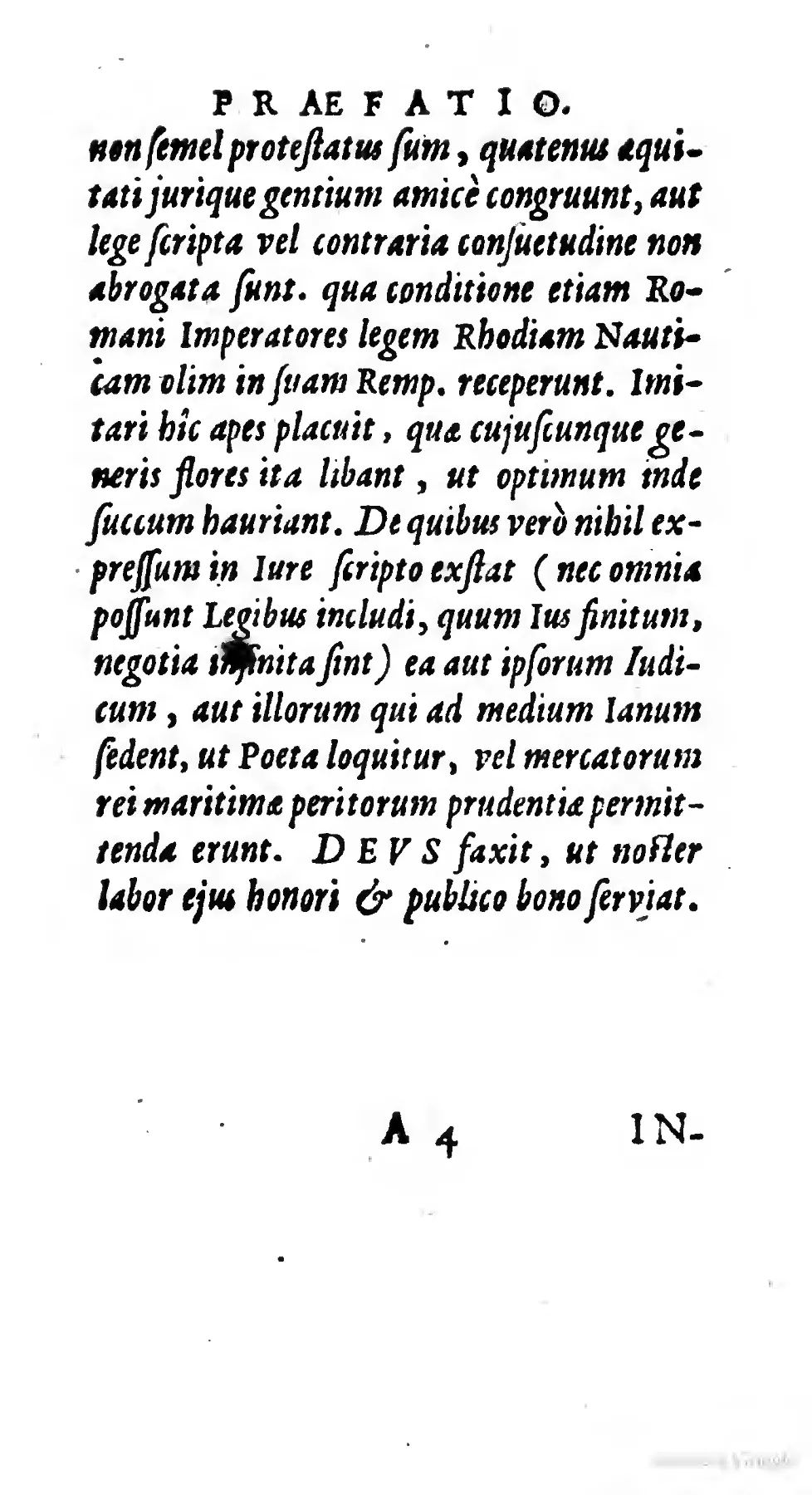
On this final recto of the preface, the large italic type gives Loccenius's method its clearest form: like bees drawing usable substance from many flowers, maritime law is to be distilled from Roman, Rhodian, Nordic, and mercantile sources rather than inherited from any single authority. The signature "A 4" and catchword at the foot mark the threshold between methodological preface and body text, making this the hinge on which his reconciliation of philology, equity, and living sea custom turns. Source ↗.
Three Conceptually Heavy Latin Keywords:
- Imperium maris universale vs. imperium maris particulare. This distinction positions Loccenius between Hugo Grotius's Mare liberum (1609) and John Selden's Mare clausum (1635). Imperium universale denotes a universal dominion of the sea analogous to the civitas maxima of late-scholastic jurists (Suárez, De legibus, II.19); imperium particulare acknowledges legitimate coastal jurisdiction over bays, straits, and zones required for navigation. Loccenius himself frames the question as one drawn inter imperium maris universale, & particulare, that is, between universal and particular dominion of the sea. His deployment of the distinction places him in the mediating tradition later refined by Cornelius van Bijnkershoek (De dominio maris, 1703) and ultimately codified in the modern territorial-sea doctrine.
- Foenus nauticum / pecunia traiecticia. Loccenius retains the Roman-law vocabulary for maritime loans while endorsing the doctrine that the lender's assumption of periculum (risk of total loss) constitutes the iusta causa for charging interest above the sortis (principal). He defines the instrument in exactly these terms: maritime loan is nothing other than money which the creditor, taking upon himself the peril of doubtful outcome, hands over to another at fixed interest as compensation for the risk, Nauticum foenus nihil aliud est, quam / talis pecunia, quam creditor, recepto in / se dubii eventus periculo, alicuisub certis / usuris, tanquam periculi compensatione / tradit. This framework, inherited from Thomas Aquinas (Summa theologiae II-II, q.78) and mediated through Leonard Lessius and Luis de Molina, was the standard justification by which early-modern moral theologians and jurists reconciled maritime bottomry with the canonical usury prohibition — a paradigmatic instance of the bee-method drawing moral theology into juridical doctrine.
- Postliminium and ius navigandi. Postliminium, in Roman law the fiction by which a person or thing returning from enemy capture recovered its prior legal status, is extended by Loccenius to vessels, cargoes, and persons recovered beyond a presumed prescriptive terminus. He defines it as the right of recovering a lost thing from a stranger and restoring it to its former state, Postliminium / est jus amissæ rei recipiendæ ab extraneo, & in pristinum statum restituendæ,, a definition characteristically fixed by the etymology of post and limen. The companion concept ius navigandi is grounded not in Grotian communicatio but in the Vitorian doctrine of ius communicationis as developed in De Indis, §3.1–3.4, and transmitted through the Salamancan school. Loccenius defines the right of navigation as a harmless faculty of crossing to neighboring or distant peoples, permitted by natural, gentile, divine, and civil law, Ius navigandi est innoxia facultas / transfretandi ad vicinos aut remotos populos, / à jure naturæ, gentium, divino & / civili permissa; the fourfold appeal to natural, gentile, divine, and civil law is itself the bee-method in compressed form. He frames free navigation as a corollary of the constraints imposed on bellum iustum, a position that aligns him with the humanist-internationalist current rather than the absolutist doctrine of dominium maris.
Summarizing the Treatise and Its Central Claim
De iure maritimo et navali libri tres (Stockholm: Janssonius, 1651) is a systematic juridical treatise — a maritime-law compendium — composed in Latin by the German-born Swedish jurist Johannes Loccenius (1598–1677). Employing the early-modern juridical-humanist method of apis ex omnibus floribus ("the bee from all flowers"), Loccenius synthesizes Roman, Swedish, Wisby, Hanseatic, and Belgic sources into a coherent and comparative ius maritimum. The work's core thesis is the elevation of Baltic and Nordic positive law — especially the Laws of Wisby — to the normative status previously occupied by the Rhodian Sea Law, thereby constructing a specifically Northern European maritime-law tradition. Loccenius states this elevation in his own words, in the preface: he called the Wisby maritime laws to witness whenever occasion invited, laws which today hold nearly the same authority the Rhodian laws once held, Ita Leges maritimas Wisbyenses, quoties oportunitas / allicuit & res ipsa jussit, ad testimonium / vocavi. quæ Leges eandem ferme authoritatem hodie obtinent, quam olim Leges / Rhodiæ.
The treatise is organized in three books. Book I addresses foundations: navigation, ship construction, the right of navigation, dominion of the sea, shores, shipwreck, ports, fishing, and the right of staple (ius stapulae). Book II concerns maritime security and mercantile instruments: perils of the sea, admiralty jurisdiction, piracy, postliminy, marine insurance, bottomry, jettison, and general average. Book III treats private law at sea: freight and charter, the actio exercitoria, maritime delicts, and admiralty procedure and forum.
The work was composed in Latin and, so far as the available evidence indicates, has never been translated into a modern vernacular language; English-language scholarship continues to cite it under its Latin title. No modern critical edition has been published. The 1651 Stockholm imprint by Jan Janssonius (Johannes Janssonius) constitutes the editio princeps, with a 1652 reissue also recorded.
Placing Loccenius in the Historiography of the Law of the Sea
Loccenius's treatise occupies a pivotal position in the historiography of the law of the sea and of early modern commercial law for four interlocking reasons.
1. The mare liberum / mare clausum controversy. The work intervenes in the long-running debate inaugurated by Grotius's Mare liberum (1609) and answered by Selden's Mare clausum (1635). Loccenius's bipartite distinction between imperium maris universale and imperium maris particulare mediates between these poles, and his engagement with Pontanus's Discussions on the Origin of the Sea and Rivers and the Rhodian Sea Law positions him as a key transitional figure in the genealogy that runs from Baldus de Ubaldis through Grotius to Cornelis van Bijnkershoek. He names his interlocutors directly, citing Selden in Mare clausum, Rivius in his naval history, and Pontanus in his Historical Discussions, Seldeno in Mari clauso, Rivio in Historia navali, Pontano in / Discussionibus Historicis. He also mobilizes diplomatic precedent, inviting his readers to hear Elizabeth Queen of England as arbiter, who thus responded through her Senate to the Spanish envoy in England, as recorded in Camden for the year 1580, audiant Reginam Angliæ Elisabetham arbitram, quæ sic per Senatum respondit / Hispanico in Anglia Legato, apud Camdenum, ad annum 1580 — a characteristic recruitment of statecraft into the adjudication of the dominion question. Modern scholars including Alfred P. Rubin, David J. Bederman, and Wilhelm G. Grewe treat Loccenius as an important node in this genealogy, though he is sometimes eclipsed in the standard narratives by his more famous Dutch and English interlocutors.
2. Piracy as hostis humani generis. Loccenius's discussion of pirates as common enemies of mankind anticipates the early modern doctrine later codified in United States v. Smith (1820) and informs subsequent international law of piracy. He characterizes pirates as public enemies, on account of that notable malice, tanquam hostes / publici, ob insignem illam malitiam, a formulation that situates piracy within the broader framework of just-war theory. His treatment draws on Bartolus of Sassoferrato and on the Spanish School. The Grotius–Selden controversy, the Spanish theologians, and the consolidation of piracy doctrine in the nineteenth century form the historiographical context.
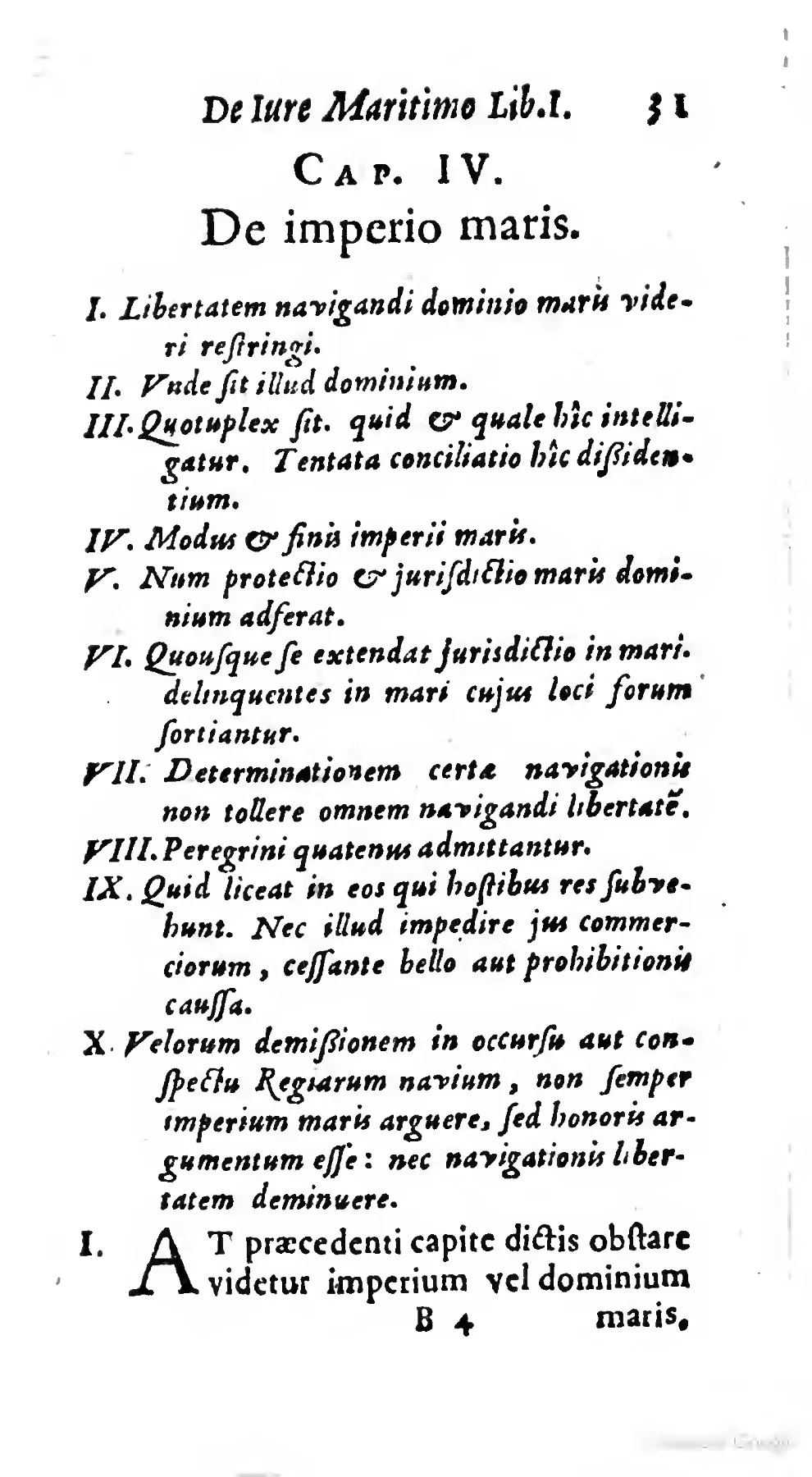
At the opening of Chapter IV, the roman heading and numbered italic syllabus make the dominion-of-the-sea dispute a sequence of adjudicable questions—navigation, jurisdiction, foreign access, aid to enemies, and maritime honors—before the large decorated initial begins the argument. That typographic ordering frames the legal world in which Loccenius could treat pirates not as ordinary offenders but as public enemies within a broader doctrine of maritime sovereignty and just war. Source ↗.
3. Marine insurance and bottomry. The treatise is a principal source for the early modern treatment of foenus nauticum and the risk-compensation justification of maritime interest, as its definition of the maritime loan as periculi compensatione makes plain. Matthiass's 1912 monograph on foenus nauticum and Sleurink's later study provide the historiographical scaffolding, situating Loccenius within the Thomistic–Molinist tradition of moral theology as filtered through Lessius and Molina. Compensation for assumed risk is canonically licit under the periculi compensatio doctrine. This is one of the clearest early-modern articulations of the principle that later became foundational to marine insurance law. The treatise also preserves merchant practice directly, reproducing an insurance undertaking in which the parties promise and bind themselves to avert the peril, Nos subscripti promittimus & obligamus / nos ad avertendum periculum — a documentary insertion that exemplifies the bee-method's willingness to draw living commercial usage into doctrinal exposition.
4. Northern European maritime-law canon and the comparative turn. Loccenius's elevation of the Wisby laws to the dignity of the Rhodian Sea Law, and his integration of Hanseatic and Dutch sources, made the treatise a touchstone for the Northern European maritime-law tradition. Heineccius's 1740 Scriptorum de iure nautico et maritimo fasciculus canonized the trio of Stypmann (Greifswald), Kuricke (Hamburg), and Loccenius (Uppsala) as the foundational authorities of the Northern tradition, and the work continued to be cited in German pandectist and Roman-Dutch legal scholarship through the nineteenth century. Modern scholarship in the history of international law — including Stephen C. Neff, Justice Among Nations (2014), and the literature on the history of the law of the sea — treats Loccenius as a representative voice of the Baltic-Nordic contribution to early-modern ius gentium.
Comparative positioning: Kuricke and Stypmann. Loccenius is conventionally evaluated alongside Reinhold Kuricke (Hamburg, De adsecurationibus diatriba, 1642) and Friedrich Stypmann (Greifswald, Tractatus de iure maritimo et nautico, 1651), who together constitute the Northern maritime-law canon. Whereas Kuricke focused primarily on marine insurance and Stypmann on procedural and commercial aspects, Loccenius produced the broadest systematic synthesis, covering public and private, substantive and procedural maritime law. This breadth, combined with the prestige of his Uppsala professorship and his role as royal historiographer, gave his work a canonical authority that Kuricke and Stypmann individually did not attain in the eighteenth-century German-language legal literature.
Tracing the Editions, the Object, and Its Afterlife
Editions traced. (a) Stockholm: Janssonius, 1650 (title-page date; engraved title dated 1651) — editio princeps; (b) Stockholm: Janssonius, 1652 — editio secunda; (c) Brussels: P. de Dobbeleer, 1652 — a parallel imprint; (d) Leiden, 1672 — with commentary by Z. van Zwanenburgh; (e) Venice, 1706 — a Latin reissue; (f) Halle (Magdeburg): Orphanotrophei, 1740 — as Scriptorum de jure nautico et maritimo fasciculus, ed. Johann Gottlieb Heineccius, printed with Kuricke and Stypmann. The 1740 Heineccius fasciculus is the canonical collected-edition form of the Northern maritime-law canon.
Materiality. The Janssonius imprints follow the typographic conventions of seventeenth-century Stockholm printing: small quarto or octavo, roman and italic types, decorated initials, with an engraved title-page bearing the imprint. The 1652 Stockholm reissue collates [20], 288, [4] pp.; copy-specific collation varies. The 1672 Leiden edition adds van Zwanenburgh's commentary apparatus. The 1740 Halle fasciculus is a substantial octavo volume of c. 1194 pages, reflecting the book's consolidation into a teaching corpus.
Print culture and the Janssonius network. The Janssonius press of Amsterdam maintained a Stockholm branch through which Swedish learned works reached the European market. The 1650/1651 imprint is bibliographically distinguishable from later editions by signature collation and imprint statement. The Brussels de Dobbeleer issue of 1652 reflects the diffusion of the work into the Spanish Netherlands market. That such a Latin synthesis of Northern positive law should circulate through an Amsterdam-based network and into the Spanish Netherlands is itself a material register of the comparative reach that the bee-method claimed at the level of doctrine, and the engraved title page of the 1651 imprint renders that reach in a single image.
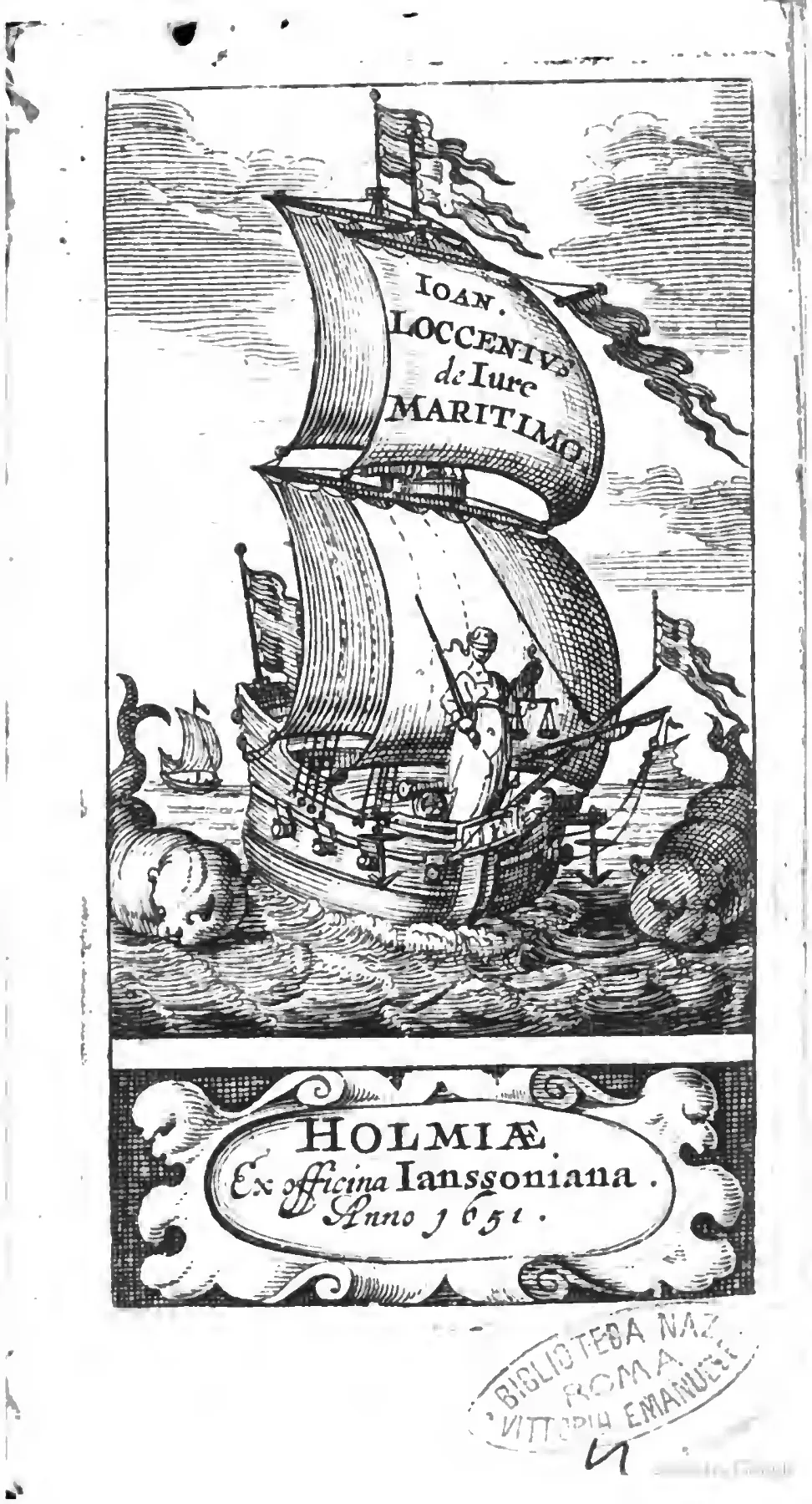
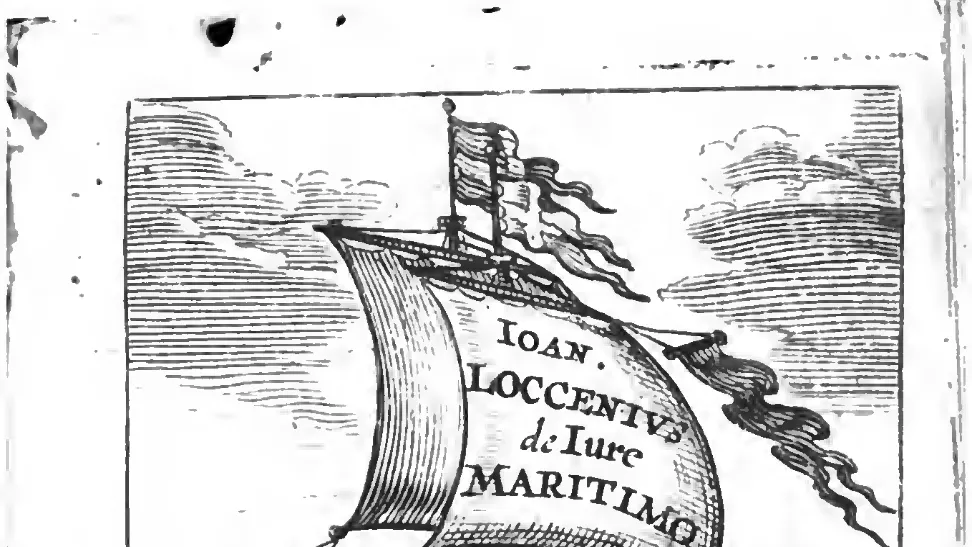
On the 1651 Stockholm editio princeps, Loccenius's title is literally carried in the sail of a trading vessel while Justice stands aboard with scales, condensing navigation, commerce, and jurisprudence into the treatise's governing image. The lower cartouche's "Ex officina Ianssoniana" imprint makes the same point materially, locating this Northern legal synthesis within the Amsterdam-linked print network that helped carry it into wider European circulation. Source ↗.
Reception and patronage. The work was consulted by English judges and advocates from the mid-eighteenth century onward (Lord Mansfield and Sir William Scott are recorded in the Kennefick study) and was incorporated into the German pandectist and Northern European maritime-law tradition via the Heineccius fasciculus. A dedicatee or patron could not be confirmed from available sources, though the dedication is noted in both the SBL and Kennefick studies; verification requires consultation of the Kungliga biblioteket exemplar.
Following the Argument Book by Book
The Programmatic Image and the Elevation of Wisby
Loccenius announces the governing principle of his compilation in a single programmatic image that discloses, before any doctrine is stated, the epistemological wager of the entire treatise — the resolution to imitate the bees, which so sip the flowers of every kind that they draw the best nectar from them, the figure with which Section 1 opened its philological survey. The metaphor does more than gesture at eclectic reading. It converts a problem of authority — the fact that Roman civil law, Swedish enactment, the Wisby ordinances, and the Hanseatic and Belgic statutes possess neither equal standing nor a common voice — into a problem of selection and distillation, over which the compiler retains sovereign discretion. The apian labour is precisely the labour of judgment: the bee does not privilege one flower over another by rank but takes from each what is best, so that the resulting succus owes its authority to the coherence of the whole rather than to the pedigree of any component. This is the maneuver that permits Loccenius to place living Nordic practice beside the Roman inheritance without subordinating the one to the other.
That leveling is made explicit in the preface's treatment of the Wisby maritime laws, where the metaphor's promise is cashed as a specific claim of normative parity. The claim that those laws hold today nearly the same authority the Rhodian laws once held — already set out in the executive summary — repays a closer look at its syntax. The Wisby laws are summoned ad testimonium, as witnesses, a forensic idiom that treats them as bearers of probative authority rather than as local color; and the qualifier ferme, "nearly," registers a scholar's caution even as the comparison to the Rhodian law — the ancient touchstone of the whole genre — does its elevating work. The temporal contrast between hodie and olim is doing the heavy lifting: the Rhodian law is invoked in the past tense as a bygone standard, while the Wisby laws hold their authority in the present, so that the north is not merely likened to a venerable antiquity but positioned as its living successor. The self-restraint of ferme is what makes the claim persuasive rather than merely assertive.
Definition as Method: Navigation and the Dominion of the Sea
From this methodological ground the treatise builds outward by definition, and the definitions themselves enact the bee-method in miniature by fusing plural juridical orders into a single formula. The foundational instance is the right of navigation, which Loccenius fixes as a harmless faculty of crossing over to neighboring or distant peoples, permitted by the concurrent voice of natural, gentile, divine, and civil law — the fourfold formula already isolated among the philological keywords. The definition is calibrated at every joint. The adjective innoxia, harmless, preemptively answers the objection that free passage might threaten the coastal sovereign: the right is bounded by its own innocence, and a crossing that ceases to be harmless would fall outside the faculty here defined. The pairing vicinos aut remotos extends the right across the full range of maritime distance, from coasting trade to the long-haul voyages on which the argument's commercial stakes rest. Most tellingly, the fourfold permission is not a rhetorical crescendo but a structural claim: by grounding the ius navigandi simultaneously in all four orders of law, Loccenius makes it overdetermined, so that no single order can be invoked to defeat it. The compressed catalogue is the distilled nectar of which the preface spoke.
The definitional method reaches its most contested application in the doctrine of the sea's dominion, where the whole apparatus is bent toward mediating a live European controversy. Loccenius frames the question as one lying between universal and particular dominion of the sea, the bifurcation examined in Section 1 as imperium maris universale against imperium maris particulare. The split is itself the instrument of reconciliation: by dividing imperium maris into a universal claim, which he can resist, and a particular one, which he can concede, he opens a middle position between the maximalist poles of the debate. That debate he names with pointed precision, setting his interlocutors against one another as parties to a suit — Grotius in the Mare liberum against Selden in the Mare clausum, Rivius in his naval history, Pontanus in his Historical Discussions, the roll of names already cited in the account of the dominion controversy. The gesture is characteristic of the bee at work among the flowers: the great contested question is not settled by submission to any one authority but adjudicated by arraying the authorities in confrontation and distilling a settlement from their disagreement. Loccenius reinforces the adjudicatory posture by recruiting statecraft into the juridical record, inviting his readers to hear Queen Elizabeth of England as arbiter responding through her Senate to the Spanish envoy — the diplomatic precedent noted in Section 3. The verb audiant, "let them hear," stages the doctrinal exposition as a tribunal at which diplomatic precedent testifies alongside the jurists, and the word arbitram casts the sovereign herself as the neutral adjudicator whose ruling the reader is summoned to weigh. The chapter's own printed architecture enacts this adjudicatory posture before a word of doctrine is stated.
Shipwreck, the Maritime Loan, and Documented Practice
The same synthetic instinct governs the treatise's treatment of shipwreck, where doctrine turns unusually rhetorical because the stake is moral rather than merely technical. Against the fiscal seizure of wrecked goods Loccenius mobilizes the authority of Antoninus in a question set in the emphatic capitals of the printed page: for what right does the fisc have in another's calamity, QVOD ENIM IVS HABET / FISCVS IN ALIENA CALAMITATE,. The interrogative form is itself the argument: framed as a rhetorical question to which the expected answer is nullum, none, it converts a juridical prohibition into an appeal to humanitas, treating the survivor's disaster as a limit that no treasury claim may cross. The heightened register — the borrowed imperial voice, the typographic emphasis — marks the point at which the comparative method draws not on competing statutes but on a shared moral premise that Roman and Nordic law alike are made to underwrite.
In the domain of mercantile instruments the method licenses commercial usage against inherited constraint, most clearly in the definition of the maritime loan — the instrument that Section 1 fixed as money handed over by a creditor who has taken upon himself the peril of a doubtful outcome. The whole legitimacy of that instrument is loaded into the ablative absolute recepto in se periculo: because the creditor assumes the periculum, the interest ceases to be usury and becomes periculi compensatio, compensation for risk. The hedging particle tanquam, "as it were," is the philologically precise register of a jurist aware that he is applying a category by analogy rather than identity — the interest is treated as though it were compensation, and it is precisely that qualified equivalence which reconciles the bottomry contract with the prohibition it would otherwise violate. That the doctrine is not merely theoretical the treatise itself attests, for the chapter closes on a documented Swedish judgment on maritime loan adjudicated thirteen years earlier before the royal courts of the realm, quod ante tredecim / annos in judiciis Regiis hujus regni / discussum est, so that living Nordic case law is set beside the Roman definition as its confirming instance. The same documentary impulse produces the fully reproduced insurance undertaking in which the parties promise and bind themselves to avert the peril, the merchant's formula discussed in Section 3 — a vernacular practice of the market transcribed into the doctrinal exposition, where it becomes a source ranked with the jurists.
Postliminy, Piracy, and the Space of Legitimate Commerce
A final register of the method in the treatise's opening books is the philological grounding of doctrine in etymology, exemplified by the treatment of postliminy — defined, after Paulus, as the right of recovering a lost thing from a stranger and restoring it to its former condition, the definition already parsed among the philological keywords. Its key phrase, in pristinum statum restituendæ, discloses the conceptual logic of the fiction: the recovered thing is treated not as newly acquired but as restored to a status it never truly lost, the legal continuity preserved across the interval of capture. The characterization of pirates belongs to the same enterprise of fixing status by definition, for it is on the ground of their standing outside every legal community that Loccenius treats them as public enemies, on account of that notable malice, the formulation already quoted in the account of piracy doctrine. The pirate, defined as the common enemy of all, is the negative image of the navigator whose harmless faculty of passage the treatise had defended at the outset: where the ius navigandi is permitted by the concurrent voice of every order of law, the pirate stands condemned by all of them, and the two definitions frame between them the space of legitimate commerce that the whole synthetic enterprise exists to secure.
The Private Law of Book III: Carriage, Partnership, Delict, and Forum
The final movement of the treatise concentrates the synthetic ambition of the whole into its most concrete registers: the ordinary contingencies of carriage, partnership, delict, and forum. Here the bee-method operates not on abstract questions of dominion but on the granular substance of commercial life, and the reconciliation of Roman category with Nordic and scriptural precedent proceeds by the same distilling motion at the level of the individual case. The book's own index lays out this sequence at a glance.
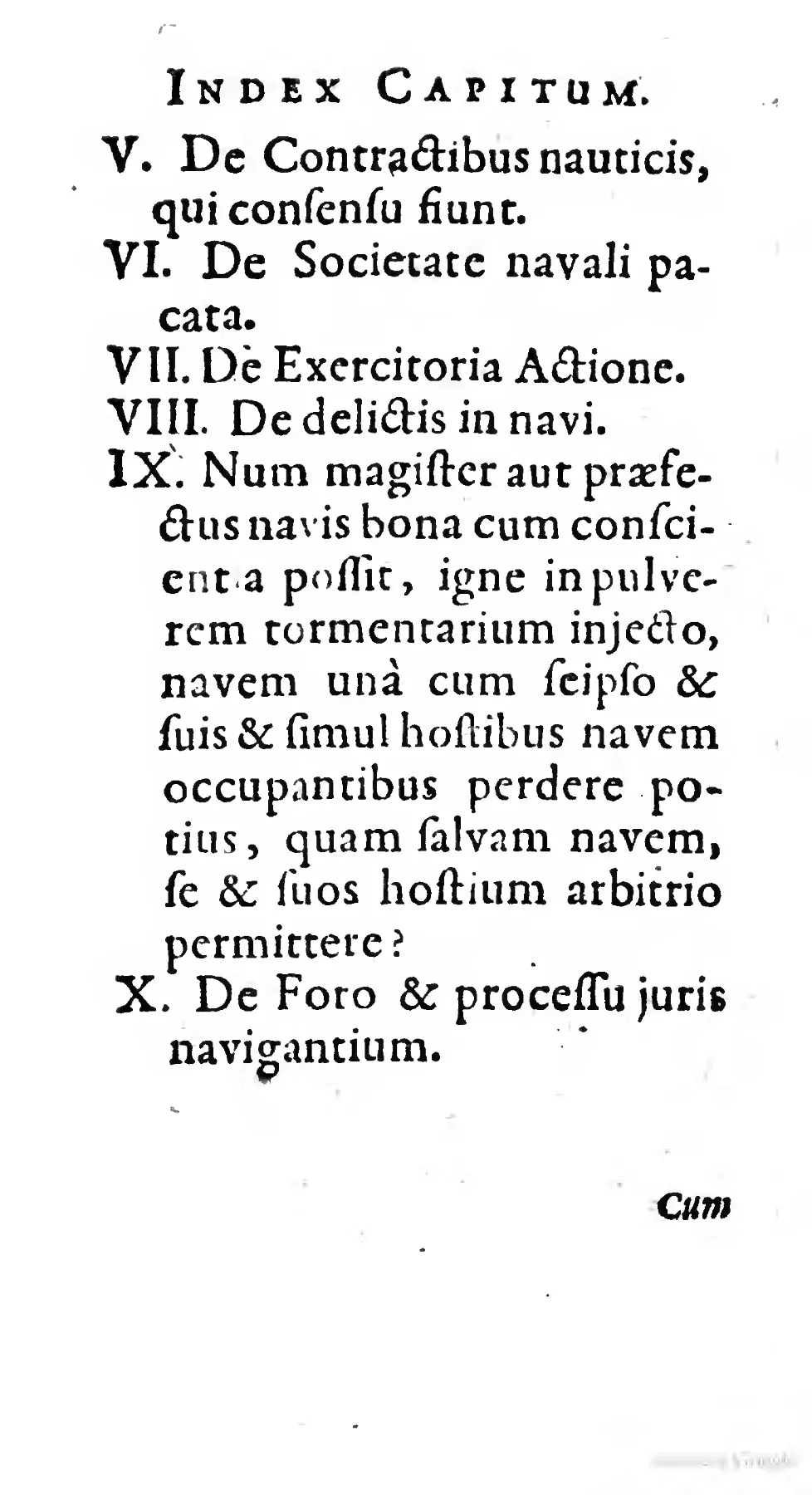
This spare Book III index makes visible the sequence by which Loccenius moves from maritime partnership and shipmaster liability to delicts at sea, before isolating in chapter IX the exceptional question of whether a captain may destroy his own ship rather than submit to capture. Its plain roman typography underscores the treatise's legal architecture: ordinary commercial doctrines culminate in a concentrated moral test of conscience under wartime necessity. Source ↗.
Book III opens on the action for diverted cargo, where Loccenius resolves a delicate question of ownership by attending to the physical disposition of grain aboard ship. His governing distinction turns on whether the commodity has been kept separate or commingled, and it is the fact of commingling that dissolves the bailment into something the master owns outright: and thus if they have gone into credit in common, the grain is deemed made the sailor's, and therefore by giving to one his share, he is not seen to divert the cargo, but is seen to give rightly, & sic in creditum ierint communiter, frumentum factum nautæ videtur, & ideo uni dando pro sua parte, onus avertere non videtur, rectè dare videtur. The reasoning is quintessentially Romanist in its instinct — the conversion of an obligation to return the idem corpus into a quasi-mutuum once the identifying boundaries collapse — but its application to the hold of a working vessel, where planks partition one owner's cargo from another's, shows how Loccenius fits the inherited category to the material realities of Baltic freight. Ownership follows identifiability; where identifiability lapses, so does the master's exposure under the oneris aversi action.
From this contractual particular the exposition rises to the law of maritime partnership, and it is here that the treatise's characteristic gesture — the grounding of a civil-law institution in scriptural antiquity — appears in its purest form. Defining the peaceable, commercial partnership as distinct from the warlike, Loccenius validates its lineage not from the Digest but from the book of Kings: the peaceable naval partnership is of no less ancient custom than the warlike, as among other things is clear from the partnership of Solomon, which he contracted with Hiram and his Tyrian subjects, men skilled in maritime affairs and navigation, with a joined fleet, Societas navalis pacata non minus est antiqui moris, quam bellica: veluti inter alia constat ex societate Salomonis, quam cum Hiram & Tyriis hujus subditis rei maritimæ & navigationis peritis conjuncta classe contraxit. The move is more than ornamental. By making the Ophir gold-voyage the locus classicus of commercial partnership at sea, Loccenius grants the institution a dignity and a sanction that no purely Roman derivation could supply, and the surrounding geographical excursus — reaching to the East Indies beyond the Ganges, to Pegu, Malacca, and Sumatra — quietly folds contemporary Portuguese and Dutch colonial-commercial geography into a biblical frame. The bee gathers here from Scripture, from classical geography, and from the living cartography of the long-distance trades, distilling all three into a single doctrinal warrant. The counter-example of Jehoshaphat's failed venture with the impious Ahaziah, and the reproduced theological consilium on whether a Christian may partner with a Jew, extend the same method into moral theology, registering the real confessional anxieties that attended cross-confessional maritime ventures in the mid-seventeenth-century Baltic.
The longest sustained exposition is reserved for the actio exercitoria, and Loccenius introduces it by the etymological procedure that governs his handling of every technical term. The action is named from the working of a ship: the exercitorian action is so called from the exercising of a ship, of which the utility is so great that it pertains to the highest interest of the commonwealth, Exercitoria dicitur Actio ab exercitatione navis: cujus tanta est utilitas, ut ad summam remp. pertineat. The definition does two kinds of work at once. It fixes the meaning of the action by tracing it to its verbal root, and it justifies the action's stringency by an appeal to public utility — the encouragement of shipping being a matter of the commonwealth's supreme concern. Upon this foundation rests the operative rule that governs the whole chapter: those who have appointed a master to a ship are held by the exercitorian action to those who have contracted with the master of the ship, Illi verò qui præposuerunt magistrum navi, tenentur exercitoria actione illis qui cum magistro navis contraxerunt. The rule of representative liability — that the appointment of the master binds the appointer to third parties dealing with him — is the mechanism by which commercial credit at sea becomes possible, and Loccenius grounds it in the necessity of navigation and the implied trust reposed in the exercitor. That he glosses this Roman figure with the vernacular of the northern trades, the Swedish and Dutch and German terms for the shipowner, is the comparative turn made visible at the level of the word: the exercitor of the Digest is silently identified with the Reedare of the Baltic quay, and the ancient category is thereby shown to describe a living institution. Notably, when Loccenius reaches the question whether solidary liability accords with natural equity, he registers dissent, citing the Dutch non-observance of the rule after Grotius and Vinnius — a candid acknowledgment that the reconciliation of sources does not always yield unanimity, and that positive practice may diverge from Roman doctrine even where the doctrine claims the authority of equity.
Among the delicts treated in the following chapter, Loccenius's textual-critical instinct surfaces in his handling of the classic parallel among the keepers of tavern, ship, and stable, where he reproduces the provision verbatim: if anything perishes from a tavern, ship, or stable, it is to be reclaimed from those who are in charge of such places, or who conduct business in them, in such wise that they render oaths concerning their own knowledge, Si quid de taberna, nave vel stabulo perierit, ab his qui locis talibus præsunt, vel qui in his negotiantur, repetendum est, ita ut præstent sacramenta de conscientia sua. The passage is valuable twice over. As a reproduced source it exhibits the nautae caupones stabularii liability that stands behind the master's answerability for goods lost aboard; and Loccenius's accompanying note — that the word nave had dropped out of the Lindenbrog edition and must be restored — shows the philological care he brings to his sources, treating the establishment of the correct text as a precondition of correct doctrine. The bee-method here reaches into the Edictum Theodorici itself, restoring a maritime reading that a defective edition had effaced.
The most concentrated moral argument of the book is the self-contained quaestio on whether a master facing certain capture may destroy ship, crew, and enemy together with gunpowder rather than surrender. Having laid out the affirmative case from Chytraeus and Burgersdijk, Loccenius overturns it by a single controlling axiom of Scripture: let even the one saying of the Holy Spirit suffice: evils are not to be done — whether directly or obliquely, for it speaks indefinitely — that goods may come of them, Romans 3, verse 8, vel unicum Spir. S. dictum sufficiat: Non sunt facienda mala (sive directè sive obliq[ue] indefinite enim loquitur) ut eveniant bona Ro. 3. v. 8. The interpolated gloss — that the prohibition binds whether the evil be done directly or obliquely, since the apostle speaks without qualification — is doing precise casuistic work, foreclosing the escape route by which a defender might urge that his self-slaughter is merely the incidental means to a public good. By insisting on the indefinite scope of the axiom, Loccenius denies that the intended public benefit of destroying the enemy can license the intrinsically evil act, and the Samson exemplum is set aside as a singularis instinctus rather than a repeatable warrant. Here the treatise shows moral theology overruling martial expediency, the scriptural axiom functioning as an absolute limit on what the necessity of war may command.
The closing chapter on forum and procedure distills the practical philosophy of the whole into a rule of expedition. Maritime causes cannot tolerate the ordinary tempo of litigation, because the very conditions of seafaring make delay perilous: but the case is to be brought to maturity in as brief a span of time as possible, on account of the necessity of navigation, whose peril lies in delay, sed quam brevi potest temporis spatio, causa maturanda ob navigandi necessitatem, cujus periculum est in mora. The formula periculum est in mora justifies summary process by the mobility of ships and men: witnesses disperse with the next tide, and a forum that cannot act quickly cannot serve those who live by the sea. The same responsiveness to maritime realities that shaped the substantive doctrine — the partitioned grain, the trusted master, the vernacular shipowner — governs the procedure that enforces it, so that the treatise closes as it proceeded throughout, fitting inherited legal form to the exigencies of the seagoing life before ending on its devotional colophon.
Frequently Asked Questions
What is Johannes Loccenius's De iure maritimo et navali libri tres?
It is a systematic sea-law treatise, first printed at Stockholm by Janssonius in 1651, in which the German-born Swedish jurist Johannes Loccenius (1598–1677) drew Roman civil law, Scripture, and the living statutes of the Baltic and North Sea into a single comparative doctrine. Organized in three books, it treats navigation and dominion of the sea, maritime security and mercantile instruments, and the private law of carriage, partnership, delict, and forum. Its central claim raises the medieval Laws of Wisby to the normative dignity once held by the ancient Rhodian Sea Law.
Who was Johannes Loccenius?
Johannes Loccenius (1598–1677) was a German-born Swedish jurist who held a professorship at Uppsala and served as royal historiographer. Writing at the moment Sweden's commercial and naval power was ascendant, he composed his maritime-law treatise in Latin, distilling Roman, Swedish, Wisby, Hanseatic, and Belgic sources into a comparative discipline. The prestige of his Uppsala chair and his royal office gave his work a canonical authority that his fellow Northern jurists Reinhold Kuricke of Hamburg and Friedrich Stypmann of Greifswald did not individually attain in eighteenth-century German legal literature.
What is the "bee-method" Loccenius uses in the treatise?
It is Loccenius's own image for his working method, drawn from a humanist commonplace: he resolves to imitate the bees, which sip flowers of every kind so as to draw the best nectar from them. In practice this means proceeding by etymology and definition, then reconciling plural and unequal sources — Roman law, Scripture, Wisby, Hanseatic, and Belgic statutes — into coherent doctrine rather than submitting to any single authority. The metaphor converts a problem of competing authorities into one of selection and distillation, over which the compiler keeps sovereign discretion, so that doctrine owes its force to the coherence of the whole.
How did Loccenius justify charging interest on a maritime loan despite the ban on usury?
He grounded it in the lender's assumption of risk. Defining the foenus nauticum (maritime loan) as money handed over by a creditor who takes upon himself the peril of a doubtful outcome, Loccenius held that this assumed periculum constitutes just cause for charging interest above the principal, so the interest becomes periculi compensatio — compensation for risk — rather than usury. The reasoning, inherited from Thomas Aquinas and mediated through Lessius and Molina, was the standard means by which early-modern moral theologians reconciled bottomry with the canonical usury prohibition. He confirmed the doctrine with a Swedish judgment adjudicated thirteen years earlier before the royal courts.
Is there an English translation of De iure maritimo et navali libri tres?
So far as the available evidence indicates, the work has never been translated into a modern vernacular, and no modern critical edition has been published; English-language scholarship continues to cite it under its Latin title. This negative finding should be treated with caution rather than as proof that none has ever existed. Separately, the Leo edition presents the full transcription and a complete English translation for the first time, part of an effort to make freely available online, at no cost, English translations of every text printed in Latin in early modern Europe between 1450 and 1750. That translation is generated by AI.
This report was generated by an advanced AI assistant that conducted deep research alongside an extensive interpretation of the transcribed original text. Every effort has been made to preserve fidelity to the source and to guard against inaccuracy, but corruption in the text recognition process and model hallucination may nonetheless have entered the text. Treat every claim, quotation, translation, and citation as provisional, and verify each against the original source before relying on or citing it.
Bibliography
- David J. Bederman, The Pillars of Global Law: The broad genealogy of the ius gentium here supplies the frame within which Loccenius's split between universal and particular dominion becomes legible as a mediating position rather than an eccentric one. Read it to see why a jurist working from Uppsala belongs on the same shelf as the Dutch and English names that usually crowd him out.
- Ciara Kennefick, "English Law's Encounters with Sweden's Loccenius," Stockholm Centre for Commercial Law: The one modern study that follows the treatise into the hands of Mansfield and Scott, and thus the surest guide to how a Latin compendium of Baltic law came to be quoted in English admiralty courts. It also furnishes the title-page transcription on which this report's provisional English rendering rests.
- R. W. Lee, An Introduction to Roman-Dutch Law: A dependable orientation to the Roman-Dutch tradition that carried Loccenius's Romanist synthesis across the Baltic and North Sea commercial worlds. Consult it to understand the doctrinal machinery — bailment, mutuum, the actio exercitoria — that Book III fits to the working hold of a ship.
- Bernard Matthiass, Das foenus nauticum und die geschichtliche Entwicklung der Bodmerei: The classic account of bottomry's Roman origins and early modern career, indispensable for weighing Loccenius's claim that assumed risk converts interest into periculi compensatio. It shows precisely how far his formulation was standard and where it was his own.
- D. P. O'Connell, The International Law of the Sea, vol. 1: The modern doctrinal survey against which the seventeenth-century bifurcation of dominion acquires its later contour, running from Loccenius's coastal jurisdiction to the territorial-sea regime. Useful for readers who want to measure how much of his mediating instinct survived into codified law.
- Michael Stolleis, Geschichte des öffentlichen Rechts in Deutschland, vol. 1: The authoritative history of German public law that situates Loccenius within the Northern jurisprudential milieu he shared with Kuricke and Stypmann. It clarifies why the Heineccius fasciculus of 1740 could bind the three of them into a single teaching canon.
- Wikipedia, Laws of Wisbuy: A serviceable entry point to the medieval Gotland sea law whose elevation to Rhodian dignity is the treatise's central wager. Consult it to grasp what body of positive custom Loccenius was promoting when he summoned the Wisby laws ad testimonium.
- Wikipedia, Maritime law: A general survey of the maritime-law tradition — Rhodian, Oléronnais, Wisby, Hanseatic — that maps the sources Loccenius gathered and reconciled. It offers the non-specialist a quick sense of the plural inheritance the bee-method was built to digest.