The Citadel of Medicine: How Lorenz Scholtz's 1610 Letter-Anthology Put Galenic Method on Trial Against Paracelsian Chymistry
A physician's craft, or a gamble paid for in corpses? This is a scholar's guide to Epistolae philosophicae, medicinales ac chymicae, the 1610 anthology in which Breslau physician Lorenz Scholtz von Rosenau printed the learned correspondence of the late-Rudolfine medical elite. Its letters convert plague, poison, and gold-drinking into courtroom disputations, defending Galenic reason against chymical enthusiasm one signed exchange at a time.
ExLatinis
July 20, 2026
A physician's craft, or a gamble paid for in corpses? This is a scholar's guide to Epistolae philosophicae, medicinales ac chymicae, the 1610 anthology in which Breslau physician Lorenz Scholtz von Rosenau printed the learned correspondence of the late-Rudolfine medical elite. Its letters convert plague, poison, and gold-drinking into courtroom disputations, defending Galenic reason against chymical enthusiasm one signed exchange at a time.
This volume assembles, under the editorial hand of the Breslau physician Lorenz Scholtz von Rosenau, the learned correspondence of the foremost physicians and natural philosophers of the late sixteenth century — the circle gathered around Johann Crato von Krafftheim, imperial physician to Maximilian II and Rudolf II, together with Peter Monau, András Dudith, Girolamo Mercuriale, Girolamo Capivacci, Thomas Erastus, and their interlocutors. It is not a monograph and not a documentary archive but a constructed corpus epistolarum: a printed anthology in which the learned letter, stripped of the incidental matter of date and dedication and ordered to the demands of controversy, becomes a portable and citable instrument of natural-philosophical debate. What the volume preserves is less a chronicle of exchanges than the texture of a method — the way a community of physicians reasoned together across the distances between Prague, Breslau, Padua, Basel, Heidelberg, and Montpellier.
The single problem that runs through the collection is how the physician ought to adjudicate the boundary between Galenic-humoral orthodoxy and the ascendant Paracelsian and chymical therapeutics — how to refuse chymical enthusiasm and its metaphysical extravagances without also refusing the genuine remedies that chymical practice, pursued to legitimate ends, had brought to light. The recurring intellectual move by which the letters confront this problem is the conversion of each disputed matter — the nature of contagion and plague, the ontology of poison, the status of chymical extracta and aurum potabile, the so-called disease of total substance, the metaphysics of individuals — into a dialectical quaestio answered from Hippocratic-Galenic and Aristotelian first principles and then tested against daily experience and the demands of the healing art. The spine of the volume is thus method-as-arbitration: reason guided by nature, rather than the force of medicaments, is what wins victory over disease.
The stakes of this adjudication were at once medical, philosophical, and confessional. The Galenic defence of humoral pathology against a tria prima ontology of Salt, Sulphur, and Mercury was inseparable from the Erastian polemic against Paracelsus that took shape in Reformed Heidelberg; the ontology of poison, the etiology of epidemic disease, and the nominalist question of whether there can be a disease of substance as such were fought as skirmishes in a single campaign over what counts as legitimate natural knowledge and legitimate cure. The presence in the collection of correspondents as theologically fraught as Michael Servetus, under his Latinised name, marks how closely the medical disputation ran alongside the confessional fault lines of the age.
These several disputes are held together by a shared conviction about the physician's craft and its limits — a conviction that the healing art is rational and methodical rather than a matter of fortune or of the brute potency of drugs. That conviction is what allows the letters to condemn what they take to be fictions while conceding what they take to be genuine, and it is what gives the anthology its argumentative coherence across the diversity of its occasions. The throughline that connects the volume's keyword philology, its bibliographical and material history in the Wechel–Marne–Aubry printing consortium, and the analysis of its textual movement is precisely this: the elevation of the learned letter into a juridical genre in which method itself is placed on trial and vindicated.
What follows traces that throughline first through the culturally weighted vocabulary the volume deploys, then through its genre, editorial construction, and printing history, its scholarly significance and the historiography that frames it, and finally its textual and material biography — with the granular exposition of the primary text reserved for the structural analysis below.
Explore more on Leo
This text was transcribed and translated as part of the ExLatinis project—an effort by Leo to make English translations of every published text in Latin in early modern Europe (between 1450 and 1750) available to the public for free online.
→ Read the original text and translation on Leo
You can save a copy of this document into your Leo account to run deep text searches, conduct further analysis, or cross-reference it with your own research.
Naming the Volume: English Title and Philological Framing
Editorial English Title: The Volume of Philosophical, Medical, and Chymical Letters Written by the Foremost Philosophers and Physicians of Our Age, Now for the First Time Published through the Labour and Industry of Lorenz Scholtz von Rosenau (an editorial translation supplied for convenience; no established English title exists in the historiography).
Conventional Short Title: Epistolae philosophicae, medicinales ac chymicae (Scholtz 1610).
Three Culturally Heavy Latin Keywords:
(a) Epistola. In the early modern respublica litteraria the learned letter was a formally licensed vehicle for medical quaestiones. Where the consilium addressed a single patient and the published treatise crystallised one position, the epistola — when gathered, printed, and circulated — functioned as a juridical genre in which two or more named authorities exchanged arguments under their own signatures, producing a portable, citable disputation. The Scholtz volume deliberately elevates this genre: by stripping away dates, dedications, and patient-specific matter, and by ordering exchanges according to the demands of learned controversy rather than the chronology of receipt, the editor transforms the letter into the locus of natural-philosophical debate. The letters themselves make this dialectical inheritance explicit, presenting the epistolary method as a continuation of an ancient scholastic protocol: the ancient practice is to question on a proposed problem, dispute, answer the inquirer, and recall the answer to examination, Vetus est ratio de problemate proposito interrogare, disputare, ac percunctanti & sciscitanti respondere, quodq[ue] responsum est ad examen reuocare. This dialectical genealogy is precisely what Scholtz's prefatory address to the reader stages typographically before any single dispute is joined.
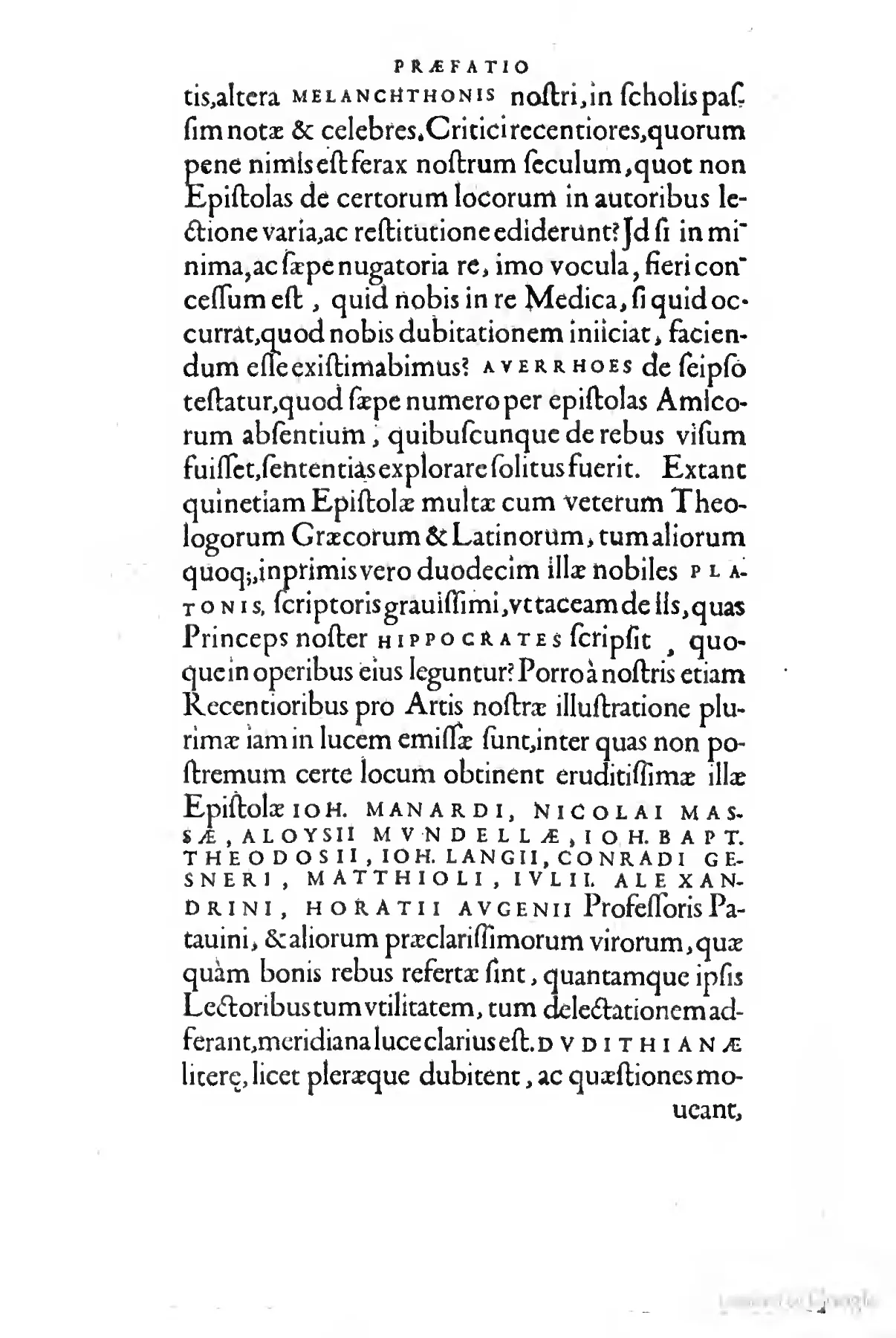
Scholtz's "Ad Lectorem" preface visually stages the learned letter as an authoritative lineage: dense roman type gathers ancient, medieval, and contemporary medical writers into a printed genealogy before closing with the Breslau-dated colophon of 30 March 1598. By introducing Dudith among these epistolary predecessors, the page anchors the volume's transformation of correspondence into a citable forum for medical quaestiones—the juridical epistola that gives the collection its dialectical spine. Source ↗.
The quaestio-and-response structure that the consilium tradition confined to the clinic is here transposed into print as the governing form of learned exchange, and it is this dialectical protocol — method-as-arbitration — that supplies the volume's connective spine.
(b) Venenum. The collection stages a Galenic defence of venenum as a relational category — substance that is aliment, medicine, or poison only ad hominem, by dose, disposition, and temperament — and wields this relational reading against Paracelsian pharmacology, which located therapeutic and toxic power in the tria prima resident in matter itself. This Galenic move is the volume's principal pharmacological resource, and it is grounded on an explicit appeal to Galenic authority: Galen expressly pronounces these three — nutriment, medicament, and poison — to be relative to something, namely to man, Rectius mihi philosophari: Galenus nositer videtur: qui & 3, de temperamentis 4. & 1. simpl. 1. expressis verbis tria hæc: alimentu[m] videlicet, medicamentum, & venenum, relata esse ad quid, diserte pronunciat: ad hominem nimirum. The tripartite scheme locates toxic or therapeutic power not in the substance considered in itself but in its relation to the body that receives it — the same dialectical conversion of an ontological question into a relational quaestio that governs the volume throughout.
(c) Contagium / morbus totius substantiae. The collection contests the Paracelsian-Fernelian notion of a morbus totius substantiae — a disease of substance as such, allegedly elicited by chymical operations — and reasserts the Galenic doctrine that disease is a dyscrasy of the humours, not an affection of substance per se. The volume registers the received doctrine of contagion in its full ontological force — contagion is an affection destructive of substance, as Montanus says, to which putrefaction cannot succumb unless it reaches the venomous quality of a certain form, Est enim contagium affectus destructiuus substantiæ, vt Montanus ait, cui putredo non possit subuenite, nisi sit talis & tanta, vt perueniat ad venenatam qualitatem certæ formæ — and then works to reduce that "affection of substance" back to the humoral register, arguing that by nature putrefaction is nothing but a vitiated temperament: it is impossible for a putrid thing, as putrid, to taint another body without corruption of temperament, since by nature putrefaction is nothing but a vitiated temperament, Impossibile autem est, vt res putrida, quatenus putrida est, corpus aliud maculet, absque temperamenti corruptione, quia natura nihil est aliud putredo, quam vitiosa temperatio. The disease of total substance is in turn dismissed as a novelty of chymical provenance — a recent fiction, first devised, I think, by Fernel; it seems to have first sprouted from chymistry, recens figmentum, à Fernelio primu[m], vt arbitror, exogitatum. Videtur autem è chimia pullulare primum coepisse. This anti-Fernelian, anti-Paracelsian polemic is the volume's principal argumentative armature against what it flags as a recens figmentum of chymical etiology.
The title's three-adjective stack — philosophicarum, medicinalium, ac chymicarum — is not neutral. It claims parity among natural philosophy, university medicine, and chymistry, but the texts themselves (judging from the named correspondents) overwhelmingly vindicate the first two against the third. The Latin is humanist; the Greek technical vocabulary embedded in the letters (ζύμωσις, ἐνέργεια, οὐσία) requires, and the volume supplies, the appended Interpretatio Graecorum.
Placing the Volume: Genre, Editor, and Imprint at a Glance
Genre: Printed anthology / volumen of learned medical-philosophical-chymical correspondence, compiled, edited, and ordered by a single editor from materials circulating in the medical-humanist network centred on the late Rudolfine court and Silesian (Breslau/Wrocław) learned milieu. Not a monograph; not a journal; a constructed corpus epistolarum in the early-modern sense — closer in genre to a humanist centuria epistolarum than to a modern collected-works edition. The letters themselves advertise their standing as a mode of learned exchange fully equal in utility to the formal consilium, casting the epistolary form as the natural vehicle for the dialectical quaestio.
Compiler / Editor: Lorenz Scholtz von Rosenau (Laurentius Scholzius à Rosenaw, 20 September 1552 – 22 April 1599), Breslau physician and botanist; alumnus of Wittenberg (1573), Padua (M.D. 1582), and Strasbourg; close correspondent of Johannes Crato von Krafftheim. The volume is posthumous for the 1610 imprint.
Date and Place of Printing: Hanau (Hanoviae), 1610, printed under the joint imprint of Claude de Marne and the heirs of Johann Aubry, successors of Andreas Wechel, with the imprint line typis Wechelianis, apud Joannem Aubrium. Catalogue reference: USTC 2106666.
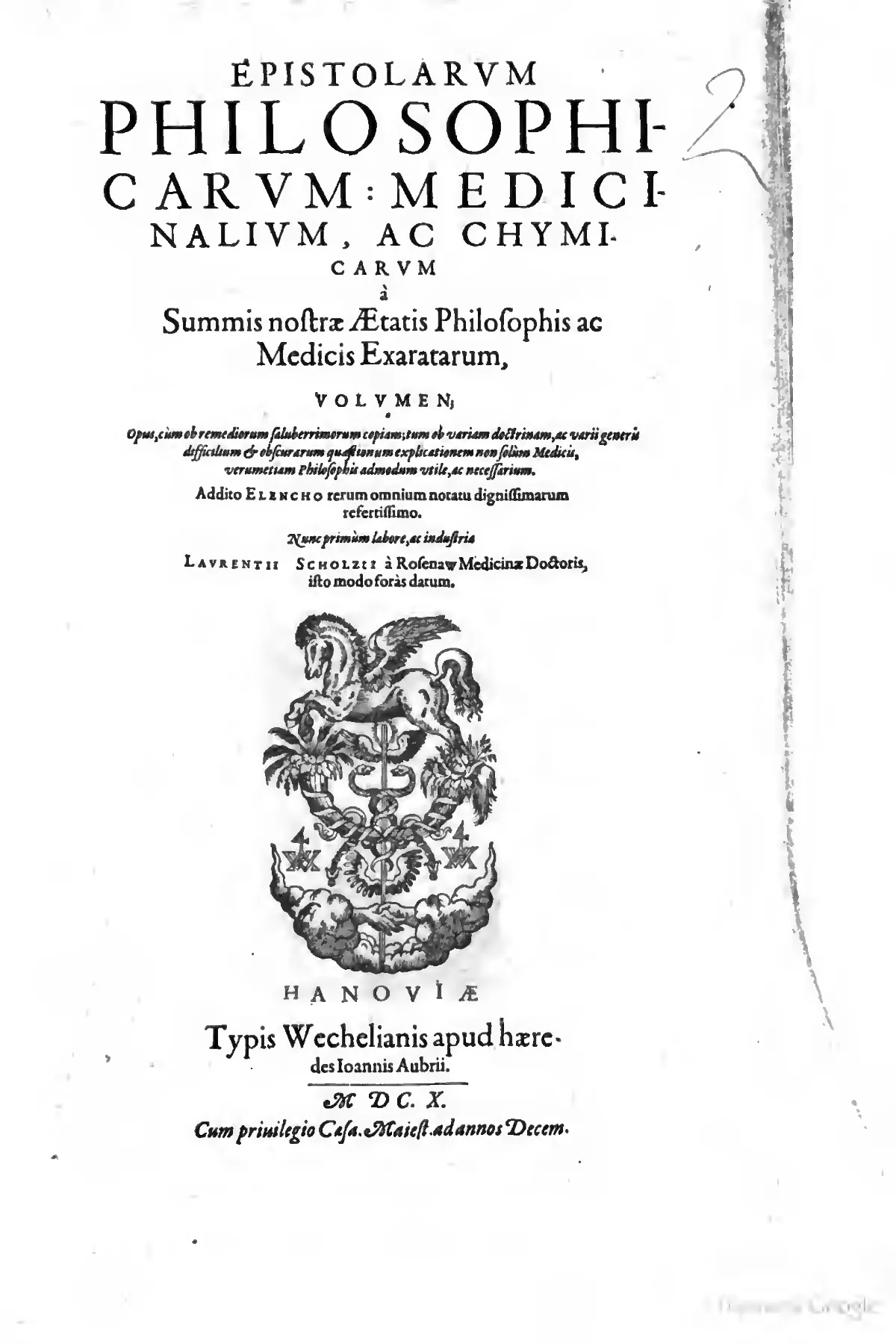
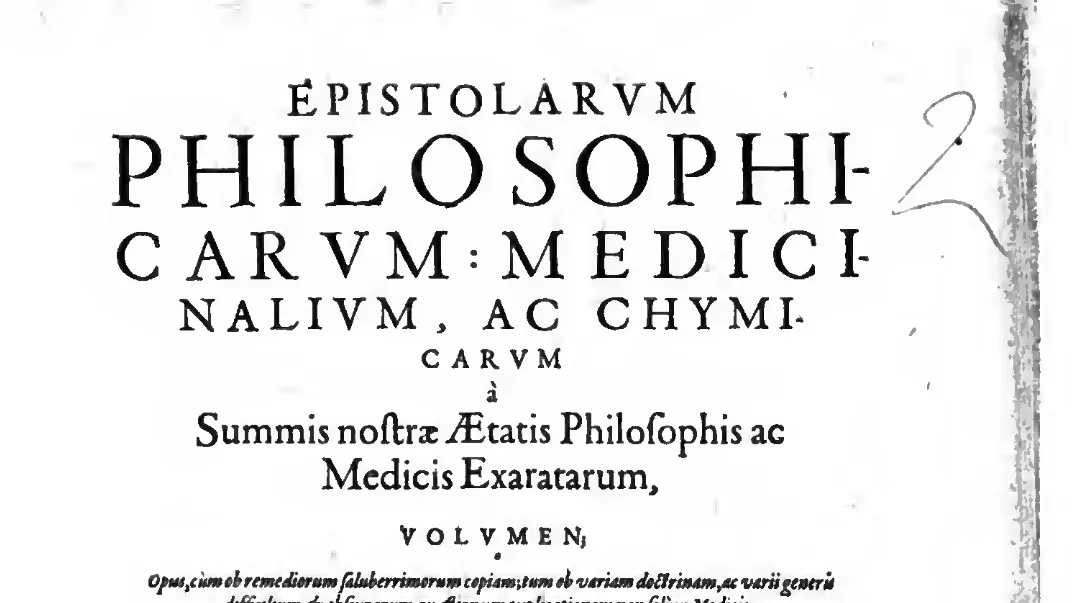
On the 1610 Hanau title page, the stepped display typography gives visual weight to the volume's claimed span across philosophy, medicine, and chymistry, while the credit to Scholtz and the imprint at the foot anchor the folio in the Wechel–Aubry publishing succession named here. The large Pegasus printer's device at center complicates the press's otherwise austere typographic presentation, making the material imprint history visible rather than merely bibliographic. Source ↗.
Earlier Issue: Frankfurt am Main, 1598, apud Andreae Wecheli haeredes, Claudium Marnium et Joan. Aubrium (USTC 653947), 8° format — the 1610 Hanau folio is a reprint of this 1598 setting.
Core Purpose: To preserve and publish, under named signatures, the learned disputations of the foremost physicians and natural philosophers of the age — above all the Crato-Monau-Dudith-Erastus-Mercuriale-Capivacci circle — and to fix in portable, citable form the Galenic position on contagion, poison, and the morbus totius substantiae against Paracelsian and chymical claims. The organising conviction is Crato's own therapeutic credo, that with nature as guide by art, not by the force of medicaments, do we rightly and safely win victory over diseases, certe natura duce arte, non medicamento rum robore victoriam in morbis recte atq[ue] tute consequimur — the method-as-arbitration that unifies the collection.
Language of Composition: Latin throughout, with embedded Greek technical terms (Aristotelian natural-philosophical vocabulary, Galenic nosological terms) gathered into the appended Interpretatio Graecorum vocabulorum in hoc libro passim occurrentium. No vernacular translation exists; neither the constituent letters nor the volume as a whole appears to have been translated into any modern language.
Weighing the Volume's Significance and Its Historiography
Why the Volume Matters:
The volume is a primary source for three intersecting fields:
(i) The sociology of the late-humanist medical respublica litteraria. The correspondence networks reconstructed by historians of early-modern learned culture converge here: the Crato–Monau–Dudith–Erastus–Mercuriale–Capivacci axis is the central node of the imperial medical humanism that operated between Prague, Breslau, Padua, Basel, Heidelberg, and Montpellier. The volume preserves the texture of that network.
(ii) The Galenic–Paracelsian controversy of the 1560s–1610s. The Erastian polemic against Paracelsus and chymical therapeutics, structured as learned disputation rather than systematic treatise, found its portable, citable form in the Scholtz compilation. The anti-Paracelsian animus is stated at full pitch — the learned physician must credit Hippocrates' art and Galen's Methodic doctrine, whereas Paracelsian dreams are covered over by so many wrappings of verbal falsity, Artem enim ipsam Hippocratis, & doctrinæ Methodicæ Galeni acceptum ferre, vt eruditum Medicum oportet; Ita Paracelsica somnia tot verborum falsitatis inuolucris tecta — and the polemic extends to the daily record of chymical practice, where the chymical enthusiasts imagine great gain from their fire-made remedies, but daily experience proves that more harm than benefit is inflicted on bodies, Chymici Enthusiastæ suis pyreticis medicam[m]eris magnum emolumentum consecutos sibi imaginantur, quæ siq[ui] sis secum d ligenter reputat, plus detrimenti inde corporibus inuri; quam commode acquiri, experientia quotidiana abunde comprobat. That the polemic is directed at chymical enthusiasm and not at chymistry as such is important: the same correspondents concede a legitimate practice, declaring that they have never reproached chymistry insofar as it pursues legitimate ends but rather praise and celebrate it, Sed nec reprehendi ego voquam chimiam, quatenus in diuam perseq[ui]tur, sed laudo eâ & celebro, and even grant Paracelsus his due as an empiric, attributing much to Theophrastus in the name of experience since he brought many excellent medicines to light, Theophrasto expetientiæ nomine multum tribuo, quandoquidem multa præclara medicamenta... si non a se inuenta. Saltem exculta in lucem protulerit, eandem vero arcem medicinæ deiectis veteribus inuadentem non æquiori animo sustineo. The polemic thus polices the edge of respectability rather than rejecting chymistry wholesale. The 1610 reissue in folio format signals the persistence of the controversy into the second decade of the seventeenth century and the continued demand for learned Galenic defences in humanist form.
(iii) The codicology and bibliography of the Wechel–Marne–Aubry printing consortium. The volume belongs to the Hanau phase of the consortium's output and exemplifies the Wechel-Aubry model of learned-medical publishing under confessional pressure.
Major Debates Touched:
- Galenism vs. chymiatry. The Paracelsian refusal of humoral theory and its substitution of a tria prima ontology (Salt, Sulphur, Mercury) underwrote a new pharmacology of distillation and spagyric remedy. The volume's anti-Paracelsian animus is concentrated in the Erastus letters, and the confessional heat of the exchange is captured in the party slogan the letters record and repudiate, that of despising Galen's brain in medicine, unworthy of pity in that it did not shine forth, Galeni cerebrum in medicina contemno, indignum commiscratione quod non præniterit.
- The ontology of poison. Galenic relational reading of venenum against Paracelsian material-specific virtues.
- Plague etiology. The contagium as affection destructive of substance, contested as recens figmentum.
- The status of the morbus totius substantiae. Nominalist-realist crux on whether there can be a disease of substance per se; the volume sides with qualities inhering in substance, against substance per se as site of disease. The nominalist commitment surfaces explicitly, holding that truly then Peter, Paul, and the other individual men exist, while the species subsisting separately does not exist, Vere igitur existunt Pettus, Paulus & cæteri singuli homines, ipsa species seorsim subsistens non existit.
- Supralunary change. The 1572 nova in Cassiopeia supplied the cosmological correlate of anti-Aristotelianism that Paracelsians were thought to share.
The scholastic-pathological armature that supports these debates is itself Galenic-methodical: the containing cause is identified with the formal cause and made the source of therapeutic indication — hence I conclude the containing cause is the formal cause, is of the essence of disease, and from it indications for curing are drawn, Hinc colligo, causam contentiuam esse causam formalem, esse de esientia morbi, & ideo ab hac sumi indicationes curandi — and grounded on the Galenic principle that no action is harmed while its instrument is unharmed, for Galen at the end of the second book of De locis affectis firmly sets this principle, Nam Galenus in libro de loc. affect. in fine secundi asseueranter hoc huius methodi principium statuit. Nullam actionem lædi, instrumento eius non læso. The appeal to daily experience against theoretical assertion is equally characteristic, as when a correspondent proposes to cite peoples, regions, kingdoms whose daily tables have nothing more common than sugar, yet scarcely know the name of kidney-stones, proferam tibi populos, regiones, regna, in quibus mensæ quotidianæ nil saccharo frequentius habent, ac vix renum calculorum nomen scitur.
Key Secondary Literature:
- Charles D. Gunnoe, Sr., Thomas Erastus and the Palatinate: A Renaissance Physician in the Second Reformation. Leiden: Brill, 2011. The standard biography of Erastus and the indispensable institutional context for the anti-Paracelsian campaign.
- Jole Shackelford, "Early Reception of Paracelsian Theory: Severinus and Erastus." Ambix 42 (1995). Establishes the textual mechanics of how Erastian disputations were constructed and disseminated; methodologically central for treating the Scholtz volume as a continuation of that exchange by epistolary means.
- Iain Maclean, Logic, Signs and Nature in the Renaissance: The Case of Learned Medicine. Cambridge: Cambridge University Press, 2001; and Maclean, "The Medical Republic of Letters before the Thirty Years War," Intellectual History Review 18 (2008): 15–30. Foundational sociological treatment of the medical epistolary republic in which the Scholtz compilation operates; methodological point of departure for any reading of the volume as a snapshot of that network.
- William R. Newman, Atoms and Alchemy: Chymistry and the Experimental Origins of the Scientific Revolution. Chicago: University of Chicago Press, 2006. Defines the "chymistry" reframing required to read responsibly the third term of the volume's title (chymicarum) within the broader historiographical question of what counts as legitimate natural knowledge.
- Lawrence M. Principe, The Secrets of Alchemy. Chicago: University of Chicago Press, 2013. Synthesizes early modern chymical practice and theory, situating the Galenic attack on Paracelsian remedies within the larger epistemological contest over operative knowledge, distillation, and materia medica.
- Alessandro Carlino (ed.), Girolamo Mercuriale – Johannes Crato von Krafftheim: Lettere (1564–1597) (critical edition, Florence: Leo S. Olschki, 2018). Provides the rigorous modern edition of a Crato-circle correspondence on which the Scholtz compilation is modeled; methodologically essential for treating the volume as a constructed anthology rather than documentary archive.
Where Historiography Is Thin:
There is no modern monograph dedicated to Scholtz himself; no comprehensive bibliography of his editorial labours; no full English-language translation of any portion; no dedicated codicological study of the 1610 folio compared with the 1598 octavo; no use history or marginalia survey of surviving copies. The volume's significance is therefore inferred from the broader Crato, Erastian, and Wechel-Aubry literatures rather than from dedicated scholarship.
Tracing the Volume's Editions, Press History, and Material Life
Editions and Transmission: Two editions are documented:
- Frankfurt am Main, 1598 (apud Andreae Wecheli haeredes, Claudium Marnium et Joan. Aubrium), 8° format. USTC 653947.
- Hanau, 1610 (typis Wechelianis, apud Joannem Aubrium), 2° (folio) format, collation [12], 536 columns (= 268 leaves of double-column text), [14]. USTC 2106666.
No intervening printings are catalogued between the 1598 and 1610 issues. The 1610 folio is treated by USTC as a distinct edition rather than a reissue of the 1598 setting.
Press History (Wechel → Marne → Aubry): Andreas Wechel the Elder (d. 1581) moved his press from Paris to Frankfurt am Main in 1572/73. After his death the press passed to his two sons-in-law, Claude de Marne (Claudius Marnius) and Johann Aubry (Joannes Aubrius), who continued publishing under the joint imprint. Marne died in 1602; Aubry subsequently relocated the press to Hanau (then a Calvinist refuge under Count Philipp Ludwig of Hanau-Münzenberg) and continued publishing under the typis Wechelianis imprint until his own death c. 1613. The Scholz volume thus belongs to the Hanau phase of the Wechel-Aubry press and reflects the dispersal of the Frankfurt book trade under confessional pressure — the same confessional pressure that gives the volume's Galenic-humanist polemic its second, doctrinal edge.
Materiality: The 1610 folio employs a double-column setting typical of the volumen genre of medical-philosophical correspondence, accommodating the appended indices of correspondents, the indices rerum, and the Interpretatio Graecorum glossary. The catalog data does not record a special title-page engraving or illustration programme for either issue; this is consistent with the austere humanist aesthetic of the Wechel-Aubry imprint, which generally eschewed pictorial frontispieces in favour of typographic title pages. The appended Greek glossary is itself the material trace of the volume's method: the Greek technical vocabulary that the quaestio-and-response letters carry throughout required an editorial apparatus to render the collection citable and usable.
Named Correspondents and Circle: The volume draws its correspondence from the learned medical-humanist network centred on Johannes Crato von Krafftheim, imperial physician to Maximilian II and Rudolf II. Identified correspondents and addressees reconstructed from the secondary literature on the Crato circle include: Crato himself (1519–1585); Peter Monau (Petrus Monavius, 1551–1588); Andreas Dudith (Duditius, 1533–1589); Girolamo Mercuriale (1530–1606); Hieronymus Capivaccius (d. 1601); Thomas Erastus (Lieber, 1524–1583); Theodor Zwinger (1533–1588); Jean Fernel (d. 1588) by reference; Giovanni Argenterio (d. 1572) by excerpt; Garcia da Orta (d. 1568) by excerpt; Thomas Moffett (Mouserus Anglus); Adolph Occo (d. 1607); Tomáš Jordán (Jordanus, d. 1586); Rembert Dodoens (Dodonaeus, d. 1585); Charles de l'Écluse (Clusius, d. 1609); Michael Servetus (Villanovanus, 1509/1511–1553); Giovanni Battista da Monte (Montanus, d. 1551); Joseph Duchesne (Quercetanus, d. 1604); Pietro d'Abano (Conciliator, d. 1315) by reference; Tadeáš Hájek (Hagecius, 1525–1600).
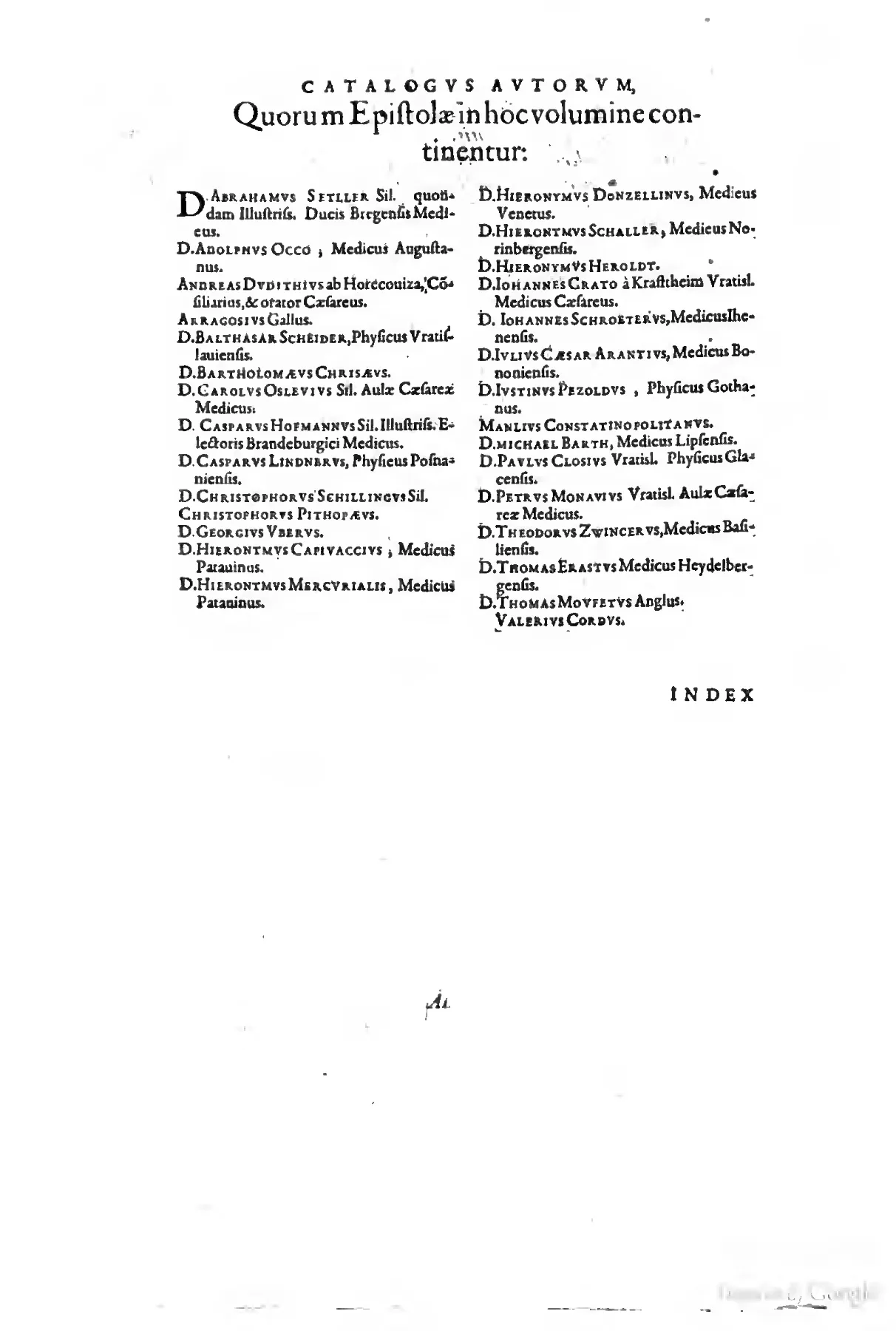
The prefatory Catalogus Autorum turns the Crato circle into a printed map of authority: its two-column roster links imperial physicians, Padua clinicians, Heidelberg reformers, and other named correspondents under a single editorial heading. By placing Crato, Mercuriale, Capivaccius, Dudith, Erastus, and their peers before the index, the Wechel-Aubry volume visually converts a dispersed humanist exchange into a public, citable corpus epistolarum. Source ↗.
Dedicatees: Rudolf II and Ferdinand I are named as dedicatees on the title-page grounds; this pairing should be verified against the 1610 preliminaries before being accepted as final.
Censorship Status: No record of Index condemnation or formal expurgation has been located. The presence of Michael Servetus under his Latinised name (Michael Villanovanus) is the most theologically sensitive editorial decision and warrants archival investigation into whether the 1610 issue contains any internal softening, retraction, or omission of the Servetus material relative to the 1598 setting.
Object Biography / Use History: Surviving copies are held at, among others, the Bayerische Staatsbibliothek, the British Library, the Niedersächsische Staats- und Universitätsbibliothek Göttingen, the Herzog August Bibliothek Wolfenbüttel, and (in North America) the University of Wisconsin–Madison. Marginalia and ownership marks have not been surveyed in the consulted catalogue data, so a full provenance chain is not reconstructable from available sources.
Following the Argument: Structure, Progression, and Textual Evidence
The Editorial Preface and the Dialectical Protocol
The front matter of the collection establishes, before any single medical dispute is joined, the editorial claim that the learned letter is not an occasional or subordinate form but a rigorous instrument of inquiry equal in dignity to the formal consilium. Scholtz grounds this claim in an explicitly dialectical genealogy already announced in the volume's opening pages, presenting his enterprise as the continuation of an ancient protocol whose fourfold sequence — interrogation, disputation, response, and the recall of the response to renewed scrutiny — is the scholastic quaestio transposed from the disputation hall into the medium of print. What matters for the argumentative economy of the collection is the final clause of that protocol: the answer, once given, is not final but is drawn back ad examen, so that each printed exchange remains provisionally open to further testing. This is the mechanism by which the anthology converts a body of private correspondence into a self-perpetuating juridical process, and it licenses the reader to treat every subsequent letter not as a settled verdict but as a move within an ongoing case.
The Opening Disputes: Mineral Remedies and the Edge of Legitimacy
The opening run of letters immediately puts this protocol to work on the most contested pharmacological terrain of the age, the legitimacy of mineral and chymically prepared remedies. The strategy of the orthodox physicians is not to reject such medicines outright but to detach them from their Paracelsian pedigree and reclaim them for the ancient tradition. Such remedies as are compounded from minerals, the argument runs, are falsely ascribed to that Theophrastus Paracelsus, for it is well known to the ancients that chemistry was familiar, Talia sunt, quæ ex mineralib[us] compatantur, quæ falso Theophrasto illi Patacelso adscribuntur. Notum enim est veterib[us] chemiam fuisse familiarem. The rhetorical work here is subtle and characteristic of the volume's edge-policing: the disdainful illi attached to Paracelsus's name distances the innovator even as the operative concession — that mineral therapeutics are usable — is granted. By relocating the origin of chymical practice among the veteres, the letter neutralizes the polemical charge that adopting antimony or other mineral preparations amounts to a defection to the Paracelsian camp. Chymistry pursued to legitimate ends is thus not a novelty to be feared but an ancient competence to be recovered, and the burden of illegitimacy falls not on the practice but on its false claimant. The very form in which such a case is presented is legible from the opening page of the body text itself.
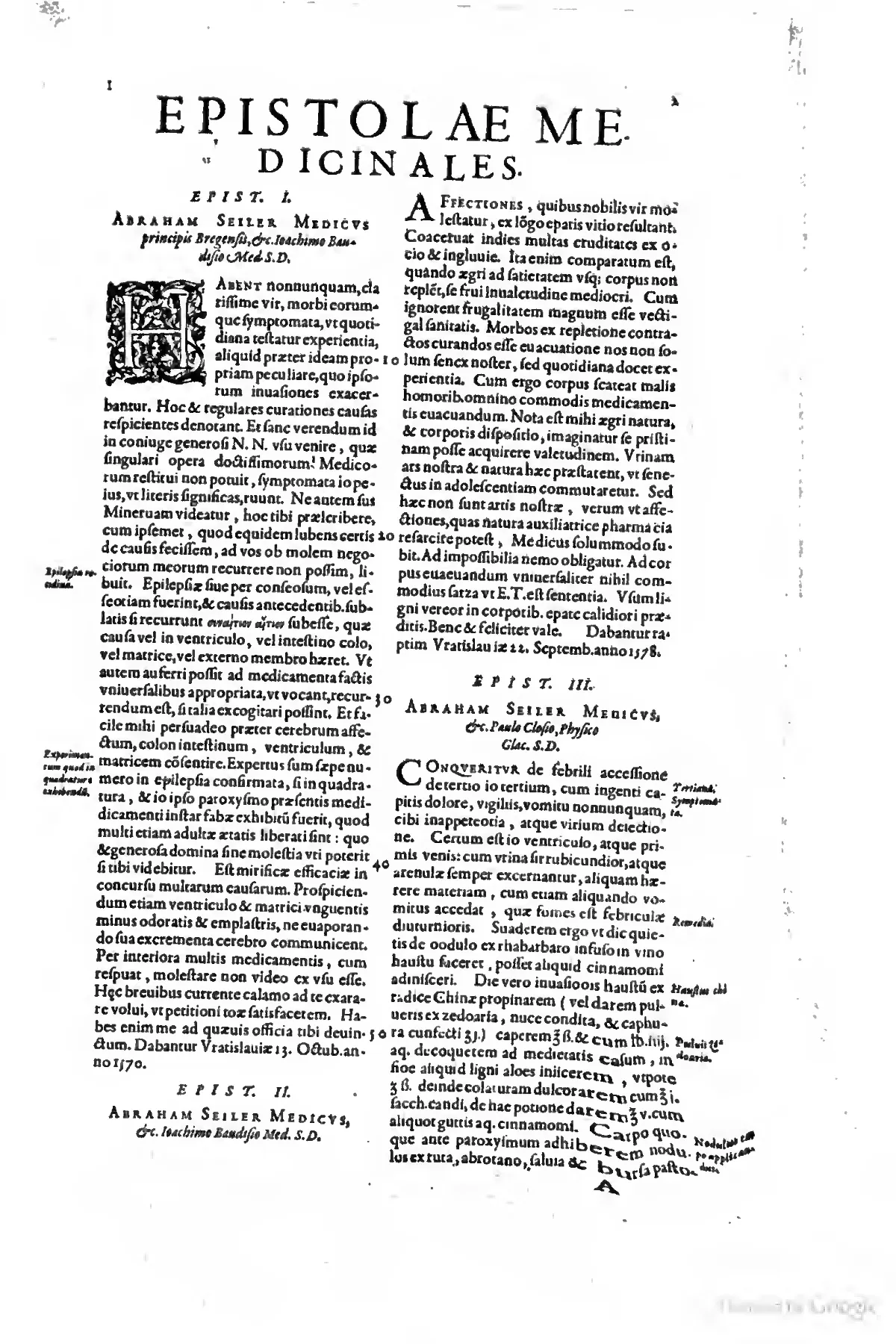
The first page of the Epistolae Medicinales body text turns a physician's letter into an apparatus for judgment: the large woodcut initial, double-column setting, and printed marginal subject flags frame a patient case as evidence to be tested against daily clinical experience. That same epistolary format underwrites the volume's later handling of contested chymical and mineral remedies, presenting therapeutic innovation not as Paracelsian rupture but as material to be disciplined within learned, ancient, and observational medicine. Source ↗.
That concession is immediately balanced by its counter-pressure within the same body of correspondence, which registers the danger of chymical practice at full pitch. The label attached to the reckless practitioners — Chymici Enthusiastæ — is precisely calibrated in the letter already noted for its polemical bite: the target is not the chymist as such but the enthusiast, the one whose confidence in the pyretica, the fire-made, rests on imagination rather than on the arbiter the letter invokes against him, experientia quotidiana, daily experience. The rhetorical opposition is between a self-flattering fantasy of profit and the sober ledger of clinical observation, and the verb inuri, to be burned in, foreshadows the corporeal imagery the polemic will exploit more graphically later. The two passages together map the volume's governing distinction with unusual economy: the same collection that rehabilitates mineral remedies as ancient condemns their reckless deployment as an enthusiasm that daily accounting exposes.
The graphic register threatened by inuri is realized in the indictment of oil of vitriol, where the abstract calculus of harm becomes a scene of dying men. The physician reports having heard certain men, near to death, lamentably bewailing their own rashness, and with great outcries detesting themselves for the enormity of the pain, and crying out repeatedly that their inner parts were being burned and gnawed, Audiui quosdam morti proximos lamentabiliter deplorate temeritatem suam, & magnis vociferationibus detestari seipsos præ dolorum immanitate, & interlora sibi vri & rodi subinde clamasse. The rhetorical intensity is deliberate and forensic. The patients do not merely die; they die accusing themselves (temeritatem suam, detestari seipsos), so that the testimony against chymical remedies is placed in the mouths of their own victims. The doublet vri & rodi, burned and gnawed, renders the corrosive action of the vitriol as a sensible, reportable agony, transforming an argument about pharmacological theory into eyewitness clinical evidence. This is the same appeal to experientia quotidiana dramatized to its extreme, and it demonstrates how the epistolary genre allowed the naked report of the sickbed to function as a probative instrument within a learned dispute.
Dudith's Skepticism and the Theory of Extraction
If the mineral-remedy exchanges test the boundary of legitimate practice, the Dudith letters test the ground of the healing art itself. Dudith's skepticism reaches its sharpest formulation in the charge that the physicians' whole art is conjectural, and, as the saying goes, makes its experiments through the deaths of men, Coniecturalis est ars vestra tota, & per mortes hominum, vt ille inquit, experimenta facit. The provocation is aimed at the very confidence in method that unifies the collection: to call the art coniecturalis in its totality (tota) is to deny that reason guided by nature yields secure knowledge, and the barbed clause per mortes hominum experimenta facit turns the appeal to experience against itself, since if experience is the arbiter, its schooling is paid for in corpses. That such a radical challenge is preserved and printed alongside the physicians' confident procedures is itself significant: the volume does not suppress the case against its own method but admits it as one of the quaestiones recalled ad examen, so that the vindication of the art must be won against, rather than in the absence of, its most articulate skeptic.
The chymical material is not confined to polemic; the Arragosius letter to Crato develops a systematic theory of extraction that the orthodox letters must reckon with on its own terms. The definition is carefully analytic: an extract is an equivocal and general name, signifying whatever can be drawn out from any subject whatever, and this is either terreous, or aereous, or more igneous, or unequally composed from these by the symmetrical, Intelligo autem extractum esse nomen æquiuocum ac generale, significans quicquid à subiecto quousis extrahi potest. Est autem illud vel terreum, vel aëreum, vel igneum magis, vel ex iis inæqualiter compositum à symmetro. The insistence that extractum is nomen æquiuocum ac generale is a philosophical move before it is a chymical one: it treats the disputed term as a logical crux to be disambiguated, subordinating operative practice to definitional rigor and thereby drawing chymistry into the same dialectical apparatus that governs the humoral questions. The tripartite scheme of terreous, aereous, and igneous fractions, resolved by the symmetron, supplies the theoretical scaffold on which the letter builds toward its most ambitious claim, that since the moist itself is the seat of life, it will also be the seat of health, cum ipsum humidum sit sedes vitæ, erit quoque sanitatis sedes. The syllogistic form — the radical moisture is the seat of life, therefore the seat of health — binds the chymical theory of the extracted igneous oil to the physiology of the humidum radicale and, ultimately, to the aspiration of potable gold as a restorative of the vital principle. Here the collection displays chymistry at its most metaphysically extended, reasoning from the seat of life to a universal medicine, and it is precisely this reach beyond the humoral register that the Galenic letters are built to resist.
The confessional and disciplinary heat beneath these disputes surfaces without disguise in the exchange over Paracelsus and Galen, where the Paracelsian party's contempt is quoted in its own words in the party slogan the volume records and repudiates. The slogan is reproduced not to be endorsed but to be exhibited as the mark of a party that has abandoned reasoned disputation for scorn, and its inclusion shows the editorial method at work: even the adversary's most intemperate formulations are entered into the record so that the case may be judged against the actual language of the contest.
The Formal Question of Contagion
The opening exchange on contagion then presses the Aristotelian doctrine of substantial form to its therapeutic breaking point, beginning with the negative conclusion Capivaccius states at the outset, that no disease is formally contagious, Nullus morbus formaliter est contagiosus. The adverb formaliter is load-bearing: it concedes that diseases may be communicated while denying that contagion belongs to disease under its formal definition, thereby reframing an etiological question about plague as a problem in the logic of predication grounded on Avicenna and Galen. The bare, apodictic form of the thesis, advanced as a conclusion to be defended by argument, exemplifies once more the dialectical protocol announced in the preface, where a proposed problem is met with a disputed answer that is then recalled to examination.
From this thesis the letters generate a paradox that fastens on the scholastic axiom that forms admit neither intension nor remission: if disease inheres in the whole form rather than in a corrigible quality, then it lies beyond the reach of any rational cure. Thus all diseases from the whole form would be incurable, because otherwise there would be granted a regress from a substantial privation back to a habit, against the philosophers, Ergo omnes morbi à tota forma essent incurabiles, quia alias daretur regressus à priuatione substantiali ad habitum contra philosophos. The force of the argument lies in its refusal to let the healing art override a first principle of natural philosophy: a privation of substance cannot be reversed into its opposite habit, and so a morbus à tota forma, if it exists at all, would fall outside the physician's methodical competence altogether. The stakes are precisely those the volume as a whole contests — whether the domain of disease is that of qualities inhering in substance, which the art can adjust, or that of substance as such, which it cannot. The volume's positive answer to this impasse is given visual form in the anatomising tabella of the similar parts, printed alongside a new epistolary opening.
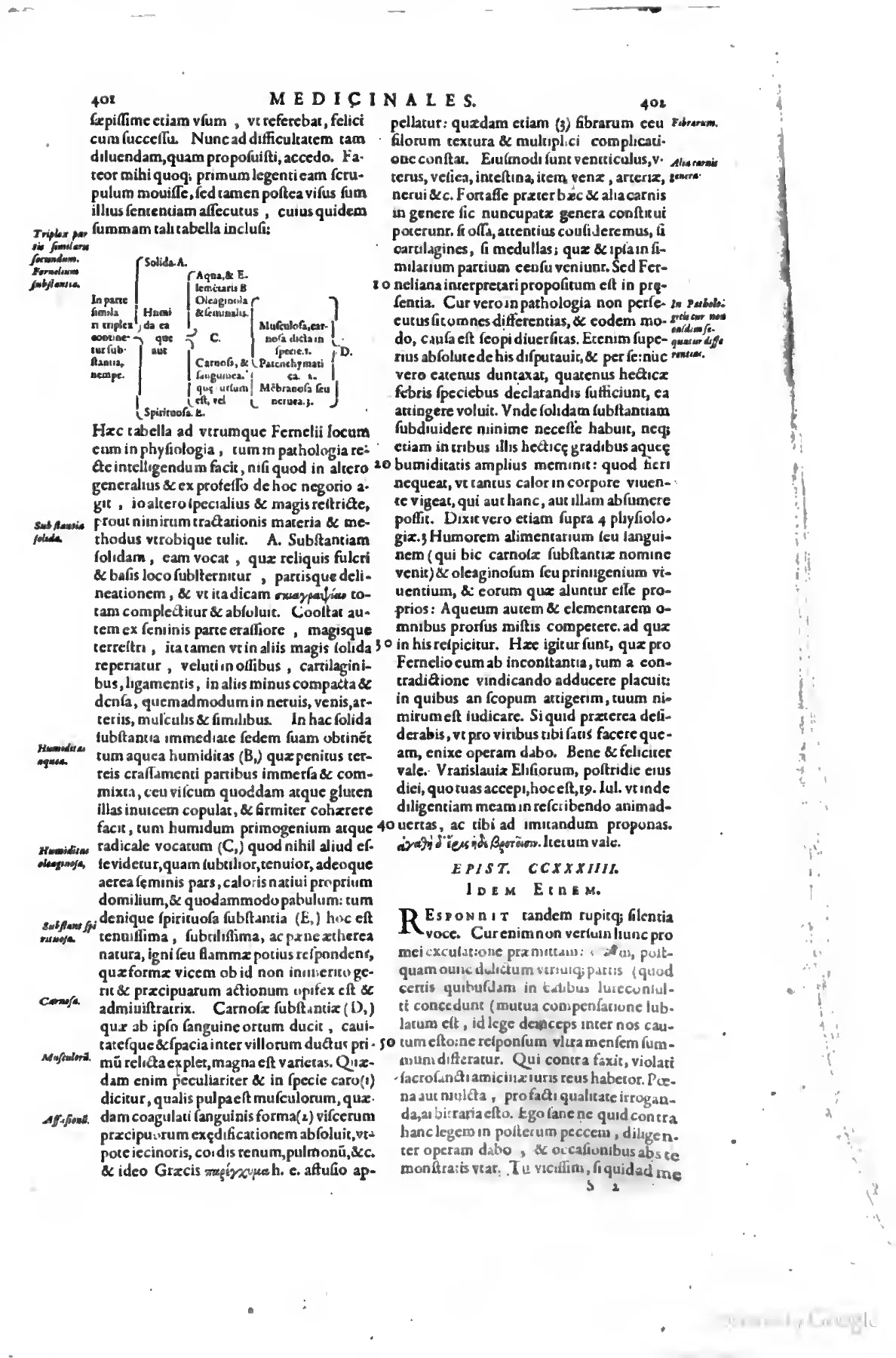
The boxed tabella in the left column translates Fernel's doctrine of the similar parts into a branching hierarchy of solids, humidities, flesh, and spirit, making visible the effort to reconcile his physiology with pathology rather than leave disease lodged in an uncorrigible whole substance. Set beside a new epistolary opening in the right column, the schematic exemplifies how the correspondence turns disputed scholastic axioms about form, privation, and cure into a practical apparatus for medical judgment. Source ↗.
The response to this impasse is to relocate the site of disease within the causal architecture that the art can actually manipulate, and here the discussion fastens on the containing cause. Capivaccius identifies it with the formal cause and with the very essence of the disease, drawing from this identification the source of all therapeutic indication, as already noted in the volume's scholastic-pathological armature. The move is subtle: rather than concede an incurable disease of substance, the disputant reconceives the causa contentiua as the formal principle that both constitutes the disease and yields the rule of its cure, so that essence and indication coincide. What might have been a metaphysical dead end becomes instead the pivot on which methodical treatment turns, because the very thing that makes a disease what it is becomes the very thing from which the physician reads off what to do. This is the characteristic conversion the collection performs everywhere — an ontological question about form and privation is answered not by abandoning the difficulty but by dissolving it into a quaestio about causes and indications that the art can adjudicate.
Epidemic Fever, Sugar, and the Physics of Substances
The same appeal to the tribunal of experience governs the exchange over the European epidemic of 1580, where the disputants trace the fever to a corruption of the surrounding air rather than to any occult affection of substance. They judge with reason that the external cause drew its origin from the constitution of the air, and the internal from catarrhal matter, which as it putrefied excited now an ephemeral, now a putrid fever, arbitramur merito causæ externam originem duxisse ab aeris constitutione: Sin internam, à materia catarrhali, quæ dum putrescebant nnec febrem ephemeram, nunc puttidam excitabat. The etiology is resolutely humoral and environmental: the disease is referred to an external constitution of the air and an internal catarrhal matter whose putrefaction accounts for the alternation of fever types, keeping the whole phenomenon within the register of quality, matter, and temperament rather than admitting a disease of the whole substance. The epidemic that swept nearly the whole of Europe is thus domesticated into the familiar Galenic apparatus of putrefying humours acted upon by a corrupt air.
That same confidence in daily observation drives Mercurialis's rejoinder to Dodonaeus on whether sugar generates the stone. Against a theory that would make sugar lithogenic, Mercurialis marshals a quasi-epidemiological counter-instance, offering to name whole peoples whose tables are steeped in sugar yet who scarcely know the name of the disease. The argument is methodologically pointed: a causal claim about saccharum is tested not by disputation over its qualities but by the absence of the predicted effect among populations who consume it in abundance, so that observed distribution overrides theoretical inference. The reasoning presupposes that the true material of the calculus must be thick and tenacious, and sugar, whatever its qualities, does not supply it — but the decisive stroke is empirical, the appeal to what is and is not found among the Neapolitans, Sicilians, and Turks.
When the letters turn from pathology to the underlying physics of substances, the Peripatetic framework asserts itself openly, as in the correction of Galen on the nature of the heavy metals. Mercurialis explains the extreme weight of gold, lead, and quicksilver by their composition from thoroughly concocted, congealed, and mixed earth and water: gold, lead, and quicksilver are for this reason the heaviest bodies, because they consist of water and earth most excellently concocted, congealed, and mixed, aurum, plumbu[m], hydrargyrum ideirco esse corpora grauissima, quod constent ex aqua, & terra optime percoctis, congelatis, & mixtis. Here the physician reaches past Galenic authority to Aristotelian metallurgical principles, grounding a claim about weight in the theory of elemental mixture and concoction. The willingness to correct Galen on natural-philosophical grounds while defending him on medical ones reveals the discriminating rather than deferential posture of these correspondents: authority is honoured where it holds and amended where the philosophy of nature demands it.
The Ontology of Poison and Crato's Mediating Definition of Contagion
This same analytic flexibility underwrites the treatment of poison, where the disputants deploy the doctrine of the categories to dissolve an apparent contradiction about whether venenum is a substance or a relation. The solution is that a single thing, taken under different descriptions, may be placed under different categories: what prevents one and the same thing, differently taken, from being placed under different categories? the great and the small under quantity and relation, quid prohibet vnam & eandem rem diuersimode acceptâ sub diuersis prædicamentis collocari? Magnum & paruum in quantitatis & relationis. By the analogy of the great and the small, which fall at once under quantity and under relation, the disputant shows that poison may be considered as a substance in one respect and as a relative term in another, defusing the objection without surrendering the Galenic insight that toxic power is intelligible only in relation to the body that receives it. The categorial apparatus becomes an instrument for holding together what a cruder ontology would force apart.
The most consequential formulation in this stretch belongs to Crato, whose definition of contagion supplies the collection's key qualification of the doctrine of substantial disease, already registered as the volume's received doctrine of contagion in its full ontological force: contagion is an affection destructive of substance, but one that putrefaction cannot achieve unless it reaches a venomous quality of a certain determinate form. The formula is a deliberate mediation: it retains the received language of destruction of substance yet makes that destruction conditional upon a threshold of putrefaction that culminates in a venenata qualitas. Contagion is thus neither a bare grade of ordinary putrefaction nor an inexplicable affection of substance as such, but putrefaction intensified to a specific venomous quality — a reading that concedes the ontological seriousness of contagion while tethering it to the qualitative, causal terms in which the healing art can still operate. The therapeutic corollary follows directly: against such a venom the physician must deploy an antidote and remove the induced putrefaction by drying. Crato professes with the greatest assurance that poison requires only an antidote, and that only desiccation avails to remove it and the putrefaction it has induced: poison indeed requires only an antidote, nor for removing this and the putrefaction induced by it does anything but desiccation alone avail, I profess with the utmost assurance, Venenum vero solam antidotum requirere, nec ad hoc collendum, putredinemq[ue] ab eo inductam remouendam solam exiccationem conferre, summa cum asseueratione profiteor. The definition and its cure are of a piece: because the venom is a determinate quality reached by putrefaction, it answers to alexipharmaca and to drying, precisely the rational, indication-driven regimen the volume everywhere defends.
Undergirding these particular controversies is a governing conviction about the nature of the art itself, stated with Hippocratic terseness in the methodological essay dedicated to Hervart: he who rightly knows the medical art least regards fortune, and both with it and without it acts rightly, Qui medicam artem recte nouit, minime fortunam respicit, & cum hac & sine hac recte facit. The maxim distills the whole polemical stance of the collection into a single antithesis of art against fortune: the physician who possesses the method does not depend on luck, and his rightness of action is a function of rational knowledge rather than of chance outcome. It is this confidence in the sufficiency of method that licenses the letters to submit contagion, poison, and epidemic fever to dialectical resolution rather than leaving them to the brute contingency the chymical enthusiasts were thought to court.
The philosophical exposition of innate heat extends this rationalizing ambition to the very origin of life, tracing the calor innatus to a celestial power operative within the seed. The heat, once excited, acts within the seed by a celestial force and diffuses itself through all the parts, insinuating itself so intimately that life animating precedes rather than deserts this heat: this heat then, excited by celestial power, acts within in the seed, and diffuses itself through all the parts, and so tightly insinuates itself into them, that life animating sooner than this heat deserts, Hic igitur calor excitatus vi coelesti intus in semine agit, & per omnes partes sese ita diffundit, eisque ita arcte se insinuat, vt vita prius animans, quam hic calor deserat. The account mediates between the Platonic fiery and the Galenic airy-watery conceptions of vital heat, admitting a celestial cause at the origin of the seed's warmth while binding that heat inseparably to the life it sustains. Even here, at the threshold between natural philosophy and the mysteries of generation, the argument proceeds by reconciling authorities and locating the phenomenon within an intelligible causal order rather than surrendering it to occult power — the same disposition that governs the collection's handling of disease, poison, and the destructive affections of substance.
Crato's Credo and the Taxonomy of Plague
The correspondence next stakes out, in Crato von Krafftheim's own voice, the methodological allegiance that governs the entire collection. The learned physician is bound to credit the art of Hippocrates and the Methodic doctrine of Galen, whereas the productions of the opposing school are dismissed as fabrications covered over by so many wrappings of verbal falsity, as the volume's polemic against Paracelsian dreams has already made plain. The rhetorical weight rests on the noun inuolucra — wrappings, coverings, husks — which recasts the Paracelsian lexicon not as a competing terminology but as a screen of language interposed between the physician and the thing itself. The charge is not merely that the Paracelsists are wrong but that their nomenclature, in which (as the surrounding letters complain) sulphur is now oil and now antimony, is constitutively opaque: it hides rather than names. The polemic thus turns on a philological anxiety proper to a humanist physician, that a corrupted vocabulary corrupts the knowledge it purports to carry, and it is precisely this anxiety that motivates the volume's own editorial supplement, the glossary that renders its Greek technical terms citable.
That same letter supplies the positive counterpart to the polemic in the therapeutic credo that grounds Crato's position within the volume's larger arbitration — that with nature as guide, by art and not by the force of medicaments, do we rightly and safely win victory over diseases. The martial metaphor of victoria in morbis is deliberately deflected from the medicament to the method: robur, the brute strength of a drug, is set against ars directed by natura, and the adverbial pair recte atque tute fuses correctness with safety, so that the Galenic procedure is commended not only as true but as prudent. This is the load-bearing move of Crato's position. It permits him to condemn Paracelsian pretension while conceding the genuine efficacy of particular preparations — laudanum, sulphur in affections of the chest, oil of vitriol — and even to recall that he himself had introduced distilled oils and extracts into the pharmacopoeias decades earlier. The relational suspicion of forceful remedies extends to the mercurials, where he presses the question of what sort of physician Paracelsus is when armed with precipitate or turpethum minerale, Quæ obsecro est ipse Paracelsis medicus cum præcipitato seu turpetho minerali — the obsecro carrying an edge of scorn against a therapeutics that would trust its cures to violent minerals rather than to the governed cooperation of nature.
The clinical letters that follow translate this credo into the texture of daily practice, and they are inseparable from Crato's insistence on the weakness of the body's own operations. His pathology of stone-formation grounds itself on a failure of innate heat: because the natural heat is feeble, Quia calor naturalis est imbecillus, the concoction that would prevent the deposition of gross matter cannot be completed. The physiological premise — that disease follows upon the debility of calor naturalis rather than upon any specific material virtue — is exactly the register into which Crato wishes to reduce all disputed etiologies, and it is the same register in which he reads his own decline, weaving his morbid catarrh, his kidney stones, and his marasmus into counsel offered to others. Among the vaunted remedies he weighs with characteristic reserve is the antidotal stone, of which he judges that bezoar confers little in plague, Bezoar in peste parum confere — a verdict consistent throughout: the exotic specific, like the forceful mineral, is subordinated to method and to the assessment of the individual constitution. Even the celebrated wood-remedies for the morbus Gallicus are appraised comparatively rather than as sovereign cures, as when he observes that the lignum sanctum the more strengthens the stomach, lignum sanctum magis ventriculum roborare, measuring guaiac not by any occult power but by its ordinary action upon a debilitated organ.
The theoretical center of this stretch is Crato's epidemiology, which furnishes the taxonomy on which the later exchange with Monavius depends. Against a monolithic notion of plague he distinguishes a disease arising from internal cause from one propagated by a morbid exhalation: assuredly one plague is private, that is, which arises from an internal cause and does not have a morbid exhalation, yet it is destructive to many, Certe pestis alia est priuata, id est, quæ ab interna causa oritur, nec morbidam exspirationem habet. Est tamen multis exitiosa. The taxonomy is doing careful conceptual work. By segregating the pestis priuata, which springs from putrefaction within the body and is not transmissible, from the public pestilence carried by morbida exspiratio, Crato preserves the humoral account of most fevers while granting genuine contagion a delimited, exhalation-borne mechanism. The concessive tamen — such a private plague is nevertheless lethal to many — forestalls the objection that a non-contagious pestilence must be a trivial one; virulence and communicability are decoupled. This is the same relational and reductive strategy visible in his pharmacology: rather than positing a disease of substance as such, he grounds even the deadliest fevers in an interior corruption of temperament, and reserves the transmissible variety, which he holds unknown to the ancients in his own region, for a specifically exhalatory cause. The term morbida exspiratio thus becomes the precise instrument that lets him affirm contagion without conceding a Paracelsian ontology of transmitted substance, and it is unsurprising that the letters repeatedly summon Erastus on the same question. Alongside these material questions the letters also test the boundaries of the quinta essentia, which Crato is willing to name in a naturalized sense — this spirit I reckon the fifth essence, Hunc spiritum ego quintam essentiam duco — appropriating the chemists' term while stripping it of its metaphysical extravagance and rendering it a spiritus answerable to Galenic physiology.
Monavius and the Harmonization of Aristotle with Galen
The most philosophically ambitious movement in this part of the collection belongs to Monavius, whose letters carry the arbitration into the harmonization of Aristotle with Galen. His doctrine of the duplex temperamentum addresses how a congenital heat, latent and inert in itself, is brought to act: but that it may also produce actions, whether vital or animal or even natural, a second temperament besides must be added, which may rouse that heat lying as it were hidden and sluggish in the depths, Vt vero actiones etiam edat, siue vitales, siue animales, aut etiam naturales, altera accedat præterea temperies oportet, quæ illam veluti in profundo latentem & ignauam excitet. The vocabulary of the passage — heat in profundo latentem & ignauam, requiring a second temperies to excitare it — supplies a Neo-Aristotelian refinement of the Galenic account, distinguishing the innate from the influent heat and making the actualization of physiological function depend on their conjunction. Monavius himself flags the claim as his own methodological wager, that he has asserted a twofold temperament just as a twofold heat, Qvod duplex temperamentum asseruerim, sicut & calorem duplicem, announcing the distinction as a considered thesis to be defended rather than a received commonplace.
The same scholastic technique governs his treatment of putrefaction, which he resolves by dividing the term in Aristotle so that Galen's medical usage may be shown consonant with natural philosophy: for Aristotle expressly makes mention of a twofold putrefaction, of which one is opposed to the simple generation of mixed bodies as a most common contrary, and a corruption according to the whole, the other a corruption only according to a part, Duplicis enim putredinis expresse meminit, quatum alteram simplici generationi mistorum, vt contrarium maxime commune oppositam, & corruptionem secûdum totum, alteram corruptionem tantum secundum partem. The distinction between a corruptio secundum totum and a corruptio secundum partem is not idle logic-chopping: it is precisely the wedge by which the volume's Galenists resist the notion that putrefaction, and the contagion that follows from it, must be understood as a destruction of substance as such. If Aristotle already recognized a partial corruption, then the physician may locate ordinary putrefaction and its resulting fevers in a vitiated temperament of parts rather than in the annihilation of the whole substance — the same reduction Crato performs on his pestis priuata. This part of the argument presses the harmonizing method into the disputed category of morbid causation itself, asking whether a containing cause is truly given in diseases, An causa contineo seu contentiua in morbis vere detur — a question that keeps the whole exchange within the Aristotelian-Galenic architecture of formal and containing causes rather than surrendering it to a chymical ontology of substance.
The Relational Ontology of Poison and the Discipline of Metallic Remedies
The dispute over the nature of poison resumes by dissolving an ontological question into a relational one through the invocation of Galenic authority. Against interlocutors who would have poison, nutriment, and medicament be settled categories, the correspondent argues that Galen himself refers all three to man, grounding the position in explicit textual citation from the Galenic corpus, as the volume's central pharmacological resource has already established. The force of the phrase relata esse ad quid is precisely the Aristotelian category of the relative, ad aliquid: what a thing is, as agent upon the body, is not a property lodged in its own substance but a function of the encounter between it and a particular temperament. This is the same relational conversion that governs the volume's larger pharmacological argument, deployed here at the level of the individual letter and buttressed with chapter-and-verse so that the reader may verify the reduction for himself.
The relational thesis is then given its scholastic articulation through the criterion of conquest. The three classes are distinguished by whether and how far the body's native heat masters the ingested agent: foods or nutriments are those which are conquered by our nature both according to substance and according to qualities, and so yield to the nourishing and augmenting of the body, whereas medicaments, though dissimilar in substance, are yet overcome by our heat with respect to their qualities, Cibi seu alimenta dicuntur, quæ à natura nostra, tum secundum substantiam; tum secundum qualitates vincuntur, eo nutriendo, augendoque corpori cedunt. Medicamenta vero, quæ secundum substantiam quidem dissimilia, secundum qualitates tamen hactenus à calure nostro superantur. The elegance of the scheme lies in its economy: a single variable — the degree to which natura nostra subdues the substance or its qualities — generates all three classes. Food is doubly conquered and so assimilated; medicament resists in substance but is beaten in quality; poison, by the logic the definition implies, is conquered in neither and therefore destroys. The definition is thus not a taxonomy of kinds of matter but a taxonomy of relations of mastery, and it is this that allows the letters to insist that toxicity is never simply resident in a thing. The keyword under contest, that poison is not a quality or accident but rather a substance, venenum esse non qualitatem aut accidens, sed potius substantiam, is precisely the position the relational reading is marshalled to refuse, and the reader watches the correspondent work to relocate poisonous power from the substance considered in itself to the substance considered in relation to the receiving body.
From poison the correspondence turns to a physical quaestio that shows the same method applied outside pathology. The problem is why lead cauldrons used for boiling salt do not liquefy under the fiercest fire, Cur scilicet plumbea caldaria, in quibus sal coquitur, vehementissimo etiam substrato igne non colliqueant. The correspondent's second cause is a principle drawn from the physics of boiling: another consideration is that in all cooking or boiling the upper parts grow hotter than the lower, for fire by its nature is carried upward, Altera cautâ est, quod in omni coctiunc seu elixatione superia magis calent, quam inferna. Ignis enim & ab hoc etiamaris ealot, ex sua natura sursum fertur. The claim is Aristotelian in its premise — the natural upward motion of fire — but the letter does not rest on the dictum; it appeals to the tripod experiment, testing the abstract principle against a repeatable manipulation. The methodological texture here is exactly what the volume's larger argument prizes: a first principle taken from the philosophers, then submitted to the tribunal of daily manipulation rather than left to stand on authority alone.
The metallica debate carries this experiential discipline into the most contested therapeutic territory of the age. The question is whether metallic medicines may be taken safely and reckoned among internal remedies, and the answer is conditional and procedural rather than doctrinal. Metals are to be counted among the things taken into the body only if three cautions are observed in their use: that they first be rightly prepared, that once rightly prepared they be corrected by other additions, and that once corrected they finally be given in due quantity, that is, in dose, Num metallica profus eorum, quæ iotta corpus sumuntur, oumero exitmenda fiot, si in corundem vsu, hæc tria caute observantur, vt nimirum, ante recte præparentur, recte præparata aliis additis corrigatur, & correcta demum debita quantitate, seu dosi exhibeantur. The triad of preparation, correction, and dose is the practical corollary of the relational ontology of poison established at the outset: since toxicity is a matter of relation and degree rather than fixed substance, a metallic agent may be rendered safe by manipulating precisely those variables — its preparation, its adjuncts, its quantity — through which the body's mastery over it is decided. What might otherwise appear a concession to chymical pharmacy is thus disciplined back within the Galenic frame, admitted not because chymical remedies possess virtues resident in matter but because dose and correction govern whether natura nostra can conquer them.
Zwinger's Verdict and the Erastian Reduction of Putrefaction
That same balance of concession and refusal governs Zwinger's verdict on Paracelsus, one of the most measured statements of the moderate late-humanist reception. He grants the experiential contribution while condemning the systematic assault, allowing that he attributes much to Theophrastus under the name of experience, since he brought many excellent medicines to light, but that he cannot with an even mind endure the same man invading the citadel of medicine with the ancients cast down, as the volume's account of the moderate reception has already recorded. The metaphor of the arx medicinae, the citadel of medicine, is telling: Zwinger will accept new stores brought into the fortress but not the toppling of its ancient defenders. The distinction that runs through the whole collection — between chymical enthusiasm as ideology and chymical practice as a source of genuine remedies — is here drawn with unusual precision, and it is reinforced by the same correspondent's characterization of chemistry as the handmaid of medicine, ministram medicinæ chi miam. The word ministra fixes the hierarchy exactly: chymistry may serve, may supply and refine, but it may not command; the architectonic authority remains with the ancient art.
The Erastus correspondence supplies the theoretical foundation on which these judgements ultimately rest, and it does so by dismantling the very category that would license a chymical etiology of disease. Erastus reduces putrefaction — the mechanism by which contagion was thought to act upon substance as such — to a disorder of temperament, arguing, as the volume has already registered in its central keyword philology, that it is impossible for a putrid thing, insofar as it is putrid, to taint another body without corruption of temperament, since by nature putrefaction is nothing other than a vitiated temperament. The maneuver is decisive for the volume's central campaign. If putrefaction is by definition a vitiosa temperatio, a vitiated blending of the qualities, then there can be no disease that acts by whole substance independently of temperament: the supposed morbus totius substantiae, and with it the plague's power to kill by an occult corruption of substance, collapses back into the humoral register of intemperies. Contagion retains its destructive force, but that force is redescribed as an assault on the heart's temperament and native heat rather than on substance considered as such. The reduction is the exact conceptual pivot on which the anthology's Galenic defence turns: every disputed agent — poison, metallic remedy, contagious seminarium — is drawn out of any autonomous ontology of matter and returned to the relation between the receiving body and the qualities it must either conquer or fail to conquer.
The Nominalist Foundation and the Dismantling of the Disease of Substance
The concluding stretch of the collection stages, through the exchange between Thomas Erastus and Peter Monau, a sustained demonstration that the whole apparatus of chymical pathology collapses once one presses on the metaphysics of what a disease is. Erastus builds from the ground up, and the ground is nominalist. Before any pathological claim can be made, he fixes the ontology of the individual, holding that only Peter, Paul, and the other individual men truly exist while the species subsisting separately does not, as the volume has already noted in its survey of the nominalist-realist crux. The move looks like a scholastic exercise on universals, but it is doing polemical work. If only particulars subsist, then there is no "action in general" that could be damaged, and no free-floating "substance as such" that could be the seat of an affection. Every action is a determinate action — vision, digestion, locomotion — and every disease must therefore be lodged in some determinate, particular thing: a temperament, an organ, a continuity of parts. The nominalist premise is thus not a detachable preliminary but the lever by which the entire category of the morbus totius substantiae is pried loose from the real order and reclassified as a fiction of language.
That reclassification is delivered with named culpability. Erastus does not merely deny the total-substance disease; he identifies its author and brands the doctrine a fabrication, holding these to be figments, which the architect of these diseases, Fernel, and Argenterio devised, Quate figmenta sunt, quæ horum morborum architectus Fernelius, &. The metaphor of the architectus is pointed: it casts the disputed pathology not as a discovery of nature but as a built thing, a structure raised by human contrivance rather than found in the body. The charge is sharpened when Erastus supplies the doctrine with a genealogy that ties it directly to the volume's governing anxiety about chymical medicine — a recent fiction, first devised, he thinks, by Fernel, which seems to have first sprouted from chymistry, as the volume's central keyword philology has already recorded. Two rhetorical strategies converge here. The temporal marker recens denies the doctrine the dignity of antiquity, setting it against the Hippocratic-Galenic patrimony that the whole collection treats as authoritative; and the botanical verb pullulare, "to sprout" or "shoot up," assimilates the doctrine to a rank, spontaneous growth — the kind of weed that springs from suspect soil. The soil named is chimia. In a single clause the ontological quarrel over what disease is becomes a front in the anti-Paracelsian campaign, so that to defend humoral pathology is at once to expose a chymical intrusion masquerading as natural philosophy.
Against the fictive disease of substance Erastus reasserts a pathology grounded in temperament and its instruments, and the reassertion turns on a Galenic principle of method that he must both wield and rescue from apparent self-contradiction — the settled tenet, drawn from the end of the second book of De locis affectis, that no action is harmed while its instrument is unharmed, which the volume's scholastic-pathological armature has already set out. The word asseueranter is carefully chosen: it insists that Galen laid the rule down not as a passing remark but as a settled tenet of methodus, and it is on the authority of that settledness that Erastus can convert the principle into a diagnostic axiom. If damaged action entails a damaged instrument, then there is nowhere for a "total-substance" disease to hide — every genuine impairment must be traceable to a determinate organic or temperamental defect. The difficulty Erastus faces is that Galen elsewhere seems to allow that concoction can fail without instrumental injury, and his solution is the distinction, flagged throughout the exchange, between actio and opus: a frustrated concoction may arise not from a faulty faculty but from an unsuitable object, so that fire's failure to consume stone or the magnet's failure to draw other metals reflects the object's incongruity rather than any lesion in the agent. The distinction preserves the principle intact while accommodating the recalcitrant cases, and it does so precisely by refusing to let failure of a product be read as damage to a power — a refusal that once again keeps disease pinned to the instrument and denies it the roving, substance-wide existence the Paracelsian-Fernelian account required.
The pathological framework is completed by a definition that fixes health and disease as genuine contraries, each identified by the moral quality of the actions it governs. Health is the natural affection that in the first place produces good and praiseworthy actions, while disease, its contrary, is the affection that in the first place harms actions, bringing forth bad and culpable ones, Saninitas porro est affectus naturalis actiones primo producens bonas, & laudabiles. At morbus huic contrarius est affectus, actiones primo lædens; seu malas & culpabiles proferens. The definition is doing more than nosological bookkeeping. By making sanitas and morbus strict contraries — affections that respectively yield laudable and culpable actions — Erastus forecloses the middle ground that a "disease of substance" might have occupied, since a contrary admits no neutral third between its poles at the level of first effects. The phrasing primo producens and primo lædens locates the difference at the point of origin of action, so that health and disease are diagnosed not by remote or accidental outcomes but by what the affection immediately does to operation. This coheres exactly with the actio/opus distinction: because it is the immediate bearing on action that defines the state, a failed product traceable to an unsuitable object need not be reckoned a disease at all. The system is thus internally braced — the ontology of particulars, the Galenic instrument-principle, and the contrary definition of health and disease all reinforce one another to leave no conceptual room for the doctrine Erastus is dismantling.
The Discriminating Polemic and the Practical Formulary
Having cleared the theoretical ground, the correspondence turns to the practical edge of the controversy, and here the polemic reveals its studied discrimination. Erastus does not reject chymistry wholesale; he polices its boundary. He is explicit that his quarrel is with the transmutational and occult pretensions, not with the operative art as such, declaring that he has never reproached chymistry insofar as it pursues legitimate ends but rather praises and celebrates it, as the volume's account of the discriminating polemic has already noted. The qualifying clause carries the whole force of the concession: chymistry earns praise quatenus, insofar as, it keeps to legitimate ends, which for Erastus means distillation and the preparation of genuine remedies rather than the ancient and vainly attempted transmutation of base metals into gold. This calibrated verdict is what allows the same voice that brands the total-substance disease a figmentum to speak of chymistry with approval; the target is enthusiasm and metaphysical overreach, not the fire and the still. The distinction runs through the surrounding materia-medica debates — the denial that metals, gems, or quintessences can nourish or restore the spirits, the deflation of gem-lore as the province of the most superstitious, the reduction of rhubarb's purgative power to material qualities rather than a mysterious substantial form — each case testing an occult claim against the demand that therapeutic power be intelligible in ordinary natural-philosophical terms.
That the collection is designed to be used on exactly these questions is confirmed by the practical procedures that close the epistolary sequence, where doctrine descends into the compounding of remedies. The magistery of pearls, contributed in the letter of the Englishman Thomas Muffet, is given as a finished operative result: thus you have the essence or magistery of pearls, in the form of a mealy powder, Sic habes essentiam siue magisterium perlarum, in forma pulueris farinacei. The passage matters not for any occult virtue it might claim but for the register it occupies: essentia siue magisterium names a chymically prepared preparation, and the recipe reports it as a plain product, a puluis farinaceus, without the metaphysical apparatus of specific properties that Erastus elsewhere refuses. The pearl-magistery thus exemplifies the volume's settled position in miniature — the legitimate chymical operation, described and transmitted as craft knowledge, standing on the approved side of the line that separates praised distillation from condemned transmutation. Alongside such recipes for mumia, chalybeate preparations for splenic obstruction, osteocolla, and the trochisks of viper with their warnings against Venetian fraud, the material shows the correspondence functioning as both a theoretical arbitration and a practical formulary. The appended Interpretatio Graecorum and the alphabetical Index rerum et verborum, keyed by column and line, are the material completion of this design: they render the whole disputation navigable, converting the sequence of letters into a systematic reference in which a physician may locate at once the metaphysics of the individual, the Galenic principle of the instrument, and the recipe for the magistery of pearls.
Frequently Asked Questions
What is the Epistolae philosophicae, medicinales ac chymicae of Lorenz Scholtz von Rosenau?
It is a printed anthology of learned medical, philosophical, and chymical correspondence, edited by the Breslau physician Lorenz Scholtz von Rosenau and first issued at Frankfurt in 1598, then reprinted as a Hanau folio in 1610. Rather than a monograph, it is a constructed corpus epistolarum, a body of letters, drawn from the circle around Johann Crato von Krafftheim, imperial physician to Maximilian II and Rudolf II. Stripping away dates and dedications, Scholtz ordered the exchanges by controversy, converting private letters into a citable disputation over the boundary between Galenic medicine and Paracelsian chymistry.
Who was Lorenz Scholtz von Rosenau?
Lorenz Scholtz von Rosenau (Laurentius Scholzius à Rosenaw, 20 September 1552 – 22 April 1599) was a Breslau physician and botanist who studied at Wittenberg (1573), Padua, where he took his M.D. in 1582, and Strasbourg. He was a close correspondent of Johann Crato von Krafftheim and gathered the letters of the late-Rudolfine medical elite into his anthology. No modern monograph is devoted to him, and no comprehensive bibliography of his editorial work exists. The 1610 folio imprint is posthumous, appearing more than a decade after his death.
What central question does the collection argue over?
The letters ask how a physician should adjudicate the boundary between Galenic-humoral orthodoxy and Paracelsian chymical therapeutics — how to refuse chymical enthusiasm and its metaphysical extravagances without discarding the genuine remedies that legitimate chymical practice had produced. Each disputed matter — contagion, the nature of poison, chymical extracts and potable gold, the so-called disease of total substance — is converted into a dialectical quaestio, a formal question, answered from Hippocratic-Galenic and Aristotelian principles and then tested against daily experience. Crato's credo governs throughout: with nature as guide, by art rather than the force of medicaments, the physician wins victory over disease.
What does the collection say about the dangers of chymical remedies like oil of vitriol?
The letters press the charge that reckless chymical practice kills. Against the "chymical enthusiasts" who imagine great gain from their fire-made remedies, the correspondents set daily experience, which they say proves more harm than benefit is inflicted on bodies. The indictment of oil of vitriol becomes a sickbed scene: a physician reports hearing men near death lamentably bewailing their own rashness, detesting themselves for the enormity of the pain, and crying out repeatedly that their inner parts were being burned and gnawed. This eyewitness testimony, placed in the victims' own mouths, functions as probative evidence within a learned dispute.
Is there an English translation of the Epistolae philosophicae, medicinales ac chymicae?
No modern English translation has been identified. There is no full English-language rendering of any portion of the volume, and it appears never to have been translated into any modern language; its scholarly significance is inferred from the broader Crato, Erastian, and Wechel-Aubry literatures rather than dedicated study. Separately, the Leo edition presents the full transcription together with a complete English translation for the first time. That translation is generated by AI, part of an effort to make English versions of every text printed in Latin in early modern Europe, between 1450 and 1750, freely available online at no cost.
This report was generated by an advanced AI assistant that conducted deep research alongside an extensive interpretation of the transcribed original text. Every effort has been made to preserve fidelity to the source and to guard against inaccuracy, but corruption in the text recognition process and model hallucination may nonetheless have entered the text. Treat every claim, quotation, translation, and citation as provisional, and verify each against the original source before relying on or citing it.
Bibliography
- Carlino, Alessandro, ed., Girolamo Mercuriale – Johannes Crato von Krafftheim: Lettere (1564–1597): The one rigorous modern critical edition of a Crato-circle correspondence, and therefore the closest methodological template for reading Scholtz's volume as a made object rather than a documentary dump. Its apparatus shows precisely what editing a learned letter-exchange to scholarly standard entails, throwing Scholtz's own editorial choices — the stripping of dates and dedications, the ordering by controversy — into sharp relief.
- Gunnoe, Charles D., Sr., Thomas Erastus and the Palatinate: A Renaissance Physician in the Second Reformation: The definitive biography of the man whose anti-Paracelsian arguments supply the volume's polemical armature, and the indispensable guide to the confessional and institutional stakes at Heidelberg. It usefully includes, with Shackelford, translated excerpts of Erastus's own Paracelsus correspondence, so a reader can check the Latin disputations against their author's wider campaign.
- Johannes Crato von Krafftheim, Wikipedia: A serviceable orientation to the imperial court physician around whom the entire collection is organized, fixing the dates and the three-emperor career that made him the network's central node. Treat it as a first coordinate for the biography rather than a scholarly authority, and follow its references outward.
- Lorenz Scholz von Rosenau, Wikipedia: The most accessible sketch of the compiler himself, confirming the Breslau physician-botanist's dates and his authorship of the Epistolae — which is more than the dedicated scholarly literature currently offers, since no monograph on Scholtz exists. Consult it to establish the editor's identity, then note precisely where the trail goes cold.
- Maclean, Ian, "The Medical Republic of Letters before the Thirty Years War," Intellectual History Review: The sociological point of departure for reading the volume as a snapshot of a working correspondence network spanning Prague, Breslau, Padua, and Heidelberg. Its insistence on treating printed letter-collections as constructed artifacts rather than transparent archives is exactly the caution the Scholtz volume demands.
- Newman, William R., Atoms and Alchemy: Chymistry and the Experimental Origins of the Scientific Revolution: Supplies the "chymistry" reframing without which the third adjective of the title cannot be read responsibly, and explains why the correspondents could damn chymical enthusiasm while praising chymistry pursued to legitimate ends. Read it to see that the volume's fine distinction between the still and the transmutation dream was a live intellectual position, not mere fence-sitting.
- Principe, Lawrence M., The Secrets of Alchemy: A clear synthesis of early modern chymical theory and practice that situates the Galenic attack on Paracelsian remedies within the wider contest over operative knowledge, distillation, and materia medica. Pair it with Newman to understand what the volume's disputants were actually arguing about when they weighed extracts, quintessences, and potable gold.
- Shackelford, Jole, "Early Reception of Paracelsian Theory: Severinus and Erastus," Ambix: Reconstructs how Erastus's anti-Paracelsian disputations were built and circulated, which is exactly the textual mechanics needed to see the Scholtz compilation as a continuation of that campaign by epistolary means. Essential for grasping the relationship between the academic disputation and the published letter in the Galenic-Paracelsian contest.
- Universal Short Title Catalogue, Edition — No. 2106666: The catalogue record fixing the 1610 Hanau folio's format, place, and bibliographic identity, and the authority behind the report's edition and press-history claims. Start here to verify the physical description, then cross-check the 1598 octavo (USTC 653947) to confirm the two-edition transmission the report reconstructs.