Court and Government Records
Court and government record series hold enormous runs of handwritten case files, dockets, and registers that were never indexed. Leo reads them with source integrity preserved, turning unsearchable holdings into well-described, publicly accessible text — without putting fragile originals at risk.
5 articles
Leo Team · August 18, 2026
Chancery Court Records: How to Read Bills, Answers, and Deposition Bundles
Reading Chancery equity suits as a single procedural sequence of bills, answers, interrogatories and depositions, with guidance on series, parchment membranes, hands, languages and machine transcription.
Read the articleLeo Team · August 18, 2026
Digitizing Court Records: A Capture-to-Transcription Plan for Clerks and Archives
End-to-end digitization plan for court records covering series survey, access restrictions, preservation capture, page classification, OCR and HTR paths, and field-level acceptance testing for clerks and archives.

Leo Team · August 6, 2026
Writing a Digitization Services RFP: Transcription Requirements You Can Actually Test
How to draft enforceable transcription-accuracy clauses in a digitization services RFP, using measurable CER, buyer-owned ground truth, normalization rules, and separate image and text acceptance gates.
Leo Team · August 6, 2026
What Records Digitization Cost Really Covers: Line Items, Recurring Costs, and Where the Money Goes
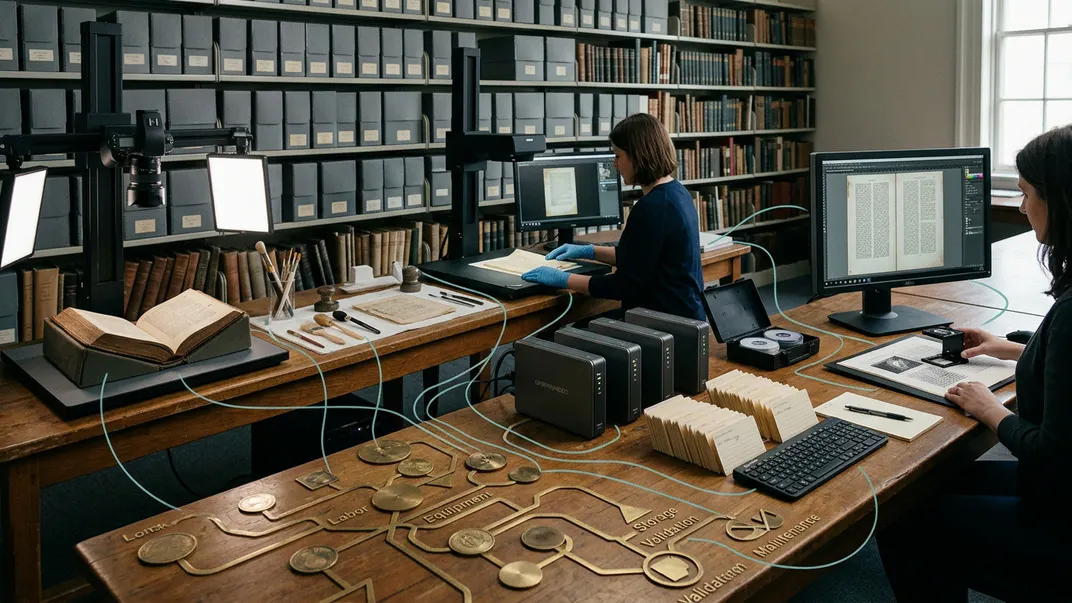
Records digitization cost as a full pipeline budget for archives and courts, covering every one-time and recurring line beyond the per-page scan rate.

Leo Team · July 22, 2026
Court Record Transcription: Making Historical Case Files and Dockets Readable at Scale
Compares crowdsourcing, general OCR, LLMs, and specialist HTR for transcribing large-scale historical court and judicial records (dockets, case files, probate/naturalization series), arguing for a hybrid pipeline with targeted human review of high-stakes fields like names and dates.

Decipher your archive


© 2026 Leo Technologies Limited. All rights reserved