How to Read Secretary Hand: A Beginner's Guide
Beginner’s guide to reading secretary hand in early modern English manuscripts, focusing on distinctive letterforms, abbreviations, contextual reading, and how machine transcription fits.
Leo Team
July 14, 2026
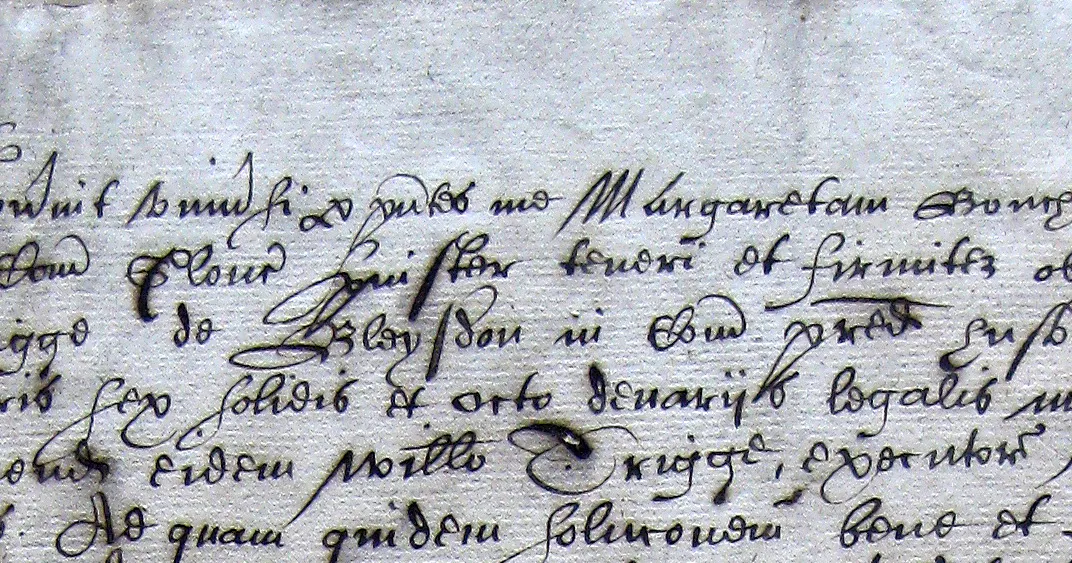
Secretary hand is the everyday handwriting of English-speaking Europe from roughly 1500 to 1700 — the script behind most parish registers, wills, deeds, and letters of the period. This guide explains how to read secretary hand from first principles: the letterforms, the abbreviations, and the habit of reading by context that together turn an illegible page into a legible one. If old handwriting has stalled a line of your family research, this is where you start.
Learning to read secretary hand comes down to three things: the letterforms that differ systematically from modern ones (the secretary e, c, r, h, and the long s), the abbreviations that delete whole syllables, and the habit of reading by context rather than by exact spelling. It is a learnable skill, not a gift. The difficulty is structural, not a matter of messy penmanship.
That last point is worth settling before anything else. The reason a will from 1580 stops you cold is not that the scribe wrote badly. It is that the writing system itself differs from the one you know. Once you see the differences as a system, they stop being noise and become rules — and rules can be learned. This guide walks through what those rules are, in the order a beginner actually needs them, and sits within a broader set of resources on reading old handwriting and paleography that covers other hands and periods.
What secretary hand is — and what it is not
Secretary hand developed in the early sixteenth century, descending from earlier cursive business hands, and remained the dominant everyday script through the sixteenth and seventeenth centuries before italic slowly displaced it. It was used across much of northern Europe — for English, German, Dutch, Welsh, and Gaelic writing — which matters because the same letterforms recur across languages. The skill you build on an English will transfers, in part, to a Dutch register.
Two distinctions save beginners a great deal of confusion.
First, secretary hand is not the same as court hand. Court hand is a narrower, more angular script used specifically in English legal records from the thirteenth to eighteenth centuries, descending from a different lineage — a gothic chancery hand. The two overlap in time, and courts used secretary hand too, so you will meet both. But if a document looks far more cramped and unfamiliar than the wills and letters around it, you may be looking at court hand, which is a separate study.
Second, secretary hand is overwhelmingly a vernacular script. This is the misconception that trips up newcomers most often. The documents you will read are in English (or German, or Dutch) — not Latin. Latin appears only in formulaic patches: legal boilerplate, dating clauses, standard abbreviations. Do not expect to need Latin to read a Tudor will. You need to read early modern English written in an unfamiliar hand.
By the later seventeenth century, educated writers were blending secretary and italic letterforms into what paleographers call mixed hand — the transitional stage that eventually became modern handwriting. There is no clean cut-off year. If your document sits around 1650–1700, expect a mixture.
Start with the letterforms that differ
The single most efficient thing a beginner can do is learn the handful of letters that look nothing like their modern equivalents. Most of the alphabet is close enough to read on sight. It is a small set of troublemakers that does the damage.
The usual suspects are the secretary e, c, r, and h — each of which can be startlingly unlike its modern form — along with a two-stroke or reversed e that appears where you least expect it. Rather than memorising these in the abstract, work from an alphabet chart alongside a real manuscript. The free tutorials from The National Archives, the Society of Genealogists, and Cambridge's English Handwriting 1500–1700 online course all pair a letter-by-letter chart with graded practice manuscripts and model transcriptions. Cambridge's course in particular builds through lessons of increasing difficulty, each with a manuscript to transcribe and a semi-diplomatic transcription to check yourself against — which is exactly how the skill is built, one page at a time.
The long s
The long s (ſ) is the letterform beginners most often get wrong, because it looks like an f and the mistake is easy to make.
It is a distinct graph for /s/, used at the start of a word or in the middle, but never at the end. So "yes" could be written yeſ, and "shelf" is ſhelf — but a word-final s is always the modern round s. It is also not used before f, k, or b. The visual tell, as the Society of Genealogists guide notes, is the cross-stroke: an f normally has a bar going right through the stem, while the long s has, at most, a nub on the left side that does not fully cross. It is not an old-fashioned f; it is an s.
The long s is stubborn. It survived in manuscript hands into the second half of the nineteenth century, long after it vanished from London print around 1800. You will meet it well outside the secretary-hand period.
Learn the abbreviations, because they delete letters
The second structural difficulty is that secretary-hand writers abbreviated constantly, and their abbreviations do not merely shorten words — they delete whole letters and syllables that you are expected to supply. Miss the mark and you miss the missing letters entirely.
A working beginner's inventory:
- The macron (or tilde/titulus) — a horizontal stroke over a vowel — marks an omitted nasal, m or n. So coũent stands for convent. When you see a bar floating over a vowel, suspect a dropped m or n.
- Superscript letters signal contraction: raising one or more letters above the line, often with a suspension mark. w̃ch is "which," w̃th is "with," yor is "your." Cambridge's conventions page sets out how editors expand these.
- Brevigraphs are single symbols standing for a whole word or syllable — the ꝑ that resolves to per, pro, or pre depending on context, or a stroke standing for terminal -us.
- The Tironian et (⁊), a small mark meaning "and," survives from seventh-century shorthand and is the ancestor of the modern ampersand.
These are not decoration. They carry meaning, and a transcription that silently drops them has lost information from the page.
The thorn, and "Ye Olde"
One abbreviation deserves its own note because it powers a famous misconception. The thorn (þ) was the Old English letter for the th sound. In many secretary-hand forms it came to look like a y, and early printers — lacking a thorn sort in their type — substituted a y. That is the entire origin of "Ye Olde." As the history of the letter thorn records, the word was always "the," pronounced /ðə/, never "yee." When you see ye, yt, or y⊤ in a manuscript, read the, that, this. The letter had dropped out of standard English as a live phoneme by the end of the fourteenth century, but it lingered in these stock spellings for centuries.
Read by context, not by spelling
Two further habits separate a beginner who is guessing from one who is reading.
The first is the minim problem. A minim is a single short vertical stroke, and the letters i, m, n, and u are all built from them. A run of minims — as in minimum — is genuinely ambiguous on the page, because the strokes are identical and only their grouping distinguishes the letters. There is no visual trick that resolves this. You resolve it by knowing what word is plausible in context. This is why fluent reading depends on expectation as much as eyesight.
The second is spelling variation. Standardised spelling is a recent convention. Before the mid-eighteenth century, one writer could spell a name four ways in a single document — Ann, Anne, An, Anne — with no error implied. For genealogists this is the crucial adjustment: match names phonetically, by how they sound, rather than hunting for an exact string. A parish clerk who wrote Smyth one year and Smith the next was not confused. He was writing before the rule you are applying existed.
A practical order of work
Putting it together, the sequence a beginner should follow on any new document:
- Date and place the hand. Pure secretary, or a mixed secretary-italic hand? Roughly what decade? This sets your expectations.
- Read the easy words first. Transcribe what you can read on sight and leave gaps for the rest. The known words anchor the unknown ones.
- Attack the troublesome letterforms. Bring the e, c, r, h, and long s to the words you left blank.
- Expand the abbreviations, marking the letters you have supplied so your transcription stays honest about what was on the page and what you added.
- Resolve the minims and the spelling by context, using the surrounding text and your knowledge of the likely names and formulae.
- Check against a model transcription where the tutorial provides one.
Human paleography remains the standard for this work, and the free tutorials from the National Archives, Cambridge, and the Society of Genealogists are the best places to build the skill. There is no substitute for reading pages.
Where machine transcription fits — and where it misleads
At some point the volume of material outgrows what you can transcribe by hand, and the question of software arrives. Here the beginner needs one clear warning and one honest picture of the options.
The warning concerns general-purpose chatbots. It is tempting to paste a manuscript image into ChatGPT, Claude, or Gemini and accept what comes back. Do not treat that output as ground truth. A University of Virginia Library report found that general-purpose models produce fluent, plausible-looking transcriptions that nonetheless contain errors a beginner cannot catch — and, crucially, they offer no confidence flag when they meet a letterform they cannot read. This is the specific danger: the output reads correctly. A model that silently "corrects" Smyth to Smith, resolves an ambiguous minim to the modern-sounding word, or expands an abbreviation the wrong way hands you a clean paragraph with the errors buried where you will never spot them. For genealogy, where a single misread name derails a line for months, a plausible fabrication is worse than an obvious gap.
Dedicated handwritten text recognition (HTR) is the better path. Tools built for historical hands transcribe the image rather than guess at prose. Transkribus, the established platform, publishes a model — Egerton: English Secretary Hand — that reports a 2.89% character error rate on its own validation set; a useful figure, though one earned on a curated test set, so performance on your particular parish register or will is likely to be worse. Transkribus also asks for a subscription and, for the most part, expects users to train or fine-tune models to get the best results on a given corpus.
This is where Leo fits, and it is worth being specific about why. Leo's transcription model, ATR-1, reads Latin-script manuscripts — English, German, Dutch, and the other languages that alphabet records — out of the box, with no per-corpus model training. On a randomized 97-image sample of early-modern English manuscripts from the Folger Shakespeare Library, ATR-1 scored roughly 5% character error rate at its release — 61% fewer errors than the next-best model tested, with Transkribus's Text Titan I at about 13% and the general LLMs far higher (full benchmark here). More to the point for this guide: it is built to preserve what is on the page rather than smooth it into modern prose. The long s stays a long s; the macron is not silently resolved; the archaic spelling survives. That source integrity is exactly the property a beginner needs, because it keeps the machine's errors on the surface — recoverable slips at the level of characters and words — rather than buried in fluent, confident paragraphs. If you want to understand the mechanism behind that distinction, the difference between OCR and HTR for historical documents is the place to start.
Whatever tool you use, the discipline does not change: always correct the machine output against the original image. Software gives you a first pass. Your eye, trained on the letterforms, gives you a transcription you can trust.
The skill is worth building
The tools will keep improving — and models trained on user corrections do compound in accuracy over time — but none of them removes the need to read. A machine transcription you cannot check is a machine transcription you cannot defend, and for family history a name you cannot defend is a branch you may have to prune later. Learn the secretary e and the long s. Learn to see a macron and supply the missing n. Learn to read ye as the and to match Ann to Anne by sound. Do that, and the documents that stalled your research for months become, page by page, simply things you can read.
Frequently Asked Questions
How do you read secretary hand as a beginner?
Start by learning the handful of letterforms that differ systematically from modern ones — the secretary e, c, r, h, and the long s — then learn the abbreviations that delete whole letters and syllables, and finally build the habit of reading by context rather than exact spelling. Work from an alphabet chart alongside a real manuscript, transcribing the easy words first and leaving gaps for the rest. Expand abbreviations, resolve ambiguous minims by plausible context, and check yourself against a model transcription. It is a learnable skill built one page at a time, not a gift.
What is the difference between secretary hand and court hand?
Secretary hand is the everyday vernacular script of English-speaking Europe from roughly 1500 to 1700, used for wills, deeds, letters, and parish registers. Court hand is a narrower, more angular script used specifically in English legal records from the thirteenth to eighteenth centuries, descending from a different lineage — a gothic chancery hand. The two overlap in time, and courts used secretary hand too, so you will meet both. If a document looks far more cramped and unfamiliar than the wills and letters around it, you may be looking at court hand, which is a separate study.
Is secretary hand written in Latin?
No. Secretary hand is overwhelmingly a vernacular script, so the documents you read are in English, German, Dutch, and other spoken languages — not Latin. This is the misconception that trips up newcomers most often. Latin appears only in formulaic patches: legal boilerplate, dating clauses, and standard abbreviations. You do not need Latin to read a Tudor will. What you need is to read early modern English written in an unfamiliar hand, with attention to the letterforms and abbreviations that make the page look harder than the language actually is.
Why does "the" look like "ye" in old handwriting?
Because of the thorn (þ), the Old English letter for the th sound. In many secretary-hand forms the thorn came to look like a y, and early printers — lacking a thorn sort in their type — substituted a y. That is the entire origin of "Ye Olde." The word was always "the," pronounced /ðə/, never "yee." When you see ye, yt, or a similar form in a manuscript, read the, that, this. The thorn had dropped out of standard English as a live sound by the end of the fourteenth century, but it lingered in these stock spellings for centuries.
Can AI transcribe secretary hand accurately?
Dedicated handwritten text recognition can, but general-purpose chatbots like ChatGPT, Claude, or Gemini should not be trusted for it. General models produce fluent, plausible-looking transcriptions that contain errors a beginner cannot catch, and they give no confidence flag when they meet a letterform they cannot read. Purpose-built HTR tools transcribe the image rather than guess at prose. Leo's ATR-1 model scored roughly 5% character error rate on a randomized sample of early-modern English manuscripts — 61% fewer errors than the next-best model tested — and preserves the long s, the macron, and archaic spelling rather than smoothing them away. Whatever tool you use, always correct its output against the original image.