How to Read Old Handwriting: A Practical Guide to Deciphering Historical Documents
A practical, step-by-step method for deciphering historical handwriting (identifying the hand, learning deceptive letterforms, expanding abbreviations, transcription conventions, and where HTR tools fit) aimed at genealogists, historians, and archivists.
Leo Team
July 22, 2026
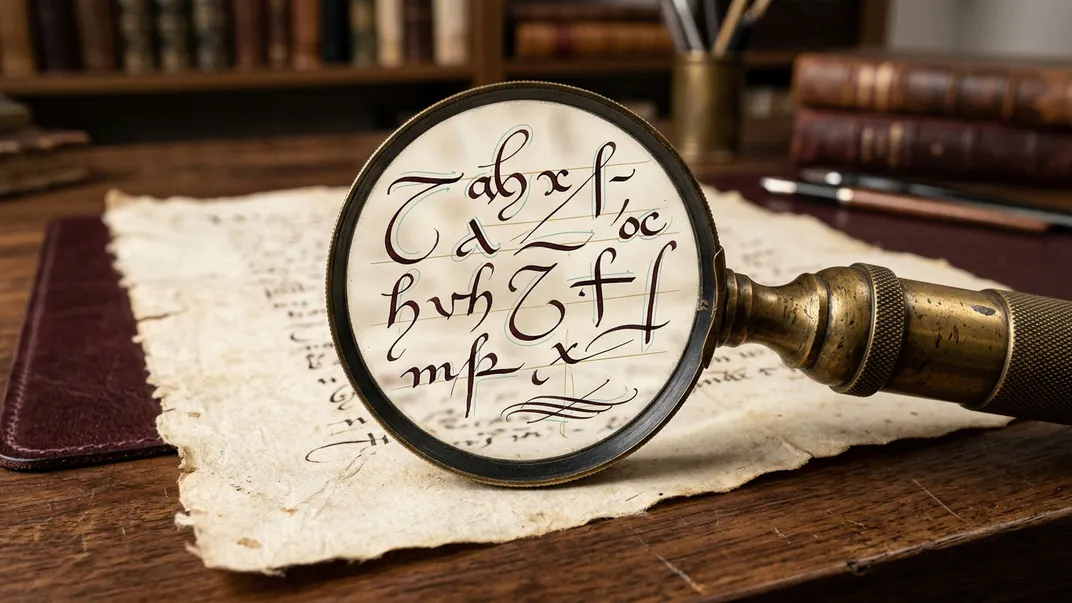
This is a working guide to how to read old handwriting — the method researchers, genealogists, and archivists actually use to move from an unreadable page to a faithful transcription. It walks through identifying the hand, learning the letterforms that mislead you, expanding abbreviations, and reading in context, so a document that looks like a wall of scribble resolves into a record you can trust.
Reading old handwriting is a learnable skill, not a talent. The method is consistent across periods and languages: identify the hand and its date, learn the script's diagnostic letterforms, expand the abbreviations, and read in context rather than letter by letter. The single most common mistake is treating the writing as messy or random. Historical scripts are systematic, named, and datable, and once you know which system you are looking at, most of the difficulty resolves into a manageable set of recurring problems.
This guide walks through that method in the order you would actually use it. It is written for anyone facing a page they cannot yet read: a genealogist stalled on a parish register, a historian at the start of an archival project, an archivist opening an unindexed series. The examples lean on English and Latin because the reference literature is richest there, but the underlying marks travel into French, German, Dutch, Spanish, and Italian hands written in the same alphabet. This is the practical core of the broader subject of reading old handwriting and paleography; the specific hands and periods each reward closer study of their own.
First, identify the hand — not the letters
Paleography is the study and decipherment of historical handwriting, and its first lesson is that handwriting comes in named, datable styles. A period hand is a script with characteristic letterforms and a known range of use. Before you try to read a single word, work out which one you are looking at, because the letterforms you will spend the next hour deciphering only make sense inside their own system.
For English-language material after about 1500, the two hands you will meet most often are secretary and italic. English secretary hand was dominant from roughly 1500 to 1700, progressively giving way to italic through the eighteenth century — so a document from the 1650s may mix both, with a secretary body and italic proper names or Latin phrases. English court hand, used in the courts of law from the medieval period into the eighteenth century, is a separate and more compressed problem again.
Beyond English, the same principle holds. German-language documents use Kurrent — descended from gothic cursive, not from the rounded Antiqua of print — in broad use from the sixteenth century until the mid-twentieth, with the school variant Sütterlin taught from 1911 until 1941. Spanish records bring the heavily looped procesal and cortesana hands; Italian, the mercantile mercantesca. Each has its own quirks. Naming the hand and pinning its approximate date is not a preliminary nicety; it tells you which alphabet chart to keep open and which letterforms are likely to deceive you.
If you are unsure where to start, the UK National Archives palaeography tutorial uses real 1500–1800 English documents, Cambridge's English Handwriting 1500–1700 online course runs to 28 graded lessons, and the BYU Script Tutorial offers the broadest free multi-language coverage — English, German, Dutch, French, Italian, Spanish, Latin, and more. For a fuller treatment of how the major hands relate, see the guide to early modern paleography.
Learn the letterforms that lie to you
Most of the pain in early reading comes from a small number of letters that look like something they are not. Learn these first and the rest of the alphabet largely takes care of itself.
The long s (ſ)
An archaic lowercase s used in medial and initial positions, with a tall ascender and — crucially — no crossbar, or only a partial one. It resembles an f and is the single most common misreading for beginners. The round, modern-looking s appears at the ends of words; the long s appears everywhere else. Once you internalise the positional rule, the confusion largely disappears.
Minim ambiguity
A minim is a short vertical pen stroke, the building block of i, m, n, u, and sometimes w. In a cramped hand, a run of minims becomes a picket fence: minimum can dissolve into a dozen identical strokes with no reliable division between letters. Here you cannot read the shape; you must read the word, using context and the known vocabulary of the document type to decide where one letter ends and the next begins.
Secretary-hand specials
Secretary hand has a distinctive two-stroke e, a c carrying a horizontal stroke, and forms of r and h that surprise modern eyes. These are worth drilling explicitly. The Society of Genealogists' guide to reading secretary hand catalogues the letterform confusions, and our own beginner's guide to secretary hand works through them with examples.
Letter interchange
u and v, and i and j, were not yet fixed as separate letters in early-modern spelling. "Vpon," "iustice," and "loue" are not errors; they are the orthography of the period. Reading them as mistakes — or silently correcting them — distorts the record.
The lesson underneath all of these is that you read forward from the letterforms to the word, then check the word back against the letterforms. Pure shape-matching fails on exactly the marks that matter most.
Expand the abbreviations
Scribes abbreviated relentlessly to save time and parchment, and abbreviation is where a page that looked merely difficult becomes genuinely opaque. The system, again, is learnable. Scribal abbreviation falls into a few recurring types.
A suspension omits letters from the end of a word — q with a mark for que. A contraction omits letters from the middle, usually signalled by a superscript letter or a stroke through an ascender. The macron or titulus, a horizontal stroke placed over a letter, most often marks an omitted nasal — m or n — so that comune may be written comūne. Brevigraphs and special signs stand in for whole common words or syllables.
These marks are shared across Latin and the vernaculars, which is why they reward study once rather than language by language. For Latin and Italian, the standard reference remains Adriano Cappelli's Dizionario di abbreviature latine ed italiane, now freely searchable through the Cappelli Online tool at Ad fontes. The National Archives' Latin palaeography activities give graded practice. Our reader's guide to manuscript abbreviations and ligatures covers the main types and the key decision that comes with them: whether to expand a mark or preserve it. That decision belongs to your transcription convention, which is the next thing to settle.
Decide how faithfully you will transcribe
Before you commit readings to a file, decide what kind of transcription you are making, because the choice governs a hundred small decisions and should be made once, deliberately.
A diplomatic transcription preserves the original exactly — spelling, abbreviations, capitalisation, and layout as written. A semi-diplomatic (or normalised) transcription keeps original spelling and abbreviations but regularises layout, capitalisation, and punctuation for readability. The Folger's transcription conventions set out the distinction and the notation for expansions, additions, and uncertain readings.
Whichever you choose, the governing principle is source integrity: transcribe what is on the page, not what you expect to find. The archaic spelling stays. The abbreviation is either preserved or expanded in marked brackets — yo[u]r — never silently rewritten. The strikethrough and the marginal addition are part of the record and belong in the transcription. This discipline matters most precisely when a smoother reading is available and tempting, because a plausible modernisation buries evidence that a later reader — often you, months on — will need.
Read in context, and expect the machine to need you
No amount of letterform drilling replaces contextual reading. You infer an unclear letter from the word, the word from the sentence, the sentence from what this kind of document says. A will has a structure; a parish register has repeating formulae; a deed recites boundaries in a set order. Knowing the genre lets you predict, and prediction is what carries you past the truly illegible mark. The formulaic passages that make these documents tedious are also what make them readable. Our working guides to transcribing old wills, transcribing parish records, and reading census records each turn on this document-shape knowledge.
At some point, if you are working through a long series rather than a single page, the question of machine transcription arises. It is worth being precise about what the current tools do and do not do.
General-purpose OCR — Google Cloud Vision, Amazon Textract, ABBYY FineReader — was engineered for clean modern print: it segments the page into discrete glyphs and classifies them against a modern type model. Manuscript writing, with its variable baselines and connected strokes, violates every assumption in that pipeline, which is why OCR output on handwriting is untrustworthy even when the interface makes it look confident. Handwritten text recognition (HTR) is the purpose-built alternative, using neural networks trained on annotated manuscript samples. Accuracy is measured as character error rate — the proportion of characters you would have to change to reach the correct transcription — and on well-matched, single-hand material, HTR reaches low single-digit CER. Mixed-hand and multi-scribe sources drive that figure up sharply and demand human review.
General LLMs — ChatGPT, Claude, Gemini — are increasingly reached for, and on some material they read handwriting surprisingly well: one published benchmark on eighteenth- and nineteenth-century English reports first-pass character error rates in the same broad range as specialist HTR, though it is a single corpus in one language, still requires verification, and its authors flag a distinct danger — fluent, plausible, wrong readings that are harder to catch than garbled output because they read like sense. A misread character announces itself; an invented word does not. That is the reason to keep interpretation separate from the base transcription and to verify against the image regardless of which tool produced the draft.
This is where a specialist tool earns its place in the workflow. Leo is a purpose-built HTR platform whose model, ATR-1, reads Latin-script manuscripts and print — English, French, German, Dutch, Spanish, Italian, Latin, and other languages written in that alphabet — out of the box, with no per-corpus model training. Its design commitment is the one this guide has argued for throughout: it transcribes what is on the page rather than smoothing it into modern prose, preserving the long s, the macron, the strikethrough, and the archaic spelling rather than silently resolving them. On a randomized 97-image sample of early-modern English manuscripts from the Folger Shakespeare Library, ATR-1 scored roughly 5% character error rate at release — 61% fewer errors than the next-best model tested, with Transkribus's Text Titan I at about 13% and the general LLMs higher still (full benchmark data here). None of that removes the reader from the loop. It produces a faithful first draft you then verify against the image, which is faster than starting from a blank page and safer than trusting fluent output unchecked.
The skill still sits with you
Whatever the tool, the gating step remains human paleographic judgement. HTR is reliable only where its training matches the document; on unfamiliar or mixed hands, no system yet removes the need for a reader who knows the period, the genre, and the marks. Machine transcription changes what paleography is for — less first-pass drudgery, more verification and editorial judgement — but it does not retire the skill.
So the path forward is the one this guide has traced. Name the hand and date it. Learn the letters that lie to you. Master the abbreviation system once, since it serves every language in the alphabet. Fix your transcription convention before you start. Read in context, always. Do that, and the page that looked like a wall of scribble resolves into what it always was: a record, written by someone who expected to be read.
Frequently Asked Questions
How do you read old handwriting?
Read old handwriting by working through a consistent method rather than guessing letter by letter. First, identify the hand and its approximate date, since scripts are named, systematic, and datable — secretary and italic for English after about 1500, Kurrent for German, procesal for Spanish. Next, learn the letterforms that mislead you, such as the long s that looks like an f. Then expand the abbreviations scribes used to save space. Finally, read in context: infer an unclear letter from the word, the word from the sentence, and the sentence from what that document type usually says.
What is the long s and why does it look like an f?
The long s (ſ) is an archaic lowercase s used in medial and initial positions, with a tall ascender and no crossbar, or only a partial one. That shape makes it resemble the letter f, which is why it is the single most common misreading for beginners. The rule is positional: the round, modern-looking s appears at the ends of words, while the long s appears everywhere else. Once you internalise that positional rule, the confusion between long s and f largely disappears, and words that looked garbled become readable.
What is the difference between a diplomatic and a semi-diplomatic transcription?
A diplomatic transcription preserves the original exactly — spelling, abbreviations, capitalisation, and layout as written. A semi-diplomatic, or normalised, transcription keeps the original spelling and abbreviations but regularises layout, capitalisation, and punctuation for readability. Choose which one you are making before you start, because the decision governs many small choices. Whichever you pick, the governing principle is source integrity: transcribe what is on the page, not what you expect to find. Archaic spelling stays, abbreviations are either preserved or expanded in marked brackets rather than silently rewritten, and strikethroughs and marginal additions belong in the record.
Can ChatGPT or Google OCR read old handwriting?
General OCR tools like Google Cloud Vision and ABBYY FineReader are unreliable on old handwriting because they were engineered for clean modern print, segmenting pages into discrete glyphs against a modern type model — assumptions that manuscript writing violates. General LLMs like ChatGPT read some material surprisingly well, with reported first-pass error rates comparable to specialist tools on eighteenth- and nineteenth-century English, but that rests on a single corpus in one language and still requires verification. Their distinct danger is fluent, plausible, wrong readings that are harder to catch than garbled output because they read like sense. Verify any draft against the image.
Is reading old handwriting a skill you can learn, or do you need a talent for it?
Reading old handwriting is a learnable skill, not a talent. The method is consistent across periods and languages: identify the hand and its date, learn the script's diagnostic letterforms, expand the abbreviations, and read in context rather than shape-matching letter by letter. The most common mistake is treating the writing as messy or random, when historical scripts are systematic, named, and datable. Once you know which system you are looking at, most of the difficulty resolves into a manageable set of recurring problems — a handful of misleading letters, a set of abbreviation types, and the formulaic structures of each document genre.