The Asparagus and the Rapture: Thomas Bartholin's On Diseases in the Bible: A Medical Miscellany
A Danish physician trained in Galen and Hippocrates opens the Old and New Testaments and reads Job's boils, Nebuchadnezzar's beastliness, and the "fiery serpents" of the wilderness as clinical cases — this is De morbis biblicis miscellanea medica, printed at Copenhagen in 1672 by Thomas Bartholin (1616–1680), among the most celebrated anatomists of the age. Bartholin assigns each scriptural affliction a natural pathological name while reserving for divine action whatever medicine cannot explain, staking out contested ground between the faculties of medicine and theology in Lutheran Copenhagen. For historians of medicine, of biblical reception, and of the confessional culture of the north, it is the most ambitious surviving expression of medicina biblica — and the first written from within a Lutheran setting.
ExLatinis
July 24, 2026
Contents
A Danish physician trained in Galen and Hippocrates opens the Old and New Testaments and reads Job's boils, Nebuchadnezzar's beastliness, and the "fiery serpents" of the wilderness as clinical cases — this is De morbis biblicis miscellanea medica, printed at Copenhagen in 1672 by Thomas Bartholin (1616–1680), among the most celebrated anatomists of the age. Bartholin assigns each scriptural affliction a natural pathological name while reserving for divine action whatever medicine cannot explain, staking out contested ground between the faculties of medicine and theology in Lutheran Copenhagen. For historians of medicine, of biblical reception, and of the confessional culture of the north, it is the most ambitious surviving expression of medicina biblica — and the first written from within a Lutheran setting.
Thomas Bartholin's De morbis biblicis miscellanea medica, printed at Copenhagen in 1672 under the imprint of the royal bookseller Daniel Paulli, is a Latin medical miscellany that turns the diagnostic apparatus of seventeenth-century faculty medicine upon the pages of Scripture. Its author (1616–1680) was among the most celebrated physicians of his age, a central figure of the Copenhagen medical faculty and a name now read as a bridge between the iatrochemical inheritance and the emerging mechanical physiology. The book gathers the bodily afflictions, marvels, and cures reported across the Old and New Testaments — Job's boils, Nebuchadnezzar's descent into beastliness, the "fiery serpents" of the wilderness, the woman with the flow of blood whom Christ healed — and asks, of each, what a learned physician trained in Galen and Hippocrates might say about it. As its subtitle announces, it is miscellanea medica: a compilatory collection rather than a systematic treatise, arranged as a lexical progression through scriptural disease-language rather than as a sustained argument.

Thomas Bartholin appears in this 1651 line engraving as the learned Copenhagen physician whose later De morbis biblicis miscellanea medica would bring faculty medicine to bear on the ailments of Scripture. Its printed scholarly apparatus, identifying his academic authority and aligning him with ancient medical exemplars, visualizes the Galenic-Hippocratic credentials behind that biblical-medical project. Source ↗.
The intellectual problem at the book's core is at once simple to state and delicate to negotiate: how far can the bodily events reported in Scripture be given a natural, pathological identity without dissolving the miraculous into mere nature? Bartholin's characteristic move is what modern historians of medicine call retrospective differential diagnosis. He collates the biblical text with patristic, rabbinic, Greek, and Roman authority and assigns each affliction a natural pathological name — elephantiasis or scurvy for Job, a melancholic delusion for Nebuchadnezzar's lycanthropy, the guinea-worm for the fiery serpents, puerperal disease in the consolatory dedication — while carefully policing a boundary that reserves for divine action whatever medicine cannot explain. Adam's sleep in Eden is not anaesthesia but a raptum divinum, a divine rapture; Christ's cures are of conditions medically incurable by definition. The two commitments — naturalistic explanation and doctrinal limit — are held together rather than set against one another, with Augustine's rule that demons act only as God permits functioning as the theological ceiling above all natural causation.
The stakes of that balancing act were considerable in Lutheran Copenhagen. To claim that the diseases named in Scripture are properly medical entities, and so fall within the physician's exegetical competence, was to stake out territory long contested between the faculties of medicine and theology. The tradition Bartholin joins — learned-medical commentary on Scripture, medicina biblica — had been inaugurated by Francisco Vallés's De sacra philosophia (1587) and carried forward by Jesuit and Franciscan commentators; Bartholin's treatise is now regarded as its most ambitious surviving expression, and the first to be written from within a Lutheran confessional setting. That setting sharpens certain passages into polemic. His treatment of the oleum infirmorum, the oil of the sick, argues that anointing passed first from physicians to theologians and was originally a medicament rather than a sacrament — a claim that touches directly the Lutheran-Catholic dispute over extreme unction defined at Trent, and one that Ole Peter Grell has identified as the text's most charged contemporary resonance.
What a first-time reader will find most striking is the range of learning marshalled to a single interpretive end, and the wit with which it is deployed. Bartholin draws on anatomy and iatrochemistry, on Hebraist philology by way of the Basel authority Johannes Buxtorf the Younger, on numismatics and iconography, on the natural history of the tropics gleaned from Portuguese and Dutch travel reports, and on the whole patristic and rabbinic inheritance. He corrects the Vulgate's rendering of Moses as "horned" and traces the painters' error to it; he explains the iconographic Nimbus as a radiate solar crown transferred to sanctity; he rejects, on historical grounds, the identification of Job's disease with syphilis, which he dates to its return from the West Indies with Columbus in 1494. He can also be disarming about his own method, confessing that he tossed the collection onto the page faster than asparagus is cooked — a remark that at once excuses the miscellany's disorder and signals the confidence of a physician who treats scriptural pathology as native ground. The book was written in the shadow of grief: its dedication to the powerful royal minister Peder Schumacher Griffenfeld is a consolatio on the death in childbed of his wife, Karen Nansen, and it treats the puerperium itself as a mortal disease.
The unity of the work lies in the constancy of that bounded, naturalizing method across every domain it touches — its philological corrections, its antiquarian excursions, its confessional polemic, and its clinical diagnoses alike proceed by naming a natural cause and then marking the point beyond which nature does not reach. Its conceptual vocabulary (morbus, raptum divinum, oleum infirmorum), its production in the aftermath of the 1670 Hagestedgaard library fire and amid Bartholin's most productive year, and its internal movement from the diseases of the Old Testament to those of the New are all expressions of a single programme: to map the body, its pathologies, and its scriptural allusions onto one Galenic-iatrochemical frame while leaving the miraculous intact. It is that programme, sustained with erudition and held under deliberate doctrinal restraint, that makes De morbis biblicis reward the attention of historians of medicine, of biblical reception, and of the confessional culture of the Lutheran north.
Read the full text and English translation on Leo
This text was transcribed and translated as part of the ExLatinis project, an effort by Leo to make free English translations of every text published in Latin in early modern Europe (1450–1750) available online. The complete transcription and English translation of this work can be read free of charge:
→ Read the original Latin text and full English translation on Leo
You can save a copy of this document into your Leo account to run deep text searches, conduct further analysis, or cross-reference it with your own research.
Naming the Diseases in Scripture: Bartholin's English Title and Latin Vocabulary
Conventional scholarly English title: On Diseases in the Bible: A Medical Miscellany (1672). The rendering is that of the 1994 Willis translation published as volume 41 of Acta Historica Scientiarum Naturalium et Medicinalium (Copenhagen, 1994; ISBN 87-16-15099-6); it is the conventional English title now established in the historiography, adopted by Ross (2019) as 'On Biblical Diseases'. No earlier established English title is recorded.
Philological framing. Three heavy Latin terms carry the weight of the text's argument, and a fourth — miscellanea medica — names the genre.
First, morbi biblici. The phrase names the rubric, but conceals a precise polemical claim: that the diseases named in Scripture are properly medical, not merely metaphorical, and so fall within the physician's exegetical authority. Morbus in early modern faculty medicine carries the technical weight of Galenic nosology — a defined disease entity with cause, signs, and course — and not the looser modern sense of 'illness'. Biblicus, in turn, is not simply 'biblical' but 'pertaining to Scripture' in the technical exegetical sense, so that morbi biblici reads as 'the diseases named in Scripture considered as a nosological category'. The compound thus stakes the learned-physician's competence to interpret scriptural disease-language by mapping it onto contemporary Galenic categories. That competence is exercised concretely wherever a scriptural affliction is referred to the ancient medical authorities: of Jacob's lamed hip, for instance, Bartholin observes that Galen pronounces dislocation of the hip incurable and the resulting limp a necessary consequence, curabilem luxationem coxendicum pronunciat Galenus l. 18. de Us. Part. c. 2. futuramq[ue] necessario cruris claudicationem, mapping a scriptural detail directly onto a Galenic prognosis.
Second, raptum divinum, or raptus divinus in the alternative construction. This is the boundary-marker between miraculous and natural causation in early modern learned medicine. The term descends from Aristotle's technical vocabulary on prophecy and ecstasy (a raptus is a passive carrying-away of the intellect by a superior) and enters scholastic and patristic usage through Augustine and Aquinas. In Bartholin's learned-medical Latin, raptum divinum designates the category of bodily events whose proximate efficient cause is natural but whose formal sign is divine — the structural device that allows the physician to offer a medical account of prophecy, ecstasy, catalepsy, or divination without dissolving the theological claim that such events occur under divine permission. The device operates in his handling of the deep sleep that fell upon Adam, which he refuses to reduce to a merely natural sopor, judging that one should recognize here not the reading of the Septuagint translators but a divine rapture, malè meo judicio hic agnoscas LXX Interpretibus, sed raptum divinum. The text's wager is that this category is irreducible: collapse it and either theology yields to mechanism, or medicine yields to miracle.
Third, oleum infirmorum, or oleum infirmorum — literally, 'oil of the sick'. This is the matter of the sacrament of Extreme Unction (Anointing of the Sick) in Catholic sacramentology, defined at Trent's Fourteenth Session (1551) and codified in the Roman Catechism. Within a Lutheran learned-medical commentary, the term carries polemical freight precisely because Lutheran theology rejected Extreme Unction as a sacrament proper (retaining only Baptism and Eucharist) while retaining the use of oil for medicinal purposes. Bartholin's treatment of oleum infirmorum thus occupies a precise theological-legal seam: he describes the natural virtues of consecrated oil as a physician, while leaving the sacramental question to the theologians — a move that simultaneously honours Lutheran polemic against Trent and preserves the physician's authority over the natural substance. The polemical claim is stated plainly, for he believes the anointing passed first from physicians to theologians, Credo ego undionem istam à Medicis primo ad Theolog manasse, reordering the very genealogy of the practice so that its medical origin precedes its sacramental appropriation.
Finally, miscellanea medica names the genre: a 'medical miscellany' in the technical sense used since the late sixteenth century for compilatory treatises drawing heterogeneous material into a single physicianly frame. The phrase marks the text as a learned collection rather than a systematic treatise, and prepares the reader for the lexical-disorder arrangement by which diseases of the Old and New Testaments are successively anatomised rather than argued through. Bartholin himself embraces the register of hasty compilation, remarking that he tossed these miscellanea onto the page faster than asparagus is cooked, Arrept calamo Miscellanea hæc citius in chartam conjeci quam coqvantur asparagi — a self-deprecating flourish that both excuses the collection's loose arrangement and asserts the ease with which a physician commands such material.
What De morbis biblicis Is and Argues: A Summary Overview
Section 2 unavailable. A summary at the executive level is provided in lieu of the standard executive summary, with substantive content recorded in Sections 1, 3, 4, and 6.
The text is De morbis biblicis miscellanea medica (Copenhagen, 1672), a Latin compilatory medical miscellany by the Danish physician Thomas Bartholin (1616–1680), printed and sold under the imprint of Daniel Paulli, royal bookseller to the Danish crown. The work treats the diseases and bodily conditions catalogued across the Old and New Testaments under the headings of contemporary faculty medicine, drawing upon Galen, Hippocratic commentary, Francisco Vallés's De sacra philosophia (1587), patristic tradition, and Bartholin's own iatrochemical and anatomical observations. Its core thesis is that the diseases named in Scripture are intelligible to, and properly the province of, the learned physician, and that the physician may anatomise scriptural pathology without trespassing on theology, provided the category of the divine efficient cause (raptum divinum) is preserved. The work was composed in Latin and has been translated into English once, by James Willis, edited by Johan Schioldann-Nielsen and Kurt Sørensen, and published in Copenhagen in 1994 (Acta Historica Scientiarum Naturalium et Medicinalium, vol. 41; ISBN 87-16-15099-6).
Why Bartholin Matters: Medicine, Biblical Reception, and Confessional Controversy
Section 3 unavailable. A narrative historiographical analysis is integrated into Sections 1, 4, and 6 below; a synthetic overview follows here for completeness.
The text matters to modern scholarship for four interlocking reasons. First, the history of medicine: Bartholin is now read as a bridging figure between the iatrochemical tradition and the new mechanical physiology, and De morbis biblicis is the most learned extant medical commentary on Scripture in the seventeenth century. Second, biblical reception: the text exemplifies the learned-medical reading of Scripture, a tradition inaugurated by Francisco Vallés's De sacra philosophia (1587) and continued by the Jesuit and Franciscan commentators of the early seventeenth century, now reaching its most ambitious expression in Lutheran Copenhagen. Bartholin's dependence on that tradition is explicit at the crux of his diagnosis of Nebuchadnezzar, whose transformation he declines to read as metempsychosis, preferring, more rightly with Vallesius, to call it a melancholy by which the king imagined himself changed into a beast and therefore to be pastured on herbs, rectius Vallesius de Sacr. Philos. c. 80. melancholiam, qua sibi imainabatur, se in bestiam immutatum, ideoue herbis pascendum — a humoral rationalization of imagination-disorder that names Vallés as the immediate authority. Third, Christian Hebraism: the text draws on Buxtorf's Basel Hebraist inheritance (consulting Buxtorf for Hebrew philology of nesem and maschuch), and so places Bartholin in the Lutheran Christian-Hebraist tradition of consulting Jewish learned traditions. Fourth, confessional controversy: the oleum infirmorum passage navigates the Lutheran-Catholic dispute over extreme unction by treating the consecrated oil as a substance whose natural virtues the physician may lawfully describe while leaving the sacramental form to the theologians, a polemically delicate manoeuvre that has been characterised by O. P. Grell as the text's most charged contemporary resonance. That manoeuvre rests in part on conciliar evidence, Bartholin holding the medical priority of the anointing to be established from the First Council of Nicaea, canon 68 in the Arabic, ex scilio Niceno Primo Canone 68. Arabico sit mifestum.
The historiographical frictions the text touches are most visible in four zones. (i) The boundary between miracle and natural pathology: Ross frames Bartholin's project as a sustained wager that the boundary is negotiable through careful learned-medical exegesis, against older supernaturalist readings that would simply deny the physician any competence over scriptural disease-naming. The wager is held in check by a firm theological limit, for with Augustine he believes that omnipotent God can do whatever he wills, and that demons can effect nothing according to their own nature except what He permits, credimus, Omnipotetem DEUM omnia posse facere, uæ voluerit, sive vindicando, sive præstano, nec damones aliquid operari, secundum aturæ suæ potentiam, nisi quod ille permiserit; and it is further bounded by his insistence that the cures worked by Christ were necessarily of incurable conditions, since all the sicknesses cured by Christ our Saviour were incurable, that flow of the woman being wholly incurable, disserit; ægritudines omnes quæ cuæ sunt à Christo salvatore nostro, incurabifuisse; hocque dixit, quia fluxus ille muris omninò erat incurabilis. (ii) The Columbian-origin debate on syphilis: Bartholin's treatment of Job's boils engages Juan Díaz de Pineda's earlier discussion and so participates in the late-seventeenth-century reception of the Columbian hypothesis, a question still unsettled in the modern historiography of syphilis. He rejects the venereal identification of Job's disease on historical grounds, observing that the disease mostly invaded with fever, which does not happen in the venereal disease, and that it was epidemic, whereas syphilis was disseminated only by contagion and in no other way, Nam morbus ille utplurium cum febre invasit, quod non accidit in e Venerea; & fuit epidemius, cum lues Verea saltem per contagium, & nullo alio modo erit disseminata, and he fixes the disease's chronology by the report that a noble Spanish soldier brought this evil back with him from the West Indies with Columbus in 1494, At nobilis ille miles Hispanus ex India Occidentali id malum secum cum Columbo asportavit 1494. In place of syphilis he inclines to scurvy, being not far from believing that scurvy supervened, excited by melancholic humours in a man worn out by so many miseries, whom the Devil tossed like a ball, Parum enim ab quin Scorbutum accessisse credam à melancholicis humoribus excitatum in homine tot æmnis desatigato, quem velut pilam versavi Daemon. (iii) Retrospective diagnosis as a method: A. J. Larner and Anna Jamieson have warned against the methodological hazards of retrospective diagnosis, and Bartholin's text is a paradigm case of the genre in its mature seventeenth-century form. (iv) Lutheran-Catholic sacramental controversy: Grell's review of the Willis translation identifies the extreme-unction dispute as the text's most volatile contemporary resonance. Across these zones, the principal modern interlocutors are T. M. Ross (2019, Early Science and Medicine), Sarah Berkowitz (2021, chapter in Brill's Worlds of Knowledge volume), Ole Peter Grell (1997 review, Medical History), Andrew Cunningham, and Jon Aritzabalaga; disagreements centre on whether Bartholin's project is properly 'medicine' or 'biblical exegesis', and on whether retrospective diagnosis is methodologically defensible as a historical method.
The Copenhagen Quarto of 1672: Printing, Dedication, and Object Biography
Production and transmission. Thomae Bartholini De morbis biblicis miscellanea medica was first printed in Copenhagen in 1672 in quarto format under the imprint of Daniel Paulli, royal bookseller to the Danish crown. A near-simultaneous issue, designated Editio secunda correctior on the title-page, was issued from the same bookseller's Frankfurt stock in octavo format in the same year (USTC edition record 1968314 confirms the quarto at Hafniae, while the 1705 Frankfurt octavo reissue is recorded separately). A further reprint at Frankfurt in 1705 by heirs of Paulli continued to circulate the text in the Empire. No censorship or suppression is recorded; the work circulated freely within Denmark-Norway, the Holy Roman Empire, and the Dutch Republic. The 1994 English translation by James Willis, edited with introduction and commentary by Johan Schioldann-Nielsen and Kurt Sørensen, was issued as volume 41 of Acta Historica Scientiarum Naturalium et Medicinalium and distributed by Munksgaard (ISBN 87-16-15099-6). The 1994 translation has not been re-issued; the original Latin editions remain accessible through digital surrogates (MDZ, Wellcome, HathiTrust, Internet Archive).
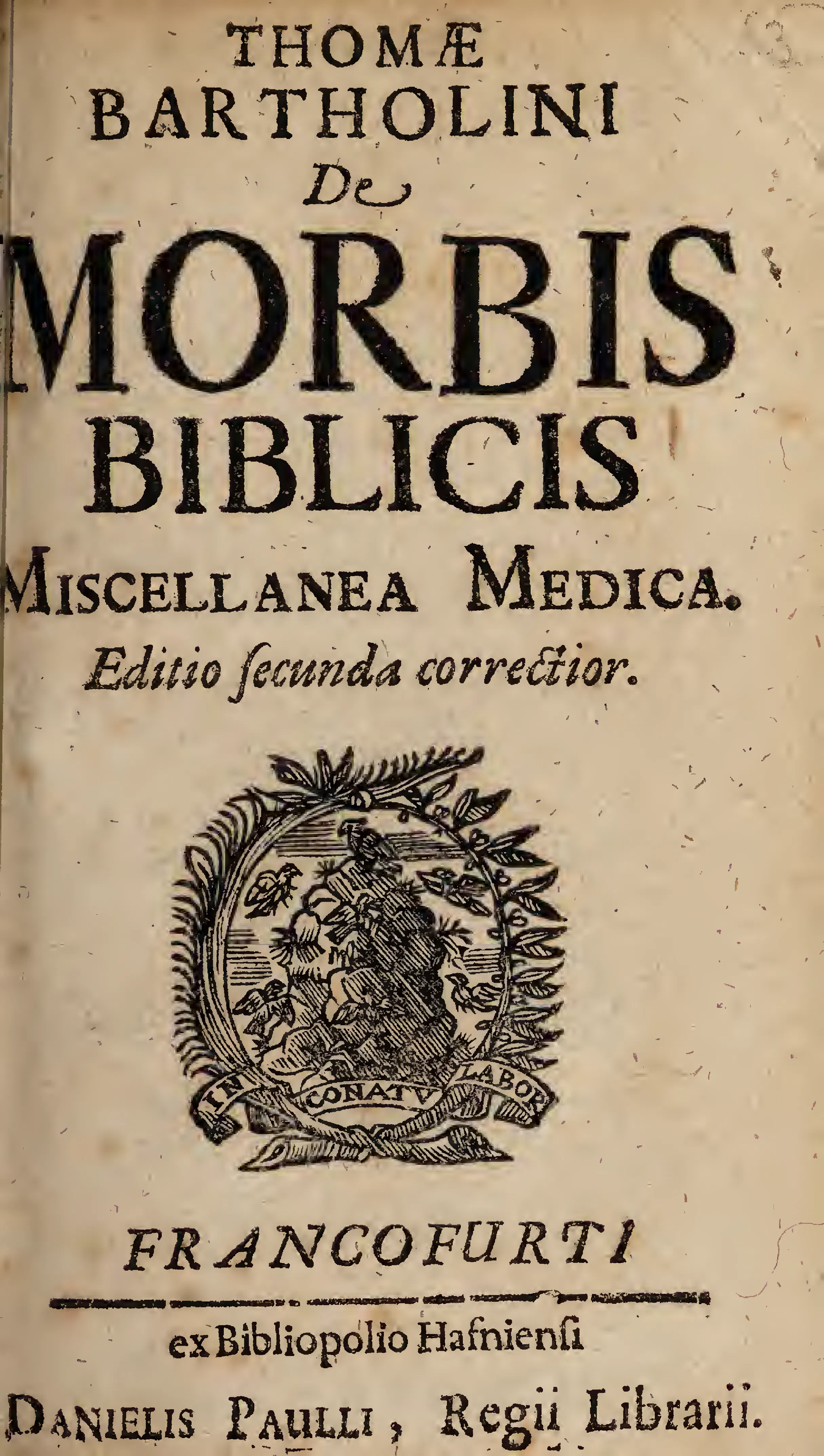
The title page of Bartholin's De morbis biblicis identifies the work not as a systematic pathology but as "Miscellanea medica," while the italic "Editio secunda correctior" marks the corrected second issue circulating alongside the Copenhagen quarto. Daniel Paulli's bookselling imprint — paired with the central device and motto "IN CONATU LABOR" — anchors the book's movement through Paulli's Frankfurt stock and its wider imperial transmission. Source ↗.
The work's genesis lies in a bookseller's prompt: Bartholin reports that, when he had a mind to bring his hitherto scattered sacred opuscula into the light joined in a single fascicle, and since it was well known that he had once written something on the paralytics of the New Testament, he was asked not to withhold from the public good whatever he had on the other diseases in the sacred Codex, Cum enim Opuscula sacra hactenus dispersa, uno fasciculo juncta in lu cem proferre animus esset, & de Paralyti cis Nov. Test. olim me quædam esse com mentatum haud ignoraret, rogavit, de cæ teris quoque morbis in sacro Codice, si quid haberem, bono publico ne inviderem. The passage grounds both the compilatory occasion of the work and its self-declared public-good rationale, and situates De morbis biblicis within the projected gathering of the Opuscula sacra.
Material footprint and format. The quarto first edition collates as [4] + 133 + [1] leaves (the figure 133 includes the duplicated page 81 anomaly noted in the NLM catalogue; pagination runs 33 omitted, 81 repeated). The octavo Editio secunda is recorded at [4] + 133 + [1] leaves. No engraved plates or folding tables are recorded; the work is typographic throughout, with side-notes and indexes. The preliminary leaves comprise a title-page (with Daniel Paulli's device and the royal-bookseller designation), the dedication to Peder Schumacher Griffenfeld, a brief preface, and indices of biblical loci and diseases. The text is set in roman and italic types in Latin, with Hebrew and Greek type cited in passages dealing with philological matters. The Copenhagen quarto uses a different setting of type from the Frankfurt octavo, consistent with Paulli's practice of issuing Copenhagen imprints through the University printer and Empire reprints from a Frankfurt associate.
Bookseller and printing milieu. Daniel Paulli (Paulli Bibliopola), royal bookseller in Copenhagen, issued both imprints under his own name. Paulli is recorded in the Dansk Biografisk Leksikon as operating between c. 1660 and 1684 alongside the academic printer Matthias Godiche (whose press printed the 1662 Cista medica hafniensis). The Bartholin imprint thus sits at the intersection of Paulli's bookselling house and the academic press; whether the 1672 quarto was physically printed at the University of Copenhagen's press or at an associated Copenhagen house is not directly documented in the available sources. The 1672 De morbis biblicis is therefore best described as a Paulli imprint under a likely Godiche (or successor) press run, following standard early-modern Copenhagen bookselling practice.
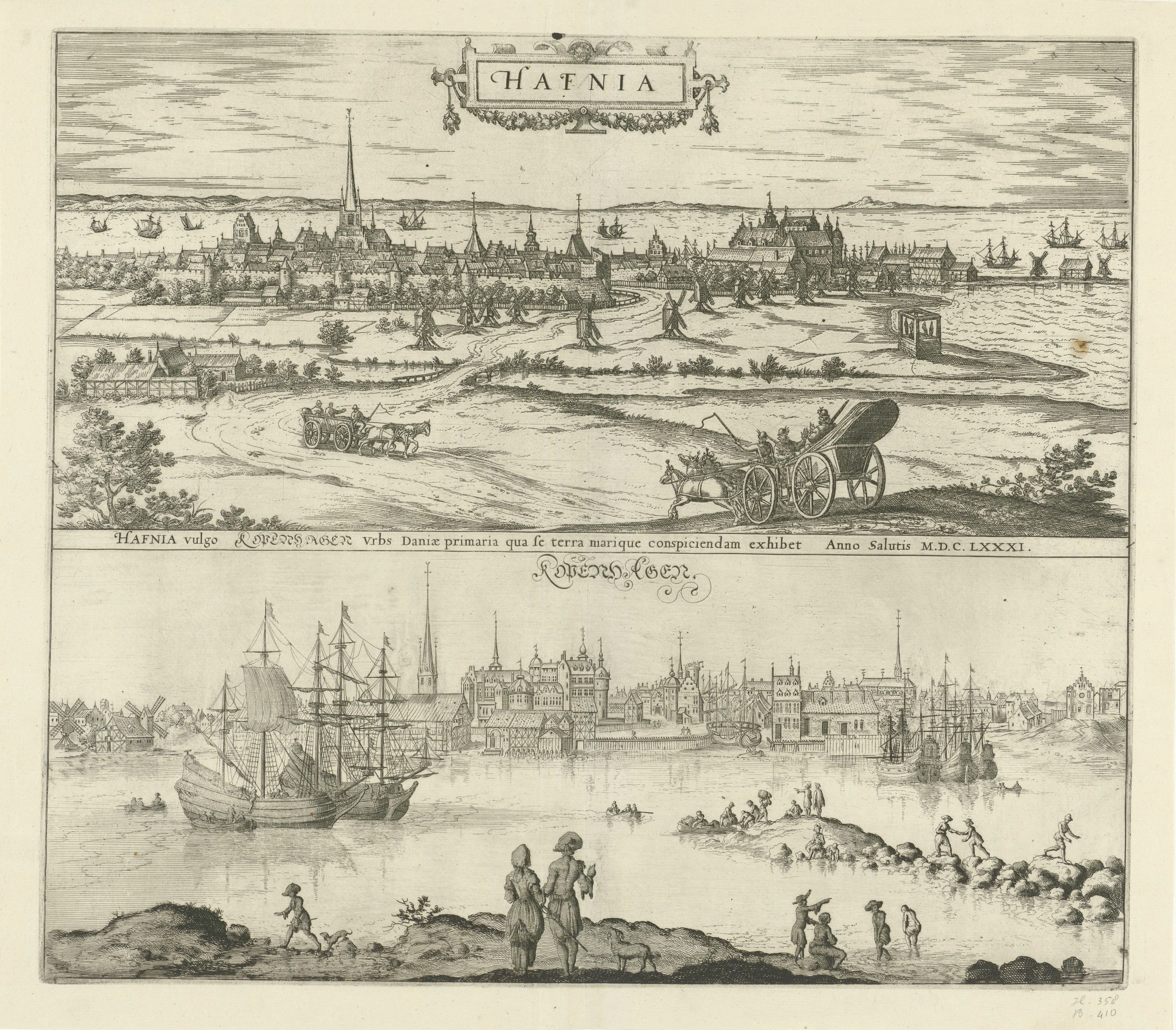
This engraved prospect of Copenhagen, titled "Hafnia" on the object, evokes the fortified Lutheran capital in which Daniel Paulli's bookselling house and the University's printing networks operated during Bartholin's career. It shows neither Bartholin nor De morbis biblicis itself, but it situates the 1672 Paulli imprint within the compact urban and institutional milieu of early-modern Copenhagen scholarship. Source ↗.
Dedicatee and consolatory occasion. The work is dedicated to Peder Schumacher Griffenfeld (1635–1699), elevated to Baron Griffenfeld in 1671 and created first Count of Griffenfeld in 1673, then Danish Grand Chancellor and later impeached and imprisoned. The dedication addresses Griffenfeld on the occasion of the death in childbed of his wife Karen Nansen (1656–1672), shortly after the birth of their daughter Charlotte Amalie Griffenfeld (1672–1703), and thus takes the form of a consolatio on the death of a consort written in a learned-medical register that treats the puerperium itself as a mortal disease. The dedication cannot be later than late 1672 (Karen Nansen's death) and provides internal evidence for the dating of composition; combined with the 1672 imprint, this places the work's production in the same year as Bartholin's Anatomia reformata and in the immediate aftermath of the Hagestedgaard library fire of 14 October 1670.
Hebrew philology and correspondence. The Hebrew philological matter in De morbis biblicis is grounded in Bartholin's consultation of the standard Christian Hebraist authorities of the preceding century, principally Johannes Buxtorf the Younger (Basel, 1599–1664), whose posthumous Lexicon Chaldaicum, Talmudicum et Rabbinicum and Tiberias (both published posthumously in 1669) are cited. The rabbinic-juridical antiquarianism extends to Buxtorf material on the nose-ring (nesem) and on epispasm (maschuch). Because Buxtorf the Younger died in 1664, the citation must be from printed works rather than living correspondence, situating the Bartholin text within the wider reception of the Basel Hebraist school rather than within direct personal epistolary exchange.
Reception and network. Contemporary reception is documented in the JSTOR-indexed secondary literature (Ross 2019; Grell 1997; Berkowitz 2021), and through Bartholin's standing correspondence networks preserved in the published Epistolae medicinales. No contemporary refutation or censorship of the work is recorded, and the absence of suppression is itself significant given the Lutheran-Catholic sensitivities of the oleum infirmorum passage, whose polemical claim that anointing passed first from physicians to theologians would have carried real confessional charge. The work is also embedded within Bartholin's wider corpus: the anatomical output (Anatomia reformata 1672; the lymphatic-system investigations), the parallel De paralyticis Novi Testamenti and De cruce Christi hypomnemata of the same period (issued under the collective title Opuscula sacra or Opuscula), and the medico-historical Cista medica hafniensis (Copenhagen, 1662) of the same author. De morbis biblicis is thus best understood not as an isolated curiosity but as one element of a sustained programme of learned-medical writing in which Bartholin mapped the human body, its pathologies, and its scriptural allusions onto a single Galenic-iatrochemical framework.
The same naturalizing-yet-bounded method that governs the medical chapters extends to the work's philological and iconographic corrections, which likewise belong to this programme. Bartholin cautions against following the Vulgate too closely, since it wrongly rendered the face of Moses as horned as he came down from the mountain, whence the painters' error arose, Nolim autem vulgatæ nimium fidas versioquæ cornutam egredientis Moysis faciem malè posuit. Unde pictorum ortus error, correcting horns to rays of light and tracing an entire iconographic tradition to a translator's slip; and he identifies the radiate crown of sacred imagery, explaining that such a radiate crown is called a Nimbus, Nimbus vocatur ejusmodi corona radiata, connecting solar iconography to the visual language of sanctity. The naturalizing method reaches the natural history of the tropics as well: the "fiery serpents" of the wilderness he explains by their effect, holding that they are to be called fiery because, endowed with a caustic and pyrotic nature of venom rather than of fire, they can burn and finally consume with inflammation and heat, Nempe ignitos vocandos, quia potius igne, veneno causticæ & pyroticæ nat e utere possint, & comburere tandem indio & æstu — a reading consonant with the identification of the serpents' affliction with the guinea-worm drawn from Portuguese and Dutch travel reports.
Place among Bartholin's other works. De morbis biblicis belongs to Bartholin's wider corpus at three levels. (i) Anatomically: it sits alongside the Anatomia reformata (1672) and the Anatomicae institutiones corporis humani, sharing their Lutheran learned-medical idiom. (ii) Parallel biblical-medical works: it accompanies De paralyticis Novi Testamenti and De cruce Christi hypomnemata, which circulated together in the Opuscula sacra collective imprint. (iii) Medico-historical and antiquarian writings: it parallels Cista medica hafniensis (1662), De bibliothecae incendio (1670), and the wider Bartholin family output (Caspar Bartholin the Elder, Erasmus Bartholin, and Caspar Bartholin the Younger as separate authors not to be conflated with Thomas).
From Adam's Rapture to the Oil of the Sick: How the Argument Unfolds
The Preface: Compilatory Occasion and the Physician's Ease
The work opens by staking out the conditions of its own composition, and it does so in a register that at once excuses its disorder and asserts its author's mastery over the material. Bartholin frames the miscellany as a response to a bookseller's prompt: when he had a mind to gather his scattered sacred opuscula into one fascicle and it was known that he had once written on the paralytics of the New Testament, Daniel Paulli asked him not to withhold from the public good whatever he had on the other diseases in the sacred Codex — the same passage that establishes the compilatory occasion of the Opuscula sacra and its public-good rationale, already discussed above in connection with the work's genesis. The genesis is thus located outside the author's own systematic design, a gathering of loose pieces rather than a treatise conceived whole. The same address to the reader supplies the work's most quoted flourish, in which the physician reports having tossed these miscellanea onto the page faster than asparagus is cooked, Arrept calamo Miscellanea hæc citius in chartam conjeci quam coqvantur asparagi. The proverbial figure of asparagi, whose brief cooking was a byword for speed since antiquity, performs a double office: it disarms criticism of the collection's want of order while advertising the fluency of one for whom scriptural pathology is native ground and requires no laborious assembly. The self-deprecation is, in effect, a claim of authority.
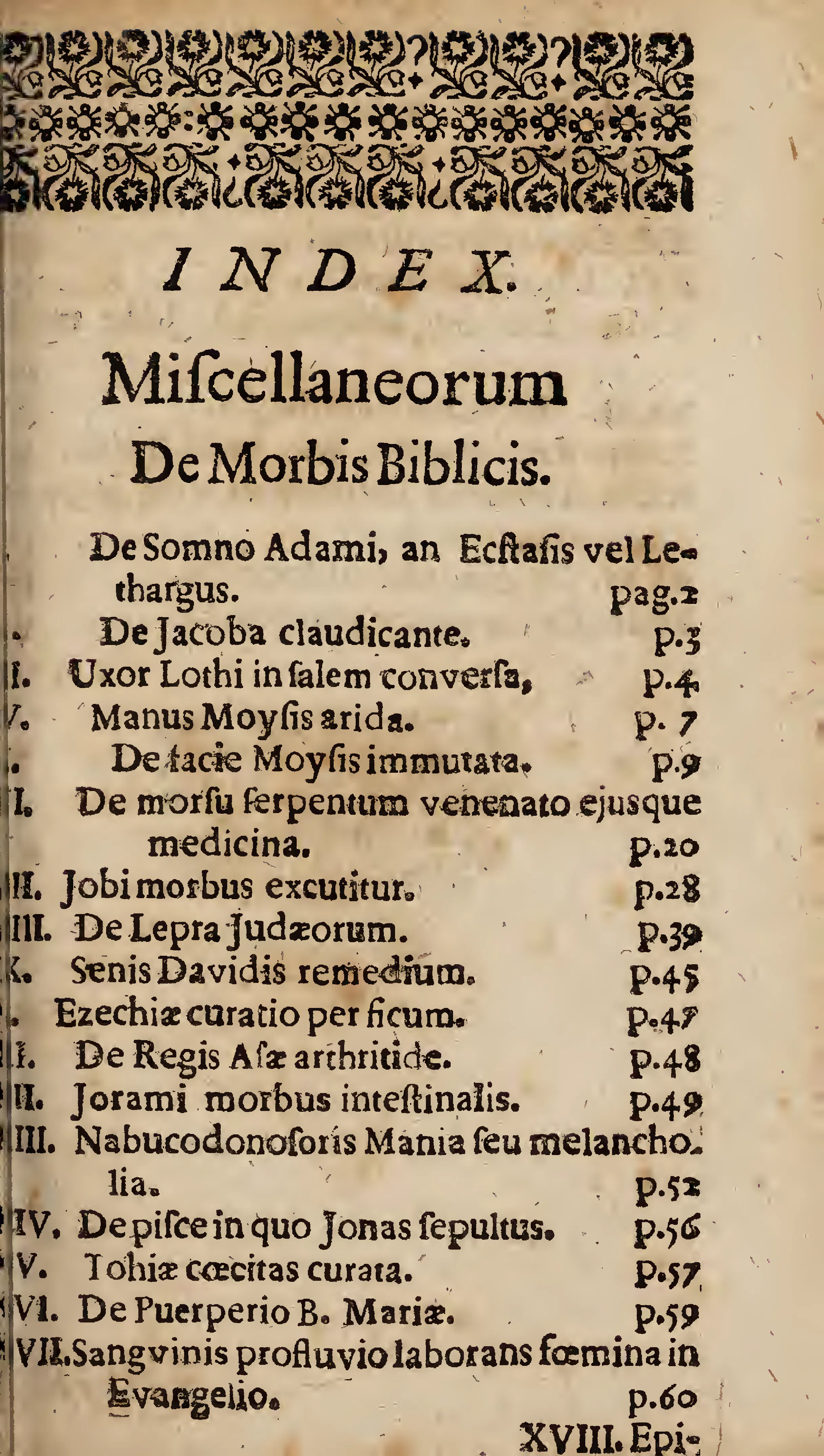
On the opening leaf of the printed "INDEX / Miscellaneorum / De Morbis Biblicis," an elaborate floral headpiece gives way to a compact sequence of chapter headings and page numbers, turning Bartholin's sacred pathology into an ordered list of discrete biblical afflictions rather than a continuous medical system. Cases such as Job, Nebuchadnezzar, Adam's sleep, and the woman with the issue of blood are gathered as separate diagnostic occasions, even as the typography imposes discipline on material presented as rapidly assembled. Source ↗.
The Diseases of the Old Testament: Method Displayed
That authority is exercised immediately in the chapter on Adam's sleep, where the method that governs the whole is first displayed. Confronted with the deep sleep of Genesis, Bartholin declines both the Septuagint's language of ecstasy and the reading that would reduce the event to a pathological lethargy, judging that one should recognize here not the interpreters' rendering but a divine rapture, malè meo judicio hic agnoscas LXX Interpretibus, sed raptum divinum. The move is characteristic and structurally decisive: the physician engages the medical categories — lethargy, ecstasy — precisely in order to exclude them, reserving the event for a class of bodily happenings whose proximate identity is not natural disease but divine action. The raptum divinum functions here as the ceiling above which the diagnostic apparatus does not climb; it is invoked not against medicine but at medicine's own boundary, and its placement at the very opening of the numbered chapters signals that every subsequent naturalization will be conducted under this reserve.
Where no such reserve is triggered, the diagnostic machinery operates without restraint, and it does so by appeal to ancient authority. The lamed hip of Jacob is referred directly to Galenic prognosis, the dislocation of the hip being pronounced incurable and the resulting limp a necessary consequence — the prognosis discussed above in framing the technical weight of morbus. The citation is precise to book and chapter, and its polemical purpose is to close off the reading that Jacob was healed the following day: if Galen is right that such a dislocation cannot be reduced, then the scriptural detail of the enduring limp is not merely narrative colour but a clinical necessity, and the physician's nosology confirms rather than dissolves the sacred text.
The interpretive method broadens beyond the strictly clinical in the extended treatment of Moses's transformed face, where Bartholin turns his correcting eye upon the Vulgate and, through it, upon the whole pictorial tradition. As noted in connection with his iconographic corrections, he cautions against following the Vulgate too closely, since it wrongly rendered the face of the descending Moses as horned, whence the painters' error arose. The passage is programmatic for the antiquarian and iconographic dimension of the work: a translator's slip in rendering the Hebrew is made to account for an entire iconographic convention, and the correction from cornu to rays of light is pursued across numismatics, the classical solar crown, and the halo tradition. The same naturalizing impulse that assigns a Galenic name to a scriptural affliction here assigns a philological cause to a visual error, tracing the horned Moses not to Scripture but to a defective versio.
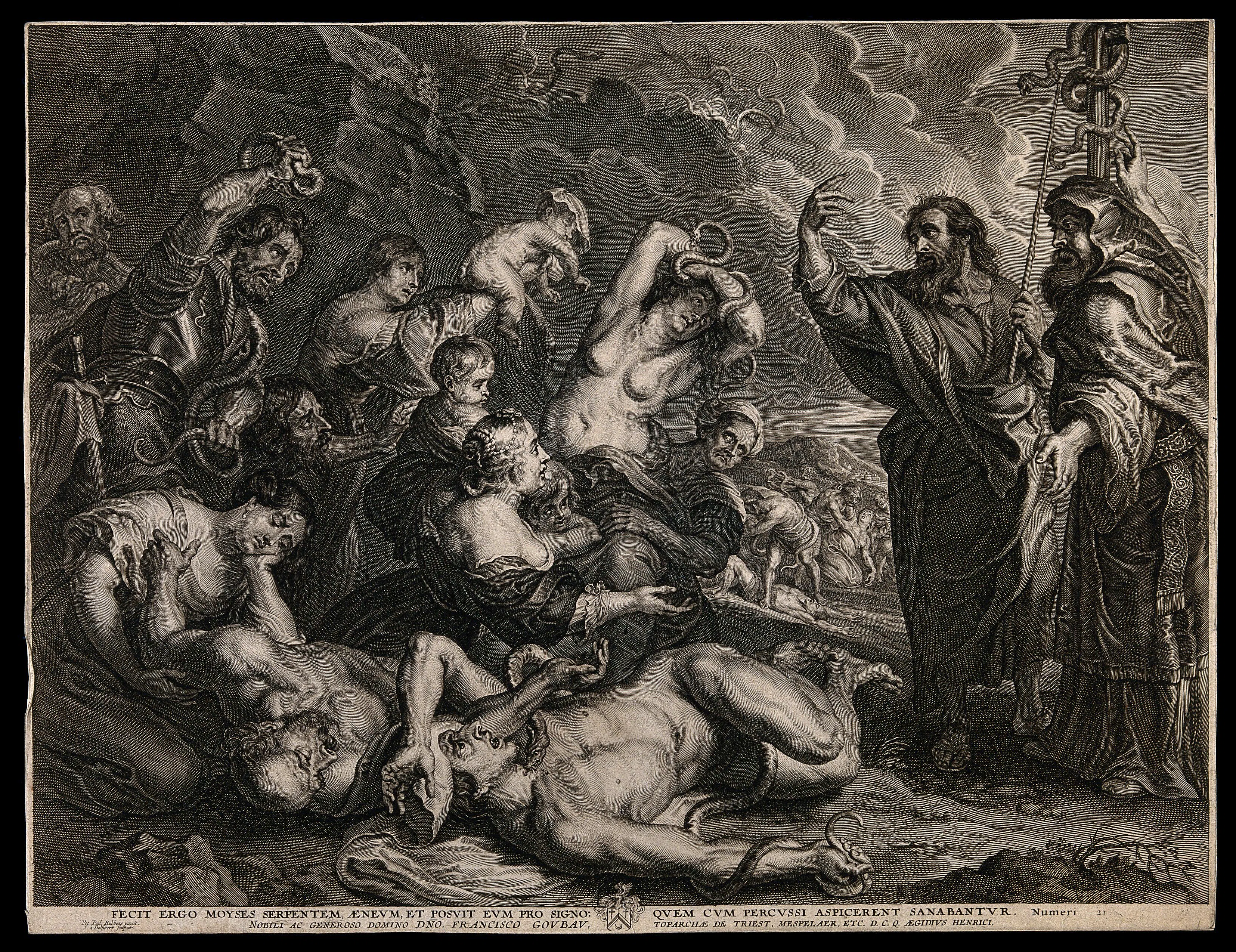
The chapter on the fiery serpents shows the method resolving a philological ambiguity by recourse to physiology. The question is whether ignitus names cause or effect — whether the serpents were literally aflame or burned in their operation — and Bartholin resolves it, as observed above, by locating the fire in the action of the venom: the creatures are called fiery because, endowed with a caustic and pyrotic nature of venom rather than of fire, they can burn and finally consume with inflammation and heat. The adjective is thus grounded in a pathological mechanism, the burning being the felt effect of a caustic poison rather than any literal flame; the exegetical crux is settled by the physician's understanding of how venom inflames tissue, and the scriptural epithet is naturalized without being emptied.

Schelte Adams Bolswert's Baroque engraving after Rubens renders Numbers 21 as a scene of bodily crisis: Israelites contort under snakebite while Moses and Eleazar present the brazen serpent. The emphasis on writhing bodies and venomous affliction makes it a pointed counterpart to Bartholin's reading of the "fiery" serpents, in which the fire belongs not to literal flames but to the caustic, inflammatory action of poison. Source ↗.
Job's Boils: Retrospective Differential Diagnosis in Full
It is in the treatment of Job that the retrospective differential diagnosis that is the work's intellectual signature receives its fullest exercise. Bartholin proceeds by elimination, and his rejection of the venereal identification is argued on historical and epidemiological grounds rather than by mere assertion: the disease mostly invaded with fever, which does not happen in the venereal disease, and it was epidemic, whereas syphilis was disseminated only by contagion and in no other way, Nam morbus ille utplurium cum febre invasit, quod non accidit in e Venerea; & fuit epidemius, cum lues Verea saltem per contagium, & nullo alio modo erit disseminata. The argument turns on two differentiae — the presence of fever and the mode of transmission — and it disqualifies syphilis by a criterion of contagion that the ancient epidemic is said not to satisfy. The chronological support for the exclusion is supplied by the narrative of syphilis's New-World origin, for a noble Spanish soldier brought this evil back with him from the West Indies with Columbus in 1494, At nobilis ille miles Hispanus ex India Occidentali id malum secum cum Columbo asportavit 1494. The dating is doing real evidential work: if the lues Venerea entered Europe only at the close of the fifteenth century, spreading thence from the siege of Naples, then it cannot have afflicted the patriarch, and the anachronism is fatal to the venereal reading. Having cleared the ground, Bartholin advances his own contribution, inclining to scurvy: he is not far from believing that scurvy supervened, excited by melancholic humours in a man worn out by so many miseries, whom the Devil tossed like a ball, Parum enim ab quin Scorbutum accessisse credam à melancholicis humoribus excitatum in homine tot æmnis desatigato, quem velut pilam versavi Daemon. The diagnosis is notable for the seamlessness with which it folds the demonic agency of the biblical narrative into a humoral aetiology: the Devil who tosses Job like a ball is not displaced by the melancholic humours but is made to operate through them, so that the naturalizing account and the scriptural drama are held together in a single sentence rather than set at odds.
Nebuchadnezzar's Transformation and the Augustinian Limit
The same integration of humoral pathology with the letter of Scripture governs the reading of Nebuchadnezzar, where the king's transformation is refused as literal metamorphosis or metempsychosis and referred instead to a disorder of the imagination. Following his immediate authority in the medicina biblica tradition, Bartholin holds, more rightly with Vallesius, that it was a melancholy by which the king imagined himself changed into a beast and therefore to be pastured on herbs — the humoral rationalization of imagination-disorder already examined above, where it names Vallés as the immediate source. The bestial pasturing is thus preserved as a datum of the text while its cause is relocated to the deluded imagination of a melancholic, the outward behaviour explained without conceding any real change of species.
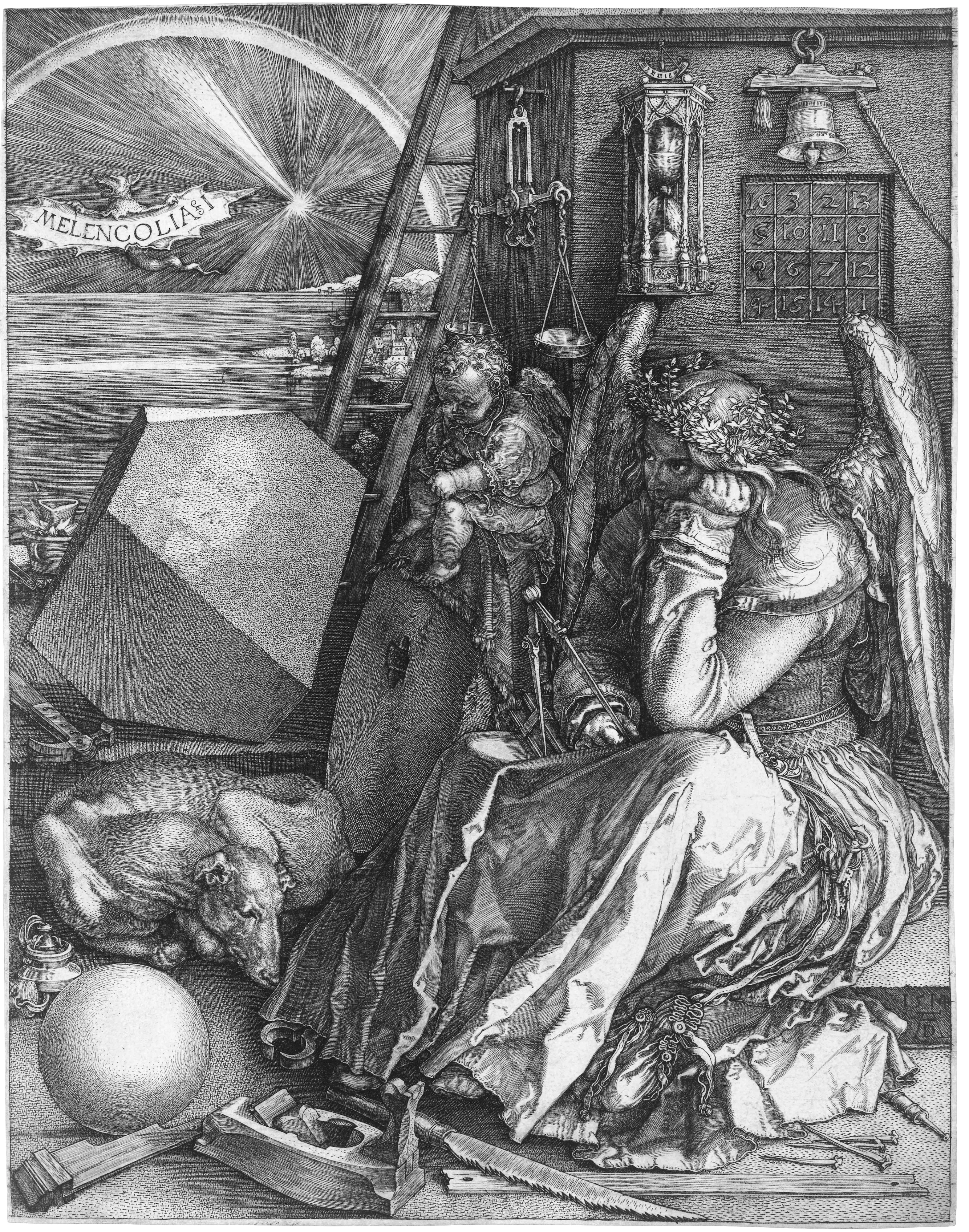
Dürer's Melencolia I personifies the melancholic temperament as a brooding, immobilized intelligence amid scattered tools and instruments — a visual counterpart to the early modern habit of treating disordered imagination as a bodily-humoral condition. In Bartholin's reading of Nebuchadnezzar, such melancholy explains the king's bestial behaviour without requiring a literal transformation of species. Source ↗.
Yet the naturalizing programme is everywhere bounded by a firm doctrinal ceiling, and the same chapter that rationalizes lycanthropy articulates the limit with Augustinian precision. As noted above in the discussion of the miracle-nature boundary, Bartholin believes, with Augustine, that the omnipotent God can do whatever he wills, whether in punishing or in bestowing, and that demons can effect nothing according to the power of their own nature except what He permits. The formulation subordinates diabolic causation to divine permission and so fixes the outer frame within which all the humoral and mechanical explanations operate: the Devil who tosses Job and the melancholy that deludes the king alike act only within the compass of what God allows. This is the theological device that keeps the naturalizing method from tipping into a self-sufficient mechanism.
The Diseases of the New Testament: Christ's Cures and the Anointing with Oil
The logic of the boundary is inverted, and made positive, in the treatment of Christ's cures, where medical hopelessness becomes the very condition of the miracle. On the woman with the flow of blood, Bartholin reports, as observed above, the argument that all the sicknesses cured by Christ our Saviour were incurable, that flow being wholly incurable. Here the physician's nosology is enlisted not to explain the cure but to certify its impossibility by natural means: the force of the miracle depends precisely on the case lying beyond the reach of the medical art, so that the diagnostic apparatus, far from dissolving the wonder, guarantees it.
The work closes its argumentative arc on the most confessionally charged terrain, the anointing with oil enjoined in the Epistle of James, where the naturalizing method acquires an explicitly polemical edge. Bartholin advances the genealogical thesis, discussed above in framing the oleum infirmorum, that the practice was medical before it was sacramental, believing that this anointing passed first from physicians to theologians. The claim reorders the whole descent of the oleum infirmorum, subordinating the sacramental appropriation to a prior medical use, and it is buttressed by conciliar evidence marshalled to show the oil's originally medicinal character, for from the First Council of Nicaea, canon 68 in the Arabic, it is made manifest — the conciliar testimony already cited above — that the fathers enjoined the blessing of water and oil not after the manner of baptism nor as chrism, but as the oil of the sick. The physician here operates on a delicate seam: he describes the natural virtues of consecrated oil as falling within his own competence while leaving the sacramental question to the theologians, a distribution of authority that at once honours Lutheran polemic against the Tridentine sacrament of extreme unction and preserves the medical man's jurisdiction over the natural substance. That the argument rests on the early church's own canons rather than on confessional assertion is what gives it its force: the medical priority of the anointing is presented as a historical finding, established from the councils and the fathers, and the naturalizing method that opened with Adam's rapture thus reaches its most contested application by the same procedure it has used throughout — naming a natural cause and marking, with equal care, the point at which the theologians' province begins.
Frequently Asked Questions
What is Thomas Bartholin's De morbis biblicis miscellanea medica?
It is a Latin medical miscellany printed at Copenhagen in 1672 that reads the diseases and bodily afflictions reported in the Old and New Testaments as clinical cases. Bartholin gathers Job's boils, Nebuchadnezzar's descent into beastliness, the "fiery serpents" of the wilderness, and the woman with the flow of blood, and asks what a physician trained in Galen and Hippocrates might say of each. A compilatory collection rather than a systematic treatise, it assigns each affliction a natural pathological name while reserving for divine action whatever medicine cannot explain.
Who was Thomas Bartholin?
Thomas Bartholin (1616–1680) was a Danish physician among the most celebrated of his age, a central figure of the Copenhagen medical faculty now read as a bridge between the iatrochemical inheritance and the emerging mechanical physiology. Beyond De morbis biblicis, his corpus includes the Anatomia reformata (1672), investigations of the lymphatic system, the Cista medica hafniensis (1662), and the parallel biblical-medical pieces De paralyticis Novi Testamenti and De cruce Christi hypomnemata. He belonged to a scholarly family and should not be confused with his father Caspar or his brother Erasmus.
How does Bartholin diagnose Job's boils, and why does he reject syphilis?
Bartholin proceeds by elimination and rejects the venereal identification on historical and epidemiological grounds. He argues that Job's disease mostly came with fever, which does not happen in the venereal disease, and that it was epidemic, whereas syphilis spread only by contagion. He fixes the chronology by the report that a noble Spanish soldier brought the evil back from the West Indies with Columbus in 1494 — too late to have afflicted the patriarch. In its place he inclines to scurvy, excited by melancholic humours in a man worn out by miseries, whom the Devil tossed like a ball.
What does raptum divinum mean in Bartholin's argument?
Raptum divinum, a "divine rapture," is the boundary-marker between miraculous and natural causation in Bartholin's learned-medical Latin. It designates bodily events whose proximate cause is natural but whose formal sign is divine, letting the physician account for prophecy, ecstasy, or catalepsy without dissolving the theological claim. He applies it at the very opening of his numbered chapters to Adam's deep sleep in Eden, refusing to reduce it to mere natural sopor and recognizing instead a divine rapture. The category functions as the ceiling above which the diagnostic apparatus does not climb, held in place by Augustine's rule that demons act only as God permits.
Is there an English translation of De morbis biblicis miscellanea medica?
Yes. The work has been translated once, by James Willis, edited by Johan Schioldann-Nielsen and Kurt Sørensen and published at Copenhagen in 1994 as volume 41 of Acta Historica Scientiarum Naturalium et Medicinalium (ISBN 87-16-15099-6). Separately, the Leo edition presents the full transcription alongside a complete English translation that is generated by AI. Leo is an effort to make freely available online, at no cost, English translations of every text printed in Latin in early modern Europe between 1450 and 1750.
This report was generated by an advanced AI assistant that conducted deep research alongside an extensive interpretation of the transcribed original text. Every effort has been made to preserve fidelity to the source and to guard against inaccuracy, but corruption in the text recognition process and model hallucination may nonetheless have entered the text. Treat every claim, quotation, translation, and citation as provisional, and verify each against the original source before relying on or citing it.
Critical Further Reading and Contextual Resources
- Bartholin, Thomas, On Diseases in the Bible: A Medical Miscellany, 1672, trans. James Willis, ed. Johan Schioldann-Nielsen and Kurt Sørensen: The sole modern critical edition and English translation (Acta Historica Scientiarum Naturalium et Medicinalium, vol. 41; Copenhagen, 1994; ISBN 87-16-15099-6), with an editorial introduction and clinical-historical commentary by two psychiatrists. Any reader unwilling to wrestle with Bartholin's abbreviated Latin should start here, though the editors' retrospective-diagnostic enthusiasm is precisely the tendency Larner cautions against.
- Bartholin, Thomas, Th. Bartholini De Morbis Biblicis Miscellanea Medica (Google Books surrogate): A digital surrogate of an early printed copy, useful for checking the report's page tokens against the original setting. The prudent user will collate it against the Wellcome and MDZ scans, since paginations diverge and page 81 is duplicated.
- Berkowitz, Sarah, "Sacred Medicine in Early Modern Europe," The Worlds of Knowledge and the Classical Tradition in the Early Modern Age: Chapter 6 of the Brill volume, placing Bartholin's treatise as the most ambitious extant learned-medical commentary on Scripture and tying it to the European tradition begun by Vallés. Read it for the comparative frame the present report can only gesture toward.
- Digitale Sammlungen (Bayerische Staatsbibliothek), Bartholin, Thomas: De Morbis Biblicis: The Munich digitization of the printed text, cited here at the leaf bearing the Greek term for ecstasy. The Greek and Hebrew type reproduce cleanly, which matters for verifying the philological passages the report leans on.
- Grell, Ole Peter, Review of On Diseases in the Bible: A Medical Miscellany, 1672, Medical History: A short but pointed review that supplies the 1994 edition's full publication details and singles out the extreme-unction dispute as the text's most volatile contemporary resonance. It is the origin of the claim, repeated throughout this report, that the oleum infirmorum passage carried real confessional charge.
- Grell, Ole Peter, and Andrew Cunningham, eds., Medicine and the Reformation: A collection that supplies the confessional framework for the Lutheran-Catholic controversies over extreme unction that Bartholin's discussion navigates. Oriented to the Reformation rather than the later seventeenth century, but indispensable for readers who want the doctrinal stakes rather than the clinical ones.
- Larner, A. J., "Retrospective Diagnosis: Pitfalls and Purposes," Journal of Medical Biography: A brisk methodological warning about reading past disease-language through present clinical categories — the exact operation that structures every chapter of De morbis biblicis. Consult it before taking Bartholin's scurvy-for-Job verdict, or the editors' endorsement of it, at face value.
- National Library of Medicine, Th. Bartholini De morbis biblicis miscellanea medica (catalogue record): The NLM catalogue entry that records the collation and the notorious duplicated page 81. The place to confirm the material-bibliographical claims the report makes about the quarto's makeup.
- Ross, Tricia M., "Sacred Medicine and the Bible: Thomas Bartholin's On Biblical Diseases (1672)," Early Science and Medicine: The single most direct scholarly treatment of the text, situating Bartholin within the longer medicina biblica line descending from Vallés and Pineda. It furnishes the report's governing thesis — that Bartholin wagers the miracle-nature boundary is negotiable through learned exegesis — and should be read first by anyone approaching the work seriously.
- Universal Short Title Catalogue, De morbis biblicis miscellanea medica (edition record 1968314): The USTC record confirming the 1672 Copenhagen quarto and distinguishing it from the later Frankfurt issues. Useful for untangling the edition sequence that the report's textual history depends on.
- Wellcome Collection, De morbis biblicis miscellanea medica (digitized copy): A high-resolution open-access scan of a printed copy, the readiest way to inspect Paulli's title-page device and the preliminary leaves. Pair it with the MDZ digitization when a token needs verifying against more than one witness.
- Wikipedia contributors, Johannes Buxtorf II: A serviceable orientation to the younger Buxtorf, whose posthumous Basel lexica furnish Bartholin's Hebrew philology of the nose-ring and epispasm. Enough to establish why the citation must be to print rather than correspondence, given Buxtorf died in 1664.
- Wikipedia contributors, Peder Griffenfeld: A biography of the dedicatee, the rising royal minister whose wife's death in childbed occasioned the consolatory dedication. It clarifies the political altitude of the man Bartholin was addressing and the precariousness that would soon overtake him.
- Wikipedia contributors, Thomas Bartholin: A general biographical entry on the author, adequate for placing him within the Copenhagen faculty, the lymphatic-system disputes, and the Bartholin dynasty. Treat it as a map, not a source, and do not confuse Thomas with his father Caspar or his brother Erasmus.
- Wikipedia contributors, Horns of Moses: A survey of the Vulgate mistranslation and its iconographic afterlife that Bartholin diagnoses as a painters' error. Handy background for the report's account of how a philological slip became a visual convention.



,_RP-P-OB-44.171.jpg)

