The Face of Proteus: Berger and Vater's On True Plague
In the summer of 1710, as plague from the Great Northern War pressed toward the Baltic, a young Wittenberg licentiate named Abraham Vater stood before his examiners to defend a set of medical theses drafted by the senior physician Johann Gottfried Berger. The result, printed that same year as De pestilentia vera — "On True Plague" — is a compact quarto disputation that stakes an uncompromising claim: that plague properly so called has one cause and one only, contagion, a septic seed-bed of fine particles carried body to body, with the corrupted air, the stars, and dietary excess demoted to mere disposing conditions. For any reader curious how early modern medicine argued its way toward a theory of transmission — decades before germs could be seen — this forty-eight-page exercise offers the contagionist case laid out thesis by thesis, from the coinage of its central category to a candid admission that the true cure still lies hidden in the bosom of nature.
ExLatinis
24 July 2026

Contents
In the summer of 1710, as plague from the Great Northern War pressed toward the Baltic, a young Wittenberg licentiate named Abraham Vater stood before his examiners to defend a set of medical theses drafted by the senior physician Johann Gottfried Berger. The result, printed that same year as De pestilentia vera — "On True Plague" — is a compact quarto disputation that stakes an uncompromising claim: that plague properly so called has one cause and one only, contagion, a septic seed-bed of fine particles carried body to body, with the corrupted air, the stars, and dietary excess demoted to mere disposing conditions. For any reader curious how early modern medicine argued its way toward a theory of transmission — decades before germs could be seen — this forty-eight-page exercise offers the contagionist case laid out thesis by thesis, from the coinage of its central category to a candid admission that the true cure still lies hidden in the bosom of nature.
In the summer term of 1710, in the medical faculty at Wittenberg, a young licentiate named Abraham Vater stood before his examiners to discharge a set of theses on the nature of plague. The presiding professor was Johann Gottfried Berger, then among the senior physicians of that faculty; the theses were his in substance, Vater's to defend. What the two men produced, printed that same year at the Gerdes press under the title De pestilentia vera — "On True Plague" — is a compact quarto disputation of forty-eight pages, organized into twenty-four numbered theses, and cast in the Latin of the learned academic exercise, with the odd Greek term left standing in the original. It is a document of a particular kind and a particular moment: an inaugural medical disputation of the Saxon electorate, produced as the plague of the Great Northern War pressed toward the Baltic and central Europe.
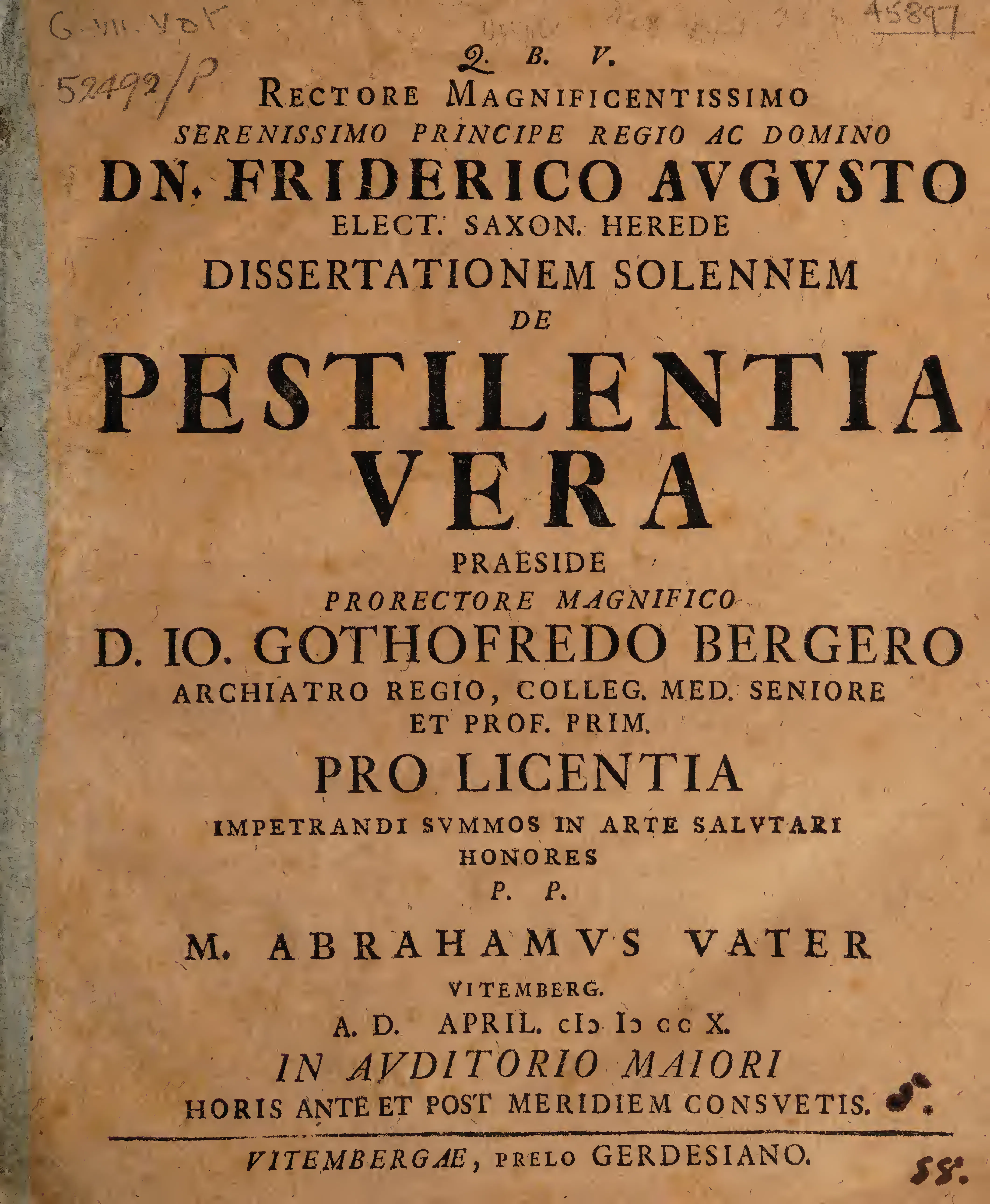
The title page identifies De pestilentia vera as a solemn Wittenberg medical disputation, naming Johann Gottfried Berger as praeses, Abraham Vater as respondent, and the Gerdes press as printer, and framing the exercise as a licentiate examination for the highest honors in medicine. Its opening invocation of Friedrich August as Rector Magnificentissimus places the plague dissertation within the institutional and political world of the Saxon electorate rather than an abstract medical debate. Source ↗.
The work turns on a single, deliberately narrowed question: what actually causes plague — not epidemic sickness in general, but plague properly so called? Its governing move is to coin and defend a category. Berger and Vater set apart pestilentia vera, "true plague," from the loose sense in which any widespread sickness might be called pestilential, and they do so precisely to fix a cause. The authors state the purpose of the qualifier plainly: they have called plague "true," they write, so as to avoid all ambiguity of terms and to distinguish this contagious pestilence from an epidemic, which can be of various kinds. Having drawn that line, they argue that the true plague has one efficient cause and one only — contagium, a morbid effluvium that operates as seed-bed, as tinder, and as ferment. Corrupted air, the influence of the stars, and dietary disorder are demoted to at most disposing conditions; the pestilential venom itself, they hold, is never generated by the atmosphere.
To carry this claim the disputation reaches back to the contagion theory of Girolamo Fracastoro, whose seminaria morbi had, since 1546, furnished European medicine with a vocabulary of seeds, contact, and transmission at a distance. But the apparatus is here refracted through the corpuscular and iatromechanical natural philosophy that Daniel Sennert had naturalized at Wittenberg: the seminarium becomes a matter of very fine, sharp, septic particles acting upon the circulating blood, and the older picture of plague as extreme putrefaction is set aside in favor of a mechanical account of a poison of minute parts. From this etiology the practical consequences follow in train — the segregation of the infected on the precedent of Mosaic law, quarantine against arrivals from suspect places, flight as the surest preservative, a marked skepticism toward amulets and vaunted antidotes, and a candid admission that the true specific remedy for plague still lies hidden in the bosom of nature. The stakes of all this were both intellectual and immediate: the contagion-versus-miasma question was among the governing axes of early modern plague theory, and how one answered it bore directly on what a city, a faculty, or a prince ought to do when plague approached.
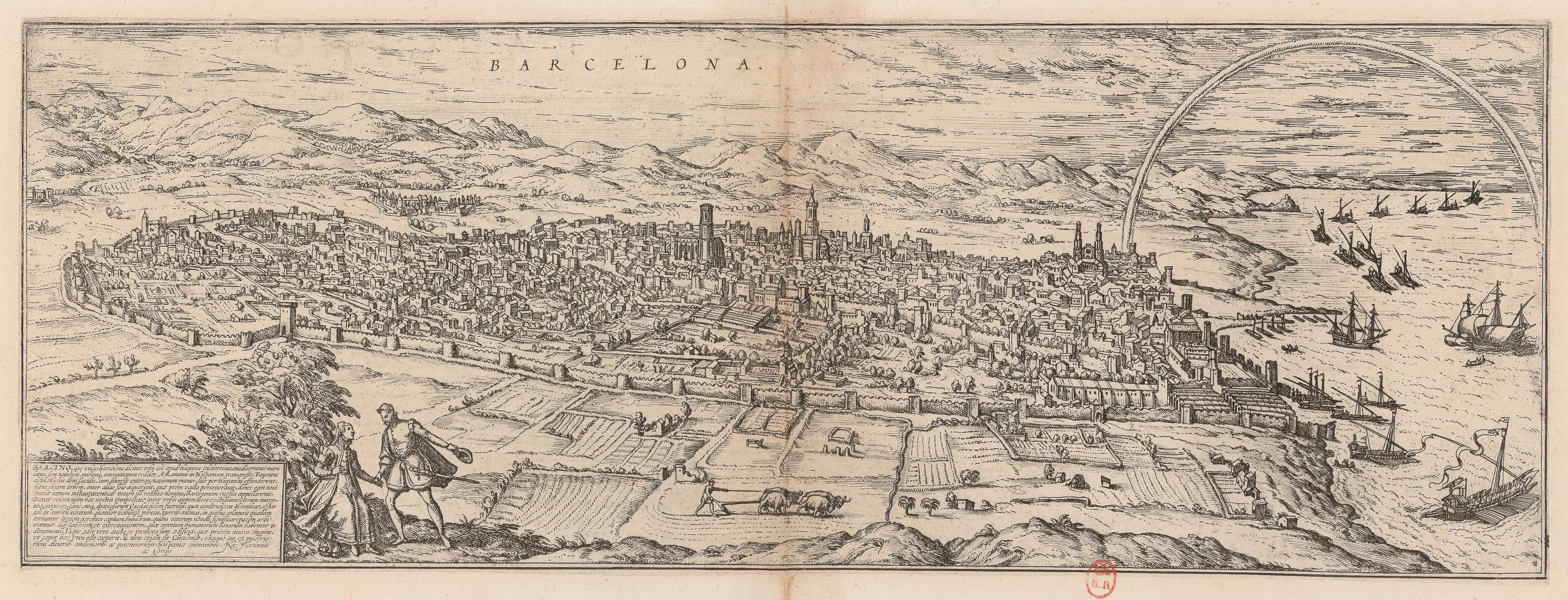
Several things make the text memorable to a first-time reader. There is the vividness of its clinical eye — the recognition that plague "often shows the face of Proteus," that among a great multitude of the infected scarcely any two are afflicted in exactly the same way. There is the polemical sharpness with which it dismisses those who would prescribe any remedy for avoiding plague other than flight as either ignorant men or would-be swindlers. There is the dense company of authorities the disputation keeps — Hippocrates, Celsus, Galen, and Thucydides among the ancients; Sennert, Diemerbroeck, Sydenham, Willis, Mercuriale, and many more among the moderns — and the notable fact that Fracastoro, whose framework underwrites the whole, is never named. And there is the disputation's excursion into disease geography, where the arrival of syphilis in Europe is traced through the return from the West Indies to Barcelona and Naples, setting the lues venerea beside the plague of the East as a second imported disease.
What binds the work together is the discipline of its central thesis. The coined distinction of pestilentia vera, the Fracastorian vocabulary of seed and effluvium, the corpuscular reading of the venom, the appeal to autopsy and to the behavior of the circulating blood, and the sanitary program of segregation and flight are not separate topics but successive applications of one claim: that all the blame for this evil is to be traced to contagion and to nothing else. Whether that claim can be sustained the authors argue thesis by thesis; that a true cure remains beyond reach they concede without embarrassment, closing on the Hippocratic warning that from every art, and most of all from medicine, delay is alien. What follows sets out the philology of the work's key terms, its authorship and production, its place in the historiography of contagion, and its material transmission.
Read the full text and English translation on Leo
This text was transcribed and translated as part of the ExLatinis project, an effort by Leo to make free English translations of every text published in Latin in early modern Europe (1450–1750) available online. The complete transcription and English translation of this work can be read free of charge:
→ Read the original Latin text and full English translation on Leo
You can save a copy of this document into your Leo account to run deep text searches, conduct further analysis, or cross-reference it with your own research.
Defining Pestilentia Vera: The Philology of Contagion, Seeds, and Venom
The Latin title De pestilentia vera — literally "concerning true plague" or "on the true pestilence" — articulates a deliberate nosological hinge. The qualifier vera is not rhetorical flourish but a discriminating technical instrument: it separates pestilentia in the proper sense, the contagious, bubonic, and carbuncular plague historically recognized since the Black Death, from mere pestilentia in the loose sense of any epidemic constitution arising from atmospheric, miasmatic, astrological, or dietary perturbation. Berger and Vater thus claim the word pestilentia as a strict category whose referent is exclusively the disease propagated by contagium, not the broader epidemiological phenomenon of mass sickness. This distinction is the spine of the entire disputation and accounts for the section numbering (I–XXIV) that structures the inquiry: each thesis refines the boundaries between the vera and the merely spuria or accidental plague. The authors make the discriminating function of the qualifier explicit, explaining that they have called plague "true" so as to avoid all ambiguity of terms and to distinguish this contagious pestilence, of which they intend to treat, from an epidemic, which can be of various kinds, Nos vero Pestilentiam diximus veram, ut omnem evitaremus vocum ambiguitatem, et luem hanc contagiosam, de qua agere nobis est animus, ab epidemia, quæ varia esse potest, distingveremus. Crucially, the category is defined by mode of causation rather than by scale of spread: epidemic diffusion is no part of the essence of true plague, a point the authors underscore with the observation that it does not pertain to the nature of true plague that the disease be epidemic, Neque enim ad veræ pestilentiæ naturam pertinere, ut morbus sit epidemius, præclare Eustachius Rudius Pract. lib. I, c. 30, monuit. Thus the vera/spuria boundary is drawn by cause — contagion — and not by the visible extent of an outbreak.
The vocabulary of contagion in this text operates within a Fracastorian and post-Fracastorian register that has been mechanically refracted through the Wittenberg corpuscular tradition. Contagium, from contingere (to touch together), names the medium of transmission: a noxious substance passed from a sick body to a well one. The disputation supplies its own formal definition, glossing contagion as, in general, a morbid excretion or effluvium by which, as by a certain ferment, or as by a graft and seed-bed, the taint and corruption of one body is transferred and propagated into another of the same kind, contagione generatim excretionem notari morbidam, sive effluvium et, quo, tanquam fermento quodam, aut veluti traduce ac seminario, labes et corruptio unius corporis in alia eiusdem speciei transfertur et propagatur. Seminarium (seed-bed, or "seed"), the technical term inherited from Fracastoro's De contagione (1546), designates not a single corpuscle but the generative matrix from which the contagious particles multiply; the text presents the seed-bed as the very condition of onward transmission, holding that the venom never fails to have joined to it a seed-bed of contagion, by which it can flow farther and be propagated, nunquam tamen non coniunctum habet seminarium contagii, quo manare longius et propagari possit. Where Fracastoro's seminaria were sometimes conceived as animate or quasi-animate, the Wittenberg reading subjects them to corpuscular-mechanical explanation in the line of Sennert's atomism, rendering them as minima or very fine particulate matter whose propagation is governed by motion, contact, and the chemistry of bodily fluids. Virus, in this period, retains its older Latin sense of "venom" or "poisonous juice" (cf. virulentia) and is identified with a septic effluvium of very fine parts — not yet the microbiological sense of the nineteenth century — meaning that virus here designates the active, venomous principle transmitted by the seminarium, not a living organism.
These three terms together — contagium, seminarium, virus — form a graduated vocabulary: contagium is the act or mode of transmission, seminarium the originating source or seed-bed, virus the active particulate venom itself. The disputation's authority for this vocabulary is implicitly Fracastoro (via Sennert) without explicit citation, a circumstance that distinguishes Wittenberg contagionism from Italian humanist contagionism by its reception through Lutheran academic channels.
Berger, Vater, and the 1710 Wittenberg Disputation: An Overview
Genre: Inaugural/licentiate medical disputation (disputatio inauguralis medica) under the early modern Wittenberg academic convention, in which a praeses (presiding professor) defends stated theses against a respondens who formally discharges them and undergoes public examination.
Date and Place: Wittenberg, 1710. The imprint reads Vitembergae: Prelo Gerdesiano ("Wittenberg: at the press of Gerdes"), placing the disputation in the publishing ecosystem of the Saxon electorate during the late reign of the Polish-Saxon Wettin dynasty.
Authorship: The respondent and author of record is Abraham Vater (Wittenberg, 1684–1751), then a licentiate of medicine who would later attain the doctorate, become professor of anatomy and botany at Wittenberg, and lend his name to the ampulla/papilla of Vater and the corpuscles of Vater. The presiding praeses is Johann Gottfried Berger (1659–1736), professor of medicine at Wittenberg. Under the conventions of academic disputation, authorial responsibility may inhere with either the presiding professor or the respondent; in practice, the praeses authored the substance and the respondens discharged it, with both names appearing on the imprint. The attribution question is to be resolved bibliographically with reference to Berger's collected writings catalogued by Trevisani (1979).
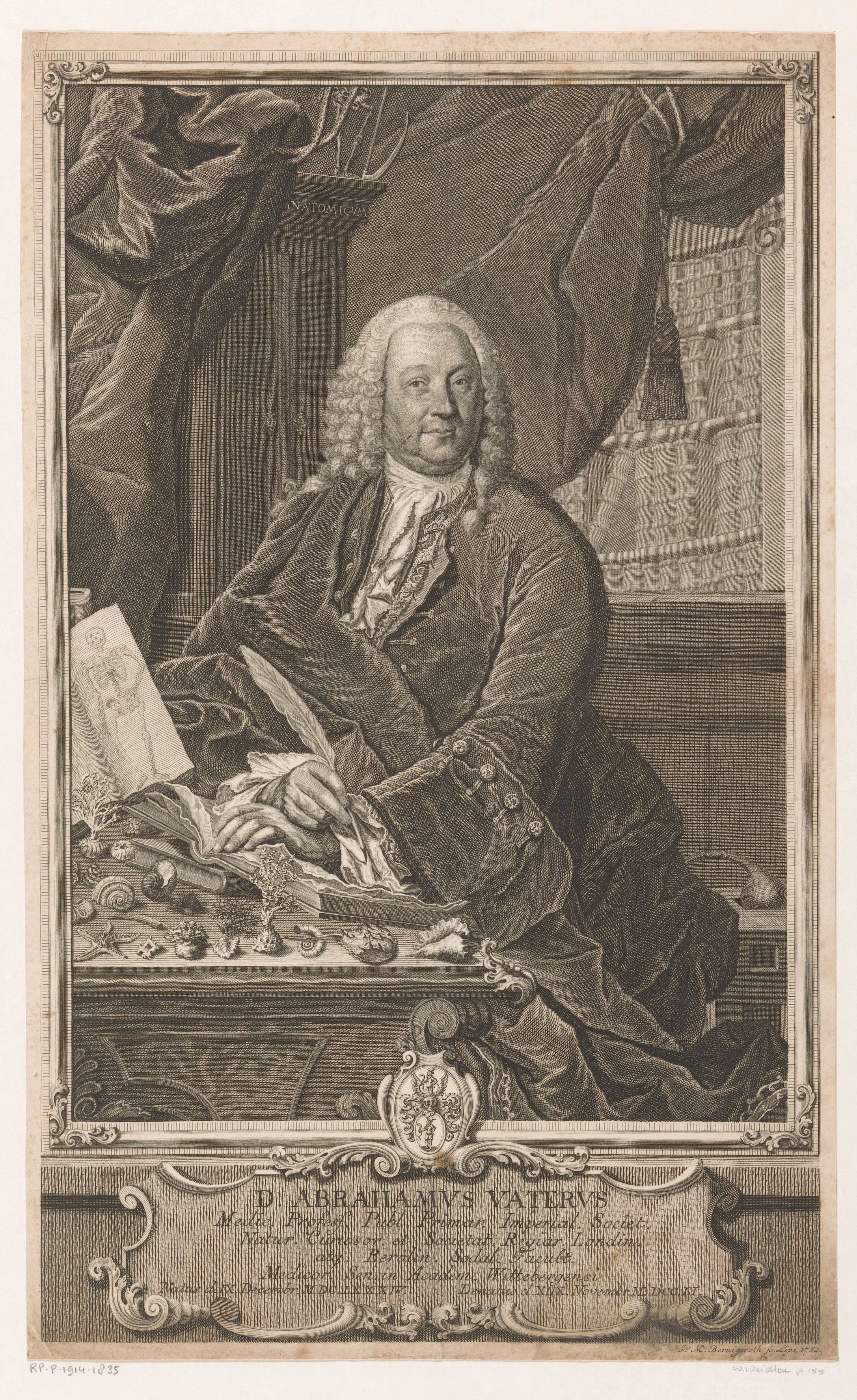
Johann Martin Bernigeroth's 1752 engraved portrait presents Abraham Vater amid the apparatus of learned medicine—open books, anatomical imagery, specimens, and a cabinet-like scholarly setting—cues that match the Wittenberg medical world in which the 1710 disputation was produced. As named respondent and author of record for De pestilentia vera, Vater stands at the center of the attribution problem posed by academic disputation, even as his later professorships in anatomy and botany shaped his retrospective image. Source ↗.

Core Thesis: Pestilentia vera — true plague, as distinguished from a generic epidemic constitution — is caused exclusively and solely by contagion (contagium), understood as a particulate, septic effluvium originating from a seed-bed (seminarium), disseminated by contact, fomites, and at a distance. The authors state this exclusivity in the strongest terms, declaring that, if they may speak freely what they feel, after the matter has been examined more carefully, they judge that all the blame for this evil is to be traced from nowhere else than contagion, Si tamen id, quod, re diligentius agitata, sentimus, dicamus libere, omnem huius mali culpam non aliunde, quam a contagio, repetendam ducimus. Atmospheric, astrological, and dietary explanations are explicitly excluded; the Hippocratic τὸ θεῖον ("the divine [sc. atmospheric] element"), historically invoked as a cause of epidemic disease, is reread naturalistically as a miasmatic rather than a divine cause.
Language of Composition: Latin, with embedded Greek terms (notably τὸ θεῖον) preserved untranslated. The imprint is 48 pages in quarto format, organized in numbered theses (I–XXIV) per the standard pattern of disputation; numbering irregularities are noted but not reproduced here. No English or modern-language translation of the disputation has been identified in current bibliographic registries; the work is consulted in the original Latin by scholars of contagion theory and early modern academic medicine.
Contagion Against Miasma: The Disputation in the History of Medicine
De pestilentia vera belongs to a specific moment in the early-eighteenth-century history of medicine: the consolidation of contagionism in the German academic tradition at the moment of the Great Northern War plague outbreaks approaching the Baltic and central Europe (1708–1712). The text operates at the intersection of three debates that structured early modern learned medicine: (i) contagion versus miasma; (ii) corpuscular versus humoral etiologies of epidemic disease; and (iii) the Sydenhamian therapeutic epistemology that distinguishes vera plague, with its hidden specific, from illnesses susceptible to symptomatic regimen.
The contagion-versus-miasma debate was the central axis of early modern plague etiology, and here the disputation stakes out its position unequivocally, holding that by no suitable argument can it be demonstrated that the pestiferous virus is generated by the air, uti nullo idoneo argumento demonstrari potest, virus pestiferum ab aere gigni — a denial that grounds the contagion-only thesis on which the whole inquiry turns. Fracastoro's De contagione et contagiosis morbis (1546) had first articulated a systematic contagionism with seminaria propagating disease by direct contact, by fomites, and at a distance; Vivian Nutton's foundational studies of the reception of Fracastoro have demonstrated how the seminaria were variously accepted, adapted, and rejected across the sixteenth and seventeenth centuries. By 1710, contagionism had been naturalized within German academic medicine chiefly through the mediation of Daniel Sennert's Wittenberg corpuscularism, and Michael Stolberg has shown how Sennert's atomism was reconciled with Lutheran natural philosophy. The disputation participates in this transmission without explicit citation of Fracastoro — a circumstance characteristic of Wittenberg contagionism, in which the Italian source is mediated through Sennert and through local academic tradition.
The corpuscular and iatromechanical reframing of contagion engages figures of late seventeenth-century physiology: Thomas Willis, Marcello Malpighi, and the broader mechanistic school at Halle (where Friedrich Hoffmann and Georg Ernst Stahl were establishing the German iatromechanical tradition). Iatromechanism sought to explain bodily processes by matter and motion, and contagion was reframed as the mechanical transmission of corpuscular septic matter rather than as a noxious vapor or an astrological influence. The disputation gives this reframing precise expression when it characterizes contagion or the pestilential effluvium as partaking of a certain poison of very fine parts, or sharp and septic, contagium seu ulaqua pestilens veneni cuiusdam tenuium valde partium, acrisve, et septici, particeps, locating the disease's agency in the mechanical properties of minute matter acting on the circulating blood.
This 1721 frontispiece from Jean-Jacques Manget's Traité de la peste presents the plague visitor's protective habit—morocco leather, crystal eye pieces, and a perfume-filled beak—as a material apparatus for confronting infection. Set beside the account of contagion as fine, sharp, septic particles, it makes visible the practical and sensory defenses through which early modern medicine tried to manage an invisible disease agent. Source ↗.
;_WHO_version.png)
This same commitment underwrites the text's departure from the older etiology of extreme putrefaction: reasoning from the behavior of the circulation, the authors note the paradox that one might rightly wonder that in plague the highest degree of putrefaction is present without a sign of putrefaction, mireris merito, in pestilentia summum putredinis gradum sine signo putredinis adesse, and turn instead to the septic venom of fine parts as the more adequate explanation. Thomas Broman's The Transformation of German Academic Medicine, 1750–1820 documents the longer arc of this transformation at Halle, Leipzig, Jena, and Göttingen, against which the 1710 Wittenberg disputation can be situated as an early node in a process that would not mature until the late eighteenth century. The Wittenberg medical faculty itself, founded in 1502, had by 1710 produced multiple generations of academic physicians (Caspar Peucer, Augustin Schurff in the sixteenth century; Daniel Sennert in the seventeenth; Vater and Berger in the early eighteenth).
The disputation's therapeutic epistemology is characteristically restrained. It endorses the Sydenhamian conviction that the decisive remedy has yet to be found, reporting the judgment that it seems probable that a peculiar remedy for plague, and a proper antidote for its very destruction, still lies hidden concealed in the bosom of nature, Mibi, inquit, verisimile est, peculiare pestis remedium, propriumque ipsius perniciei alexiterium adhuc in naturæ sinu abditum delitescere — a frank concession that the specific cure remains beyond the physician's present reach. This candor about the limits of cure coexists with a keen attention to the disease's clinical mutability, captured in the observation that plague often shows the face of Proteus, and that in a great multitude of the infected rarely is one or another afflicted in exactly the same way, adeo ut sæpe Prothei ostendat faciem, et in magna infectorum multitudine raro unus alterve eodem prorsus modo affligatur.
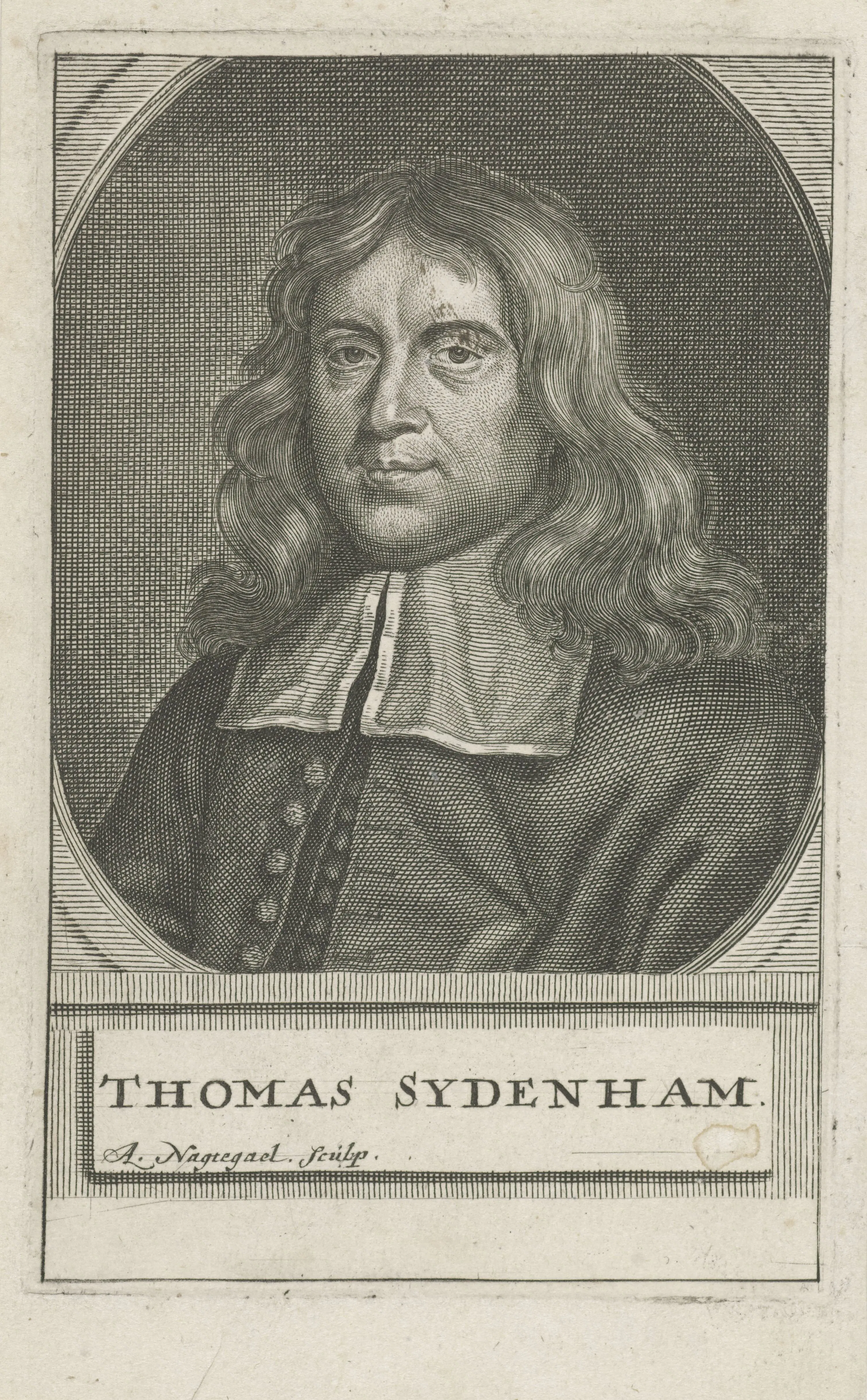
A Dutch engraved-and-etched oval bust portrait presents Thomas Sydenham as the kind of medical authority Berger and Vater could invoke when conceding that plague's true specific remedy remained undiscovered. His presence here underscores the disputation's Sydenhamian balance of empirical clinical attention with therapeutic restraint. Source ↗.
,_RP-P-1910-421.jpg)
The disease-geography of syphilis (lues venerea) and the Columbian hypothesis of its New World origin, articulated by the text's references to Barcelona, Naples, and the return from the West Indies, situates the disputation within the long-running debate about the origins of syphilis. The Columbian hypothesis, contested since the late fifteenth century, has been re-evaluated by recent paleoepidemiological and genomic work.
The Gerdes Imprint: Textual History, Materiality, and Object Biography
Imprint and Production
De pestilentia vera was printed at Wittenberg in 1710 at the press identified on the title page as Prelo Gerdesiano — the printing house of the Gerdes (Gerdesius) family, a workshop active in the Wittenberg book trade during the late seventeenth and early eighteenth centuries. The imprint "Vitembergae : Prelo Gerdesiano" is registered in the holdings of the Wellcome Library (London) and the Internet Archive (identifier b3037599x), and the electronic copy is now widely accessible through Wikimedia Commons and Internet Archive digital repositories. The physical collation is 48 pages in quarto (4to), with Abraham Vater named as respondent and Johann Gottfried Berger as presiding professor on the title page.
Bibliographic Registries and Holdings
The imprint is catalogued by WorldCat (OCLC via archive.org), the Wellcome Library catalogue, and the Internet Archive. For a Wittenberg imprint of this period, the standard national-bibliography reference is the Verzeichnis der im deutschen Sprachraum erschienenen Drucke des 17. Jahrhunderts (VD17), whose successor infrastructure VD18 would catalogue this 1710 imprint; consultation of VD18 alongside WorldCat and the Wellcome catalogue constitutes the highest-value bibliographic chain. The Herzog August Bibliothek Wolfenbüttel and the Sächsische Landesbibliothek – Staats- und Universitätsbibliothek Dresden (SLUB) are recognized starting points for any Wittenberg imprint of this period, though specific shelfmarks for De pestilentia vera in those two collections have not been individually verified here. The Wellcome Library (London) holds a copy, accessible digitally through the Internet Archive, and is the most readily traceable modern repository.
Authorship Convention and the Praeses–Respondens Question
The disputation follows the standard early modern academic convention in which a praeses (presiding professor) frames and is substantively responsible for the theses, while the respondens (respondent) formally discharges them and undergoes public examination for the degree. For Abraham Vater (1684–1751), the disputation falls early in his career, shortly before he received the doctorate in philosophy and subsequently medicine at Wittenberg, and decades before his appointment as professor of anatomy and botany at the same faculty and the anatomical publications (notably the 1720 paper on the biliary diverticulum that became the ampulla/papilla of Vater) by which he is chiefly remembered today. For Johann Gottfried Berger (1659–1736), professor of medicine at Wittenberg and a writer on physiology, De pestilentia vera belongs to the cluster of medical disputations presided over by him in the early eighteenth century; bibliographic enumeration of these disputations (including De avertenda pestilentia, also 1710, and the Vater De Melancholia) appears in the JSTOR/standard bibliography of Berger by F. Trevisani.
Format and Materiality
The 48-page quarto format is typical of academic disputations of the period. The text is organized as numbered theses (I–XXIV, following the customary structure of the disputatio medica inauguralis). The internal ordering follows the analytic movement of the argument from definition through etiology to the sanitary and therapeutic program; the practical portion is grounded in scriptural and civic precedent, invoking, for example, the sanction of Mosaic law that the infected be at once separated from the sound, et lege Mosaica sancitum, curandum est, ut statim infecti ab integris segregentur, and tracing the origin of quarantine to the principle that no one arriving from suspect places, still less from infected ones, be received, ut nemo, qui ex locis suspectis, nedum ex infectis accesserit, recipiatur. The disputation's most emphatic practical counsel is likewise structural to its close, insisting that those who prescribe any other remedy for avoiding plague than flight are either ignorant men or wish to swindle, Qui aliud remedium pro vitanda peste instituunt, quam fugam, vel sunt homines ignorantes, vel volunt æruscare. No dedicatory epistle to a Saxon sovereign (Fridericus Augustus) has been verified within the available bibliographic data; the hypothesis that Friedrich August of Saxony might appear as dedicatee or in the ruler-context has not been confirmed in the consulted sources, and is reported here as unverified.
Reception and Citation Lineage
No contemporary printed review, reply, or counter-text to De pestilentia vera has been identified in the consulted bibliographic data; the work's first citation is in modern scholarship on contagion theory and on the Wittenberg medical faculty. Within Abraham Vater's broader corpus, the disputation is eclipsed by his anatomical works and is not cited among his eponymous contributions (the ampulla of Vater, the corpuscles of Vater). It survives primarily as a documentary artifact of the Wittenberg contagionist position at the moment of the Great Northern War plague outbreak approaching the Baltic and central Europe.
How the Argument Unfolds: Structure, Progression, and Textual Evidence
The Imported-Disease Prologue
The disputation announces its argumentative program before it defines its object, opening not with plague in the abstract but with a pair of contagious diseases whose entry into Europe can be historically fixed. The venereal disease furnishes the first case: unknown to antiquity, it is traced to the return of Columbus's infected soldiery from the West Indies, reaching Barcinonem primum in Hispaniis and thence Naples and the rest of the peninsula, so that it is, in the author's phrase, deservedly named venereal, merito venereum vocatur.

Frans Hogenberg's engraved view of Naples frames the city as a dense maritime capital, making visible the kind of Mediterranean node through which early modern writers imagined disease moving with soldiers, ships, and trade. In the account of the venereal disease, Naples follows Barcelona in the west-to-east itinerary from the Indies, preparing the contact-based logic later applied to plague. Source ↗.
.jpg)
This is not an incidental excursion into disease geography but a strategic prologue: the lues venerea, whose importation and person-to-person propagation could hardly be disputed, supplies the pattern of reasoning that the whole disputation will then transfer to plague. By pairing an unarguably imported and communicated disease with the pestilence of the Orient, the author establishes at the outset that new diseases enter fixed populations from without, by contact, rather than arising spontaneously from a corrupted local atmosphere.
The Definition of True Plague
With that pattern in view, the text turns to the labor of definition that gives the work its title. As the philological framing has already registered, the qualifier vera is introduced as a deliberate terminological instrument, marking off the contagious lues from the merely epidemic so as to remove all ambiguity from the object of inquiry. The maneuver is at once lexical and etiological. By reserving pestilentia vera for the contagious lues and consigning the merely epidemic to a separate genus, the author fixes the referent of his inquiry in advance and, in doing so, quietly predetermines its outcome: a category defined by mode of transmission cannot be caused by anything other than transmission. The recovery of ancient usage — the Greek λοιμὸν, the Hippocratic Epidemics, Celsus — is enlisted to lend this coinage the authority of long precedent, but the operative discrimination is the author's own, and it is the fulcrum on which every later thesis turns.
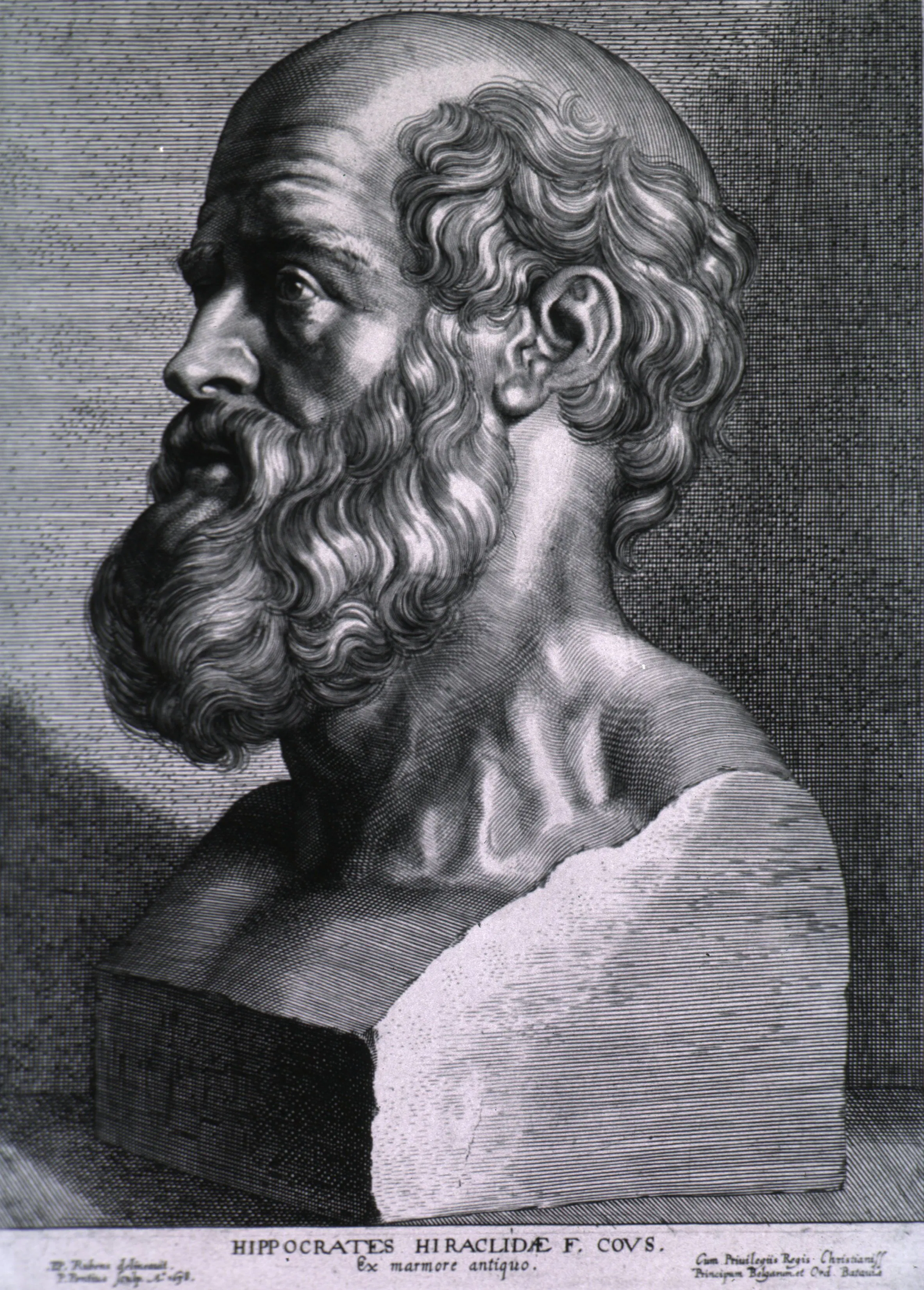
This engraved portrait of Hippocrates after Rubens presents the ancient physician as the kind of classical authority invoked when λοιμὸν, the Epidemics, and Celsus are enlisted to give a new medical distinction the force of precedent. Its early modern form is apt: Berger and Vater do not merely repeat antiquity, but translate venerable names and terms into a contemporary argumentative framework. Source ↗.

The most consequential move of the definitional phase is the severance of true plague from mass incidence, a claim registered earlier on the authority of Rudius, that epidemic diffusion is no part of the nature of true plague. The claim is more radical than it first appears. It detaches the identity of the disease from its visible scale, so that a single infected person in a city is sufficient to instantiate true plague. Epidemic diffusion, the very phenomenon that most readers would take as the defining mark of pestilence, is here demoted to an accident of circumstance rather than an essential property. This inversion is indispensable to the contagionist case, for it forecloses the counter-argument that plague's characteristic spread across whole regions bespeaks a shared atmospheric cause; if extent of spread is no part of the disease's nature, then the atmosphere loses its most plausible claim to authorship.
The abstract point is secured by a governing analogy drawn from natural philosophy. Just as fire by its nature indeed burns, yet does not lose the force of its nature if it does not burn when its material is withdrawn, Sicut enim ignis natura quidem sua urit, nec tamen naturæ suæ vim amittit, si non urat subtractam materiam. The figure does precise conceptual work. Fire remains fire whether or not fuel is present to sustain combustion; its essence is a fixed power, not the accident of its momentary reach. Transposed to plague, the simile answers the objection that a contained or quarantined outbreak, which fails to propagate, must be something other than true plague: containment removes the materia on which the disease acts but leaves its intrinsic nature untouched. The analogy thereby converts a potential embarrassment — the fact that plague sometimes stays confined to a single house — into positive evidence for the contagion thesis, since a specific agent starved of susceptible bodies behaves exactly as fire deprived of fuel.
From this etiological groundwork the sanitary program follows as a direct corollary. The historical origin of quarantine, as noted in the account of the work's practical portion, lies in the principle that no arrival from suspect or infected places be received. Quarantine is presented not as arbitrary civic custom but as the logical expression of the contagion thesis: if plague travels with infected persons and their goods, interdicting arrivals from suspect places is the rational measure, and the ancients' apparent want of such provision is noted as a lacuna in their practice rather than a defect in their understanding.
The Clinical Face of Plague
Before pressing the negative case against rival causes, the disputation registers the disease's formidable clinical variability with a striking figure, already met in the account of its clinical mutability: the recognition that plague shows the face of Proteus, scarcely afflicting any two of a great multitude of the infected in exactly the same way. The Protean image is a candid acknowledgment that the symptomatology resists the tidy uniformity a single-cause theory might seem to require. Yet the concession is carefully bounded: the variability lies in the disease's presentation, not in its origin, and the author immediately reasserts that a skilled observer can recognize the one disease beneath its many faces by the totality of signs and the swiftness of its course. Protean multiplicity of symptom is thus made compatible with singularity of cause, and the seeming contradiction between clinical diversity and etiological unity is resolved in favor of the latter.
The Case Against the Air and the Thesis of Contagion
The polemical center of the work is its rejection of the atmospheric etiology that dominated contemporary plague theory. The denial that the pestiferous virus is generated by the air, established earlier as the that grounds the whole inquiry, clears the field for the positive claim that the disputation has been building toward from its opening pages. That claim it now states in its own voice, having already been quoted in the strongest terms: after the matter is examined more carefully, all the blame for this evil is to be traced from nowhere else than contagion. The rhetorical framing — the appeal to free speech, the invocation of careful examination — casts the exclusivity of the thesis as a hard-won conclusion rather than a dogmatic premise, though the definitional groundwork laid earlier has in truth made any other conclusion unavailable. The air is not wholly banished from the account; it is permitted a secondary, disposing role in rendering bodies receptive to the plague seeds. But the crucial distinction between disposing condition and efficient cause is held firm, and the corollary that plague is not spontaneously generated locally but conserved and transported is stated in the same movement, the disease being preserved by tinder and carried from one region into another, sed a fomite conservari, atque ab una regione subinde in aliam deferri.
Having settled that contagion is the cause, the author must specify what contagion is. Here the disputation supplies the formal definition already set out in the philological framing, glossing the term as a morbid excretion or effluvium by which, as by ferment, graft, and seed-bed, the taint of one body is transferred into another of the same kind. The triad of metaphors — ferment, graft, seed-bed — is the inherited Fracastorian conceptual vocabulary, and its retention of the language of seminarium signals the descent of the account from the sixteenth-century contagionism that the disputation nowhere names. The emphasis on transfer into another body of the same kind (eiusdem speciei) is significant: it encodes the specificity of contagious disease, the principle that a given contagion reproduces itself as itself rather than degenerating into some generic corruption, and thereby distinguishes this mechanism sharply from the older notion of plague as a mere excess of universal putrefaction.
The Corpuscular Venom and the Refutation of Putrefaction
That older notion is dismantled by a pointed reductio grounded in the physiology of the circulation. The paradox observed earlier — that in plague the highest degree of putrefaction is present without a sign of putrefaction — leans on the doctrine of circulating blood: living blood in constant motion cannot simultaneously be at the extreme of putrefaction that the older theory demanded, since manifest putrefaction would arrest the vital circulation itself. The absence of putrefactive signs in a disease supposedly defined by maximal putrefaction becomes, in the author's hands, evidence that the true agent is something other than putrescence. That agent is then given the corpuscular-mechanical description already quoted in the account of the iatromechanical reframing: contagion partakes of a poison of very fine parts, sharp and septic. The venom is thus reconceived as minute, sharp, septic particulate matter acting mechanically upon the blood — the seed-bed of Fracastoro naturalized into the idiom of fine-particle natural philosophy, its agency located in the geometry and motion of minima rather than in any occult or vaporous quality.
The Sanitary and Therapeutic Program
The final movement translates this etiology into a program of action, its most emphatic warrants drawn from scripture and from a blunt medical maxim. Isolation is grounded in religious sanction, the sanction of Mosaic law that the infected be at once segregated from the healthy having been noted in the account of the work's practical portion, so that the sanitary discipline of segregation is presented as the convergence of experience, reasoned etiology, and divine command. The skepticism toward preventive pharmacy that runs through the closing sections finds its sharpest expression in Santorio's dictum — already cited in the account of the disputation's most emphatic practical counsel — that those who prescribe any remedy for avoiding plague other than flight are either ignorant men or would-be swindlers. Flight is the one preservative the contagion thesis can consistently endorse, since removal from the seed-bed is the only sure means of escaping a disease propagated by contact and effluvium; the vaunted antidotes are correspondingly demoted to the province of ignorance or fraud.
The disputation closes on a note of frank therapeutic humility that its confident etiology might not have led one to expect. Adopting Sydenham's admission, quoted earlier in the account of the work's therapeutic epistemology, the author grants that the specific cure — a peculiar remedy for plague — still lies hidden in the bosom of nature, however securely the cause has been identified. This candor is not resignation but a spur to timeliness, and the disputation ends on the Hippocratic warning that from every art procrastination is alien, but most of all from medicine, Ab omni arte aliena est procrastinatio, maxime vero a Medicina. The maxim seals the practical logic of the whole: if the specific antidote is still hidden and the venom acts by penetrating the blood in fine and septic particles, then whatever the physician can do must be done at once, before the seed-bed does its work — the urgency of intervention standing in for the specific that nature has not yet yielded.
Frequently Asked Questions
What is De pestilentia vera (On True Plague)?
De pestilentia vera, printed at Wittenberg in 1710, is a compact quarto medical disputation of forty-eight pages organized into twenty-four numbered theses and composed in Latin, with some Greek terms left standing. Its governing claim is uncompromising: that plague properly so called has one efficient cause only, contagion — a septic effluvium of fine particles carried body to body. Corrupted air, the stars, and dietary excess are demoted to at most disposing conditions. Produced as the Great Northern War plague pressed toward the Baltic, it lays out the contagionist case thesis by thesis.
Who were Abraham Vater and Johann Gottfried Berger?
Abraham Vater (1684–1751) was the respondent and author of record, then a Wittenberg licentiate of medicine who later became professor of anatomy and botany and lent his name to the ampulla and papilla of Vater and the corpuscles of Vater. Johann Gottfried Berger (1659–1736) was the presiding professor and a writer on physiology, who framed the theses in substance while Vater discharged them in public examination. Under the conventions of academic disputation, the praeses authored the matter and the respondens defended it, both names appearing on the imprint.
Why does the work coin the category "true plague"?
The qualifier vera, "true," is a deliberate technical instrument, introduced to remove all ambiguity of terms and to separate contagious plague from any epidemic constitution arising from air, stars, or diet. By reserving pestilentia in the strict sense for the disease propagated by contagium, the authors fix its cause in advance. Notably, true plague is defined by mode of causation, not scale of spread: epidemic diffusion is held to be no part of its nature, so a single infected person suffices to instantiate it — a move that forecloses the atmospheric counter-argument.
What does the disputation say about the arrival of syphilis in Europe?
The work opens not with plague but with the venereal disease, the lues venerea, whose entry into Europe it fixes historically. Unknown to antiquity, it is traced to the return of Columbus's infected soldiery from the West Indies, reaching Barcelona first in Spain and thence Naples and the rest of the peninsula — so, in the author's phrase, deservedly named venereal. This is a strategic prologue: an unarguably imported, person-to-person disease supplies the pattern of reasoning later transferred to plague, establishing that new diseases enter fixed populations from without, by contact.
Is there an English translation of De pestilentia vera?
No modern English or other-language translation of the disputation has been identified in current bibliographic registries; the work has been consulted in the original Latin by scholars of contagion theory and early modern academic medicine. Separately, the Leo edition presents the full transcription together with a complete English translation, generated by artificial intelligence and here offered for the first time. Leo is an effort to make freely available online, at no cost, English translations of every text printed in Latin in early modern Europe between 1450 and 1750.
This report was generated by an advanced AI assistant that conducted deep research alongside an extensive interpretation of the transcribed original text. Every effort has been made to preserve fidelity to the source and to guard against inaccuracy, but corruption in the text recognition process and model hallucination may nonetheless have entered the text. Treat every claim, quotation, translation, and citation as provisional, and verify each against the original source before relying on or citing it.
Bibliography
- Armelagos, George J., "The Science behind Pre-Columbian Evidence of Syphilis in Europe: Research by Documentary," Evolutionary Anthropology: Lays out the modified Columbian hypothesis and the competing paleoepidemiological models for syphilis's arrival in the Old World, which is precisely the terrain the disputation crosses when it routes the lues venerea from the West Indies through Barcelona to Naples. Read it to see how genomic and skeletal evidence has since complicated the tidy importation narrative the Wittenberg authors took as settled.
- Cipolla, Carlo M., Fighting the Plague in Seventeenth-Century Italy: Documents the lazarettos, cordons, and health-board bureaucracy that turned contagionist theory into civic machinery across early modern Italy. It supplies the operational counterpart to the disputation's paper program of segregation, quarantine, and flight, showing what such counsel actually cost a city to enforce.
- Fracastoro, Girolamo, Hieronymi Fracastorii: The Italian Scientist Who Described the "French Disease": A biographical and conceptual portrait of the man whose seminaria morbi underwrite the entire disputation while going pointedly unnamed within it. Consult it to measure how faithfully — and how silently — Berger and Vater inherited the sixteenth-century Italian framework they refracted through Sennert.
- Nutton, Vivian, "The Reception of Fracastoro's Theory of Contagion: The Seed That Fell Among Thorns?," Medical History: Tracks the uneven fortunes of Fracastoro's seminaria across two centuries of European medicine, explaining exactly why a 1710 Wittenberg author could deploy the graft-and-seed-bed vocabulary without crediting its origin. Indispensable for understanding the unacknowledged debt at the heart of this text.
- Nutton, Vivian, "The Seeds of Disease: An Explanation of Contagion and Infection from the Greeks to the Renaissance," Medical History: Reconstructs the long descent of contagion concepts from Hippocratic miasma through Galenic and Arabic medicine into the Renaissance. It clarifies how the disputation could recruit classical authorities like Hippocrates and Celsus for a thoroughly post-Fracastorian, corpuscular argument.
- Stolberg, Michael, "Particles of the Soul: The Medical and Lutheran Context of Daniel Sennert's Atomism," Science in Context: Explains how Sennert reconciled corpuscular atomism with Lutheran natural philosophy at the very faculty that later produced this disputation. It is the missing link that turns Fracastoro's quasi-animate seeds into the fine, sharp, septic minima Berger and Vater invoke.