Nightingales at Regensburg, 1546: Otto Melander's Jests and Serious Matters
Otto Melander's Joco-Seria, a Neo-Latin anthology of several hundred jests, sayings, and remembered episodes printed in the opening decades of the seventeenth century, sets out to teach readers how to tell warranted authority from counterfeit — largely by laughing at the counterfeit. Every numbered item arrives under a De … heading and closes with a named source, so that a joke parsing Papa as a participle, a nativity Melanchthon cast and half-missed, or a baker hanged on a confession wrung out by torture delivers a verdict and its warrant together. Melander, a Hessian jurist who taught law and philosophy at Herborn and died at Prague in 1640, was assembling a portable, indexed training manual in discernment for lay readers who would never sit through a formal disputation.
ExLatinis
August 8, 2026

Contents
Otto Melander's Joco-Seria, a Neo-Latin anthology of several hundred jests, sayings, and remembered episodes printed in the opening decades of the seventeenth century, sets out to teach readers how to tell warranted authority from counterfeit — largely by laughing at the counterfeit. Every numbered item arrives under a De … heading and closes with a named source, so that a joke parsing Papa as a participle, a nativity Melanchthon cast and half-missed, or a baker hanged on a confession wrung out by torture delivers a verdict and its warrant together. Melander, a Hessian jurist who taught law and philosophy at Herborn and died at Prague in 1640, was assembling a portable, indexed training manual in discernment for lay readers who would never sit through a formal disputation.
Otto Melander — Otho Melandrus in his Latin dress — was born at Eschwege in 1571 and died at Prague in 1640; the authority records describe him variously as poet, professor of law and philosophy at Herborn, jurist, diplomat and councillor, and writer of jest narratives. The work for which he is remembered is a large Neo-Latin anthology of short tales, sayings, and anecdotes, transmitted under the paired title Joco-Seria and Jocorum atque seriorum, and in German as Schimpff und Ernst. Its documented German witnesses begin with a two-volume Lich edition of 1605 printed by Ketzel, followed by a Darmstadt edition of 1617 from Berner whose catalogue record states that the work had first appeared in Latin under D. Otho Melander and was afterwards translated into German at the request of readers; the Latin transmission surfaces in a complicated Schmalkalden record of 1611, in three Latin volumes from Palthenius at Frankfurt in 1626, and in three more from Endter at Nürnberg in 1643. No authoritative first Latin imprint, place of composition, or date of composition has been established, and a commercial claim of an original edition in 1603 under Dionysius Melander remains unconfirmed by any authoritative catalogue.
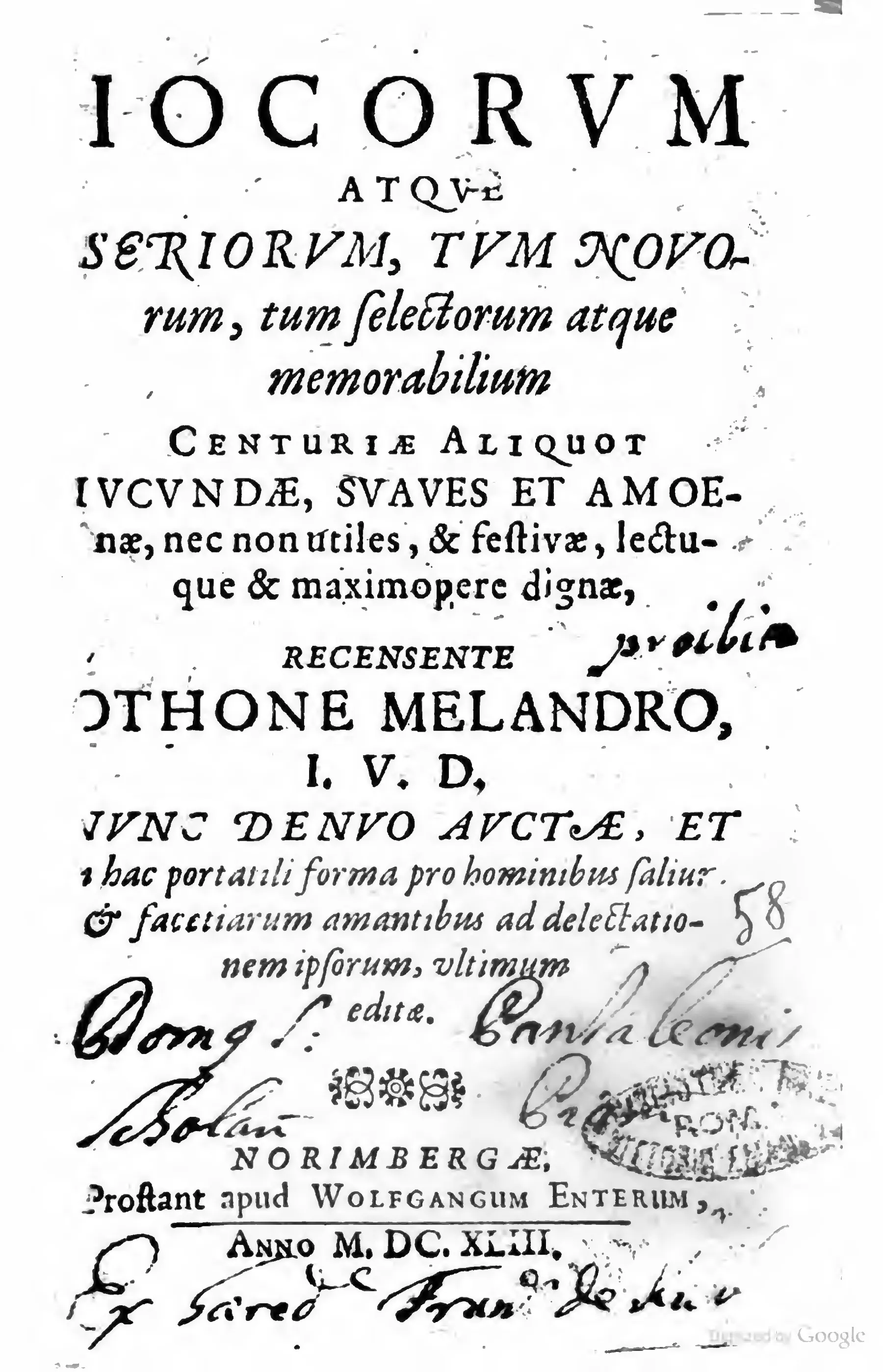
Endter's 1643 Nürnberg title page anchors one of the firmer Latin witnesses in Melander's tangled transmission, naming Otto Melander in print and advertising the book's portatili forma for readers who delight in wit and facetiae. Later marginal handwriting and an institutional stamp record the copy's afterlife. Source ↗.
What holds the hundreds of small items together is not a plot or a doctrinal sequence but a problem: after the confessional settlement of the Empire had broken apart the older channels of religious and intellectual authority, where does trustworthy authority now reside, and how can the capacity to tell the trustworthy from the fraudulent be taught to lay readers who will never sit through a formal disputation? Melander's answer is formal as much as doctrinal. He builds a numbered series of brief exempla, each headed De … and each closed by a printed attribution to the authority from whom it comes, in which a jest, a witticism, or a small remembered episode delivers a verdict — doctrinal, juridical, or moral. The recurring move is to set some claimant to authority against the standard of God's word and providence, and then let the anecdote deflate it: the papal catalogue of heretics and the traffic in relics measured against the constancy of the condemned; judicial astrology measured against the doctrine that afflictions come from God and not from the stars; torture on urgent indications measured against a magistracy that judges by equity and the good; fine clothing, wine, and pulpit eloquence measured against the plain evidence of what a man actually is. Laughter, in this arrangement, is the instrument of judgement; the named source attached to each item is the instrument of credit.
Learning enjoys no exemption from the procedure, and this is part of what makes the collection memorable. Rudolf Gwalther is quoted calling Heinrich Loriti of Glarus the most learned of all fools he had ever laid eyes on; Melanchthon, styled the coryphaeus and prince of theologians, is rebuked for turning from prayer to nativities and depending upon the stars as upon a deity incapable of deceit; the word Papa is put through a mock grammatical parsing and declared a participle, because it takes part from the clergy and part from the secular estate; a Swiss mason, asked by his prince which religion he holds, cheerfully professes three at once. Alongside the polemic runs a broad appetite for the marvellous and the observed: the Speyer spectre, the piper of Hameln, werewolves under the names Lycanthropi and Beerwolff, talking magpies and parrots, and the nightingales that imitated human speech at the Diet of Regensburg in 1546, admitted on the strength of the author's claim to have heard them with his own ears. The moral registers are just as broad, from two sustained excursus — one on clothing, tracing its origin to the Fall and its regulation to canon and civil law, one on drunkenness as a species of madness — to a pregnant martyr who distinguishes what she suffers as a woman from what she will suffer tomorrow as a Christian.
The stakes of this material are both historical and methodological. As evidence, the collection stands at the junction of Latin learned anecdote and German vernacular jest-book, in the tradition of Johannes Pauli's Schimpf und Ernst, and it shows how confessional argument, criminal procedure, comparative constitutional description of the Swiss cantons, ornithology, and demonology could be carried to a lay readership inside a form built for amusement. As a bibliographical object it is instructive precisely because its records disagree: title language, place, printer, volume count, and even the author's forename shift from witness to witness, and the 1611 Schmalkalden record, which assigns the heading to Dionysius Holzapfel, dit Melander, cautions against collapsing Otto Melander into other bearers of the name. Direct scholarship on the collection remains thin — no critical edition, no monograph, no identifiable peer-reviewed controversy over its authorship has been located — so that much of what can be said about its confessional temper, its sources, and the distribution of its exempla awaits fuller verification against the surviving text.
The throughline that makes the work legible is the same in its vocabulary, in its history of production, and in its internal arrangement. Its title is not a promise of frivolity but a program: jest set beside seriousness, and, in the German subtitle, useful and memorable histories set beside amusing and pleasant ones. Its keywords — ioco-seria itself, astrologia iudiciaria, indicia vrgentia, ebrietas species furoris — each name a place where a pleasing surface conceals a judgement to be made. Its passage from Latin into German at the readers' own request, and its repeated reissue in three-volume Latin sets across four decades, belong to the same impulse that governs its form: a discernment-training anthology, portable, indexed, and attributable item by item, addressed to readers who needed to weigh authority for themselves.
Read the full text and English translation on Leo
This text was transcribed and translated as part of the ExLatinis project, an effort by Leo to make free English translations of every text published in Latin in early modern Europe (1450–1750) available online. The complete transcription and English translation of this work can be read free of charge:
→ Read the original Latin text and full English translation on Leo
You can save a copy of this document into your Leo account to run deep text searches, conduct further analysis, or cross-reference it with your own research.
Assigning an English Title to Melander's Joco-Seria
Editorial title supplied for convenience, not an established English title: Jests and Serious Matters: Otto Melander's Joco-Seria and the Neo-Latin Book of Anecdote. The title forms securely attested in the catalogue tradition are Joco-Seria and Jocorum atque seriorum; the German 1605 and 1617 manifestations give the vernacular equivalent Schimpff und Ernst. Ioco-seria is not merely a promise of frivolity. Its paired nouns place jest beside seriousness and, in the German subtitle, useful and memorable histories beside amusing and pleasant ones. The most defensible interpretation is a title-level program of mixed delectation and instruction, not a claim that every tale is simultaneously comic and doctrinal. That the compound was treated as the work's own standing self-designation rather than as a bookseller's flourish is visible in the Latin text, where the phrase recurs as a running designation across its pages, serio-comic matters, IOCO_SERIA. 199.
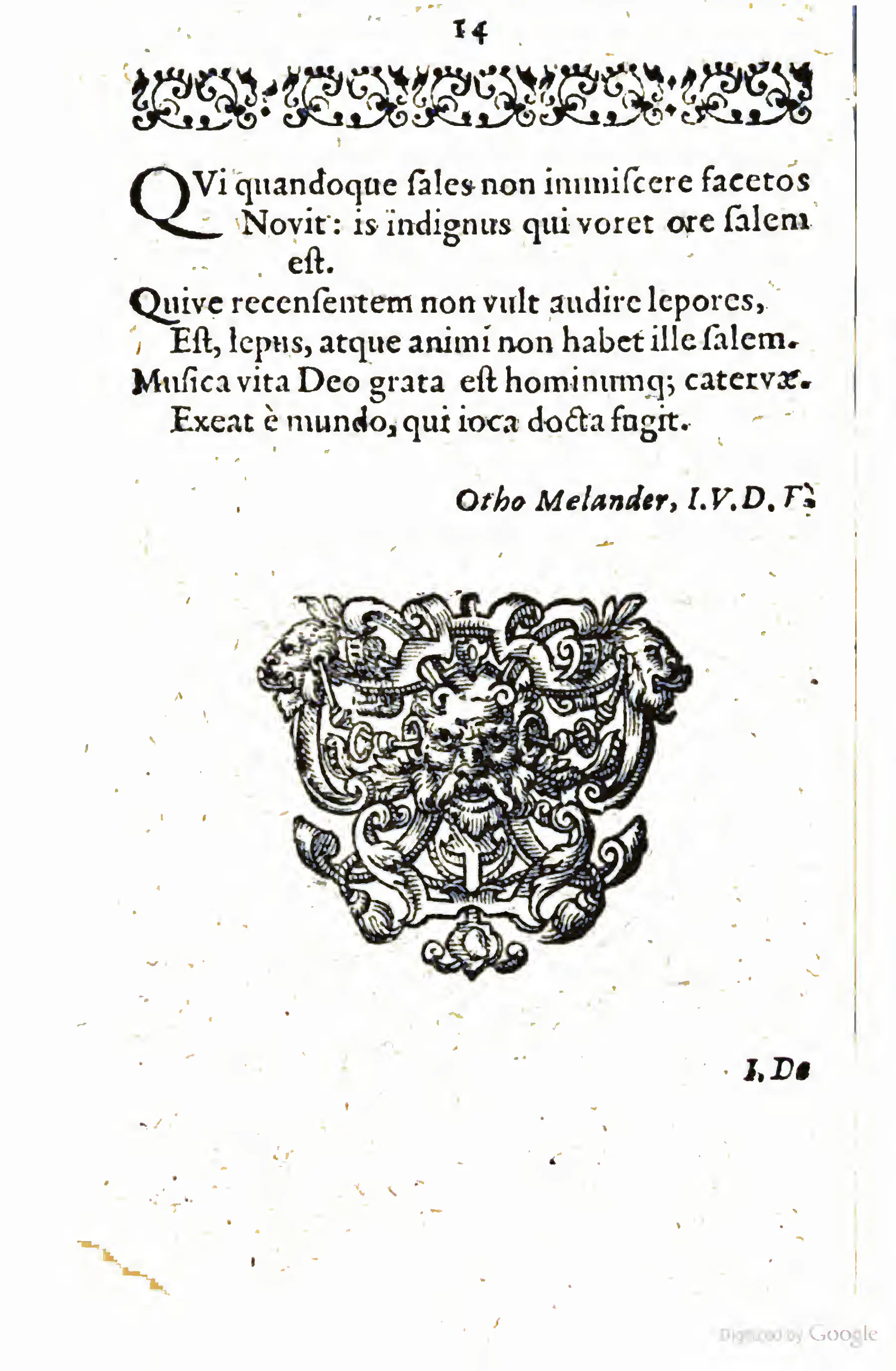
Melander's signed prefatory epigram states the title-level program outright, defending learned jest as fit for cultivated judgment rather than idle diversion. The grotesque mask ornament beneath his name, and the catchword leading into the first exemplum, make the leaf a threshold between paratext and the serio-comic series proper. Source ↗.
The related humanist expression serio ludere—to play seriously—has a documented Renaissance history in which learned play and moral or intellectual purpose coexist. Its relevance here is contextual rather than demonstrably intertextual: no accessible catalogue record proves that Melander directly borrowed the phrase from a particular classical or Erasmian passage. The mechanism by which the collection makes jest bear judgement is nevertheless exhibited plainly enough in the Latin. A condemned schoolmaster, flinching at a roasting spit on the eve of his execution, turns his own fright into a jest that certifies rather than undermines his constancy — behold, he said, I tremble now, when I merely touch a roast; what will tomorrow be, when I myself am roasted? Yet on the following day he died most steadfastly and courageously, Ecce, inquit, trepido nunc, cum tantum assaturam attingo, quid cras erit futurum, cum ipse assabor? Tamen postridie constantissime & animosissime mortuus est. The same technique is applied to the papacy through the schoolroom: the word Papa is put to the grammatical question and returned as a participle, on the ground that it takes part from the clergy and part from the secular estate, with the sorrow of the whole world, and stands without moods and tenses, Papa cuius partis orationis est? R[espondeo]. Participii partis: quia partem capit de clero, partem de seculari, cum totius orbis doloris significatione, sine modis & temporibus. In both cases the comic form is the vehicle of a verdict, which is what the title's paired nouns lead a reader to expect.
The title's Latin seriorum likewise means serious matters or earnest subjects in opposition to jocorum, while the German Schimpff und Ernst shows how the conceptual polarity was made legible to a German-reading audience. The exact senses of further expressions proposed for the collection, including astrologia iudiciaria, indicia urgentia, and ebrietas species furoris, cannot be securely assigned to Melander on catalogue evidence alone, and their fuller philological delimitation still depends on direct examination of the primary transcription; the Latin text does, however, carry each of them in a determinate sense. Drunkenness is defined outright as a species of madness — it is, the passage says, the frenzy of Dionysius, that is, of Bacchus, whence the Bacchanalia, for where drunkenness is, there lust and frenzy hold sway, EST ebrietas species furoris, est, inquam, furor Dionysii, id est, Bacchi, vnde Bacchanalia. Vbi enim ebrietas, ibi libido dominatur & furor,. Judicial astrology is attacked through a reported saying of Luther, that astrologers are a wretched and indeed deplorable race of men who dream that afflictions and hardships come not from God the maker and governor of the world but from the stars, and that this is precisely why they do not bear the cross patiently, Lutherus hanc in sententiam ipsi respondit: Næ miserum atque adeo deplorandum hominum genus sunt Astrologi, quippe qui somniant, afflictiones atque ærumnas non à Deo mundi effectore & gubernatore, sed ab astris proficisci. Atque hæc quidem caussa est, cur crucem patienter haud ferant. And the language of indicia appears in its technical procedural sense in the case of a man tortured on such indications more harshly than was fitting, who, unable to bear the pain, confessed a crime he had not committed and was punished capitally though innocent, ptime culter ille respondebat, hisce indiciis acrius, quam par erat, tortus, doloris impatiens, delictum, quod non patrarat, confessus innocens capite fuit punitus [reading uncertain]. Each of these keywords marks a point at which an apparently pleasing or authoritative surface — the cup, the horoscope, the confession extracted under duress — is subjected to a standard external to it, which is the conceptual movement the title itself advertises.
Summarizing the Joco-Seria: Form, Authorship, and Documented Editions
The work is a multilingual collection of short jests, serious matters, and entertaining or useful histories—best classified as a prose jest or Schwankbuch collection rather than as a single doctrinal treatise. Internally it takes the form of a numbered series of brief exempla, each introduced by a De … heading and closed by an attribution to the source from which the item derives, so that the collection reads as an accumulation of individually warranted anecdotes rather than as continuous exposition. The German editions identify the author as Otto Melander, also styled Otho Melander in Latin. Deutsche Biographie records his life as 1571–1640, birth at Eschwege and death at Prague, and describes him as a poet, professor of law and philosophy at Herborn, and writer of jest narratives; other authority records identify him as a jurist, diplomat, and councillor.
The material collected ranges very widely — confessional polemic, martyrology, Reformation memory, criminal procedure and the critique of litigation, princely and courtly exempla, clerical satire, moral excursus on dress and drink, marvels and demonology, and natural history — but the items are consistently turned toward the discernment of authority. A Swiss mason, questioned by his prince, replies that he is not imbued with or content with any single religion but follows three equally, the papistical, the Lutheran, and likewise the Zwinglian, Ego vero, clementissime Princeps, inquit, non vna aliqua religione imbutus contentusve sum, sed tres ex æquo sector, vt pote Papisticam, Lutheranam, & itemque Zuinglianam, a jest that converts confessional pluralism into a joke about the credulity of the unformed conscience. Elsewhere a drunk, told by his interlocutor that he is a Lutheran, draws his sword in anger that the man had not said Martinist instead, and the item closes with the moral that contests often arise between men over things they themselves do not understand, respondit, se esse Lutheranum. Tum eb stringit gladium, ægre terens, quod non sit M tinista. Sæpe hoc accidit, vt certamina sint inter quos, quæ ipsi non intelligunt, qui inter se di diantur [reading uncertain] — the collection's characteristic reduction of factional labelling to ignorance armed.

Lucas Cranach the Elder's 1528 portrait of Martin Luther, an image of the kind that helped fix the reformer as a recognizable confessional authority. In Melander's exempla that authority is refracted through jokes about labels — Lutheran, Martinist, papistical, Zwinglian — where confessional identity becomes a test of discernment and misrecognition. Source ↗.
The securely documented German production witnesses are the two-volume Lich edition of 1605, printed by Ketzel and labelled a first edition by the Deutsches Textarchiv, and the Darmstadt edition of 1617 from Berner. The latter catalogue record states that the work had first appeared in Latin under D. Otho Melander and was then translated into German at the request of readers. Latin catalogue witnesses include a complex Schmalkalden record of 1611, a three-volume Frankfurt edition from Palthenius in 1626, and a three-volume Nürnberg edition from Endter in 1643. No authoritative first Latin imprint, place of composition, or composition date has been established. No translation other than the German versions was located in the records examined.
Reading Jest Narrative as Historical Evidence: Melander, Pauli, and the State of Scholarship
Melander's collection matters as evidence for the movement of learned anecdote between Latin and German print, and for the persistence of the Schimpf und Ernst format beyond its sixteenth-century origins. Its significance is bibliographical as much as interpretive: the surviving catalogue tradition presents different title languages, places, printers, volume counts, and author formulations, making the work a useful case for studying how early modern jest collections were repeatedly re-described and reissued.
The strongest contextual scholarship located is Albrecht Classen's work on Johannes Pauli's Schimpf und Ernst. Classen argues that jest narratives can illuminate social, intellectual, religious, gender, economic, and political conditions, while insisting that literary fiction and later editorial alteration require methodological caution. In a later article on the early modern book market, Classen explicitly places Otto Melander's Joco-Seria of 1605 and 1617 among works that drew on Pauli's model. The relevant historiographical tension is therefore methodological rather than a settled dispute about Melander: jest literature can be historically revealing, but it cannot be read as transparent reportage.
Direct Melander scholarship remains thin. No critical edition, monograph devoted to the collection, or clearly identifiable peer-reviewed controversy over its authorship was located. Lutheran, Catholic, legal, astrological, martyrological, and natural-historical exempla require verification against the primary text before any claim about their distribution, sources, or confessional force can be sustained; catalogue evidence alone cannot establish those things, and the observations that follow accordingly indicate the registers in which the Latin text works rather than the proportions in which it works them. The 1611 catalogue's Dionysius/Holzapfel attribution further counsels against collapsing Otto Melander with other Melander or Holzapfel figures.
The martyrological register is present in a form that bears directly on Classen's point about jest narrative as social and religious evidence, since the constancy of the condemned is repeatedly demonstrated through a saying rather than described. One sufferer declares that after God he valued no one's authority more than the King's, but that he could not do God dishonour, and, embracing the faggot that was the sign of death, called it the sweetest of rods to him, saying that he would rather die than act against God, quam Regis: sed se non posse DEVM contumelia afficere, & amplexus fasciculum, qui erat signum mortis, dixit, O mihi dulcissimas virgas Mori ego potius malo, quam contra Deum facere. The gendered dimension Classen identifies as historically legible in jest collections appears in the pregnant martyr's distinction between two orders of suffering — I suffer as a wretched woman, in the pain belonging to my sex because of sin; tomorrow I shall suffer as a Christian woman, for faith in Christ, patior tanquam misera malier, in dolore pertinent sexum meum propter peccatum, cras patiar ut Christ na, propter fidem in Christum [reading uncertain] — a formulation that grounds a doctrinal claim about the theology of the cross in the language of ordinary bodily experience. Confessional violence is likewise read as providentially adjudicated: within living memory, the account runs, Alfonso Díaz the Spaniard, who at Neuburg in the Palatinate wickedly killed his brother Johann Díaz, a most learned theologian, for the cause that he had embraced the Gospel, hanged himself at Rome in his own stable by the just judgement of God, NOstra memoria Alfonsus Diazius Hispanus, qui Neoburgi in palatinatu fratrem Iohannem Diazium doctissimum Theologum ob eam caussam, quod hic Euangelium esset amplexus, nefarie occidit, Romæ in equili suo tibi ipsi iusto DEI iudicio laqueum mandauit. The pattern is the one that unifies the work: an authority that claims the right to condemn is tested against providence and found wanting.
Learning and the institutions of learning are subjected to the same test, which is one reason the collection is of interest for intellectual history and not only for the history of popular narrative. The Roman censorship is registered with wry incomprehension — the writer does not know by what adverse and perverse fate of Glareanus it came about that, when the Supreme Pontiff was compiling a catalogue of heretics in the year 1559, he too was entered in it, Nescio, quo aduerso Glareani præposteroque fa to acciderit, quod Pont. Max. Anno 1559. Ca talogum hæreticorum contextente ipse quoque i hunc relatus sit [reading uncertain] — but the same Heinrich Loriti of Glarus is then measured by a Reformed scholar's judgement, since Rudolf Gwalther, a man of outstanding learning, did not hesitate to affirm that Glareanus was the most learned of all fools he had ever set eyes on in his whole life, Ac Rodolphus Gualterus quidem vir apprimè doctus affirmare non dubitabat, esse Glareanum doctissimum omnium stultorum, quos ipse quidem in omni sua vita esset conspicatus. Erudition confers no immunity, and the point is pressed to the centre of the Wittenberg tradition itself, where Melanchthon is reproached in the second person: whereas it was fitting that he, as coryphaeus and prince of theologians, should devote himself wholly to prayer, he is found turned to the stars and depending on them as on some deity that cannot deceive, Etenim cum te quidem Philippe Melanchthon, vtpote Theologorum coryphæum ac principem, precibus vacare nunc totum conueniebat, ecce ad astra conuersus ab iis perinde pendes, atque à numine quodam fallere nescio.
The anti-astrological material is the clearest instance of a sustained argumentative method inside the anecdotal form, and it exhibits both a positive doctrine and a technique for disposing of counter-evidence. The positive doctrine is one of created purpose: the stars were not made for the use of learning from them what will happen at each particular time, but to furnish light to the earth and to serve the distinction of the seasons, Nec enim astra in eum vsum condita sunt, vt ex illis, quid vnoquoque tempore euenturum sit, discamus, sed vt lucem terris ministrent, & temporum distinctioni inseruiant. The technique concedes the awkward fact and neutralizes it theologically: it is not denied that astrologers often predict truly, but it does not follow that credence is to be given to the art, since it happens by God's just judgement that impostors sometimes speak the truth, Nec tamen negauerim, sæpius ab Astrologis vera prædici, at ideo arti huic credendum esse non sequitur. Iusto enim Dei iudicio sit, vt impoltores interdum vera dicant. Read against Classen's methodological warning, this is a valuable reminder that the collection is not a neutral archive of sayings: successful prediction is admitted as datum and then reassigned to providence, so that the outcome of the argument is secured in advance by the same standard — God's word and governance — against which every other claimant to authority in the work is measured.
For legal and constitutional history the collection is of interest chiefly as a jurist's critique of practice mounted from within, and here the epistemic posture of the text is notably careful. Roman law is not repudiated: the writer esteems the Roman laws, drawn up by the most prudent of men, most highly, and would not have their authority weakened by so much as a syllable, Ego vero Romanas leges à prudentissimis viris conscriptas maximi facio, neque earum auctoritatem, vel verbulo labefactatam velim, which frames the ensuing preference for a procedure judging by equity and the good as a reform of application rather than a rejection of the ius commune. The grievances are those of ordinary litigants: all complain, the text reports, that the duration of suits is excessive and the obtaining of justice too costly, so that it is sometimes better to have bought the thing than to have won it in court, quod nu mia sit litium diuturnitas, & sumtuosa nimis iur impetratio, vt interdum præstet rem emisse, qu in iudicio obtinuisse [reading uncertain]. Alongside the wrongly executed man convicted on urgent indications, the work also anatomizes the passions that corrupt judgement, observing of an angry accuser that he contrived how to make three crimes when he had found none, and adding that anger has this evil in it, that it will not be governed and grows angry at truth itself if truth appears against its will, Ex cogitauit, quemadmodum tria Crimina faceret, quin nullum inuenerat. Habet, inquam, iracundia hoc mali, non vult regi; irascitur veritati ipsi, si contra voluntatem suam apparuerit.
The princely and magisterial exempla extend the same enquiry into the limits of legitimate command, and they are the point at which the work's political material converges with its theology. A Christian ruler is distinguished from the classical conqueror by the number of his ends: Alexander and Julius had one end in waging wars, honour and glory, whereas Christian kings have two set before them, honour and the salvation of the soul, respondit, Alexandro & Iulio in ellis gerendis vnum fuisse finem: Honorem & loriam. Christianis autem Regibus duos esse propositos. Honorem & animæ salutem [reading uncertain]. Where the ruler's competence ends is stated with equal firmness in a refusal on the Lord's Day, which God the Best and Greatest has consecrated, vowed and betrothed to himself alone and wills to be sacred to himself alone, so that the speaker has no right over it and cannot detract even the least from its sanctity for a petitioner's sake, Diem vero dominicam Deus Optimus Maximus sibi vni consecrauit, deuouit, atque despondit, ac vult sibi hanc soli sacram esse. Itaque nihil mihi in eam iuris est, neque vero vel tantillum de eius religione vestram in gratiam detrahere possum,. Doctrine proper is embedded by the same anecdotal means. Luther's early terror is reported as an episode of reading: when he was still a monk and came upon Psalm 31, "In thee, O Lord, have I hoped: in thy justice deliver me," and took the Psalm to speak of active justice, he affirms that he was thunderstruck by the saying, QVum Dominus Lutherus adhuc esset Monachus, & incideret in lectionem Psalm. 31. In te Domine speraui: in iustitia tua libera me: ac cogi taret, Psalmu[m] loqui de iustitia actiua, ita lectione huius dicti affirmat se consternatum fuisse; and a dying man defeats his accuser by dictating scripture against himself, instructing that the writing begin here: we are as an unclean thing, and all our righteousnesses as a filthy garment, Isaiah 64, Fac igitur hinc scribendi initium facias: Sumus vt immundus nos, et tanquam vestimétum inquinatum omnes iustitiæ nostræ, Ies. 64. Justification is thus taught not by loci but by narrative crisis, which is precisely the pedagogical economy the ioco-seria form makes possible.
Finally, the collection's marvels and natural-historical curiosities are governed by the same regime of credit that governs its polemic, namely named witnesses and, where available, autopsy. The Regensburg nightingales are introduced with an explicit warrant of first-hand hearing: the writer will tell of nightingales imitating human speech something wonderful and almost incredible, which is also perfectly true, and which he himself heard with these ears and experienced at the recent Diet of Regensburg in the year 1546, dicam tibi de Lusciniis sermones hominum imitantibus admirabile quiddam, ac propemodum incredibile, quod & verissimum est, & ipse his meis auribus audiui, atque expertus sum proximis Comitiis Ratisbonensibus anni 1546. Spectres, werewolves, and speaking birds are therefore not concessions to credulity within an otherwise critical book but items admitted on the same evidentiary terms as the Díaz murder or Melanchthon's failed nativity — a consistency that bears directly on Classen's insistence that such collections be read as shaped testimony rather than as reportage, and that makes the still-unverified questions of source, selection, and editorial alteration the decisive ones for future work.
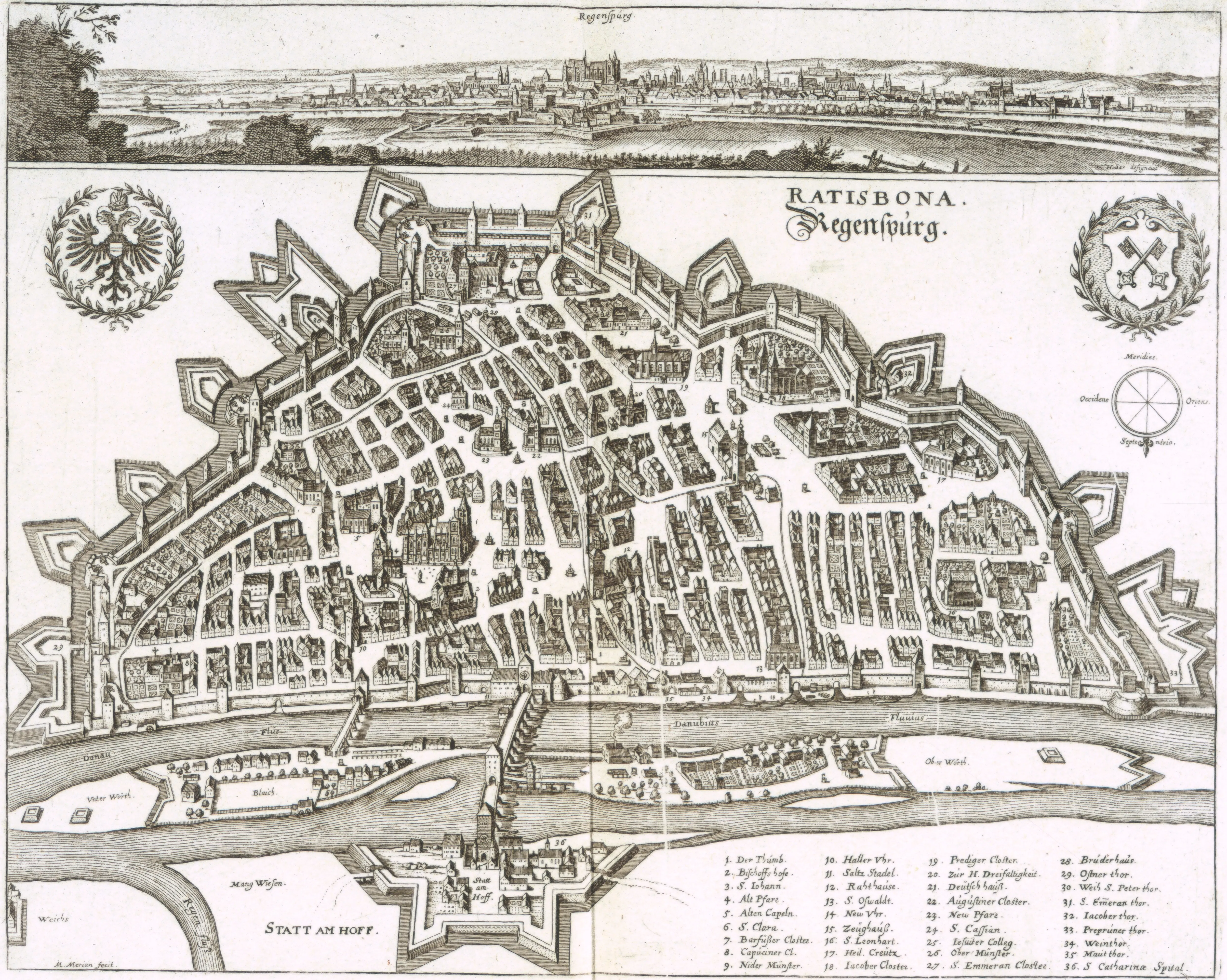
A plan of Regensburg, or Ratisbona, dated c. 1644 in the Merian and Hollar tradition of urban views. It maps the imperial city Melander names as the setting of his first-hand hearing of the speaking nightingales at the Diet of 1546, anchoring a marvel in the same geography of named places and witnessed events that underwrites the collection's claims to credit. Source ↗.
Tracing the Printing History from Lich 1605 to Nürnberg 1643
The clearest textual object is the German two-volume Joco-seria Das ist Schimpff vnd Ernst. The Deutsches Textarchiv records volume 1 and volume 2 at Lich in 1605, with Ketzel as printer; volume 1 is marked first edition, and volume 2 is represented by 475 digital scans. The catalogue language describes the contents as useful and memorable as well as pleasant and amusing histories. A later BSB record identifies the German title as Ioco-Seria: Das ist Schimpff und Ernst, published at Darmbstatt by Berner in 1617. The record gives 353 pages and four preliminary leaves for the described volume, and identifies the bound BSB exemplar as Munich, Bayerische Staatsbibliothek, P.o.germ. 923 m-1/2. Its linked MDZ reproduction is recorded under URN urn:nbn:de:bvb:12-bsb10114677-4.
The Latin transmission is more complicated. WorldCat records a 1611 Schmalkalden imprint, Jocorum atque seriorum, from the Kezelian press, but assigns the author heading to Dionysius Holzapfel, dit Melander. That record should be treated as an ambiguous or joint Melander witness, not as a secure first edition by Otto alone. A 1626 Frankfurt record gives three Latin volumes from Palthenius under the formulation Recensente Othone Melandro, J.U.D.; a 1643 Nürnberg record gives three Latin volumes from Endter under Auctore Othone Melandro, J.U.D., with Joco-Seria and Novorum as parallel title forms. A commercial claim that an original edition appeared in 1603 under Dionysius Melander was not confirmed by an authoritative catalogue and is excluded from the established chronology.
The internal articulation of the Latin text is more legible than its printing history. The numbered exempla, each with its De … heading and closing attribution, are not distributed evenly across a single flat sequence: at intervals the series gathers into thematic collectanea that function as sustained moral excursus. The excursus on clothing opens with an aetiology rather than a precept, deriving dress from the Fall — as regards clothing, its origin was the lapse of our first parents, for as soon as they sinned the eyes of both were opened, and when they knew they were naked they sewed fig leaves together and made themselves aprons, Qvod ad vestes attinet, earum origo fuit polapsum primorum parentum: vt primum nim peccarunt, aperti sunt oculi amborum, cum que cognouissent se esse nudos, consueruunt ficus, & fecerunt sibi perizomata [reading uncertain] — before proceeding through Ciceronian mediocritas to the canon and civil lawyers. Such units, together with the alphabetical index of memorable things and words that closes the Latin series, indicate a work designed for consultation as well as continuous reading, which is consistent with the catalogue language describing the contents as at once useful, memorable, pleasant, and amusing.
That double address also bears on the transmission from Latin into German recorded by the 1617 catalogue entry, which reports translation at the request of readers. The collection's own idiom is frequently proverbial and vernacular in temper even in its Latin dress, as in the rhymed tag on clothing as social credit: a well-dressed man is believed by a thousand to be skilled on account of his clothes, however much of an ignoramus he may be, Vir bene vestitus, pro vestibus esse peritus Creditur à mille, quamuis idiota sit ille. A sententia of that construction travels easily between languages, and its argument — that appearances win a credit the person does not merit — is the same critique of counterfeit authority that organizes the confessional and juridical items, here applied to the most ordinary of surfaces.
The accessible records do not establish format, collation, signatures, dedication, patronage, privilege, censorial approval, or a suppression history for the Melander editions. The 475 figure is a scan count, not a bibliographical collation. The BSB record confirms a physical copy and a digital reproduction, but the searches did not expose a complete list of additional holdings with shelfmarks. No contemporary reply, refutation, proceeding, or documented reception network was located.
Franciscus Modius's Franc. Modi Brug. Novantiquae Lectiones, tributae in Epistolas centum et quod excurrit, printed at Frankfurt by Wechel in 1584, is a distinct Latin philological book concerning Silius Italicus. Its author, title, date, place, and printer are independently recorded; it is not the German Joco-Seria, whose documented witnesses begin with the Lich 1605 edition. A derivative metadata association between the two titles has no authority over authorship or dating. The accessible catalogue evidence does not reveal the actual operation that produced such an association, so the mechanism must be reported as undetermined rather than attributed to a particular library, digitization workflow, or printer. Variant names such as Otho, Schwarzenthal, Schwarzmann, and Holzapfel occur in derivative biographical records, but the proposed etymology of Melander and the precise relationship among all bearers of those names remain unconfirmed here.
Following the Argument Through Melander's Exempla, from Kappel to the Alphabetical Index
Zurich memory and the martyr's jest
The numbered series opens on Zurich memory, and the first fully legible item shows at once how the compiler converts recent confessional history into moral demonstration. Ludwig Lavater, standard-bearer in the Italian campaign of 1521, had given a draught of wine to a thirsty Swiss soldier; eight years later, in the rout at Kappel, that same peasant, mindful and grateful for so great a benefit, with his hand stretched out in the very sight of the enemy and at great risk to his own life, dragged him out of that pit and so, as it were, from the very jaws of death, qui in Italia illum vini haustum acceperat, tanti beneficii memor atque gratus, ipsum porrecta manu, in ipso hostium conspectu, cum magno vitæ suæ discrimine ex fossa illa, ac proinde ex ipsius quasi mortis faucibus extraxerit. The Ciceronian cadence of ex ipsius quasi mortis faucibus dignifies a Swiss military catastrophe of 1531 with classicising diction, and the anecdote's logic is neither military nor doctrinal but providential: a small act of charity, unrecorded at the time, is repaid at the precise moment of extremity. The item is closed, as every item here is, by an attribution to a named printed authority — in this instance Johann Wilhelm Stucki's preface to Lavater on Nehemiah — so that the reader is offered not merely an edifying story but a warrant he could in principle pursue.
The martyrological items that follow make the collection's title program explicit by fusing jest and constancy in a single utterance. The condemned London schoolmaster who, having scorched his finger on hot roast meat the evening before his execution, asks what tomorrow will bring when he himself is roasted — the jest already discussed above — turns on an adversative tamen that carries the whole argumentative weight: the flinch and the joke are admitted as evidence of natural frailty precisely so that the following day's steadiness can be attributed to something other than temperament. Wit here does not deflate the martyr but authenticates him, and the placement of the item is pointed, since it is followed almost immediately by the drunkard who draws his sword because his interlocutor called himself a Lutheran rather than a Martinist — witness and faction set side by side, with the second reduced to ignorance armed. The same cluster defends the moderate use of wine against ascetic rigorism by putting the argument into an exorcism: the hermit answers the demon's insinuation with a profession, I believe in the Lord Jesus Christ, Son of God, that before I have drunk this cup of wine you will be obliged to depart from the man, Credo in Dominum Tesum Christum, filium Dei, quod priusquam hunc calicem vini ebibero, tu necesse habeas ex homine migrare. Drawn from Brenz on Matthew, the formula makes creedal confession, not abstinence, the operative power, and turns the cup itself into the measure of the demon's defeat — an adiaphora thesis delivered as narrative rather than as a locus.
Glareanus, and the excursus on dress and drink
The extended dossier on Heinrich Loriti Glareanus is the most sustained satirical construction in this stretch of the series, and its interest lies in the ambiguity of its subject: a humanist of high learning whose confessional position satisfied neither obedience. The narrator affects bewilderment at the scholar's misfortune, professing not to know by what adverse and perverse fate it came about that Glareanus was entered in the Supreme Pontiff's catalogue of heretics in the year 1559 — the notice examined earlier in this report. The Pauline Index is registered here not as an abstraction but as an instrument with victims among the learned, and the humour depends on the reader's knowing that Glareanus had remained in the Roman obedience: censorship is shown misfiring upon its own. The narrator then presses the joke into eschatological register with a warning about deletion from the book of life, and the Zurich Antistes Rudolf Gwalther is brought in to complete the dossier by pronouncing Glareanus the most learned of all fools he had ever seen — erudition and judgement pulled apart, so that scholarly attainment confers no exemption from the discernment the collection is teaching.
The series is not uniformly atomistic; at intervals it consolidates into thematic units set off by display headings, of which the first is announced as collected matters on clothing, COLLECTANEA DE VESTITV.. What follows is a layered structure of authority characteristic of a jurist's compiling: a scriptural aetiology deriving clothing from the shame of the Fall, then Cicero and Plutarch on its purpose, then the glossators, Johannes Andreae, Ludovicus Romanus and Bartolus on sumptuary matter and the robes of advocates. The governing norm is the classical mean, that in dress moderation too be preserved, In vestitu ego mediocritas quoque retineatur, vt, which permits the excursus to condemn both extravagance and squalor without endorsing either monastic contempt of the body or courtly display. The polemical force of the section, however, lies in its epistemology rather than its ethics: garments are shown to purchase a credence the wearer has not earned, so that the critique of luxury becomes continuous with the critique of counterfeit authority that governs the confessional and juridical items.
The second excursus, opening from the definition of drunkenness as a species of madness and Bacchic frenzy, assembles canon law, Proverbs, Cicero and Horace into an argument that intoxication dissolves both chastity and secrecy. Its most revealing turn is the one where moral condemnation slides into political technique: there is no secret where drunkenness reigns, says Solomon, chapter 13, Nullum enim secretum est, vbi regnat ebrietas, inquit Salom, cap. 13, a maxim then applied not to the drinker's peril but to the prince's advantage, since rulers are said to probe the minds and inmost characters of their courtiers through wine, with Horace supplying the authority. The vice denounced as furor a few pages earlier is thereby recommended as an instrument of statecraft, and the compiler leaves the contradiction standing. It is a diagnostic of the collection's method: the exemplum is subordinated to the immediate lesson, and the accumulated lessons are not harmonised into a system.
Princes, procedure, and the traffic in relics
The block of princely exempla that follows works the same seam between counsel and warning. The Ciceronian set-piece of Damocles is given in full narrative form — amid this display he ordered a gleaming sword to be let down from the ceiling by a horsehair, so that it hung over that happy man's neck, In hoc medio apparatu fulgetem gladium è lacunari seta equina appensum dimitti iussit, vt impenderet illius beati ceruicibus — and is immediately extended by Lavater on Proverbs 23 and by the fable of the earthen pot and the bronze one. The lesson drawn is prudential rather than constitutional: the danger lies in intimacy with power, not in tyranny as an institution, and the reader is counselled to keep his distance rather than to resist. Where the collection does press a firm juridical claim about sacred things, it reaches for positive law: against a soldier who had his son baptised ten times over for the sake of the godparents' gifts, the compiler invokes the imperial constitution of Honorius and Theodosius under the rubric that holy baptism not be repeated, Ne sanctum baptisma iteretur, constituerunt, vt si. Roman law is thus enlisted to punish a fraud that is at once sacramental and pecuniary, exactly the conjunction the collection treats as the signature of imposture.
The juridical critique reaches its sharpest formulation in the sequence on anger and wrongful conviction, where Seneca's Piso furnishes the theory — anger invents crimes where it has found none, and rages at truth itself — and a baker's case furnishes the practice, that of the innocent man tortured on such indicia more harshly than was fitting, who, unable to bear the pain, confessed to a crime he had not committed and suffered capitally, the case already set out above. The objection is evidentiary and directed at the judge's imperita seueritas: indicia sufficient to justify the question are shown incapable of validating what the question extracts, and the ancient parallel of Palamedes is appended to universalise the point.
The clerical satires that close this stretch return to fraud in its most material form, the traffic in relics. A priest near Basel persuades the people that he has bought at the Council of Constance the relics of divers saints, which the common folk call Heiligthumb, and has brought them with him to that place, the Latin naming and the German gloss standing together, appellant, coemisse, atque adeo secum in; his prize exhibit is a phial of the wine Christ made at Cana, and his exposure comes not from a theologian but from an old woman's credulous talk, followed by inquisition, imprisonment, restitution of goods and expulsion. The concluding items — the friar who preaches nothing but the Lord's Prayer, and the pastor who tells his peasants they are unworthy to hear the bread of the word daily — end the body of the collection on ignorance in the pulpit rather than on martyrdom, and the FINIS is followed by an alphabetical index of memorable matters and words whose entries, from Adulterium and Choreæ through Ebrietas, Hæretici, Ira, Luxus vestium, Papa, Periurus and Reliquiæ to Vxor mala, register the compiler's own sense of what the volume is for: not continuous reading alone, but consultation under the heads where a reader might need a verdict ready to hand.
The excursus on love as a species of madness
Beyond that division the numbered series resumes, and it resumes in the middle of a sustained collectanea on love as a disease of the mind, whose method is visible before any of its content: a physician's case history is set down first, then capped with a printed attribution to Valleriola's observationes and to Schenck von Grafenberg, and only then are the poets and the jurists allowed to speak. The case itself is narrated in the first person, so that the cure arrives as testimony rather than as doctrine — summoned to treat him, the narrator says, I bring the man back from madness by no small labour and with many remedies prepared to that end, aided by the grace of God, and restore him to entire mind and health, ad curam accersitus, hominem magno sane labore, multisque in eam rem paratis auxiliis, ab insania, Dei gratia adiutus, reuoco, & integræ menti ac sanitati restituo.. Two things are being done at once. The medical observatio supplies the empirical warrant — six months of sleeplessness, grief, and an attempted suicide restrained by the patient's own household — while the qualifying phrase Dei gratia adiutus subordinates the physician's art to the same providential governance against which every other claimant to competence in the collection is measured. The healer is credited, but not as an autonomous cause.
From the case the compilation moves outward through registers rather than through argument. Seneca's Medea furnishes verses on anger as a blind fire that will not be reined in, Propertius supplies the tag that lovers live without sense, and Palingenius's Zodiacus vitae is quoted at length on Cupid's dominion over beasts, men, and divinities alike; the demonological reading list that follows — Wier's De praestigiis daemonum, Maiolus's Dies caniculares, Scribonius's Physiologia sagarum, Alexander ab Alexandro, Jacob Rueff on conception and generation — is set out in a tapering column of references. Between the poets and the demonologists stands the forensic core of the excursus, which is where a jurist's collection shows its hand: love, the text records, is likewise a species of madness, Et amorem esse furoris species. The formulation is the exact counterpart of the definition of drunkenness elsewhere in the work, and it carries the same consequence, since Giulio Claro, Tiraqueau, and Oldradus are cited for the doctrine that a homicide committed between rivals in the heat of love ought to be punished more leniently on the analogy of the insane, with Gail's Practicae observationes appended as a contrary authority to be compared. The reader is thus handed not a verdict but a controverted question with its apparatus, embedded inside what is nominally a book of amusements — an instance of the collection teaching discernment by exhibiting the materials of judgement rather than by pronouncing.
The excursus closes with a poetic sequence from Johannes Sturm's letters, printed in a wedge that narrows to a single word and then widens again, so that the shape on the page performs the constriction and release of the argument. Its diagnosis is proverbial — lovers are bleary-eyed and blind, they neither see nor wish to have seen, Amantes lippi & coeci sunt, Nec vident, nec vidisse volunt, — but the resolution converts the whole preceding medical, poetic, and juridical accumulation into a doctrine of rightly ordered love: let us love in such a way that we hate whatever we love, if we do not love what we ought to love, for thus all things are ours, if we have God and if God has us, Amemus sic, ut oderimus Quicquid amamus, si non Amamus, quod Amare Debemus, Nam sic omnia Nostra sunt, si Deum Habemus, & si nos Habet Deus.. The pivot is characteristic of the work's economy: the pathology of furor is not refuted by a better physiology but relocated under the standard of divine possession, and the paradox of a hatred that is the condition of true love supplies the epigrammatic sting that makes the doctrine memorable. That the tapering typography, the catchwords at the foot of each page, and the signature marks of gathering Z carry this material without any break in the numbered series is itself evidence that the compiler treated verse-shapes, case histories, and legal citations as interchangeable furniture of a single sequence.
The comedy at Nidda: laughter as tribunal
The numbered exemplum that follows shifts the object of scrutiny from the passions to the professions. Its heading, in the collection's invariable De … form, names Fredericus Illyricus, jurisconsult, and Johannes, his brother's son, and the offence charged is not merely gluttony but the concealment of kinship: the uncle never fed the boy at home and habitually packed him off from the table, lest he betray that relationship to the guests whom he was continually receiving with sumptuous banquets, ne conuiuis suis, quos opiparis subinde epulis excipiebat. The vice being anatomized is a counterfeit of standing — the same fault the collection tracks in fine clothing and pulpit eloquence — and the instrument of exposure is again a performance. Johannes, cast as the parasite Johannes de Amicis in a comedy produced at Nidda by the rector and poet laureate Johannes Pistorius, uses the parasite's licensed hunger to name his uncle from the stage. The device is exact: a role built to depict insatiable appetite, flattery, and the importunity of underhanded services is turned upon a man whose kitchen and larder are the real subject of the scene, so that the fictional mask and the historical person coincide, and the audience is invited to judge the coincidence.
What follows is the collection's clearest demonstration that laughter can render a verdict which office cannot resist. Fredericus, recognizable to many in the hall, answers not with wit but with abuse and with process — he called him a mushroom, a dolt, an ass a foot and a half long, a whore's son, and a bastard, Nam & fungum ille, & bardum, & sesquipedalem asinum, & prostibuli filium, & spurium — and then attempts to drag the young man from the stage and throw him into prison by the neck. The jurist reaches for coercion from the spectators' benches, and the reach fails; the tribunal that decides is the theatre. Hissed and clapped off by the audience, he departed, having lost his cause, the lesser man to Johannes, while Pistorius brought his comedy to a neat and festive conclusion, actumq; agens Iohanne se minorem esse discessit, Pistorius vero Comoediam suam concinne quidem & festiue absoluit. The forensic vocabulary — actum agens, the cause already lost — is deliberately borrowed from the uncle's own profession and used against him, and the description of his rage as a raving swollen with grief mixed with madness ties the exemplum back to the preceding excursus: furor is not merely the lover's affliction but the condition of any authority that cannot bear to be judged.
Melander then does something the numbered form does not require, appending the prologue, argument, and opening scene of the comedy itself so that the reader may weigh the play as well as the anecdote. The prologue's frame is confessional and its genealogy parodic: concord is instituted by Cyrus, the Lord and God of all good things, and against him stand the despisers, sprung as though from the womb of Antichrist and from the wine-bearing stock of Bacchus, and puffed up with the spirit of the evil demon, who labour not so much for concord as that there may be discord everywhere, Verum, ô Dii boni, quam hodie plerique Illius contemtores acerrimi Reperiuntur, qui, tanquam ex Antichristi Vteris, & Bacchi vinaria stirpe Prognati, ac Cacodæmonis inflati Spiritu, non tam pro concordia, quam pro Discordia vt sit vbique, laborant,. The Bacchic parentage is not ornament: it stitches the appended drama to the excursus on furor and to the gluttony of the framing anecdote, making intemperance and confessional discord branches of one stock, and the mock-reverend titles conferred on Father Palladius, whose father was Antichrist and whose mother is Superstition, extend the parody of ecclesiastical honorifics that the collection practises elsewhere. The Argumentum states the antithesis in its barest form — so that what Cyrus commands may be done, Father Palladius wishes for nothing but games and banquets, while the bride Concordia wishes for nothing but to cultivate piety and sacred letters, Vt vero fiat, quod Cyrus mandat, Pater Palladius nihil aliud quam ludos & conuiuia facere vult, Sponsa autem Concordia nihil aliud quam pietatem & sacras literas colere. — and in doing so reveals why the anecdote and the play were printed together: the gluttonous jurist who starves a nephew of both food and acknowledgement is the domestic instance of the allegorical figure who prefers feasting to letters.
The final gesture of the sequence is linguistic. The parasite's opening speech is given in German inside the Latin narrative and then reprinted in German again as the first scene, my cousin, after all, is Herr Fridericus Illyricus, whose kitchen and larder are always well stocked, Ist doch mein Vetter der Herr Fridericus Illyricus, dem eine gutte Rüchen und Speiszkammer immer wolgerüstet ist.. The Latin frame supplies the moral machinery, the citations, and the confessional allegory; the vernacular carries the blow that the audience actually heard, and the compiler declines to translate it away. Within a single item the collection thus operates in both languages at once, with the Latin doing the work of attribution and judgement and the German preserving the voice in which the judgement was first delivered from the stage.
Judicial astrology and the postliminy of banished gods
The closing third of the collection continues the procedure that governs it, and it begins by turning that procedure on the learned professions themselves. An anecdote about the archdeacon of Wittenberg and a doctor of laws who courts his daughter opens out into a digression on the animosity theologians bear the jurists, whom they detest, the compiler reports, for no other reason at all than that they are learned in the law, nulla alia, quidem de caussa, nisi quod Iure sint Consulti. The observation is doubly pointed, since the title-page formula of the Latin editions styles the compiler himself J.U.D.: a jurist records a jest against jurists, lets the theologians' contempt stand in its proverbial form, and thereby establishes at the outset of this stretch that professional standing supplies no defence against the anecdote's verdict. What follows applies that rule in turn to astrology, to advocacy, to the episcopate, to the superintendency, and finally to the sectaries.
The sustained polemic against judicial astrology is the longest continuous argument in this portion, and it is built out of three unlike materials fitted together: a reported saying, a homiletic extract, and a bibliographical referral. Its historical thesis is stated in a metaphor drawn from the law of persons: judicial astrology is being restored by many, an art which recalls by right of postliminy the gods of the nations once hissed off the stage, Instauratur à multis Astrologia iudiciaria, quæ olim explosos gentium deos postliminio reuocat. Postliminium is the Roman-law doctrine by which a captive returning across the frontier resumes his former status intact, and explosi belongs to the theatre; the compound image casts the astrologers' art not as a novelty to be refuted but as a repatriation of banished deities who reclaim their old rights unaltered. The charge is therefore juridical in form and idolatrous in content: what is at stake is not the accuracy of prognostication but the legal standing of a cult.
Precisely because the argument is not primarily about accuracy, the collection can afford to narrate a case in which the prognosticator himself made accuracy the test. Melanchthon, having cast a nativity for the infant of Dionysius Melander, hands it over with a wager attached — if I am now mistaken or deceive you, Dionysius, then this whole science of ours is empty and lying, Ea genesi Dionysio tradita inquit: Si nunc ego Dionysi erro aut fallo, vana est ac mendax omnis hæc scientia nostra. The narrative then withholds both vindication and refutation: the child proves to be a daughter rather than the predicted son, falls ill in the seventh year as foretold, and survives to fourteen. The astrologer is left, in the text's own phrase, a prophet not altogether empty. This is a more corrosive outcome than plain failure would have been, and the anecdote knows it: partial fulfilment is exactly the condition under which the art perpetuates itself, since the credulous remember the hit and forgive the miss. The presence of the compiler's own family in the story — the horoscope is cast for a Melander infant — grounds the item in the domestic memory that authorizes so many of these narratives.
The doctrinal case against the art rests not on failure but on the order of creation, and its consequence is drawn in the register of pastoral discipline: those who subject men to the stars pervert the very use of nature and sin in manifold ways against the laws of true piety, Qui ergo illis homines subiiciunt, ipsum vsum naturæ peruerunt, & in veræ pietatis leges multipliciter peccant. The key term is vsus naturæ, the divinely appointed function of a created thing; the stars have one, and divination is a misapplication of it, so that the sin is a species of disorder rather than of error. What follows spells the disorder out in devotional terms — in prosperity men pray less earnestly because they credit a benign conjunction, in adversity they arraign the heavens instead of acknowledging the hand that chastises — which is why the polemic can be conducted from the pulpit as a matter of the First Commandment rather than from the observatory as a matter of measurement.
That displacement of the criterion from outcome to source is made fully explicit in the concession that closes the block, the most methodologically exposed sentence in this portion of the work: it is not denied that astrologers often predict truly, yet credence is not therefore owed the art, since by God's just judgement impostors sometimes speak the truth — the admission already examined above. The awkward datum is admitted rather than suppressed, then reassigned: successful prediction becomes evidence not for the art but for the providential permission by which the deceived are given over to their deception. Nothing an astrologer could produce could count against the position, since truth and falsehood in his mouth are both accounted for in advance. The passage shows the collection's characteristic epistemic move performed on its own polemic — a claimant to authority is measured against a standard external to it — and shows equally that the standard, God's judgement and governance, is not itself submitted to any test.
Equity, ceremony, and the plea of the dying peasant
The juridical digression that follows transposes the same enquiry into procedure. A Zurich divine's mot supplies the opening: nowhere on earth, by Hercules, are jurists held in less esteem than here, whereas among you they are both numerous and highly placed, and moreover acquire enormous wealth, Nusquam meherculgentium magis frigent Iurisconsulti, quam hic. Apud vos quidem cum magno numero locoque sunt, tum vero ingentes etiam opes acquirunt, the complaint being not that advocates are ignorant but that their interest lies in delay. The remedy is described comparatively, by way of an extended extract on the Swiss commonwealth in which causes are decided not by the written Roman law but according to what is equitable and good, and by the laws and customs of the several peoples, sed ex æquo & bono, & legibus atq; consuetudinibus singulorum populoru[m]. Two things are worth marking. First, the criterion of æquum et bonum is the classical antithesis to strictum ius, so the preference is voiced in a vocabulary the ius commune itself supplies rather than against it. Second, the argument arrives as ethnographic description of a neighbouring polity, which allows a critique of imperial practice to be advanced without the appearance of sedition: the reader is shown a working alternative and left to draw the comparison.
Against the sharp practice of the courts the collection sets exempla of detachment, of which the most striking is Maximilian I's habit of keeping his coffin by him. In a line that the printing has transmitted imperfectly, the emperor is said to have set death continually before himself and to have wished the sepulchre with him by day and by night, so that perpetual remembrance of death might make this world's empty pomp distasteful to his heart, Sic assidue mortem ante reposuit, ac dies atque noctes sepulcr esse voluit, vt perpetua mortis recorda ret cordi vanum huius mundi fastum. The item is drawn from a treatise on the institution of a prince, and it converts an imperial eccentricity into a transferable discipline: the memento mori is not a private devotion but a technique of government, the antidote to the fastus that the surrounding anecdotes attribute to nobles, doctors, and superintendents alike.
Ceremonial religion is handled by farce rather than by argument. A suffragan is fetched from Mainz to reconsecrate a church at Eschwege said to be defiled, and his Lutheran guide leads him to the town's most notorious spot with a mock-solicitous invitation, come with me, my lord, come with me, I say, for I will show you where there is need not of some little sprinkling but of a good large outpouring of lustral water, Veni mecum, mi domine, veni mecum, inquam Ego vero tibi ostendam, vbi non parua aliqua, sed bene larga aquæ lustralis effusione opus sit. The jest works by taking the sacramental to be a matter of quantity, and the episode is then closed by a dated historical outcome — for within a few months, with image-madness abolished, Prince Philip, Nam paucis interietis mensibus Princeps Philippus idolomania antiquata — where the coinage idolomania supplies in one word the diagnosis the anecdote has just dramatized, and the verb antiquare, a term of Roman legislative usage for the rejection of a bill, presents the Hessian reformation as an act of lawful repeal. Evangelical office is granted no exemption: a prince is reported wittily reproaching a superintendent's simony, in that having taken ten electoral thalers he had advanced the man to the governance of a church, salse Superintendens istius Simoniam perstringens, qui acceptis thaleris electoralibus decem istum ad Ecclesiæ gubernacula prouexerat — the joke turning on the thaleri electorales, ten coins electing a pastor where seven electors suffice for an emperor.
Doctrine proper enters by the same anecdotal door, and it enters in forensic dress. A dying peasant, confronted by a Satan who plays the notary and reads out the register of his sins, dictates the opening of the instrument himself, directing that the writing begin from Isaiah's confession that we are all as an unclean thing and all our righteousnesses as a filthy garment — the plea already quoted above. The scene borrows the machinery of the courts the collection has just been criticizing — the written act, the recording clerk, the citation of authority — and resolves it by conceding the whole indictment, so that the accuser's document becomes the debtor's proof. Justification is taught here not as a locus but as a plea, which is the pedagogical economy the ioco-seria form exists to supply.
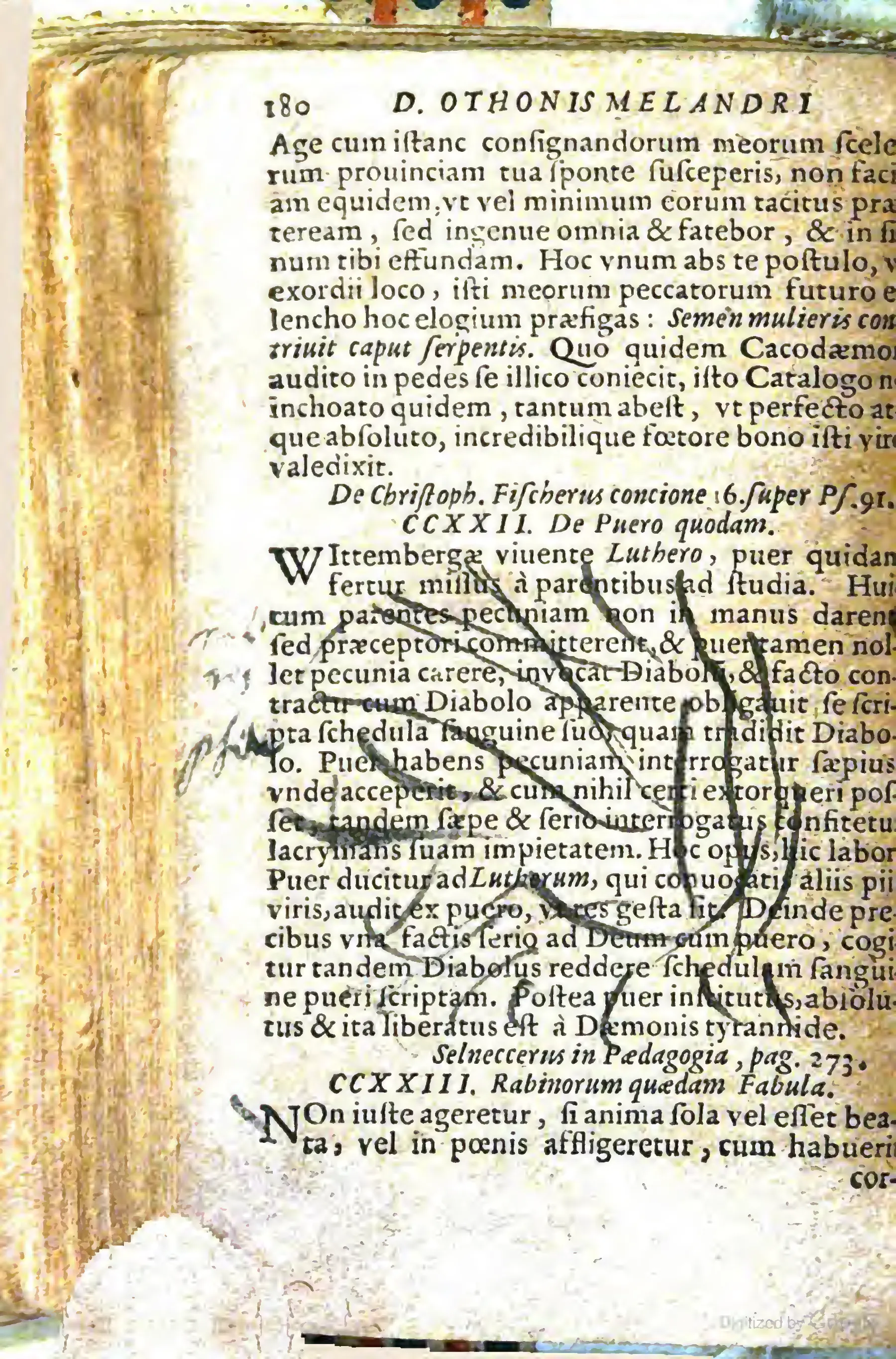
On this page the printed close of a devil-as-accuser anecdote gives way to exemplum CCXXII, in which a Wittenberg schoolboy's blood-written pact is undone by Luther's prayers and the devil compelled to return the document. The forensic machinery is retained; the demonic claim is defeated by confession, prayer, and providence. Source ↗.
The volume closes on a narrative that reverses the direction of its polemic. Johannes Kruschard, pastor of Netra, is described attacking from the word of God the Anabaptists then rampaging through the Hesse of Landgrave Philip, and doing so not only publicly from the pulpit but privately by letters, Anabaptistas per Hassiam Landgrauij Philippi grassantes ex verbo diuino non modo publice ex suggesto, sed & priuatim per literas oppugnaret; the young sectary who answers with threats stalks him for years, stabs another man in his place, and is at last not punished but reconciled, restored to the church and cured of his error. Placed last, the item makes the collection end with persuasion rather than with a verdict, and with the two instruments — preaching and correspondence — by which the word is said to work outside the courtroom. Immediately after the finis stands the alphabetical register of things and words, keying abbots and lions, drunkenness and judicial astrology, jurists and parrots to their page numbers in one undifferentiated series. That apparatus is the plainest statement of the book's design: the hundreds of narratives are not a sequence to be read through but a stock to be consulted, and the index makes each of them retrievable as an instance under a heading.
The outer edge of the corpus
At the outer limit of the material examined the printed record changes character altogether, and yields no run of the numbered exempla at all; its analytical value lies precisely in that absence. What it carries is record-level identification rather than running text: the descriptive matter that names the book as Franc. Modi Brug. Novantiquae Lectiones, Tributae in Epistolas centum & quod excurrit, attributes it to Franciscus Modius, and dates it to 1584 — an epistolary philological miscellany whose declared business is that in a great many places Silius is supplemented, emended, illustrated, and annotated. Nothing in that descriptive matter exhibits the formal apparatus that organizes the ioco-seria series: no De … heading introducing a discrete item, no closing attribution naming the authority from whom an anecdote is taken, no numbered sequence, and no gathering of items into the thematic collectanea that elsewhere convert a string of jests into a sustained moral excursus. The two architectures are not merely different in subject but different in kind. Modius's title advertises a hundred-odd letters, each a vehicle of textual criticism on a classical poet, in which the unit of argument is the disputed reading and the warrant is philological conjecture supported by collation; the anecdote collection's unit of argument is the remembered saying or episode, and its warrant is the named source or the claim of autopsy appended to each item.
Registering that divergence is a properly text-critical observation about a printed object rather than a bibliographical aside, because the structural reading of the anecdote collection depends on being able to say what belongs to its series and what does not. A descriptive header of this kind, standing without any of the collection's formal signals around it, cannot be read as an interior division of the joco-seria — it is not a running title, not a book- or part-division, and not a preliminary address to the reader of that work. It is the identification of a distinct Latin volume, printed at Frankfurt by Wechel, whose author, title, place, printer, and year are independently recorded, and whose association with the anecdote collection is an artefact of description rather than of the pages themselves.
The consequence for the exposition of textual movement is therefore stated most accurately in negative terms: this material contributes no exemplum, no conceptual pivot within the argument about counterfeit and warranted authority, and no primary passage that can be quoted as evidence of how the collection tests a claimant against the standard of God's word and providence. It marks, rather, the outer edge of the corpus under study — the point at which the descriptive record of one early modern printed Latin book has come to sit beside another, and where the discipline required of the reader is the same discernment between a plausible surface and a verifiable warrant that the anecdote collection everywhere demands of its own audience.

The final index leaf makes the collection's architecture explicit, filing exempla under named warrants, among them printed references to Dionysius Melander and D. Martin Luther. An emphatic FINIS, an ornamental device, and a later library stamp mark the volume's production and custodial edge. Source ↗.
Frequently Asked Questions
What is Otto Melander's Joco-Seria?
Joco-Seria is a Neo-Latin anthology of several hundred jests, sayings, and remembered episodes, transmitted also as Jocorum atque seriorum and in German as Schimpff und Ernst. Each numbered item arrives under a heading beginning "De …" and closes with an attribution to a named authority, so the book reads as an accumulation of individually warranted anecdotes rather than continuous exposition. Its subjects run from confessional polemic, martyrology, and criminal procedure to the Swiss cantons, werewolves, and nightingales said to imitate human speech at the Diet of Regensburg in 1546. An alphabetical index of memorable things and words closes the Latin series, marking a book built for consultation.
Who was Otto Melander?
Otto Melander, styled Otho Melandrus in Latin, was born at Eschwege in 1571 and died at Prague in 1640. Authority records describe him variously as a poet, professor of law and philosophy at Herborn, jurist, diplomat and councillor, and writer of jest narratives; the Latin title-pages style him J.U.D., doctor of both laws. That legal training shows throughout the collection, which cites Giulio Claro, Tiraqueau, Oldradus, and Gail, esteems the Roman laws highly, and yet records a jest about the contempt theologians reportedly bear jurists for no reason but their learning in the law.
How does the Joco-Seria attack judicial astrology?
It treats judicial astrology as idolatry restored, calling it an art that recalls by right of postliminy the gods of the nations once hissed off the stage. The doctrinal ground is created purpose: the stars were made to give light and to distinguish the seasons, not to teach what will happen. Melanchthon himself, styled coryphaeus and prince of theologians, is rebuked for depending on the stars as on a deity incapable of deceit, and a nativity he cast for an infant of Dionysius Melander half-failed — a daughter, not the predicted son, though the sickness foretold for the seventh year came. Successful predictions are admitted, then reassigned to God's just judgement permitting impostors to speak true.
Why are the printing history and authorship of the Joco-Seria difficult to establish?
Because the catalogue witnesses disagree on title language, place, printer, volume count, and even the author's forename. The documented German production begins with a two-volume Lich edition of 1605 printed by Ketzel, followed by Berner's Darmstadt edition of 1617, whose record states the work first appeared in Latin and was afterwards Germanized at readers' request. Latin witnesses include a complicated Schmalkalden record of 1611 that assigns the heading to Dionysius Holzapfel, dit Melander, three Palthenius volumes at Frankfurt in 1626, and three from Endter at Nürnberg in 1643. No authoritative first Latin imprint or date of composition has been established, and a commercial claim of a 1603 original remains unconfirmed.
Is there an English translation of the Joco-Seria?
No English translation has been identified; apart from the German versions of 1605 and 1617, no translation was located in the records examined, and there is no critical edition or monograph devoted to the collection. Separately, the Leo edition presents the full Latin transcription together with a complete English translation for the first time, and that translation is generated by AI. Leo is an effort to make freely available online, at no cost, English translations of every text printed in Latin in early modern Europe between 1450 and 1750.
This report was generated by an advanced AI assistant that conducted deep research alongside an extensive interpretation of the transcribed original text. Every effort has been made to preserve fidelity to the source and to guard against inaccuracy, but corruption in the text recognition process and model hallucination may nonetheless have entered the text. Treat every claim, quotation, translation, and citation as provisional, and verify each against the original source before relying on or citing it.
Further Reading on Melander, Pauli, and the Neo-Latin Jest Book
- Hélène Casanova-Robin, Serio ludere: Sagesse et dérision à l'âge de l'Humanisme: This French-language scholarly volume addresses the antecedents and Renaissance development of serio ludere, giving the philological and intellectual background needed to interpret the paired comic and earnest registers of Melander's title. It is contextual rather than a study of Melander's editions themselves, but it illuminates the mechanism by which a light form carries a weighty judgement — as when a sexton does not hesitate to affirm that even if he were learned enough to discharge the office of an Evangelical preacher rightly, he would in every respect still rather serve as a sexton, Hic qui dem asseuerare haud dubitabat, etiamsi ea erudi tione præditus esset, vt præconis Euangelici mu nere recte rationeque defungi posset, malle se ta men in omnes partes ædituum aliquem agere, a witticism whose real subject is the gravity and irrevocability of the preached word.
- Albrecht Classen, "History of Early Modern Society and Everyday Life as Reflected in the Works of the Bestseller Author Johannes Pauli (1522)," Advances in Social Sciences and Management 1, no. 7 (July 2023): 46–59: This article supplies the most useful methodological parallel: it treats didactic and entertaining jest narratives as evidence for social and intellectual history while warning that fiction, selection, and later editorial alteration complicate historical use. Its footnotes also point the reader to Johannes Bolte's still-unsuperseded two-volume edition of Pauli's Schimpf und Ernst, the obvious next stop for anyone tracing Melander's generic ancestry. The kind of everyday clerical detail that makes the parallel productive is abundant in Melander's Latin, as in the observation that many such lapses must inevitably befall those who, relying on their learning and eloquence, leap up unprepared to preach, Huiusmodi multa iis excidant necesse est, qui eruditione facundiaque sua conisi, imparati ad concionandum profiliunt; whether such items reflect observed practice or inherited narrative material is exactly the question Classen's cautions pose.
- Albrecht Classen, "The Phenomenon of a Literary Bestseller in Sixteenth-Century German and European Book Markets," Archives of Humanities & Social Sciences Research 1, no. 2 (2024): 1–5: This study explicitly places Melander's 1605 and 1617 Joco-Seria among collections shaped by Johannes Pauli's Schimpf und Ernst, alongside such imitators as Georg Stöhr's Geistlicher Schimpff und Ernst of 1608. It is especially valuable for framing Melander's work within the history of reprinting, literary models, and book-market circulation, although it does not provide a full Melander bibliography — the one thing a student of the collection most needs and still cannot get.



.jpg)
