The Sacred Anchor and Charon's Skiff: Georg Wolfgang Wedel's Opiologia, or A Treatise on Opium Drawn Up According to the Mind of the Academia Naturae Curiosorum
Georg Wolfgang Wedel, a Jena physician writing in 1674, confronted the paradox at the heart of learned medicine's dealings with opium: the drug was at once the most potent remedy in the physician's store and a substance the schools had long feared as a poison. His Opiologia ad mentem Academiae Naturae Curiosorum refuses to dissolve that paradox and instead disciplines it, asking how a physician might rightly know, prepare, and administer a drug whose power and whose danger are one and the same. Grounded in a tally of more than four hundred cured dysenteries, the interrogation of opium at the chemical furnace, and a signature doctrine that the drug can act only when the blood holds a proportioned serum, the book captures a discipline mid-transition, holding Galenic and chymical frameworks together under the pressure of a single consequential simple.
ExLatinis
July 24, 2026

Contents
Georg Wolfgang Wedel, a Jena physician writing in 1674, confronted the paradox at the heart of learned medicine's dealings with opium: the drug was at once the most potent remedy in the physician's store and a substance the schools had long feared as a poison. His Opiologia ad mentem Academiae Naturae Curiosorum refuses to dissolve that paradox and instead disciplines it, asking how a physician might rightly know, prepare, and administer a drug whose power and whose danger are one and the same. Grounded in a tally of more than four hundred cured dysenteries, the interrogation of opium at the chemical furnace, and a signature doctrine that the drug can act only when the blood holds a proportioned serum, the book captures a discipline mid-transition, holding Galenic and chymical frameworks together under the pressure of a single consequential simple.
Georg Wolfgang Wedel, a physician of Jena writing in 1674, set himself a problem that the learned medicine of his century had inherited but never resolved: opium was at once the most potent remedy in the physician's store and a substance the schools had long feared as a poison. His Opiologia ad mentem Academiae Naturae Curiosorum — a scholastic-iatrochemical monograph devoted entirely to this single simplex — takes up that paradox not to dissolve it but to discipline it, asking how the learned physician might rightly know, prepare, and administer a drug whose power and whose danger are one and the same. The book was printed at Jena by Johann Fritsch, and its very title binds it to the Academia Naturae Curiosorum, the learned society founded at Schweinfurt in 1652 that would later become the Leopoldina, and to whose programmatic frame Wedel — admitted under the academy cognomen Hercules II — explicitly subordinates his labor.
What gives the work its coherence is a single recurring move. Confronted with a disputed question — opium's true definition, its temperament, the mechanism of its narcotic action, its status as poison, its bewildering array of Oriental names — Wedel adjudicates not by weighing textual authorities against one another but by referring the controversy to clinical practice and iatrochemical analysis. The characteristic operation is twofold: first he distinguishes terms, separating use from abuse, poison proprie from poison improprie, effect per se from effect per accidens; then he grounds the verdict in observation gathered across many like cases rather than in isolated singulars. The chemical furnace, which he calls Vulcan, the microscope, and a tally of more than four hundred cured dysenteries supply the empirical warrant; philology fixes the object under discussion; and a signature physiological axiom — that opium can act only when the mass of the blood contains a proportioned serum — supplies the mechanism. The disciplining of a dangerous simple through the joint authority of experience, chemistry, and definition is the spine on which the whole treatise is built.
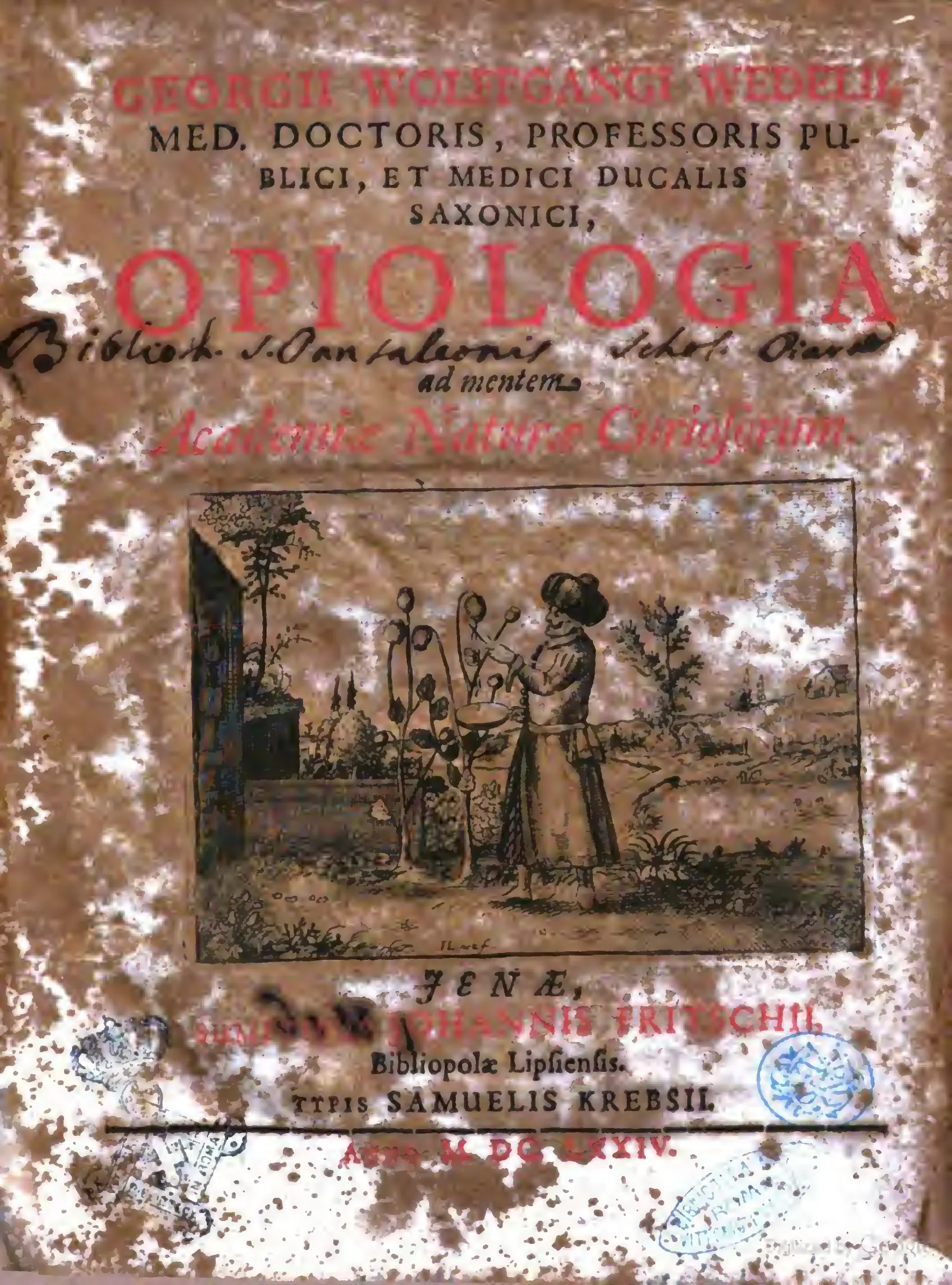
Wedel’s 1674 Jena title page frames the Opiologia as both a learned medical inquiry and an institutional exercise, its red-and-black title, authorial credentials, and printed dedication "ad mentem Academiae Naturae Curiosorum" placing the drug's definition under academic authority. The central engraving of an orientally dressed harvester incising poppy capsules gives the treatise its disciplined object — the collected poppy juice whose status as remedy or poison Wedel submits to definition, practice, and chemical analysis. Source ↗.
The stakes of this undertaking are those of a discipline in transition. In the later seventeenth century the older Galenic materia medica, organized by the four qualities in their degrees and by the doctrines of signatura and correctio, was being displaced — unevenly, and against resistance — by a chymically informed account that located the operative virtue of a drug in a separable active principle rather than in its elemental complexio. Wedel's treatise is a document of that negotiation caught in the act: it retains the Galenic vocabulary of intemperies, correctio, and venenum even as it introduces chymical analysis as the route to opium's active principle, a subtle and volatile spirituoso-saline substance freed from the gum of the poppy capsule. To read the Opiologia is to watch a learned physician try to hold two frameworks together under the pressure of a single, unusually consequential drug.
The particulars that a first-time reader will find most striking are concrete and often vivid. Wedel overturns the Galenic verdict that opium is cold in the fourth degree, judging instead that it acts through heat; he subjects the drug to the furnace and reports what the glass yields; he explains sleep as the corpuscular obstruction of the brain's pores, drawing on Kircher, Descartes, and Quercetanus; and he narrows the broad pharmaceutical labor of correctio to the chymical depuratio of the crude gum. Around this technical core runs an extraordinary philological and ethnographic reach — Greek, Arabic, Hebrew, Chaldee, Hungarian, Turkish, and Persian material, a discussion of maslach and bangue among Turks and Persians that leans on Adam Olearius's account of the Persian embassy, and an argument that maslach names not one substance but a functional class. And running through the defense of the drug is a memorable rhetoric: opium as the sacred anchor of life in prudent hands yet Charon's skiff in the hands of the inexpert, the dismissal of an empty "womanish fear," and the maxim that one swallow makes no spring and one experiment no consequence.
Much about the work is securely established — its author, its printer, its date, the sequence of its imprints — while other matters remain open: no dedicated study of the Opiologia as a discrete object has been identified, the dedicatee of the early imprints is not named in the catalogues consulted, and no modern critical edition or vernacular translation has come to light, so that the text is approached chiefly through its early-modern Latin printings. What follows sets out the philological, institutional, iatrochemical, and material dimensions of a treatise whose ambition was to render a feared drug both intelligible and safely usable by the standards of its own art.
Read the full text and English translation on Leo
This text was transcribed and translated as part of the ExLatinis project, an effort by Leo to make free English translations of every text published in Latin in early modern Europe (1450–1750) available online. The complete transcription and English translation of this work can be read free of charge:
→ Read the original Latin text and full English translation on Leo
You can save a copy of this document into your Leo account to run deep text searches, conduct further analysis, or cross-reference it with your own research.
Fixing Opium's Definition: Wedel's Philological Framing
Editorial title (supplied for convenience; no established English title exists in the current historiography): Opiologia: A Treatise on Opium Drawn Up According to the Mind of the Academia Naturae Curiosorum.
Conventional short form for citation: Wedel, Opiologia ad mentem Academiae Naturae Curiosorum (Jena: Fritsch, 1674).
—
The philological framing of the work is best developed not by glossing it lexicographically but by unpacking how three charged terms do their doctrinal work inside the argument itself, in the Latin idiom Wedelius actually employs. Before those three, however, it is worth registering how the treatise fixes its object at all, for the whole apparatus rests on a formal real definition of the drug. Wedelius defines opium as the juice, drawn out and condensed from the wounded heads of the poppy, having power to bind sensation and arrest animal motion by vaporous effluvia, OPIUM est succus, ex capitum papaveris thyrsis seu scapis vulneratis prolectus & condensatus, sensus ligandi & potentiam movendi animalem ob vaporosa effluvia sistendi vim babens. The definition is doubly loaded: it locates the drug materially in the succus of the capsa papaveris, and it already names, in the phrase vaporosa effluvia, the vaporous mechanism that the later chymical and physiological argument will elaborate. Philology, in this treatise, fixes the object before natural philosophy explains it.
The first of the three charged terms is serum. In the inherited Galenic-Avicennan lexicon serum denoted, in a roughly whey-like sense, the watery part separated from the curdled milk of the blood — the thin and aqueous residue of the chylopoietic process — and as such it had only a residual, second-order status in the physiology of the humors. What is decisive about the Opiologia is that Wedelius promotes serum from this humoral-residual sense into the operative vehicle of opium's action: the drug, he argues, can exert no effect upon the body unless a properly proportioned serum — neither too watery nor too thick, neither too alkaline nor too acrid — is contemporaneously present in the mass of blood. He grounds the claim in his own practice, reporting that it became certainly known to him from practice and most frequent observation that opium does not operate unless there is proportioned serum in the blood, Unde nobis certò ex praxi & creberrimâ observatione innotuit: Opium non operari, nisi serum sit in sangvine proportionatum. Serum accordingly ceases to be a passive residue and becomes a constitutional mediator. The doctrinal wager of the book depends upon this promotion: opium's signature — its soporific, anodyne, carminative and diaphoretic virtue — is intelligible only because serum supplies the medium in which the active principle, freed by chymical analysis from the capsule of the capsa papaveris, can be conveyed to the appropriate partibus spirituum without corrupting them. To speak of opium's serum in Wedelius, then, is to speak of a load-bearing concept, not of a watery residue; and, characteristically, the verdict is referred to praxis and repeated observatio rather than to textual authority.
The second term is the forensic pair venenum proprie dictum and venenum improprie dictum. The inherited forensic-medical tradition of the venena — running from Nicander through Dioscorides and Galen into the scholastic De venenis literature — distinguished poisons strictly so called, substances whose very notio is to corrupt by their proper substance the temperies of the principal organs, from substances only loosely and analogically so called, whose noxious effect arises not from their substantial form but from incidental or supervenient causes such as dose, idiosyncrasy, or faulty administration. Wedelius carries this forensic apparatus into the Opiologia precisely in order to defend opium against its inherited reputation as a venenum. The distinction is the crux of the defense: he separates poisons properly and improperly so called, the former hostile to the heart by a peculiar power, the latter by accident, when taken in excess, Distinguendo inter venena propriè & impropriè dicta. Illa peculiari vi cordi sunt infensa... hæc per accidens, quatenus nimiâ copiâ adsumuntur. Opium, he maintains, is not a poison in the strict sense; its occasional noxious effects follow from excess of dose, from a serum rendered disproportionate, or from an intemperies already present in the patient. Properly managed, opium proprie is not a venenum, however much it may be improprie called one. The forensic distinction thus does the doctrinal work of the entire rehabilitation of the drug — and it is the same distinguishing of terms, here per se against per accidens, that runs through the treatise as its recurring adjudicative move.
The third term is the pair correctio narrowed to depuratio. In the inherited pharmaceutical vocabulary of correctio, the Galenic-Avicennan shop handled four principal corrective operations: praeparatio, correctio, mixtio and compositio. Of these correctio was the broadest: it could mean rectification, detoxification, fermentation, sublimation, or the deliberate rectification of a hostile qualitas by its contrary. Wedelius in the Opiologia effectively narrows correctio to its subset depuratio — the purification or depuration of the crude gum of opium into a refined and rectified pharmaceutical — and the apparatus of praeparatio becomes subordinate to the labor of depuratio. The shift is significant. Where Galenic pharmacy tolerated a broad corrective repertoire (roasting, washing, trituration with aromatics, admixture of corrigentia), iatrochemical practice at Jena narrowed corrective technique to the chymical rectification of the essentum or principium. The philological narrowing of correctio to depuratio in the Opiologia therefore is not merely lexical; it tracks the displacement of Galenic correctio by chymical depuratio — a displacement that is the very topic the Opiologia negotiates.
What the Opiologia Argues: An Executive Summary
The Opiologia ad mentem Academiae Naturae Curiosorum is a scholastic-iatrochemical medical monograph on a single simplex (opium), composed in Latin by the Jena physician Georg Wolfgang Wedel and printed at Jena in 1674 by Johann Fritsch. The Academia Naturae Curiosorum named in the title is the Leopoldina, founded at Schweinfurt in 1652 under Johann Lorenz Bausch, of which Wedel was admitted a member (under the cognomen Hercules II) and to whose programmatic frame the treatise is explicitly subordinated. Wedel's thesis rests on three coordinated propositions: (1) a forensic demonstration that opium, properly managed, is not a venenum in the strict sense, since its noxious effects proceed from dose, disproportion of serum, or pre-existing intemperies; (2) an iatrochemical account of the active principle as a subtle, volatile, spirituoso-saline principle separable by chymical analysis from the gum of the capsule; and (3) a doctrine of serum requiring that opium can act only when the mass of blood contains a proportioned serum. Governing the whole is a methodological "middle way" that neither disdains native remedies nor rejects exotic ones — Nos mediam ingressi viam, nec nostra spernimus, nec, ubi opus est, exotica rejicimus — and a preference for clinical practice over bookish scholasticism. The text draws upon Greek, Arabic, Hebrew, Chaldee, Hungarian, Turkish and Persian philological material, including a section on maslach/bangue among Turks and Persians drawing on Adam Olearius's account of the embassy to Persia; a notable philological verdict there is that maslach names not a single substance but a functional class, Maslach non notat unam certam rem, plantam vel medicamentum. No modern critical edition and no complete translation into a modern European vernacular has been identified; the work is accessible chiefly through the early-modern Latin printings.
Placing Wedel Between Galen and Chymistry: Scholarly Significance and Historiography
The scholarly significance of the Opiologia is best grasped in three mutually reinforcing frames: as a contribution to the transformation of materia medica in the later seventeenth century; as a document of the institutional program of the Leopoldina; and as a specimen of iatrochemical therapeutics at the University of Jena.
First, the Opiologia belongs to the historiographic moment in which the older Galenic materia medica, organized by degrees of the four qualities and by the doctrines of signatura and correctio, was being displaced — though not extinguished — by a chymically informed materia medica that located the operative virtue of a simplex in a separable active principle rather than in its elemental complexio. The displacement was not sudden; it was negotiated, contested, and uneven. Within that negotiation, the Opiologia is significant as a work that visibly attempts to hold the two frames together: to retain the Galenic vocabulary of intemperies, correctio, and venenum while introducing chymical analysis as the route to the active principle. That chymical route is enacted at the furnace, where Wedel subjected opium to Vulcan for torture and, through the glass, obtained phlegm, a volatile urinous spirit, and a blackening oil, from which the acting power of opium is made manifest, Subjectum à nobis Vulcano ad torturam opium exhibuit, per vitream illud per se ex... Phlegma... oleum nigricans, ex quo patet vis agendi opii. The verdict against the inherited qualitative doctrine follows from just this kind of analysis: asked whether opium acts more strongly through the hot or the cold, Wedel judges that the answer must be entirely "through the hot," Quod si tamen quæratur, num per calida fortius operetur, quàm per frigida, opium, per calida omninò respondendum arbitramur. Teigen's study of 15th- and 16th-century Galenic pharmacology establishes the inherited qualitas-laden framework (complexio, hot–cold and dry–moist axes organized in four degrees) into which Wedel writes. The reciprocal-evolution piece in PMC documents the long arc of opium's medical reception up to and through the early modern period.
Second, the Academia Naturae Curiosorum was founded at Schweinfurt on 1 January 1652, under the aegis of Johann Lorenz Bausch; it received its first imperial privileges from Leopold I in 1677 and adopted the name Leopoldina from 1687. Wedel's dedication of the Opiologia to the ad mentem of the Academia must be read within that program of institutional self-fashioning, and its epistemological posture — the priority of gathered experience over the isolated case — is precisely the kind of observatio the Academy cultivated: neither does one swallow make spring, nor one experiment a consequence, more are needed, Nec una hirundo ver facit, nec unum experimentum consequentiam. Pluribus opus est, and, as he insists, experience itself is not of singulars but is gathered from many cases under the same conditions and circumstances, nec experientia ipsa est singularium, sed ex pluribus eodem modo & iisdem circumstantiis præsentibus colligitur. Wedel himself is identified in the modern histories as a member of the Leopoldina under the academy cognomen Hercules II, an affiliation that this treatise materially registers. The legum of the Academia, valid until 1670 and documented in Müller's study, governed the kind of observatio that such a monograph embodies. The institutional context is most fully treated in Maclean's 2019 article and in the Leopoldina's own published history.

Matthäus Merian’s mid-seventeenth-century engraved prospect of Schweinfurt situates the Academia Naturae Curiosorum’s 1652 birthplace within its fortified urban landscape, its printed key referring to "H.D. Bauschen thürn" and so linking the view closely to Johann Lorenz Bausch, the society's founding organizer. As a period image of the Academy's civic setting, it sharpens the institutional context behind Wedel's dedication of the Opiologia to a culture of collective observatio rather than isolated experiment. Source ↗.
Third, the Opiologia is a specimen of iatrochemistry at Jena. Wedel had been a student of Werner Rolfinck and held the Jena chairs successive to the Rolfinckian program of chymical instruction. Principe's 2021 study identifies Wedel as one of the Jena professors offering courses of chymistry in the period, and Debus's work on the German universities in the seventeenth century traces the continued influence of Jena iatrochemistry into the late seventeenth century. The Opiologia is the most prominent of Wedel's published materia medica monographs and stands in a wider Jena production of chymical materia medica in which Rolfinck and his successors set Jena apart from the Helmstedt and Wittenberg traditions.
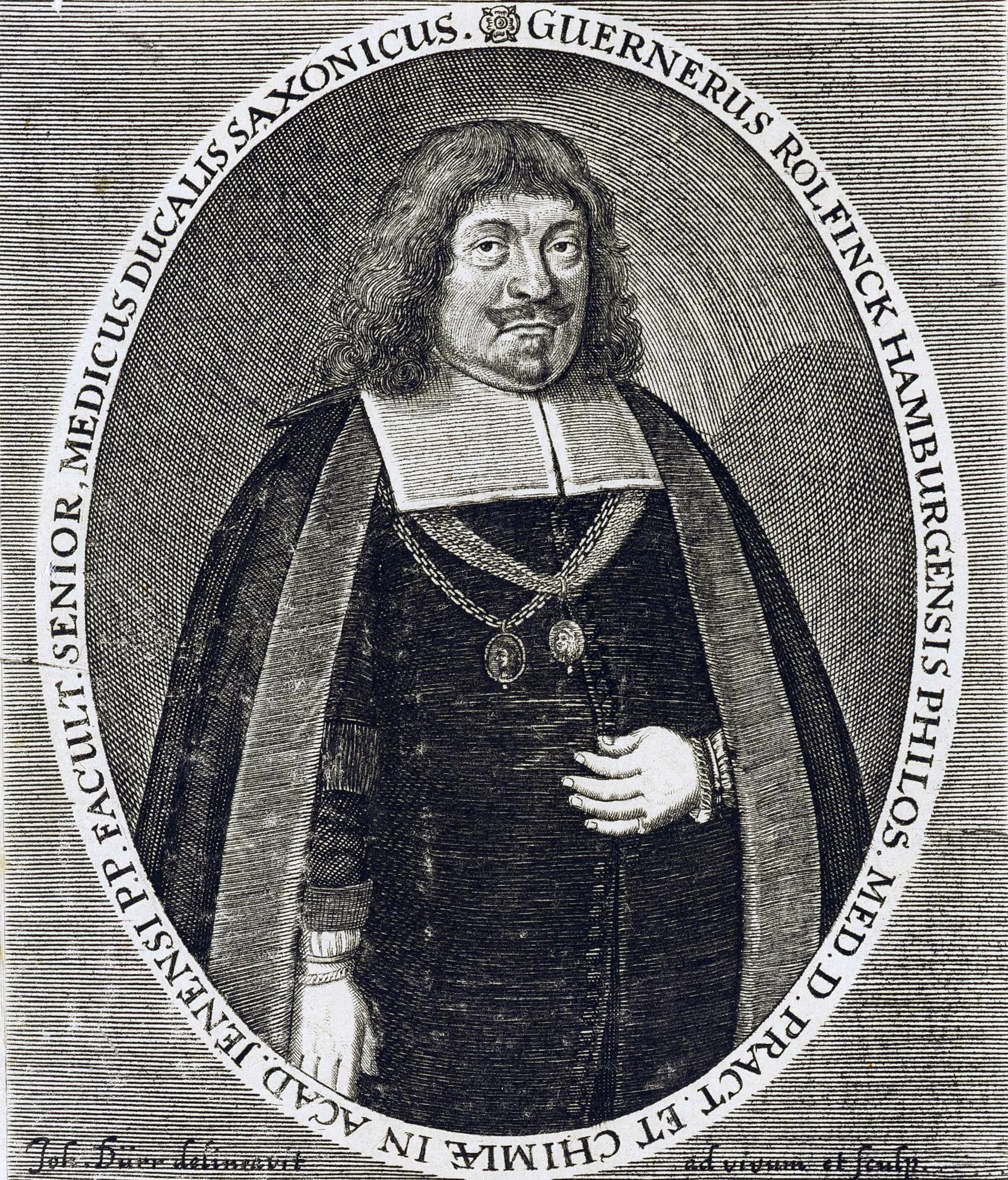
This engraved portrait of Werner Rolfinck evokes the Jena medical milieu in which chymistry became a formal part of university instruction. As Rolfinck's student and institutional successor, Georg Wolfgang Wedel carried that iatrochemical lineage into works such as the Opiologia, where materia medica was treated through the learned chemical culture that set Jena apart from neighboring traditions. Source ↗.
The principal modern scholarship bearing on Wedel and the Opiologia directly is Ian Maclean, "Die Arbeiten von Hercules. Georg Wolfgang Wedel, die Leopoldina und der norddeutsche Büchermarkt um 1680," published as a monograph/lecture under the Leopoldina imprint and as article no. 74 in the Acta Historica Leopoldina. Lawrence M. Principe's 2021 article The Two Brendels, Rolfinck, Wedel, and Others identifies Wedel's place in the Jena chymical lineage. Allen G. Debus's study of chemistry at the German universities contains the standard reference to Wedel's place in the Jena iatrochemical lineage. The Galenic pharmacopoeial background is established by Teigen's 1987 article on Taste and Quality in 15th- and 16th-Century Galenic Pharmacy, and the broader history of opium in European medicine is surveyed in the PMC article on the reciprocal evolution of opiate science.
Where the historiography on this specific text is thin: no dedicated monograph or article-length treatment of the Opiologia as a discrete object has been identified in this session. Maclean's title and venue confirm his concern with Wedel as a publishing figure of the late seventeenth century; whether Maclean's monograph contains an extended treatment of the Opiologia specifically, as opposed to Wedel's output in general, could not be verified here without direct consultation of the volume. The standard reference works treat Wedel rather than the Opiologia specifically, and the Opiologia is entered principally as a bibliographic item.
Tracing the 1674, 1682, and 1739 Imprints: Textual History and Object Biography
The textual transmission of the Opiologia is bipartite in its printed imprints, with a documented chain running from 1674 through 1682 and 1739. The full chain is catalogued under three editions: 1674 princeps, 1682 reprint, and 1739 reprint/issue.
The 1674 first edition. The imprint reads Ienae, apud Johannem Fritschium (Jena: Johann Fritsch, 1674). The volume is a quarto; standard trade catalogs record the collation as [16], 170, [20] pp. The imprint is confirmed by Google's digitization whose front matter reads "Editor, Fritschius, 1674. Original from, the Bavarian State Library" and by the Internet Archive copy (identifier stem bub_gb_0BY3vas6picC). The trade catalog aggregating rare-book listings records: "Publisher: Johannis Fritschii, Jenae; Publication Date: 1674; Binding: Hardcover; Edition: First Edition". Bibliographic reference VD17 14:693662Z is given in the Wien Chinabibliographie entry. A second variant imprint, "Not identical with VD17 14:693662Z (different illustration on the title-page); mehrere Werke in einem Band Varia," is recorded by the Deutsche Digitale Bibliothek, suggesting at least one other Jena imprint of the same year with a different engraved vignette. The volume bears, on the title-page, an engraved vignette used by the Jena printer.
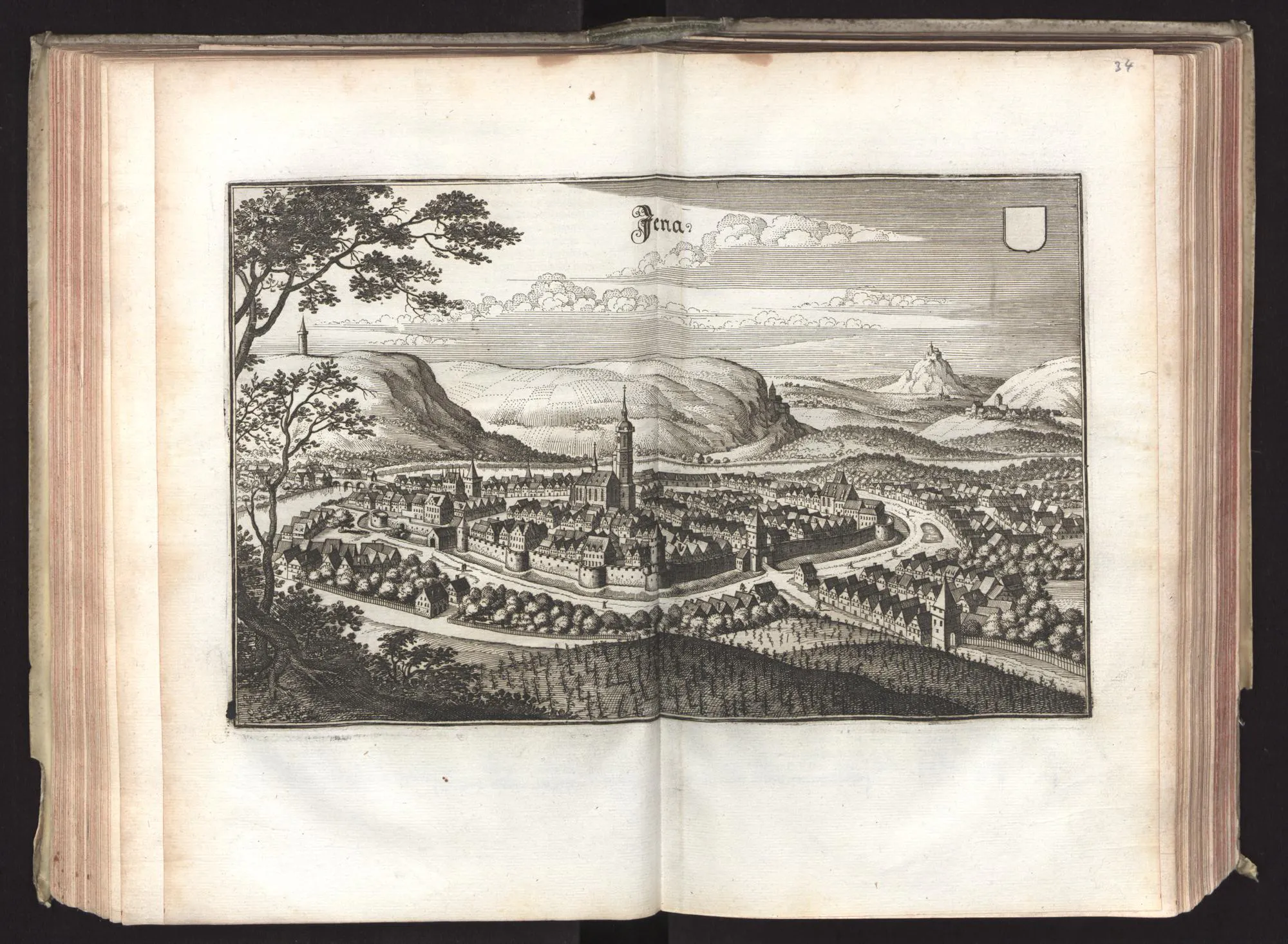
Matthäus Merian’s seventeenth-century topographic view of Jena situates Wedel's Opiologia in the university town named in the 1674 imprint, Ienae, apud Johannem Fritschium. Rather than showing the book itself, the engraving evokes the compact urban and academic milieu — shaped by the Rolfinck iatrochemical lineage — in which the treatise was printed and taught. Source ↗.
The 1682 reprint. The imprint reads Ienae, apud Samuelem Krebs' Wwe. für Johann Bielcke — Jena, widow of Samuel Krebs, for Johann Bielcke, 1682. The trade catalog (Inlibris / antiquarian) describes this as "Second edition of this early monograph on the pharmacological and therapeutic aspects of opium. The main text is a reissue of the 1674 edition" (Krivatsy). The collation is again [16], 170, [20] pp., with engraved vignette, red-and-black title.
The 1739 third impression. A 1739 imprint is recorded in the Wellcome catalog entry Ienae: sumptibus Joh. Felicis Bielckii. The Wellcome catalogue and HathiTrust records describe this as containing 248 images and 170 pages in quarto. A trade-listing description confirms: "1739 OPIOLOGIA Wedel Third Edition Early Book Use of Opium. G. W. Wedel (1645-1721) was one of the principal physicians of his age. His Opiologia won him admission to the Academy of Naturalists, the still-extant...".
Structural relation of the three imprints. Bibliographic catalogues indicate that the 1682 imprint is a reissue of the 1674 text with a new title-page; the 1739 imprint is described in the Wellcome catalogue as a reissue with a new title-page by J. F. Bielckii; the bibliographic literature does not, in the consulted entries, record a separately paginated new edition. The three imprints are catalogued as a sequence in which the text is unchanged and only the imprint is altered.
Holding institutions and shelfmarks. The 1674 first edition is held by the Bayerische Staatsbibliothek (VD17 14:693662Z; digital surrogate via Google Books and the Münchener Digitalisierungszentrum). The Bamberg Staatsbibliothek holds a print copy recorded as Wedel, Georg Wolfgang: "Georgii Wolffgangi Wedelii ... Opiologia ad mentem Academiae Naturae Curiosorum"; Location: Bamberg, Staatsbibliothek — shelfmark .51 B 15. The Deutsche Digitale Bibliothek records an additional print copy not identical to VD17 14:693662Z, bound together with other works in Varia. The Buenos Aires national library holds a copy of the 1674 edition through Google. The 1739 imprint is catalogued at the Wellcome Collection (catalogue identifier fchae4jc) as containing 248 images, in the Public Domain. NLM holds a copy of a version whose Pt. [2] has special t. p. De virtute opii diaphoretica; first published as Michael Ettmüller's dissertation, Leipzig, 1679.
Material features. The book is quarto in format, with the preliminaries paginated in Roman, the main text in Arabic, and a terminal index and corrigenda paginated in Roman or Arabic depending on the imprint. The engraved vignette on the title-page in the 1674 Fritsch imprint is described in catalogues as a Turkish figure scraping the capsule of the poppy to collect the succus — a material emblem of the same capsa papaveris from which, in the text's real definition, the condensed succus of opium is drawn. The volumes examined at auction are described as bound in contemporary vellum or half-vellum.
Object biography. The 1674 imprint, then the 1682 and 1739 reissues, constitute the transmission history of the Opiologia; the work has not, on the basis of the bibliographic evidence available in this session, been translated into a modern European vernacular; the absence of a translation is consistent with the Latin-only technical-philosophical apparatus of the text. Copies of the 1674 imprint are recorded at the Bayerische Staatsbibliothek (VD17 14:693662Z), at the Bamberg Staatsbibliothek (.51 B 15), and at the Buenos Aires national library (digital surrogate); the 1682 and 1739 imprints are documented by HathiTrust and the Wellcome Collection.
Reception, network, and dedicatees. The text bears the formal marks of the Latin materia medica monograph: a dedication (to a patron as yet identified in the catalogues consulted), a preface to the reader, the topical sections, and an Asserta or Conclusiones section; the Pt. [2] recorded at NLM with special t. p. De virtute opii diaphoretica represents Michael Ettmüller's appendix-dissertation on the qualities of opium, originally published (Leipzig, 1679) and appended in the 1739 issue. The dedicatee of the 1674 and 1682 imprints is not identified in the consulted catalogues (nor is the privilege or censorship history). The trade-listing description explicitly attributes Wedel's admission to "the Academy of Naturalists" to the success of the Opiologia, although the consultable biographical entries place his admission somewhat later in the 1670s. No reception correspondence has been identified. Wedel's other works on materia medica and iatrochemistry — including the Pharmacia in nuce and the Compendium medicinae universae — are catalogued alongside the Opiologia as his principal writings on the Online Books Page listing; the Opiologia is treated in the standard reference works as one of Wedel's chief works. The relationship of the Opiologia to Wedel's other materia medica writings is treated in passing in the reference works; no extended comparative study has been identified in this session.
Following the Argument: From Definition to the Defense of Opium
Fixing the Object: Definition and the Middle Way
Wedel's Opiologia fixes its object before it explains it, opening the natural-philosophical inquiry with a formal real definition that discharges the whole burden of the scholastic quaestio de natura. The genus and differentia of that definition — the drug lodged in the incised succus of the poppy and endowed with power to bind sensation by its vaporosa effluvia — have already been examined for their doctrinal freight in the philological framing above; what deserves emphasis here is the structural economy of the move. The definition is calibrated to do double work. Its genus, succus, settles a live controversy among the authorities — Galen, Avicenna, Dioscorides — as to whether the drug is properly a liquor, a lacryma, or a gummi, by referring it to the incised exudate of the capsule rather than to any pressed or gummy residue; and its differentia already names, in the phrase vaporosa effluvia, the corpuscular-vaporous mechanism that the subsequent chymical and physiological chapters will elaborate. What appears in the Onomatologia and definitional chapters as lexical housekeeping is in fact the laying of a foundation: the operative virtue is lodged in a material substrate and a mode of conveyance, and the two later books do little more than draw out what this single sentence has already posited.
The methodological posture governing the treatise is announced in the Prooemium, where Wedel adjudicates the dispute between physicians who favor domestic simples and those who chase exotic novelties by refusing both extremes. He has entered the middle path, he declares, neither spurning native remedies nor, where there is need, rejecting exotic ones, Nos mediam ingressi viam, nec nostra spernimus, nec, ubi opus est, exotica rejicimus. The media via is not a rhetorical evasion but the epistemic condition under which opium — a peregrine drug of Theban and Indian provenance — can be taken up at all without either chauvinist rejection or credulous enthusiasm; the criterion of admission is opus, clinical need, and the standard by which need is judged is practice rather than reputation. This subordination of the exotic to demonstrated utility prepares the reader for the treatise's characteristic operation, in which a disputed question is settled not by counting authorities but by referring the verdict to gathered observation and to what the furnace yields.
Temperament and Mechanism: The Furnace and the Corpuscular Account
That operation is nowhere more consequential than in Wedel's break with the Galenic doctrine of opium's temperament. The ancients had commonly held the drug to be cold in the extreme, and Wedel canvasses this orthodoxy at length before overturning it; asked whether opium acts more strongly through the hot or the cold, he judges that the answer must be entirely through the hot, Quod si tamen quæratur, num per calida fortius operetur, quàm per frigida, opium, per calida omninò respondendum arbitramur. The force of omninò is polemical: it does not qualify the inherited verdict but reverses it, refusing the compromise position that would grant opium a mixed or occult coldness. The warrant for the reversal is chymical. Wedel reports having subjected opium to Vulcan for torture, so that through the glass it yielded of itself phlegm, a volatile urinous spirit effervescing with acids, and a blackening oil from which the acting power of the drug is made manifest, Subjectum à nobis Vulcano ad torturam opium exhibuit, per vitream illud per se ex... Phlegma... oleum nigricans, ex quo patet vis agendi opii. The forensic idiom of tortura is telling: the furnace is an instrument of interrogation that compels the substance to confess its constituents, and what it confesses — a volatile, saline, oily, sulphureous set of principles — is incompatible with the doctrine of a merely frigid complexio. The active virtue is thus relocated from an elemental quality to a separable material principle, and the qualitative framework of the four degrees is displaced by chymical analysis without being explicitly repudiated.
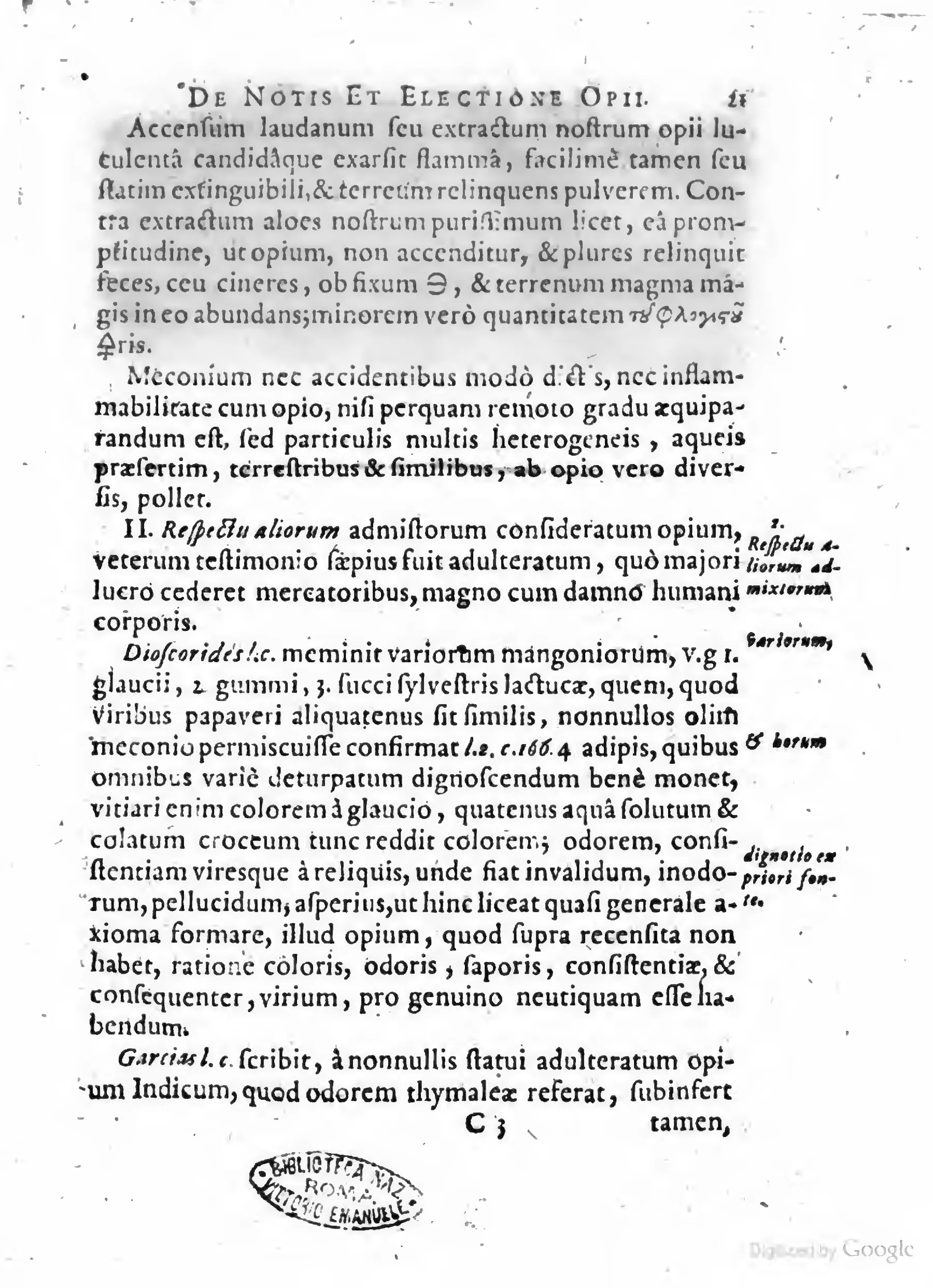
On this page from "De Notis et Electione Opii," Wedel turns the selection of genuine opium into both a chymical and a philological problem: the printed discussion compares laudanum's clear flame with the residues of other extracts, then moves to adulteration and the sensory marks by which false opium is rejected. The juxtaposition makes visible the logic behind his appeal to Vulcan — fire can disclose an active, combustible principle only once the drug itself has been secured against substitution. Source ↗.
Upon this analytic base Wedel erects his account of narcosis, which is corpuscular and mechanistic rather than qualitative. The opiate, once resolved in the body, communicates vaporous and sulphureous spirits to the blood and brain which, stopping up the receptacles of the brain, gently obstruct the pores of the brain and nerves while gently concentrating the blood, and so effect sleep, Hoc ergò opiatum in corpore resolutum spiritus vaporesos & sulphureos cum sanguine, & cerebro communicat, qui cerebri conceptacula oppilantes. Sleep here is a matter of obstruction and concentration — the physical oppilation of cerebral passages by vaporous corpuscles — and it is precisely this mechanical picture that lets Wedel dismiss the older explanation of anodyne action as stupefaction by cold. The ancients' hypothesis, that opium stills pain by stupefying the aching part through excessive cold until it loses all sensation, today utterly expires, Veterum enim hypothesis, opium dolores sistere stupefaciendo partem dolentem prænimio frigore, ut sensum omnem quasi amittat, hodiè penitus expirat. The verdict is adjudicated by appeal to experiment — Plater's and his own repeated failure to observe any stupor of a treated part — so that the same evidentiary standard that overturned the temperament doctrine here dispatches the mechanism the ancients had attached to it. The word expirat carries a deliberate finality: the inherited hypothesis is not merely doubted but declared dead in the present tense of hodiè.
The mechanism, however, is incomplete without the doctrine that most distinguishes Wedel's clinical physiology, his insistence that opium requires a proportioned blood-serum as the medium of its action — the axiom, grounded in his own repeated bedside observation and examined in the philological framing above, that opium simply does not operate unless a proportioned serum is present in the blood. This axiom does the explanatory work that the corpuscular account alone cannot: it accounts for the drug's failures and its paradoxical excitations, since where the serum is disproportionate the sulphureous spirits cannot be conveyed and diffused, and opium dries and rouses rather than sedates. Its epistemic pedigree is explicitly clinical — the verdict rests ex praxi & creberrimâ observatione — and the doubling of certainty with the language of what became known stakes the claim on accumulated experience rather than on any textual authority. The promotion of serum from a passive humoral residue to the operative vehicle of the drug's virtue is Wedel's original contribution to the physiology of narcotics, and it binds the chymical account of the active principle to the bedside conditions under which that principle can act at all.
The Double Edge and the Therapeutic Books
The therapeutic books are governed throughout by a candid acknowledgment of opium's double edge, which Wedel frames through Galen's own concession that it is difficult to have found some aid so magnificently beneficial as to work without any harm — a saying that holds, he adds, in opium above all, Qvod Galenus ait l. 11. meth. medend. c. 11. difficile esse, ejusmodi aliquod auxilium invenisse, quod citra ullam noxam magnificè prosit, illud etiam in opio vel maximè locum habet. The recruitment of Galen here is strategic: the authority whose temperament-doctrine Wedel has overturned is enlisted to warrant the treatise's governing tension, so that the danger of the drug becomes not an argument against its use but the very reason for the discipline the treatise imposes. That tension receives its most memorable formulation in the emblematic dictum that opium is the sacred anchor of life for those who act well and circumspectly, yet Charon's skiff in the hand of the inexpert and like a sword in the hand of a madman, Sacra vitæ anchora est opium, benè & circumspectè agentibus: cymba attamen Charontis in manu imperiti, & ceu gladius in manu furiosi. The three images are graded by agency rather than by the drug's own nature: the same substance is salvific, funereal, or murderous according to the prudence of the hand that wields it, which is exactly the doctrine required to sustain a rehabilitation that never denies the danger.
The logical instrument by which that rehabilitation is secured against the charge of poison is a forensic distinction inherited from the De venenis tradition. Wedel meets the accusation that opium is a venenum by distinguishing between poisons properly and improperly so called: the former are hostile to the heart by a peculiar power, the latter only by accident, insofar as they are taken in excessive quantity, Distinguendo inter venena propriè & impropriè dicta. Illa peculiari vi cordi sunt infensa... hæc per accidens, quatenus nimiâ copiâ adsumuntur. The distinction transfers the drug's noxiousness from its substantial form to a supervenient cause — dose, or a disproportion of that very serum the physiology has made central — so that opium proprie is exonerated even as opium improprie is conceded to harm the imprudent. The forensic apparatus thus completes the argumentative arc: what the definition fixed, the furnace analyzed, and the serum-doctrine explained is here defended against its inherited juridical reputation by the same recurring move of distinguishing terms.
This defense is not left at the level of principle but is underwritten by an appeal to accumulated clinical authority that directly contradicts a received prohibition. Against the tradition that forbade opium in dysentery, Wedel solemnly testifies that to all his dysenteric patients, of whom he had more than four hundred to treat, he administered opium with the happiest success, Sanctè testor, me omnibus dysentericis, quorum ultra quadringentos curandos habui, cum felicissimo successu propinasse opium. The oath-formula Sanctè testor raises the tally to the status of sworn evidence, and the sheer magnitude of the figure enacts the treatise's methodological conviction that experience is not of singulars but is gathered from many like cases; a lone contrary instance cannot dislodge a verdict grounded in four hundred. Alongside these appeals to number and to fire, Wedel draws on the Helmontian idiom to theorize the arrest of fluxes, holding that opium introduces a placable ferment so that by restoration alone and the restitution of the Archeus's alterity the disease is trodden down, opium fermentum placabile inducit, verbis utimur Helmontii, ut solâ restauratione & alteritatis Archæi restitutione, morbus conculcetur. His explicit flagging of the borrowed vocabulary — verbis utimur Helmontii — registers the eclectic composition of his framework, in which Helmontian Archeus and fermentum sit beside corpuscular pores and separable chymical principles.
The same disciplining impulse governs Wedel's pharmacy, where he presses toward the simplest possible preparation against the over-compounded remedies of the officinal tradition. His simplest laudanum, he reports, is so composed that it may at once be reduced to powder, formed into pills, and, if that too be sought, easily dissolved into a liquor, Laudanum nostrum simplicissimum ita comparatum est, ut extemplò & in pulverem redigi, & in pilulas formari, &, si id quoque experatur, facilè in liquorem solvi possit. The virtue claimed is versatility through economy: a single minimally prepared substance yielding every galenical form, in pointed contrast to the celebrated Hermetic laudanum opiatum with its elaborate accretions. This minimalism follows directly from the chymical analysis, for once the active principle has been isolated and correctio narrowed to mere depuration, the multiplication of corrigents becomes superfluous. Across definition, temperament, mechanism, poison-charge, and preparation alike, the treatise enacts a single method: it separates use from abuse and per se from per accidens, refers each contested verdict to the furnace and to gathered observation, and so renders a feared simple both intelligible and, in the prudent hand, safely usable.
Abuse against Use: The Closing Defense
The closing stretch of the Opiologia draws that defense to its rhetorical and philological climax, and it does so by turning repeatedly on a single juridical distinction between abuse and legitimate use. The chapter opens by charging its opponents with a species of intellectual negligence, insisting that it is a remarkable carelessness to make what is said of the abuse of a poorly prepared medicament refer instead to the use of the noblest of all drugs, Profectò insignis est oscitantia ista, quæ in abusum medicamenti ac minus benè præparati dicuntur, in usum nobilissimi inter omnia pharmaca velle referre; sine fundamento sæpe, ac in scholis sine experientiâ. The sentence carries the whole weight of the defense in miniature, for it does two things at once: it separates abusus from usus, thereby immunizing the drug against the failures of its handlers, and it plants the treatise's polemical flag against a scholastic medicine practiced in scholis sine experientiâ — in the schools, without experience. The condemnation of the drug, Wedel implies, is a fault not of the simplex but of the disputant who has never brought it to the bedside; the axiom that abuse must not abolish use, abusum non collere usum, thus functions simultaneously as a canon of medical logic and as a reproach to bookish authority divorced from clinical warrant.
Having established the principle, Wedel confronts the specific form the accusation takes in popular belief. The charge that opium is simply poison he assigns to the common consensus of little women, Venenum esse, communis est muliercularum consensus, and dispatches it with a gendered rhetorical maneuver characteristic of the learned physician's self-fashioning: an empty womanish fear does not terrify the level-headed physician who prescribes opiates according to the law of the art, Sed vanus timor muliebris cordatum non terret medicum, ex lege artis & methodi medendi opiata præscribentem. The move is worth pausing over, for it does more than disparage lay dread as feminine. By opposing timor muliebris to the cordatus medicus who acts ex lege artis, Wedel converts a question of pharmacological fact into a question of professional competence and temperament: the danger of opium is real but is contained not by the drug's intrinsic mildness but by the discipline of method. The rehabilitation of opium is therefore inseparable from the elevation of the physician who alone can wield it lawfully.
The anecdotal hazards adduced against the drug are met by the same strategy of controlled minimization. The reported peril of collection — the Plutarchan report that the spirit flowing off from the poppy overturns those who gather the juice without caution, spiritus à papaveri defluens non cautè observantibus iis, qui succum colligunt, subvertit homines — is neutralized by a botanical parallel to the harvesters of herb-Paris berries, whose comparable stupor no one takes as proof that the berries are venomous. Here the argumentative pattern that governs the whole treatise surfaces plainly: an isolated report of harm is not denied but reclassified, its noxious effect attributed to incautious handling rather than to the substance itself. The generalization arrives in sententious form, that nothing is useful which cannot equally do harm, Nil prodest, quod non lædere possit idem. This verse does real conceptual labor. It universalizes opium's predicament across the whole materia medica, so that the inseparability of virtue and danger becomes not a peculiar scandal of the poppy but the common condition of every potent remedy — a claim that both defuses the specific charge and dignifies the drug by placing it among the noblest and most powerful of medicines.
The mercantile charge is handled with equal care. Wedel reproduces the objection verbatim before answering it, letting Plantius warn that the opium, or rather meconium, imported to Europe is plainly adulterated and hostile by some hidden power, and therefore by no means to be used however it be corrected by art, Opium, vel potiùs meconivm, ait Plantius comm. in l.7. MM. Fernel. quod ad nos conuehitur, adulteratum planè est, & occultâ quâdam vi nobis infensum, ideoque minimè eo utendum, quâcunque id arte corrigatur. The objection is doubly dangerous, for it fuses a real commercial fact — that traded opium was substituted with inferior meconium from Apulia or Spain — with the doctrine of occulta vis, an occult hostile virtue no art of correctio could rectify. Wedel's response, supplying notes on the selection of genuine drug, meets the empirical half of the charge while implicitly rejecting the appeal to hidden hostile qualities: the remedy for adulteration is discernment in purchase and preparation, not despair of the substance.
Against the juridically loaded objection that opium offers only a palliative cure, palliativam solum præbere curam — that it merely masks symptoms without removing the disease's cause — Wedel again stages the strongest form of the argument before dismantling it. He cites the Senecan preference marshalled by opium's critics, that one would rather the patient cease than be deceived, Ego autem illum malo desinere, quàm decipi, ut verbis utamur Senecæ l. de consol. ad Helv, and then answers with the authority of Galen that it is preferable, by meeting the symptoms, to strengthen nature toward the removal of the containing cause than to carry off the sick patient along with the disease, Sed Respondemus cum Galeno l.10. Meth. med. c.10. fatiùs esse symptomatibus occurrendo ad causæ continentis ablationem roborare naturam, quàm cum morbo ægrum de medio tollere. The rebuttal reframes symptomatic relief within the Galenic economy of supporting natura: to compose pain and induce rest is not to abandon the cure but to conserve the very strength on which the removal of the causa continens depends. The chapter's thesis is then sealed with the endorsement of Platerus, that rightly used opiates do not harm at all but, by composing pains, inducing sleep, and so conserving strength, bring great solace to the sick, Si dextrè opiatis utamur, ea minimè lædere, sed dolores componendo, somnum inducendo, viresque sic conservando magnum ægro solatium. The threefold benefit — analgesia, sleep, conservation of strength — recapitulates the drug's virtues under the single governing condition of correct administration, dextrè, which is precisely the competence the whole defense has been at pains to reserve to the learned physician.
The controversy over opium's alleged capacity to provoke bleeding gives Wedel occasion for his most explicit statement of medical epistemology. Confronting Hoffmann's report of bloody micturition and Borel's report of a fatal hemorrhage after a doubled laudanum dose, he refuses to let either singular case stand as demonstration, and his rejoinder — that one swallow makes no spring and one experiment no consequence, so that more cases are needed, and that experience itself is gathered not from singulars but from many instances under the same conditions and circumstances — has already been quoted in the discussion of the Academy's evidentiary program above. The proverbial hirundo, imported into the diction of medical proof, does considerable work: it converts the anecdote from evidence into mere occurrence, insufficient on its own to bind a general verdict. Wedel presses the logical point into a methodological credo of unusual precision, wedding the scholastic distinction of per se from per accidens to a standard of repeated, condition-controlled observatio; the hostile cases are thereby reassigned — Hoffmann's to misdiagnosis, Borel's to the accident of a freshly opened vein — rather than allowed to indict the drug per se.
The Concluding Philology: Maslach, Beng, and the Learned Network
From the defense the treatise turns to its concluding philological dissertation on whether the Turkish Maslach is opium, a question Wedel frames within a scholarly division of labor by deferring the fuller treatment to the awaited work of Fogel on the Turks' Nepenthe, quod id operis sibi sumpserit feliciori auspicio Excellentissimus D.D. Fogelius, cujus opus de Turcarum Nepenthe propediem expectamus. The invocation of the Homeric grief-banishing draught to frame an exotic drug, and the reliance on a correspondent who would supply a specimen from Constantinople, together display the learned network and its texture of anticipated books and circulated samples. Wedel's handling of the etymologies is marked by a conspicuous philological scruple: he reports that neither Ludolf nor Frischmuth nor other Rabbis are pleased by the forced derivations, all holding unanimously that it is better to adduce no derivation than a less fitting one, nec aliis Rabbinis hæc arrident, qui omnes unanimiter statuunt, satius esse nullam adducere derivationem, quam minus convenientem. The principle — that a candid absence is preferable to a strained conjecture — governs his sifting of the Hebrew, Chaldee, and Hungarian roots and signals the same evidentiary restraint that ordered the defense of the drug.
Among the authorities equating Maslach with opium, Wedel gives prominence to Scaliger's ethnographic testimony that those about to enter battle devour some of it so that they may become spirited and contemners of dangers, prælium inituros ex eo vorare aliquantum, quò alacres & periculorum evadant contemptores. The martial courage-drug is one pillar of the identification, yet Wedel's own resolution refuses to collapse the term into any single referent, ruling that Maslach does not denote one certain thing, plant, or medicament, Maslach non notat unam certam rem, plantam vel medicamentum. By treating the word as a functional class-term on the model of julapium — a category defined by preparation and effect rather than by a fixed botanical substance — Wedel dissolves the dispute among his authorities without adjudicating it in favor of one party: the contradictory identifications can all be partly right because they name different preparations answering to one functional office. The distinction is then sharpened against the Indo-Arabic Beng, and enriched by travel-ethnography, as when Olearius reports that among the Persians the seed and leaves of cannabis are given for venery under the name Bengi, whence those who devour it are called Kidibengi, apud Persas semen & folia cannabinis ad venerem exhiberi sub nomine Bengi, hinc & illos, qui illud devorant, Kidibengi vocari. The native usage-terms, carried into the Latin apparatus from the Persian embassy narrative, ground the classificatory verdict in reported practice, extending to the exotic pharmacopoeia the same demand for observed particulars that governed the domestic defense of opium.
The volume closes with its formal back-matter of commendatory verse, the hexameters on the papaver praising Wedel and the pieces subscribed by Georgius Christophorus Petri, Dean of the Medical Faculty, writing from Erfordiæ d.27. Septembr. An.1674, and by Ehrenfried Hagendorn at Görlitz, the whole terminating in FINIS. These paratexts fix the printed object to Erfurt in late September 1674 and situate Wedel among the fellowship of the Academia Naturae Curiosorum to whose mind the title dedicates the work, so that the material apparatus of praise and dating ratifies the institutional affiliation the treatise has claimed throughout.
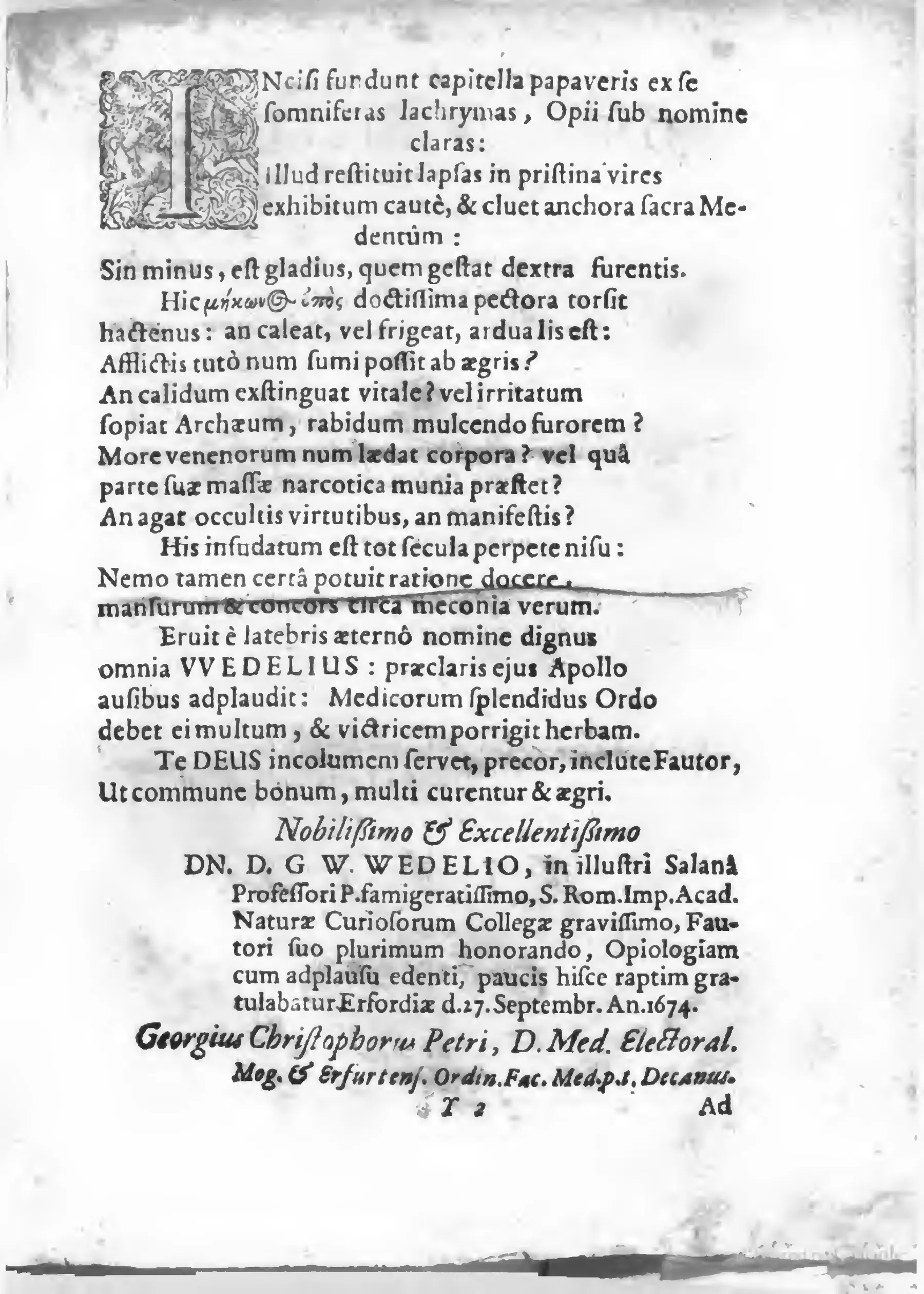
In this closing commendatory verse, a historiated initial introduces Latin hexameters that make the poppy Wedel's emblem of prudent medicine: opium is praised as the "sacred anchor" of healers yet likened to a sword dangerous in mad hands. Petri's printed Erfurt subscription of 27 September 1674 and his formal address to Wedel as a colleague of the Academia Naturae Curiosorum make the page at once praise-poem and institutional certification of the Opiologia's learned setting. Source ↗.
Frequently Asked Questions
What is Georg Wolfgang Wedel's Opiologia?
The Opiologia ad mentem Academiae Naturae Curiosorum is a scholastic-iatrochemical monograph on a single drug, opium, written in Latin by the Jena physician Georg Wolfgang Wedel and printed at Jena by Johann Fritsch in 1674. It confronts opium's central paradox — the most potent remedy in the physician's store yet a substance long feared as a poison — and disciplines it by asking how a physician might rightly know, prepare, and administer the drug. Its title binds it to the Academia Naturae Curiosorum, the Schweinfurt society of 1652 that later became the Leopoldina.
Who was Georg Wolfgang Wedel?
Georg Wolfgang Wedel was a physician of Jena, active in 1674, who held the university's chairs successive to the chymical teaching program of his teacher Werner Rolfinck. He was admitted to the Academia Naturae Curiosorum under the academy cognomen Hercules II, an affiliation the Opiologia materially registers. Trade listings attribute his admission to the treatise's success, though biographical entries place it somewhat later in the 1670s. He produced several materia medica and iatrochemical works, including the Pharmacia in nuce and the Compendium medicinae universae, of which the Opiologia is the most prominent.
Why did Wedel reject the ancient view that opium is cold?
Wedel overturned the inherited Galenic verdict that opium is cold in the fourth degree, judging instead that it acts entirely through heat (per calida omninò, "through the hot altogether"). His warrant was chymical: he subjected opium to the furnace he called Vulcan and, through the glass, obtained phlegm, a volatile urinous spirit effervescing with acids, and a blackening oil — constituents incompatible with a merely frigid temperament. He explained sleep not as stupefaction by cold but as vaporous, sulphureous corpuscles obstructing the pores of the brain, declaring the ancients' cold-stupor hypothesis dead in the present day.
What did Wedel mean by calling opium "the sacred anchor of life"?
Wedel framed opium's double edge through a graded image: it is the sacred anchor of life for those who act well and circumspectly, yet Charon's skiff in the hand of the inexpert and like a sword in the hand of a madman. The three figures turn on the prudence of the hand, not the drug's own nature — the same substance is salvific, funereal, or murderous by degree of skill. This let him rehabilitate opium without denying its danger, dismissing lay dread as an empty "womanish fear" that cannot terrify the level-headed physician prescribing by the law of the art.
Is there an English translation of the Opiologia?
No modern critical edition and no complete translation into any modern European vernacular has been identified; the work has been approached chiefly through its early-modern Latin printings of 1674, 1682, and 1739. Separately, the Leo edition presents the full transcription and a complete English translation, generated by artificial intelligence and made freely available online for the first time. Leo is an effort to publish, at no cost, English translations of every text printed in Latin in early modern Europe between 1450 and 1750. As an AI-generated rendering, it should be checked against the original Latin.
This report was generated by an advanced AI assistant that conducted deep research alongside an extensive interpretation of the transcribed original text. Every effort has been made to preserve fidelity to the source and to guard against inaccuracy, but corruption in the text recognition process and model hallucination may nonetheless have entered the text. Treat every claim, quotation, translation, and citation as provisional, and verify each against the original source before relying on or citing it.
Bibliography
- Debus, Allen G., "Chemistry and the Universities in the Seventeenth Century," Estudos Avançados: Traces the persistence of Jena iatrochemistry into the later seventeenth century and names Wedel among those who had taught chemistry there. Read it to see why Wedel's furnace work was an institutional inheritance rather than an eccentric flourish.
- Maclean, Ian, Die Arbeiten von Hercules: Georg Wolfgang Wedel, die Leopoldina und der norddeutsche Büchermarkt um 1680: The nearest thing to a modern monographic study of Wedel, framing him as a publishing operator within the Leopoldina and the north-German book trade. It supplies the institutional and commercial context the Opiologia's own title-page cannot, and its very title borrows Wedel's academy cognomen, Hercules.
- Principe, Lawrence M., "The Two Brendels, Rolfinck, Wedel, and Others," AMBIX: Positions Wedel within the Jena chymical genealogy running back to Werner Rolfinck and confirms him as one of the professors teaching courses of chymistry there. Consult it to locate the classroom and laboratory from which the treatise's chemical analysis of opium emerged.
- Stefano, George B., et al., "Reciprocal Evolution of Opiate Science from Medical and Chemical Perspectives," PMC: A long-arc survey of opium in medicine from Galen's Rome through the early modern period. Useful for placing Wedel's rehabilitation of the drug within the much longer sequence of medical opinion he was arguing against.
- Teigen, P. M., "Taste and Quality in 15th- and 16th-Century Galenic Pharmacy," The Art and History of Pharmacy: Lays out the four-quality, four-degree complexio system of Galenic pharmacy in precise detail. Read it first to grasp exactly which orthodoxy Wedel was overturning when he declared opium to act per calida omninò.
- Academia Naturae Curiosorum, Miscellanea Curiosa Medico-Physica Academiae Naturae Curiosorum: The official periodical of the Academy to whose mens the Opiologia is dedicated, the venue in which its members' observationes circulated. Browse it to see the empirical, case-gathering ethos Wedel invokes when he insists that one swallow makes no spring.



_200.jpg)