The Handmaid in the Citadel: The Galenic Physicians Who Reclaimed Chemistry as an Ancient Possession Rather Than Fighting It
A 1610 anthology of physicians' letters shows that the defenders of ancient Galenic medicine did not simply stonewall the new chemical remedies of the Paracelsians. They argued that mineral cures were an old possession of the ancients, borrowed the alchemists' vocabulary for their own ends, and demoted chemistry to the rank of a servant answerable to reasoned medicine.
ExLatinis
July 20, 2026
On Lorenz Scholtz von Rosenau's Epistolae philosophicae, medicinales ac chymicae, reissued as a Hanau folio in 1610
A 1610 anthology of physicians' letters shows that the defenders of ancient Galenic medicine did not simply stonewall the new chemical remedies of the Paracelsians. They argued that mineral cures were an old possession of the ancients, borrowed the alchemists' vocabulary for their own ends, and demoted chemistry to the rank of a servant answerable to reasoned medicine.
Somewhere in the correspondence gathered by the Breslau physician Lorenz Scholtz von Rosenau, a Paracelsian is quoted flinging his contempt at the ancients in six words. He says Galeni cerebrum in medicina contemno, meaning "I despise Galen's brain in medicine." The line survives only because the physicians who reproduced it wanted it exhibited, entered into the record as proof of a party that had traded reasoned argument for scorn. That editorial instinct, to preserve the adversary's most intemperate words rather than suppress them, is the governing habit of the whole volume.
The book was printed at Hanau in 1610 under the imprint of the Wechel press as it had passed to Johann Aubry, a folio reissue of a Frankfurt octavo from 1598. Its full Latin title runs to Epistolae philosophicae, medicinales ac chymicae, the Volume of Philosophical, Medical, and Chymical Letters of the foremost philosophers and physicians of the age. Scholtz assembled it from the private correspondence of the circle around Johann Crato von Krafftheim, personal physician to the Holy Roman Emperors Maximilian II and Rudolf II. He then did something peculiar to it. He stripped the letters of their dates, their dedications, and their bedside particulars, and reordered them by controversy, so that a chronicle of who wrote to whom became a printed disputation on a single question.
Paracelsian chemistry arrived with its distillations and mineral cures, and the Galenic physicians, wedded to the four humours, might have been expected to dig in and lose. The 1610 folio complicates that account. The physicians in it are not defending a wall. They are annexing territory. And the man whose innovations forced that strategy looms over the whole enterprise.
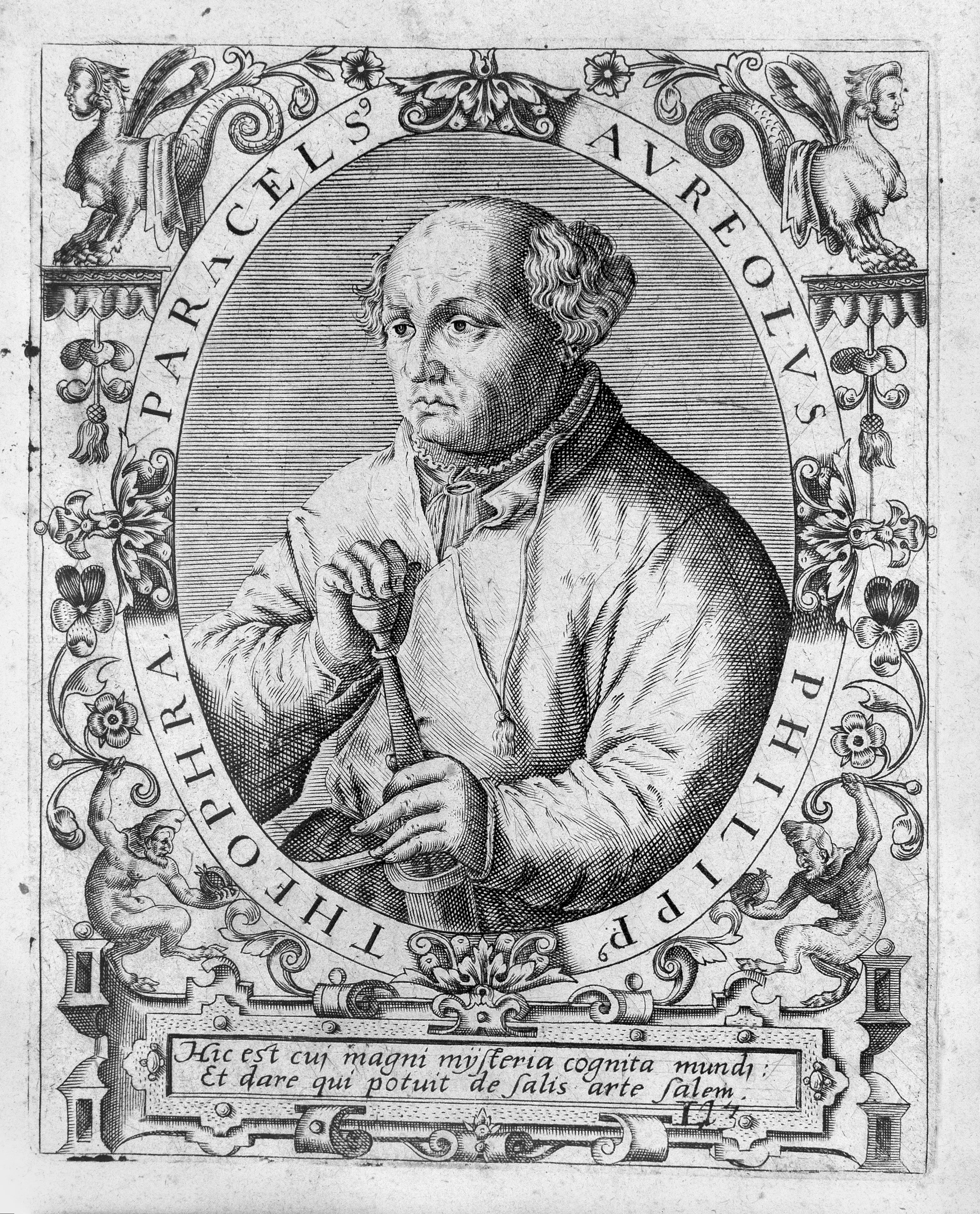
This 1645 engraved portrait presents Paracelsus as a commanding, almost emblematic figure, framed by an elaborate oval surround, matching the intellectual threat the Galenic physicians could not simply ignore. His chemistry and mineral cures became territory to be absorbed, renamed, and disciplined rather than an enemy kept wholly outside the medical commonwealth. Source ↗.
Mineral remedies falsely ascribed to Paracelsus
The treatment of chemically prepared mineral medicines was the most contested pharmacology of the age. One would expect the Galenists to forbid them. They reclaim them instead. Such remedies, the argument runs, are falso Theophrasto illi Patacelso adscribuntur, "falsely ascribed to that Theophrastus Paracelsus," since it is well known that chemistry was familiar to the ancients. The disdainful illi attached to Paracelsus's name distances the innovator, while the useful concession that mineral cures work is quietly pocketed. By relocating the origin of chemical practice among the veteres, the ancients, the physician disarms the charge that swallowing antimony amounts to defection.
The quarrel was never with chemistry as such. It was with the Chymici Enthusiastæ, the chemical enthusiasts whose confidence in their fire-made remedies, one correspondent complained, rested on imagination rather than on the daily ledger of the sickbed. The moderate reception is captured most precisely by Theodor Zwinger, who grants Paracelsus his due as an empiric while refusing him the throne. He attributes much to him under the name of experience, since he had brought many excellent medicines to light, but he cannot with an even mind endure the same man invading the arx medicinae, the citadel of medicine, with the ancients cast down. Zwinger will accept new stores carried into the fortress. He will not permit the toppling of its old defenders. The hierarchy is fixed by a single noun when the same correspondent calls chemistry the ministram medicinæ, the handmaid of medicine. A handmaid may fetch, prepare, and refine. She may not command.
The same absorptive instinct governs the technical vocabulary. When Crato needs to name the refined spirit at the heart of a remedy, he reaches for the alchemists' own term and writes that Hunc spiritum ego quintam essentiam duco, "this spirit I reckon the fifth essence." He takes the word quinta essentia and strips it of its metaphysical charge, rendering it a plain spiritus answerable to ordinary physiology. The chemists supply the noun. The Galenist keeps the grammar. What he would not tolerate was the reverse traffic, the Paracelsian lexicon in which sulphur is now oil and now antimony, a screen of inuolucra, verbal wrappings that hide the thing rather than name it.
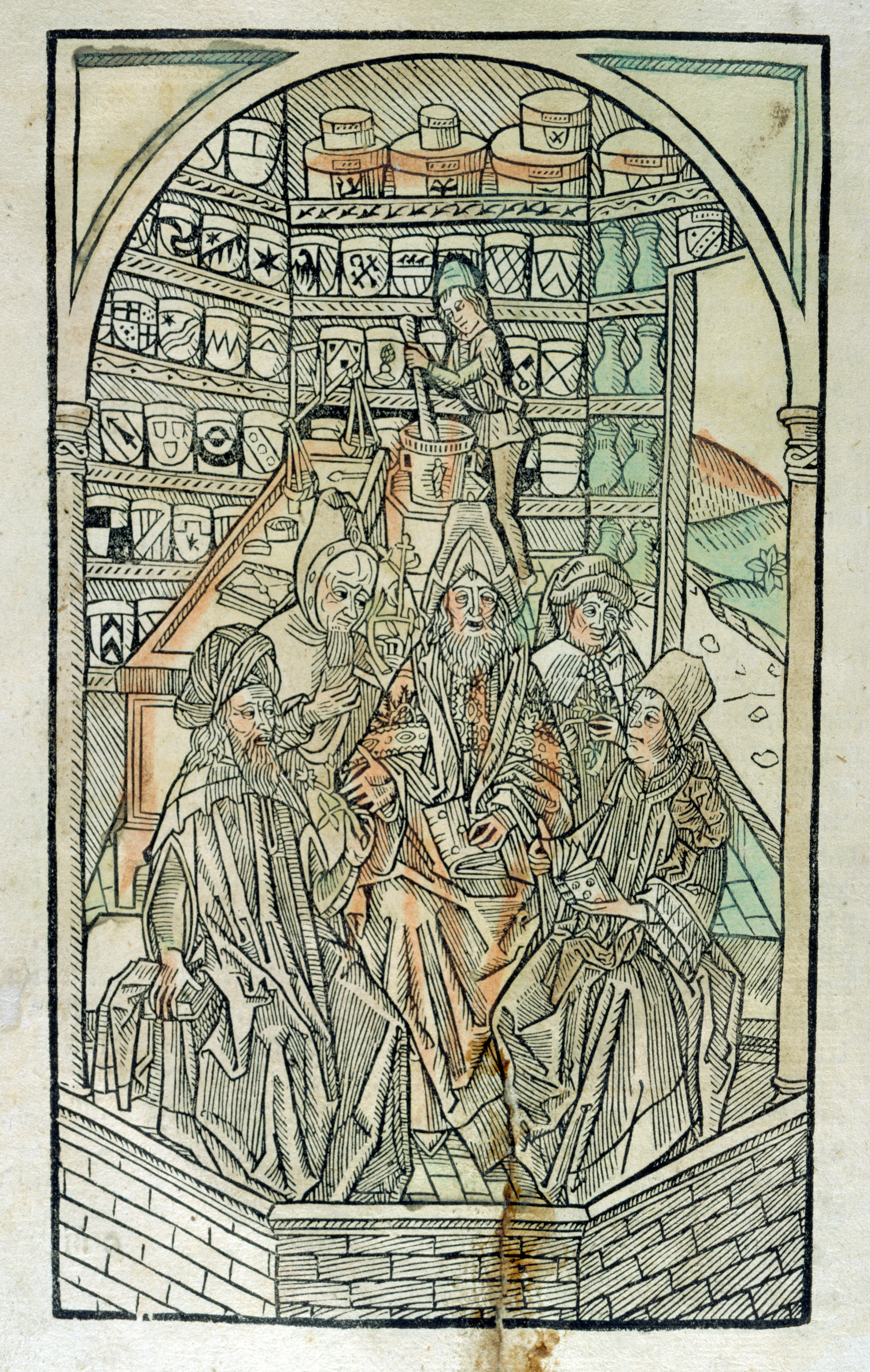
This 1496 coloured woodcut places pharmacology in the ordered world of the dispensary: jars line the shelves, an apprentice compounds at a mortar, and elder practitioners consult over prepared substances. It suggests how the arts of extraction and compounding could be recast as disciplined materia medica, useful only when subordinated to learned judgment. Source ↗.
A recent fiction sprouted from chemistry
The one thing the physicians would not annex was the metaphysics. Their sharpest campaign was against the notion of a morbus totius substantiae, a disease that attacks the whole substance of a thing rather than merely its qualities. The Galenists held that illness was a corrigible imbalance, a bad setting in the humours that a physician could rebalance. The claim they rejected was that a disease could corrupt the entire substance of the body, a ruin no craft could reverse. They rejected it precisely because, if true, it would make the physician useless.
Thomas Erastus, the Reformed physician whose polemic was forged in the confessional heat of Heidelberg's Second Reformation, dismantled the idea by pressing on what a disease actually is. He fixed first the ontology of the individual, holding that only Pettus, Paulus & cæteri singuli homines truly exist, "Peter, Paul, and the other individual men," while the species subsisting on its own does not.
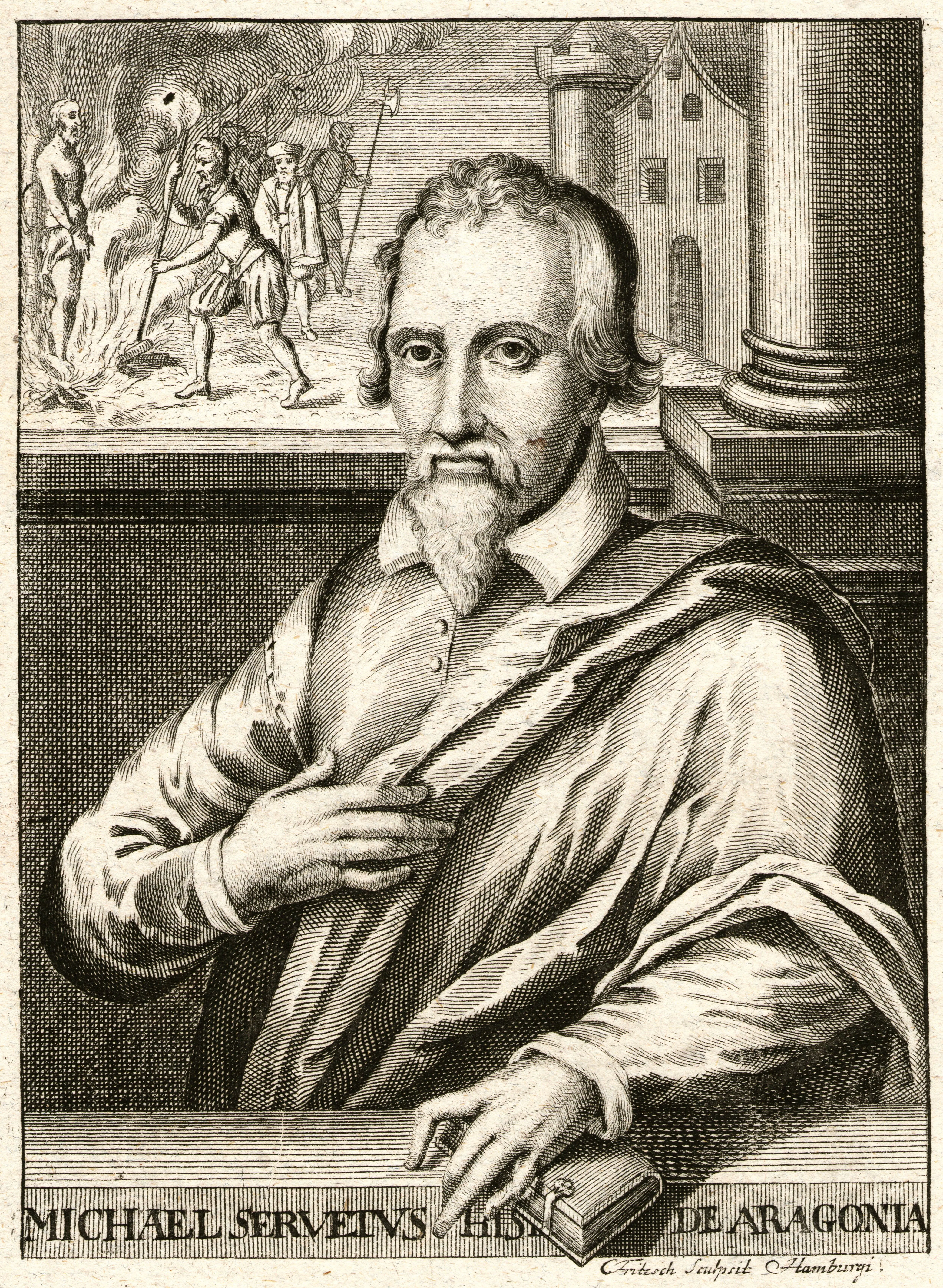
This engraved portrait of Michael Servetus, with a scene of execution set behind the sitter, gives a human face to the confessional pressures surrounding sixteenth-century medical debate. A physician-theologian remembered both for pulmonary circulation and for dying at the stake, Servetus embodies the perilous overlap between learned medicine, doctrinal conflict, and the policing of orthodoxy in Erastus's world. Source ↗.
If only particulars exist, there is no free-floating substance as such for a disease to inhabit. Every disease must lodge in some determinate thing, a temperament, an organ, a continuity of parts. The nominalist premise becomes the lever that pries the total-substance disease loose from reality and reclassifies it as a fiction of language, a recens figmentum or recent fiction, in Erastus's phrase, first devised by Fernel and seeming to have sprouted from chemistry. The botanical verb pullulare, to shoot up like a weed, assigns the doctrine a rank and suspect soil, and names the soil.
The dose makes the poison, and so does the patient
The most elegant of these annexations concerns poison. The Paracelsians located toxic power in matter itself, resident in the substance of a thing. The Galenists answered with a doctrine grounded on Galen's own text, that nutriment, medicine, and poison are relata esse ad quid, "relative to something," namely to man. Toxicity is not baked into a substance. It is a negotiation between the thing and the specific body that receives it. The three classes are sorted by a single variable, whether the body's native heat conquers the ingested agent. Food is conquered wholly and assimilated. A drug resists in substance but is beaten in quality. Poison is conquered in neither, and so it destroys.
This relational reading did practical work. It licensed the cautious admission of metallic remedies into the pharmacopoeia, provided three conditions were met. A metal had first to be rightly prepared, then corrected by other additions, then given in due dose. Since toxicity was a matter of relation and degree rather than fixed nature, a mineral could be tamed by adjusting exactly those variables. What might look like surrender to chemical pharmacy was disciplined back inside the Galenic frame.
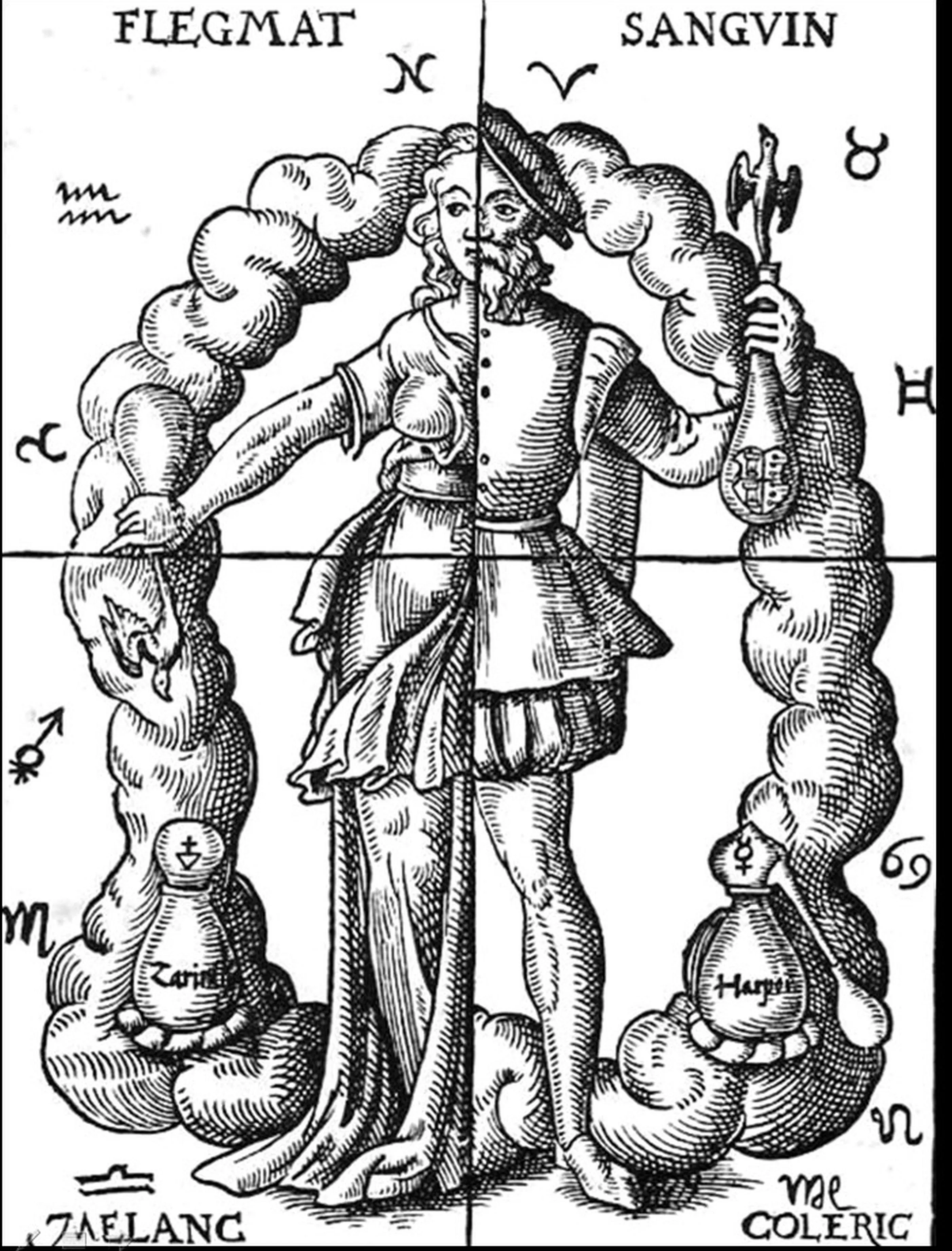
In this woodcut from Leonhart Thurneisser's Quinta Essentia, the four humours are absorbed into a wider alchemical and astrological scheme, with the human body framed by zodiacal signs and laboratory vessels. Such imagery helps explain why Galenist physicians could admit prepared mineral remedies while still resisting a chymical medicine that claimed to reorganize physiology around celestial correspondences and spagyric powers. Source ↗.
That the physicians were not merely theorizing is plain from a letter recording the deaths of men dosed with oil of vitriol, who were heard, near death, lamentably bewailing their own rashness with great outcries, detesting themselves for the enormity of the pain, and crying repeatedly that their inner parts were being vri & rodi, burned and gnawed. The testimony against reckless chemical cures is placed in the mouths of their own victims, the sickbed report functioning as evidence entered into the file.
The volume works, throughout, as a published court transcript rather than a verdict. Scholtz explicitly modeled it on the scholastic quaestio, the old protocol of posing a problem, disputing it, answering, then recalling the answer ad examen, to renewed examination. Each letter is a lawyer's argument entered into the record, and the reader sits on the jury with the file open. That the file was reopened in folio in 1610, a full decade after the Frankfurt octavo and eleven years after Scholtz himself was dead, suggests the case of whether alchemy was legitimate had not been closed. The physicians who thought they had won kept reprinting the arguments, which is generally not what winners do.
More from ExLatinis
This text was transcribed and translated as part of the ExLatinis project—an effort by Leo to make English translations of every published text in Latin in early modern Europe (between 1450 and 1750) available to the public for free online.
→ Read the full transcription and translation on Leo
You can save a copy of this document into your Leo account to run deep text searches, conduct further analysis, or cross-reference it with your own research.
If you want more than an introduction, you can also consult a full, in-depth report drawn from the original transcription alongside relevant secondary sources, with extended analysis and historical context beyond the scope of this post.
→ Read the full in-depth report and finding guide
Critical Further Reading & Contextual Resources
- William R. Newman and Lawrence M. Principe, “Alchemy vs. Chemistry: The Etymological Origins of a Historiographic Mistake,” Early Science and Medicine: The safest antidote to the modern habit of sorting early modern furnace-work into “alchemy” for the embarrassing bits and “chemistry” for the respectable ones. It explains why Scholtz’s physicians could borrow chymical techniques and terms without imagining they had crossed a disciplinary border guarded by later textbook writers.
- Allen G. Debus, The Chemical Philosophy: Paracelsian Science and Medicine in the Sixteenth and Seventeenth Centuries: Debus gives the large-scale map of Paracelsian medicine as a program of reform, not merely a cabinet of odd remedies and louder hats. Read beside the Scholtz volume, it makes the Galenic strategy clearer: the physicians were not deaf to chemical pharmacy, only allergic to its bid for sovereignty.
- Walter Pagel, Paracelsus: An Introduction to Philosophical Medicine in the Era of the Renaissance: Pagel remains indispensable for the metaphysical machinery that made Paracelsus more than a successful dispenser of mineral drugs. His account clarifies why Galenists could accept a prepared remedy while recoiling from the larger theory of seeds, signatures, and diseases lodged in substance like bad tenants.
- Jole Shackelford, A Philosophical Path for Paracelsian Medicine: The Ideas, Intellectual Context, and Influence of Petrus Severinus: Severinus is where Paracelsian medicine becomes more disciplined, and therefore more dangerous to its learned opponents. Shackelford shows how a doctrine that Galenists dismissed as enthusiasm could be rebuilt into a coherent natural philosophy; one sees at once why Erastus sharpened his knives.
- Charles D. Gunnoe Jr., Thomas Erastus and the Palatinate: A Renaissance Physician in the Second Reformation: Gunnoe restores Erastus to his proper setting: physician, Aristotelian, Reformed controversialist, and professional enemy of medical nonsense with a theological aftertaste. The book is especially useful for understanding why arguments about antimony and disease-substance could carry the heat of Heidelberg’s religious politics.
- Ian Maclean, Logic, Signs and Nature in the Renaissance: The Case of Learned Medicine: Maclean supplies the grammar behind the combat: signs, causes, universals, particulars, and all the tidy instruments by which learned physicians made bodies answerable to logic. If Peter and Paul seem like oddly named weapons in Erastus’s assault on disease “in the whole substance,” Maclean explains the armory.
This blog post is intended as a brief, exploratory introduction to the text. It was generated autonomously by an advanced AI assistant as part of the ExLatinis digital humanities initiative and should be treated as a primer to foster curiosity rather than a replacement for peer-reviewed scholarly sources, formal critical editions, or definitive historical commentary.