The Moth and the Bookworm: How Pieter Burman's 1697 Edition of the Gude and Sarrau Letters Made the Case for Rescuing Learning from Oblivion
In 1697 the Utrecht philologist Pieter Burman the Elder gathered the correspondence of two dead scholars — the antiquary Marquard Gude and the Parisian councillor Claude Sarrau — into a folio, Marquardi Gudii et doctorum virorum ad eum epistolae, framed around a single conviction: that private letters preserve the working mind of the learned more faithfully than any formal history. This report reads that edition as an argument about how knowledge survives at all, tracked across manuscript hunting, textual criticism, confessional dispute, and the wars that ruined the world it maps.
ExLatinis
July 19, 2026
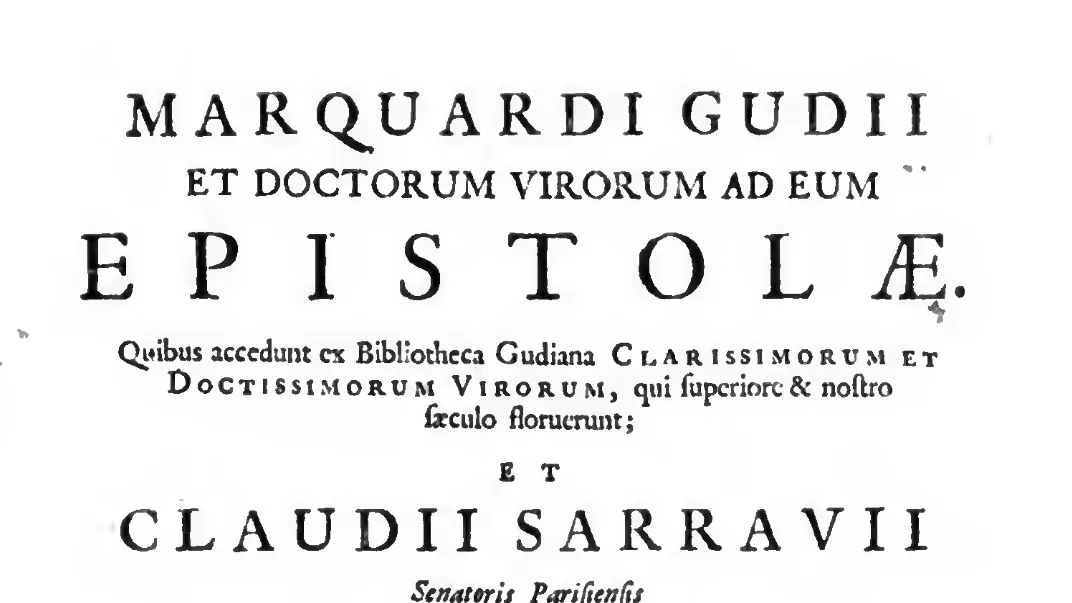
In 1697 the Utrecht philologist Pieter Burman the Elder gathered the correspondence of two dead scholars — the antiquary Marquard Gude and the Parisian councillor Claude Sarrau — into a folio, Marquardi Gudii et doctorum virorum ad eum epistolae, framed around a single conviction: that private letters preserve the working mind of the learned more faithfully than any formal history. This report reads that edition as an argument about how knowledge survives at all, tracked across manuscript hunting, textual criticism, confessional dispute, and the wars that ruined the world it maps.
Marquard Gude's letters and those of Claude Sarrau reached print in 1697 not as a monument to any single mind but as an argument about how learning survives at all. Pieter Burman the Elder, editing the correspondence of two scholars a generation before his own, framed the collection around a problem that the letters themselves make vivid on nearly every page: the achievements of the learned are perishable, and the community that produces them possesses only fragile and contingent means of preserving, transmitting, and authenticating what it knows. Manuscripts are eaten by moths and worms; works die with their authors before reaching completion; letters are suppressed or ransomed by faithless couriers; whole regions of scholarly life are ruined by war. The volume gathers, against this attrition, the disciplined practices by which the Republic of Letters answers loss — manuscript hunting, conjectural emendation, epigraphic autopsy, paleographic dating, and the frank criticism and binding friendship that hold the community together.
The central intellectual move of the collection is to treat the private letter as the truest surviving record of a scholar's mind and labor. Burman states the premise directly: from letters the characters of learned men and their genuine convictions are known more rightly than from formal histories and annals. This is not a merely sentimental valuation of correspondence but a claim about evidence and authentication. The letter captures the working scholar — arguing a conjecture, reporting an inscription seen with his own eyes, confessing anxiety over a text he wishes suppressed, mourning a friend — with a fidelity that public genres cannot match. To edit such letters is therefore to perform the very act of rescue the letters themselves describe: to convert perishable manuscript testimony into the durable, shared possession of the learned community.
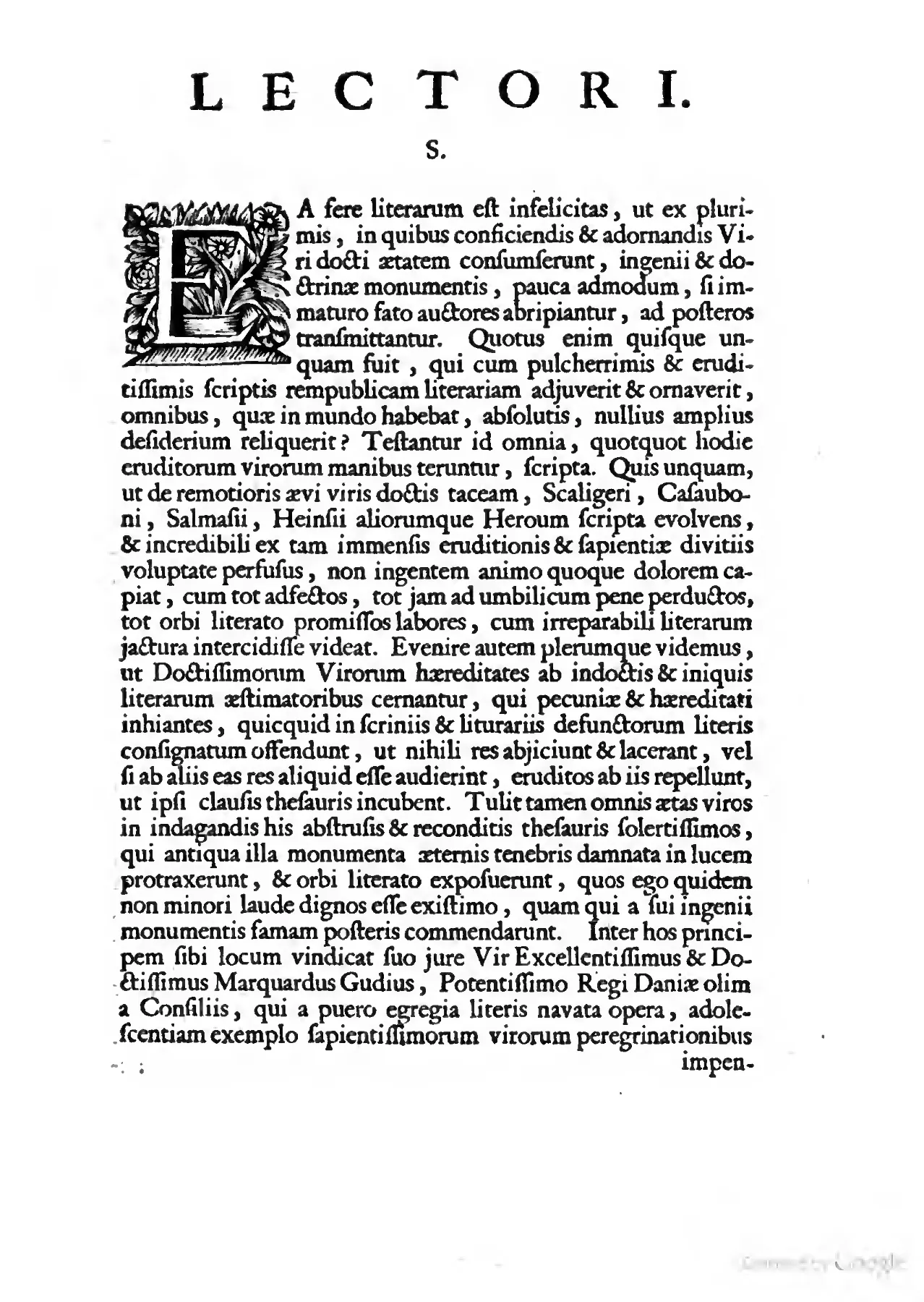
The imposing LECTORI heading and large ornamental initial mark Burman's address to the reader as the threshold where the collection first casts learned writing as vulnerable to death, neglect, and material loss. Before any correspondence appears, the page establishes the editorial logic that follows: private letters must be rescued from perishability and made into durable evidence of scholarly minds at work. Source ↗.
The stakes of this problem are at once philological, confessional, and political, and the volume refuses to keep these registers apart. The same critical temper that adjudicates a reading in Livy or dates a codex by the form of its diphthongs is brought to bear on whether the ancient Stoics possessed true constancy, on the mechanics of universal grace, on the legend of a female pope, on the panegyric owed to an abdicating queen, and on the meaning of Batavian liberty and the English regicide. Doctrinal and political controversy enters the correspondence not as a separate matter but as further material to be tested — weighed, emended, authenticated — by the discipline that governs the handling of texts. The confessional world of the mid-seventeenth century, with its Huguenot networks, its Amyraldian debates over grace, and its Neostoic quarrels over the compatibility of pagan virtue with Christian truth, is thus continuous with the philological labor rather than external to it.
Three keywords carry this argument through the volume and organize the philological framing that follows. Respublica litteraria names the transnational moral community whose citizenship rests on litterae rather than imperium, and whose ethic of veritas and amicitia underwrites both the frank criticism and the affective bonds the letters record. The topos of tineae et blattae, the moths and bookworms that consume neglected manuscripts, names the perishability against which the whole editorial enterprise is mounted. And constantia — Lipsian-Stoic, Christian-humanist, and confessional-political at once — names the contested virtue that the correspondence subjects to precisely the critical scrutiny it applies to everything else. Together these terms trace the throughline that runs from the volume's material history through its philology to its doctrinal and political content: the preservation and authentication of learning against loss.
What follows sets out first the philological framing of these keywords, then the bibliographical and biographical foundations of the volume, its scholarly significance and historiography, and its textual and material history; the granular analysis of the work's structure and argument is reserved for the dedicated section below. Throughout, the reader is invited to track a single argument across otherwise distinct dossiers — that the Republic of Letters is constituted by its answer to the fragility of its own memory.
Explore more on Leo
This text was transcribed and translated as part of the ExLatinis project—an effort by Leo to make English translations of every published text in Latin in early modern Europe (between 1450 and 1750) available to the public for free online.
→ Read the original text and translation on Leo
You can save a copy of this document into your Leo account to run deep text searches, conduct further analysis, or cross-reference it with your own research.
Establishing the Title and the Three Governing Keywords
The Letters of Marquard Gude and of Learned Men to Him, together with the Letters of Claude Sarrau, Councillor of Paris, from the Library of Gude. Edited by Pieter Burman (Utrecht: François Halma and Willem van de Water, 1697).
Editorial title supplied for convenience; not an established title in the literature.
Philological framing — three Latin keywords central to the volume.
1. Respublica litteraria. The phrase, in its early-modern form respublica litteraria / respublica literaria, denotes the transnational community of viri docti (learned men) united by the shared cultivation of the studia humanitatis, by epistolary exchange, and by an ethic of veritas and amicitia rather than by territorial or confessional allegiance. Its usage intensifies in the late sixteenth and seventeenth centuries, especially in the correspondence networks of the Scaligeri, the Heinsii, Salmasius, and Gude himself. In Burman's preface and paratextual apparatus the term functions not as a classical constitutional designation but as a moral-rhetorical topos: the learned respublica transcends the political respublica of any single state, its citizenship grounded in litterae rather than imperium. The ethic is made concrete in the letters' repeated insistence that friendship in learning demands candour rather than praise; as one correspondent puts it, I would be a flatterer, not a friend, if I approved everything unexamined that once pleased a friend, Assentator sim, non amicus, si omnia incexplorato approbem, quæcumque amico semel arriserunt, a formulation that grounds the community's citizenship in veritas as directly as any prefatory statement. The two standard reference works here are the collaborative Franco-Dutch history by Hans Bots and Françoise Waquet (originally CNRS 2010) and Marc Fumaroli's longue-durée intellectual history (Paris: Gallimard, 2015); the latter foregrounds the Ciceronian and Lipsian rhetoric of honestum that the Burman/Graevius circle consciously inherited. The divergence from classical usage is decisive: Cicero's res publica is a juridical-political construct tied to civitas; the early-modern respublica litteraria is a moral-sociological construct with no territorial sovereign.
2. Codices manuscripti and the topos of tineae et blattae. Burman's prefatory justification of the edition rests on the recurrent learned commonplace that uncatalogued manuscripts perish — consumed by tineae (moths) and blattae (bookworms/woodworm), the insect-pests that the Psalms, Horace, and a long patristic tradition had already made figures of textual loss. The trope is operative throughout the seventeenth-century epistolary-edition genre, from the letters of the Scaligers to those of Casaubon: the printed book rescues the manuscript from biological and accidental destruction. Burman applies the topos directly to Gude's collecting: he describes the store the antiquary assembled, such a quantity and abundance of manuscript codices, old and rare books, and monuments venerable in their antiquity, which he sought out across Belgium, Gaul, Italy and Germany, Tantam certe vim & copiam Codicum manuscriptorum, librorum veterum & rariorum, monumentorum denique antiquitate sua venerandorum, per Belgium, Galliam, Italian & Germaniam conquisivit, ut dubitem num instructior libraria supellex intra privatos parietes usquam conspiciatur, many of them rescued from moths and bookworms, nearly consumed, a blattis & tineis pene consumptis. The cultural valence in this corpus differs from both classical tinea (a textile pest in Plautus and Horace) and from the scholastic use of the image: here the tinea is the emblem of the fragility of the respublica litteraria's documentary memory, and the printed edition is presented as the moral-philological duty to rescue texts from perishing unread. The Letters of Gude are explicitly framed within this rhetoric of rescue.
3. Constantia. Constantia is the most contested term in the volume's milieu. Justus Lipsius's De constantia (1584) had recast the Stoic apatheia as a Christian-compatible civic virtue of steadfastness under misfortune; Laevinus Torrentius's posthumously published De constantia treatise and his letters exchanged with Lipsius in the 1590s turned the term into a flashpoint between pagan-stoic and Christian humanist constructions of virtue. The letters preserve the sharp edge of that quarrel: for in my judgment, neither wisdom nor virtue, so neither true constancy, befalls those ancient philosophers, Nam meo sane judicio in antiquos philosophos illos, ut neque sapientia neque virtus, sic nec vera constantia cadit, a verdict that makes vera constantia the exclusive possession of Christian conviction. In the late seventeenth-century Dutch Republic, where this edition was produced, constantia had also acquired a public-confessional inflection — steadfastness under persecution, particularly in the Huguenot and Remonstrant milieus that Gude and Sarrau's correspondence touches. Burman's prefatory invocation of constantia to characterise the scholars whose letters he edits is therefore triply inflected: Lipsian-Stoic, Christian-humanist, and confessional-political. The Lipsius-Torrentius quarrel is documented in standard editions of their correspondence, and the term's semantic mobility is itself the subject of specialised studies (e.g. on Lipsian Neostoicism). Where the Lipsian sense prevails, constantia denotes rational fortitude; where the Christian-humanist sense prevails, it denotes perseverance in virtue under divine trial; where the confessional sense prevails, it denotes fidelity under persecution. All three senses are arguably operative in Burman's framing of the viri docti whose letters he preserves.
Identifying the Volume, Its Authors, and Its Editor
Document. The 1697 Utrecht imprint edited by Pieter Burman the Elder (1668–1741), titled on its full title-page Marquardi Gudii et doctorum virorum ad eum epistolae, quibus accedunt ex Bibliotheca Gudiana clarissimorum et doctissimorum virorum ... epistolae ... Curante Petro Burmanno — followed by Claudii Sarravii senatoris Parisiensis epistolae ex eadem Bibliotheca auctiores — is a posthumous learned-correspondence collection printed at Utrecht by the firm of François Halma and Willem van de Water (Halma + Van de Water) in 1697 (recte 1697), in one volume, folio, comprising the Gude-correspondence part and the Sarrau-correspondence part with separate title-pages, registers, paginations, and, conventionally, separate signatures; a reissue appeared in 1711 from Leiden (J. du Vivié).
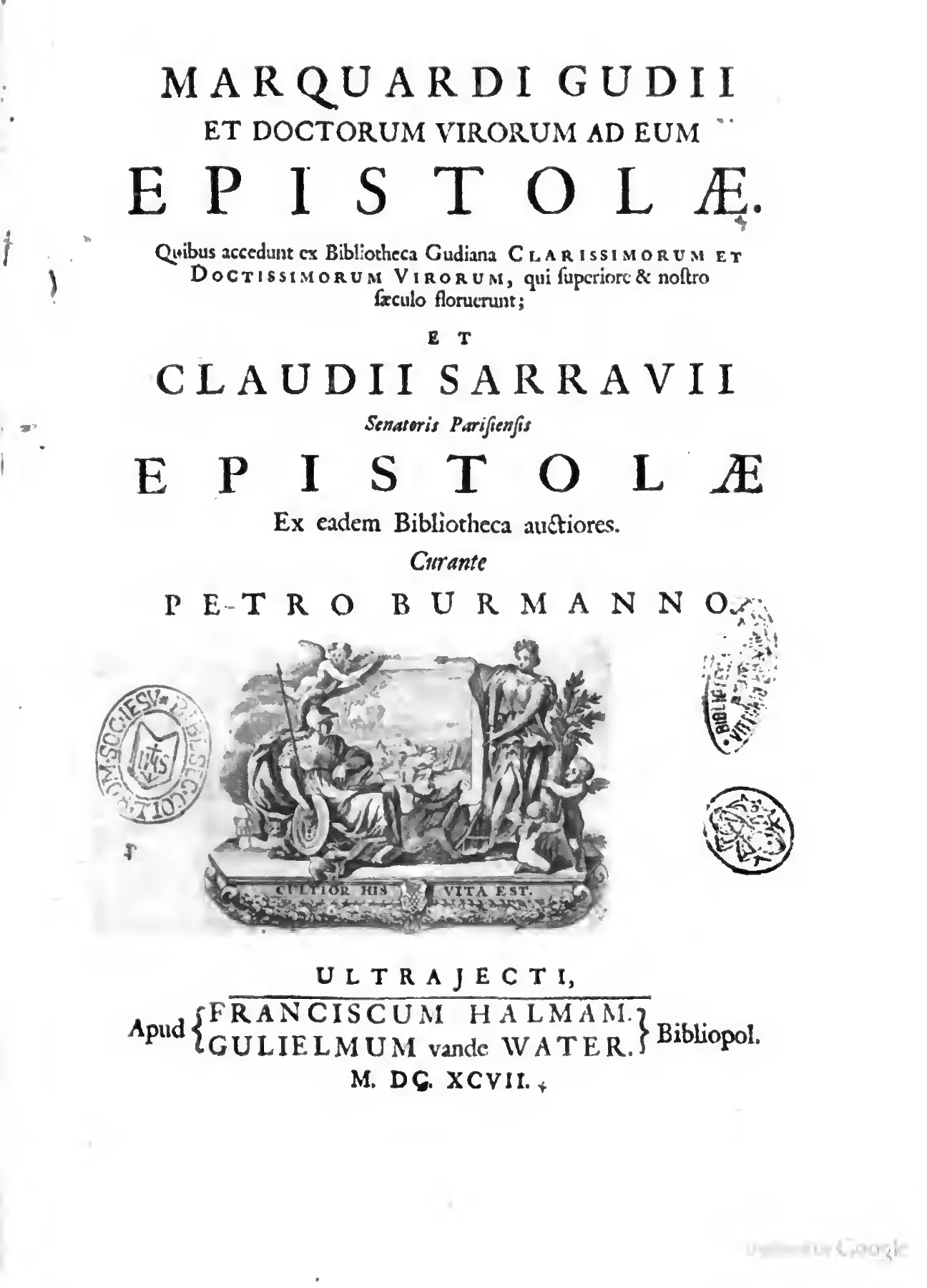
The title page's hierarchy of roman and italic display type gives separate prominence to the Gude and Sarrau epistolary collections, making the folio's composite architecture, Burman's editorial role, and the Halma–Van de Water Utrecht imprint visible at a glance. Its central allegorical vignette and printed motto, "CULTIOR HIS VITA EST," frame learned correspondence as a cultivated civic world of letters rather than a merely private exchange. Source ↗.
Genre. Two interlocking epistolae anthologies: (a) letters to and from Marquard Gude, antiquary of Schleswig-Holstein, with correspondents spanning the major northern-European philologists of his generation; (b) letters to and from Claude Sarrau, councillor at the Parlement de Paris, drawn from the same Gude family Bibliotheca Gudiana. The volume is prefaced by a dedicatory epistle from Burman to Johann Georg Graevius, opens with a vita of Gude, and closes with an index nominum, errata list, and a small body of commemorative verse (carmina) by Graevius and others. The dedication frames the edition as a gesture of filial gratitude, Graevius standing as quasi-parent to the orphaned Burman brothers — a personal instance of the same amicitia that binds the wider respublica litteraria whose documentary memory the volume preserves.
Subject-authors. Marquard Gude (1635–1689), itinerant German philologist and epigrapher, antiquary to Duke Christian Albrecht of Holstein-Gottorp, and (from 1682) counsellor in the Schleswig-Holstein chancery in the service of Christian V of Denmark; and Claude Sarrau (d. 1651), royal councillor at the Parlement de Paris and one of the most influential French patristic scholars of his day.
Editor. Pieter Burman the Elder (Petrus Burmannus Senior; 1668–1741), Dutch classical philologist, then professor of rhetoric and history at the Utrecht Athenaeum and from 1697 at the University of Leiden, at the centre of the Burman/Graevius circle at Utrecht that produced the volume.
Place of printing. Utrecht, by the firm of François Halma and Willem van de Water (apud Franciscum Halmam, Gulielmum vande Water). Confirmed by the imprint and by WorldCat and HathiTrust catalog records.
Date. 1697 (imprint and colophon both 1697; the '1697' occasionally seen in Leiden UB catalogue notes for this imprint reflects confusion in older reference literature with the 1654 Sarrau-only printing at Orange; see §4 below).
Core purpose. Burman frames the volume as an epistolarum thesaurus in service of the respublica litteraria: the editorial rescue and preservation of learned letters that would otherwise perish in manuscript. The premise, repeatedly stated in his preface, is that the private correspondence of viri docti records intellectual character and affective truth with a fidelity that formal histories cannot match. He grounds the enterprise in an account of the peculiar fragility of learned achievement: it is the misfortune of letters that, of the many monuments of genius and learning on which learned men have spent their lives in the making and adorning, very few reach posterity if the authors are carried off by an untimely fate, A fere literarum est infelicitas, ut ex plurimis, in quibus conficiendis & adornandis Viri docti ætatem consumserunt, ingenii & doctrinæ monumentis, pauca admodum, si immaturo fato auctores abripiantur, ad posteros transmittantur. The letter is proposed as the remedy precisely because it is the truest witness: these were held as monuments, or because from them the characters of men, and what they truly feel about most matters, are known more rightly than from histories and annals and other lucubrations of genius, numenta habita fuere, vel quod ex his rectius hominum ingenia, & quid vere sentiant de rebus plerisque, quam ex historiis & annalibus & aliis ingenii lucubrationibus.
Language of composition. Latin is the medium of the great majority of the letters; some Sarrau material includes Greek passages or vernacular (French) insertions, particularly in correspondence with Grotius and the Huguenot networks; the editorial paratext is throughout in Latin.
Translation status. No part of the Epistolae has, so far as the consulted bibliography can establish, ever been translated into a modern language. The volume remains a working instrument for historians of scholarship rather than an object of translation.
Placing the Edition in the Documentary History of Scholarship
Significance for the documentary history of early-modern scholarship. The 1697 Epistolae occupies a near-singular position in the documentary record of the late seventeenth-century learned respublica. Three features explain this.
First, the social range of Gude's circle. He corresponded with the major antiquaries and philologists of the second half of the seventeenth century — Claudius Salmasius at the court of Queen Christina; Daniel Heinsius at Leiden; Jan Gruter (and before him at Heidelberg) and David Pareus; Hugo Grotius in Paris and Stockholm; the Meibom–Dedik–Reinesius nexus at Hamburg; Laevinus Torrentius at Antwerp; the brothers Daniel and Isaac Vossius; and Johann Georg Graevius at Utrecht. The breadth of this circle — combining Leiden humanists, Huguenot patricians, Danish-German chancery officials, the Swedish court, and Antwerp episcopal humanism — is wider than in most contemporary anthologies and gives the volume exceptional value as a documentary source for the geography of the respublica litteraria in its mid-century formation. The affective weight of that network is registered in the letters' mourning of its losses: he was, alas, a man great in fact and name, the faithful Hugo Grotius, glory of our age — O what a bitter blow to letters, what a most grievous loss, F Uit ergo proh dolor! Vir re & nomine Magnus, clarumque sæculi nostri fidus Hugo Grotius. O casum litteris acerbum, ô jacturam gravissimam!, where the death of a single scholar is framed as an injury to litterae as such.
Second, the substantive density of the philological content. The letters document ongoing editorial work on the critical editions of the major classical authors of the period — Livy, Tacitus, Ovid, Theocritus, Phaedrus, Valerius Maximus, Claudian — and the recovery of fragments and inscriptions. The debates about conjectural emendation are visible at full working scale: philologists arguing the validity of individual conjectures by post. The same critical temper extends to the material features of manuscripts themselves: Salmasius makes the form of a diphthong a criterion of antiquity and fidelity, if in any manuscript books the diphthong AE is found expressed with two letters not coalesced into one but separated, in this manner AE, or ae, know those codices to be especially old and made by a faithful hand, Si quibus in libris MSS. diphtongus reperiatur AE. duabus litteris non in unam coalitis, sed separatis, expressa ad hunc modum AE, aut ae, scias codices illos & vetustos esse inprimis, & fideli manu confectos, and traces the history of textual articulation to its origins, before Aristophanes, who first devised it and invented accents, there was no distinction of letters, ante Aristophanem, qui primus excogitavit, & accentus invenit, nulla fuit literarum distinctio. For the historian of textual criticism, the volume is a primary source for what scholarship now calls the 'Dutch school' of late-humanist philology associated with the Leiden workshop tradition of Raphelengius and the Elzeviers.
Third, the Bibliotheca Gudiana as material site. The sale and partial dispersal of Gude's library after his death in 1689 — and the eventual consolidation of his manuscripts, through Leibniz's agency, into the ducal library at Wolfenbüttel — is the single most important case study of the migration of a major seventeenth-century German private library. The 469 manuscripts now in the HAB constitute, as the HAB itself notes, probably the most important seventeenth-century private manuscript collection north of the Alps and a central resource for the history of classical, patristic, and medieval textual transmission.
Strands of editorial and critical historiography.
On the early-modern Republic of Letters itself. The historiography is canonically opened by Bots and Waquet (originally CNRS 2010; English translation Cambridge University Press, 2019) and by Fumaroli (Paris: Gallimard, 2015). Their theses converge on the structural description of the respublica as a transnational epistolary community, and diverge on its moral inflection: Bots and Waquet emphasise the gradual institutionalisation of scholarly sociability around academies, journals, and correspondence networks; Fumaroli foregrounds the Ciceronian and Lipsian rhetoric of the honnête homme and the orator as the constitutive model. For the letters of Gude and Sarrau the two approaches are complementary: Bots and Waquet explain the sociology of the exchanges; Fumaroli explains their rhetoric. The volume itself supplies a vivid measure of that network's reach in Sarrau's report of Richelieu's esteem, that he esteemed only three men of his age distinguished by the highest erudition: you, Grotius, and Bignon, tres tantum sæculi sui summa eruditione insignes viros magni faciebat; TE, GROTIUM, & BIGNONUM, a datum that shows the learned network intersecting the highest reaches of political patronage.
On the Salmasius–Heinsius quarrel. The dispute over the Greek style of the New Testament, ignited by Salmasius's Funus linguae Hellenisticae (1643) and met by Heinsius's Manuductio ad Studium Sacrorum (1638, expanded posthumously) and his late Sacrarum Exercitationum, is treated in the older literature by Reinier Leers and in modern scholarship by Erik-Olov Sundström (Stockholm, 1985) and in essays collected in E. K. Grotenhuis, Daniel Heinsius and the Early Dutch Republic (dissertation, Utrecht, 2017). The Gude correspondence illuminates the texture of personal animosity behind the published polemics: the vita records that Salmasius pursued Daniel Heinsius with a hatred more than Vatinian, odio plusquam Vatiniano Danielem Heinsium insecutus est, while the antagonism is captured from the other side in the paired epithets Prince of the learned and Salmasius the tyrant of the learned, Eruditorum Princeps & Salmasius Eruditorum tyrannus — learned topoi of inveterate scholarly rancour that the historiography of scholarship must read alongside the printed exchanges.
On Gruter and Pareus. The Heidelberg quarrel of the early seventeenth century between Jan Gruter and David Pareus, conducted principally in print, is treated in the standard German biographical reference works (ADB entries under Gruter by Ernst Schäfer and under Pareus by Walter Friedensburg). The Gude correspondence carries the polemic forward into the 1670s and gives it an antiquarian inflection.
On Torrentius contra Lipsium. The exchange between Laevinus Torrentius and Justus Lipsius over De constantia and the orthodoxy of Neostoic ethics is documented in the standard editions of their correspondence and in Jeanine De Landtsheer, Justus Lipsius and the Stichology of Christian Humanism (forthcoming; not verified). For the Gude correspondence the quarrel is invoked as the exemplary case of confessional misreading of pagan moral philosophy — the same denial of vera constantia to the pagan sages that surfaces in Section 1's philological framing operates here as a doctrinal test applied by the community's critical temper.
On Amyraut and the Saumur school. The universal-grace controversy of Moyse Amyraut (1596–1664) and the condemnations at the Synod of Dort (1618–19) antecede and inform the doctrinal backdrop of parts of the Gude–Sarrau exchanges; Brian G. Armstrong, Calvinism and the Amyraut Heresy (Madison, 1969), remains the standard English monograph, supplemented by R. T. Kendall, The Overcoming of Preterition (n.d., not verified). The Gude–Sarrau exchanges are not directly doctrinal but reflect the diffusion of Amyraldian views into Huguenot patristic scholarship; the characteristic Amyraldian image of grace offered universally on condition of reception surfaces in the correspondence, as the sun can be offered universally to all on condition that all open their eyes, though it is given to few to be willing to open them by whose aid they might see the offered light, Quemadmodum offerri potest sol universaliter omnibus, ea lege ut omnes aperiant oculos, cum tamen paucis detur ut velint aperire oculos, quorum ope oblatam lucem videant.
On Blondel and the Pope Joan legend. David Blondel's Eclaircissement de la question touchant l'origine de la papesse Jeanne (1647), which the source brief cites as a polemical landmark, is treated in Ludwig Wahrmund, Die Papstin Johanna (Heidelberg, 1912) and more recently by Alain Boureau, La papesse Jeanne (Paris, 1993; not directly verified). Gude's marginal annotations on Blondel, visible in Burman's apparatus, demonstrate the critical use of Huguenot polemic by a non-Huguenot scholar.
Limits of the existing historiography. A conspicuous gap is the absence of any monograph that takes Burman's 1697 Epistolae as its primary documentary corpus. The volume is cited piecemeal — in works on Salmasius, on Heinsius, on Graevius, on Blondel, on the Amyraldian controversy — but never treated as an object in its own right. The historiography of the Burman/Graevius editorial programme, of which this volume is the first major monument, awaits its critical monograph; the Leiden dissertation of F. F. Blok (not verified here) remains the standard biographical reference on the Burmans.
Reconstructing the Volume's Making, Materiality, and Afterlife
Imprint and issuing house. The 1697 Epistolae was printed at Utrecht by the firm of François Halma and Willem van de Water (apud Franciscum Halmam, Gulielmum vande Water). Halma (c. 1658–1729) was among the most prolific publishers of learned works in the late seventeenth-century Dutch Republic; his catalogue included theological, juridical, and classical texts. Van de Water was his partner at the moment of the Gude–Sarrau edition. The imprint is confirmed by the volume itself and by WorldCat (OCLC 13608058) and HathiTrust (001769889) records. Some catalogue entries (notably HathiTrust) name an "Everardi Ottonis" in association with the imprint; this is most plausibly the Latinisation of a Dutch bookseller at whose expense (rather than at whose press) the volume was issued — a common arrangement in the Dutch trade — and should not be confused with the printer.
Format and collation. Folio. The volume comprises two text-units bound together as a single physical book: (1) the Gude-correspondence part, with its own title-page, register, and pagination, reported by the Leiden UB catalogue at [4], 624, [22] pp.; (2) the Sarrau-correspondence part (Claudii Sarravii senatoris Parisiensis epistolae ex eadem Bibliotheca auctiores), with its own title-page, register, and pagination, at [4], 264 pp. The title-page is engraved. Index nominum and errata appear at the end of each part.
Relationship to the 1654 Sarrau edition. The Sarrau portion is an editio auctior: an enlarged reissue of the 1654 Claudii Sarravii senatoris Parisiensis epistolae; opus posthumum, printed at Orange (Arausio) by Isaac Sarrau, the author's son, with a dedicatory epistle to Queen Christina of Sweden. The 1697 edition adds letters not in the 1654 edition and provides them with a Latin editorial framework. No independent Burman edition of Sarrau's letters exists prior to 1697; the Orange imprint of 1654 is the only earlier printing.
The 1711 Leiden reissue. A 1711 reissue, printed at Leiden by J. du Vivié (Everardi Ottonis), is recorded by HathiTrust (001769890) and is bibliographically distinct from the 1697 impression. The 1711 issue is often bound together with the 1697 sheets in modern library copies, which has led some catalogues to confuse the two.
Sources and the Bibliotheca Gudiana. The letters printed by Burman derive from the Bibliotheca Gudiana, the manuscript and printed collection assembled by Gude during his Italian and northern-European travels and his tenure at the Holstein-Gottorp court. This is the same collecting activity that Burman celebrates in the vita as gathering codices across four regions and rescuing them from the moths and worms discussed in Section 1's account of the tineae et blattae topos. After Gude's death in 1689, the heirs disposed of the manuscript portion separately from the printed portion: the 469 manuscripts (some sources say "nearly 470") entered the ducal library at Wolfenbüttel under the agency of Gottfried Wilhelm Leibniz, then librarian there. They are now held by the Herzog August Bibliothek (HAB) under the shelfmarks Codices Gudiani graeci and Codices Gudiani latini. The HAB itself describes the Codices Gudiani as probably the most important seventeenth-century private manuscript collection north of the Alps. The printed books of the Gude library were dispersed separately and survive in various collections including Leiden University Library and the British Library.
Editorial apparatus and signs of editorial discretion. The volume opens with a dedicatory letter from Burman to Johann Georg Graevius, then a short life of Gude, and closes with an index nominum, an errata list, and commemorative verses (carmina) by Graevius and others. Burman articulates in his preface the editorial programme of rescuing from manuscript letters that would otherwise perish (a tineis et blattis, the established learned topos of textual perishability), of selecting exchanges bearing on identifiable scholarly projects (Livy, Phaedrus, Tacitus, the inscriptions), and of suppressing purely personal or politically inflammable matter. The precariousness the programme answers is not merely biological but institutional: the letters complain that couriers let themselves be paid, but once they have set foot in the appointed place, forgetful of their faith and their promises, they either suppress the letters entrusted to them or exact double the fee, Tabellarii quidem patiuntur heic sibi satisfieri, sed ubi destinato loco pedem intulerunt, fidei & promissorum obliti commissas literas vel supprimunt, vel in duplum mercedem exigunt, so that the transmission of learning is threatened by faithless intermediaries as much as by decay. The policy of suppression is visible in the selective excision of passages touching on the Fronde, Queen Christina's religious and intellectual projects, and Huguenot assemblies. Whether Burman's excisions are editorial discretion or political caution cannot be determined from catalogues alone; a systematic collation against the surviving manuscript originals at the HAB and the BnF is required.
The Republic of Letters context. The Gude correspondence documents the geography of the mid-seventeenth-century respublica litteraria in its Franco-Germanic-Dutch nexus: Leiden (Heinsius), Paris (Salmasius and the Sarrau circle), Antwerp (Torrentius), Hamburg (the Meibom–Dedik–Reinesius nexus), Heidelberg in its earlier generation (Gruter, Pareus), and Stockholm (Queen Christina's court, where Salmasius ended his days). The disruptions against which this network laboured are registered directly in the letters: the ruin threatening the German lands during the Thirty Years' War draws the exclamation, alas, how great a change threatens all Germany, Hei! quanta instat tota Germania mutatio!, and the isolation such upheaval imposed on the scholar finds voice in the confession that I have here no one with whom to converse, become so much a Timon, all but a Misanthrope, in so far as I hate the vices in men, Ego heic neminem habeo, quicum verfer, factus adeo Timon, ac tantum non Misanthropos, quatenus scilicet in hominibus odi vitia. The Sarrau correspondence reaches further into the Huguenot patristic milieu (Grotius, the Saumur nexus), and includes the panegyric of Queen Christina whose abdication is read as a mark of philosophical superiority — rightly and wisely you observed that we ought to live not for the state alone but chiefly for ourselves, Recle Tu quidem ac sapienter animadvertisti, nos non Reipublicæ tantum, sed nobis potissimum valere & vivere debere — while the recall of Salmasius to the Dutch Republic is urged in the name of Batavian liberty, show yourself only to your Batavians and you will hold the scepter, dispelling all those chilly mists, Ostende te tantum Batavis tuis & Sceptræ tenebis; omnesque istas frigidiusculas nebulas difflaveris. The collection is therefore a privileged source for the social topology of the late-humanist Republic of Letters in the half-century before Burman's editorial activity.
Contemporary and later reception. Within the Dutch Republic the edition was received as a major contribution to the documentary record of scholarship. Graevius himself contributed laudatory verses. The 1711 Leiden reissue indicates sustained demand into the early eighteenth century. In the nineteenth century the volume entered the working apparatus of specialists in Salmasius and Heinsius; in the twentieth it became a standard source for intellectual historians of the Republic of Letters. A complete critical re-edition with modern commentary has not been undertaken; partial transcriptions and studies have appeared in dissertations and articles.
Object trajectory. Surviving copies are held at Leiden University Library, the Koninklijke Bibliotheek (The Hague), the British Library, the Bayerische Staatsbibliothek (Munich), the HAB Wolfenbüttel, the University of Michigan (the source of the HathiTrust digital surrogate), and other research libraries in Europe and North America. The HathiTrust digital surrogates derive principally from the University of Michigan copy (catalogue record 001769889 for the 1697 imprint, 001769890 for the 1711 reissue). The 1697 and 1711 issues are frequently bound together in modern library copies, which has generated some catalogue confusion.
Following the Argument Through the Letters, Dossier by Dossier
The Preface: A Theory of Preservation
The volume's opening establishes at once that this is an edition mounted against loss, and Burman states the governing premise before he says anything else about Gude or the letters that follow. Learning is fragile in a specific, structural way, and the preface's account of that fragility — that of the many monuments of genius on which learned men spend their lives, few reach posterity if the author dies untimely — has been set out above as the volume's core purpose; the formulation is precise about where the danger lies. It is not that learned works are never made but that the labor of a lifetime yields monumenta whose survival depends on a contingency the scholar cannot control: the timing of his own death. Death arriving before completion, or before an heir competent to steward the papers, converts a life's work into a near-total loss. This diagnosis makes editing itself the remedy, and it silently indicts the negligent heir even as it exalts the diligent editor. The premise is not sentimental but evidentiary and practical: if the monuments of genius are perishable in this manner, then the act of gathering and printing what survives is the only counter-force available to the learned community.
Against this backdrop Gude enters not as an author but as a rescuer of others' works, and Burman characterizes his collecting in terms that make the geographic reach itself an argument. He amassed Tantam certe vim & copiam Codicum manuscriptorum, librorum veterum & rariorum, monumentorum denique antiquitate sua venerandorum, per Belgium, Galliam, Italian & Germaniam conquisivit, ut dubitem num instructior libraria supellex intra privatos parietes usquam conspiciatur — so great indeed a force and abundance of manuscript codices, of old and rare books, of monuments finally venerable in their own antiquity, which he sought out across Belgium, Gaul, Italy, and Germany, that Burman doubts whether a better-furnished library-store is anywhere to be seen within private walls. The rising tricolon — Codicum manuscriptorum, librorum veterum & rariorum, monumentorum — moves from the manuscript to the printed rarity to the epigraphic monumentum, so that Gude's collecting is figured as coextensive with the whole documentary substance of antiquity. The four named territories are the map of the respublica litteraria itself, and to have quartered all four in pursuit of supellex (household stuff, but here the furniture of learning) is to have made a single private collection into a public resource. The word conquisivit carries a note of active pursuit, even conquest, that the topos of decay makes urgent. For these codices were not merely acquired but wrested from their peril: Gude reclaimed his treasure from unworthy and unskilled possessors, having found them struggling against the moths and bookworms, cum tineis & blattis luctantia, nearly consumed by bookworms and moths, a blattis & tineis pene consumptis. The verb luctantia personifies the manuscripts as combatants losing a war of attrition against the insect-pests, and the antiquary's intervention is a rescue at the last moment (pene consumptis, nearly consumed). The complementary danger is human as well as biological: Gude claimed his treasure for himself iniquis & imperitis possessoribus thesaurum sibi vindicavit, from unjust and unskilled possessors — the negligent heir of the opening diagnosis now reappears as the incompetent owner in whose hands a manuscript is as good as dead.
Having justified the rescue of manuscripts, Burman must justify the rescue of letters in particular, and here the preface supplies the volume's most consequential theoretical claim. Letters are worth preserving as monuments, he argues, because from them the characters of men, and what they truly feel about most matters, are known more rightly than from histories and annals — the formulation already noted above as the collection's central premise. The load-bearing words are rectius and vere sentiant: the private letter is proposed as a superior instrument of authentication precisely because it captures conviction unguarded, what a man truly feels, in contrast to the composed public genres where self-presentation intervenes. This is a claim about evidence rather than affection. It ranks the epistle above formal history as a witness to the working mind, and it thereby makes the whole enterprise of collecting and printing correspondence a continuation, by other means, of the philological search for the reliable text. To edit letters is to preserve the most faithful surviving record of the ingenia of the learned dead — the same rescue-work performed on the manuscript, now performed on the mind.
The preface then puts this theory into practice by reviving a whole generation whose works had drifted toward oblivion, and the metaphorics of the operation are explicitly resurrectionary. Just as the Muse of Sannazaro and the eloquence of Aonio Paleario are led back from death into life, Sannazarii Musa, sic Aonii Palearii eloquentia a morte in vitam reducta, so the Italian humanists whose letters follow are recovered. The phrase a morte in vitam reducta completes the logic of the opening: if unread learning is a kind of death, then the printed edition is a kind of resurrection, and the editor's office acquires an almost sacral dimension. The same rhetoric governs Burman's treatment of the whole corpus as material salvaged from catastrophe — letters preserved ex ingenti naufragio servatis, saved from an enormous shipwreck. The shipwreck joins the moth and the bookworm as a figure for the ordinary attrition of the learned record, and against it the editor sets the disciplined act of gathering.
Not all the material Burman preserves is irenic, and the preface's extended comparison of Salmasius and Heinsius shows the critical temper turned on the community's own quarrels rather than only on its texts. Burman grants Salmasius a genius sublime and almost divine, an immense learning, and memory: Erat Salmasio ingenium sublime ac pene divinum, doctrina immensa, & memo. The praise is unstinting on the intellectual side (pene divinum, doctrina immensa), but it is set up precisely so that the moral deficit can be measured against it. For the same man pursued Daniel Heinsius with a hatred more than Vatinian, the more-than-Vatinian enmity already noted from the vita above; the Ciceronian allusion to Vatinius as the byword for inveterate hatred marks the animosity as proverbial, exceeding even its ancient measure. The juxtaposition of near-divine intellect with more-than-Vatinian hatred is the preface's way of applying the very authentication it has just theorized: the letters reveal quid vere sentiant, and what one of the age's greatest scholars truly felt toward a rival was implacable. Burman's own editorial stance, defending Heinsius against Sarrau's hostility, is thus not a betrayal of impartiality but an exercise of the community's ethic of veritas over deference to reputation.
That the learned world is dangerous as well as fragile is registered with particular force in Reinesius's reply, which supplies the sequence's sharpest image of scholarly peril. We live, he writes, in a viperous society, and under nearly every stone a scorpion lies hidden, Vivimus in viperina societate, latetque sub quovis pene lapide scorpius. The proverbial sub lapide scorpius transforms the respublica litteraria from an idealized community of friends into a terrain of concealed threats, where the ordinary business of scholarship risks provoking venom. Read against Burman's Salmasius–Heinsius diagnosis, the image confirms that the community's ethic of frank criticism is maintained not in serene fellowship but amid genuine animosities that the letters do not conceal.
The same anxiety operates from the author's rather than the critic's side in the volume's earliest Italian letter, where Alciato begs his correspondent to destroy an oration before it can be printed. The plea is frantic in its repetition: Exime, exime mihi scrupulum istum: mitte nuntium, qui omnino eam orationem abhortivam & spuriam, & studiorum meorum carcinoma delat, Vulcano tradat, ut nunquam in lucem emergere possit — remove, remove this scruple from me: send a messenger to blot out that abortive and spurious oration, the cancer of my studies, and hand it over to Vulcan, that it might never come forth into the light. The doubled imperative Exime, exime conveys real dread, and the metaphors escalate: the oration is abhortiva (miscarried), spuria (illegitimate), and finally a carcinoma, a cancer eating at the body of the author's collected work. To hand it Vulcano, to the fire, is to seek the opposite of the preservation the whole volume celebrates. This is a revealing complication of Burman's rescue-ethic: the same publicity that saves the dead scholar's ingenium from oblivion threatens the living scholar with the permanent circulation of what he wishes unsaid. The letter that best authenticates a mind is also the document its author cannot recall, and Alciato's terror of a text that can nunquam in lucem emergere is the exact inversion of Burman's celebration of works led in vitam reducta.
Interleaved with these dramas of preservation and suppression is the plain working substance of the correspondence, which shows the discipline that underwrites the whole. Gude's letters catalogue and emend at close range — the erudite enumeration of the many men named Plato worth distinguishing in history, Hi potissimum in Historia occurrunt, qui diligentius observari mereantur, these especially occur in history who deserve to be more diligently observed — and they record the antiquary's autopsy of monuments on the ground. At Rome he inspected the amphitheatre with great care, and found everywhere in it the manifest and most certain traces of the stone steps which report says were once covered with marble, Romanum Amphitheatrum magna cum cura inspeximus, sed in eo passim manifesta & certissima vestigia reperiuntur lapideorum graduum, quos fama est olim marmore coopertos fuisse. The passage discloses the method that grounds the volume's larger claims: magna cum cura and the graded certainty of manifesta & certissima vestigia are the marks of firsthand inspection, while fama est is carefully held apart as mere report to be tested against the physical evidence. The philologist who distinguishes six Platos in the record and the antiquary who reads the amphitheatre's stones for the traces of a vanished marble facing are performing the same operation of authentication, on texts and on monuments alike — the discipline that, exercised on the correspondence itself, converts the perishable manuscript into the durable possession of the learned community.
The Italian Humanists: Invention, Print, and Peril
The correspondence gathered in this portion of the Bibliotheca Gudiana opens onto the working life of the sixteenth- and early-seventeenth-century learned community at a level of granularity that the volume's prefatory theory of the letter is designed to justify: here are the viri docti not memorialised but caught mid-labour, hunting manuscripts, negotiating with printers, quarrelling over a definition, and reporting an excavation seen with their own eyes. The single most consequential document in the series is Andreas Alciatus's report to Francesco Calvo of the invention of a literary genre. Writing of the Saturnalia, Alciatus explains that to gratify the illustrious Ambrogio Visconti he composed a little book of epigrams to which he gave the title Emblemata, for in each epigram he describes something drawn from history or from the natural world that signifies some elegant thing, whence painters, goldsmiths, and founders might fashion the like, His Saturnalibus, ut illustri Ambrosio Vicecomitimorem gererem, libellum composui Epigrammaton, cui titulum feci Emblemata: singulis enim epigrammatibus aliquid describo, quod ex historia, vel ex rebus naturalibus aliquid elegans significet, unde pictores, aurifices, fusores, id genus conficere possint. The passage is remarkable for the casualness with which it records a foundational moment: the Emblemata, which would generate an entire European tradition of word-and-image books, are here a holiday diversion, a gift of officium to a patron. What is philologically decisive is Alciatus's own account of the genre's mechanism — the epigram as a verbal description convertible into visual craft — which he immediately grounds in the iconography of the contemporary book trade, invoking the device of Aldus and the dove of Froben as the very sort of thing his epigrams might supply. The invention of the emblem is thus born inside print culture, its imagined afterlife lying in the workshops of the artisans who furnish presses with their devices. The letter enacts precisely the claim Burman's preface stakes on correspondence: that from a private letter one learns what a scholar truly thought and did in a way no formal record preserves, for no history of the Emblemata could recover this offhand genesis.
The Alciatus–Calvo series is throughout a documentary map of the early print network and of the anxieties running through it. The confessional fracture of the book trade surfaces directly when Alciatus registers his intention to move his work away from Basel on account of these heretics, propter hosce hæreticos Basilea — a remark that shows the geography of publishing bending under doctrinal pressure, the choice of a printer becoming a confessional act. The same letters carry the Reformation as fresh and unstable news: Alciatus's report of the mutual book-burnings of Luther and the canonists required the editor to intervene in the margin, correcting the text to identify Frederick, that is, he meant to say Frederick, Elector of Saxony, Frederici voluit dicere Saxonia Electoris. This editorial gesture is itself instructive: it displays the apparatus of preservation at work upon the very fragility it exists to answer, the modern editor authenticating and repairing a garbled report of events that the original correspondent had received only at second hand. The correction is a miniature of the whole enterprise, the critical temper adjudicating a name as it might adjudicate a reading in Livy. The same reportorial function appears when Beatus Rhenanus writes from Basel of the affair, insisting that Martin Luther was not abandoned by Frederick, Duke of Saxony, Martinus Lutherus non fuit a Saxoniæ duce Friderico destitutus, so that the letters preserve competing accounts of the same crisis, the correspondence functioning as a distributed and contested record of the respublica's news.
Against this backdrop of upheaval the letters record the manuscript-hunting that is the community's answer to loss. Alciatus reports the library at Saint-Maximin, endowed there by René of Anjou for the benefit of certain monks and stocked with books that Marius Philelphus had gathered, inibiem bibliotheca est a Renato Andegavensi in gratiam quorundam Monachorum instructa; suntque plerique libri, quos? Marius Philolphus eo congessit, and dispatches Calvo on the celebrated errand to ransack the library of St Francis, since certain ancient things are reputed to be in that place, and above all an integral Ammianus Marcellinus is said to survive there, excutiasque divi Francisci, quæ ibi extat, bibliothecam. Quædam enim antiqua eo in loco esse fama est, extareque præsertim Ammianum Marcellinum integrum. The desideratum of an integer Ammianus — a complete text where only mutilated copies were known — condenses the whole logic of the volume: the perishable manuscript, rumoured to survive in a monastic house, must be sought out and rescued before it is lost, and the letter is the instrument that transmits the search across the network. The economic precariousness that shadows this labour is registered with equal candour in the reports of plague scattering the universities, that everywhere in the neighbouring cities — Montpellier, Nîmes, Vienne — the pestilence rages, undique in vicinis urbibus, Monte Pessulano, Nemauso, Vienna pestilitas bacchatur, the biological attrition that threatens the professoriate mirroring the tineae et blattae that threaten its books.
The philological correspondence turns from the recovery of texts to the recovery of objects and definitions, and its opening letter shows that recovery already at work. The eyewitness account of the Laocoön, reporting that in recent months there was found in the city, in the ruins of the house of the Emperor Titus, the statue of Laocoön together with his sons, proximis mensibus in urbe in ruinis ædium Titi Imp. inventam fuisse Laocoontis statuam, una cum ejus liberis, brings the antiquarian discipline of autopsy into the epistolary record.
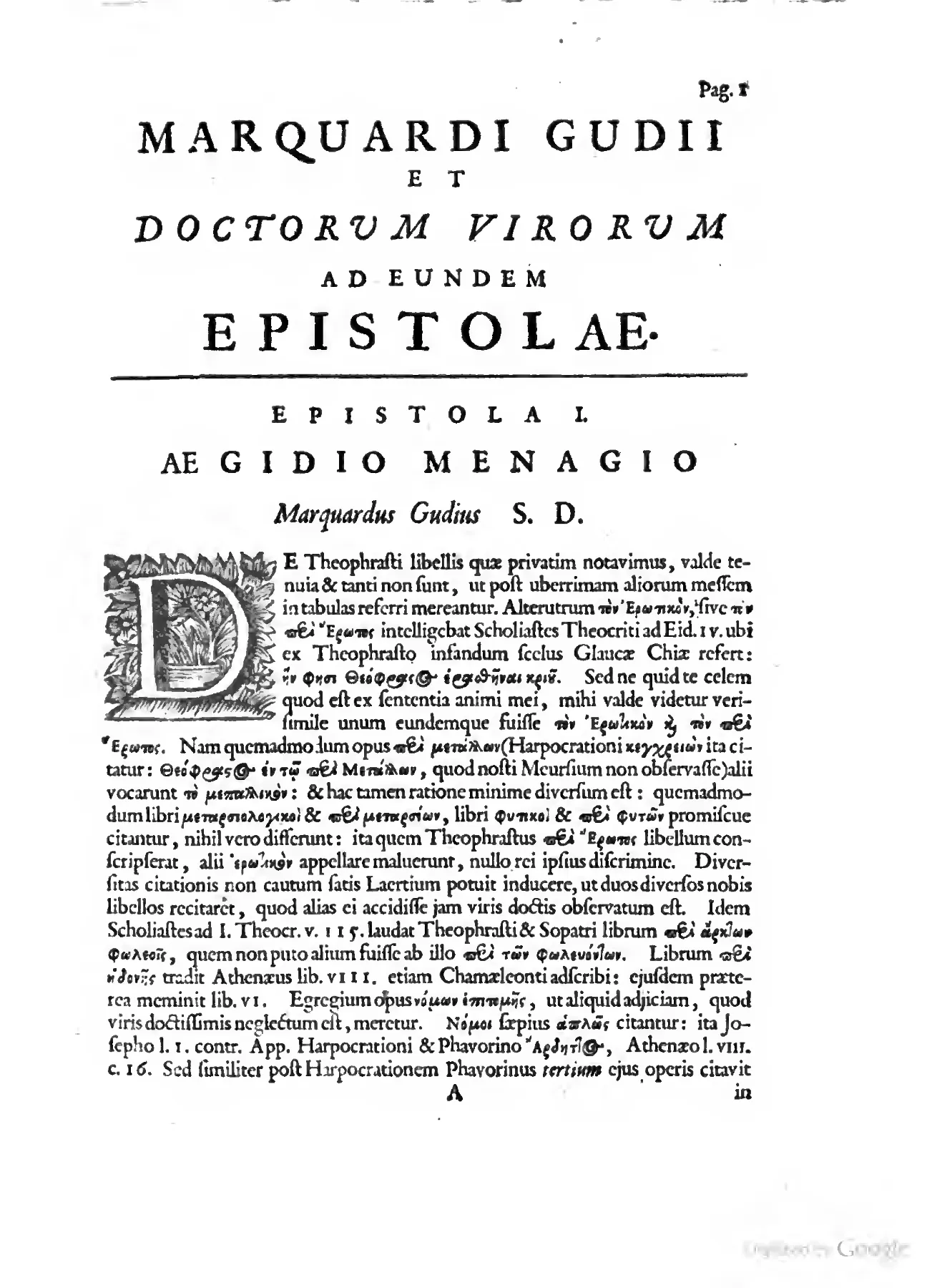
The large decorated initial opening Epistola I turns Gude's correspondence into a visible instrument of preservation, inaugurating the letter-corpus with the same source-critical comparison of ancient authorities that later supports antiquarian claims about recovered objects. Before the Laocoön enters through eyewitness report, this page presents the Republic of Letters as a workshop where texts, citations, and inherited scholarly judgments were rescued by exacting scrutiny. Source ↗.
What follows is a technical controversy conducted with philological rigour upon a sculpture rather than a text: the artists deny it was made from a single block, and point out the joins, more or less four of them, but so hidden in their placement, negant ex uno lapide confectam; ostendunt compagini plus minus quatuor, sed eas tam occulto loco junctas. The dispute over whether the group is monolithic is precisely the material-critical scrutiny applied elsewhere to the form of a diphthong: the object is examined for the traces of its making, its authenticity and manufacture reconstructed from physical evidence weighed against the received account in Pliny. The same fragility that consumes manuscripts hangs over the antiquities themselves, and the catastrophe made explicit in Verrius's allusion to the sack of Rome — I hear of the burning of the City, the plunder, the barbaric fury, audio te incendium Urbis, prædam, barbaricum furorem — reminds the reader that the whole world these letters map is exposed to violent destruction.
The doxographical and lexical disputes carry the same critical temper into the substance of ancient philosophy. In the Majoragio dossier, Nizolio defends the Ciceronian Paradoxa by tracing their pedigree through the succession of the schools: Chrysippus, who was thought to prop up the Stoic porch, was the pupil of Cleanthes, Cleanthes of Zeno, Zeno of Crates, Crates of Diogenes, Diogenes of Antisthenes, and Antisthenes indeed of Socrates, Chrysippus is, qui fulcire porticum Stoicorum putatus est, auditor fuit Cleanthis, Cleanthes Zenonis, Zeno Cratis, Crates Diogenis, Diogenes Anthenis, Antisthenes vero Socratis. The argument is an exercise in authentication by genealogy: the Stoic paradoxes are validated by being shown to descend, link by link, from Socrates himself, the succession-list functioning as a philological pedigree that certifies the doctrine's provenance. This same appetite for reconstructing the sense of an ancient institution animates Casaubon's handling of Roman funerary law, where he explains that antiquity supposed those struck by lightning to have earned the hatred of the gods, and so abominated them as hateful to the powers above, Putabat nimirum vetustas τὰς νερανοελητες Deorum odium esse promeritos: itaque ut superis exosos abominabantur. The interpretation of the archaic Numan phrase proceeds by reconstructing the religious mentality behind the ritual, the philologist recovering not merely the words but the belief they encode.
Running beneath these labours is a persistent consciousness of the community's own vulnerability to human bad faith, most vividly in Molino's denunciation of the Spanish ambassador who plundered Greek codices from the Venetian public library, stolen by an infamous scoundrel, a Spanish ambassador named Don Diego Hurtado de Mendoza, rubati da un scelerato infame, Ambassiadore Spagnuolo nominato Don Diego Hurtado di Mendozaza. Here the threat to the documentary memory of learning is neither insect nor plague nor war but calculated theft by a man of the highest station, the very patron-class on which scholarship depended turned predator upon the shared holdings of the respublica. Against such attrition the correspondence sets the countervailing ideal of scholarly greatness it exists to preserve, registered in the hyperbolic verdict that no earlier age ever saw that man's equal, illi Viro parem nulla prior ætas unquam vidit. The formula, extravagant as it is, states the stake of the entire undertaking: the achievement of the learned is singular and unrepeatable, and therefore all the more urgently to be rescued from the moths, the plagues, the sacks, and the thieves that these very letters record.
Antiquarian Recovery, Confessional Crisis, and the War in Germany
The correspondence gathered in this portion of the volume enacts, in dense and continuous fashion, the throughline that governs the whole collection: the fragility of learned achievement and the disciplined labor by which the Republic of Letters answers loss. What is striking here is that the letters do not merely testify to that fragility as a bibliographical accident; they show learning imperilled at once by war, by confessional rupture, by the isolation of the individual scholar, and by the endless deferral of projects that die unpublished. The register runs the full gamut from antiquarian minutiae to eschatological argument, and the connecting tissue throughout is the epistolary bond itself — friendship in learning as the fragile medium through which knowledge is transmitted, criticized, and preserved.
The dossier opens in the antiquarian key that recurs as a structural motif. Ancient ring-lore supplies the material: the prohibition attributed to Pythagoras against wearing rings or carving the images of gods upon them, Annulum gestare, Deorum iis imaginem insculpere Pythagoras vetuit, sets the tone of learned recovery of Roman and Greek material culture. This is not idle erudition. The projected Syntagma de annulis of Johannes Kirchmann becomes an anticipatory refrain across the sequence, correspondents pressing him toward the press with the formula, I pray well for your treatise on rings, which I long to see in the public light, Syntagmati tuo de annulis (quod in luce publica videre gestio) bene precor. The phrase in luce publica is the operative one: publication is the passage from private, perishable manuscript into the durable, shared possession of the learned community, and the repeated urging registers the community's awareness that unpublished labor is labor at risk. Kirchmann's completed monument, his commentary on the funerals of the Romans, tuus de Funeribus Romanorum Commentarius, stands over against the deferred Syntagma as the model of what the network exists to bring to light — antiquarian argument over the ritual raising of the corpse above the knees, the threefold casting of dust upon the sarcophagus, and the opening of a window to release the departing soul, recovered piecemeal through epistolary consultation.
Against this antiquarian labor the letters set the graver disruptions of the age. The Reformation-era correspondence of Julius Pflug introduces the theme of a Church in structural crisis, and does so in language that measures the stakes precisely. Pflug reports that in the creation of cardinals at this time regard was had for those whose excellent wisdom and singular piety might prop up a nearly collapsing Church, Constat enim in creandis Cardinalibus, hoc tempore rationem esse habitam eorum, quorum excellens sapientia, ac pietas singularis Ecclesiam prope ruentem fulcire possit. The participle ruentem — a Church "nearly falling" — casts ecclesiastical office as a shoring-up against imminent ruin, and it is worth marking how exactly this architectural metaphor of collapse-and-buttress mirrors the volume's larger anxiety about the perishing of what the learned have built. The same conciliatory-Catholic voice, writing from Mainz in 1535, Moguntiaci Nonis Iulii. Anno post Christum natum. M.D. xxxv, embeds the crisis in a datable, geographically specific moment: the fall of Münster and the wounds of the confessional divide are not abstractions but events reported by a man weighing service to patria against service to the Church.
The intellectual centerpiece of this portion is Laevinus Torrentius's critique of Lipsian-Stoic constancy, and it is here that the collection's critical temper is turned most sharply upon a doctrinal question. Torrentius does not merely disagree with the Stoics; he denies them the very virtue Lipsius had sought to salvage. In his judgment, as the philological framing of constantia above has already registered, neither wisdom nor virtue nor true constancy befalls the ancient philosophers. The verb cadit — the virtue does not "fall to" or "befall" the pagans — enacts a total exclusion: vera constantia is not a matter of degree but of possession or dispossession, and the pagans are dispossessed entirely. The diagnosis is precise and rests on a theory of ends. The cause of their error, Torrentius argues, is that they not only failed to hold but were utterly ignorant of the true end of life, Causa autem erroris, quod verum vitæ finem non solum non tenuerint, sed penitus ignorarint. The escalation from non tenuerint to penitus ignorarint is rhetorically deliberate: it forecloses the possibility that the ancients merely grasped the telos imperfectly, insisting instead on categorical blindness. Constancy without a true end is, on this account, structurally impossible.
What Torrentius offers in place of Stoic self-sufficiency is a constancy underwritten by divine sanction. True perseverance can be sustained only if we posit God as the avenger of perseverance broken off on the one side and the rewarder of perseverance maintained on the other, quam si Deum hinc interruptæ hujus perseverantiæ vindicem, illine servatæ remuneratorem statuamus?. The symmetry of the formulation — vindicem balanced against remuneratorem, punishment against reward, the broken against the kept — locates the efficacy of virtue not in the agent's rational fortitude but in an external economy of divine justice. This is Christian constancy grounded in the knowledge of God and the enjoyment of eternity, and it inverts the Neostoic premise at its root: where Lipsius had made steadfastness a property of the disciplined mind, Torrentius makes it wholly dependent on immortality and agnition. The passage is the doctrinal test-case for one of the volume's load-bearing terms, and it shows the community's philological rigor extended without remainder into confessional judgment — the same discriminating temper that adjudicates a reading here adjudicates the salvability of pagan virtue.
If Torrentius supplies the collection's sharpest doctrinal edge, Janus Gruter supplies its most affecting portrait of the scholar's condition. Amid his epigraphic labors — the great work of the ancient inscriptions of the Roman empire, opus illud magnum Inscriptionum antiquarum imperii Romani, the monumental corpus that stands as one of the age's great acts of documentary preservation — Gruter records his own isolation with a startling classical self-fashioning, the confession already cited above that he has no one with whom to converse, become so much a Timon, all but a Misanthrope, hating only the vices in men. The self-comparison to Timon is carefully qualified — tantum non Misanthropos, "all but" a misanthrope, and hating only the vitia, not men as such — so that the withdrawal is figured as moral discrimination rather than mere bitterness. Yet the confession lays bare the paradox at the heart of the Republic of Letters as this volume presents it: the community constituted by friendship and exchange is populated by scholars who experience their local circumstances as exile and solitude, sustained across distance only by the very letters here preserved. Gruter's isolation and his inscriptions corpus are two faces of the same reality — the preservation of the ancient documentary record carried on by a man who feels himself abandoned by his own age.
The final movement of this portion brings the war itself directly into the correspondence, and the antiquarian and doctrinal registers give way to lament. The election of Frederick V is reported with a prayer that already carries foreboding, chosen as King of Bohemia — may God prosper his undertakings, electus in Regem Bohemiæ. Deus actiones ejus fortunet!, and the catastrophe that followed is registered in Gebhardus's exile letters with grim compression. The Palatinate is divided among the Spaniard, the elector of Mainz, and the Bavarian, and all hope of its restoration to its former lord is slain, Inter Iberum, Moguntinum, Bavarum divisus est, ejus pristino Domino vindicandi spes cunctæ occisæ. The verb occisæ, "slain," applied not to men but to hope itself, personifies the extinction of political possibility, while the tripartite division names the dismemberment concretely. The wider desolation finds its cry in the exclamation, already noted above, that so great a change threatens all Germany, where instat — the change "stands over" or "presses upon" the land — conveys the imminence of ruin bearing down on the whole scholarly geography the letters have mapped.
Across these registers the letters never lose sight of the bond that makes the collection possible. The Republic of Letters is defined here as a fellowship of shared pursuits: since a likeness of studies and of minds binds us to one another, cum nos devinciat inter nos studiorum & animorum similitudo. The verb devinciat — "binds fast" — makes friendship a genuine fetter of obligation, and it is this bond that discharges the network's practical functions: the constant commendation of young scholars, as when a correspondent recommends Laurenberg, the son of your friend and colleague the physician, Laurenbergium commendas, Medici amici tui, & collegæ filium, and the shared vigilance over the failings of the book trade, the anxiety that one might have to excuse the countless errors of the typographers, typographi infinitas mendas excusarem. These small offices — vouching for a young man, apologizing for a printer's blunders, urging a treatise into the light — are the everyday mechanics of preservation, the means by which learning is passed on despite the encroachments of war, confessional strife, and the solitude of its practitioners. The letters thus perform, in their own transmission, precisely the rescue they describe: the conversion of the scholar's perishable and imperilled labor into the enduring memory of the learned community.
The Precarious Means of Transmission
The material of the letters that follow opens onto the least monumental face of the respublica litteraria: not the emended text or the recovered inscription but the sheer logistical friction against which scholarly exchange had to be conducted. The Gebhardus letters to Kirchmann return obsessively to the entanglement of learning with cash and with the faithless intermediaries who carried it. As the account of the editorial programme above has already noted, the couriers let themselves be satisfied on the spot, but once they have set foot in the appointed place, forgetful of their faith and their promises, they either suppress the letters entrusted to them or exact double the fee. The complaint is more than anecdotal grievance. The vocabulary of fides and promissa here — faith and promises broken — transposes the moral lexicon that elsewhere underwrites the friendship and candour of the learned community onto the venal figure of the tabellarius, whose betrayal threatens the very channel through which that community subsists. Suppression and extortion are the twin dangers: a letter may be silenced altogether or held to ransom, and in either case the commercium literarium is exposed as contingent upon the honesty of men who have no stake in learning at all. The perishability that the volume elsewhere locates in the moth and the bookworm is here relocated into the social mechanics of transmission, where a letter may die not by decay but by the bad faith of its carrier.
This same texture of material precarity governs the editorial and typographic anxieties that thread through the correspondence. The projects announced are substantial — Gebhardus reports Cornelius Nepos revised by his third labours and illuminated and destined for the press this summer, Cornelium Nepotem tertiis curis a me climatum, atque illustratum prælo hac æstate — and the phrase tertiis curis registers the ideal of iterated, cumulative revision that defined the philological ethic of the circle: a text is not edited once but returned to, refined across successive labours before it earns the press. Yet the same letters betray a countervailing unease about the institutional frame within which such work must be placed, as when the correspondent is warned that he is about to make trial of a new academy, periculum novæ Academiæ facturus es. The word periculum — trial, hazard, risk — casts even the promising prospect of an academic post as a venture whose outcome is uncertain, and it belongs to the same register as the war-torn instability everywhere audible behind these letters. The scholar's labour is doubly precarious: precarious in its material means, precarious in the institutions meant to house it.
Against this backdrop of contingency, the correspondence repeatedly asserts the countervailing discipline of antiquarian and philological inquiry, pursued as though its rigour could hold at bay the disorder around it. Hofmannus's investigation into the physicians' privilege of the gold ring turns a question of professional dignity into an exercise in erudite genealogy, and he grounds it in the concrete detail of academic succession, recalling that he who came into the Academy in the year 1607 has above him only Virtung, and he already at his last, tormented again and again by asthma together with orthopnoea, Ego, qui anno 1607 in Academiam veni, supra me habeo Virtungum solum, sed qui ipse jam in extremis est, asthmate cum orthopæa subinde excruciatus. The juxtaposition is telling: the antiquarian who traces the annuli medici back to the Asclepiad family and to Augustus's physician Antonius Musa dates himself with the same precision he applies to his sources, and the clinical exactitude of the medical detail — the named pathologies of a dying colleague — carries into autobiography the diagnostic temper of the discipline. The scholar authenticates his own place in a succession as he would authenticate a text, by dating and by evidence.
The Scandinavian and patristic dossiers extend this authenticating labour into the recovery of neglected northern sources, but the most sustained conceptual pivot comes with Reinesius's assault on the doctrine of the adoptive sonship of Christ. Here the critical temper that adjudicates readings and dates codices is turned upon a point of dogma, and Reinesius invokes Alcuin against Felix of Urgel to insist on the limits of human categories before divine mystery: it is better for every man to praise the goodness of God than to examine his power, to obey his precepts humbly, Est scilicet omni homini melius laudare bonitatem Dei, quam discutere potentiam ejus: humiliter obedire præceptis ejus,. The antithesis of laudare and discutere — to praise rather than to dissect — is arresting precisely because it issues from a scholar whose entire vocation is discutere, the examining, sifting, disputing labour of critical inquiry. The Adoptianist error, in this reading, consists in importing the juridical vocabulary of adoption and manumission into the generation of the Son, subjecting the ineffable to the categories of Roman civil law; and Reinesius's remedy is to police the boundary of what the critical intellect may legitimately parse. The passage thus stages, within the confessional register, the same anxiety about overreach that the material letters express about their precarious means: the discipline that authenticates everything must know where its authority stops.
The Sarrau Correspondence: Salmasius, Christina, and the Ethic of Frank Criticism
The opening of the Sarravius correspondence carries this interplay of philology and ideology into the register of political panegyric. The dedication to Queen Christina reads her abdication not as a failure of nerve but as a philosophically superior act, and Sarravius grounds the reading in a maxim of self-possession, the observation already noted above that we ought to live not for the commonwealth alone but chiefly for ourselves. The formulation is pointedly Neostoic: it subordinates the claim of the respublica — the political commonwealth — to the cultivation of the self, and in doing so it quietly aligns the abdicating monarch with the ethic of the learned respublica, whose citizenship rests on withdrawal into litterae rather than on the exercise of imperium. Christina's regni contemptus, her contempt of kingship, becomes the very mark of her superiority over the Sullas and Augustuses who clung to power; sovereignty relinquished for the philosophical life is worth more than sovereignty held. The panegyric thus enacts, at the level of a queen's biography, the same revaluation the volume performs throughout — the elevation of the community of learning above the community of rule.
That revaluation is sharpened by Sarravius's assessment of Grotius's apologetic method, where the critical eye is turned upon the temper of the age itself. Praising the De Veritate Religionis Christianæ for its fusion of doctrine and devotion, he observes wryly that Grotius has of course consulted the vice of the age, to whose palate piety itself scarcely tastes on its own, Consuluisti nimirum sæculi vitio, cujus palato ipsa pietas per se vix sapit. The metaphor of taste — the palatum of a saeculum that finds unseasoned piety insipid — diagnoses a cultural condition in which learning has become the necessary dressing for faith, and the remark carries a double edge: it is at once a compliment to Grotius's art and an indictment of an age that will not swallow devotion unless it is made learned. The philologist's discrimination is here exercised not on a text but on the taste of a generation, and the same faculty that weighs a reading weighs the spiritual appetite of the century.
The personal cost of the political disorder against which all this labour proceeds surfaces most acutely in Sarravius's complaint at the suspension of the Norman Parlement and his forced delegation to Rouen. He casts his exile from Paris and from his books as a punishment without a crime: I am punished here, I who am not said to have offended. Truly by one day I have lived longer than I ought — namely by that day on which I was delegated hither, Punior hic ego, qui non dicor deliquisse. Uno sane die plus vixi quam oportuit: eo nempe, quo huc delegatus sum. The rhetorical construction — punishment without delictum, one day too many measured from the day of exile — dramatizes the intrusion of raw political force into the scholar's life with a bitterness that recalls the war-ruin audible in the German letters. To be delegated away from one's library is to be severed from the instruments of one's vocation, and Sarravius measures the loss in the extreme currency of a life grown too long.
The dominant practical thread of the years 1640 to 1645 is the attempt to draw Claude Saumaise back to France from Leiden with a royal stipend, and the terms in which Sarrau frames Salmasius's refusal reveal how thoroughly the citizenship of the Republic of Letters is imagined as independent of, and superior to, the imperium of any prince. Sarrau urges Salmasius to remain among his Batavian hosts and to hold the scepter of learning there, dispelling the chill mists of court intrigue, in the exhortation already cited above to show himself only to his Batavians and hold the scepter. The metaphorical schema is telling: the sceptrum is transposed from political sovereignty to scholarly preeminence, and the "chilly mists" figure the negotiations and honoraria of the French court as a kind of obscuring vapor from which the true seat of Salmasius's authority — his Batavian liberty — must be protected. The very stipend that occasioned the recall is named in the plainer register of the negotiation itself, that you be summoned from there with an honorarium of two thousand crowns from the Queen, ut istinc cum honorario II. M. coronatorum a Regina evoceris, where the concrete sum measures exactly what liberty declines.
That the exchange should be conducted at all is itself governed by a self-conscious protocol of the learned community. Sarrau proposes that the two write to each other in the Roman manner, invoking the archetypes of the genre: ut more Romano literas inscribamus; Cicero Cæsari, Cæsar Cice, that we inscribe our letters in the Roman fashion, Cicero to Caesar, Caesar to Cicero. The gesture is not idle antiquarianism. By modeling their salutations on the correspondence of Cicero and Caesar, Sarrau claims for the present epistolary relation the dignity and permanence of its classical archetype, converting a working letter into a conscious participation in the tradition the volume everywhere seeks to preserve. The encomiastic pitch of this relation is unembarrassed: Sarrau tells Salmasius that he alone holds the principate in all letters, Tu nempesolus in omni Literatura principatum obtines, you alone assuredly obtain the principate in all literature — the language of sovereign rule again migrating wholesale into the domain of scholarship, so that the principatus denied to any territorial claimant is freely conferred on the philologist.
Yet this encomiastic register coexists with, and is in fact disciplined by, the community's ethic of frank criticism, which the letters state as sharply as any prefatory formula. Sarrau insists that the office of a friend is not indiscriminate approval, in the formulation already made central to the philological framing above: he should be a flatterer, not a friend, if he approved without examination everything that had once pleased a friend. The contrast between assentator and amicus is the load-bearing distinction: amicitia within the Republic of Letters is constituted not by praise but by the willingness to withhold it pending examination, so that the very warmth of the encomium above is what makes the reservation credible. Praise unmixed with judgment would collapse friendship into flattery and forfeit the veritas on which the community's authentication of learning depends. The two registers are therefore not in tension but mutually conditioning: one may call Salmasius the prince of all literature precisely because one has not surrendered the right to disagree with him.
The philological consultations that fill these letters supply the concrete matter on which such judgment is exercised, and they show the same critical temper applied to inscriptions, texts, and the natural world alike. The long letter on the Nannetensian inscription reconstructs the religious topography of the Roman provinces to account for an otherwise unattested local numen: Non solum singulis Provinciis olim & civitatibus sui Dii attributi fuere, sed etiam municipiis & vicis, not only were their own gods once assigned to individual provinces and cities, but even to municipalities and villages. From this general principle Salmasius derives the specific identification, that as regards the god Volianus, he was the local numen of that municipality, Quod ad Deum VOLIANUM attinet, locale fuit numen illius municipii. The method is exemplary of the epigraphic autopsy the volume prizes: a puzzling stone is rendered intelligible not by conjecture ex nihilo but by locating it within a reconstructed system of dii municipales vel locales, so that the singular datum is authenticated by its fit within a general antiquarian order.
The same disciplined refusal to rest in the merely inexplicable governs Salmasius's naturalist reasoning on marine shells found far inland. Against the convenient explanation that such objects are freaks of nature, he advances a teleological principle: Non illa naturæ lusus esse existimarim: nihil enim bona illa mater creavit, nisi aut utile aut necessarium aliquo tempore futurum, I should not think those to be a sport of nature, for that good mother created nothing except what would at some time be useful or necessary. The rejection of the lusus naturae is a genuine methodological commitment: to call the shells a mere game of nature would be to abandon the search for cause, whereas the assumption that nature makes nothing idle compels the inference — supported by the empirical case of the Zeeland tract the sea had abandoned — that the sea once covered the ground where the shells now lie. The heading under which Sarrau had posed the question, on oysters born in the midland far from the sea, De ostreis in mediterraneo longe a mari nascentibus, marks how a phenomenon of natural history is admitted to the same regime of causal argument that governs a diphthong or an inscription. The critical temper does not distinguish between kinds of evidence; it demands of each that it be made to yield an intelligible cause.
Textual cruces proper receive the identical treatment. The Horatian difficulty is dispatched by a lexical-institutional identification: Scriptum itaque Quæstorium est officium Scribæ Quæstoris, the "scriptum Quaestorium" is therefore the office of the quaestor's scribe. Here the emendatory labor consists in restoring to a phrase its precise administrative referent, recovering the Roman institutional reality behind a word that had become opaque. The very abundance of such dissertations becomes a topos in its own right: Sarrau warns, half in admiration, that the Salmasian letters will pass into a proverb if he continues, Abibunt in proverbium Salmasianæ Epistolæ, si pergas — the epistolary consultation has grown so learned that the letters themselves threaten to become monuments, which is precisely the transformation the volume as a whole performs upon them.
Against this collaborative labor the correspondence sets its darker counter-motion, the feud that pits members of the community against one another. The animosity between Salmasius and Daniel Heinsius over the Hellenistica and the Exercitationes Sacrae is registered in the martial idiom of a first strike: Primum hoc sentiet a tua manu telum Heinsius, Heinsius will feel this weapon first from your hand. The metaphor of the telum, the hurled spear, exposes how the same critical faculty that authenticates an inscription can be turned into an instrument of learned war; the veritas owed between friends and the polemic waged between rivals draw on one and the same discipline, and the letters do not disguise the continuity.
The stakes of belonging to this community are finally measured by the memorable topos in which Sarrau reports the late Cardinal's estimate of learning, the judgment already noted above that Richelieu esteemed only three men of his age marked by the highest erudition — Salmasius, Grotius, and Bignon. The typographic elevation of the three names, set against the anonymous remainder, dramatizes the hierarchy of merit that the Republic of Letters recognizes; and the fact that the judgment is attributed to the greatest political patron of the age shows the learned network intersecting the summit of power precisely on the network's own terms — the minister's esteem confirming, rather than conferring, a preeminence that rests on litterae alone. That the same correspondence should press theological controversy with equal seriousness — the Jansenist affair, Arnauld's reply to Petavius, the ardent and truly difficult dispute among the theologians concerning the imputation of Adam's sin, controversia, & sane ardua, inter Theologos, De Imputatione peccati Adami — confirms that doctrinal matter enters here not as a separate order of concern but as further material submitted to the community's testing, weighed and reported with the same fidelity that the letter, as the truest record of a scholar's mind, was held uniquely able to preserve.
Grace, the Pope Joan Dossier, Paleography, and the Ruin of States
The Sarrau correspondence is at once a philologist's workshop, a theological arena, and a war-diary, and its power for the volume's central concern lies in the seamlessness with which a single critical temper passes among these registers. The same hand that adjudicates a manuscript reading also weighs the mechanics of grace and reports the arrest of a prince, and in every case the operation is one of testing, authenticating, and rescuing what would otherwise perish unexamined.
The doctrinal core of these letters is the controversy over universal grace, which Sarrau expounds in the characteristic Salmurian idiom of the sun and the eye. The analogy, already cited above in the account of the Amyraldian strand, makes the offer of grace genuinely universal — light extended to all on the sole condition that they open their eyes — while reserving its efficacy to the few who are given to be willing to open them. The rhetorical elegance conceals a doctrinal tension the letters do not resolve: the offer is framed as unconditional in its scope yet wholly conditional in its reception, and the condition — the willing of the eye's opening — is precisely what the unregenerate cannot supply. The distinction between external, objective grace and internal, subjective grace is the scholastic scaffold that holds this position together, with the latter defined as consisting in some power and efficacy of the illuminating Spirit, altera enim consistit in vi & efficacitate aliqua Spiritus illuminantis. To fortify the position against the charge of Pelagianism, Sarrau does not appeal to novelty but to the authority of the reformed community's own tribunal, noting that the serious universal calling is settled as defined in express words by the Synod of Dordt, ut est a Dordracena Synodo disertis verbis definitum. The move is telling: a doctrine widely suspected of softening the decree is defended by citation, as though the synodal text were itself a manuscript whose true reading must be established against misapprehension — the philological reflex applied to confessional dispute.
That same source-critical reflex governs the extended dossier on the legend of Pope Joan, where Sarrau treats a piece of ecclesiastical polemic as a problem in textual transmission rather than mere confessional ammunition. He reports possession of the material witness, that there is now in his hands, from the Royal Library, a manuscript codex of Anastasius Bibliothecarius, Penes me jam est e B. R. codex MS. Anastasi Bibliothecarii, and then reproduces the Vita itself as documentary evidence to be assessed. The reproduced life narrates the woman disguised in male habit and led to Athens by a lover, where she is asserted to have been a woman, and in her girlhood led to Athens in male dress by a certain lover of hers, so profiting in the various sciences that none was found her equal, Hic ut asseritur fæmina fuit, & in puellari atate a quodam suo amasio in habitu virili Athenis ducta, sic in diversis scientiis profecit, ut nullus sibi par inveniretur. What matters for the volume's argument is not the salaciousness of the tale but its handling: Sarrau embeds the passage as a quotation to be collated and debated, subjecting the succession of the popes and the interpolation problem in the life of Benedict III to exactly the scrutiny of witnesses that a corrupt classical text would receive. The confessional and the philological are here indistinguishable; the legend survives as a text, and its truth-value is a text-critical question.
The strictly philological letters make explicit the paleographic doctrine that underwrites all such judgments. Salmasius reconstructs the primitive state of the written page as continuous script, in which all words were customarily inscribed in one perpetual stroke without any interval, and the sentences too run on: unbroken, except that where a sentence was complete, they did not begin another on the same line, Uno ac perpetuo ductu sine ullo interstitio voces omnes exarari solebant, & sententiæ etiam continuari: nisi quod, ubi perfecta fuerat, non in eadem linea alteram auspicabantur. From this account of scriptio continua he derives a historical narrative of the invention of the very apparatus by which reading becomes possible, tracing distinction and accentuation to a single originator in the observation already noted above that before Aristophanes there was no distinction of letters. The historical argument is not antiquarian ornament; it yields a working criterion for authenticating and dating a codex, since a book's fidelity can be read off its physical execution. Salmasius makes a diphthong the index of antiquity and honesty, in the criterion already set out above whereby a manuscript that separates the letters of the diphthong AE rather than coalescing them is to be known as especially old and made by a faithful hand. The equation of a scribal habit with a fidelis manus is the material foundation of the whole enterprise: authentication of the text begins with the physical authentication of its vehicle.
The same evidentiary rigor is turned on the sacred text itself, where Sarrau reports his own autopsy of manuscripts against a printed authority. Contesting Beza's claim that all the Greek codices oppose a given reading, he answers from firsthand collation that this is not true, and that he himself has seen two which prove the contrary, Atqui verum non est, quod ait Beza repugnare vulgatæ lectioni omnes Græcos codices. Ego enim duos vidi, qui contrarium evincant. The verb vidi carries the argument's full weight: not report but inspection, the scholar's eye on the manuscript, is what overturns the pronouncement of even so formidable an authority as Beza. The philological content extends into the recondite margins of learned exchange as well, as when Salmasius resolves the puzzle of a garment described de fundato by expounding the technique of reticulated gold-work: in garments these threads, woven from gold or sewn on in Phrygian embroidery, intersected each other crosswise, like the meshes in a net, In vestibus autem hæ, ex auro intextæ vel phrygionico opere insutæ decussatim se intersecabant, ut maculæ in reticulis. Such minute realia belong to the same enterprise as the diphthong and the collated codex: the recovery of a precise ancient meaning that would otherwise be lost to the reader's incomprehension.
Against this fabric of patient reconstruction the letters register loss at every scale, and it is here that the correspondence most directly enacts the volume's throughline. The death of Grotius draws a cry that measures a private grief as a wound to litterae themselves — the lament, already cited above, that a man great in fact and name has fallen, O bitter blow to letters, O most grievous loss. The disintegration of the very political order in which learning is conducted enters the correspondence with equal force in the crisis of the Fronde, where the arrest of the princes threatens general conflagration: for all Gaul would burn in intestine war, which may God most good avert, Omnino enim Gallia intestino bello tota conflagraret, quod avertat DEUS optimus. The prayer registers the fragility of the conditions under which manuscripts are collated and letters exchanged at all; the war that consumes states is continuous with the moths that consume codices.
Political danger presses on the scholar's own work as much as on his surroundings, and Sarrau's counsel to Salmasius over the Defensio Regia shows the critical temper operating as prudential judgment. Even in defending the murdered king of Britain, he warns, one must exercise the caution not so to exalt royal majesty that kings should seem to bestow their love upon subjects as a mere gratuitous favor, Hac tamen te cautione uti opus est, ne ita Majestatem Regiam extollas, ut erga subditos amorem videantur illis gratis largiri. The advice qualifies the volume's throughline in an instructive way: the community that preserves learning also polices the ideological exposure of its members, and its amicitia takes the form of candid warning about the reach of a claim. The correspondence closes its arc toward the court that would shelter Salmasius, and Sarrau's portrait of Queen Christina fuses erudition with sovereignty in a single figure: she gives herself to letters and handles books in such a way, he writes to Vossius, that she never lays down the scepter, and never forgets to rule her peoples by command, as though it were her own peculiar art, ita literis vacat, ita libros tractat; ut tamen sceptrum nunquam deponat, & imperio regere populos, tanquam propriæ artis suæ, nunquam obliviscatur. The queen who reads and rules embodies the aspiration that runs beneath the whole dossier: that learning and power might be reconciled, and that the fragile labor of collation, emendation, and correspondence might find, in a learned patron, a bulwark against the very losses the letters everywhere record.
The Memmian Library, Pedagogy, and the Commemorative Close
The closing stretch of the Sarravius correspondence and the volume's elaborate back-matter enact, in miniature, the entire argument the collection makes about how learning survives: the letters here are simultaneously instruments of preservation — hunting manuscripts, weighing codices, transmitting emendations — and, in their commemorative afterlife, themselves the objects rescued from oblivion by the printed page.
The Memmian dossier opens with the labor of acquisition itself. Sarrau reports on the protracted negotiation to secure the library of the president De Mesmes for Queen Christina, refusing to abandon the hope of success, Memmianam Bibliothecam quod attinet nondum desperamus voti compotes fieri, as regards the Memmian Library we do not yet despair of becoming possessors of our wish. The hunt is granular and material: the search extends to a rare Bodin, the treatise on the hidden secrets of sublime things, which alone I now send you, Bodini de abditis rerum sublimium arcanis, hunc tantum quem jam mitto li. This is the philological rescue-work of the collection reduced to its practical mechanics — the tracking of a lost autograph, the copying by another hand, the suspicion that a manuscript of offensive verse had been consigned to the flames — the very attrition against which the whole editorial enterprise is mounted, here documented as it unfolds letter by letter.
The material assessment of the codices sharpens this into technical connoisseurship. Sarrau reports on the physical constitution of the Greek manuscripts, for most of the Greek ones are of paper; very few in all, five, I believe, or six, written on parchment, Græcorum enim plerique sunt chartacei; pauci omnino, quinque, credo, aut sex in membrana scripti, a distinction that carries directly into judgments of age and value, since parchment signals both antiquity and durability against the decay that threatens paper. The same commercial-critical temper governs the haggling over price, where Sarrau invokes the Plinian maxim, that a bad purchase is always unwelcome, Pliniani dicti Mala emptio semper ingrata est, setting an exorbitant demand against a sober counter-offer. Here the citizen of the Republic of Letters is also an agent of the political respublica of the Swedish crown, and the two roles interlock: the queen's imperium funds the rescue that only the scholar's litterae can direct.
The relation to Christina is performed most vividly not in the marketplace but in the domestic and confessional sphere. Sarrau records that his wife has borne a daughter whom, as she was washed at the sacred font, I wished to be named CHRISTINA in honor of the Highest and Incomparable Queen; it was done on the last Lord's Day, at Charenton, in the public assembly of our church, Uxor mea, partu novissimo filiam peperit, quam, sacro fonte dum abluitur, in honorem Summæ & Incomparabilis Reginæ nominari volui CHRISTINAM. Factum id postrema die Dominica, Carentoni, in publico Ecclesiæ nostræ coetu. The gesture stages patronage as an act of Reformed piety: the naming occurs at Charenton, the great Huguenot temple outside Paris, in the public assembly of the congregation, so that fidelity to a learned patron and confessional identity are folded into a single sacramental moment. The exchange of tokens runs in both directions — Sarrau acknowledges the queen's gifts, expressing gratitude for the portrait of the divine countenance, PRO TABULA DIVINI VULTUS, a portrait and a gold coronation coin whose iconography prompts a theoretical excursus.
That excursus is one of the conceptual pivots of this closing sequence. Contemplating the coronation image on the coin, Sarrau denies that the rite is empty pageantry: for that sacrosanct and splendid rite of coronation is not, as some dream, a mere ceremony performed for form's sake, Nec enim sacrosanctus & splendidus iste Coronationis ritus, mera est, quod quidam somniant, cæremonia, quæ dicis causa perali 3. He construes it instead as a genuine reciprocal bond, but it is a true covenant, which is entered into between the Prince and the subjects, sed est verum foedus, quod initur inter Principem & subditos.
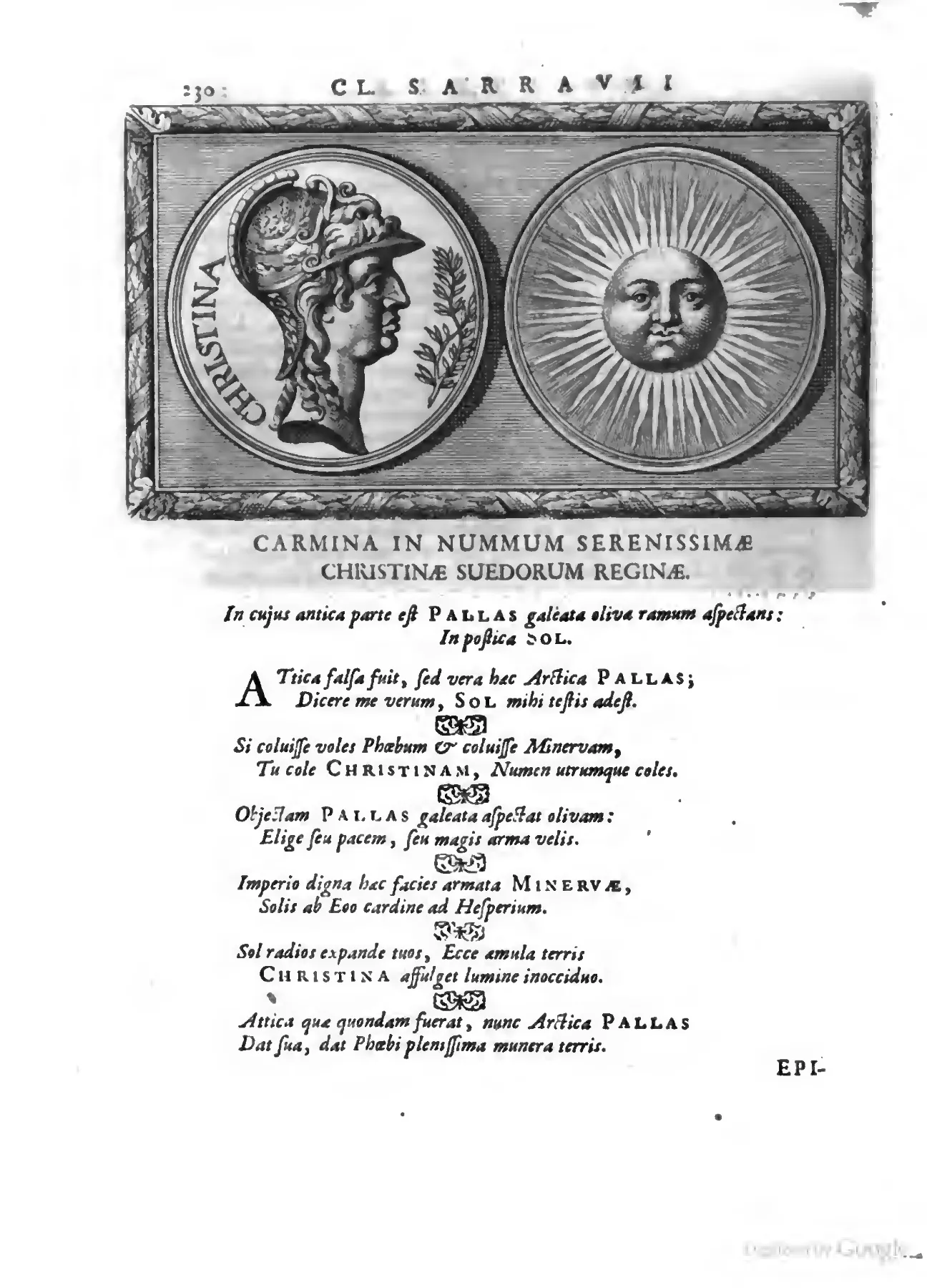
The engraved medal pair above Sarrau's elegiac verses turns Christina's coronation coin into an object to be read: the helmeted royal profile and radiant solar reverse make visual the fusion of Minerva-like learning and sovereign brilliance that frames the coronation as more than empty spectacle. Set within dense Latin print rather than isolated as ornament, the numismatic image shows how philology, panegyric, and political theory converge in Sarrau's address to the Swedish queen. Source ↗.
The move from numismatic autopsy to political theory is characteristic of the volume's refusal to keep philological and political registers apart: the same eye that reads the form of a diphthong reads the image on a coronation medal, and the reading issues not in antiquarian pedantry but in a contractual account of sovereignty. That a Huguenot magistrate should derive from a Lutheran queen's coinage a theory of the foedus binding prince and subject registers the confessional and constitutional charge that the correspondence carries beneath its bibliographical surface.
The exchange with Tanaquil Faber turns the same critical discipline back upon the ancient texts and upon the transmission of learning itself. The technical work is on display in the emendation of the poets — Faber's conjecture that there yet remains a ruin propped upon your shoulders, Restat adhuc humeris fulta ruina tuis, where the proposed ruina displaces the transmitted reading — and in the exacting standard by which such work is measured, that nowhere in the whole body was there a blemish, In toto nusquam corpore menda fuit. But Faber's most substantial contribution is a full pedagogical discursus that reframes the volume's anxiety about loss as a problem of transmission across generations. He opens with the humanist's central grievance, asking what the cause may be that, though an almost infinite multitude of boys is daily handed over to the professors of letters for instruction, one nonetheless finds so few who attain even some middling knowledge of them after an incredible waste of both time and money, Quid causæ sit, SARRAVI CLARISSIME, cur, cum infinita prope puerorum multitudo quotidie literarum professoribus in disciplinam tradatur, tam paucos tamen reperias, quivel mediocrem aliquam illorum cognitionem post incredibilem & temporis & pecunia jacturam assequantur?. The diagnosis is that learning perishes not only through moths and worms but through defective pedagogy — a squandering of the very resources the Republic of Letters exists to husband.
Faber's remedy is the disciplined reading of the ancients themselves, insisting that there is certainly no other way than the accurate reading of the old writers, nulla certe alia quam veterum scriptorum accurata lectio, and he supplies a concrete graduated syllabus, asking which of the ancients furnished all these things more rightly than Phaedrus, Apollodorus, Eutropius, Cornelius Nepos, and Pomponius Mela — little books which, within the space of a single year, if only some diligence be applied, can be read through with no trouble, Ea autem omnia, quinam e veteribus præstiterunt rectius quam Phædrus, Apollodorus, Eutropius, Cornelius Nepos, & Pomponius Mela? Qui libelli intra unius anni curriculum, si qua modo adhibita diligentia fuerit, nullo poterunt negotio perlegi. The prescription is telling: the same Phaedrus whose text the correspondents elsewhere emend is here the first rung of an educational ladder mounting toward Cicero and Homer. Preservation and pedagogy are thus continuous — the ancient corpus is at once the object of critical rescue and the instrument by which the next generation of rescuers is formed.
The literary quarrels that close the correspondence show the community's ethic of frank criticism at its most abrasive. The exchanges over Bochart, the Pope Joan controversy, and the standing of the great philologists culminate in the paired epithets that fix Salmasius's reputation between admiration and resentment — the naming of him at once as prince of the learned and as the tyrant of the learned that Section 3 has already remarked. The formula compresses into a single antithesis the ambivalence of a respublica whose citizenship rests on litterae: the same preeminence in learning that earns the title of prince earns, from those it overshadows, the title of tyrant.
The volume's back-matter completes the argument by turning the letters' subjects into the objects of the same commemorative preservation. The commemorative verse honors Sarrau's own celebration of the learned — his tribute to that distinguished work of the highest man Samuel Bochart, On Sacred Geography, IN EXIMIUM OPUS SUMMI VIRI SAMUELIS BOCHARTI De Geographia Sacra — before the funerary carmina transform the correspondent into the mourned.
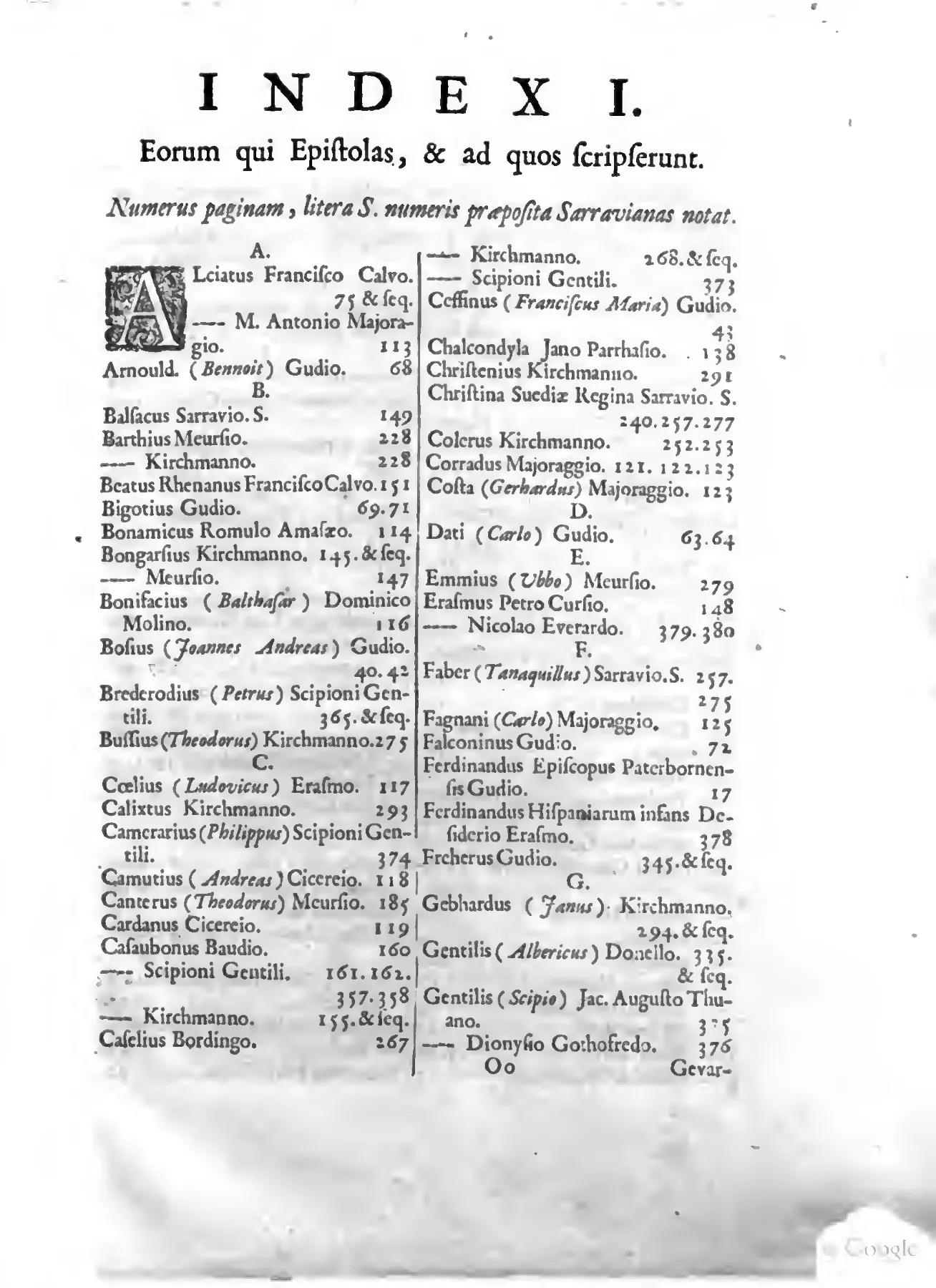
Opening beneath a large historiated initial, this two-column Index I turns the correspondents and addressees of the Gude–Sarrau volume into a durable map of learned sociability rather than a perishable scatter of letters. Its printed page references, including the "S." prefix for Sarrau's separately paginated letters, make the volume's dual structure navigable and complete the back-matter's work of commemorative preservation. Source ↗.
The lament asks why Sarrau fell at an immature age, UR immaturo SARRAVIUS occidit ævo?, voicing precisely the untimely fate that the collection's preface identifies as the great threat to learned achievement. Sudorius answers the lament with the consolation of the satisfied guest: now, as a banqueter sated from the table withdraws, so, filled with the richness of learning, he dies; he ceases, as his wisdom touched the farthest goal, nor has life anything further to be taught, Jam satur a mensa veluti conviva recedit, Ubere doctrina sic satiatus obit. Cessat, ut extremam tetigit prudentia metam, Vita nec ulterius quod doceatur, habet. The Lucretian image of the conviva satur converts premature death into completeness — Sarrau died young in years but full in learning, so that the very fullness of his erudition answers the reproach of untimeliness. The three indexes that follow, cataloguing correspondents, the ancient authors laudantur, illustrantur vel emendantur, and persons and topics, perform the final act of rescue: the index of those who wrote the letters and to whom they wrote, Eorum qui Epistolas, & ad quos scripserunt, renders the perishable network of exchange permanently navigable, converting a scattered correspondence into a durable instrument of the learned community it records.
Directions for Further Reading
The categories of scholarship required to contextualise this collection are identifiable, and each bears on the volume's central concern with the preservation and authentication of learning against loss.
(i) Histories of the early-modern Republic of Letters and the ethics of learned correspondence. Hans Bots and Françoise Waquet, La République des Lettres (CNRS, 2010; English translation Cambridge University Press, 2019), for the sociology of the transnational epistolary community; Marc Fumaroli, La République des Lettres (Paris: Gallimard, 2015), for the Ciceronian and Lipsian rhetoric of honestum and the honnête homme that the Burman/Graevius circle inherited. These works together illuminate both the network's structure and the ethic of frank criticism over flattery — the refusal to be an assentator — that the letters themselves enact.
(ii) Studies of classical philology and conjectural emendation in the seventeenth-century Dutch universities (Leiden/Utrecht). Scholarship on the 'Dutch school' of late-humanist philology and the Leiden workshop tradition of Raphelengius and the Elzeviers, within which Gude's correspondents debated readings in Livy, Phaedrus, Tacitus, and Claudian, and on the paleographic and stichometric criteria (punctuation, the AE diphthong, the role of Aristophanes of Byzantium) by which manuscripts were dated and authenticated.
(iii) Biographical and intellectual studies of Claudius Salmasius and the Stockholm circle of Queen Christina. Erik-Olov Sundström (Stockholm, 1985) and the essays in E. K. Grotenhuis, Daniel Heinsius and the Early Dutch Republic (dissertation, Utrecht, 2017), for the Salmasius–Heinsius quarrel and its more-than-Vatinian animosity; studies of Christina's court, her abdication, and her patronage of learning (including the Bibliotheca Memmiana acquisition) for the panegyric strand of the Sarrau correspondence. The Leiden dissertation of F. F. Blok (not verified here) remains the standard biographical reference on the Burmans.
(iv) Studies of Amyraut, the School of Saumur, and the universal-grace controversy in its transnational diffusion. Brian G. Armstrong, Calvinism and the Amyraut Heresy (Madison, 1969), remains the standard English monograph, supplemented by R. T. Kendall, The Overcoming of Preterition (n.d., not verified); for the doctrinal backdrop of the Synod of Dort and the diffusion of Amyraldian views into Huguenot patristic scholarship reflected in the Gude–Sarrau exchanges.
(v) The history of early-modern learned correspondence as a genre and its editorial practices. Studies of the epistolary-edition genre from the letters of the Scaligers and Casaubon onward, within which Burman's editorial programme — rescue from tineae et blattae, selection by scholarly project, suppression of politically inflammable matter — should be situated; and, for the Neostoic quarrel over constantia, the standard editions of the Lipsius–Torrentius correspondence and Jeanine De Landtsheer, Justus Lipsius and the Stichology of Christian Humanism (forthcoming; not verified).
(vi) The Pope Joan controversy and the critical use of confessional polemic. Ludwig Wahrmund, Die Papstin Johanna (Heidelberg, 1912), and Alain Boureau, La papesse Jeanne (Paris, 1993; not directly verified), for the context of David Blondel's Eclaircissement (1647) and Gude's critical annotations upon it.
Readers should consult specialist library catalogues for verified editions of works in these categories rather than rely on citations assembled from memory.
Frequently Asked Questions
What is the 1697 volume of Gude and Sarrau letters edited by Pieter Burman?
It is a posthumous folio of learned correspondence, Marquardi Gudii et doctorum virorum ad eum epistolae, printed at Utrecht by François Halma and Willem van de Water in 1697. Pieter Burman the Elder gathered two interlocking anthologies: letters to and from the antiquary Marquard Gude, and letters to and from the Parisian councillor Claude Sarrau, both drawn from the Gude family library. Burman frames the whole around one conviction — that private letters preserve the working mind of the learned more faithfully than formal histories, and that printing them rescues perishable manuscripts from loss.
Who was Marquard Gude, and who was Claude Sarrau?
Marquard Gude (1635–1689) was an itinerant German philologist and epigrapher from Schleswig-Holstein, antiquary to Duke Christian Albrecht of Holstein-Gottorp and, from 1682, a counsellor in the Schleswig-Holstein chancery. He amassed a vast collection of manuscripts and rare books across Belgium, Gaul, Italy, and Germany. Claude Sarrau (died 1651) was a royal councillor at the Parlement de Paris and one of the most influential French patristic scholars of his day, corresponding with figures including Hugo Grotius and Claudius Salmasius. Their letters reached print together from the same Gude family library.
What did Burman mean by the "moths and bookworms" that run through the volume?
The phrase names the insect-pests — tineae (moths) and blattae (bookworms) — that consume neglected manuscripts, a learned commonplace Burman makes central to justifying his edition. He describes Gude reclaiming codices "nearly consumed" by these pests from unskilled owners. The image marks the fragility of the learned community's documentary memory: uncatalogued manuscripts perish by biological decay, and the printed book is presented as the moral duty of rescue. Burman extends the same rhetoric to the letters themselves, saved, as he puts it, from an enormous shipwreck.
How does the volume treat the Stoic virtue of constantia?
Constantia — steadfastness — is the most contested term in the volume's world, carrying Lipsian-Stoic, Christian-humanist, and confessional-political senses at once. The letters preserve the sharp edge of the Lipsius–Torrentius quarrel: Laevinus Torrentius denies the ancient philosophers true constancy altogether, judging that neither wisdom nor virtue nor "vera constantia" (true constancy) befalls them. Their error, he argues, was ignorance of life's true end. He grounds genuine perseverance instead in God as avenger of broken constancy and rewarder of constancy maintained, making steadfastness dependent on Christian conviction rather than rational fortitude.
Is there an English translation of the Gude and Sarrau letters?
As far as the consulted bibliography can establish, no part of the Epistolae has ever been translated into a modern language; it has remained a working instrument for historians of scholarship rather than an object of translation. This is a negative finding, not proof that none exists. Separately, the Leo edition presents the full transcription together with a complete English translation generated by artificial intelligence, made freely available online for the first time. Leo aims to render every text printed in Latin in early modern Europe between 1450 and 1750 into English at no cost.
This report was generated by an advanced AI assistant that conducted deep research alongside an extensive interpretation of the transcribed original text. Every effort has been made to preserve fidelity to the source and to guard against inaccuracy, but corruption in the text recognition process and model hallucination may nonetheless have entered the text. Treat every claim, quotation, translation, and citation as provisional, and verify each against the original source before relying on or citing it.
Bibliography
- Marquard Gude and Claude Sarrau (Pieter Burman, ed.), Marquardi Gudii et doctorum virorum ad eum epistolae: The object of the entire report, in the HathiTrust surrogate drawn from the University of Michigan copy of the 1697 Utrecht imprint. Consult it to test every translation and page token in the analysis against the folio itself, and to see how Burman's two-part folio physically stitches the Gude and Sarrau dossiers together.
- Brian G. Armstrong, Calvinism and the Amyraut Heresy: The standard English account of the universal-grace controversy that shadows the Gude–Sarrau exchanges. Read it to see why Sarrau's sun-and-eye analogy needed the cover of the Synod of Dort, and why contemporaries smelled Pelagianism where Amyraut insisted on none.
- Bodleian Libraries, Early Modern Letters Online: The Cultures of Knowledge union catalogue of early modern correspondence, which indexes the very kind of epistolary metadata Burman assembled by hand. Use it to reconstruct the wider network around any single letter in the volume and to check who was writing to whom, and when.
- Alain Boureau, La papesse Jeanne: A modern treatment of the Pope Joan legend that situates Blondel's demolition and Sarrau's source-critical handling of Anastasius Bibliothecarius. Consult it to understand why a Huguenot magistrate would treat a scurrilous medieval tale as a problem in manuscript transmission rather than confessional artillery.
- Hans Bots and Françoise Waquet, La République des Lettres: The sociological baseline for the transnational learned community whose documentary memory Burman set out to preserve. It explains the institutional scaffolding — academies, journals, correspondence — that gives the volume's amicitia and frank criticism their concrete setting.
- Columbia University, Epistolae: Medieval Women's Letters: A digital collection of Latin letters to and from medieval women, useful as a methodological counterpoint to the male-dominated correspondence Burman edits. It shows how the epistolary genre carries evidentiary weight of exactly the kind Burman claimed for it, in a different archive.
- Dena Goodman, The Republic of Letters: A Cultural History of the French Enlightenment: A later-period study of the same institution Burman's volume documents in its seventeenth-century phase. Read it to measure the distance between the Latinate, confessionally charged respublica of Gude's circle and the salon-centred francophone version that succeeded it.
- Herzog August Bibliothek, Marquard Gude (1635–1689) and his manuscripts: The custodian institution's account of the 469 Codices Gudiani that Leibniz steered to Wolfenbüttel. Essential for the object-biography of the Bibliotheca Gudiana and for verifying the report's claims about the dispersal of Gude's library after 1689.
- Herzog August Bibliothek, Preserver of antiquity: A companion HAB page framing Gude precisely as a rescuer of texts from oblivion — the very self-image Burman's preface constructs. It confirms, from the manuscripts' present home, the tineae et blattae rhetoric the report treats as a governing topos.
- Jan de Jongste et al., Petrus Burmannus Senior: A biographical orientation to the volume's editor, then a young Utrecht professor on the cusp of his Leiden chair. Useful for placing the 1697 Epistolae at the start of the Burman/Graevius editorial programme rather than at its height.
- Leiden University Library, M. G. et Cla. Sarravii Epistolae una cum responsis: The Leiden UB catalogue record that supplies the collation the report cites ([4], 624, [22] and [4], 264 pp.). Consult it to see how a major holding library describes the two-part folio and to trace the bibliographic confusion between the 1697 and 1711 issues.
- Marquard Gude, Antiquae inscriptiones quum Graecae, tum Latinae: Gude's posthumously published corpus of Greek and Latin inscriptions, the epigraphic counterpart to the correspondence. Read it to see the antiquarian autopsy described in the letters — the reading of stones for the traces of the past — realized as a finished reference work.
- Marc Fumaroli, La République des Lettres: The rhetorical, longue-durée counterpart to Bots and Waquet, foregrounding the Ciceronian and Lipsian honestum the Burman circle inherited. It supplies the intellectual genealogy behind the volume's insistence that friendship in learning demands candour, not flattery.
- R. T. Kendall, The Overcoming of Preterition: A study of Reformed debates over the extent of the atonement that supplements Armstrong on the Amyraldian question. Approach it with the report's own caution (the citation is unverified), but use it to gauge how the "grace offered to all" formula sat within predestinarian orthodoxy.
- Jeanine De Landtsheer, Justus Lipsius and the Stichology of Christian Humanism: The specialist reference (flagged unverified in the report) for the Lipsius–Torrentius quarrel over De constantia that underwrites the volume's most contested keyword. Consult the Torrentius correspondence it treats to see the denial of vera constantia to the pagan sages argued at length.
- Onlinebooks (University of Pennsylvania), Sarrau, Claude, -1651: A finding aid gathering digital surrogates of Sarrau's works, including the 1654 Orange editio princeps against which Burman's editio auctior should be collated. Use it to identify which letters Burman added in 1697 and which he inherited.
- Erik-Olov Sundström, Some sources for early modern letters (Warburg Institute research guide): A curated Warburg guide to the printed and manuscript sources for the Scaliger circle and its neighbours, the milieu in which the epistolary-edition genre matured. Read it to situate Burman's editorial practice within the tradition running from the Scaligers and Casaubon.
- Ludwig Wahrmund, Die Papstin Johanna: The early twentieth-century scholarly reconstruction of the Pope Joan tradition and its early modern debunkers. Pair it with the Anastasius Vita Sarrau transcribes to follow the legend's transmission and the confessional stakes of its refutation.
- WorldCat, Marquardi Gudii et doctorum virorum ad eum epistolae: The union catalogue record (OCLC 13608058) confirming the Utrecht imprint of Halma and Van de Water. Consult it to locate surviving copies internationally and to cross-check the imprint details the report relies on.