The Waldsassen Compounder and the Diseased Brain: Johann Weyer's On the Tricks of Demons and on Enchantments and Poisonings, in Five Books
In 1563 a physician to the Duke of Cleves published, in learned Latin, one of the sixteenth century's boldest arguments against burning witches. Johann Weyer's De praestigiis daemonum, et incantationibus ac veneficiis libri V holds that the old woman who confesses to night-flight and coupling with demons is not a criminal but a sick and deluded patient — a melancholic whose corrupted imagination Satan has invaded — and that the executioner's proper business is only the poisoner who truly harms the body by material means. It matters because it relocated the accused witch from the courtroom to the clinic, set the terms of the century's fiercest debate over witch prosecution, and drew both Jean Bodin's furious rejoinder and Reginald Scot's sympathetic English extension.
ExLatinis
July 23, 2026
In 1563 a physician to the Duke of Cleves published, in learned Latin, one of the sixteenth century's boldest arguments against burning witches. Johann Weyer's De praestigiis daemonum, et incantationibus ac veneficiis libri V holds that the old woman who confesses to night-flight and coupling with demons is not a criminal but a sick and deluded patient — a melancholic whose corrupted imagination Satan has invaded — and that the executioner's proper business is only the poisoner who truly harms the body by material means. It matters because it relocated the accused witch from the courtroom to the clinic, set the terms of the century's fiercest debate over witch prosecution, and drew both Jean Bodin's furious rejoinder and Reginald Scot's sympathetic English extension.
In 1563 the humanist printer Johannes Oporinus issued from his Basel press a substantial Neo-Latin treatise by Johann Weyer — latinized as Ioannes Wierus — a physician then in the service of Duke William V of Cleves-Jülich-Berg, to whom the work is dedicated. Born around 1515 at Grave in Brabant and trained in medicine within the humanist circle of Heinrich Cornelius Agrippa, Weyer produced in De praestigiis daemonum, et incantationibus ac veneficiis libri V a learned polemic that is at once demonological, medical, juridical, and exegetical in its ambitions. It is, in its plainest description, a physician's intervention into the mid-sixteenth-century controversy over the prosecution and execution of those accused of witchcraft.
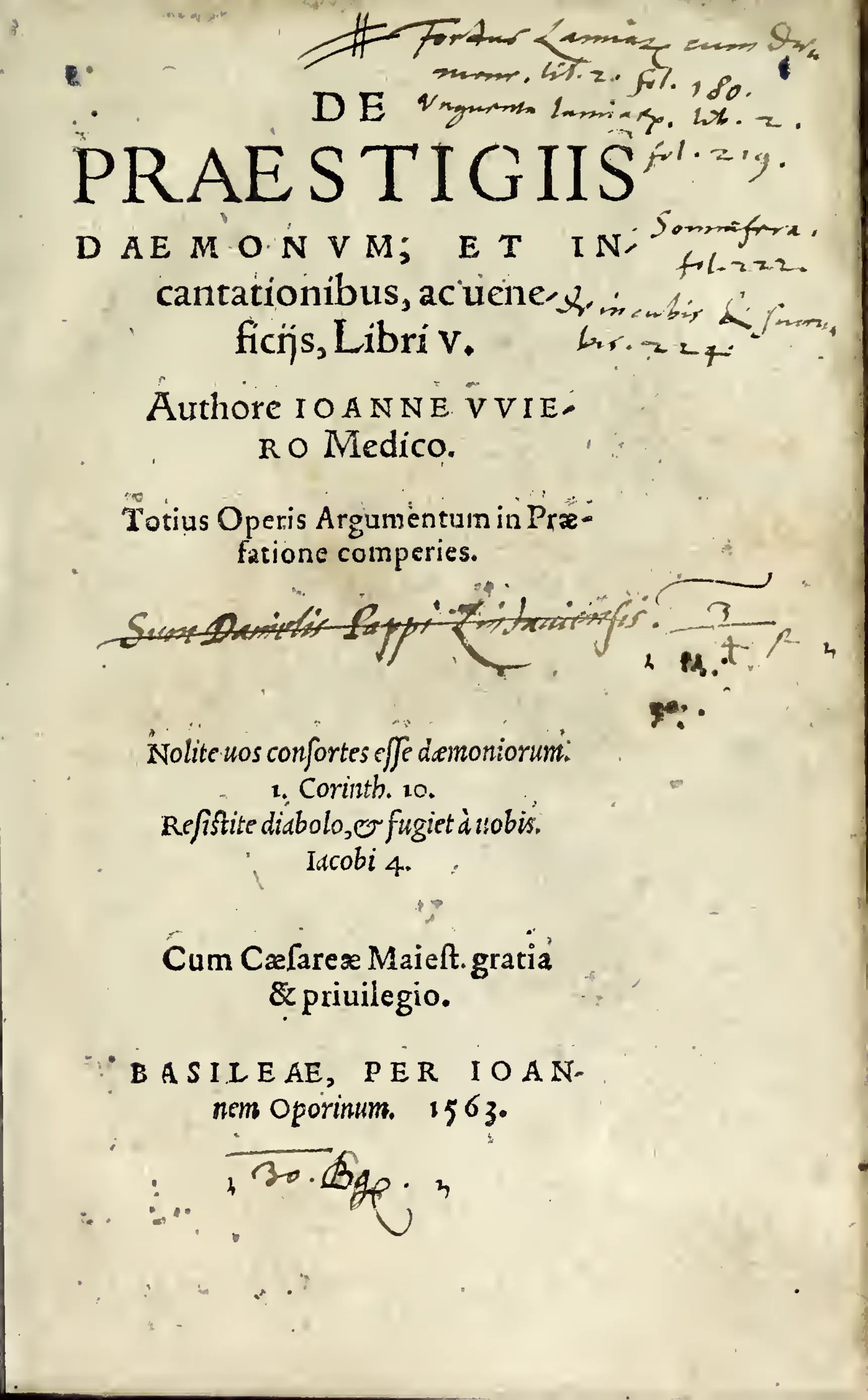
The 1563 Basel title page frames Weyer's intervention as a learned medical work: the printed attribution "Authore IOANNE VVIERO Medico" and Oporinus imprint place the case against witchcraft prosecutions under the authority of the physician and the humanist press. Later handwritten notes clustered across the margins show this copy as an actively used object, layering reception history onto the book's opening claim to scholarly legitimacy. Source ↗.
The single problem the treatise confronts is how to disentangle the genuine crime that human law may rightly punish from the imagined crime for which melancholic and deluded women were being condemned to the stake. Weyer's recurring move — the connective thread running through every book — is to argue that the marvels traditionally attributed to witches belong to the category of praestigiae, diabolical illusions permitted by God, and never to the category of real causation. The old woman who confesses to night-flight, to copulation with incubi, or to metamorphosis is, on this account, the passive victim of a corrupted imaginatio into which Satan has instilled phantasms of guilt; she is not a party to any efficacious covenant. From this controlling commitment Weyer builds a coordinated fourfold argument — theological, philosophical, medical, and juridical — by which he naturalizes each alleged marvel as delusion, as the effect of a drug, or as the demon's sleight of hand, and by which he severs the illusory demonic pactum from any real efficacy. The argument culminates in an exegetical and legal shift: a rereading of the Mosaic edict of Exodus 22:18 through Hebrew philology so that the death penalty falls upon the veneficus, the poisoner who truly harms the body by material means, and not upon the deluded lamia.
The stakes of this argument were considerable, and they cut across several domains at once. To recategorize the witch's confession as a symptom of humoral melancholy rather than as the attestation of a criminal compact was to relocate the accused from the juridical to the clinical register, and to raise, decades before such questions were systematically posed, the problem of whether a will overborne by disease can be held criminally liable. To restrict capital exposure to the poisoner under the Roman-law lex Cornelia de sicariis et veneficis was to advance an early rationale for confining criminal liability to those who make a real causal contribution through a competent will. And to correct the Vulgate's maleficus against a philologically reconstructed Hebrew original was to enlist the highest contemporary humanist scholarship, in the tradition of Reuchlin and Andreas Masius, in the service of a demonological and legal case. The whole enterprise is governed by the principle that Satan acts only by divine permission and requires no human accomplice — a theological premise that, pressed to its conclusion, renders the witch redundant to the very harms she is accused of causing.
What a first-time reader will find most striking is the concreteness with which Weyer prosecutes each naturalizing move. The nocturnal ride with Diana or Herodias is treated as a phantasm; the flight to the sabbath is referred to the narcotic force of the flying ointment and the power of imagination; the incubus is reduced to an imaginary event of a damaged mind or, at most, to a physical titillation; the objects vomited by the possessed are explained as the demon's imperceptible speed and subtlety deceiving the eye; the "sacred disease" of epilepsy is stripped of its supernatural pretensions through Hippocratic authority. The treatise names its adversaries without euphemism — above all Heinrich Kramer (Institoris) and Jakob Sprenger, the Dominican authors of the Malleus Maleficarum, whose doctrine of demonic sperm-transfer between succubus and incubus Weyer singles out for ridicule — and it reaches into anatomy, pharmacology, Roman and canon law, and classical and Hebrew philology in turn. It is at the same time a work of marked deference: Weyer closes by submitting everything he has asserted to the judgment of the Church, ready to correct it by spontaneous palinode.
How Weyer is best understood remains genuinely contested. Whether the treatise is most accurately read as the inaugural document of a psychiatric genealogy, as an Erasmian plea for humane restraint, as an instrument of Protestant anti-Catholic polemic, or as a rigorously coherent extension of demonology itself to the point where the witch ceases to be necessary — each of these readings commands serious scholarly support, and the confessional placement of its author is itself unsettled. So too is the relation of Weyer's Hebrew philology to the wider Christian-Hebraist programme, a dimension that has been comparatively little studied. What is not in doubt is that the work set the terms of the debate over witchcraft prosecution for the remainder of the century, drawing the great hostile rejoinder of Jean Bodin and the sympathetic extension of Reginald Scot, and that its conceptual vocabulary — praestigiae, lamia, venefica, pactum, divine permission — carries the whole weight of its argument, binds its production and patronage context to its polemical purpose, and structures the movement of its five books from the devil, through the magicians and the afflicted, to cure and to punishment.
Read the full text and English translation on Leo
This text was transcribed and translated as part of the ExLatinis project, an effort by Leo to make free English translations of every text published in Latin in early modern Europe (1450–1750) available online. The complete transcription and English translation of this work can be read free of charge:
→ Read the original Latin text and full English translation on Leo
You can save a copy of this document into your Leo account to run deep text searches, conduct further analysis, or cross-reference it with your own research.
Naming the Work: An English Title and Philological Framing of the 1563 Basel Treatise
The conventional English title by which this treatise is known in current English-language scholarship is On the Tricks of Demons and on Enchantments and Poisonings, or more compactly On the Tricks of Demons, the rendering popularized through twentieth-century reference works and carried into the bibliographic apparatus of the 1991 Binghamton critical English edition, Witches, Devils, and Doctors in the Renaissance: Johann Weyer, De praestigiis daemonum. Because no fully conventional scholarly English title has crystallized in the discipline — the late-modern English translation lineage prefers the moralizing and dramaturgical English title Witches, Devils, and Doctors in the Renaissance, which is properly the title of the editor's translation rather than of the work itself — the editorial title supplied above, On the Tricks of Demons and on Enchantments and Poisonings, in Five Books, registers the full Latin head-title De praestigiis daemonum, et incantationibus ac veneficiis libri V together with the first-edition book-count, and serves as a convenience rather than as an inherited convention.
At the philological heart of the treatise lies the noun praestigiae, whose early-modern semantic field is dense and contested. In classical and late-antique Latin, praestigiae designated the conjurer's sleight of hand, the optical illusion that deceived the senses without producing any real effect; by the high and late Middle Ages the term had migrated into demonological vocabulary, where it could designate, by synecdoche, the entire class of diabolically permitted sensory deceptions. The treatise exploits precisely this inherited elasticity. Its thesis is that everything traditionally catalogued under the witch's maleficium — the nocturnal flight, the Sabbat, the bodily harm supposedly inflicted by touch or by glance — falls under the head of praestigiae, that is, under illusory operations whose only efficient cause is the action of demons permitted by God upon a corrupted faculty of imaginatio. The text makes this framing explicit, distinguishing what the devil's agents display, illusions rather than miracles, which obtain their effect not by God's assistance but by God's permission on account of men's unbelief and the demon's compact, Præstigias ostentant, non miracula: quæ non Dei / assistentia, sed Dei permissione ob hominu[m] incredulitatem, & demonum / pactione sortiuntur effectum. Praestigiae in this text are never real causation: they are diabolical theatre operating upon a diseased imagination, and they require no human accomplice. This commitment, established in the opening books and reinforced at the philological crux of Exodus 22:18, governs the entire argumentative economy of the work. Where the Malleus Maleficarum of Heinrich Kramer and Jakob Sprenger had constructed an alternative economy of maleficium understood as genuine physical harm wrought by witches in league with demons, the treatise reabsorbs every such case into the category of the praestigiosum, the merely phenomenal, and thereby withdraws it from the reach of capital penal law. The controlling thesis is stated in the treatise's own terms early on: witches can by no malign will, curse, or malicious gaze harm anyone, their imagination having been corrupted by the demon's hidden effort so that, agitated as though by melancholy, they induce into their own minds the belief that Satan's evils were their doing, nimirum Lamias nemini ulla uoluntate maligna, quacunq[ue] dira imprecatione, aut intuitu malitioso nocere posseat uitiata dæmonis conatu occulto / phantasia, eas tanquam melancholia / agitatas, in mente[m] sibi inducere.
A second terminological axis is supplied by the deliberate juridical separation of the venefica from the lamia. The treatise's most consequential technical move is the partition of the older, undifferentiated category of the malefic into two juridically distinct figures. The venefica (and her masculine counterpart the veneficus) is the poisoner, one who by material means — herb, compound, or natural substance — truly harms the body, and who accordingly falls under the Roman-law tradition codified in the lex Cornelia de sicariis et veneficis and is liable to capital punishment. The lamia, by contrast, is the deluded, melancholy old woman, deceived in her faculty of imaginatio by demonic praestigiae, whose confession of night-flight, of copulation with incubi, and of metamorphosis is to be explained as the symptom of a humoral disturbance rather than as evidence of criminal compact. The lexeme lamia is itself antique and ambivalent: in classical Latin it names a child-devouring witch or hag, and in biblical and patristic usage it can shade into the vampiric figure of the night, yet the treatise deliberately strips it of any demonic-agency charge and reduces it to a clinical category — the melancholic whose imagination is the theatre on which the devil plays. This separation is the juridical pivot of the entire work, and it is precisely the move that the treatise's hostile readers, and above all Jean Bodin, were to contest: their objection, in substance, is that the distinction is sophistical, because the lamia has nevertheless consented to the diabolical in her imaginatio and so remains a poisoner of souls if not of bodies.
A third terminological register concerns the vocabulary of compact and the paired nouns foedus and pactum. The demonic compact — the explicit, bilateral agreement by which the witch is held to surrender her soul and body in exchange for the demon's services — is the keystone of the inquisitorial doctrine of witchcraft codified in the Malleus Maleficarum. The treatise undertakes to dismantle this doctrine not by denying that witches avow such compacts but by reframing the compact as praestigiosum. Weyer holds it easily recognized that the pact is illusory, established by a phantasm or imagination, or by a form falsely appearing through the dazzling body of the spirit, quod esse præstigiosum, phantasmate aut imaginatione, / uel phantastico præstringentis spiritus corpore / fallaciter apparente. The pactum is not annulled but reinterpreted: recast as a phenomenon of the mente laesi, the wounded or stupefied mind, rather than a juristically valid foedus. A foedus in the proper sense is a binding covenant between competent parties, and a pactum in the proper sense a consensual agreement presupposing deliberative assent; the treatise argues that neither condition is satisfied in the melancholy lamia, whose will is overborne by a corrupted imagination and whose confessions under torture are the empty products of praestigiae rather than the juridical attestation of true consent. To declare the demonic pactum illusory and void, contracted on a stupefied mind, is therefore not to deny that witches say they have signed such compacts; it is to deny that their words are signs of consent rather than symptoms of disease. This is the philological redefinition by which the treatise effectively evacuates the legal category of demonic compact from witchcraft prosecution, leaving intact only the lex Cornelia prosecution of the genuine poisoner.
What Weyer Argues: A Summary of the Case Against Witch Prosecution
Johann Weyer's De praestigiis daemonum, et incantationibus ac veneficiis libri V is a learned polemical treatise of 1563 composed in Neo-Latin and printed at Basel by the humanist printer Johannes Oporinus. Weyer — latinized as Ioannes Wierus, occasionally styled Piscinarius — was born c. 1515 at Grave in Brabant, trained in medicine under the humanist circle of Heinrich Cornelius Agrippa, and from around 1550 held the office of physician to the court of Duke William V ("the Rich") of Cleves-Jülich-Berg, to whom the first edition is dedicated. He died on 24 February 1588 at Tecklenburg. The work's organizing thesis is that the alleged witch — recategorized by Weyer as a lamia — is a melancholic, deluded woman whose confessions of night-flight, demonic copulation, and metamorphosis are symptoms of a humoral disturbance acted upon by demons permitted by God, never of a true covenant with the devil. Weyer presents the crux directly: what God's secret counsel permits the devil, the demon often instills into the woman's diseased brain as if it had been designed by her, though she is wholly innocent of the crime, id uitiato feminæ cerebro dæmon sæpe ingerit, quasi ab illa designatum sit: cuius tamen sceleris illam planè insontem esse comperiet. The demonic pact (pactum/foedus) is declared illusory and juridically void, contracted on a mente laesi; Satan acts only by divine permission and never requires a human accomplice in the infliction of harm — the treatise insists that without His assent Satan cannot act even against beasts, much less against men, ut citra / eius assensum ne in bestias quidem aliquid possit, / multo minus in homines. Only the genuine poisoner (veneficus/venefica) who harms by material means remains liable to capital punishment, and even then only under the Roman-law lex Cornelia de sicariis et veneficis, not under any theological-criminal charge of maleficium. The treatise is at once a demonological intervention, a medical commentary on the melancholy imagination, a juridical argument for restricting the scope of capital prosecution, and a Christian-Hebraist philological engagement with Exodus 22:18, and it sets the terms of the subsequent mid-sixteenth-century debate over witchcraft prosecution. The Latin text circulated in successive expanded recensions through 1564, 1566, 1568, 1577, and 1583, with the 1577 six-book recension introducing the De lamiis liber and the Pseudomonarchia Daemonum appendix; a German translation tradition (Von Teuffelsgespenst, Zauberern und Gifftbereytern) begins with Fuglin's 1566 partial rendering and continues through Frankfurt imprints of the 1580s. The principal modern English translation is the 1991 Binghamton critical edition, Witches, Devils, and Doctors in the Renaissance: Johann Weyer, De praestigiis daemonum, edited by George Mora with associate editor Benjamin Kohl, translated by John Shea, with a foreword by John Weber and contributions by H. C. Erik Midelfort and Helen Bacon (Medieval & Renaissance Texts & Studies, ISBN 0866980830); an abridged translation by Shea followed in 1998.
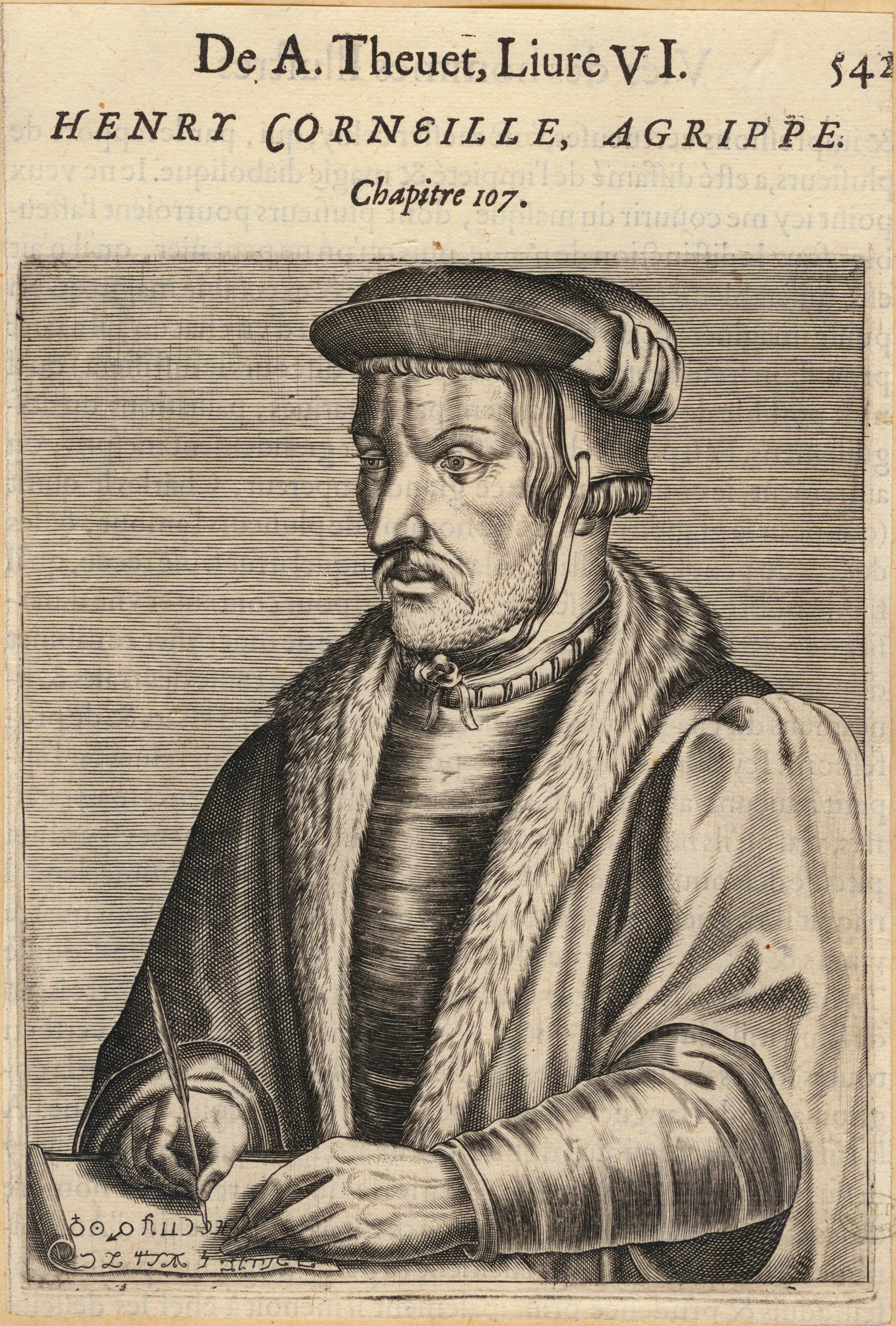
This engraved portrait of Heinrich Cornelius Agrippa, published in Thevet's 1584 compendium, evokes the learned humanist-occultist milieu in which Johann Weyer received his medical and intellectual formation. Agrippa's circle helps explain the unusual blend in Weyer's later demonology: philological learning, natural philosophy, medical psychology, and a sustained skepticism toward the prosecution of alleged witches. Source ↗.
Why Weyer Matters: Scholarly Significance and the Historiographical Debate
The treatise matters to modern scholarship at four convergent registers, and the historiography has organised itself along each.
First, it is the earliest substantial medicalising intervention in demonological argument. By relocating the witchcraft confession from the category of criminal compact to the category of melancholic delusion acting upon a corrupted imaginatio, Weyer effects a translation of the witch from the juridical to the clinical register, anticipating by several decades the kind of psychiatric reframing that would be consolidated only in the late seventeenth and eighteenth centuries. The clinical resolution of this move is explicit in the treatise's prescription that, in place of the executioner, one must flee to the physician of good conscience, celebrated in profession, learning, and practice, who discerns the differences and causes of diseases, ad eum ex Dei ordinatione confugiendum est, qui professione, doctrina atque artis usu celebris, morbos eorum differentias & causas penitius dignoscat: nimirum ad bonæ conscientiæ medicum. H. C. Erik Midelfort's A History of Madness in Sixteenth-Century Germany (Stanford, 1999) treats this as the central pivot of the sixteenth-century German medical culture of melancholy, and the historiography has largely followed him in reading Weyer as the inaugural figure of what would later become the psychiatric genealogy. The historiography here is robust but not unanimous: the question of whether Weyer is best read as proto-psychiatrist or as a thoroughgoing demonologist who happens to medicalise the witch is one on which the secondary literature is divided (see below).
Second, it is a central document in the juridical history of capital punishment and the limits of criminal liability. By limiting capital exposure to the genuine poisoner under the Roman-law lex Cornelia de sicariis et veneficis, and by removing the melancholy lamia from the reach of the theological-criminal charge of maleficium, Weyer offers one of the earliest rationales for what would later harden into the principle that criminal liability requires a competent will and a real causal contribution. The treatise grounds the demand for differentiated punishment in its own taxonomy, insisting that since he has distinguished magicians from witches and poisoners, one and the same penalty must not be set for all confusedly and indifferently, magos uarios quum supra multo discrimine à sagis et ueneficis meritò distinxerim, non eadem debet his simul confusè & indifferenter statui poena; the lex Cornelia itself is invoked in narrowly material terms, punishing whoever has made, sold, or possessed a harmful poison for the purpose of killing a person, Qui uenenum malum necandi hominis causa fecerit, uel uendiderit, uel habuerit, plectitur. This dimension of the treatise has been less foregrounded in the Anglophone historiography than the medical and exegetical dimensions, but it is central to the Continental reception, particularly in the Italian and Spanish traditions.
Third, it is a monument of Christian-Hebraist philology applied to the most-cited biblical locus for witch-execution. By drawing on Andreas Masius and on the Reuchlinian Hebraist tradition to argue that the Hebrew mechassepha of Exodus 22:18 designates a poisoner and not a witch, Weyer transfers the authority over the biblical text from the Vulgate's maleficus to a philologically corrected Hebrew original, rendering the Mosaic edict so as to read that one shall not permit poisoners — or, as the Hebrews have it, female poisoners — to live, Veneficos (uel, ut Hebræi habent, ueneficas) non sinetis superuiuere. This is exegetical intervention at the highest level of contemporary humanist scholarship, and it situates the treatise not only within demonology but also within the broader Reuchlinian programme of Christian Hebraica. The historiography on this dimension is comparatively thin, and the treatise's significance for the history of Christian Hebraism deserves fuller treatment than it has yet received.
Fourth, it is a central document in the gendered anthropology of melancholy and the sexus femineus. Weyer inherits and turns against the traditional Galenic-Hippocratic claim that the female body is by complexion predisposed to melancholy and demonic operation, and he deploys this claim against the prosecution by arguing that the very melancholic predisposition of the sexus femineus is what makes women vulnerable to praestigium rather than to genuine compact. He describes the feminine sex as unstable, credulous, malicious, weak of spirit, and melancholic through ill-governed affections, and singles out especially exhausted, wavering old women as those whom the subtle deceiver leads on, Plurimum uerò huc sexum femineum, nimirum temperamenti ratione lubricum, / credulum, maliciosum, / impotentis animi. The historiography on this dimension is itself contested: some scholars read the move as proto-feminist, others as a re-inscription of the very gender hierarchy it ostensibly dismantles.
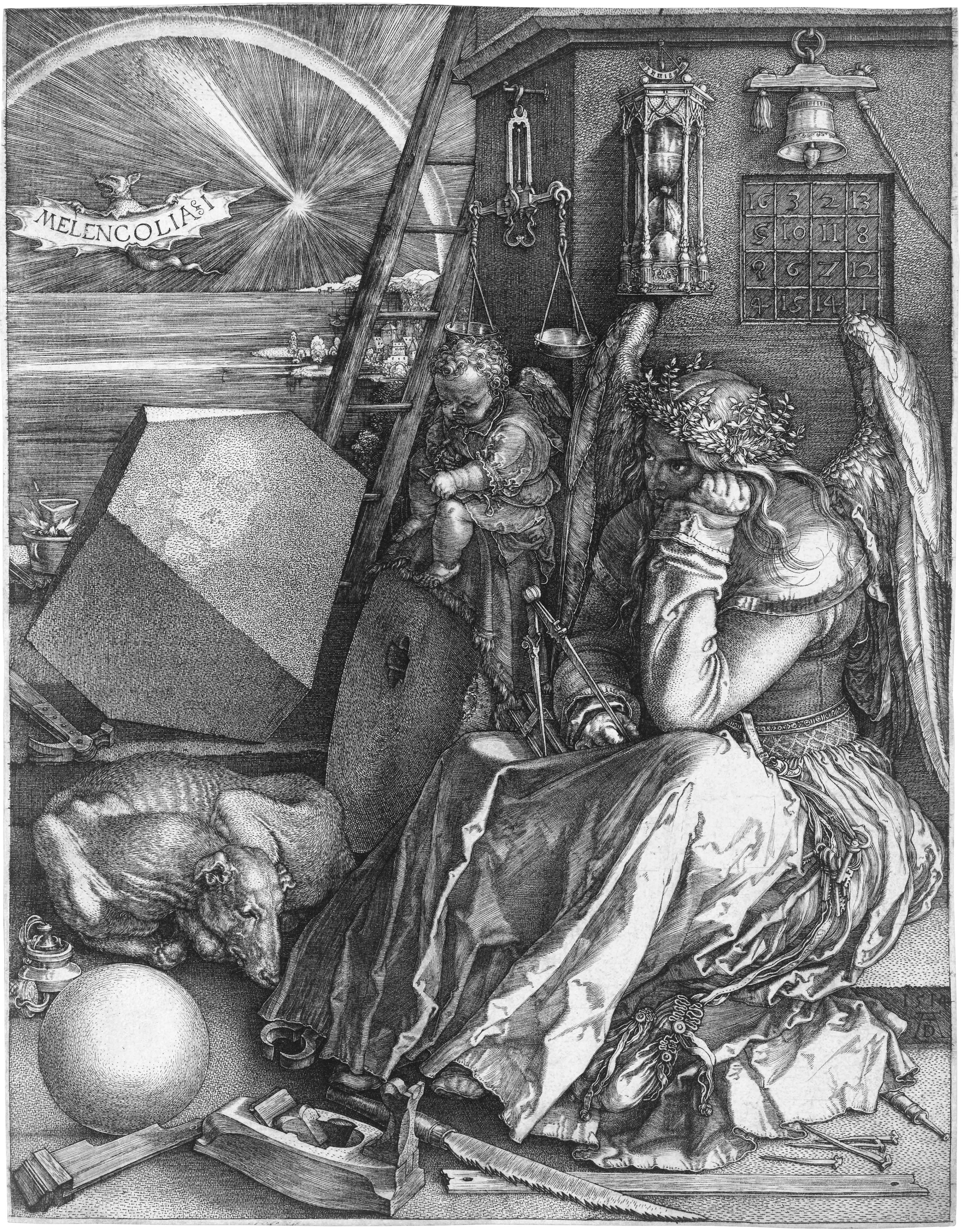
Dürer's 1514 Melencolia I casts the melancholic temperament as a brooding, winged figure surrounded by measuring tools, a polyhedron, an hourglass, and other instruments of disciplined knowledge rendered inert by inward affliction. Set beside Weyer's argument, this canonical image of melancholia sharpens the stakes of his gendered anthropology: the accused woman's visions and confessions become less proof of compact than symptoms of a vulnerable imaginatio exposed to demonic deception. Source ↗.
The major scholarly disagreements may be schematised as follows. E. William Monter's reading, in his chapter "Witchcraft in France and Switzerland: The Weyer-Bodin Debate" (originally in European Witchcraft, Wiley, 1969, and reprinted in Witchcraft in France and Switzerland, Philadelphia, 1976), frames Weyer as a humane Erasmian irenicist and treats the Weyer-Bodin polemic as the central episode of the early modern persecution debate; this remains the canonical Anglophone reading. Stuart Clark's Thinking with Demons: The Idea of Witchcraft in Early Modern Europe (Oxford: Clarendon Press, 1997) re-frames the consensus: Clark argues that Weyer is best read not as a proto-psychiatrist or as an Erasmian but as a sophisticated and coherent participant in the demonological cliché of his age who extends the doctrine of demonic praestigia to such a pitch that the witch becomes redundant, and that the work is therefore best understood as continuous with, rather than a departure from, the demonological tradition. Weyer's own insistence that nowhere in the whole volume of the Old and New Testament will one find Satan employing or requiring the aid of some lamia in afflicting bodies, Nec usquam in uasto Veteris & Ioui testamenti volumine exemplum, ubi in affligen dis corporibus, alicuius Lamiæ operam usurparit, aut etiam requisierit, satan, shows precisely the demonological rigour Clark identifies, since it is by extending divine permission and demonic agency to their limit that the human witch is rendered superfluous. Sydney Anglo's chapter on Weyer in The Damned Art: Essays in the Literature of Witchcraft (London: Routledge & Kegan Paul, 1977) treats Weyer as a 'defender of witches whose humanitarianism misfired', arguing that Weyer is vulnerable precisely because he conceded the reality of the devil while exculpating women, and that the work is best read as a polemical genre-piece whose coherence as a system of psychopathology is limited. Christopher Baxter's chapter "Johann Weyer's De praestigiis daemonum: Unsystematic Psychopathology" (in Anglo, 1977) pursues the question of Weyer's coherence as a medical-demonological theorist and argues that the treatise fits only awkwardly into later psychiatric genealogies. The Vera Hoorens article "Why did Johann Weyer write De praestigiis daemonum? How Anti-Catholicism inspired the Landmark Plea for the Witches" (BMGN — Low Countries Historical Review 129, no. 1, 2014: 1–28) advances a significant minority interpretation that the treatise is at least equally an instrument of confessional anti-Catholic polemic as a defense of the witches, and reads it as continuous with Protestant confessional anti-Catholicism rather than as a purely Erasmian irenicism. Michaela Valente's scholarship on the Weyer-Bodin controversy in Italy (in Bodin in Italia: La Démonomanie des sorciers e le vicende della sua traduzione, Florence: Centro editoriale toscano, 1999; and her contribution to Howell A. Lloyd (ed.), The Reception of Bodin, Leiden: Brill, 2013) tracks the Italian reception and the Weyer-Bodin exchange across confessional boundaries.
Where the historiography is thin or divided, this account says so plainly. The question of Weyer's confessional placement—whether he is best read as Reformed, Erasmian, or Catholicate—remains unsettled in the modern literature; the treatise's own closing gesture of submission to the Church, discussed below, is one of the data points that keeps the question open. The relationship of the De praestigiis to the Christian-Hebraist programme of Reuchlin and his successors has been under-studied. The juridical dimension of the treatise has been less foregrounded in Anglophone scholarship than the medical and exegetical dimensions, and the Italian, Spanish, and Dutch reception traditions remain undermapped relative to the French and German. These gaps in the literature are noted here as a matter of intellectual honesty rather than papered over.
Finally, the relationship to Reginald Scot and Jean Bodin is central and must be registered. Bodin's De la démonomanie des sorciers (Paris, 1580) constitutes the principal hostile rejoinder, contesting Weyer's praestigia doctrine at every point and accusing him of effectively protecting criminals by medicalising them; Bodin's polemic was translated into Latin and into the major European vernaculars and shaped the late sixteenth- and seventeenth-century consensus against Weyer's position. Scot's The Discoverie of Witchcraft (London, 1584) constitutes the principal sympathetic extension in the English vernacular, drawing extensively on Weyer and carrying the argument into a distinctively English tradition of witchcraft scepticism; Scot's work in turn shaped later English sceptical writing and contributed to the genealogy of Enlightenment witchcraft scepticism.
Editions, Transmission, and the Material Life of the Basel Treatise
Production and Transmission. The first edition was printed at Basel by Johannes Oporinus in 1563 in five books, with the orthography of the head-title rendered ueneficiis in imitation of the humanist convention. The Oporinus press at Basel was, at the date of printing, one of the leading humanist printing houses in Europe, with an active programme in patristic, classical, and medico-scientific texts; the choice of Oporinus, rather than of a less prestigious house, is itself a paratextual signal that the work was projected as a learned Neo-Latin treatise rather than as a vernacular polemic. The programmatic design of the work is set out in its own front matter, which announces an argument partly theological, whereby the devil's studies are exposed by scriptural testimonies, and partly philosophical, whereby Satan's mockeries and the corrupt imagination of witches are refuted by natural reasons, Argumentum est partim Theologicum, / quo diaboli & studia, sacrarum literarum / testimonijs prodûtur; this fourfold theological, philosophical, medical, and juridical method furnishes the connective architecture that carries the praestigiae thesis through all five books. The polemical target is likewise named at the outset, Weyer challenging anyone who objects that the Malleus Maleficarum had already accomplished this task to read that book's absurd and often impious trifles heaped up by the theologians Institoris and Sprenger, Si Maleficarum malleum hoc absoluisse p[er]esum quis obijciat, is amabò illius libri congestas à Theologis Henrico Institoris & Iacobo Sprêger ineptias absurdas, sæpe etia[m] impias, legat.

Merian's 1642 view of Basel offers a later image of the Rhine city whose presses gave Johann Weyer's De praestigiis daemonum its first form in 1563 and sustained its subsequent recensions. The compact fortified cityscape anchors the Oporinus imprint not as incidental publication data but as part of the learned humanist milieu in which Weyer's Neo-Latin polemic was framed. Source ↗.
The work was reissued by Oporinus in 1564, 1566, and 1568; in 1577 it was recast into a six-book recension (libri VI) and printed Ex Officina Oporiniana, with the addition of an appendix catalogued in modern reference literature as Pseudomonarchia Daemonum (1577), a demonological catalogue that has been identified as a principal source for the Ars Goetia of the later Lemegeton. The 1577 Basel six-book edition also bound in the freestanding De lamiis liber of the same year. The 1583 Basel edition printed by Oporinus bears the head-title De Praestigiis Daemonum, & incantationibus ac veneficiis Libri sex and constitutes the standard form of the work that the later transmission-physique editions follow. A 1660 Amsterdam collected edition was printed by Peter Vanden Berge as Opera Omnia, gathering the De praestigiis with the Medicarum observationum and other works, and remains the principal modern textual access point for the non-witch writings of Weyer. The German translation tradition, beginning with the Fuglin partial rendering of 1566 and continuing through the Frankfurt Von Teuffelsgespenst, Zauberern und Gifftbereytern imprints of the 1580s (catalogued in the BSB opac), carried the work into the vernacular sphere of the Empire.
Catalogue and Repository Footprint. The work is recorded in WorldCat under OCLC record 14320378 for the 1563 first edition and OCLC 165966640 for the six-book recension; in the German Verzeichnis der im deutschen Sprachraum erschienenen Drucke des 16. Jahrhunderts (VD16) tradition, an independent retrieval of a dedicated VD16 shelfmark could not be completed in this round and is flagged accordingly; in the Bavarian State Library (BSB) catalogues, including the MDZ digital collections, 1586 German imprints of the Von Teuffelsgespenst tradition are catalogued; in the Wellcome Collection (London) catalogues, the 1567 Medicarum observationum rararum Liber I is separately recorded; and in the Internet Archive, the 1563 Oporinus first edition is digitally reproduced. The English-language critical translation is catalogued at the Wellcome Collection under Witches, devils, and doctors in the Renaissance (Binghamton: Medieval & Renaissance Texts & Studies, 1991; ISBN 0866980830).
Materiality and Paratextual Apparatus. Format, collation, and the specific printer's device of the 1563 edition are not separately confirmed in the catalogue sources examined in this round and are flagged as not publicly documented at the present resolution. The dedication to Duke William V of Cleves-Jülich-Berg is confirmed across multiple sources, and the paratextual figures named in the surrounding documentation — Heinrich Bars (called Olisleger / Henricus Barzius / Olislegerus), Johann Ewich (Ioannes Evwich), and Johann Brachel (Ioannes Brachelius) — are referenced in the accompanying documentation and in the secondary literature, though their specific paratextual role in the 1563 edition (preface, commendatory letter, verse elegy) could not be independently verified in the catalogue sources and is accordingly flagged as inferred rather than directly documented. The work is not recorded in the Index Librorum Prohibitorum in the consulted sources, and the absence of an Index entry does not preclude local condemnation or confessional polemic; censorship historiography notes that the treatise circulated in Protestant and Catholic territories under varying regimes of confessional reception. Consonant with that varied confessional reception, the treatise closes on a marked note of deference, Weyer wishing nothing so asserted that he does not wholly submit it to the fairer judgment of the catholic Church of Christ, ready to correct it by spontaneous palinode, Nihil autem hic ita assertum uolo, quod æquiori catholicæ Christi ecclesiæ iudicio, non omnino submittam: palinodia mox spontanea emendaturus.
Reception and Polemical Lineage. The dedicatee and patron was Duke William V of Cleves-Jülich-Berg; the named adversaries attacked in the text are, in the first instance, Heinrich Kramer (Institoris) and Jakob Sprenger, the Dominican inquisitors responsible for the Malleus Maleficarum, and in the second instance the naturalising philosophers Girolamo Cardano, Giambattista della Porta, Pietro Pomponazzi, Johannes Trithemius, Charles de Bovelles, Andrea Alciato, and Giovanni Francesco Ponzinibbio. The attack on the Malleus authors is at its sharpest on the question of demonic sperm-transfer, where Weyer objects that very many theologians argue most absurdly — like the architects of the Malleus, Institoris and Sprenger — that the same demon is a succubus to the man and then an incubus to the woman, ac argumententur absurdè admodum pleriq[ue] Theologi (ut Mallei maleficarum architecti, Henricus Institoris & Iacobus Sprenger. The principal hostile rejoinder was Jean Bodin's De la démonomanie des sorciers (Paris, 1580), which contested the praestigia doctrine at every point and accused Weyer of effectively protecting criminals by medicalizing them. The principal sympathetic extension in the English tradition is Reginald Scot's The Discoverie of Witchcraft (London, 1584), which borrows extensively from the treatise and carries its argument into the English vernacular. Subsequent hostile responses by Thomas Erastus and, at a longer interval, by King James VI of Scotland in his Daemonologie (Edinburgh, 1597) extended the polemic into the seventeenth century and consolidated the anti-Weyerian consensus in late-Elizabethan and early-Stuart England.
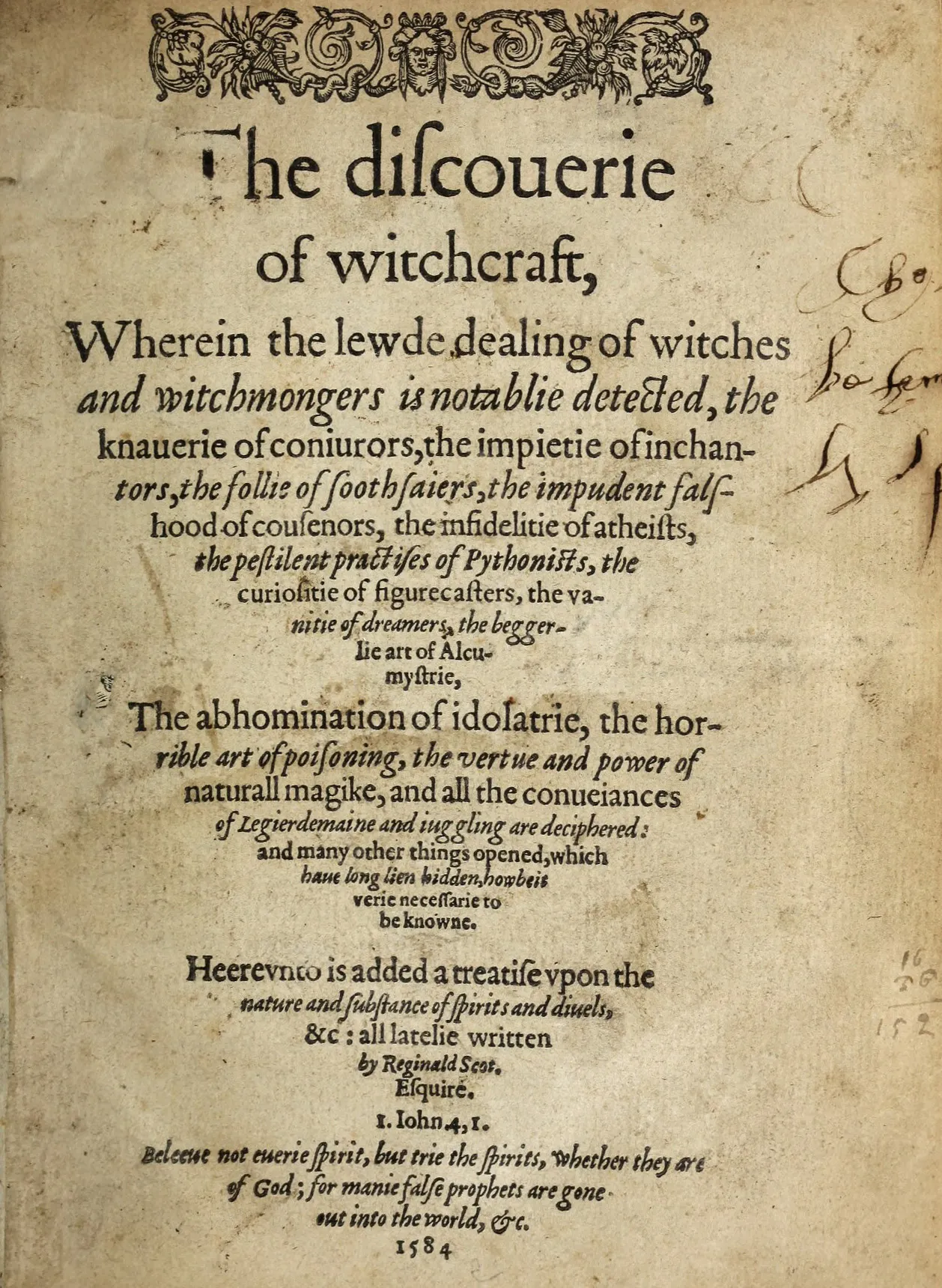
The 1584 London title page of Reginald Scot's The Discoverie of Witchcraft marks the English vernacular afterlife of Weyer's anti-prosecution argument: where Bodin answered Weyer by defending demonological severity, Scot recast much of the skeptical case for Elizabethan readers. As a printed artifact, it makes visible the route by which Weyer's challenge to the Malleus tradition entered a distinctively English controversy over witches, fraud, and judicial belief. Source ↗.
Relation to Weyer's Other Works. The 1563 treatise is the inaugural work of Weyer as author of the witch-polemic; it is followed by the medical Medicarum observationum rararum Liber I (Basel, Oporinus, 1567), which furnishes the Galenic and Hippocratic framework within which the De praestigiis medicalizing argument is articulated; by the De lamiis liber of 1577, a freestanding digest of the 1563 treatise's central polemic against witch prosecution, stripped of the Hebrew-philological apparatus and addressed to a narrower audience; and by the Pseudomonarchia Daemonum appendix of the same year, bound into the 1577 six-book recension. The collected Opera Omnia of 1660 (Amsterdam, Peter Vanden Berge) gathers the De praestigiis with the Medicarum observationum and constitutes the principal modern textual access point for the non-witch writings of Weyer.
How the Argument Unfolds: The Five Books from the Devil to the Poisoner
The treatise opens by announcing its own controlling wager before it argues a single case, and the front matter is where that wager is made audible. In the dedicatory epistle to Duke William of Cleves-Jülich-Berg, Weyer already draws the distinction on which everything downstream turns, separating the ruinous opinion conceived concerning the maledicium of witches — emphatically, he interjects, not their veneficium — in the phrase that names the harm-magic he means to deny, opinio nimirùm concepta de Lamiaru[m] maledicij. The parenthetical correction, (non inquam / ueneficij), performs in miniature the entire juridical operation of the book: it refuses to let the reader collapse the imagined crime of malefic cursing into the real crime of poisoning, and it stakes the physician's claim to authority over a matter that theologians and jurists had presumed to settle. That the intervention is a physician's is inscribed on the title page itself, which presents the author as IOANNE VVIERO Medico and the imprint as BASILEAE, PER IOANnem Oporinum. 1563; the professional epithet is not decorative but programmatic, since the whole apparatus of humoral diagnosis that follows depends on the reader's granting that the competent judge of these cases is the physician rather than the inquisitor.
The Front Matter and the Fourfold Method
Weyer's methodological self-description makes the interdisciplinary ambition explicit. He states that the argument is partly theological, whereby the devil's studies are laid open by the testimonies of sacred letters — the programmatic statement of method already registered in the account of the work's production — and continues that the philosophical portion refutes by natural reasons the vanity of Satan's mockeries and the corrupt imagination of the witches. The four registers — theological, philosophical, medical, juridical — are not merely juxtaposed but coordinated toward a single end, each supplying a distinct guarantee that the marvels catalogued in the demonological tradition can be reduced to illusion, delusion, or material poisoning. The polemical energy of this coordination is sharpest where Weyer names his adversaries. Anticipating the objection that the Malleus Maleficarum has already treated these matters, he answers, as noted in the discussion of the front matter above, that whoever raises it should read that book's absurd and often even impious trifles heaped up by Institoris and Sprenger. The charge of impiety is calculated: it turns the inquisitorial manual's own theological credentials against it, implying that the witch-hunters' doctrine offends against right belief rather than defending it.
The dedicatory apparatus then yields to the programmatic thesis, which fuses the demonological and the medical into one exculpatory proposition — the claim, already met at the philological core of the work, that witches can by no malign will, dread curse, or malicious gaze harm anyone, their imagination corrupted by the demon's hidden effort so that, agitated as though by melancholy, they induce into their own minds the belief that Satan's evils were their own doing. Two causal chains are welded here into one: the demon corrupts the phantasia, and melancholy agitates the humoral complexion, and the joint effect is a false internal attribution of guilt. The witch is doubly passive — passive before the demon's occult operation and passive before her own black bile — and it is precisely this double passivity that dissolves her supposed agency. Against the imagined harm Weyer sets the one harm that is real; his hand, that only poisoning genuinely injures, breaks off in the transmitted text at Veneficium solu[m]modo à, but the syntactic frame is unmistakable, and the juridical consequence follows directly: the magistrate is to punish only where a material poison, administered or applied, has demonstrably harmed the body.
This severance receives its scriptural warrant in the reinterpretation of the Mosaic edict that closes the preface. Rendering the verse from the Septuagint against the Vulgate's maleficus, Weyer gives it, in the philological rendering already discussed, as the command that one shall not permit poisoners — or, as the Hebrews have it, female poisoners — to live. The parenthetical appeal to the Hebrew is the philological hinge of the entire legal case: by relocating the death penalty from the maleficus to the veneficus, Weyer withdraws the capital sanction from the deluded old woman and fastens it exclusively upon the poisoner who works by natural means. The Hebrew scholarship on which this rests is made visible in the second book, where the feminine form of the term at Exodus 22, Mechassepha, is discussed with attention to why the female sex is there specified — a question Weyer will answer not by conceding female malice but by explaining female susceptibility to delusion.
Book I: The Theology of Divine Permission
Book I supplies the theological governor without which the exculpation would collapse. Having grounded his angelology in Genesis and Mosaic authority against both Aristotelian denial and Platonist demonology, and having marshaled the great euhemeristic catalogue whereby the gods of the nations are shown to be demons, as the royal prophet David affirms, Deos gentium / dæmonia esse, affirmat regius ille uates Dauid, Weyer arrives at the doctrine that bounds all diabolical power. The devil, he insists, can do nothing without God's assent — so that without that assent Satan cannot act even against beasts, much less against men, ut citra / eius assensum ne in bestias quidem aliquid possit, / multo minus in homines. This is the load-bearing premise of the whole treatise. If Satan is radically constrained by divine permission and requires no human confederate to accomplish what God allows, then the witch is superfluous to any harm she is accused of causing; her supposed compact adds nothing to a demonic agency already complete in itself. The fear of autonomous witch-power is thereby dismantled at its theological root, and the human accomplice is rendered redundant not by minimizing the devil but, paradoxically, by maximizing the sovereignty of God over him.
Book II: Praestigiae, the Illusory Pact, and the Melancholy Imagination
Book II presses the same logic through the philological and exegetical registers. Weyer's epistemological watchword is that the magicians display illusions, not miracles, effects obtained not by God's assistance but by God's permission on account of men's unbelief and the demon's compact — the distinction already set out at the philological core of the work. The distinction between assistentia and permissio is doing precise theological work: a miracle is God's positive concurrence, whereas a praestigium is merely something God suffers to occur, and every marvel of the magical tradition is reclassified into the latter, lower category. From this it follows that the foedus itself, the demonic pact that grounded the inquisitorial charge, must be illusory. Weyer declares it, in the passage examined earlier, easily recognized to be praestigiosum, established by a phantasm or imagination, or by a form falsely appearing through the dazzling body of the spirit. A covenant contracted upon a deceived and stupefied mind, between an illusory apparition and a will overborne by disease, satisfies neither the condition of competent parties nor that of genuine consent, and so carries no binding juridical force.
The forensic payoff of this reasoning is Weyer's account of confession under torture, which severs the evidentiary link on which the trials depended. These women, he argues, so dementated by the demon through forms impressed upon the phantastic faculty, know these things no otherwise than if they truly happened, so that nearly all their unnatural actions merely seem imaginary, and therefore, forced by the question and near the flames, they openly confess crimes known to them only through dream or image, non aliter ac si hæc ita uerè fierent, scire: uti ferè / omnes illarum præter naturam actiones, imaginariæ / saltem uidentur: & propterea quæstionibus adactæ, / flammisque; propinquæ, sua apertè confitentur flagitia, / per somnum uel simulachrum illis solummodo cognita. The confession, the very instrument the tribunals treated as decisive proof, is here converted into a symptom: it attests only to the vividness of the delusion, not to the reality of the deed. Weyer's exegetical method reinforces this by working through the locus classicus of necromancy; examining the raising of Samuel more deeply, he undertakes to show that it was not Samuel himself but a demonic spectre in his image, gladly obliging the Pythonic woman in order to deceive, that was seen, penitius / tamen rem intuenti ostendam, non ipsum Samuelem, / sed illius imagine diaboli spectrum, Pythiæ / foeminæ libenter obsequutum, ut ludificaret, uisum / fuisse. If even the most authoritative scriptural apparition resolves into a diabolical spectrum, then no reported apparition can be trusted as evidence of the dead returning at a witch's command.

In A. Laurentius's eighteenth-century engraving after Salvator Rosa, Saul and the woman of Endor confront a shrouded apparition while demonic figures press in behind them, turning the biblical episode into a theatre of deception. For Weyer this was precisely the point of the Endor story: the figure seen was not Samuel raised by female necromancy but a diabolical spectrum whose convincing appearance exposed the danger of treating visions—or confessions born of such phantasms—as proof. Source ↗.
The medical anthropology that underwrites the whole defense surfaces most fully where Weyer accounts for why women predominate among the accused. The subtle deceiver, as observed in the discussion of the gendered anthropology of melancholy, leads on especially the feminine sex — by temperament unstable, credulous, malicious, of weak spirit, and, because of affections it can scarcely govern, melancholic — and above all exhausted and wavering old women. The inherited Galenic-Hippocratic doctrine of female complexion is here turned against the prosecution: the very predisposition to melancholy that the tradition read as proximity to the demonic becomes, in Weyer's hands, an explanation of vulnerability to praestigium rather than evidence of malefic capacity. He grounds the point in a catalogue of melancholic delusions drawn from clinical observation — some think themselves made into earthen vessels and so yield to passers-by lest they be shattered, others fear death yet sometimes take their own life, Nonnulli se uasa fictilia factos esse putant: ob id occurentibus, ne collidantur, cedunt. alij mortem timent, / quam sibi tamen consciscunt interdum — displaying that the disordered imagination generates convictions as false and as vividly held as any confession of night-flight. To this humoral etiology Weyer joins a patristic authority on the affective mechanism, citing that more powerful than every diabolical action for harming is the magnitude of sorrow, for the demon overcomes whomever he overcomes through sorrow, Omni diabolica actione potentior / ad nocendum est moeroris magnitudo: quia dæmon / quoscunq[ue] superat, per moerorem superat. The demon's true point of entry is thus emotional and physiological, not contractual: he works upon a mind already weakened by grief and black bile rather than through any signed covenant.
The same naturalizing impulse governs Weyer's recruitment of Hippocratic medicine against the category of the supernaturally caused disease. Those who first pronounced the falling sickness sacred, he reports from the treatise On the Sacred Disease, seem to him to have been such men as are even now the magi and expiators and charlatans who feign themselves exceedingly pious and to know something more, Qui primi hunc morbum sacrum esse pronunciarunt, tales homines mihi / fuisse uidentur, quales etiam nunc sunt magi & expiatores & circulatores. The move is characteristic of the whole slice: an affliction long assigned to demonic causation is returned to the domain of natural disease, and those who insist on its supernatural origin are exposed as impostors trading on false piety. Across the front matter and the first two books, then, the treatise assembles a single coordinated instrument — theological in its doctrine of divine permission, philosophical in its reduction of marvels to praestigiae, medical in its diagnosis of melancholy and corrupted imaginatio, and juridical in its philological confinement of the capital sanction to the poisoner — by which the deluded lamia is lifted out of the reach of the criminal law and delivered instead to the physician.
The Physics of Demonic Deception
Weyer's central explanatory mechanism enters the next stretch of the treatise already fully operational, and the reader encounters it first at the level of demonic method rather than human agency. The devil, Weyer insists on Augustinian authority, works no miracle upon nature but exploits two natural prerogatives, and Augustine teaches that demons can do many such things by two things as by a certain prerogative, namely by sharpness of sense and speed of motion, so as either to inject into human senses or to forecast what they themselves are about to do, qui dæmones eiusmodi multa posse docet, duabus rebus ueluti quadam prærogatiua, sensus nimirum acrimonia, & motus celeritate: sicq[ue] hominum sensibus uel ingerere, uel prænunciare, quæ ipsi dæmones facturi sunt. The force of this formulation lies in its deflationary economy: the demon's apparent omnipotence is reduced to two faculties, acuity of perception and rapidity of movement, both of which belong to the order of created nature rather than to any power over it. Everything the treatise subsequently naturalizes — the phantasmic flight, the illusory transformation, the objects seemingly vomited from a bewitched body — follows from this initial restriction of demonic capacity to the manipulation of the human senses, which are deceived precisely because they cannot register a speed that outruns perception. The whole argumentative apparatus is thus secured at its foundation to a proposition about the physiology of sensation, not about the metaphysics of evil.
From this premise the argument moves to the corrupted imagination as the site upon which the demon operates. The nocturnal cavalcade with pagan deities, the staple of the Canon Episcopi tradition, is presented not as an event but as a shared delusion of belief and profession together: certain little women converted to Satan believe and profess that in the night hours they ride with Diana, goddess of the pagans, or with Herodias, or Minerva, or with an innumerable multitude of women, credunt se & profitentur nocturnis horis cum Diana Paganorum dea, uel cum Herodiade, uel Minerua, uel innumera mulieru[m] multitudine equitare. The coupling of credunt with profitentur is doing precise conceptual work: the confession that a tribunal would receive as testimony to a real crime is here recast as the verbal residue of a false belief, so that the very act of profession, far from evidencing the deed, evidences only the delusion that has captured the faculty of imagination. Weyer's technical vocabulary makes this explicit, since he defines phantasia itself as a depravation of the intellect, reason, or cogitation, et phatasiam, intellectus uel rationis, uel cogitationis deprauationem; where the faculty of judgment is corrupted, the images it entertains carry no probative weight, and the sabbath dissolves into a disorder of the mind.
Against this diagnostic backdrop the treatise substitutes clinical verdict for demonological explanation with a bluntness that is itself rhetorically weighted. Confronted with the man who believed himself a wolf, Weyer offers his own first-person judgment: it is my opinion that this man was driven by melancholia, Melancholia exagitatu[m] hunc fuisse, mea est sententia. The terseness of mea est sententia asserts the physician's authority over a case that the demonological tradition would have claimed for itself, relocating the phenomenon from the register of preternatural transformation to that of humoral pathology. Melancholia here is not a metaphor but a specific medical category, the black-bile disorder whose recognized effects include precisely the fixed and terrifying imaginings that make a man mistake his own shape.
The naturalizing programme extends to its most consequential case in the treatment of the flying ointment, where Weyer, drawing on Della Porta, dissolves the flight to the sabbath into narcotic dreaming. So, he reports, the women seem to be carried by night through the air to feasts, sounds, dances, and the embraces of handsome youths, which they most desire, so great is the force of imagination, Sic non illum nocte per aera deferri uidentur ad co[m]uiua, sonos, tripudia & formosorum iuuenum concubitus, quos maximè exoptant: tanta est imaginationis uis. The verb uidentur carries the entire weight of the reduction: they are not carried but seem to be, and the seeming is anchored to desire — quos maximè exoptant — so that the content of the vision is explained as the projection of longing under the influence of a soporific compound. This is the pharmacological arm of the treatise's fourfold method operating in concert with the psychological, and it is grounded empirically in a dated firsthand observation. The wretched woman at Waldsassen, Weyer records, prepared drugs and prophesied around the year 1555, Ea misera in Vualdsassia conficiebat pharmaca, et uaticinabatur circa annum 1555, a case resolved not at the stake but through the intervention of a jurist, and offered as evidence that the compounder of hallucinogenic substances is a proper object of natural inquiry rather than of demonological terror.
The same reductive logic governs Weyer's celebrated demolition of demonic intercourse. The congress of incubus and succubus, he argues, is like nearly everything else merely imaginary from a damaged mind, or at most some titillation stirred by whatever friction, hanc comixtionem, ut reliqua propemodum omnia, merè esse ex læsa mente imaginariam, uel saltem qualicunque affricitu titillatione[m] cieri. The phrase ut reliqua propemodum omnia is telling, for it explicitly subsumes the sexual case under the general rule already established — nearly everything is illusion — while the concessive uel saltem grants at most an incidental physical sensation with no demonic partner behind it. It is against this reduction that Weyer directs his sharpest named polemic, ridiculing the doctrine of demonic sperm-transfer as the invention of the Malleus authors, the doctrine — already noted in the account of the treatise's named adversaries — that the same demon is a succubus to the man and then an incubus to the woman, ac argumententur absurdè admodum pleriq[ue] Theologi (ut Mallei maleficarum architecti, Henricus Institoris & Iacobus Sprenger. Naming the inquisitors as architecti of the doctrine converts a scholastic commonplace into an identifiable target and stakes the treatise's authority against theirs on the terrain of natural philosophy and anatomy.
Book III: The Afflicted and the Demonstration Against the Lamia
The turn into Book III sharpens the juridical stakes latent throughout, and it opens with a definition that relocates all agency. Those are said to be afflicted by witchcraft who, in various and mostly unusual ways beyond nature, with God's assent, are troubled in their bodies by a demon, Malescio affecti dicuntur, qui uarijs & insolitis plerumque modis, præter naturam, Dei assensione, à dæmone in suis corporibus exercentur. The grammar itself carries the argument: the afflicted are the subject acted upon, the demon the agent, and the operative qualifier Dei assensione subordinates even the demon to divine permission. The witch has no place in this sentence, and Weyer immediately fortifies the omission with Scripture, insisting — in the passage that best displays the demonological rigour discussed above — that nowhere in the vast volume of the Old and New Testament will one find an example where Satan, in afflicting bodies, employed or even required the aid of some Lamia, Nec usquam in uasto Veteris & Ioui testamenti volumine exemplum, ubi in affligen dis corporibus, alicuius Lamiæ operam usurparit, aut etiam requisierit, satan. The doubled verbs usurparit, aut etiam requisierit press the point to its limit: the devil neither uses nor needs a human accomplice, which withdraws the causal ground on which the prosecution of the lamia rests. It is precisely by extending demonic agency and divine permission to their fullest that the human witch is rendered superfluous to the harms attributed to her.
The physiological demonstration that follows shows the same method applied to the spectacle of possession. The nails, needles, cloth, and hair that the afflicted appear to disgorge were never lodged in the body; rather, by one irrefutable argument Weyer means to prove that these things are thrust into the mouth by the demon's imperceptible subtlety and speed, our eyes being either overcome by his speed or deceived by delusion, ea dæmonis subtilitate celeritateque imperceptibili, ori ingesta, nostris ad hæc oculis uel celeritate eius uictis, uel fascino delusis. This closes the circle back to the opening premise: the demon's celeritas deceives the eye exactly as Augustine's motus celeritate had promised, and the marvel is dissolved into a sleight exploiting the limits of perception, buttressed by anatomical argument about the passages of the throat and stomach that could not have held such objects.
What gives all of this its polemical urgency is Weyer's insistence on the human cost of mistaking delusion for crime. The causal chain from corrupted imagination through coerced confession to execution is stated without euphemism: these wretched women, wrongly believing, subjected to torture, confess; from their own confession they hear the sentence of death and are at last consigned to the dread flames, perperam credant bis miseræ, quæstionibus subiectæ confiteantur, à propria confessione mortis sententiam audiant, dirisq[ue] tandem flam[m]is deuoueantur. The sequence of verbs traces a juridical process in which the confession, itself the product of a false belief and extracted under quaestio, becomes the sole evidentiary basis of the capital sentence — à propria confessione — so that the entire machinery of prosecution is shown to feed upon the very delusion the physician has diagnosed.
Book IV: The Theology of Cure and the Power of Belief
Book IV opens with the theology of cure, and here the remedy is relocated from counter-magic to faith. The believer is to put on the whole armor of God that he may be able to stand against the assaults of the devil, Induite totam Dei armaturam, ut aduersus diaboli assultus consistere possitis, a Pauline injunction that establishes spiritual defense, not amulet or sigil, as the answer to demonic affliction. Against the alternative Weyer wields the Augustinian principle that whatever men have instituted for idolatry is superstitious, and that to this class belong all ligatures and remedies which the discipline of physicians also condemns, Super stitiosum est, quicquid institutum est ab hominibus... Ad hoc genus pertinent omnes etiam ligaturæ, atque remedia quæ medicorum quoque disciplina condemnat. The double condemnation is characteristic of the treatise's method, for the inscribed characters and periapta are indicted at once as impious before God and worthless before medicine, the theological and the clinical registers converging on a single verdict. Yet the note that follows complicates any simple dismissal of the efficacy of belief, since Weyer allows, on the authority of Augerius Ferrerius, that so great is the force of our mind that if it persuades itself of something and firmly perseveres in that persuasion, it enacts what it conceived and works powerfully, tanta est uis animi nostri, ut si quid honesti sibi persuaserit, atque in ea persuasione firmiter perseuêrarit, idipsum quod concepit, agat, & potenter operetur. The recognition of a genuine psychosomatic power of constans credulitas — that steadfast conviction can itself work upon the body — supplies the naturalistic counterpart to the demonic exploitation of the imagination examined earlier: the same force that renders the mind vulnerable to phantasmic delusion is, rightly directed, the instrument of its own cure.
That reduction is carried further in the disenchantment of healing magic, where the operative force of ritual is stripped away and relocated to the psychology of the patient. Neither incantation nor inscribed sign, Weyer insists, possesses efficacy; the whole apparent power of the cure resides in the confident disposition of the mind acting in concert with the sufferer, Non sunt ergo carmina, non sunt characteres, qui talia possunt: sed uis animi confidentis, & cum patiente concordis. This reduction is philologically precise: the carmina and characteres of the magical tradition are voided of any vis proper to themselves and become mere occasions for the confidentia of an indoctus animus that requires external props where the learned mind needs none. The move is characteristic of the treatise's whole economy, in which apparent marvels are reassigned either to natural causation or to the praestigiae of the demon, never to the ritual object as such.
Yet Weyer does not collapse all extra-mental operation into illusion. He carefully preserves a domain of genuine natural virtue under the technical rubric of the ligatura physica, conceding that many substances are, by the constitution proper to their generation, endowed from the heavens with a virtue that binds the actions of others by an innate and hidden antipathy, Pleræque enim substaniæ in earum generatione specificæ aut individualis (ut sic dicam) constitutionis ratione, coelitus aliqua imbuntur uirtute, quæ ingenita & occulta antipathia aliarum quarundam actiones inhibeat & liget. This concession is load-bearing rather than incidental: it allows Weyer to affirm the occult antipathia of the natural philosophers — the checking of the magnet, the neutralizing of amber — while denying that any of this licenses the demonic sign. The distinction is sharpened by the Thomist mechanism he imports, whereby demons are drawn through the varied kinds of stones, herbs, woods, animals, songs, and rites not as animals are drawn by food but as spirits by signs, dæmones allici per uaria genera lapidum, herbarum, lignorum, animalium, carminum, rituum, non ut animalia cibis, sed ut spiritus signis. The antithesis of cibis and signis is the conceptual hinge: natural substances operate physically upon bodies through their real qualities, whereas the demon is engaged only through signification, through the pactum inuocationis expressè uel tacitè that constitutes the illicit compact. Physics and pact are thereby held rigorously apart, and the whole burden of Weyer's polemic against ritual magic rests on keeping the categories from bleeding into one another.
Against this backdrop the treatise mounts its critique of the exorcistic practice of the age, and the rhetorical intensity rises to a peak as Weyer opposes the ceremonial apparatus of the licensed exorcist to the bare power of scriptural faith. The true rite, he declares, is not the prescribed formula but the invocation of the Word: this is the conjuration, this the vehement and strong exorcism, this the sure manner of putting the demon to flight, this the brief formula, Hæc est coniuratio, hic uehemens fortisq[ue] exorcismus, hic modus fugandi dæmonis certus, hæc breuis formula. The anaphoric hammering of hic … hic … hic … hæc enacts the very concision it commends, setting the breuis formula of faith against the elaborate ceremonies Weyer condemns. The scriptural weaponry is then gathered under the Pauline figure of the panoplia, the man girded with the sword of the spirit, which is the Word of God, and fortified on every side with the divine armor, gladio spiritus, quippe Dei uerbo accinctus, atq[ue] diuina panoplia circumquaq[ue] munitus. This martial metaphorics is not ornamental: it substitutes an interior, faith-borne militancy for the exteriorized ceremonial that Weyer equates with the practice of the incantatores, and it prepares the transition to a therapeutics of prayer, fasting, and almsgiving in which spiritual remedy displaces ritual coercion.
The pivot from cure to method is where the treatise's clinical program becomes explicit. Before any spiritual remedy, the afflicted must be brought under diagnostic scrutiny, and here Weyer issues the prescription — already registered in the account of the treatise's medicalizing significance — that by God's ordinance one must flee to the physician of good conscience, celebrated in profession, learning, and the practice of his art, who may more deeply discern the diseases, their differences, and their causes. The vocabulary of differentias & causas is the vocabulary of learned Galenic medicine, and its deployment here relocates the whole question of demonic affliction into the register of diagnosis: melancholy, epilepsy, uterine suffocation, and poisoning must be discriminated from the genuinely preternatural before any ecclesiastical minister is involved. The physician thus stands, by divine ordinance no less than the minister, as the first gatekeeper against the misidentification of natural disease as maleficium.
Book V: The Penal Theory and the Palinode
Book V converts this diagnostic architecture into a penal one, and it announces itself with a distinct title devoted to the punishments of magicians, of infamous witches, and of poisoners. The organizing principle is a demand for differentiation, the insistence — met in the account of the treatise's juridical significance — that since Weyer has above rightly distinguished the various magicians, by a great distinction, from witches and poisoners, one and the same penalty must not be established for all of them together, confusedly and indiscriminately. The adverbs confusè and indifferenter carry the polemical charge: the error Weyer attacks is precisely the juridical conflation of categories that his taxonomy has laboriously separated, and the graded penalties he proceeds to assign — severity for the book-buying, demon-summoning magician, correction for the harmless illusionist, prosecution for the slanderous diviner who falsely diagnoses maleficium — all follow from the refusal to treat unlike cases alike.
The exculpatory core of the argument concerns the lamiae, and it turns on the doctrine of demonic authorship that governs the whole treatise. What happens by the will and secret counsel of God, or is divinely permitted to the devil, the demon often instills into the woman's diseased brain as though it had been designed by her, though he will find her wholly innocent of that crime, id uitiato feminæ cerebro dæmon sæpe ingerit, quasi ab illa designatum sit: cuius tamen sceleris illam planè insontem esse comperiet. The phrase uitiato feminæ cerebro fuses the medical and the demonological: the corrupted brain is at once the humoral substrate of melancholy and the theatre on which Satan inscribes phantasms of guilt, so that the confession of the lamia attests to the demon's operation and never to her own agency. From this it follows that the deluded women, their minds utterly corrupted by Satan and distracted by false imaginings, if they have committed nothing else by the act itself, are to be examined and rather instructed in the chief points of the Christian faith, Quare hæ menti prorsus à satana corruptæ, & falsis imaginationibus distractæ, si nihil aliud ipso actu in alium comiserint, erunt examinadæ, & rectius in præcipuis nostræ fidei Christianæ capitibus instituendæ. The qualifying clause si nihil aliud ipso actu is doing precise work: liability is reserved for a real act, ipso actu, and where no such act exists, catechetical instruction replaces the stake. The refusal to treat these women as heretics rests on the same logic, since heresy is constituted not by error in the mind but by pertinacity of the will, a distinction that removes the deluded melancholic from the reach of the charge altogether.
The evidentiary and forensic arguments reinforce the exculpation from the side of legal procedure. Weyer demands that proofs be clearer than the midday light, especially in what is called a criminal action, Oportet siquidem probationes luce meridiana esse clariores, maximè in actione quam uocant criminali, setting a standard that confession-based prosecution of the deluded cannot meet. The forensic reductio he borrows from Alciati exposes the incoherence of treating the sabbath as real: why not rather presume the demon was with his demons while the woman was with her husband, why compound a real body in a fictitious game and a phantastical one in a real bed, Cur non potius cacodæmonem cum suis dæmonibus, illa uerò cum marito fuisse præsumis? cur ueru[m] corpus in ficto lusu, phantasticu[m] in uero lecto cominisceris?. The chiastic pairing of uerum corpus in ficto lusu against phantasticum in uero lecto renders the category-confusion visible as a logical impossibility: one cannot situate a real body in an illusory revel and a phantasm in a real bed at once, and the whole edifice of sabbath-confession collapses under the incompatibility.
With the lamia thus removed, the only category that retains capital exposure is the genuine poisoner, and Weyer confines the Roman-law text to precisely that figure: whoever has made, sold, or possessed a harmful poison for the purpose of killing a person is punished, Qui uenenum malum necandi hominis causa fecerit, uel uendiderit, uel habuerit, plectitur. The material specificity of uenenum malum and the deliberative necandi hominis causa are the two conditions that the melancholic lamia precisely fails to satisfy — she wields no material poison and forms no efficacious murderous will — so that the lex Cornelia de sicariis et veneficis falls upon the venefica alone and never upon the deluded old woman. The penal book thus closes the circle opened by the diagnostic method: real, material harm proceeding from a competent will remains punishable, while illusory harm instilled upon a corrupted imagination does not.
The treatise ends on a carefully calibrated gesture of submission that guards the whole argument doctrinally, the offer — met earlier in the account of the treatise's confessional reception — that Weyer wishes nothing here so asserted that he does not wholly submit it to the fairer judgment of the catholic Church of Christ, ready soon to correct it by a spontaneous palinode. The offer of a palinodia mox spontanea is at once a rhetorical captatio and a genuine safeguard: having pressed the doctrine of divine permission and demonic praestigiae to the point where the human witch becomes redundant to the harms she is accused of, Weyer anticipates hostile reception and frames his most consequential juridical conclusions as tenders offered to ecclesiastical correction rather than as pronouncements set against the Church, an ambivalence that leaves his own confessional position poised between deference and dissent.
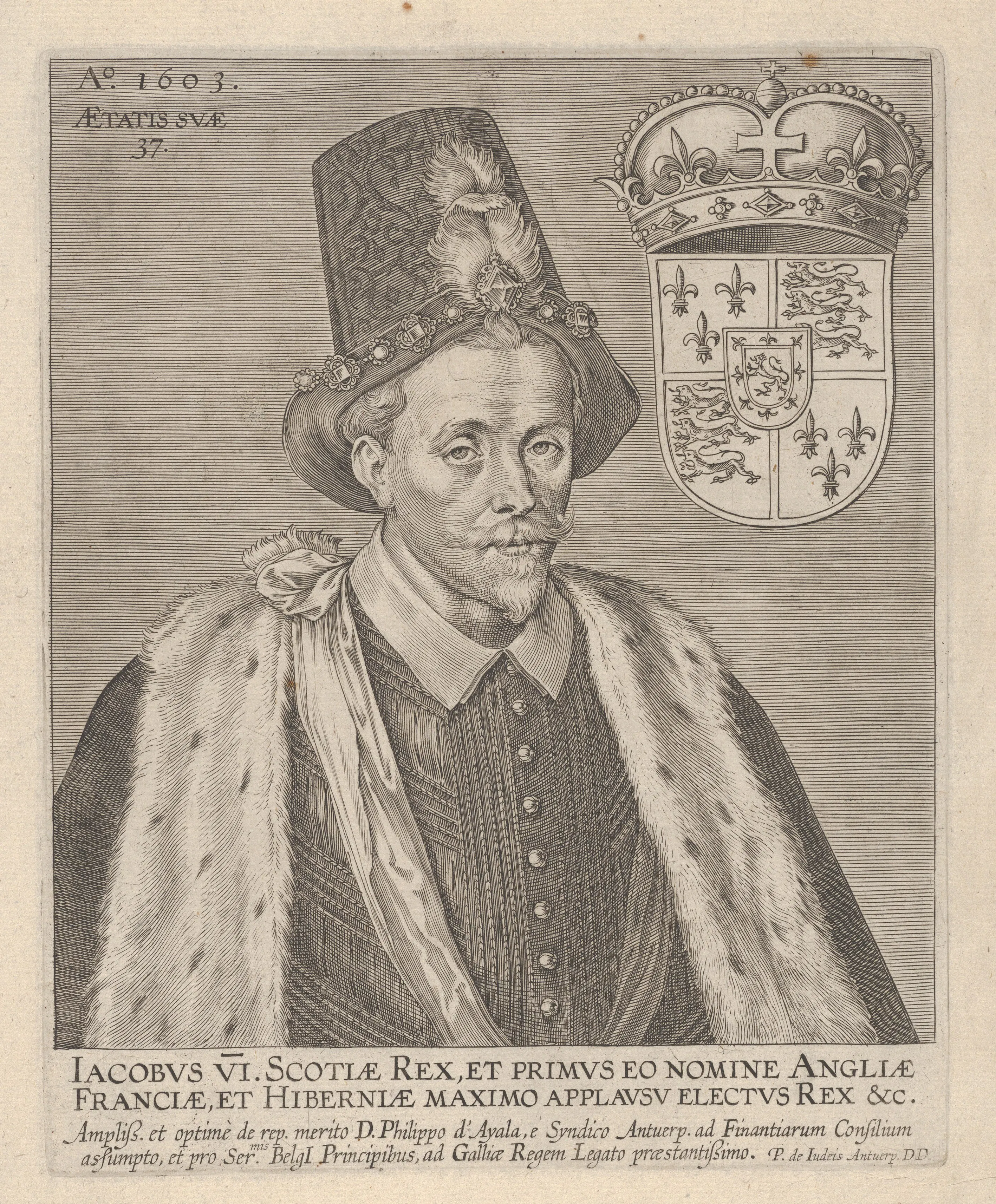
This 1603 engraved portrait of James VI of Scotland gives visual form to one of the most consequential hostile readers of Weyer's argument. James's Daemonologie rejected the kind of doctrinal and juridical caution signaled by Weyer's offer of a spontaneous palinode and helped carry the anti-Weyerian consensus into the English Stuart world. Source ↗.
Frequently Asked Questions
What is Johann Weyer's De praestigiis daemonum?
De praestigiis daemonum, et incantationibus ac veneficiis libri V is a learned Neo-Latin treatise of 1563, printed at Basel by Johannes Oporinus, in which the physician Johann Weyer argues against the burning of accused witches. Its controlling claim is that the marvels attributed to witches — night-flight, coupling with demons, metamorphosis — are diabolical illusions permitted by God, worked upon a corrupted imagination, and never real causation. The accused old woman is recast as a melancholic, deluded patient rather than a criminal. Only the poisoner who truly harms the body by material means remains liable to capital punishment.
Who was Johann Weyer?
Johann Weyer, latinized as Ioannes Wierus and occasionally styled Piscinarius, was a physician born around 1515 at Grave in Brabant and trained in medicine within the humanist circle of Heinrich Cornelius Agrippa. From about 1550 he served as physician to Duke William V ("the Rich") of Cleves-Jülich-Berg, to whom his 1563 treatise is dedicated. He died on 24 February 1588 at Tecklenburg. Alongside the witch-polemic he wrote medical works, including the Medicarum observationum rararum Liber I (1567), which supplies the Galenic and Hippocratic framework underpinning his medicalizing argument.
How did Weyer explain the witches' flight to the sabbath?
Weyer dissolved the flight to the sabbath into narcotic dreaming and the force of imagination. Drawing on Giambattista della Porta, he argued that women who anointed themselves with a flying ointment only seemed to be carried through the air to feasts, dances, and the embraces of youths they most desired — the vision being the projection of longing under a soporific compound. He grounded this in a firsthand case: a wretched woman at Waldsassen who "prepared drugs and prophesied" around 1555, resolved through a jurist's intervention rather than at the stake, offered as proof that the compounder of hallucinogenic substances belongs to natural inquiry.
What is the difference between a lamia and a venefica in the treatise?
The distinction is the juridical pivot of the whole work. The venefica (or veneficus) is the poisoner who harms the body by material means — herb, compound, or natural substance — and who falls under the Roman-law lex Cornelia de sicariis et veneficis, liable to capital punishment. The lamia, by contrast, is the deluded, melancholy old woman whose confessions of night-flight and demonic copulation are symptoms of a humoral disturbance rather than evidence of a criminal compact. Weyer strips lamia of its antique demonic charge and reduces it to a clinical category, withdrawing the accused from the reach of penal law.
Is there an English translation of De praestigiis daemonum?
Yes. The principal modern English translation is the 1991 Binghamton critical edition, Witches, Devils, and Doctors in the Renaissance: Johann Weyer, De praestigiis daemonum, edited by George Mora with Benjamin Kohl, translated by John Shea, with contributions by H. C. Erik Midelfort and Helen Bacon (Medieval & Renaissance Texts & Studies, ISBN 0866980830); an abridged Shea translation followed in 1998. Separately, the Leo edition presents the full Latin transcription alongside a complete, freely available English translation generated by AI, part of an effort to make every text printed in Latin in early modern Europe (1450–1750) available online at no cost.
This report was generated by an advanced AI assistant that conducted deep research alongside an extensive interpretation of the transcribed original text. Every effort has been made to preserve fidelity to the source and to guard against inaccuracy, but corruption in the text recognition process and model hallucination may nonetheless have entered the text. Treat every claim, quotation, translation, and citation as provisional, and verify each against the original source before relying on or citing it.
Bibliography
- Sydney Anglo (ed.), The Damned Art: Essays in the Literature of Witchcraft: The indispensable Anglophone starting point, pairing Anglo's own verdict that Weyer was a defender of witches whose humanitarianism misfired with Christopher Baxter's dissection of the treatise as "unsystematic psychopathology." Read it to see why the claim that Weyer founded modern psychiatry was contested from within the very volume that popularized the debate, and note its attention to the briefer De Lamiis and to the prejudice of the trial judges.
- Stuart Clark, Thinking with Demons: The Idea of Witchcraft in Early Modern Europe: The single most consequential reframing of Weyer, arguing that he was no proto-psychiatrist breaking with demonology but a rigorous demonologist who pushed the doctrine of praestigia until the witch became superfluous to her own alleged crimes. Consult it to understand why reading the treatise as a departure from its intellectual world may be a category mistake.
- Vera Hoorens, "Why did Johann Weyer write De praestigiis daemonum? How Anti-Catholicism inspired the Landmark Plea for the Witches," BMGN — Low Countries Historical Review: A pointed minority argument that the treatise is at least as much confessional anti-Catholic polemic as it is a defense of accused women. It matters here precisely because it unsettles the comfortable Erasmian-irenicist reading and keeps the question of Weyer's motives — and his confession — genuinely open.
- Howell A. Lloyd (ed.), The Reception of Bodin: The essential companion for tracking how Bodin's furious rejoinder to Weyer travelled across Europe's confessional and linguistic borders, including Michaela Valente's contribution on the Italian reception. Read it to follow the afterlife of the Weyer-Bodin quarrel as it cross-fertilized European intellectual life rather than merely dividing it.
- H. C. Erik Midelfort, A History of Madness in Sixteenth-Century Germany: The standard account of the German medical culture of melancholy within which Weyer's clinical relocation of the witch becomes intelligible. It supplies the diagnostic context for Weyer's portrait of the sexus femineus and his insistence that the afflicted belong to the physician's consulting room, not the executioner's yard.
- E. William Monter, Witchcraft in France and Switzerland: The source of the canonical Anglophone framing of Weyer as a humane Erasmian and of the Weyer-Bodin exchange as the defining episode of the sixteenth-century persecution debate. Read it as the baseline against which Clark, Anglo, and Hoorens each register their objections.
- Michaela Valente, Bodin in Italia: La Démonomanie des sorciers e le vicende della sua traduzione: A focused study of how Bodin's attack on Weyer was translated and received in Italy, mapping a reception tradition that remains under-explored relative to the French and German. Consult it to see the Weyer-Bodin controversy from the Mediterranean vantage the standard narratives tend to neglect.



_CIPB1131.jpg)


.jpg)

