The Sign of the Olive: Leonardo Vairo's Three Books on Fascination: On the Evil Eye, its Species and Causes
In the winter of 1583 a Benedictine bishop-to-be published a three-book Latin treatise arguing that the evil eye is real but that nothing in nature — not the imagination, not the radiating eye, not touch, voice, or the stars — can cause it, so that its true efficient cause must be a demon operating through a pact. Leonardo Vairo's De fascino libri tres accepts the folkloric and medical lore of the fascinum only to reassign its causation to the demonic, folding a topic of medical curiosity into the post-Tridentine theological program against superstition. It matters because it is one of the earliest systematic Latin treatments of the demonic pact in the Counter-Reformation, a work in which philology, faculty psychology, philosophy of language, medicine, and theology are marshalled toward a single demonstrative end.
ExLatinis
23 July 2026

Contents
In the winter of 1583 a Benedictine bishop-to-be published a three-book Latin treatise arguing that the evil eye is real but that nothing in nature — not the imagination, not the radiating eye, not touch, voice, or the stars — can cause it, so that its true efficient cause must be a demon operating through a pact. Leonardo Vairo's De fascino libri tres accepts the folkloric and medical lore of the fascinum only to reassign its causation to the demonic, folding a topic of medical curiosity into the post-Tridentine theological program against superstition. It matters because it is one of the earliest systematic Latin treatments of the demonic pact in the Counter-Reformation, a work in which philology, faculty psychology, philosophy of language, medicine, and theology are marshalled toward a single demonstrative end.
In the winter of 1583, from a printing house at the sign of the Olive on the Rue Saint-Jacques, there issued a Latin quarto in three books on a subject at once universally familiar and philosophically intractable: the fascinum, the malignant force of the evil eye. Its author was Leonardo Vairo (in Latin, Leonardus Vairus), a Benedictine of the abbey of Santa Sofia in Benevento, born at Magliano Vetere in the diocese of Capaccio around 1543 and, from January 1587, Bishop of Pozzuoli. The De fascino libri tres — Three Books on Fascination: On the Evil Eye, its Species and Causes — is a systematic scholastic-demonological treatise, addressed to a readership of bishops, inquisitors, and censors trained in the Aristotelian and Thomistic vocabulary of the schools, and composed at the height of the post-Tridentine Roman campaign against superstitio.
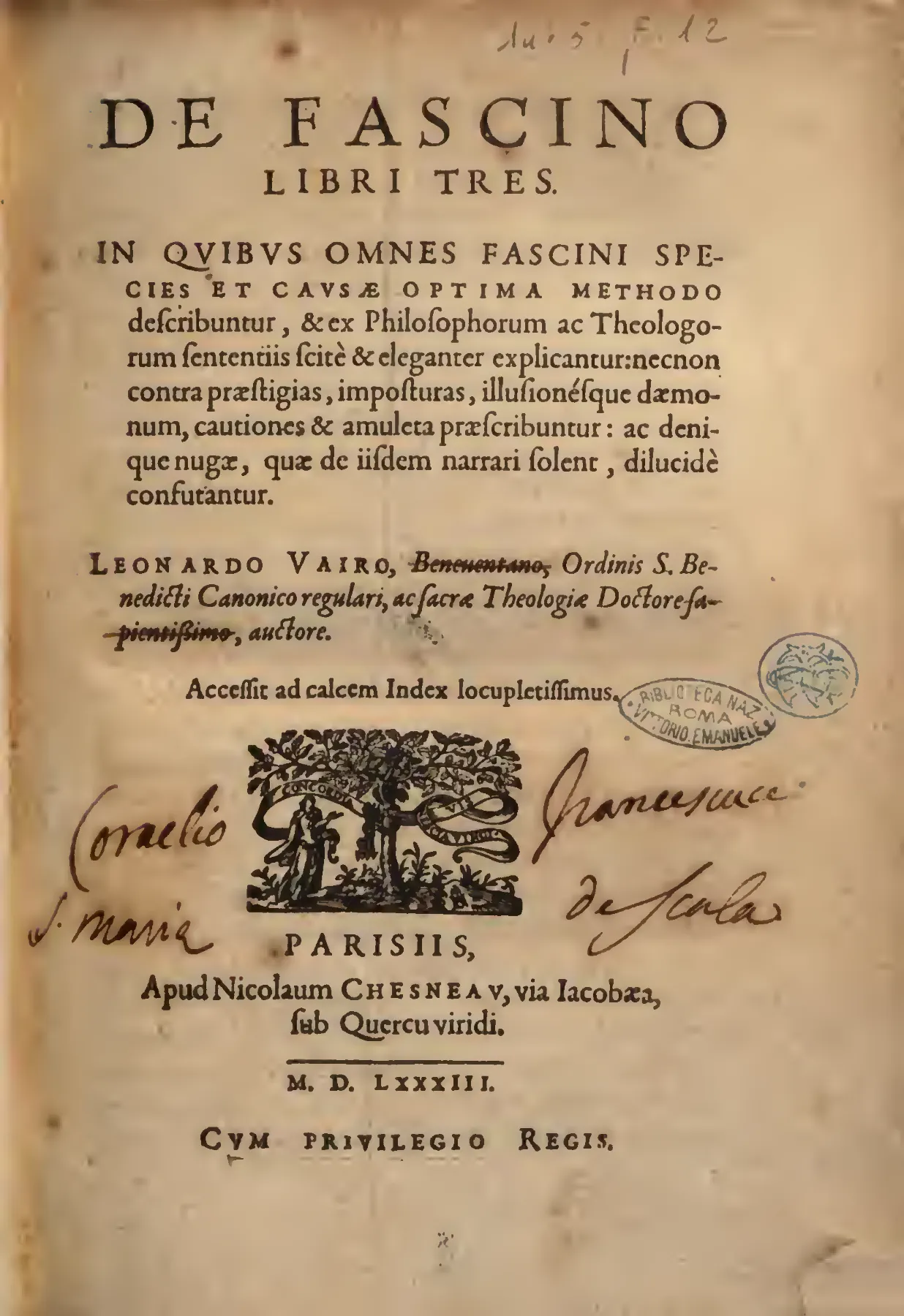
The 1583 Paris title page anchors Vairo's De fascino in Nicolas Chesneau's Rue Saint-Jacques shop, its imprint naming the shop sign as the "green oak" (sub Quercu viridi) and framing the volume with a royal privilege and date within licensed Catholic print culture. The printed subtitle already announces the treatise's program: to classify fascination, prescribe cautions and amulets against demonic illusion, and refute popular tales, turning evil-eye lore into a work of post-Tridentine theological discipline. Source ↗.
The intellectual problem the work confronts can be stated simply: granting that fascination is real — a datum Vairo never doubts, buttressing it from Scripture with the verse from Wisdom that "the fascination of wickedness obscures good things" and the Apostle's cry to the "foolish Galatians" who had been bewitched — what, precisely, causes it? The treatise's recurring move, and the spine on which its whole architecture rests, is a disciplined migration of an explanatory category from nature to the demonic. Vairo grants fascination's reality, then subjects each proposed natural cause in turn — the intense imagination, the radiating eye, contagion by touch or voice, the observation of the heavens, the passions of love and hatred — to systematic examination and rejection, before reassigning causation to the operation of demons through a tacit or express pact (pactum tacitum vel expressum). Book I affirms fascination's existence and canvasses the natural explanations; Book II refutes each, on the principle that an immanent act such as imagining cannot pass into an external subject and that words and characters signify only by human convention, ex hominum consensu, not by nature; Book III resolves the question theologically, redefining fascination as a pernicious quality wrought by demonic art and moralizing it as disobedience to divine law.
The stakes of this move are considerable, and they explain why the treatise rewards attention beyond the antiquarian. To relocate the cause of the evil eye from nature to the demonic pact is to enlist a topic of medical and folkloric curiosity in the service of a theological program: the same structural position occupied by the natural philosopher's occult qualities comes to be occupied by the theologian's demons. In assembling this argument, Vairo stands among the earliest systematic Latin treatments of the demonic pact in the Counter-Reformation, in a line that the later work of Remigius, Binsfeld, and Delrio would extend. He accepts the descriptive faculty-psychology of imaginatio the better to deny its explanatory reach; he treats words, characters, and numbers as conventional signs whose apparent efficacy, where real, lies not in the sign but in the pact behind it; and he treats metamorphosis — the werewolf, Circe, Lot's wife — as demonic illusion specie tenus, sustained in appearance and not in substance. None of these positions originates with Vairo, but their assembly into a single demonstrative sequence against the naturalist tradition is what gives the treatise its historical particularity.
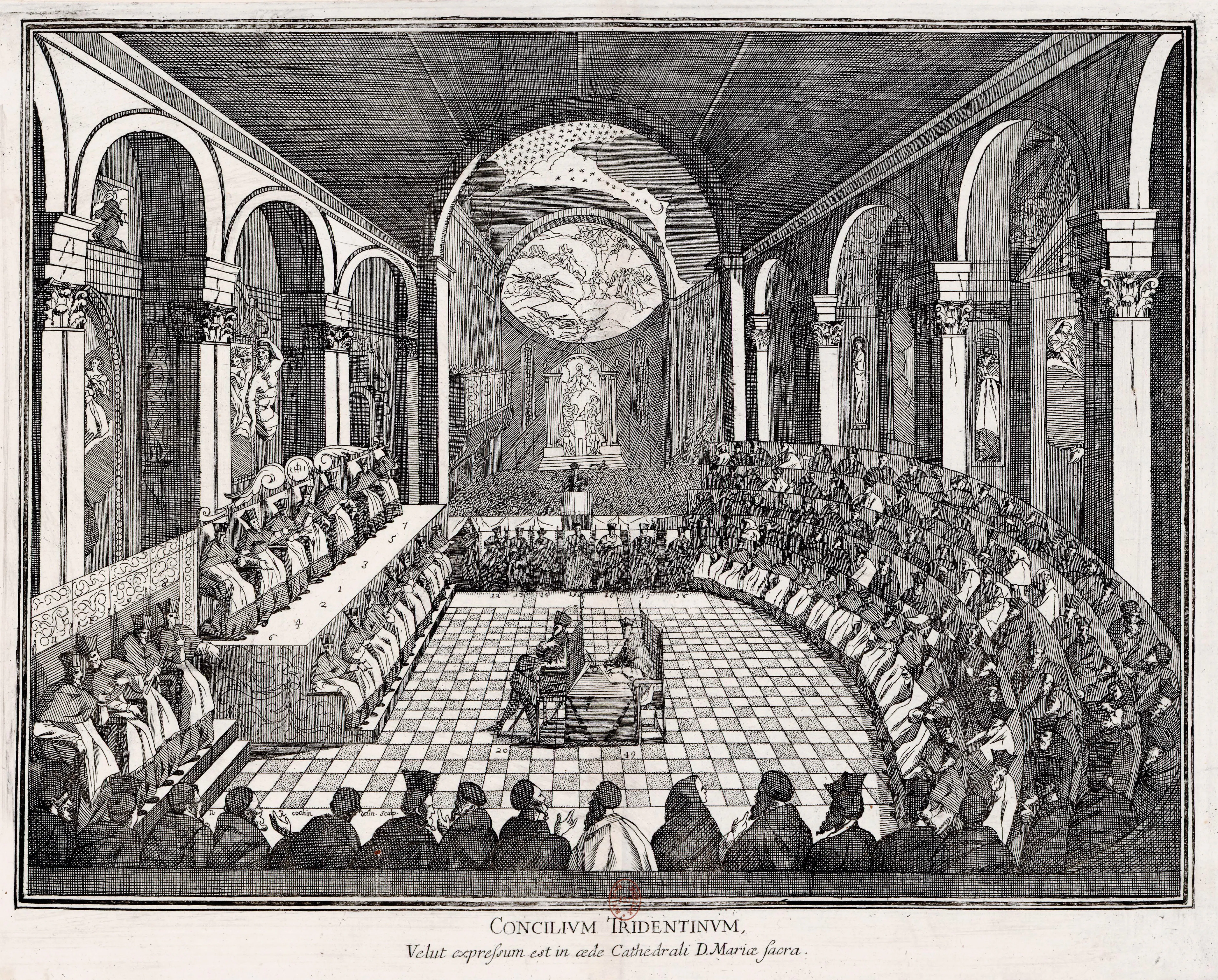
Frans Hogenberg's engraved view of Naples evokes the Italian Catholic urban world in which post-Tridentine arguments over superstition, natural philosophy, and demonic agency circulated. Rather than illustrating the evil eye itself, the city panorama situates Vairo's demonological synthesis within the broader Counter-Reformation landscape that made such a theological reclassification urgent. Source ↗.
.jpg)
What a first-time reader will find most striking is the concreteness with which this austere scholastic apparatus is grounded. The treatise's method is announced as a deliberate following of Aristotle — adversaries' opinions aired first, then examined and rejected, so that the author's own view stands the firmer — yet its cases are drawn from the immediate world of the Neapolitan and northern European sixteenth century: the bewitched wife of Sepino, the werewolf of Poligny who confessed under torture to having donned a wolf's form by a demonically confected unguent, the weather-magic of the north. Most remarkable of all is the appended forensic-medical epistle by the physician Horatius Albinus (Orazio Albini) on the poisoning of Vairo himself at Santa Sofia di Benevento in 1573 — a clinical enarratio of sublimate poison and its antidotes, Theriac, Mithridatic, and Bezoar, that extends the treatise's natural-versus-demonic boundary-work into the domain of toxicology, since it is proper to poison, on this account, to convert a substance into its own venomous nature.
The throughline that unites the work's conceptual vocabulary, its production in the Spanish-Neapolitan ecclesiastical milieu, and its internal argument is this single controlled reassignment of cause, secured at every turn by scriptural authority set above pagan antiquity. The treatise subordinates the "showy inscription of volumes and the antiquity of authors" to the weight of revealed truth, and in doing so converts the whole inherited lore of amuleta from superstition into the sacramental discipline of the Church. It is a work in which philology, faculty psychology, philosophy of language, medicine, and theology are made to serve one demonstrative end; how well the demonstration holds is a question the surviving text itself invites the reader to weigh.
Read the full text and English translation on Leo
This text was transcribed and translated as part of the ExLatinis project, an effort by Leo to make free English translations of every text published in Latin in early modern Europe (1450–1750) available online. The complete transcription and English translation of this work can be read free of charge:
→ Read the original Latin text and full English translation on Leo
You can save a copy of this document into your Leo account to run deep text searches, conduct further analysis, or cross-reference it with your own research.
Assigning the English Title and Framing Vairo's Key Terms
Title
Three Books on Fascination: On the Evil Eye, its Species and Causes.
Philological Framing
The treatise turns on three lexical axes whose semantic fields cannot be flattened into a single vernacular register without loss. The first is the classical pair fascinum and fascinatio, a doublet whose two faces Vairo exploits while refusing to dissolve. In classical Latin fascinum designated both the apotropaic phallic amulet hung against the malignant gaze and, by transference, the malicious emission of the eye itself: fascinatio. Varro and Pliny preserve both senses, and Aulus Gellius records the popular etymology that linked fascinum to fascinare, to bewitch by speech or song. By the late sixteenth century the technical vocabulary of the schools had telescoped these two faces into a single object, so that fascinum names at once the noxious quality transmitted by eye, voice, or touch and the agent or medium of its transmission. Vairo mobilises that collapse deliberately. In Book I he lays out fascinum as a perniciosa qualitas in the Aristotelian sense — a quality whose bearer is corrupted by mere contact — his opening definition holding fascination to be FASCINVM, est perniciosa quædam qualitas, intensa imaginatione, visu, tactu, voce, coniunctim vel diuisim, cæli quandoque observatione adhibita, propter odium vel amorem inflicta, that is, a certain pernicious quality inflicted by intense imagination, sight, touch, or voice, jointly or severally, sometimes with observation of the heavens applied, on account of hatred or love. In Book III he reframes the same word as the product of a demonic operation founded on a tacit or express pactum, the definition now reading that fascination is a pernicious quality Fascinum est perniciosa qualitas, demonu arte illata, ob tacitú vel expressum hominú pactú cum eisdé dæmonibus firmatur, brought about by the art of demons and confirmed on account of the tacit or express pact of men with those same demons. The shift is philologically as well as doctrinally significant: in the first register fascinum is a scholastic qualitas, in the third it is a relatio to a spiritual agent. The treatise's argument turns on that shift — the same disciplined migration of cause from nature to the demonic that governs the whole work — and the English translation must move between "fascination" in the scholastic sense and "bewitchment by the evil eye" in the operative sense. The semantic neighbour veneficium — poisoning, sorcery — is deliberately distinguished: a venenum is administered by physical contact or ingestion, whereas fascinum is propagated through species intentionales and so belongs to a different ontological order. The toxicological register is precise on this point, since it is proper to poison, in the appended medical epistle's terms, Veneni proprium est, substantia in sui venenatam naturam conuertere, to convert a substance into its own poisonous nature — a mode of action distinct from the sensory propagation of fascination.
The second axis is the forensic vocabulary of compact. Pactum tacitum vel expressum is not Vairo's invention but the technical term of late-medieval inquisitorial procedure, by which an accused witch was held to have entered into an agreement with the demon, whether by explicit words or by the tacit consent implied in continuing commerce after a first encounter. Vairo borrows this vocabulary and applies it to the fascinator: the bewitcher, by consenting to a tacit compact with the demon, becomes the conduit of a perniciosa qualitas that reaches the victim through the senses. He states the principle directly where the reported marvels of fascination must, he holds, be ascribed to the action of demons dæmonum actioni... adscribenda esse duco, qui tacitum vel expressum pactum cum maleficis habere solent, who are wont to have a tacit or express pact with sorcerers. The English translation should preserve pactum as a term of art — "compact," "covenant," or "pact" are acceptable glosses but should be flagged as the technical concept they name. It is the importation of inquisitorial pact-theory into the natural-philosophical debate over fascination that constitutes the treatise's principal conceptual innovation.
The third axis is the technical vocabulary of faculty psychology. Imaginatio and phantasia in the Aristotelian and Galenic traditions designate the sensitive soul's power to retain and recombine the forms of perceived things; when its motions are intense enough they can, on the dominant naturalist view, produce real alterations in the body. Vairo himself concedes the descriptive claim, allowing that tamen præcipuam alterandi vim imaginatio tenet, & cò magis cùm imaginationi assensus vel dissensus accedit; ex quibus passiones & alterationes oriuntur — that imagination holds the chief power of alteration, the more so when assent or dissent is added, whence arise the passions and alterations. Pomponazzi's De incantatione had made this faculty the engine of a wide range of reported marvels, and the De fascino is written against that inheritance. Vairo accepts the descriptive psychology of imaginatio but contests its explanatory reach: the imagination may indeed produce alterations, but the alterations it can produce do not account for the species of effect attributed to fascination. The decisive limiting principle is that the act of imagining is immanent to its subject; as Vairo puts it, the act of imagining remains in the one who imagines, actus verò imaginandi, in eo qui imaginatur persistit, ergo non verisimile existimari potest, vt meorum oculorum videndi actus aliis quoque à me communicetur, so that it cannot be thought likely that the seeing-act of my eyes should be communicated to others outside me. Phantasia, in the Galenic-medical register, is the cognitive product of imaginatio as it appears to consciousness; the translation should leave imaginatio and phantasia unrendered or gloss them as "imagination in the technical scholastic sense," since the modern colloquial sense loses precisely the technical content that Vairo is disputing.
Where the inherited sense of a term is redefined by Vairo, the redefinition is itself the argument. Amuleta in Pliny and in much patristic writing names objects worn against demons or disease that the Church condemns as superstitiosa. Vairo distinguishes amuleta in that older sense from the legitimate sacramentals of the Church — the Agnus Dei, the sign of the Cross, holy water — by relocating the latter into the category of causae obedientiales, instruments whose efficacy depends not on any natural quality but on divine institution. He gathers these under a redefined heading of the true amulets, Hæc sunt amuleta, dæmones ipsos, fascinationes, & omnia mala dæmonum arte illata expellentia, the amulets that expel the demons themselves, the fascinations, and all evils brought about by the art of demons. The terminology is therefore not ornamental: it is the load-bearing structure of the third book, and it carries the same migration of cause from nature to the demonic into the domain of remedy.
Vairo, the Benedictine Bishop, and the Argument of the De fascino at a Glance
Leonardo Vairo (Latin Leonardus Vairus; born Magliano Vetere in the diocese of Capaccio, c. 1543; died Pozzuoli, 4 January 1603), Benedictine of the abbey of Santa Sofia in Benevento and from 25 January 1587 Bishop of Pozzuoli, is the author of the De fascino libri tres (Paris: Nicolas Chesneau, 1583), reissued at Venice in 1589 by the heirs of Aldo Manuzio the Younger. The work is a systematic scholastic-demonological treatise organised in three demonstrative books: it first catalogues the species and causes of fascination, then unfolds them through a method drawn from the schools, and finally converts them to theological use against the prestiges of demons. The method is expressly Aristotelian, Vairo declaring that he resolved to follow Aristotle's footsteps, Aristotelis vestigia persequi decreui; qui de re quapiam tractaturus, aduersariorum opiniones in primis in medium affert; quibus examinatis & reiectis, sua deinde sententia firmior & validior persistit, who when treating any matter first sets out the adversaries' opinions, then, these examined and rejected, lets his own view stand the firmer and more valid. Its driving thesis is that the proximate efficient cause of fascination is not natural — not imagination, not the radiating eye, not contagion by touch, voice, or incantation, not stellar influence, not the passions of love or hatred — but demonic, operating through an explicit or tacit pact and by means of species intentionales projected upon the victim's interior senses. Vairo states the conclusion baldly for the case of the harmful gaze, insisting that the effect must be ascribed non oculorum naturæ, sed dæmonum virtuti adscribendum est, not to the nature of the eyes but to the power of demons. Because the cause is demonic, the remedies must be re-sited: legitimate protection is not to be sought in pagan amuleta or occult virtues, but in the sacramentals of the Church and in the moral disposition of the faithful, on which the demonic pact finds its purchase. The treatise was composed in Benevento in the early 1580s, printed in Paris in 1583 with a privilege and royal approbation, and reissued at Venice in 1589 by the heirs of Aldo Manuzio the Younger with an Aldine preface of that year. The text is in Latin and draws on the technical vocabulary of scholastic philosophy and theology; no translation into a modern vernacular (Italian, Spanish, French, German, or English) has been located, and its transmission has been principally through later Latin-writing demonologists who cited it.
Situating the De fascino in the Historiography of Demonology and the Evil Eye
The De fascino libri tres sits at the intersection of three large historiographical problems. The first is the structural transformation of late-sixteenth-century demonological writing, the displacement of natural causation by demonic causation as the governing logic of occult phenomena. Stuart Clark's reading of this transformation as the displacement of agency, in which the natural philosopher's occult qualities and the theologian's demons occupy the same structural position, is the indispensable frame for Vairo's argument: the treatise is a paradigmatic instance of the post-Tridentine theological claim that the immediate cause of fascination is demonic, and that any natural account is at best an instrument of the demon's operation. This is the treatise's governing throughline — the migration of an explanatory category from nature to the demonic — made explicit in the theological climax of Book III, where Vairo argues from the destructive character of the effect that its cause cannot be natural, sed fascinum destruit naturam, igitur naturâ non est, since fascination destroys nature and therefore is not from nature. The second is the historiography of the demonic pact, of which the De fascino is one of the earliest systematic Latin treatments in the Counter-Reformation; the tradition of Remigius, Binsfeld, and Delrio that follows is unthinkable without Vairo's argument that fascination implies a tacit or express compact with the demon. The third is the history of the Counter-Reformation campaign against superstitio, in which the De fascino participates by reclassifying pagan amuleta as superstitious and relocating legitimate protection into the sacramentals of the Church, in line with the disciplinary programme of the Council of Trent's twenty-fifth session and the papal condemnations of 1580–1586. This reclassification culminates in Vairo's moral diagnosis of fascination's ultimate cause, where he judges Præcipuam causam, qua fascinamur, nullam aliam esse arbitror, quàm legis contemptu[m], & coelestium inobedientia[m] mandatorum, that there is no other chief cause by which we are fascinated than contempt of the law and disobedience of the heavenly commandments.
The treatise also touches on three subsidiary debates that have a vigorous modern literature: the faculty-psychology debate over imaginatio and its power to alter the body (Pomponazzi, Cardano, Della Porta, and the Paduan tradition against which Vairo argues), the philosophy-of-language debate over whether words and characters signify by nature or by human convention (ex hominum consensu), and the history of metamorphosis as demonic illusion specie tenus. In each of these, the De fascino marks a post-Tridentine inflection: it accepts the descriptive psychology of imagination in order to deny its explanatory reach, treats words and characters as conventional signs whose demonic efficacy lies not in the sign but in the pact, and treats metamorphosis as illusion sustained by demonic operation. On the linguistic question, Vairo is unequivocal that the significance of such words and names is not natural, huiusmodi autem vocum, ac nominum cunctorum significatus non natura, sed ex hominum consensu & libito est, but derives from the consent and will of men — a position that voids verbal and numerical magic except insofar as a demonic pact stands behind it. On metamorphosis he holds that demons do not create natures but alter appearances, Nec sanè Dæmones naturas creant, si aliquid tale faciunt, de quo hæc vertitur quæstio: sed specie tenus, quæ à Deo sunt creata commutant, vt videantur esse quod non sunt, changing in appearance only what God has created so that things seem to be what they are not; the werewolf of Poligny, who confessed under torture that he had put on the form of a wolf by a demonically confected unguent, se vnectione quadam dæmonum arte confecta lupi formam induisse, is his case in point. None of these positions is original to Vairo, but the treatise is one of the earliest places in which they are assembled into a single systematic demonstration against the naturalist tradition and in favour of the Roman theological regime.
The historiographical disagreements to which the work is relevant cluster around three axes. The first is the question of how far the late-sixteenth-century demonologising of occult phenomena should be read as a continuation of medieval scholastic demonology or as a distinctively post-Tridentine production: the De fascino is evidence for the latter, since its argument presupposes the disciplinary authority of Trent and the Roman campaign against superstitio. The second is the question of the relationship between natural philosophy and theology: the treatise is evidence for the view that the two are not in continuity but in polemical opposition in this period, and that the demonological text is the form in which the polemic is conducted. Vairo's own methodological declaration marks the opposition sharply, subordinating philosophical antiquity to revelation when he affirms that those to whom God has manifested His word can pronounce with certainty on any matter, At nos quibus Deus suum sermonem manifestauit, qui ab omni falsitate purus est, & omni obscuritati lucem affert, de quacunque re certam indubitámqque sententiam eius innixi auctoritati, proferre possumus, relying on His authority, and further that nihilominus apud me plus ponderis & auctoritatis veritas ipsa habet, quàm speciosa voluminum inscriptio, & auctoru vetustas, that truth itself carries more weight with him than the showy inscription of volumes and the antiquity of authors. The third is the question of how the historiography of the evil eye (Malocchio, mal de ojo) should be situated in the broader history of medical and theological ideas: the De fascino is one of the principal early modern Latin texts in which the medical tradition on the evil eye is folded into the demonic-pact framework — a folding sharpened by Vairo's careful boundary-work, as when he insists that a harm passed by a leper or plague-stricken person to others is not fascination at all, quod accidit cùm quis lepra, peste, aut alio co[n]tagioso morbo affectus, alios inficit, idque nô fascinum sed contagium dicédum est, but must be called contagion.
Tracing the Print History and Object Biography of the 1583 Paris Quarto
Production, Imprint, and Edition History
The De fascino libri tres was first printed at Paris in 1583 by Nicolas Chesneau, operating from the sign of the Olive on the Rue Saint-Jacques, in quarto format. Two issues were struck: the first bearing the dedicatory epistle to Juan de Zúñiga y Requesens, the second (or variant) with the privilege and royal approbation. The Aldine reissue of 1589 was printed at Venice by the heirs of Aldo Manuzio the Younger; it preserves the Latin text but adds an Aldine preface dated to that year and resets the table of contents. The 1583 and 1589 editions are parallel editions rather than reimpressions of one another: no evidence has been located that the 1589 Aldine was set from the 1583 Paris plates, and the bibliographical evidence indicates two independent settings of type.
No third Latin edition during the author's lifetime has been identified. No vernacular translation in Italian, Spanish, French, German, or English has been located in the catalogues consulted; the absence of such translations is consistent with the technical register of the work, which presupposes a reader trained in the Aristotelian and Thomistic vocabulary of the schools and engaged in the practical ministry of bishop, inquisitor, or censor. The work has been excerpted and cited extensively by later Latin-writing demonologists — Nicolaus Remigius, Petrus Binsfeld, and Martin Delrio are named in the secondary literature as having drawn upon Vairo's argument — but the specific passages and contexts of those citations have not been verified within the present evidentiary basis and are flagged as a gap.
Materiality and Bibliographical Apparatus
The Paris 1583 quarto opens with a privilege leaf, a dedicatory letter to Juan de Zúñiga y Requesens, and a table of contents at the foot of the privilege; signatures are gathered in eights, the text is set in roman with italic for marginal scholia and Greek for occasional citations of Aristotle and Galen. The 1589 Aldine reissue is in octavo or small quarto, signatures in eights, with the same index reset; the Aldine preface and the original privilege are reproduced, the latter by way of a prefatory note by the heirs of Aldo. Neither edition contains woodcut illustrations beyond the printer's device on the title and a small initial at the head of each book.
Object Biography: From Press to Library
The dedicatory address to a Spanish grandee who served as viceroy of Naples (1579–1582) and prince of Pietraperzia in right of his wife situates the work in the Spanish-Neapolitan ecclesiastical-political milieu of the early 1580s. The work was thus conceived, from its first edition, not as a purely scholastic exercise but as a contribution to the post-Tridentine Roman Catholic regime of knowledge concerning the occult, directed to a readership of bishops and inquisitors in the Spanish-Italian sphere; Vairo states his own purpose as the opening-up of a hidden and difficult matter, writing that he undertook the work quò abdita & salebrosa fascini vis aperiretur, tantisque tenebris vel tatillum lucis afferretur, so that the hidden and rugged force of fascination might be opened up and a little light brought to such great darkness. The presence of the medical enarratio by Horatius Albinus on the poisoning at Santa Sofia di Benevento in 1573 functions as a forensic frame for the treatise's argument: a learned Benedictine physician attests, by clinical observation, to the reality of the demonic assault that Vairo's theory posits, and the toxicological reasoning of that epistle — resting on the principle that poison converts a substance into its own venomous nature — extends the treatise's natural-versus-demonic boundary-work into the register of forensic medicine.
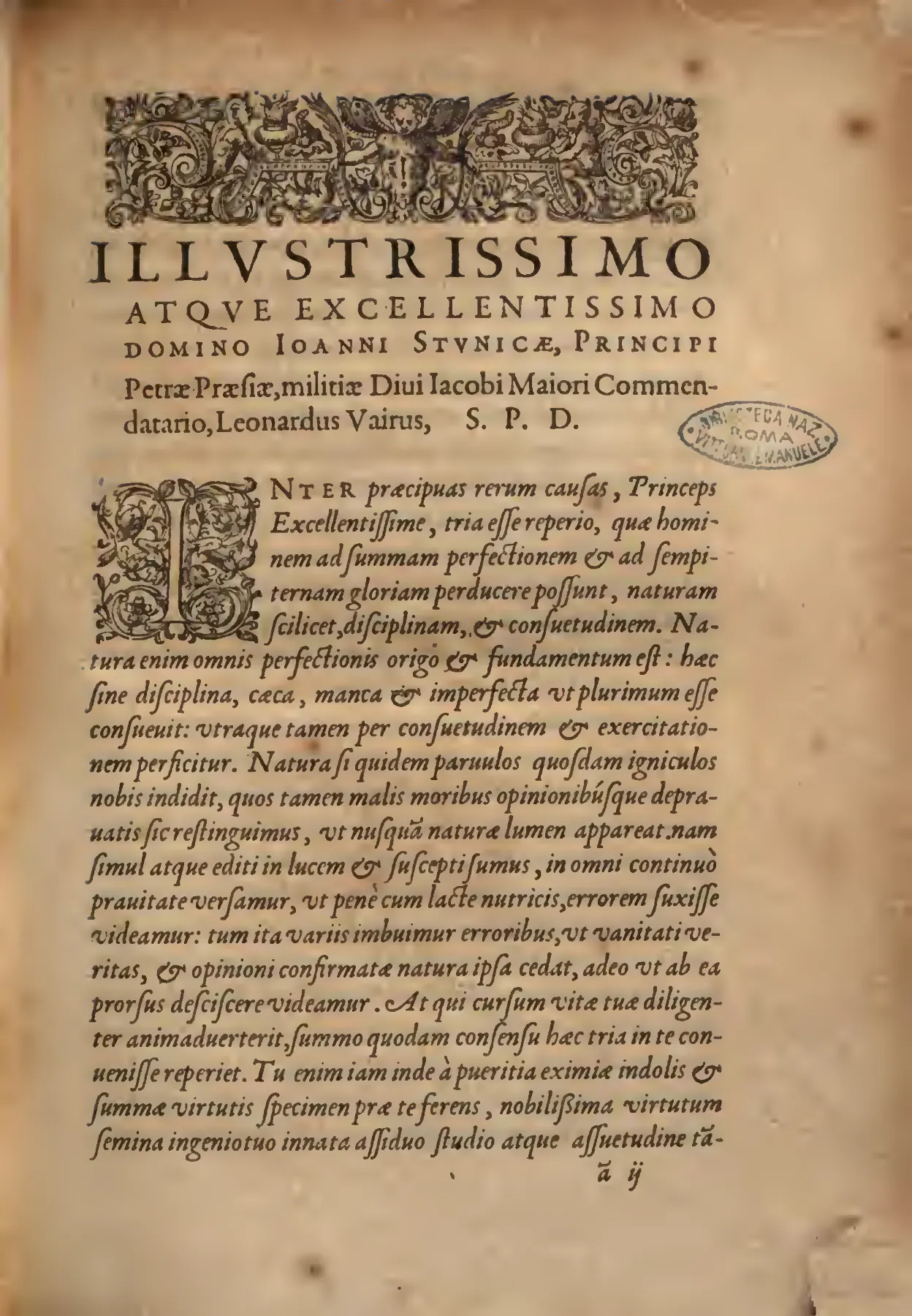
The dedicatory epistle opens with an elaborate headpiece, display roman address, and large initial, giving visual weight to Vairo's appeal to Juan de Zúñiga y Requesens and placing the treatise within the Spanish-Neapolitan world of viceregal authority, episcopal oversight, and inquisitorial learning. Its printed preamble on nature, discipline, and custom frames praise of the patron in the same moral vocabulary that underwrites the work's effort to distinguish human disposition, natural causality, and demonic fascination. Source ↗.
The work's transmission is documented in part by the catalogues of the Bayerische Staatsbibliothek (J.pract. 43.2 and Phys.m. 279 for the 1589 Aldine), by Vatican Library holdings, and by the British Library and Bibliothèque nationale de France for the 1583 Paris edition; the USTC and WorldCat provide consolidated catalogue records. The later bibliographical tradition — Grässe's Oracula Magica and Joseph Hansen's Quellen und Untersuchungen zur Geschichte des Hexenwahns of 1901 — cites the treatise as one of the principal early modern demonological texts.
The Author and His Context
Vairo's biography is reconstructed in the standard reference works: born at Magliano Vetere in the diocese of Capaccio (in the kingdom of Naples) in 1543, professed in the Benedictine order at the abbey of Santa Sofia in Benevento, promoted to the episcopate of Pozzuoli on 25 January 1587, and died at Pozzuoli on 4 January 1603. His placement within the post-Tridentine ecclesiastical elite situates the De fascino at the intersection of monastic learning, episcopal authority, and the Roman campaign against superstitio that culminated in the papal condemnations of 1580–1586. The appendix by Horatius Albinus (Orazio Albini) on the alleged poisoning of Vairo in 1573 provides a contemporary medical attestation of the demonic causation that the treatise propounds.
How Vairo Builds the Argument: From Natural Causes to the Demonic Pact
Book I: Method, the Datum of Fascination, and the Case for Natural Causes
Vairo's treatise begins its demonstrative work by declaring the method that will govern its every subsequent movement. In the proem to the first book he announces that he has resolved to follow the footsteps of Aristotle, who, when about to treat any matter, first brings the opinions of his adversaries into the open, and then, these having been examined and rejected, lets his own view stand the firmer and more valid — a procedural declaration already registered in the executive summary as the work's Aristotelian warrant. This is not merely a topos of scholastic modesty but the structural warrant for the peculiar shape of the whole work: the extended, sympathetic exposition of the natural causes in Book I is not an endorsement but a deliberate strategy of maximal concession, the airing of the adversary's strongest case so that its subsequent demolition may confer the greater security on the demonic conclusion. The dialectical architecture is thus built into the method from the outset, and the reader is instructed to hold the naturalist theories of the first book provisionally, as opinions awaiting refutation rather than as settled doctrine. Vairo pairs this procedural declaration with a statement of purpose that frames fascination as a subject long neglected and obscure, undertaking the work so that the hidden and rugged force of fascination might be laid open, and at least a little light brought to such great darkness — the same purpose already quoted in the discussion of the work's object biography. The imagery of tenebrae and lux is not incidental: it casts the entire investigation as an act of illumination against darkness, a metaphorical schema that will acquire theological force once the darkness in question is identified with the operation of demons.
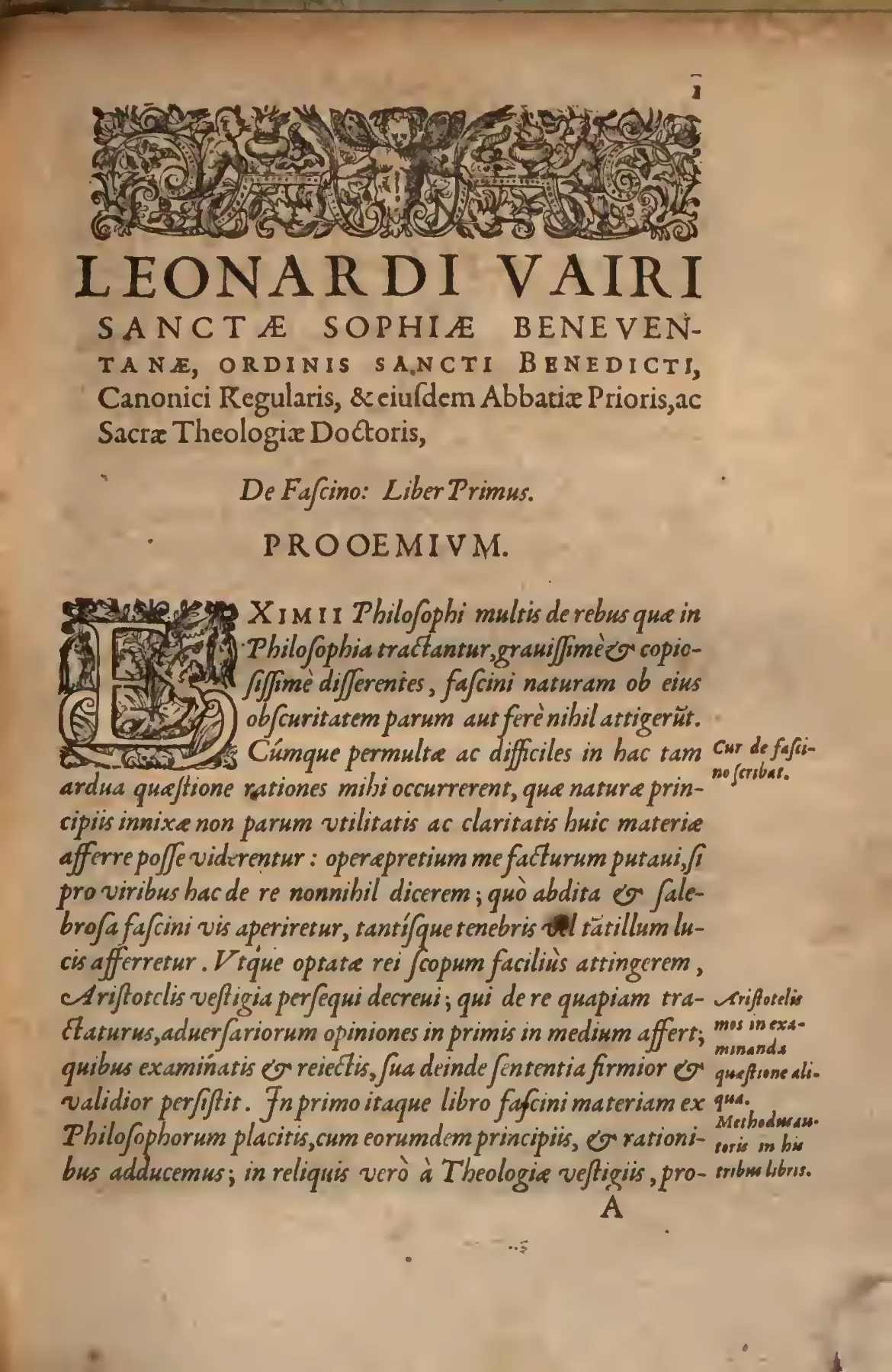
The opening page of Book I, framed by a woodcut headpiece and a large decorated initial, makes the proem's formal ambitions visible: Vairo presents his credentials before announcing the Aristotelian procedure by which rival natural explanations will be aired and then judged. Its printed marginal cues and programmatic opening keep the treatise's guiding metaphor in view—the attempt to bring light to the obscurity of fascination, a scheme that will later sharpen into a theological account of demonic darkness. Source ↗.
The reality of fascination is secured before its causation is examined, and secured on scriptural rather than philosophical ground. Vairo cites the book of Wisdom, from which these words are read, that the fascination of wickedness obscures good things, Vnde Sapientiæ libro hæc verba leguntur, Fascinatio malignitatis obscurat bona, and reinforces it with the Pauline outcry, that the Apostle too cries out thus, O foolish Galatians, who has bewitched you, Apostolus quoque ita clamat, O insensati Galatæ, quis vos fascinauit?. The choice to establish the datum from revelation, before the natural-philosophical machinery is even engaged, is characteristic of the treatise's ordering of authorities: the fact that fascination exists is placed beyond the reach of philosophical dispute by resting it on Scripture, so that the ensuing debate can concern itself solely with the cause, never with the existence, of the phenomenon. The Wisdom verse is moreover semantically apt, since its own language of obscuring good things rehearses the tenebrae-schema of the proem and prepares the eventual identification of fascination's darkness with a spiritual malignity.
From this secured datum the treatise proceeds to its pivotal working definition, the sentence on which the entire chapter-by-chapter examination of the first two books is scaffolded. This is the opening definition already set out in the philological framing, holding fascination to be a certain pernicious quality inflicted by intense imagination, sight, touch, or voice, jointly or severally, sometimes with the observation of the heavens applied, on account of hatred or love. The definition is an inventory of candidate causes as much as a definition, and its analytic structure predetermines the labour of refutation to come: each vehicle named — imaginatio, visus, tactus, vox, and the caeli observatio — corresponds to a chapter or cluster of chapters, while the terminal clause, propter odium vel amorem, locates the motive force of fascination in the passions. Framing the object as a perniciosa qualitas in the Aristotelian idiom is itself a consequential choice, for it commits the discussion to the categorial vocabulary of quality and its transmission, and it is precisely the question of how such a quality could pass from agent to victim that Book II will exploit to dismantle the naturalist account.
The first book presses the case for imagination with real vigour, which is what the Aristotelian method requires of it. As already noted in the philological framing, Vairo grants that imagination holds the chief power of alteration, the more so when assent or dissent is added, whence arise the passions and alterations. This is the descriptive faculty-psychology of the sensitive soul stated at its strongest, and the concession is deliberate and total on the level of description: imagination genuinely alters the body of the one who imagines, all the more when the movements of assent and dissent supervene to breed the passions. The strategic hazard of so generous a concession is exactly what the method demands, since Vairo means to accept the whole of the descriptive claim and to contest only its reach across the boundary of the imagining subject. The moral-psychological correlate of the definition's odium clause is developed in the same book, where the fascinator's motive is anatomised: no other remedy is believed more present or more salutary against grief, sadness, and hatred than fascination, through which we take vengeance upon those who oppose us, inflicting on them diseases, calamities, and diverse kinds of evils, nullu[m] aliud magis præsentaneu[m], ac salutare, quam fascinum creditur, per quod illos qui nobis aduersantur, vliscimur, eis morbos, calamitates, & diuersa maloru[m] genera inferendo. The passage voices, without yet judging, the affective economy of envy and vengeance in which fascination is imagined to operate, and it exposes an ideological anxiety that runs beneath the natural-philosophical surface: fascination is desired as a remedium, a false salve for the fascinator's own grief, so that the malice of the act is at once a psychological relief and a moral corruption.
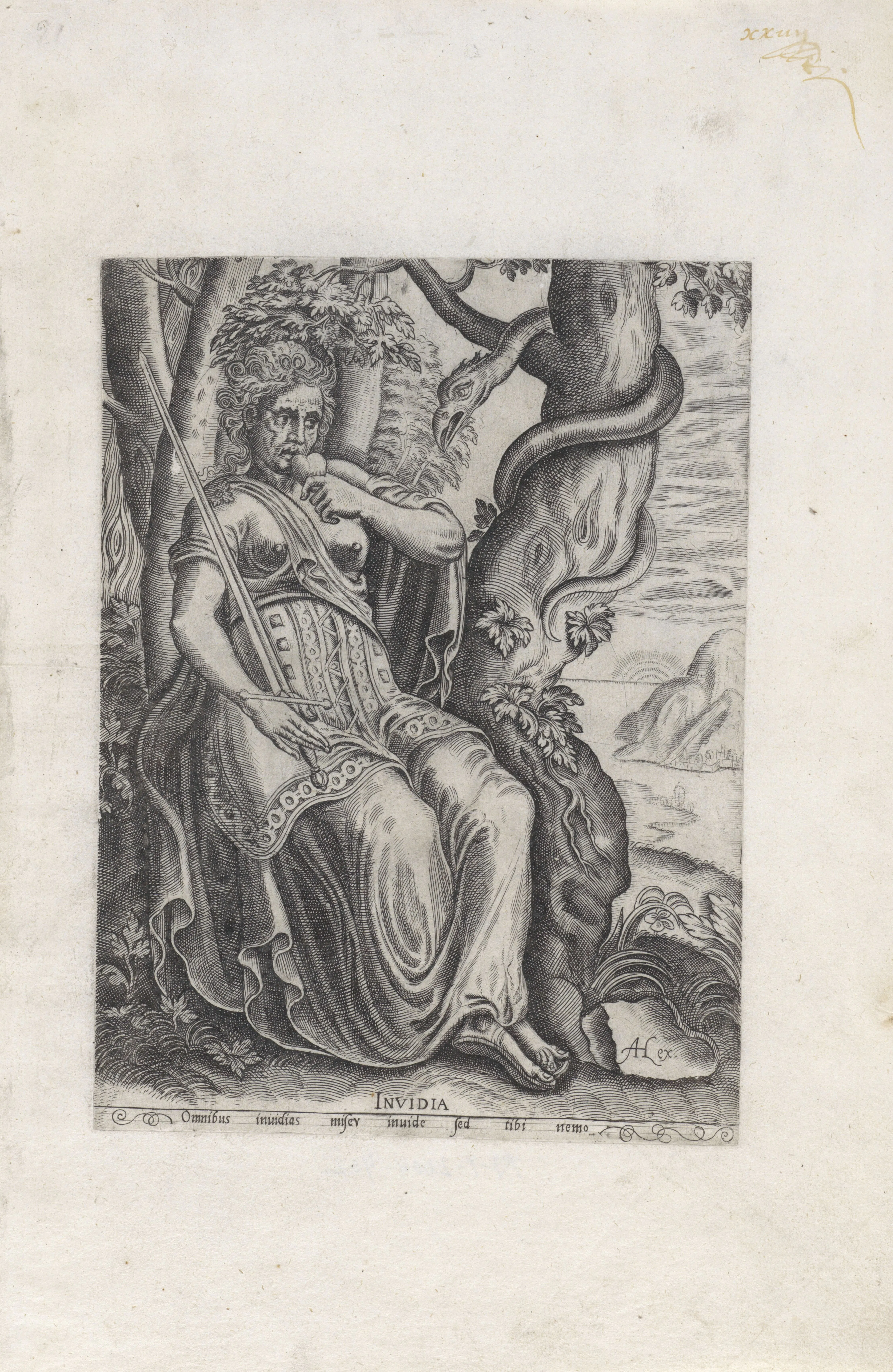
This early modern personification of Invidia from the Vices tradition gives visual form to the passion Vairo places behind fascination: a hatred that seeks relief by injuring another. Set beside his account of fascinum as a false remedium for grief and resentment, the image makes envy not a decorative vice but the moral psychology driving imagined vengeance. Source ↗.

Book II: The Reordering of Authority and the Refutation of Natural Causes
The second book opens by shifting the ground of authority itself, and it is here that the treatise's Counter-Reformation orientation becomes explicit in its epistemology. Against the accumulated weight of pagan philosophy, Vairo asserts that those to whom God has manifested His word — pure of all falsity and bringing light to all obscurity — can pronounce a certain and indubitable judgment about any matter, relying upon His authority; this is the methodological declaration already examined in the treatment of the work's polemical stance. The lux–obscuritas pairing returns, now transposed from the register of intellectual difficulty to the register of revealed certainty: Scripture is the light that dispels all darkness, and it is on that light, not on the resources of natural reason, that indubitable judgment rests. The claim is sharpened by a strikingly critical estimate of philosophical authority, in which Vairo affirms that truth itself carries more weight with him than the showy inscription of volumes and the antiquity of authors — the same subordination of pagan antiquity to revealed truth already quoted above. The phrase speciosa voluminum inscriptio is pointedly dismissive of the merely ornamental prestige of the ancient corpus, and the sentence performs a delicate manoeuvre: it deploys a humanist-critical posture — that antiquity does not confer truth — in the service of subordinating the whole pagan philosophical inheritance to revelation. The critical instrument is borrowed from the philologists, but its edge is turned against the sufficiency of philosophy itself.
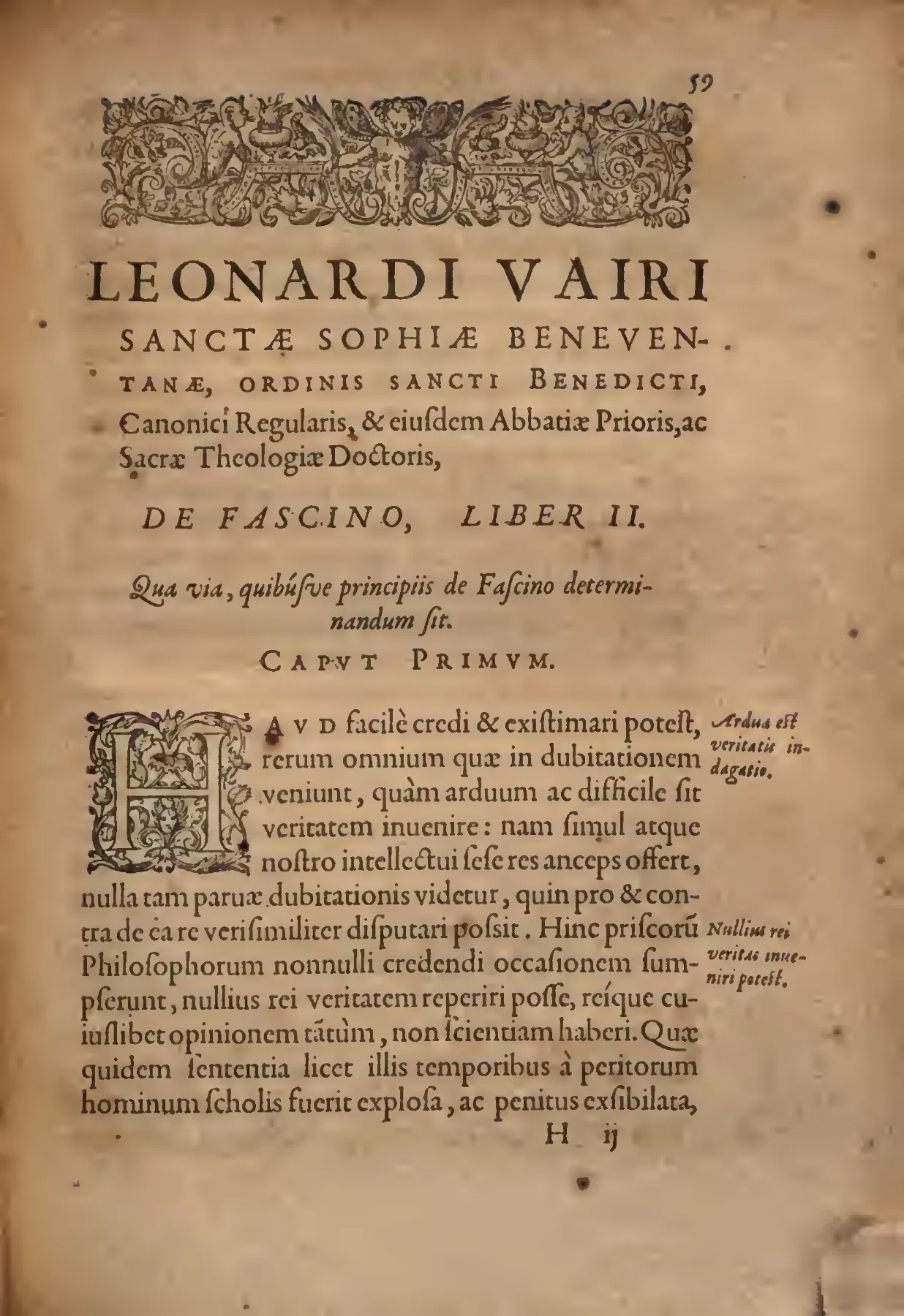
The formal opening of De fascino, Book II, is staged with a dense woodcut headpiece and an ornate initial, giving visual weight to the treatise's decisive turn from rehearsing natural explanations to refuting them. Its printed marginal prompts on the arduous search for truth and the elusiveness of certainty introduce the epistemological move that follows: Vairo concedes the limits of natural reason in order to subordinate pagan philosophical authority to the surer light of revelation. Source ↗.
With the hierarchy of authorities thus reordered, the refutation proper can begin, and its decisive stroke against imagination is a metaphysical one drawn from the doctrine of immanent and transient acts. As set out in the philological framing, the act of imagining remains in the one who imagines, so that it cannot be thought likely that the seeing-act of the eyes should be communicated to others outside the imagining subject. Here the earlier concession is precisely delimited and defeated: imagination alters, yes, but its act is immanent, terminating in the subject who imagines and incapable by its own nature of passing into an external subject. The naturalist account founders not because imagination lacks power but because the power it has is of the wrong ontological kind to reach a victim at a distance. The refutation of vision is pressed along a complementary, teleological line, for Vairo urges that if nature had given man sight for the purpose of bewitching, it surely would not have provided well for the utility of men, At si homini visum ad effascinandu[m] natura dedisset, præfectò non bene hominu[m] vtilitati prospexisset. The argument turns the providential ordering of the faculties against the naturalist thesis: the eye is ordained to the good of seeing, and a nature that had ordained an organ to the harm of its possessors' fellows would be a nature working against its own ends, which is inadmissible.
The vacancy left by the eviction of the natural causes is filled, unmistakably, by the demons. Vairo charges that these demonic imposters are not ashamed, while they themselves persist in voluntary error as though fascinated, to impose upon us too in these matters, Nec dæmoniacos impostores pudet, cùm ipsi in voluntario errore, tanquam fascinati persistant, nobis quoque in iis modis imponere. The formulation is doubly barbed, for it casts the demons themselves as tanquam fascinati, held fast in a voluntary error that is itself a species of bewitchment, and makes their deception of men a propagation of that same self-inflicted blindness. The reassignment of cause is then stated in its fullest and most consequential form, gathering the demonic operation under the technical rubric of the pact: the effects some ascribe to imagination must, as already noted in the philological framing, be ascribed to the action of demons, who are wont to have a tacit or express pact with sorcerers. This is the load-bearing sentence of the whole demonstration, importing the forensic vocabulary of inquisitorial procedure — the pactum tacitum vel expressum — into what had presented itself as a natural-philosophical inquiry, and thereby completing the migration of cause from the faculties of the soul to the covenanted agency of spirits.
The technique by which this migration is accomplished at the level of individual figures is nowhere clearer than in Vairo's handling of the basilisk. The venomous-gaze creature of natural history is not merely explained but allegorised, so that the basilisk is taken by the sacred doctors for a demon, ideo ipsum pro Dæmone sacri Doctores accipiunt. The commonplace of the killing look is thus lifted out of the domain of Plinian natural history and deposited in the demonological register, its authority now the sacri Doctores rather than the naturalists, and its referent the Devil rather than a serpent. The maneuver epitomises the treatise's argumentative economy in its opening books: a datum is granted, its natural explanation is shown to be metaphysically or teleologically untenable, and its place in the causal order is taken by a demonic agent, whose commerce with men is secured through the pact — the single controlled reassignment that governs the exposition from the proem's promise of light in darkness to the identification of that darkness with the operation of demons.
The closing chapters of Book II bring Vairo's refutation of the naturalist causes to its sharpest point, and the movement of his argument in these chapters is best watched at the seam where the analysis of amatory and ocular fascination turns from psychology to demonology. On the question of love, Vairo dislodges causation entirely from the object's gaze and re-sites it within the lover's own disordered interior: it is not because the lover is seen by the beloved that he is affected, but because he himself sees and esteems the thing seen at more than it deserves, Et ideò non quia amans ab amata videtur, afficitur; sed quia ipse videt, & rem visam pluris quàm debet æstimat. The maneuver is characteristic: the whole apparatus of the radiating amatory eye, so richly developed in the Ficinian and Neoplatonic tradition, is quietly voided by making the seeing subject, not the seen object, the site of the disorder. The biblical exempla he marshals — Zorobabel and Apame, David and Bathsheba, Amnon and Thamar, Solomon — are read not as instances of bewitchment but of praua libidine, base lust, so that a topic the poets had made luminous is reduced to a defect of the appetite. The same reduction governs his treatment of the malefic gaze proper. Confronted with the entire folkloric repertoire of the evil eye — horses wasting and dying, crops drained, trees dried, herds robbed of their milk — Vairo does not deny the phenomena but denies their proximate cause, insisting, in the sentence already quoted in the executive summary, that all of it must be ascribed not to the nature of the eyes but to the power of demons. This is the treatise's governing migration of cause performed in miniature: the empirical catalogue is granted, the naturalist explanation withdrawn, and the demon installed in the vacated explanatory position.
That the demonic reassignment does not swallow every proximate physical process is itself an argumentative discipline, and Vairo is careful to police the boundary. The transmission of harm by a leper or a plague-stricken person to others belongs, he holds, to a wholly different order and must be called not fascination but contagion — the boundary-marking distinction already noted in the discussion of the medical tradition on the evil eye. The distinction is load-bearing rather than incidental: by conceding that certain morbid transmissions are genuinely natural, Vairo protects the specificity of fascinum as a category that natural philosophy cannot capture, and simultaneously insulates his demonology from the charge of dissolving all disease into diabolic agency. What natural contagion can explain is left to nature; what it cannot is reserved for the demon. The rigor of the argument depends precisely on this refusal to let the demonic hypothesis expand without limit.
The refutation of verbal and characterological magic in Chapter XI proceeds from a thesis in the philosophy of language that Vairo states without hedging: as already registered in the discussion of the linguistic question, the significance of all such words and names is not by nature but from the consent and will of men. The conventionalist position is deployed as a demolition tool: if words signify only by agreement, then no name, no incantatory formula, no inscribed character can possess an intrinsic power to bind or to harm, since the sound bears no natural proportion to any effect. Vairo drives the point home with the empirical fact of linguistic diversity, observing that words are not the same among all peoples but that their variety is very great, At verba non eade[m] apud omnes reperi[n]tur, verùm illorum varietas maxima est. The multiplicity of tongues, dramatized by the confusion at Babel and framed against the Psammetichan experiment reported in Herodotus, becomes decisive evidence that meaning is imposed rather than found. The consequence for magic is total: whatever apparent efficacy attaches to spoken charms or written signs cannot inhere in the signs themselves, and so must, once again, be referred to the pact behind them. The conventionalist thesis thus does double duty, dismantling the naturalist account of verbal magic while leaving the demonic residue exactly where the treatise wants it.
The theory of metamorphosis in Chapter XII applies the same logic to the transformation of bodies, and here Vairo's debt to Augustine is explicit. Demons, as already quoted in the discussion of metamorphosis, possess no creative power over natures and can only counterfeit them, changing in appearance only what God has created so that things seem to be what they are not. The governing phrase specie tenus — in appearance only — carries the entire weight of the doctrine: metamorphosis is real as illusion and unreal as substance, a deception of the senses rather than a transmutation of forms, and the metaphysical guarantee is the fixed order of the created world, which no created spirit may overturn. The abstraction is immediately grounded in a concrete forensic case, the werewolf of Poligny in the Franche-Comté, sourced to Cardinal Granvelle, who, in the confession already noted above, admitted under torture that he had put on the form of a wolf by an unguent made by demonic art. The confession is instructive for the theory it is made to serve: the ointment is real, the transformation apparent, and the demon supplies the illusion rather than the substance, so that even a judicial confession of lycanthropy is folded into the doctrine of appearance-only change without conceding that any nature was in fact altered.
All of these refutations converge on the formal definition with which Book II closes and to which the whole demonstrative apparatus has been building. This is the reframed definition already set beside its Book I counterpart in the philological framing: fascination is a pernicious quality, brought about by the art of demons, confirmed on account of the tacit or express pact of men with those same demons. Every clause here answers a defeated naturalist rival: the perniciosa qualitas retains the Aristotelian idiom of the opening book, but its efficient cause is now dæmonum arte, and the ground of the demon's purchase on the fascinator is the pactum tacitum vel expressum imported from inquisitorial procedure. The definition is thus not a fresh assertion but the sedimented conclusion of the preceding chapters, each of which had cleared a candidate cause from the field.
Book III: The Theological Resolution and the Discipline of Remedy
Book III consolidates the result and moralizes it. The teleological argument against natural fascination is compressed into a single proposition, already quoted in the treatment of the theological climax: fascination destroys nature, therefore it is not from nature. The reasoning turns on a principle of natural finality — that nature does not arm its noblest creature with a power ordered to its own destruction — and this same anthropology underwrites the claim that a harmful natural endowment would be superfluous in man, for whereas the beasts are furnished with weapons, to man, who is divine, none of these was given but reason for procuring all things necessary to himself, at homini, qui diuinus est, nihil horum, sed rationem ad omnia sibi necessaria parâda dedit. If man is equipped by reason rather than by natural instruments of harm, then a native power of fascination has no place in his constitution, and the etiology is driven wholly toward the moral and the diabolic. Vairo states the terminus of that drive without qualification, in the moral diagnosis already quoted in the treatment of the Counter-Reformation campaign against superstitio: the chief cause by which we are fascinated is none other than contempt of the law and disobedience of the heavenly commandments. The whole physical and psychological inquiry is thereby subsumed into a spiritual diagnosis: the vulnerability to fascination is a function of sin, and the demon finds purchase only where obedience has failed.
The abstract etiology is anchored in the vivid case of the bewitched wife of Sepino, whose testimony exhibits the demonic manipulation of the imagination in a domestic setting. Interrogated, she said she could give no account of the matter, and indeed that she burned with such longing and love for her absent husband that she could not express it in words, inquit, se nullam eius rei rationem reddere posse: quin absentis mariti tanto desiderio & amore se flagrare dicebat. The case is doctrinally exact: the woman's inability to render a rational account of her inflamed desiderium is precisely the symptom the theory predicts, since the demon operates upon the phantasia and its consensual bond with the heart, producing passions that outrun the sufferer's power to explain them. The consistency between the psychology and the case is the treatise's method in action — the abstract mechanism displayed in a concrete, locally attested marriage.
The consequence for remedy follows directly from the reassignment of cause. Because the harm is demonic, protection cannot lie in pagan objects or occult virtues but must be sought in the sacramental discipline of the Church; Vairo gathers his eighteen-point program under a redefined heading, declaring, in the sentence already quoted in the philological framing, that these are the amulets that expel the demons themselves, the fascinations, and all evils brought about by the art of demons. The very term amuleta, condemned by Pliny and the Fathers as superstitious, is captured and reassigned, so that the migration of cause completes itself in a migration of cure: the efficacy of protection resides not in any natural quality of the object but in divine institution and the moral disposition of the faithful.
The appended medical enarratio of Horatius Albinus extends the treatise's boundary-work into forensic toxicology, and it does so on a principle strictly parallel to Vairo's demonology of quality. Its governing thesis, already noted in the philological distinction of veneficium from fascinum, is that it is proper to poison to convert a substance into its own poisonous nature — a mode of action defined by the transformation of the recipient body rather than by any sensory propagation, and therefore ontologically distinct from fascinum. The epistle grounds itself in a documented event, recording that the poisoning occurred when Vairo was dining among the monks of Santa Sofia of Benevento, in the year 1573, on the third day of August, cùm apud monachos sanctæ Sophiæ Beneuentanæ, annom. D. LXXIII. die tertia Augusti. The datum situates the whole appendix as a clinical attestation adjacent to, but categorically separate from, the demonic assault the treatise anatomizes: sublimate poison acting by the conversion of substance stands on the natural side of the line, exactly where contagion had been placed in Book II, confirming that Vairo's system reserves the demonic explanation for what natural causation demonstrably cannot reach.
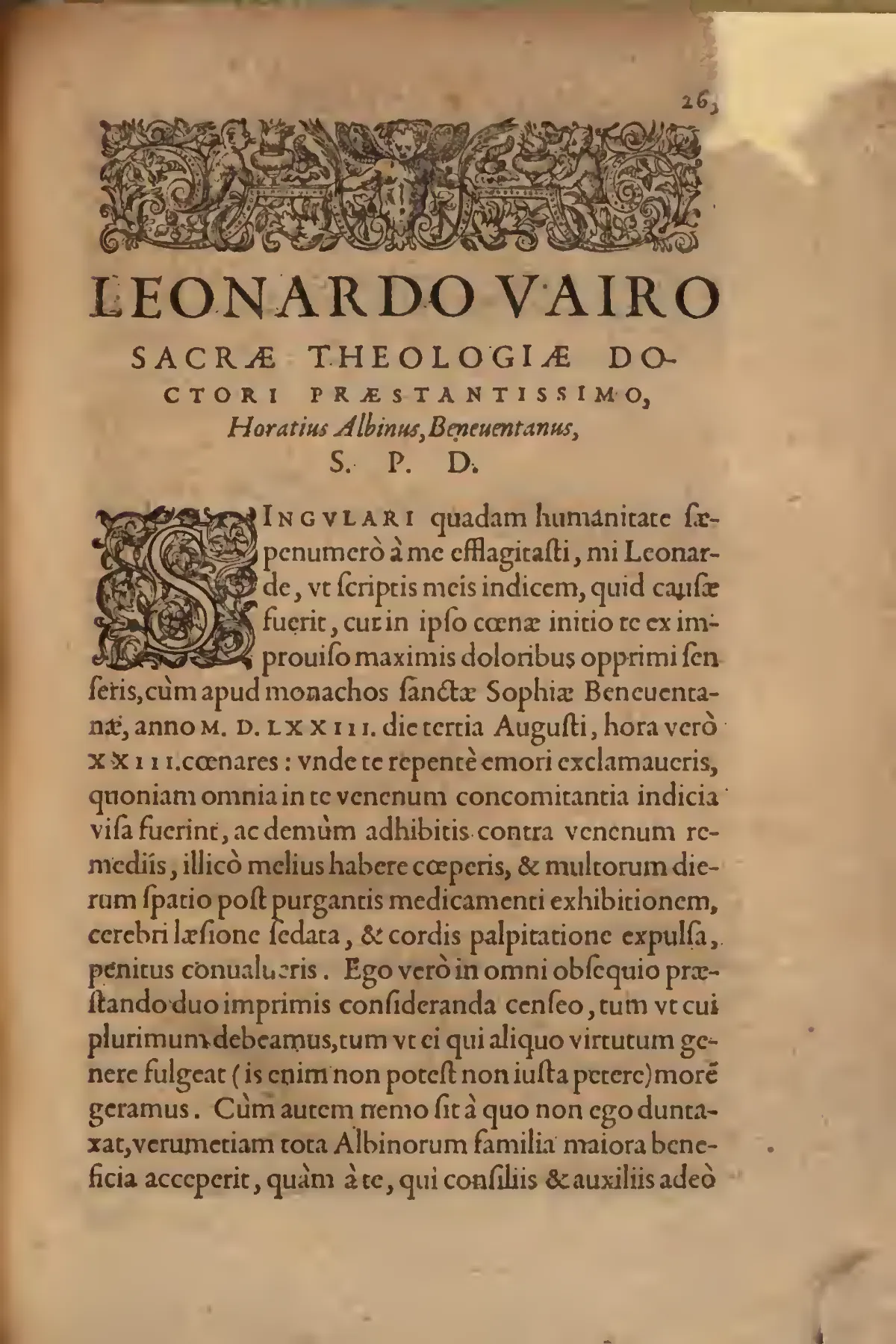
The epistle's opening leaf announces its forensic weight typographically: a dense woodcut headpiece, the dedicatee's display capitals, and a large historiated initial set off Albinus's account of Vairo's sudden illness at Santa Sofia on 3 August 1573. By presenting poisoning as a documented clinical episode rather than an instance of fascination, this paratextual threshold helps mark the treatise's central boundary between natural toxic action and demonic causation. Source ↗.
Frequently Asked Questions
What is Leonardo Vairo's De fascino libri tres about?
The De fascino libri tres (Three Books on Fascination: On the Evil Eye, its Species and Causes) is a Latin scholastic-demonological treatise arguing that the evil eye is real but has no natural cause. First printed at Paris in 1583, it accepts that fascination exists — grounding the claim in Scripture — then examines and rejects every proposed natural cause: intense imagination, the radiating eye, contagion by touch or voice, stellar observation, and the passions of love and hatred. Its conclusion is that the true efficient cause is a demon operating through a tacit or express pact.
Who was Leonardo Vairo?
Leonardo Vairo (Latin Leonardus Vairus) was a Benedictine monk and later bishop, born at Magliano Vetere in the diocese of Capaccio around 1543 and professed at the abbey of Santa Sofia in Benevento. He was promoted to the episcopate of Pozzuoli on 25 January 1587 and died there on 4 January 1603. His De fascino libri tres addressed a readership of bishops, inquisitors, and censors trained in Aristotelian and Thomistic vocabulary, and belongs to the post-Tridentine Roman campaign against superstitio that culminated in the papal condemnations of 1580–1586.
Why did Vairo argue the evil eye could not be caused by the eyes themselves?
Vairo rejected the radiating eye on two grounds. First, a teleological argument: if nature had given man sight for bewitching, it would not have served human welfare well, since a faculty ordained to harm one's fellows would work against nature's own ends. Second, he held that the destructive character of fascination proves it cannot be natural — fascination destroys nature, therefore it is not from nature. The harmful gaze, including the folklore of wasting horses and drained crops, he ascribed not to the nature of the eyes but to the power of demons.
What was the poisoning of Vairo described in the appended medical epistle?
The treatise includes a forensic-medical epistle by the physician Horatius Albinus (Orazio Albini) concerning the poisoning of Vairo himself while he was dining among the monks of Santa Sofia di Benevento on 3 August 1573. This clinical account describes sublimate poison and its antidotes — Theriac, Mithridatic, and Bezoar — and rests on the principle that it is proper to poison to convert a substance into its own venomous nature. Because poison transforms the recipient body rather than propagating through the senses, it stands on the natural side of the treatise's boundary, distinct from fascinum.
Is there an English translation of De fascino libri tres?
No modern vernacular translation — Italian, Spanish, French, German, or English — has been located in the catalogues consulted, a gap consistent with the work's technical Latin register. Its transmission was principally through later Latin-writing demonologists who cited it. Separately, the Leo edition presents the full transcription and a complete English translation, generated by artificial intelligence, for the first time. Leo is an effort to make freely available online, at no cost, English translations of every text printed in Latin in early modern Europe between 1450 and 1750.
This report was generated by an advanced AI assistant that conducted deep research alongside an extensive interpretation of the transcribed original text. Every effort has been made to preserve fidelity to the source and to guard against inaccuracy, but corruption in the text recognition process and model hallucination may nonetheless have entered the text. Treat every claim, quotation, translation, and citation as provisional, and verify each against the original source before relying on or citing it.
Bibliography
- Michael D. Bailey, Fearful Spirits, Reasoned Follies: The Boundaries of Superstition in Late Antiquity through the Early Modern Period: The most pertinent single volume for the treatise's redefinition of amuleta from superstition into sacramental discipline; Bailey shows precisely how the boundary between licit and illicit protection was drawn and redrawn, which is the operation Vairo performs on the whole inherited lore of the evil eye. Read it to see why "superstition" was a moving line policed by theologians rather than a stable category.
- L. Bianchi, Studi sull'astrologia del Rinascimento: Situates Vairo's polemic against imagination and stellar influence within the post-Tridentine re-appropriation of magia naturalis, with chapters bearing directly on Pomponazzi, Della Porta, and Cardano. Consult it to reconstruct the naturalist adversaries whose strongest case Vairo airs only to demolish.
- Stuart Clark, Thinking with Demons: The Idea of Witchcraft in Early Modern Europe: The indispensable frame for the treatise's central move, the displacement of natural agency by demonic agency; Clark's argument that demonology was a shared intellectual science, not a fringe curiosity, explains why a future bishop would treat the evil eye as a problem worth three demonstrative books. Vairo's insistence that harm be ascribed to the power of demons rather than the nature of the eyes is a textbook instance of the structural substitution Clark anatomises.
- Brian P. Levack, The Devil Within: Possession and Exorcism in the Christian West: A companion for the pastoral end of Vairo's argument, where remedy migrates from pagan objects to the sacramentals and rites of the Church; Levack maps the institutional machinery of exorcism and dispossession that the treatise's remedy-program presupposes. Useful for grasping how demonic diagnosis translated into liturgical practice.
- D. P. Walker, Unclean Spirits: Possession and Exorcism in France and England in the Late Sixteenth and Early Seventeenth Centuries: Walker's close studies of contested possession cases illuminate the evidentiary and forensic pressures — confession, testimony, clinical observation — that Vairo mobilises in the wife of Sepino and the werewolf of Poligny. Read it to see how a demonic hypothesis was made to answer to concrete, locally attested cases rather than to abstraction alone.