The File and the Furnace: Josse Clichtove's An Ecclesiastical Elucidation of the Matters Pertaining to the Office of the Church, in Four Books
In late 1515 or early 1516, Henri Estienne's Paris press issued the Elucidatorium ecclesiasticum, the Flemish theologian Josse Clichtove's four-book manual for the whole Divine Office and the Mass, built on a single conviction: that the Church sings its daily hymns, canticles, and prayers without understanding them. Against corrupted texts and forgotten authors Clichtove trained the full apparatus of Christian humanism — textual emendation, metrical scansion, and Hebrew-Greek-Latin philology — always in the service of a sharper orthodoxy. It is the principal liturgical monument of the circle around Jacques Lefèvre d'Étaples, and the constructive programme whose arguments Clichtove would later turn against Luther.
ExLatinis
July 24, 2026

Contents
In late 1515 or early 1516, Henri Estienne's Paris press issued the Elucidatorium ecclesiasticum, the Flemish theologian Josse Clichtove's four-book manual for the whole Divine Office and the Mass, built on a single conviction: that the Church sings its daily hymns, canticles, and prayers without understanding them. Against corrupted texts and forgotten authors Clichtove trained the full apparatus of Christian humanism — textual emendation, metrical scansion, and Hebrew-Greek-Latin philology — always in the service of a sharper orthodoxy. It is the principal liturgical monument of the circle around Jacques Lefèvre d'Étaples, and the constructive programme whose arguments Clichtove would later turn against Luther.
In late 1515 or the first weeks of 1516, the presses of Henri Estienne in Paris issued a folio volume whose title announced an ambitious pastoral and scholarly project: the Elucidatorium ecclesiasticum, an "ecclesiastical elucidation" of the matters pertaining to the Church's daily worship, arranged in four books. Its author was Josse Clichtove (Jodocus Clichtoveus, c. 1472–1543), a Flemish theologian trained at Paris and the most industrious literary associate of Jacques Lefèvre d'Étaples, around whom a circle of humanist reformers had gathered at the university in the years before the evangelical rupture at Meaux. The work is a liturgical hand-book in the humanist manner: a systematic exposition of the Divine Office and the Mass that lays each hymn, canticle, sequence, and prayer of the Church open to explanation, from the theological rationale of the canonical hours to the wording of the Canon of the Mass.
The problem the book confronts is stated plainly at its outset and never abandoned: the texts the Church sings every day are recited without being understood. Their words have been corrupted in scribal transmission, their authors forgotten, their doctrinal and typological freight lost to those who — in Clichtove's memorable diagnosis — merely rattle sacred songs on their lips while holding no understanding of them in the heart. Against this, the whole work is organized around the Pauline and Psalmic charge to psallere sapienter, to sing wisely: to praise God with the mind as well as the spirit. The recurring move by which Clichtove answers that charge is a layered elucidation of each text. Humanist textual criticism first restores the wording ad limam, "by the file," and names its author where he can be identified; metrical and prosodic analysis then explains the verse-form, subordinating rhyme to grammatical congruity; trilingual philology, drawing on Hebrew, Greek, and Latin, unfolds the loaded terms; and verse-by-verse annotations draw out the typological, sacramental, Trinitarian, Marian, and hagiological doctrine the text carries. The conversion of rote recitation into intelligent devotion is the spine along which every part of the book is arranged.
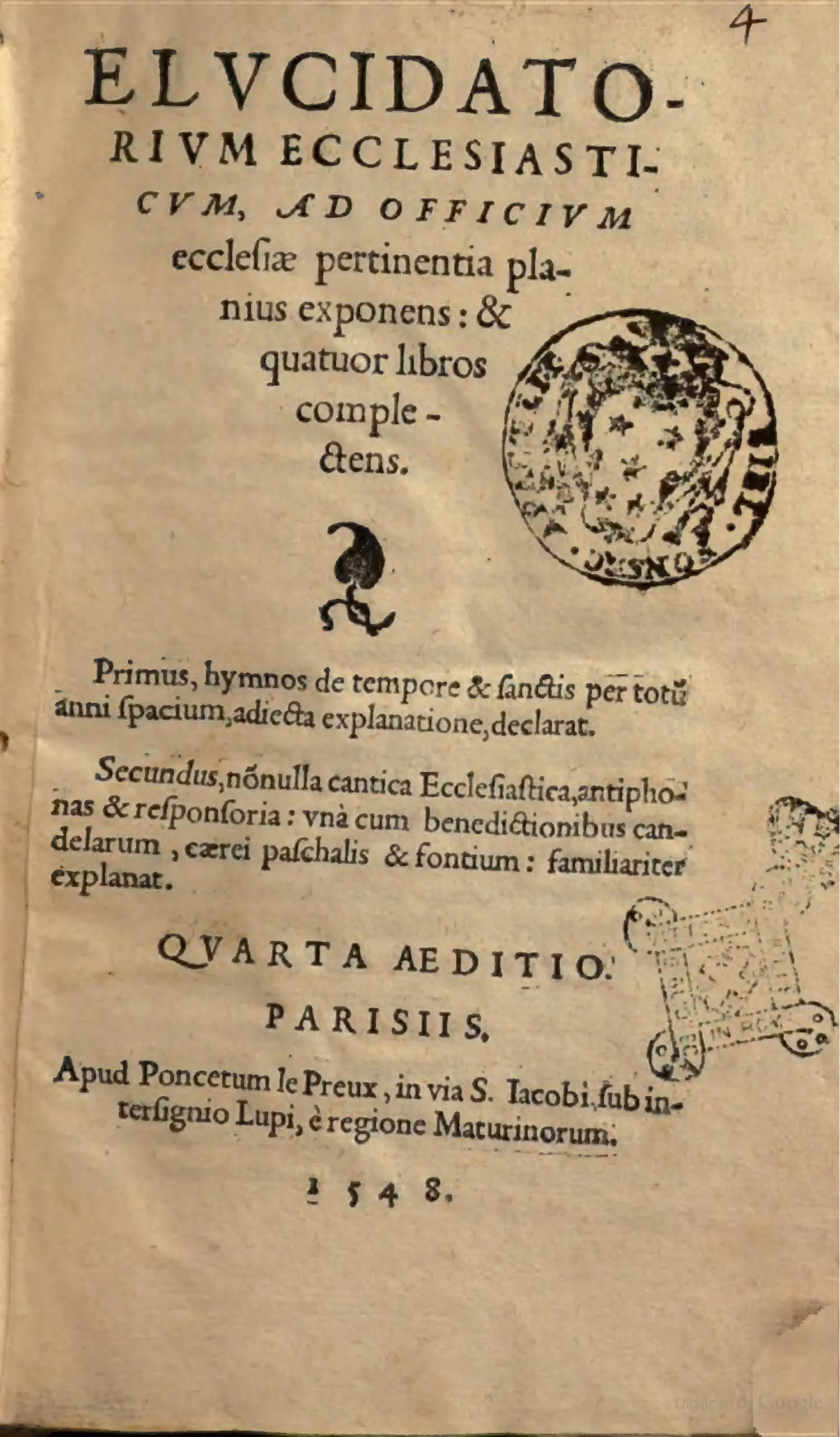
The 1548 Paris title page turns Clichtove's programme into a promise on the page: an "Elucidatorium" for the "officium ecclesiae," arranged in "quatuor libros" and advertised as the "QVARTA AEDITIO." Its imprint for Poncet le Preux, framed by later institutional stamps, links the book's Parisian commercial history to the modern scholarly afterlife through which this edition has become especially accessible. Source ↗.
What makes the work distinctive is the disciplined breadth of that programme and the way it binds philology to dogma. Clichtove will emend a hymn's meter and, in the same chapter, defend transubstantiation, the Chalcedonian formula, the intercession of the saints, or salvation by grace rather than works. He can rule, with a grammarian's confidence, that missa is not a past participle but a substantive noun; that pascha is a Hebrew word meaning not "passion" but "passage"; that Alleluia joins the Hebrew verb for "praise" to a name of God. He dismisses the erotic and pagan matter of classical verse — the odes of Horace, the praises of Diana and of Venus and Cupid — in favor of pious hymns to God and the saints, yet he brings to those hymns the full apparatus of classical scholarship, faulting sequences that merely count syllables and insisting that all rhyme without due congruity of speech is insipid. The book is also unmistakably a document of its moment: it prays against the advancing power of the Ottomans, invokes the wars pressing upon the kingdom of France, and dwells on the relic of the Crown of Thorns preserved in the royal palace at Paris. An internal reckoning of years even fixes the horizon of composition around 1520, when portions of the text appear to have been revised.
The historical stakes of this project are considerable. The Elucidatorium stands as the principal liturgical monument of the Fabrist circle, showing how the ad fontes method of Christian humanism could be trained upon the Church's own worship without any departure from institutional allegiance — indeed in the service of a more precise orthodoxy. It is among the earliest sustained humanist critiques of the late-medieval hymnal and sequentiary, deploying techniques of emendation and source-criticism that the Reformation would soon appropriate to very different ends. And because Clichtove would later turn his pen against Luther, in the Antilutherus of 1524 and the Propugnaculum ecclesiae of 1526, the Elucidatorium has come to be read as the constructive statement whose arguments those polemics defend — the positive programme of which the later controversy is the negative after-image. How precisely to locate Clichtove in the years between 1516 and 1521 remains contested: the older scholarship read him as an unambiguously conservative controversialist, while the foundational modern reassessment recast him as a moderate reformer working from within, and more recent work sharpens his role as a hinge figure. All parties agree, however, that he himself broke decisively with the evangelical movement after 1521.
A reader coming to the Elucidatorium for the first time will find, then, a work in which the recovery of a corrupted word and the defense of a contested dogma are treated as one and the same labor. Its conceptual vocabulary — psallere sapienter, emendatio ad limam, mysterium fidei, transitus — is not ornamental but load-bearing, naming the moves by which the book turns the daily liturgy from something merely uttered into something understood; and the same conviction that animates its argument links it outward to the humanist publishing network of Estienne's Paris that produced it and to the confessional pressures of the age it addresses. It is a book that asks what it means to sing with understanding, and answers the question one hymn, one canticle, one prayer at a time.
Read the full text and English translation on Leo
This text was transcribed and translated as part of the ExLatinis project, an effort by Leo to make free English translations of every text published in Latin in early modern Europe (1450–1750) available online. The complete transcription and English translation of this work can be read free of charge:
→ Read the original Latin text and full English translation on Leo
You can save a copy of this document into your Leo account to run deep text searches, conduct further analysis, or cross-reference it with your own research.
Naming the Work: Clichtove's Elucidatorium and Its Philological Vocabulary
Editorial English Title
The conventional English rendering, here supplied as an editorial title for convenience, is "An Ecclesiastical Elucidation of the Matters Pertaining to the Office of the Church, in Four Books." This title preserves the three operative terms of the imprint: elucidatorium (the humanist explanatory manual), officium ecclesiae (the liturgical office in its full late-medieval scope), and quatuor libros complectens (the advertised count of books, a marketing feature emphasized on the title page and retained in the 1548 reprint).
Philological Framing
Three Latin locutions central to the work's programme deserve period-specific exposition. The operative formula that names the project itself is elucidatorium, a term that, in the publishing trade of fifteenth- and sixteenth-century Paris, designated not merely a commentary but an explanatory manual capable of restoring a textual tradition to intelligibility. Clichtove adopts the humanist sense: the elucidation is corrective as well as didactic, recovering a putative original Latin against the glosses and accretions of medieval liturgical use. The term belongs to the post-Valla, post-Bembo programme of emendatio applied to sacred texts, and its choice signals membership in the philological wing of early-Tudor Christian humanism rather than in the scholastic tradition of quaestio and quodlibet. The corrective ambition is stated by Clichtove himself as an editorial undertaking: to correct whatever errors or corruptions are found in the texts ad limam, "by the file," and to name their authors where they are known to him, si qua in illis errata aut mendosa depre hesafuerit ad lima reducere: authores ipsorum vbi mihi cõperti fuerint nominatim exprimere. The philological posture is thus written into the work's stated method, correction of transmitted corruption paired with the attribution of authorship.
The framing clause ad officium ecclesiae pertinentia planius exponens is the second operative phrase. Officium retains its full late-medieval liturgical breadth: the Divine Office in its entirety (matins, lauds, prime, terce, sext, none, vespers, compline, and the Mass), together with the Proper of the Season and the Proper of the Saints. The adverb planius, drawn from the Ciceronian lexicon, carries the sense of "clearly, plainly, without ambiguity" rather than the modern English "plainly" in the sense of "unadorned." Clichtove's planius is the plainness of the humanist philologist who recovers classical Latinity, not the plainness of rustic speech; it opposes itself to the obscurity of scholastic terminology and to the corrupt transmission of late-medieval breviaries.
A third locution, programmatic for the Lefebvrist circle, is the Pauline formula psallere sapienter, drawn from 1 Corinthians 14:15, "I will sing with the spirit, and I will sing with the mind also" (Vulgate: spiritu psallam, psallam et mente). To psallere sapienter in Clichtove's hands means to recover the literal and historical sense of the liturgy, to emend the transmitted texts of hymns and sequences against manuscript witnesses, and to defend the older quantitative Latin prosody against the accentual, rhymed verse forms that had displaced antique meters in the late-medieval hymnals. The motto opposes itself to what Clichtove takes to be the unreflective recitation of corrupted texts: psalmody without intelligence is, in his Pauline vocabulary, psallere non sapienter, bodily praise without the spirit. Clichtove opens the work by grounding the whole enterprise in this charge, admonishing the reader that the divine Psalmist warns us to sing wisely to God, uttering not bare words with the mouth but meditating with piety on their meaning, AD monet nos diuinus Psaltes, sacratissime antistes: quod deo sapienter psallamus, non sola scilicet nuda ver ba ore proferentes, sed & piam eoru[m] intelligentiam ac sensum, mente in deum excitata meditates. The negative image of this ideal is the clerical ignorance he diagnoses in those who rattle sacred songs on their lips but hold no understanding of them in their inmost heart, qui labiis quidem per strepunt sacra cantica sed intimo corde nullam eorum tenent intelligentiam; the polemical target is precisely the recitation without understanding that the psallere sapienter programme is designed to cure. The programme presupposes a Tridentine horizon that the work itself anticipates but does not survive to witness.
A fourth expression, recurrent in the Eucharistic chapters, is the Roman Canon formula mysterium fidei, taken from 1 Corinthians 11:25 and codified in the Canon of the Mass. Clichtove treats the phrase as the touchstone of sacramental orthodoxy: it names the objective content of the sacrament against any reduction that would diminish the real presence under either species by separation or compromise. He glosses the epistemology the phrase encodes directly, explaining that it is called the mystery of faith because one thing is seen and another understood — the appearance of wine is seen, and the truth of Christ's blood is believed, aliud ibi cernitur & aliud intelligitur. cernitur enim species vini: & creditur veritas sanguinis Christi. The formula carries the period connotation of doctrinal precision at a moment when the eucharistic vocabulary was being contested across the Latin Church; this same distinction between what is perceived and what is understood is the sacramental application of the work's governing insistence that worship be intelligent rather than merely sensory.
Finally, the term transitus in its liturgical context denotes the death of the Christian as passage rather than annihilation, the soul's passage to the beatific vision. In Clichtove's treatment of the cult of the saints, prayer for the dead, and purgatory, transitus names the doctrine that mortal death is no rupture of the communion of saints. The term is not yet freighted with the Reformers' denial of purgatory; in Clichtove's usage, it is an orthodox commonplace deployed in defense of a doctrine under pressure. The word carries a philological pedigree that Clichtove takes care to establish: by a more careful reading, he observes, it was found that pascha is a Hebrew word interpreted not as passion but as passage, A diligè tioribus & à doctoribus inuentum est, quia pascha hebræum verbum est, & non interpretatur passionem sed transitum. Here the trilingual philology and the doctrinal exposition converge, the recovery of the Hebrew sense of pascha supplying the very vocabulary in which the passage of the faithful dead is understood.
What the Elucidatorium Is: A Four-Book Manual for the Office and the Mass
The Elucidatorium ecclesiasticum is a four-book Latin treatise on the Divine Office and the Mass, composed in Paris by the Flemish humanist-theologian Josse Clichtove (Jodocus Clichtoveus, c. 1472–1543) and first printed in Paris at the press of Henri Estienne in late 1515 or early 1516 (more Veneti, 1516). The work is a liturgical hand-book in the humanist manner: it lays out the theological rationale of the canonical hours, examines the hymnal and sequentiary traditions, and offers philologically annotated expositions of the Canon of the Mass, all with the aim of restoring the liturgy to intelligibility and doctrinal precision. The work's animating principle is the Pauline motto psallere sapienter: praise that is both spiritually sincere and intellectually lucid, in which textual corruption is treated as an obstacle to right worship and humanist emendatio as the cure. The text was reprinted in Paris in 1548 (Antoine Jure, at the sign of the Cock) and again in 1558 by Jean de Roigny, with subsequent issues running into the later sixteenth century. It was composed in Latin and has never been translated into a modern vernacular; an early-modern French paraphrase circulated in manuscript within the Meaux circle and is sometimes confused with the printed Latin text. Clichtove's subsequent polemical works against Luther, the Antilutherus (1524) and the Propugnaculum ecclesiae (1526), re-use arguments first articulated in the Elucidatorium and are best read as its negative after-image.
Placing Clichtove: Fabrist Humanism, Liturgical Reform, and the Historiographical Debate
Why the Elucidatorium Matters
The Elucidatorium ecclesiasticum occupies a privileged position in the history of early-modern Catholic reform and Christian humanism for four converging reasons.
First, it is the principal liturgical monument of the so-called Fabrist circle — the group of humanist reformers gathered around Jacques Lefèvre d'Étaples at the University of Paris between roughly 1507 and 1521, before the evangelical fissure at Meaux. Within this circle Clichtove functioned less as an original speculative thinker than as a literary executor who translated Lefèvre's philological programme into the inherited genres of scholastic and pastoral theology. The Elucidatorium is therefore read by historians of humanism as evidence of how the Parisian viri obscuri sought to bring the methods of ad fontes humanism to bear on the liturgia horarum and the Mass without abandoning institutional allegiance.

Holbein's portrait of Erasmus, framed by a Renaissance pilaster, stands as a neighboring emblem of the Christian-humanist milieu rather than a likeness of Clichtove himself. Erasmus's association with the 1516 programme of learned emendatio helps situate the Elucidatorium within the same ad fontes intellectual world. Source ↗.
Second, the work is one of the earliest sustained humanist critiques of the late-medieval hymnarius and sequentarius. Clichtove's textual emendations of hymns such as the Pange lingua, the Veni Creator, and the Ave maris stella — his insistence on quantitative scansion and on the recovery of an older stratum of wording — belong to the same current that produced Erasmus's Ratio of 1516 and that converges in the 1520s with Luther's liturgical reform. This critical stance is programmatic rather than incidental: Clichtove faults hymns that keep neither the rule nor the feet of their professed meter but only the number of syllables, observing of one that it seems composed in iambic dimeter yet by no means keeps its rule and feet, Videtur hic hymnus carmine iambico dimetro esse copositus: eius tame regulam & pedes nequaquam seruat, sed solum syllabarum numeru[m]. The same principle governs his subordination of rhyme to grammar: all rhyme without due congruity of speech is insipid and inept, so that congruity of speech without rhyme is to be accepted but rhyme without congruity by no means, cu[m] tamen rythmus omnis sine debita sermonis congruitate: sit insulsus ac ineptus: & congruentia orationis sine rythmo sit recipienda, rythmus aute[m] sine congruentia, nequaquam. The humanist repudiation of pagan poetic matter that accompanies this metrical rigor is equally explicit, as when Clichtove bids the Horatian odes depart and the praises of Diana and of Venus and Cupid farewell, that in their place the praises of God and the saints written in pious hymns may succeed, Facessant igitur odæ horattanæ, valeant Dianæ laudes & Veneris, Cupidinisque: atque in earum locum succedant pijs hymnis conscripta dei & sanctorum præconia. Modern scholarship, notably Guy Bedouelle and the team around the Centre d'études supérieures de la Renaissance at Tours, treats the Elucidatorium as a hinge text: it predates the Reformation yet deploys methods the Reformation would appropriate.
Third, the work is the principal documentary evidence for the intellectual formation of the Meaux circle and for its movement, after the condemnation of Lefèvre's Psalterium (1521), from erudite liturgical reform toward evangelical preaching. Clichtove's later polemics against Luther — the Antilutherus of 1524 and the Propugnaculum ecclesiae of 1526 — read most coherently as the via negativa of the philological programme laid down in 1516.
Fourth, the Elucidatorium matters as a document of the trilingual (Hebrew–Greek–Latin) exegetical ambition of early-Tudor Christian humanism: the work presupposes the philologist's command of all three sacred languages as the precondition of right worship. That trilingual command is displayed at the level of individual liturgical terms, as when Clichtove explains that Alleluia means the same as "praise the Lord," since halelu is a Hebrew verb signifying "praise" and ia is a name of God, Significat aute[m] halelu ia: tantundem, sicut laudate dominu[m], and again when he derives martyr from the Greek and equates it with the Latin testis, noting that the Greek martyr is the same as the Latin testis and martyrium is testimony, & idem signat quod martyr: quin potius ediverso martyr græcum nomen: idem est quod testis latinum, & martyrium testimonium. In each case the recovery of the source-language sense is made the precondition of understood worship, the philological gloss serving the same psallere sapienter programme that organizes the whole.
Major Historians and Their Arguments
The historiography of the Elucidatorium is uneven and falls into three layers.
The older Catholic scholarship, represented by the Catholic Encyclopedia of 1913 and by A. Clerval's monographic study De Judoci Clichtovei, Neoportuensis, doctoris theologi vita et operibus (Paris, 1895), treats Clichtove primarily as a conservative Catholic controversialist and locates the Elucidatorium within the pastoral-theological tradition of the late-medieval church. The Encyclopædia Britannica of 1911 follows a similar line.
The foundational modern monograph is Jean-Pierre Massaut's two-volume Josse Clichtove: l'humanisme et la réforme du clergé (Paris: Les Belles Lettres, 1968), which remains the indispensable reference and is cited universally. Massaut argued, against the older view, that Clichtove was a moderate reformer whose Elucidatorium should be read as a programme of ecclesiastical reform from within, not as a Protestant-leaning text.
Subsequent scholarship has built on Massaut. Guy Bedouelle's studies of Lefèvre d'Étaples situate Clichtove's liturgical humanism within the Lefebvrist programme of ad fontes. Philippe Delhaye's article in Recherches de théologie ancienne et médiévale locates the Elucidatorium within the early-modern Catholic moral-theological tradition and against the evangelical current with which Clichtove later broke. Klaus Hedwig's monograph on sacramental theology offers the only sustained treatment of Clichtove's Eucharistic and Marian chapters.
The most recent synthetic reassessment is Richard J. Oosterhoff's Faber Stapulensis and His Circle: The Early French Reformation (Leiden: Brill, forthcoming 2024), which positions the Elucidatorium as a documentary hinge between Erasmian humanism and the early evangelical movement at Meaux.
Points of Contention
Two substantive historiographical disagreements merit attention.
The first concerns Clichtove's precise theological location in the years 1516–1521. The older Catholic scholarship (Catholic Encyclopedia, Clerval) treats him as unambiguously orthodox; Massaut (1968) reframed him as a moderate Catholic reformer open to evangelical impulses; Oosterhoff (2024, forthcoming) sharpens this further by reading the Elucidatorium as a hinge text whose methods the Reformation would appropriate. The disagreement is one of degree, not of substance: all parties agree that Clichtove himself broke with the evangelical movement after 1521. The text itself supplies matter for both readings: passages that would later become confessional flashpoints appear here within a wholly orthodox frame, as in Clichtove's insistence that we say with blessed Paul that not from works of righteousness which we did but according to his great mercy God will save us, and that we lean not on trust in our works as on a reed-staff, quòd non ex operibus iustitiæ quæ fecimus nos: sed secundum magnam misericordiam suam saluos nos faciet in regno suo cælesti, & in sola misericordia dei speremus saluari: neque fiduciæ operum nostroru[m] tanqua[m] baculo arundineo innitamur. The emphasis on grace over works sits alongside a robust defense of the cult of the saints, so that the difficulty of locating Clichtove is legible in the text's own combinations rather than resolved by them.
The second concerns the scope of humanist textual criticism applied to the liturgy. Massaut treats Clichtove's emendations as essentially philological, internal to the humanist programme. Bedouelle reads them as theologically charged, as already participating in the ad fontes critique of late-medieval piety. The disagreement has implications for how one locates the Elucidatorium in the genealogy of liturgical reform.
Editions, Dedicatee, and the Life of the Object: The Elucidatorium in Print
The Princeps (1515/1516)
The editio princeps of the Elucidatorium ecclesiasticum was printed in Paris at the press of Henri Estienne (Henricus Stephanus) and completed at the very end of 1515 in the Venetian reckoning of the year, i.e., early 1516 by the modern calendar. The full title-page reads: Elucidatorium ecclesiasticum, ad officium ecclesiae pertinentia planius exponens, & quatuor libros complectens. The volume is a folio; the digital exemplar held by the Biblioteca Nazionale Centrale di Roma preserves 636 leaves of text. Henri Estienne was at this date the leading classical-printer in Paris, whose press had already issued the major Aldine-derived editions of classical Latin texts and was simultaneously producing Erasmus's Novum Instrumentum (1516); the association of the Elucidatorium with this press signals Clichtove's location within the humanist publishing network of the capital. An internal chronological reckoning is consistent with a moment of composition or revision around 1520: Clichtove calculates that Christ came in the intermediate interval, after about 5,200 years, and that now after his coming 1,520 years have elapsed, post quinquæ milia annorum & ferè ducentos, & nunc post eius aduentum fluxerunt anni mille quingenti & viginti.

Braun and Hogenberg's 1574 view of Paris, made about sixty years after the first printing of the Elucidatorium ecclesiasticum, evokes the urban world in which Estienne's press and the University's humanist theologians operated. The dense cityscape situates the book's production within a specifically Parisian geography of scholarship, printing, and devotion. Source ↗.
Second Paris Edition (1517)
A second Paris issue followed almost immediately, dated 1517 on the title page. This edition has been identified in the French post-incunables database as the work of Antoine Jure, working at the sign of the Cock (ad signum Galli) on the rue Saint-Jacques, and associated with the bookseller Poncet le Preux, who is named on the half-title as the vendor of certain copies. The 1517 reissue is bibliographically of the same textual family as the princeps but with corrected sheets; a surviving digital exemplar preserves a half-title indicating the bookseller rather than the printer.
The 1548 Paris Edition
The 1548 Paris reprint, published apud Anthonium Iure, sub signo Galli, in via ad D. Victorem, is the edition most readily accessible to modern scholarship through the digitized Internet Archive holding. This edition carries a new internal date of 1520, suggesting that portions of the text were revised in or around that year. The volume runs to 636 pages of text plus prefatory matter and is paginated continuously, in contrast to the unpaginated folio of the princeps. The 1548 edition is identified in the BP16 database as the fourth Parisian edition, indicating the existence of at least three earlier printings in Paris. That the text underwent authorial revision between editions is confirmed from within the work, where Clichtove notes that in the first edition of the book he had observed, around a certain place, that in most ecclesiastical books two clauses are interjected, beginning "O truly necessary sin of Adam," in prima huius libri editione circa hunc locum annotaui in plærisq[ue]; libris ecclesiasticis interiectas esse; the passage documents Clichtove's practice of self-correction across the successive printings.
The 1558 Paris Edition
Jean de Roigny (Johannes de Roigny), who had inherited the press of his father-in-law, the celebrated printer and bookseller Charlotte Guillard, issued the 1558 reprint apud Ioannem de Roigny, sub signo Luteae, in via Iacobaea. This was the last major sixteenth-century edition of the Elucidatorium; subsequent printings through the 1560s and 1570s derive from the 1548/1558 text. The work continued to circulate in abridged selections into the seventeenth century.
Physical Format and Material Features
The Elucidatorium is a folio volume of approximately 200 by 300 millimetres in the early editions, set in roman and italic types with extensive use of Greek type for the philological excursus on Greek hymnographers. Headpieces and initials are the standard Parisian gros-bâtard and grècis of the period. The princeps is unpaginated; later editions are paginated continuously. No manuscript draft of the Elucidatorium survives in any published catalogue; Clichtove's working papers have not been located.
The Dedicatee: Johannes Gosztonyi
The princeps is dedicated to Johannes Gosztonyi (Ioannes Gozthon / Iauriensis), Bishop of Győr (Jaurinum) in Hungary from 1511 to 1525 and subsequently Bishop of Transylvania. Gosztonyi was in Paris in 1515–1516 as part of the Hungarian embassies to the French court and was a known patron of humanist learning. The choice of dedicatee situates the Elucidatorium within the early-sixteenth-century Franco-Hungarian cultural exchange that brought Clichtove's Meaux circle into contact with scholars such as Georg von Brandenburg-Ansbach and members of the Orsini-papal diplomatic orbit.
Attributions Within the Text
Alongside the naming of its dedicatee and printers, the work itself performs a sustained labor of attribution, restoring to the liturgical corpus the authorship its transmission had obscured — the second half of the editorial promise to name authors where they are known. Clichtove identifies the author of the Corpus Christi office as Saint Thomas Aquinas, who at the request of Pope Urban IV elegantly composed the whole ecclesiastical office of the most holy sacrament of the body of Christ, Author eius: sanctus Thomas Aquinas. Qui ad petitionem Vrbani quartissimi pontificis totum officium ecclesiasticum de sanctissimo corporis Christi sacramento eleganter & luculenter compositi. He likewise names the venerable father Adam of St Victor, who while he lived adorned by his learning and holiness the house of St Victor built in the suburbs of Paris, venerandus pater Adam de sancto victore, qui religiosam ... domum sancti Victoris in Parisiorum suburbis constructam, cum uixit: insigni doctrinæ splendore & vitæ sanctimonia illustrauit. These attributions bind the work's philological method to the concrete history of the liturgical texts it elucidates, locating their composition in identifiable authors, patrons, and Parisian institutions.
Censorship and the Index
No entry for the Elucidatorium has been located in any published catalogue of the Roman Index librorum prohibitorum or in any national Index. The work's cautious, anti-Lutheran trajectory from the later 1520s onward, together with its explicit defence of the Roman Canon of the Mass, would have rendered it theologically unobjectionable to Roman censors; its absence from the Index is consistent with this profile. The defense of the Canon is doctrinally uncompromising: Clichtove states that at the moment closing the utterance of the words of consecration the substance of bread ceases, and under its accidental dispositions there is now truly and really contained the true body of Christ, desinit substantia panis, atque sub illius accidentariis dispositionibus iam vere & re ipsa côtinetur ... verum Christi corpus. This robust affirmation of transubstantiation, and of the eucharistic realism that names flesh the food and blood the drink while Christ remains whole under either species, Caro cib[us], sanguis pot[us] Manet tame Christo totus: Sub utraque specie, is consistent with the profile of a work that Roman censors found unobjectionable.
Contemporary Reception and Named Opponents
The only documented contemporary reply to the Elucidatorium during the author's lifetime is the brief critique by Pierre de Cousturier (Petrus de Quercu), the curial theologian, in his Petrus de Quercu contra elucubrationes Clichtovei — a work now lost except through Clichtove's rejoinder. Clichtove later re-deployed arguments first articulated in the Elucidatorium in his anti-Lutheran polemics: the Antilutherus (Paris, 1524) and the Propugnaculum ecclesiae adversus Lutheranos (Paris, 1526). No Lutheran response to the Elucidatorium itself has been identified, and no Roman Catholic condemnatory response beyond the lost Cousturier tract is recorded.
Clichtove's Other Works and the Place of the Elucidatorium
The Elucidatorium sits at the centre of Clichtove's early liturgical-humanist production. It is preceded by his Disciplinarium puerorum et adolescentium and his school-text editions of Lefèvre's Quincuplex Psalterium (1509, 1513, 1519), and is followed by the Rationale divinorum officiorum paraphrase and by the polemical anti-Lutheran works. The Elucidatorium thus marks the transition from Clichtove's purely pedagogical phase to his mature pastoral-theological phase, and it remains the principal monument of the Lefebvrist liturgical humanism of the years 1510–1520.
Following the Argument: Hymns, Canticles, the Canon of the Mass, and the Sequences
The internal movement of the Elucidatorium can be followed division by division, from the hymns of the temporal and sanctoral cycles through the scriptural canticles and the treatise on the canonical hours, into the exposition of the Canon of the Mass, and finally through the annotated sequences of the fourth book. At every stage the same discipline governs the exposition: a text is restored by grammar, attributed to its author, scanned against the standard of classical measure, and made to yield the doctrine it carries. What changes from division to division is the interpretive key — metrical and philological where the object is metered hymnody, historical and typological where it is received scripture, dogmatic and juridical where it is the Canon — but the governing conviction never wavers, that the daily texts of the Office are to be sung with understanding rather than merely voiced.
The Hymns of the Temporal and Sanctoral Cycles
The hymns of the temporal and sanctoral cycles receive the fullest working-out of the layered method the work's preface promises: each unit prints the hymn text, weighs its verse against the classical metrical canon, and then unfolds its historical, philological, and doctrinal freight in a numbered annotation. What holds this apparatus together is a governing distinction between hymns that merely count syllables and hymns that keep both rule and feet. Clichtove faults one Passion hymn for observing only the number of syllables, in the terms already noted, where a verse that seems built in iambic dimeter by no means keeps its rule and feet. The complaint is not aesthetic fastidiousness but the practical criterion of a philologist trained to read quantitative Latin: a hymn that observes only numerus syllabarum has lapsed from antique prosody into the accentual, syllable-tallying practice of the late-medieval hymnal, and the whole point of the elucidation is to make that lapse visible and, where possible, correctable. The positive counterpart to this recurring reproach appears when a hymn satisfies the standard, for Clichtove is as ready to praise as to fault: the iambic dimeter, he writes, is here observed integrally and accurately, with each foot everywhere set in its own seat as the matter itself demands, Carmen iambicum dimetrum hoc in hymno integre & accuratè obseruatur, singulis pedibus in sua sede vt res ipsa efflagitat vbique constitutis. The phrase vt res ipsa efflagitat is telling: metrical correctness is not imposed on the matter but demanded by it, so that right verse and right sense are made to coincide.
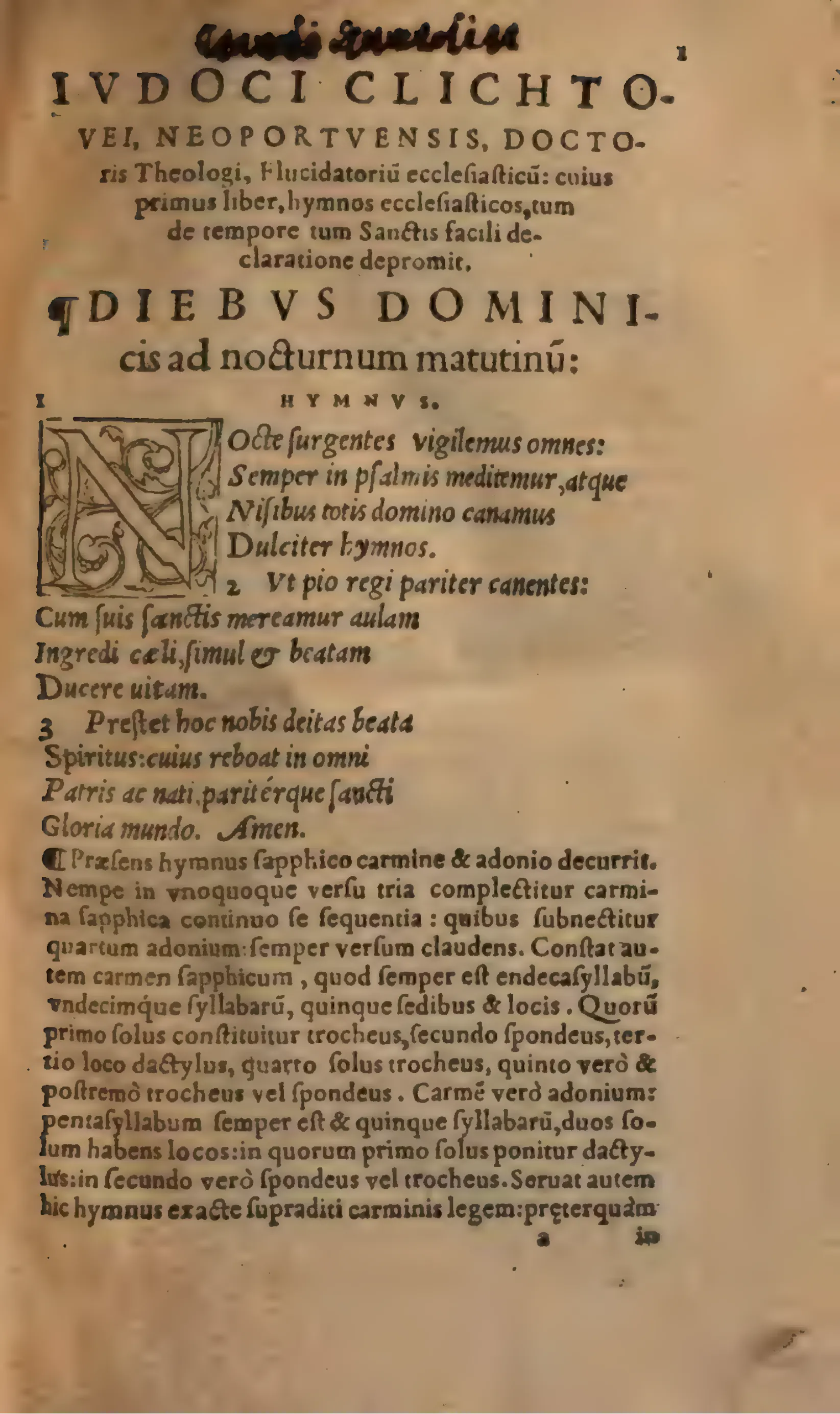
Opening Book I's hymn exposition, the italic text of "Nocte surgentes vigilemus omnes" begins with a large foliate woodcut initial before giving way to prose commentary that identifies and explains its Sapphic-Adonic meter. The page makes Clichtove's method visible at a glance: hymn, scansion, and annotation form a single apparatus for restoring Latin hymns to the discipline of classical feet rather than mere syllable counting. Source ↗.
The same metrical scrupulosity governs the Assumption hymn analyzed at length in this portion, where Clichtove diagnoses a mixed measure with a grammarian's precision. The present hymn, he notes, is modulated in a varied kind of verse — the first four lines built of three Asclepiadean cola and a Glyconic, the last five of three Sapphics and an Adonic, all of which observe their proper structure and the right disposition of feet, Præsens hymnus vario carminum genere modulatur. Nam quatuor primi versus tribus asclepiadæis carminibus constant, & quarto glyconico. Postremi vero quinque, tribus constant sapphicis & quarto adonico. Quæ omnia carmina suum contextum & rectam pedum dispositionem obseruant. Even where the verse holds, he registers a substitution — a choriamb resolving into two disyllabic feet, a spondee followed by a pyrrhic — with the exactness of one who scans before he interprets. This granular attention to the foot is not detachable from the devotional matter; it is the precondition of singing with understanding, since a reader who cannot parse the line cannot grasp what the line asserts.
That the metrical labor issues in editorial intervention against corrupt exemplars is the second face of the same programme, and this portion preserves a characteristic instance of Clichtove correcting the wording itself. On the Nativity hymn Gloriosae dominae he weighs a false quantity: the last syllable of prouide is shortened where it ought to be lengthened, so that a trochee wrongly occupies the seat a iambus should hold, and he confesses he cannot tell whether the fault belongs to the copyist or to the author, since other codices read qui te creauit vnicè, a reading that would let the verse stand and keep its proper measure — Verúm nescio an id sit vitium libra rij, an authoris ipsius, cum in aliis codicibus habeatur, qui te creauit vnicè: quod carmé staret, & rectam ipsius mensuram seruaret, quandoquide[m] producit vltimam. The reasoning is exemplary of the method: metrical failure is treated as diagnostic evidence of textual corruption, the surviving variant is adduced as the metrically sound reading, and the question of authorial versus scribal error is raised without being forced to a verdict. Here the emendatio ad limam announced in the preface is not a slogan but a demonstrated procedure, the file applied to a single displaced quantity.
Alongside emendation runs the labor of attribution, and this stretch supplies two of the work's most precise author-notices. The Eucharistic hymns Pange lingua, Sacris solemniis, and Verbum supernum are assigned without hesitation to Thomas Aquinas, whose commission from Urban IV to compose the whole Corpus Christi office has already been noted. The doctrinal payload of that attribution follows immediately, for Clichtove reads the Verbum caro of the hymn as an assertion of the Eucharistic conversion itself: the Word made flesh makes true bread into flesh, because that which before the blessing was true bread he converts into his own flesh and most sacred body, Verbum caro: fili[us] est dei factus homo: sicut ait euangelista. Verbum caro factu[m] est. Is autem verum panem efficit carnem: quia id quod ante benedictionem fuit verus panis, convertit in suam carnem & sacratissimum corpus. The elucidation of a hymn's phrasing thus opens directly onto the defense of transubstantiation, and the philological and the dogmatic are shown to be a single operation: to parse verbum caro correctly is already to affirm the doctrine it encodes.
The binding of liturgy to lived history, a strain the work's framing marks as one of its distinctive features, surfaces here in a rare eyewitness datum. Commenting on the elevation-verse of the Eucharistic office, Clichtove recalls the years when conspiring enemies rose up on every side against the most flourishing kingdom of France and strove with hostile arms to crush it, cum vndiquaque in florentissimum Galliæ regnum coniurati insurgereut hostes, & infestis armis ipsum opprimere moliretur, recording that the verse was then sung at the elevation of the sacrament throughout the realm. The note fixes the hymn's use to a datable political emergency and shows the author reading the liturgy not as a timeless text but as an instrument deployed in the wars pressing upon his own moment. The same anxiety recurs in the All Saints hymn, where the petition to drive off the gens perfida is glossed with contemporary specificity: the perfidious nation, he explains, is so called with respect to the time in which the hymn was composed, whether Saracen, Persian, or Turkish, which oppressed the worshippers of Christ with great forces and had seized the kingdoms and provinces of the faithful, Gens perfida hic dicitur, respectu illius temporis quo compositus fuit hic hymnus, siue Saracenica, siue Persica, siue Turcica, quæ Christi fidem oppugnans, atque impugnans, magnis copijs, & valida manu Christicolas oppresserat, & fideliu[m] regna atque prouincias occupauerat. The petition is read as an implored status ac tranquillitas rei Christianæ, a prayer for the peace of Christendom under military threat, so that the hagiological intercession and the geopolitical pressure of the Ottoman advance are made to speak in one voice.
The sanctoral commentary sustains the same fusion of erudite background and doctrinal exposition. The Lawrence material at the head of this portion narrates the deacon's martyrdom with hagiographical fullness — the exchange with Pope Sixtus, the demand of Decius and the prefect Valerian for the treasures of the Church, the gridiron, and the saint's final words of thanksgiving as he gave up the spirit — so that the hymn's compressed allusions become legible against the whole legend. The Marian annotations, meanwhile, show Clichtove refusing a facile reading where a subtler one is available. On the Eva / Ave motif he declines the mechanical letter-reversal that piety had made commonplace, holding that the change of Eve's name by the blessed Virgin is rather to be understood, in his judgment, according to the condition and lot of Eve, wholly changed into opposite properties through the holy Virgin, Sed mutatio illa nominis Eua à beata virgine, potius meo iudicio accipienda est secundùi códitionem & sortem ipsius Eua. The meo iudicio is characteristic: the elucidator exercises critical discretion over the received glosses, preferring a theological reversal of Eve's condition to a merely graphic play on syllables.
The doctrinal apparatus of the sanctoral hymns also carries the careful redeployment of a pagan vocabulary for Christian sanctity, most delicately in the treatment of numen. Applied to the Virgin, the word is hedged with etymology and qualification: not only angels but holy and divine men, in whom there is something of the divine, are said to have numen and are sometimes called numina, the term deriving from nuo, to nod, so that numen is as it were the nod of divinity, numen habere dici, & interdum numina appellari. Est autem numen: à nuo, is, quod nutum significat, dictumq[ue] est numen quasi diuinitatis nutus. The gloss lets a term saturated with classical polytheism be turned to the praise of Marian dignity while its sense is philologically disciplined, since the highest and first majesty resides in God alone and it is by his nutus that all things are governed. The same ordering impulse structures the exposition of the angelic host in the All Saints hymn, where Clichtove lays out the nine orders in three hierarchies after Pseudo-Dionysius — Seraphim, Cherubim, and Thrones in the supreme rank, Dominations, Virtues, and Powers in the middle, Principalities, Archangels, and Angels in the lowest — distinguished according to their diverse offices and degrees of ministry, in tres Ierarchias, quarum quælibet tres habet angelorum. Across the whole run of hymns, from the scansion of a displaced foot to the ranking of the celestial choirs, the method holds constant: the recovery of the word and the securing of the doctrine are treated as one labor, and the reader is equipped to sing each hymn with the understanding its matter demands. The sequence closes with the rubric marking the end of the collection, FINIS HYMNORVM de tempore & sanctis, as the volume turns toward its next division.
The Paschal Hymns and the Close of Book I
The material that follows falls into two adjoining but methodologically distinct movements: the close of Book I, where Clichtove's hymn-by-hymn commentary reaches the paschal hymns and then closes with a candid statement of what he has chosen not to expound, and the opening of Book II, where the exposition turns from metered hymnody to the scriptural canticles of Lauds and, with them, to a sustained typological and cosmological mode of reading. Reading across the seam, one watches the psallere sapienter programme prosecuted in two registers: the philological-metrical apparatus that governs the hymns, and the allegorical-doctrinal apparatus that governs the canticles. Both are trained on the same object — the daily texts of the Office — and both answer the same charge, that worship be understood and not merely voiced.
The paschal hymns show the annotative method at its most granular. In the Easter hymn Ymnum dicamus domino, Clichtove's Annotationes do exactly the corrective work the prefatory method had promised: he refuses a received reading and prescribes the true one, insisting that the text is not to be read deuinctc pmorte principem, vt habent codices inemendati: sed deuicta mor tis principe: hoc est deuicto & superato mortis principe, qui est diabolus, the corruption of "uncorrected copies" set against the grammatically and doctrinally sound ablative absolute. The gloss is at once philological and dogmatic: the correct case yields the correct theology, the devil vanquished as the prince of death. The commentary then unfolds each figure — the radicem serpentis read as the mortal malice of the ancient serpent whom Christ crushed by his death and resurrection — so that the emended word opens directly onto the drama of redemption. This is the layered elucidation in miniature: restore the wording, then draw out the mystery it carries.
With Venantius Fortunatus's Salve festa dies the method turns from meter to a delicate register of literal sense. Clichtove identifies the distichs of hexameter and pentameter, attributes the hymn to Fortunati episcopi, and then confronts a genuine interpretive difficulty peculiar to the paschal repertory: why these hymns, unlike those of the Nativity or Epiphany, so insistently bind themselves to the literal circumstance of the day. His answer historicizes the hymnographers' practice — the authors of the other feasts, he explains, alias solennitates non ita presserunt. Hunc autem hymnum paschalem: & alios eiusdem festi uitatis, ad ipsius diei circumstantiam & tempus, alligarut & coartarunt: ad quod & nos illos exposuimus. The remark is methodologically revealing: the expositor tailors his reading to the compositional habit of the individual author, so that exegesis follows authorship. When he glosses the gratia renascentis mundi, he permits the natural world its full presence — the reflorescence of spring, meadows greening, birds singing, the whole rerum natura renewed — before folding it into the theological reading whereby the world's vernal rebirth coincides with Christ's rising as the sol iustitiæ. The reading is careful not to let the poem's descriptive charm dissolve into allegory; the literal spring and the risen Christ are held together as concurrent, mutually illuminating.
The close of Book I is, for the study of Clichtove's method, one of the most telling passages in this stretch, because it states the limits of his own labor. Having appended a table of eight hymns whose authors are unknown — recording each under the rubric Hymnus. Author. Annus incarnat. with a conjectured year of incarnation so that, as he says, their memory not be effaced — he then declares what he has deliberately passed over: multa alia in his omnib[us] hymnis ec clesiasticis obseruatu digna, & explicanda: consulto mit timus: partim quia grammatices sunt propria, quæ hoc lo co persequi non est animus: partim ne fastidiú generaret & enormem molem, tam multarum rerum congesta simul tractatio. Two governing anxieties surface here. The first is disciplinary: matters that are grammatices propria, the proper business of the grammarian, are consciously withheld, marking a boundary between the elucidator's theological-devotional remit and the technical grammar he presupposes but declines to rehearse. The second is a concern for proportion and readerly appetite — the fear of fastidium and of an enormem molem, a monstrous bulk. The elucidation is thus explicitly self-limiting: selectivity is not neglect but editorial judgment, and the table of anonymous hymns registers the outer edge of what attribution can recover. Even where the author cannot be named, the year is supplied and the memory preserved; where the grammar is elementary, it is left to the grammarian. Book I ends with its colophon on precisely this note of a completed, bounded task, FINIS PRIMI LIBRI embracing the hymns DE tempore & sanctis.
The Scriptural Canticles of Book II
The transition into Book II changes the interpretive key entirely. The scriptural canticles do not admit metrical emendation in the manner of the hymns; they are received text, and the elucidation that suits them is historical, typological, and doctrinal. Clichtove announces the new object plainly: the first canticle to be expounded is canticum trium puerorum, qui in Babylone iussu Nabuchodonosor regis in caminum ignis ardentis coniecti sunt. What follows is a densely worked exercise in figural reading. He addresses why only three youths are commemorated when a fourth walked in the furnace, marshaling the doctors' opinions that the fourth was an angel or — the reading he himself prefers — the Son of God, and why the canticle is ascribed to the youths rather than to the far greater prophet Daniel, on the ground that the three, in their deliverance from the flames, carry a figuram redemptionis generis humani per Christum. The numerological reading is characteristic of the mode: the three youths, and the ter mille anni of humanity's captivity under sin, are made to signify the long servitude broken by the Incarnation, the millenary number taken to denote perfection and universality. The furnace itself is then read through a chain of scriptural loci — the psalm's Probasti nos deus igne, Peter's probatio vestræ fidei, and Wisdom's Tanquam aurum in fornace pro bauit electos dominus, & quasi holocausti hostiam accepit illos, & in tempore erit respectus illorum — so that fire uniformly signifies tribulation and gold the tested elect. Here the exposition presupposes, and quietly enacts, a theology of election and probation: the tribulations befall the elect not ad interitum but ad probationem, that they be at last laid up in the celestial treasury.
The verse-by-verse gloss of the Benedicite that follows is where the cosmological learning of the schools is imported wholesale into liturgical commentary. Confronted with the invitation to the heavens to bless the Lord, Clichtove supplies the full apparatus of the spheres — the seven planetary heavens, the eighth firmament of fixed stars, the ninth primum mobile — culminating in the cœlum empyreum, quod non habet motum, sed est quietum & immobile in quo est habitatio dei, & omnium beatorum. The exposition confronts the philosophical difficulty of the "waters above the heavens" directly, weighing the objections that water is heavy and corruptible while the celestial bodies are incorruptible, and resolving the tension not by natural reason but by submission to Scripture: whatever the mode by which the waters are so placed, certè fatê dum est, ita esse: quia scriptura hoc asserit. A persistent conceptual scruple governs the whole gloss. Clichtove is careful that the summons to irrational creatures — sun, moon, fire, water — to praise God not be misunderstood, since such creatures possess no reason by which they might praise; rather, they furnish to rational creatures the occasionem & materiam benedicendi deo, and are said to bless him insofar as we desire that God be praised by every creature. The grammatical exactitude of Book I persists here in a new form: he parses the alternation of Benedicite and Benedic by grammatical number, and distinguishes the two cases of dominus in a single verse, so that even in the allegorical canticle the philological instinct never quite yields the field. What unites the metered hymn and the scriptural canticle across this seam is thus a single conviction worked in two idioms — that the text sung daily must be laid open to the understanding, whether by the file that corrects a corrupted case-ending or by the figural reading that discloses in three youths and a furnace the redemption of the human race.
Witness, Relic, and the Marks of Contemporary Anxiety
The martyrological hymns to St. Lawrence make the interlocking of Clichtove's registers visible at their most granular, where the elucidation of a single hymn becomes at once a prosodic ruling, a lexical excavation, and a doctrinal deposition. In annotating the word testis, Clichtove pauses to establish an equivalence that carries the whole theology of witness: the name testis, here nominative singular joined to the verb "he speaks," means the same as martyr, and indeed conversely the Greek noun martyr is the same as the Latin testis, and martyrium is testimony — the equivalence already registered above in the discussion of the trilingual method. The grammatical observation — the case of the noun, its syntactic dependence on the verb — is not idle pedantry but the threshold across which the doctrinal point is reached: the martyr is not a passive sufferer but a legal witness whose endurance constitutes testimony, and the equivalence of the two source-languages is made to carry that theological content. The same passage supplies a companion ruling in the etymological mode, Clichtove denying that any verb laureor exists and deriving laureatus instead from the noun laurea, laureatus autem tritum & aptum nomen à nomine laurea, æ, non à verbo descendit. Here the philological correction disciplines the very language of victory in which the martyr's crown is celebrated, subordinating the hymnographer's usage to a grammarian's account of derivation. The recovery of the source-language sense is, in each instance, made the precondition of understood praise, exactly the operation the work advertises as its method.
The sequence for the Feast of the Holy Crown of Thorns anchors this same apparatus to a specific relic and a specific place, and in doing so reveals how firmly the work is planted in the devotional geography of its own moment. Having developed a chain of Old Testament figures — the ram caught in the thicket, the burning bush, the golden crowns of the Ark, table, and altar — as types of Christ's crowning, Clichtove localizes the antitype's surviving physical token: the illustrious realm of the Gauls and especially the most flourishing city of Paris preserves this treasure of the sacred crown of thorns hidden away in its royal palace, Inclyta Gallorum regio & præsertim florentissima vrbs Parisiensis: hunc sacrae coronæ spinae thesaurum conseruat in regio illius palacio reconditum. The typological exegesis that precedes the annotation supplies the interpretive frame, but the annotation itself grounds the hymn in a relic the reader could locate in the Sainte-Chapelle, so that the labor of intelligent worship terminates not in abstraction but in a concrete object of the royal cult. The rhetorical elevation of the city — florentissima, inclyta — binds the philological project to the standing of the French kingdom that housed both the relic and the press that produced the book.
The hymns for national and royal saints extend this territorial logic into a typology of apostolate. Commenting on the hymn for St. Stephen of Hungary, Clichtove constructs a parallel of regional evangelizers: just as the most sacred father Dionysius the Areopagite is called the apostle of the Gauls, and Firmin the apostle of the people of Amiens, so this blessed Stephen is rightly called the apostle of the Hungarians, Sic enim sacratissimus pater Dionysius Areopagita: Galliarum dicitur apostolus, & sanctus Firminus: Ambianensium, ita & beatus iste Stephanus: rectè dicitur Hungarorum apostolus. The gloss rests on the etymology of apostolus as "one sent," a Greek term whose sense Clichtove extends from the twelve to the founders of national churches; the effect is to place Hungary and Gaul within a single grammar of Christianization, a construction that is legible against the Franco-Hungarian diplomatic and dedicatory context in which the work was launched. The extended prose narratives attached to these hymns — the conversions, the baptisms, the royal genealogies — serve the same purpose of furnishing the singer with the historical substance the liturgical text presupposes but does not supply.
The Marian and Christological material shows the philological instrument turned upon the vocabulary of the councils. Clichtove defends the title theotocos by anchoring it in conciliar decision, reporting that it was attributed to Mary in the third universal council held at Ephesus under Pope Celestine I and the emperor Theodosius the Younger, in condemnation of Nestorius, primu[m] in tertio co[n]cilio vniuersali... celebrato apud Ephesiu[m], sub Celestino primo, summo pontifice, & Theodosio iuniore Romanoru[m] impetratore. The Greek Marian title thus carries the full weight of Christological orthodoxy, and the annotation transforms a single word of the hymn into a compressed record of the anti-Nestorian settlement, dated by Clichtove's own reckoning. Here the recovery of a source-language term and the defense of a contested dogma are indeed one labor: to sing theotocos wisely is to sing the decree of Ephesus.
The same portion carries the work's sharpest register of contemporary anxiety. Annotating a prayer against the enemies of the faith, Clichtove identifies the gens perfida of the hymn with the Ottoman power pressing upon Christendom: since the Hagarenes and Turks scorn and mock the Christian faith which they are nonetheless bound to embrace, that whole crowd is here called a faithless people, whom we ought above all to pray God to remove from the borders of believers, seeing that in this present storm it rages against us and grows strong beyond measure, Cum igitur Agareni & Turcæ aspernantur ludibrioque habeant fide Christianam ad quam tamen capessendam astringuntur... ideo omnis illorum caterua: gens perfida hic dicitur. Quam vt deus auferat de finibus credentium: vel maxime deum orare debemus quoniam hac præsertim tempestate: nimis in nos grassatur & inualescit. The loaded juridical-religious term perfidus is applied not as casual invective but with a stated rationale — the obligation to embrace the faith that the Turks are held to reject — and the temporal marker hac præsertim tempestate pulls the exegesis out of the timeless frame of hymn commentary into the immediate emergency of the sixteenth century. The prayer of the liturgy is thereby made to answer a present military crisis, and the philological identification of the hymn's referent doubles as a call to intercession.
Against this defense of the cult and its enemies, the annotations also carry passages whose emphasis falls squarely on grace. In a moment of professed humility, Clichtove urges that we hope to be saved by God's mercy alone, leaning not on trust in our own works as on a reed-staff — the passage already cited among the confessional flashpoints that make his theological location a matter of continuing debate. The image of the reed-staff — the baculus arundineus that snaps under weight — sharpens the disavowal of confidence in works, and the phrase in sola misericordia stands within a book that also mounts a vigorous defense of the saints and their intercession. The juxtaposition is not a contradiction resolved by the text but a combination held together within a wholly orthodox frame, and it is precisely such combinations that make the author's theological location in these years a matter of continuing scholarly debate.
The colophon PRIMI LIBRI ELVcidatorij Ecclesiastici: Finis marks the formal close of the treatment of hymns and the transition to Book II, which takes up the canticles. The new book opens by re-attaching each canticle to its scriptural source and to a received tradition of authorship. The Te Deum is introduced through its legendary origin, said to have been composed by the most celebrated doctors of holy church, Augustine and Ambrose, when the latter had cleansed the former with the sacred waters of baptism, Hoc canticum à celeberrimis sancte ecclesiæ doctorib[us] Augustino & Ambrosio dicitur esse copositu[m]: cu[m] hic illu[m] sacris baptismi abluisset vndis. The cautious dicitur preserves the attribution as tradition rather than asserting it as fact, a characteristic hedge in a book whose stated method is to name authors where they are securely known. To this Clichtove adds a devotional-historical anecdote binding the canticle to Eucharistic piety, reporting that St. Thomas Aquinas, distinguished for piety and religion toward God, was accustomed at the elevation of the most sacred Body of Christ in the sacrifice of the altar to recite this verse devoutly, together with those following, down to the end, dicitur sanctus Thomas Aquinas pietate in deum & religione insignis: in eleuatione sacratissimi corporis Christi in sacrificio altaris solitus fuisse hunc versum cum cæteris sequentibus ad calcem vsque deuote legere. The anecdote models the very disposition the work exists to cultivate: the text sung not with the lips alone but with the mind and heart engaged in the mystery of the altar.
The exegesis of the more difficult canticles is prefaced by an explicit statement of method and its stakes. Approaching the canticle of Habakkuk, Clichtove invokes Jewish exegetical tradition to gauge the difficulty of his material, noting that the Hebrews say there are four parts of sacred scripture more difficult to understand than the rest, whose reading ought not to be undertaken except by men advanced in age and distinguished in learning, Sanè dicunt hebræi quatuor esse partes scripturæ sacra: reliquis ad intelligendum difficiliores, quarum lectionem aggredi non debent nisi prouecti ætate viri: & eruditione insignes. The appeal to rabbinic caution both dignifies the passage and licenses the full deployment of the trilingual apparatus, and it discloses Clichtove's conviction that intelligent worship requires an interpretive competence not evenly distributed among the clergy. The Habakkuk commentary then leans on Augustine for its messianic reading, adopting the interpretation of "in the midst of two animals thou shalt be known" as meaning either in the midst of the two testaments, or of the two thieves, or of Moses and Elijah conversing with Christ on the mount, In medio duoru[m] animalium cognosceris, quid est, nisi aut in medio duoru[m] testamentorum, aut in medio duorum latronum, aut in medio Moysi & Holie cum eo in monte sermocinantiu[m]. The triple gloss shows the allegorical method at full stretch, converting a cryptic prophetic verse into a compact statement of the economy of salvation joining the two testaments, the Passion, and the Transfiguration. Embedded in this same stretch is the internal chronological reckoning — the calculation that Christ came after about 5,200 years and that 1,520 years have now elapsed since his coming — that fixes the horizon of the work's composition or revision, situating the labor of elucidation within a datable present rather than an undated commentary tradition.
The Canticles, the Canonical Hours, and the Paschal Blessings
The verse-by-verse exposition of the canticle of Habakkuk supplies the first sustained demonstration of the method in its typological register. Clichtove reads the prophet's imagery of cosmic glory as a coded proclamation of the Passion understood as triumph, so that the wood of the cross becomes not an instrument of shame but a trophy of conquest. He states the governing thesis directly, that Christ, nailed and fixed to the horns of the cross, conquered and laid low the devil and won a glorious victory over him by the shedding of his blood, quoniam ipse conclauat & affixus cornibus crucis, expugnauit ac prostrauit diabolum: præclarâmque de eo tulit victoriam effusione sui sanguinis. The martial vocabulary — expugnauit, prostrauit, victoriam — recasts the crucifixion in the register of a military rout, and the prophet's "horns" are drafted into this schema as the paradoxical weapons of the conqueror. The paradox is sharpened in the companion gloss on the hiddenness of divine power, where Clichtove explains that on the cross the Lord's strength was hidden because he did not exercise the power of his divinity against the Jews, whom he could have overthrown by a mere nod, abscondita fuit fortitudo domini, quoniâ suæ diuinitatis potestatem non exercuit in Iudæos, quos solo nutu potuisset subuertere. The restraint of omnipotence — the solo nutu, the single nod that could have destroyed — is made the very measure of the victory: strength concealed is strength perfected. The kenotic reading and the triumphal reading are thus held together rather than opposed, the concealment of power being the condition of its most complete exercise.
That same exposition discloses the supersessionist typology that runs through the canticle commentaries and becomes explicit in the treatment of the canticle of Moses. Reading Deuteronomy's rehearsal of Israel's election and ingratitude, Clichtove identifies the barren fig as a figure of the Jewish nation, explaining that by the fig is understood the nation of the Jews, figured by the fig tree in which the Lord sought fruit and found only leaves, Per sicu[m] hic intelligitur gens Iudæorum, figurata per siculneam in qua[m] dominus noster quæsivit fructum & inuenit folia tantum. The image of leaves without fruit — the outward show of the Law without its saving substance — is the typological counterpart, in the register of exegesis, to the diagnosis of liturgical recitation without understanding that animates the whole work: in both cases the outward form is present and the inner reality absent. The historical horizon of the canticle is drawn out in the same key, the destruction of Jerusalem by the Chaldeans and later by Titus figured as the punishment the prophetic song foretells.
Within these commentaries the philological temper of the enterprise surfaces even in devotional matters. Clichtove attends to a textual variant in the same canticle with a humanist's care for the wording, observing on Augustine's authority that certain codices better read "I will rejoice in God my Jesus" than those which, wishing to render the phrase in Latin, did not place the name itself, which is sweeter for us to name, Gaudabo in deo Iesu meo, quam ij, qui volentes id latinè ponere: nomen ipsum non posuerunt, quod est nobis amicitius & dulcius nominare. Here the recovery of a better reading and the cultivation of devotion to the name of Jesus are one gesture: the emended text is at once more accurate and more affecting, and the dulcius nominare makes the philological preference a matter of piety as much as of scholarship.
The exposition of the Athanasian creed concentrates the dogmatic labor that the philological method serves. Clichtove reproduces the technical vocabulary of Trinitarian and Christological orthodoxy and glosses it against the named heresies, so that the annotation is at once a lexicon and a refutation. The dogmatic core is stated in the creed's own terms, that the Catholic faith is this, that we venerate one God in Trinity and Trinity in unity, neither confounding the persons nor separating the substance, Fides autem catholica hæc est: ut unum deum in trinitate, & trinitatem in unitate ueneremur. Neque confundentes personas: neque substantiam separantes. The two verbs of error — confounding and separating — map precisely onto the two named heresiarchs, Sabellius who collapses the persons into one and Arius who divides the divine substance, so that the formula operates as a double defense holding the middle against both extremes at once. The Christological clause is handled with the same precision, the Chalcedonian formula supplying the measure of orthodoxy in the definition of Christ as perfect God, perfect man, subsisting from a rational soul and human flesh, Perfectus deus, perfectus homo: ex anima rationali & humana carne subsistens. The insistence on the anima rationalis — the rational soul as a constituent of the assumed humanity — guards against the Apollinarian truncation of Christ's manhood, and the balanced pairing of perfectus deus, perfectus homo enforces the integrity of both natures without confusion. That this dogmatic apparatus is deployed in the exposition of a liturgical text, and not in a scholastic disputation, is the characteristic move of the work: the creed is sung daily, and to sing it wisely is to grasp the anti-heretical precision its clauses encode.
The Marian canticle draws the same union of devotion and doctrine into the register of encomium. Expounding the Magnificat's language of humility, Clichtove marshals an Augustinian apostrophe that piles up the cosmic effects of Mary's lowliness, addressing that true humility which bore God to men, gave life to mortals, renewed the heavens, purified the world, and opened paradise, O vera humilitas, quæ deum hominibus peperit, vitam mortalibus ædidit, cælos innouauit, mundu[m] purificauit, paradisum aperuit. The rhetorical structure — a single abstract virtue governing a cascade of transitive verbs whose objects ascend from men to mortals to the heavens themselves — makes humilitas the pivot on which the whole economy of redemption turns, the ground of Mary's exaltation being the very lowliness the canticle proclaims.
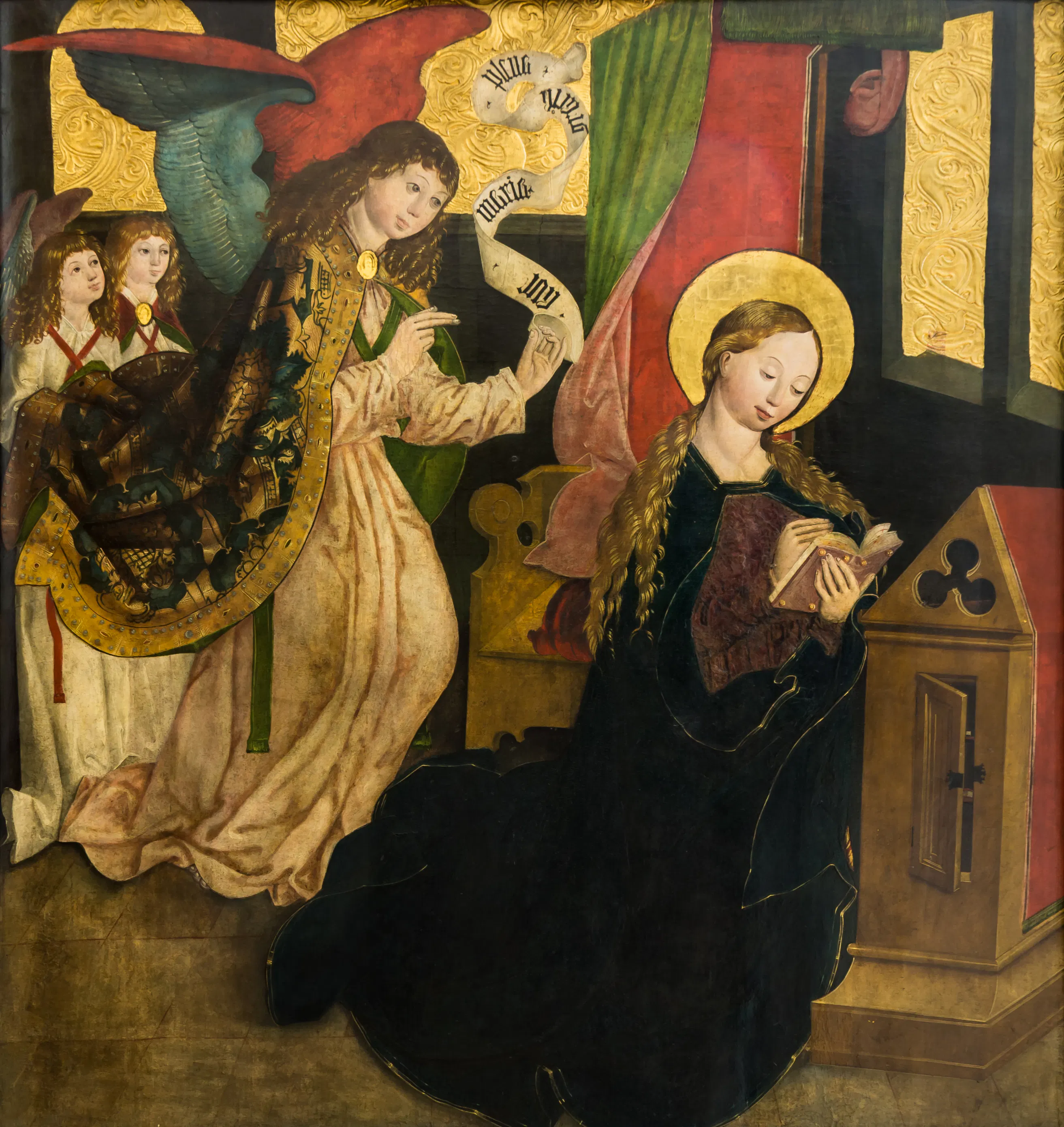
In this Annunciation panel attributed to the Master of Seitenstetten, the kneeling Virgin's stillness gives pictorial form to the humility that Marian exegesis made central to redemption. The lettered scroll and intimate interior setting evoke the devotional world in which Clichtove's commentary on Marian canticles and hymns translated inherited iconography into doctrinal praise. Source ↗.
The treatise on the canonical hours articulates the structural rationale of the Office itself. Clichtove grounds the sevenfold daily praise in the Psalmist's own words, declaring that ecclesiastical constitution has ordained a sevenfold praise to be rendered daily in the divine office, according to the prophetic word, seven times a day have I given praise to thee, seftena[m] quotidie laudem in officio divino exoluendu[m] esse: secundu[m] illud propheticu[m] verbu[m]. Here the institution of the hours is derived not from custom alone but from a scriptural pattern, the number seven furnishing the frame within which the mystical significance of each hour is unfolded. The philological method attends to the very acclamations that punctuate the Office, and the treatment of Alleluia is a model of the procedure: dissecting the Hebrew acclamation into its constituents, Clichtove derives it, as noted above among the displays of trilingual command, from halelu as "praise" and ia as a name of God. The trilingual competence on which the work insists is here brought to bear on a single word sung daily, and the recovery of its Hebrew sense is offered as the precondition of uttering it with understanding rather than as mere sound. The catalogue of ecclesiastical persons that follows extends this lexical labor into the vocabulary of status, defining with juridical exactness the categories of the faithful and the unfaithful, and framing the definition of heretics in terms that carry particular weight, as those who pertinaciously defend a position and sect contrary to the piety and rectitude of the faith, Hæretici sunt qui pietati & rectitudini fidei co[n]trariam positionem & sectam pertinaciter defendunt. The stress on pertinaciter locates heresy not in error as such but in obstinacy against correction, a distinction of enduring canonical import.
The commentary on the canticle of Moses reaches a eucharistic climax that binds the trilingual and typological methods to sacramental doctrine. Applying the Deuteronomic boast of Israel's nearness to its God against the pagan nations, Clichtove reads it as a figure of the Real Presence, declaring that there is no other nation so great that has gods drawing near to it as our God is present to us, Non est alia natio tam grandis, quæ habeat deos appropinquantes sibi, sicut deus noster adest nobis. The contrast between the deos appropinquantes of the nations and the deus noster adest nobis of the Church transfers the Deuteronomic polemic against idolatry into the sacramental register, the nearness of God in the Eucharist surpassing every proximity the pagan cults could claim.
The paschal blessings that close this portion display the same fusion of rhetorical intensity and editorial rigor. The Exultet furnishes the rhetorical summit, proclaiming that this is the night in which, the bonds of death destroyed, Christ rose victor from the dead, Hæc nox est: in qua destructis uinculis mortis: Christus ab inferis victor ascèdit. The anaphoric Hæc nox est and the triumphal victor return the paschal proclamation to the same key of hidden strength made manifest that governed the Habakkuk exposition, closing the circle of the christological reading. Yet even here Clichtove intrudes with the critical apparatus of the humanist editor. He revisits his own earlier judgment on the famous phrase, recalling — as the note on the successive printings has already shown — that in the first edition he had observed two clauses interjected in most ecclesiastical books, beginning "O truly necessary sin of Adam." This first-person return to a prior verdict marks the printed object as a revised, author-corrected text, and it exposes the labor of collation as an ongoing enterprise rather than a settled result. The same editorial vigilance governs his handling of the blessing of the font, where he corrects the received wording against Scripture, reporting that some books here, and especially the exemplar copy left with him, read "not with Dathan and Abiron," but wrongly in his judgment and faultily, Nonnulli libri hoc loco habet... vt no[n] cum Dathan & Abiron ignem tibi offerentibus alienu[m] incendamur, sed perperam meo iudicio, & mendosè. The verdict perperam meo iudicio, & mendosè shows the file at work upon the liturgy: a text sung in the solemn rites of Holy Saturday is weighed against the scriptural record and found corrupt, and the emendation is proposed on the editor's own authority against the very exemplar entrusted to him. In this convergence of the loftiest paschal rhetoric with the soberest textual correction, the double labor that organizes the whole work stands fully disclosed — the recovery of the right word and the exposition of the right doctrine treated as a single act of singing wisely.
The Canon of the Mass in Book III
The third book moves through the Canon of the Mass in the manner the whole work prescribes for every liturgical text: the words that the celebrant utters daily are not merely reproduced but laid open, so that what is sung and said becomes something understood rather than something merely performed. In this division the object of that labor is the most doctrinally freighted stretch of the entire liturgy, and Clichtove's exposition accordingly binds his philological method to the defense of contested dogma at every turn, exactly the fusion of emendation and doctrine that organizes the book as a whole.
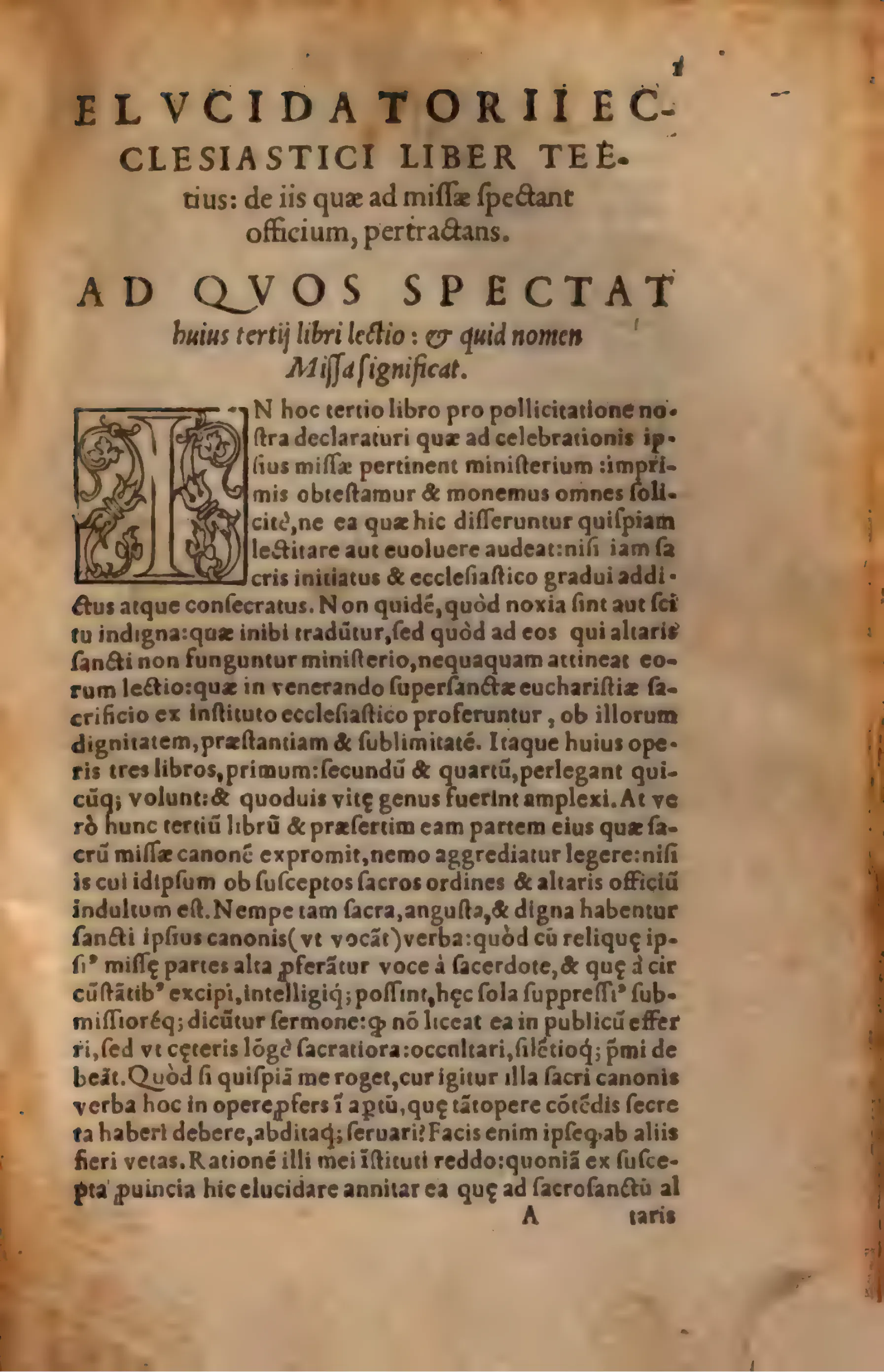
The formal opening of Book III, framed by display type and a decorated woodcut initial, marks the turn to the Canon of the Mass as both a text to be explained and a sacred action to be guarded. Its printed warning about who may read this section, followed by the derivation of Missa as officium and sacrum mysterium, makes the page a threshold between philological exposition and the sacerdotal authority Clichtove defends. Source ↗.
The exposition of the intercessory logic of the Canon establishes the frame within which the saint-lists and the prayers for the dead will be read. Clichtove grounds the petitions of the Mass in a reciprocal structure of prayer, observing that just as the scriptural petitioners once pleaded for their own, so now the faithful and devout pray for their own both by themselves and through the priest, joined to those they pray for by varied bonds of condition and kinship, Ita & modo fideles ac devoti & per se & per sacerdotem orat pro suis: varia sibi conditione ac necessitudine coiunctis. The double preposition, per se and per sacerdotem, is not incidental: it prepares the sharp distinction he will later draw between the lay and the sacerdotal modes of offering, and it establishes intercession as a structural principle rather than an occasional favor.
That principle immediately requires a defensive gloss, because the invocation of saints in the Communicantes was among the most exposed features of the Roman rite in the confessional climate of the reprints. Clichtove meets the objection with a carefully bounded formulation, insisting that the saints are not invoked as givers of the goods for which we pray, since their sole author and bestower is the Lord God, but only that they may be intercessors for us before the Lord, Non tamen inuocantur sancti tanquam datores eorum bonorum pro quibus oramus: nam illorum solus author ac largitor est dominus deus, sed vt intercessores sint pro nobis apud dominu[m]. The precision here is doctrinal engineering: by lodging causality entirely in God as author ac largitor and reserving to the saints only the office of intercession, Clichtove concedes the theological premise that would otherwise fuel the objection — that God alone gives — while preserving the practice the Canon enshrines. The cult of the saints is thus recast as an extension of the intercessory logic already established, not as a rival economy of grace.
The same defensive instinct governs his treatment of why the Canon names these particular saints and forbids the addition of others. He is willing to entertain, and by no means to scorn, the opinion that the Canon itself was composed by special divine inspiration and ordination just as it is read, Aliquorum verò sententia est haudquaquam aspernanda, ca nonem ipsum speciali inspiratione ordinationeque diuina ita vt legitur compositum esse. The appeal to inspired fixity does double work: it explains the closed character of the saint-lists and it insulates the received text against the very kind of interpolation that a proliferating late-medieval piety had encouraged. Yet the appeal to fixity is not a surrender of the humanist's critical prerogative. On a clause said to have been added by Gregory III, Clichtove exercises exactly the personal editorial judgment the work claims for itself, ruling that the particle is in his judgment rather to be omitted, as less necessary and as introducing a deformity from the common usage of the church, illa particula, à Gregorio tertio (vt ferunt) adiecta, potius meo iudicio omittenda est: tanquam minus necessaria, & inducens diformitate[m] à comuni vsu ecclesiæ. The reasoning is telling: the criterion invoked is not antiquarian recovery of an original but conformity to the comunis vsus ecclesiæ, uniformity of use, so that the file of textual criticism is here applied in the service of liturgical order rather than against it. The tension between reverence for an inspired canon and readiness to prune a later accretion is characteristic; Clichtove resolves it by making uniformity, not primitiveness, the arbiter.
At the doctrinal center of the third book stands the exposition of the consecration itself, where philology and dogma become a single operation. Clichtove fixes the moment of change with scholastic exactness, declaring — in the formulation already registered among the marks of eucharistic realism — that at the close of the utterance of the words the substance of bread ceases and under its accidental dispositions the true body of Christ is now truly and really contained. The vocabulary — the cessation of substantia, the persistence of accidentariae dispositiones, the adverbial pairing vere & re ipsa — is the technical apparatus of transubstantiation deployed without hesitation. The epistemology that this doctrine demands is then supplied through a gloss on the mysterium fidei embedded in the words over the chalice, the distinction between what is seen and what is understood already unfolded in the philological framing of the work: the appearance of wine is seen and the truth of Christ's blood is believed. This is the sacramental application of the book's governing conviction that worship must engage the intellect and not the senses alone: the same demand that the singer understand what he sings reappears here as the demand that the communicant believe what the eye cannot verify, with cernitur and intelligitur marking precisely the gap between sensory report and doctrinal apprehension.
The consecration of the cup carries with it the problem of the pro multis clause, which Clichtove resolves through the scholastic distinction between sufficiency and efficacy. Christ's blood, he holds, was not shed for all as to efficacy, being sufficient to take away all sins where it finds no obstacle of a contrary will, yet effecting salvation in the elect alone, no[n] tamen quantum ad efficaciam. Sufficiens est enim tollere omnia peccata, vbi non inuenit obstaculum contrariæ voluntatis. Efficit autem salutem in solis electis. The formulation is dense with predestinarian weight — salvation in solis electis — yet the qualifying clause, vbi non inuenit obstaculum contrariæ voluntatis, preserves a role for the resisting will and so holds the doctrine short of any strict determinism. The distinction lets Clichtove read the Canon's own wording as theologically exact rather than loose: the liturgy says pro multis and not pro omnibus because the language tracks efficacy, not sufficiency.
The intercessory frame established at the outset returns in the exposition's treatment of the dead. Clichtove marshals conciliar and papal authority to argue that the most precious blood, poured out for many unto the remission of sins, avails not only for the salvation of the living but also for the absolution of the dead, non solum ad salutem viuentium, verumeriam ad absolutionem valeat mortuorum. This closes the circle opened by the intercessory logic of the Canon: prayer through the priest, defended at the start as the mode by which the faithful plead for their own, is now shown to reach across the boundary of death itself. The reciprocity of intercession is thereby extended to the whole communion of saints, living and departed, and the doctrine of prayer for the dead is presented not as an addendum but as the necessary consequence of principles already laid down.
Underlying the entire economy of offering is a firm demarcation of who offers and in what mode. Clichtove specifies that the priests alone consecrate and alone offer, as public persons for the salvation of the whole church, the rest being said to offer only insofar as they desire and pray that the priest's oblation be accepted, Sacerdotes namque soli consecrant & soli offerunt: vt personæ publicæ pro salute totius ecclesiæ. The category of the persona publica is doing precise conceptual work: it distinguishes the sacerdotal act of consecration and oblation, which is objective and effective, from the lay participation, which is a matter of desire and prayer. This clarifies retrospectively the double preposition of the opening passage, since the per sacerdotem names the public and effective channel while the per se names the associated devotion of the laity.
The exposition of the Lord's Prayer is organized by a systematic schema that ranks the objects of petition. Clichtove maps the seven petitions onto a hierarchy of goods and evils, teaching that the greatest goods are those of eternal beatitude and glory, which are sought in the second petition, "Thy kingdom come," Maxima sunt bona æternæ beatitudinis & gloriæ, quæ secunda petione poscuntur, adueniat regnum tuum. The tripartite ranking of goods as maxima, media, and minima imposes an intelligible order on the petitions, converting a familiar sequence of clauses into a graduated theology of desire and again enacting the demand that what is recited be understood in its structure and not merely uttered.
The allegorical reading of the fraction ceremony shows the same drive toward intelligibility carried into ritual gesture. Clichtove interprets the breaking of the host into two halves as signifying the double state of the predestined pertaining to the mystical body of Christ, of which Christ himself is the head, ad significandum duplicem statum prædestinatorum ad corpus Christi mysticum pertinentium: & quorum Christus ipse est caput. The gesture is thus read as an eschatological cipher, and elsewhere in the same allegory a host-fragment is made to signify the souls purged by the fire of purgatory, so that the ceremony encodes the full range of states in the mystical body. Here the exegetical method reaches its most ambitious: not only words but movements of the celebrant's hands are treated as bearers of doctrine to be decoded.
The philological ruling on Ite missa est returns the exposition to the grammatical ground on which the whole work stands. Clichtove insists that missa ought not to be understood as a past participle, but is a substantive noun of the first declension, signifying the ministry, sacrifice, and office of confecting the Eucharist, sed primæ inflexionis nomen est substantium, significans ... ipsum altaris ministerium sacrificiumque & officium conficiendæ eucharistiæ. The parsing is not pedantry for its own sake: by ruling that missa is a noun naming the whole sacrificial office rather than a participle, Clichtove secures the very concept of the Mass as sacrificium that the preceding chapters have defended, so that the grammatical determination and the doctrinal claim reinforce one another. With this the third book closes.
The Sequences of Book IV
The opening of the fourth book turns from the Canon to the sequences sung at Mass, and it announces its method with a definition that is at once grammatical and programmatic. Clichtove explains that a prose is called loose speech, which is not constrained by the law of meter and a fixed number of feet but roams with free reins, prosa ... dicitur oratio soluta: quæ scilicet lege carminis & certo pedum numero non constringitur, sed liberis vagatur habenis. The definition establishes the classical categories — oratio soluta, lex carminis, pedum numerus — against which the medieval sequences will be measured, and the metaphor of the loosened reins, liberis habenis, carries a quiet evaluative charge: what roams free of metrical law is precisely what the humanist critic must classify and, where its versification fails, judge. The rejection of the barbarous term sequentia in favor of the properly Latin prosa is the first application of that critical standard, and it sets the terms on which the annotated sequences of the fourth book — Advent, Marian, Christmas, and the feasts of the first martyrs — will be presented and assessed.
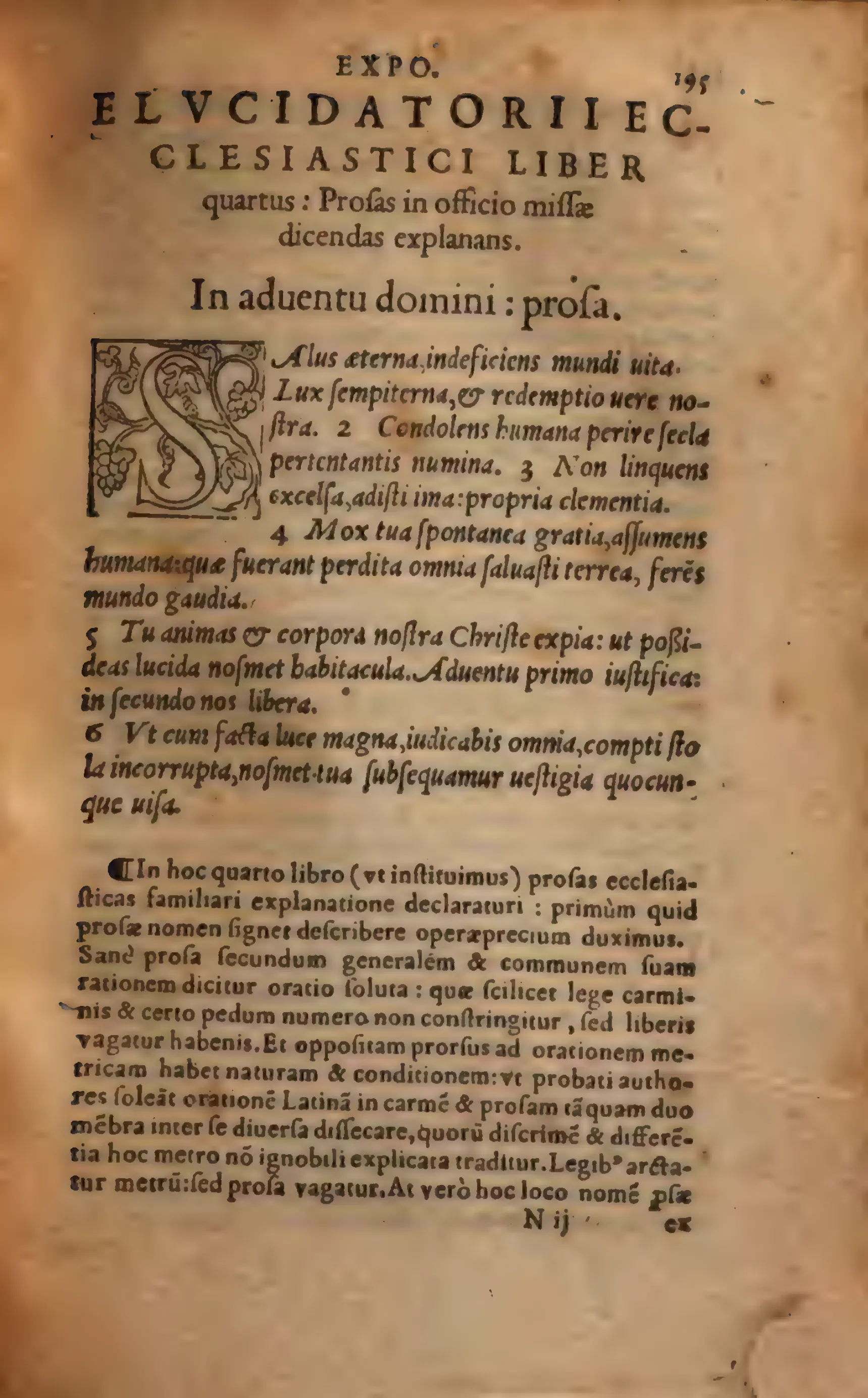
The opening of Book IV turns the Elucidatorium toward the Mass proses with a large vine-filled initial and a printed heading framing the section as an explanation of what is to be sung in the office. By defining prosa through the classical language of loose speech, metrical law, and numbered feet, Clichtove makes the page a threshold between liturgical use and humanist critique. Source ↗.
The exposition of the prosae furnishes the most sustained demonstration in the entire work of how Clichtove binds philological adjudication to doctrinal exposition, treating each sequence as a text to be restored, attributed, scanned, and dogmatically unfolded in a single continuous labor. The method is regular to the point of ritual: the sequence is printed stanza by stanza, a prose argumentum identifies its author and matter, and a series of numbered ANNOTATIONES keyed to individual verses draws out the grammatical, metrical, and theological freight of each phrase. What the section reveals is that, for Clichtove, the recovery of a corrupted word and the defense of a contested formula are not adjacent tasks but the same task under two descriptions.
Nowhere is the priority of grammar over the transmitted text more sharply visible than in his handling of a variant in the Johannine sequence. Confronted with the phrase Ioannes Christo chare, where witnesses offered both the dative Christo and the genitive Christi, he adjudicates not by manuscript authority but by the government of the adjective itself: charus takes a dative but never a genitive, since it does not pass over into a substantive noun, just as amicus, inimicus, and socius do not, Nam charus, datiuum aptè recipit: genitiuum nunquam, cum non transeat in substantiuum nomen: sicut amicus, inimicus, socius, & similes. The reading is settled by a rule of construction, the grammarian's confidence standing in for the collation of copies. The same subordination of euphony to correctness is elevated into an explicit methodological declaration, the rule already cited in the discussion of the humanist critique of the sequentiary, that all rhyme without due congruity of speech is insipid and inept, so that congruity without rhyme is to be accepted but rhyme without congruity by no means. This is the humanist critique of the late-medieval sequentiary in its most concentrated form: the accentual, rhymed verse that had displaced antique meters is measured against the standard of classical Latinity and found wanting wherever it purchases its jingle at the cost of grammar.
The attributional labor that accompanies this metrical scrutiny is grounded in concrete archival witness rather than in received tradition. Clichtove names the venerable father Adam of St Victor, whose learning and holiness adorned the observant house of St Victor in the Paris suburbs, in the notice already registered among the work's attributions. The specificity of the notice — the institution, its suburban Parisian location, its observant discipline — shows the second half of the editorial promise at work: to name authors where they are known, on evidence the author could himself inspect. The parallel ascription of Lauda Sion to Aquinas, Author eius fuisse traditur beatus Thomas Aquinas, and of Sancti spiritus assit nobis gratia to King Robert II of France, Eius author fuisse memoratur Robertus quondam rex Franciæ, extends the same recuperative discipline across the sequentiary, restoring to anonymous liturgical usage a history of identifiable composers, patrons, and houses.
Yet the section's philology is never merely antiquarian, because each restored text carries a dogmatic charge that the annotations exist to release. In the Johannine material the theme of virginity is made an epistemic privilege: Clichtove reports Bede's judgment that John by his singular privilege of chastity merited to grasp and reveal the secret of Christ's divinity more deeply than the other authors of Scripture, Idipsum & Beda perhibet dicens, quòd Ioannes singularis priuilegio meruit castitatis: vt cæteris altius scripturæ conditoribus diuinitatis ipsius Christi caperet simul & patefaceret arcanum. Chastity is construed not as an ascetic ornament but as the condition of a deeper penetration into the arcanum of the divine nature, so that the hagiographic praise-title becomes a claim about the very capacity for theological understanding. The Marian material likewise enlists natural-philosophical analogy in the service of dogma: as a crystal drenched with watery moisture and set against the sun's ray sends out sparks of fire without being ruptured or broken, so the Virgin brought forth without loss of integrity, Si (inquit) crystallus humore perfundatur aqueo, & obiiciatur radio solis: scintillas ignis emittit, absque sui tamen diruptione aut fractione. The physics of refraction is pressed into figurative service to render the paradox of the intact virginity in partu intelligible without dissolving its mystery.
The Easter sequences concentrate the section's typological and polemical energies. Expounding the duello of Victimae paschali laudes, Clichtove reads the Resurrection as a forensic contest: in the passion of Christ there was a great contest between death and life, In passione autem Christi magnum fuit certamen inter mortem & vitam. The martial figure of a duel is unpacked into the doctrine that life, though seemingly overcome, proved the stronger and seized the victory. The same block sharpens into overt polemic over the credibility of the resurrection witnesses, where Clichtove weighs testimony by a juridical maxim: to one truthful witness rather than to many liars is credence rather to be given, Sane vni veraci quam pluribus mendacibus est potius adhibenda fides. The single truthful Magdalene is set against the bribed and mendacious crowd, the philological exposition of a sequence verse thus opening directly onto the confessional defense of the Resurrection's historicity.
The doctrine of the nut governs the Christmas octave sequence and displays the tripartite allegorical schema at its most deliberate: through the whole nut Christ is intimated and represented, embracing in himself a twofold nature and in one of them enduring the bitterness of death, per totam nucem insinuatur atque repræsentatur Christus: in se vno geminam complectens naturam, & in altera earum amaritudinem mortis perpessus. The bitter shell, the protective husk, and the hidden kernel are mapped onto passion, humanity, and concealed divinity, so that a homely natural object is made to carry the Chalcedonian formula of two natures in one person. The convergence of botanical figure and dogmatic precision is characteristic: the sequence supplies the image, and the annotation supplies the doctrine the image was always meant to encode.
The Eucharistic and Trinitarian sequences bring the section's dogmatic ambition to its highest pitch, and here the philological register recedes before the exposition of contested formulae. From Lauda Sion Clichtove draws the concise statement of concomitance, that flesh is the food and blood the drink, yet Christ remains whole under either species — the verse already cited among the affirmations of eucharistic realism — and the closely related Thomistic doctrine that the fraction of the host divides only the species: when the sacrament is at last broken, one must not waver but remember that there is as much under the fragment as is covered by the whole, Fracto demùm sacramento, Ne uacilles, sed memento Tantu[m] esse sub fragmento: Quantum toto tegitur. Both passages enact the sacramental application of the work's governing distinction between what is perceived and what is understood: the senses register the broken species, but faith registers the undivided body. The Trinity sequences carry a corresponding safeguard against modalism, insisting that the sequence's language of three names not be misread: this is not to be so taken as though in the most holy triad there were only a trinity of names, without any distinction or difference of persons, Nô hoc ita accipiendum, quòd in supersancta triade, sola nominu[m] sit trinitas, sine aliqua personarum distinctione aut differentia. The danger is named explicitly as the heresy of Sabellius, and the positive doctrine is supplied through the scholastic enumeration of notional properties, the Son having generation in that he is begotten by the Father alone, Filius gignentiam siue nascetiam habet quòd à patre solo sit genitus. That a commentary on a rhymed liturgical sequence should reach for the technical apparatus of relative versus substantial predication measures how thoroughly Clichtove treats the sung text as a vehicle of precise dogma.
The trilingual method that organizes the whole work surfaces here in the onomastic exposition of the Ascension sequences, where the Hieronymian technique of interpreting Hebrew names is applied to Christ: Iedithun is worth as much as "leaping" or "leaping across them," Idithu[m] tantundem valet atque saliens vel transiliens eos, the etymology supplying the very figure of the Ascension as a transcending leap. The section closes on the ecclesiology of the Dedication sequences, where the Church on earth is declared both mother and virgin, Ecclesia Christi in terris degens: & mater dicitur & virgo — mother because through the regeneration of baptism she begets spiritual offspring, virgin because that offspring is born of God rather than of the flesh. The paradox recapitulates in ecclesiological terms the same Marian figure of fecundity without corruption that the crystal analogy had earlier served, binding the section's beginning and end in a single conception of intact generation. Throughout, the discipline is constant: the sequence is restored by grammar, attributed to its author, scanned against the standard of classical measure, and made to yield the typological, sacramental, and Trinitarian doctrine it carries — so that to sing these prosae wisely is, in Clichtove's practice, to sing them corrected, attributed, and understood.
Frequently Asked Questions
What is Josse Clichtove's Elucidatorium ecclesiasticum?
The Elucidatorium ecclesiasticum is a four-book Latin manual for the whole Divine Office and the Mass, first printed in Paris at the press of Henri Estienne in late 1515 or early 1516. Its guiding conviction is that the Church sings its daily hymns, canticles, sequences, and prayers without understanding them. Clichtove lays each text open through humanist textual criticism, metrical scansion, and Hebrew–Greek–Latin philology, restoring corrupted wording, naming forgotten authors, and drawing out the doctrine each text carries — always in the service of a sharper orthodoxy.
Who was Josse Clichtove?
Josse Clichtove (Jodocus Clichtoveus, c. 1472–1543) was a Flemish theologian trained at Paris and the most industrious literary associate of Jacques Lefèvre d'Étaples, around whom a circle of humanist reformers gathered before the evangelical rupture at Meaux. He functioned less as an original speculative thinker than as one who translated Lefèvre's philological programme into pastoral and scholastic theology. After the condemnation of Lefèvre's Psalterium in 1521, he broke decisively with the evangelical movement, later turning against Luther in the Antilutherus (1524) and the Propugnaculum ecclesiae (1526).
What does the phrase psallere sapienter mean in the Elucidatorium?
Psallere sapienter — "to sing wisely" — is the Pauline charge, drawn from 1 Corinthians 14:15, that organizes the entire work. It means praising God with the mind as well as the spirit: recovering the literal and historical sense of the liturgy, emending corrupted hymns and sequences against manuscript witnesses, and defending quantitative Latin prosody. Its negative image is the cleric who rattles sacred songs on his lips but holds no understanding of them in the heart. The whole apparatus of emendation, attribution, scansion, and doctrinal annotation exists to turn rote recitation into intelligent devotion.
How does the Elucidatorium respond to the Ottoman threat and the wars of its time?
The work is unmistakably planted in its own moment, praying against advancing Ottoman power. Annotating a prayer against the enemies of the faith, Clichtove identifies the gens perfida of the hymn with the Hagarenes and Turks who scorn the Christian faith, urging that God be prayed to remove them from the borders of believers, "seeing that in this present storm it rages against us." He recalls, too, the years when conspiring enemies pressed upon the kingdom of France, and dwells on the Crown of Thorns preserved in the royal palace at Paris.
Is there an English translation of the Elucidatorium ecclesiasticum?
No modern English translation has been identified; the work was composed in Latin and, apart from an early-modern French paraphrase said to have circulated in manuscript within the Meaux circle, appears never to have been rendered into a modern vernacular. Separately, the Leo edition presents the full transcription together with a complete English translation, generated by artificial intelligence. Leo is an effort to make freely available online, at no cost, English translations of every text printed in Latin in early modern Europe between 1450 and 1750.
This report was generated by an advanced AI assistant that conducted deep research alongside an extensive interpretation of the transcribed original text. Every effort has been made to preserve fidelity to the source and to guard against inaccuracy, but corruption in the text recognition process and model hallucination may nonetheless have entered the text. Treat every claim, quotation, translation, and citation as provisional, and verify each against the original source before relying on or citing it.
Bibliography
- Bedouelle, Guy, Lefèvre d'Étaples et l'intelligence des Écritures: Places the Elucidatorium squarely within Lefebvrist ad fontes humanism and traces the philological method Clichtove applied to liturgical texts. The work's own trilingual practice — its recovery of the Hebrew sense of pascha as transitus, its parsing of Alleluia, its derivation of martyr from the Greek testis — exemplifies precisely the method this study traces.
- Delhaye, Philippe, "L'Enseignement de la théologie morale au début du XVIe siècle: le cas de Josse Clichtove," Recherches de théologie ancienne et médiévale: Locates the Elucidatorium within the early-modern Catholic moral-theological tradition and against the evangelical current with which Clichtove later broke. A useful corrective to any reading that would pull the work toward the Reformation, it fixes Clichtove firmly on the far side of the confessional divide.
- Hedwig, Klaus, Sakramentensprache und sakramentale Theologie bei Josse Clichtove: The only sustained treatment of Clichtove's sacramental theology, with extensive discussion of the Eucharistic and Marian chapters of the Elucidatorium. Its concerns bear directly on the work's exposition of the mysterium fidei, of transubstantiation and concomitance, and of the distinction between the sufficiency and the efficacy of Christ's blood — Clichtove holding that as to sufficiency the blood was shed for all, but not as to efficacy, since it effects salvation in the elect alone, no[n] tamen quantum ad efficaciam. Sufficiens est enim tollere omnia peccata, vbi non inuenit obstaculum contrariæ voluntatis. Efficit autem salutem in solis electis.
- Massaut, Jean-Pierre, Josse Clichtove: l'humanisme et la réforme du clergé: The foundational biographical and bibliographical monograph; situates the Elucidatorium within Clichtove's reform programme and remains indispensable for any serious study. Massaut's insistence that Clichtove was a reformer from within, not a crypto-Protestant, still sets the terms every subsequent reader must argue with.
- Oosterhoff, Richard J., Faber Stapulensis and His Circle: The Early French Reformation: Recent synthetic reassessment of the Lefebvrist circle that reads the Elucidatorium as a hinge text between Erasmian humanism and the early evangelical movement at Meaux. It sharpens Massaut's reading by pressing the question of how methods loyal to Rome could nonetheless furnish tools the Reformation would take up.
- Wiley Online Library, "Students of History, Masters of Tradition: Josse Clichtove," Renaissance Studies: A focused study of how Clichtove positioned himself as heir to and custodian of tradition, engaging Massaut's revisionist verdict directly and largely endorsing it. Consult it to see how the "reformer from within" thesis has fared in the most recent journal literature.