The Debunker of Saints and the Ointment-Bearer of Ephesus: Jean de Launoy's An Inquiry into the Inquiry Concerning Mary Magdalene as a Newcomer to Marseille
In 1643 the Sorbonne doctor Jean de Launoy — the Norman critic contemporaries nicknamed le dénicheur de saints, "the debunker of saints" — published the Disquisitio disquisitionis de Magdalena Massiliensi advena, a page-by-page demolition of the Jesuit case that Mary Magdalene had sailed to Provence, evangelized Marseille, and died in the grotto of La Sainte-Baume. Working from a single controlling axiom — that the earliest witness wins and recent testimony without ancient warrant deserves contempt — Launoy convicts the Provençal cult of resting on forged chronicles and pious wishful thinking, and marshals Greek and Byzantine sources for a rival burial at Ephesus. The result is one of the founding documents of critical hagiography, a forensic instrument in the long quarrel over how historical truth is to be weighed against sanctified tradition.
ExLatinis
July 24, 2026
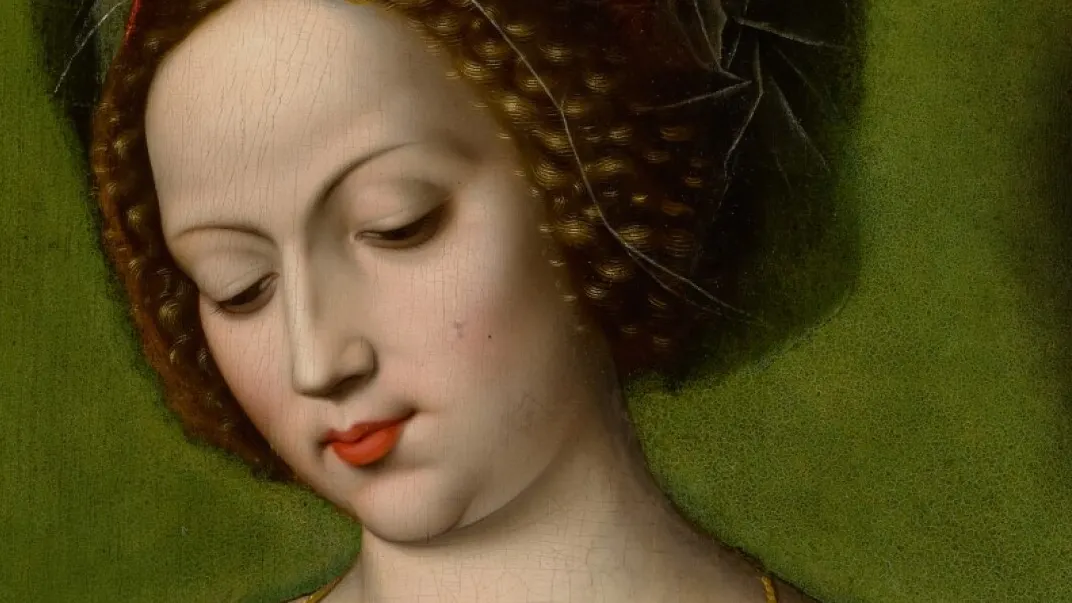
In 1643 the Sorbonne doctor Jean de Launoy — the Norman critic contemporaries nicknamed le dénicheur de saints, "the debunker of saints" — published the Disquisitio disquisitionis de Magdalena Massiliensi advena, a page-by-page demolition of the Jesuit case that Mary Magdalene had sailed to Provence, evangelized Marseille, and died in the grotto of La Sainte-Baume. Working from a single controlling axiom — that the earliest witness wins and recent testimony without ancient warrant deserves contempt — Launoy convicts the Provençal cult of resting on forged chronicles and pious wishful thinking, and marshals Greek and Byzantine sources for a rival burial at Ephesus. The result is one of the founding documents of critical hagiography, a forensic instrument in the long quarrel over how historical truth is to be weighed against sanctified tradition.
In the spring of 1643, a doctor of the Sorbonne named Jean de Launoy (1603–1678) — a Norman from Coutances, socius of the Collège de Navarre, and a scholar whose relentless scrutiny of ill-founded cults would earn him from contemporaries the sobriquet le dénicheur de saints, "the debunker of saints" — issued a slender octavo at Paris with a title of studied provocation: Disquisitio disquisitionis de Magdalena Massiliensi advena, an inquiry into an inquiry concerning Mary Magdalene as a newcomer to Marseille. The doubled noun is not accident but program. Launoy's book is a forensic dismantling, page by page, of a work published only the year before: the Jesuit Jean-Baptiste Guesnay's defense of the tradition that Mary Magdalene had come as an advena — a latecomer, a foreign resident — to Provence, evangelized Marseille, and ended her days in the grotto of La Sainte-Baume, her relics resting at Saint-Maximin. Against this the tract sets a rival account, inherited from the Christian East, in which the Magdalene died and was buried at Ephesus.
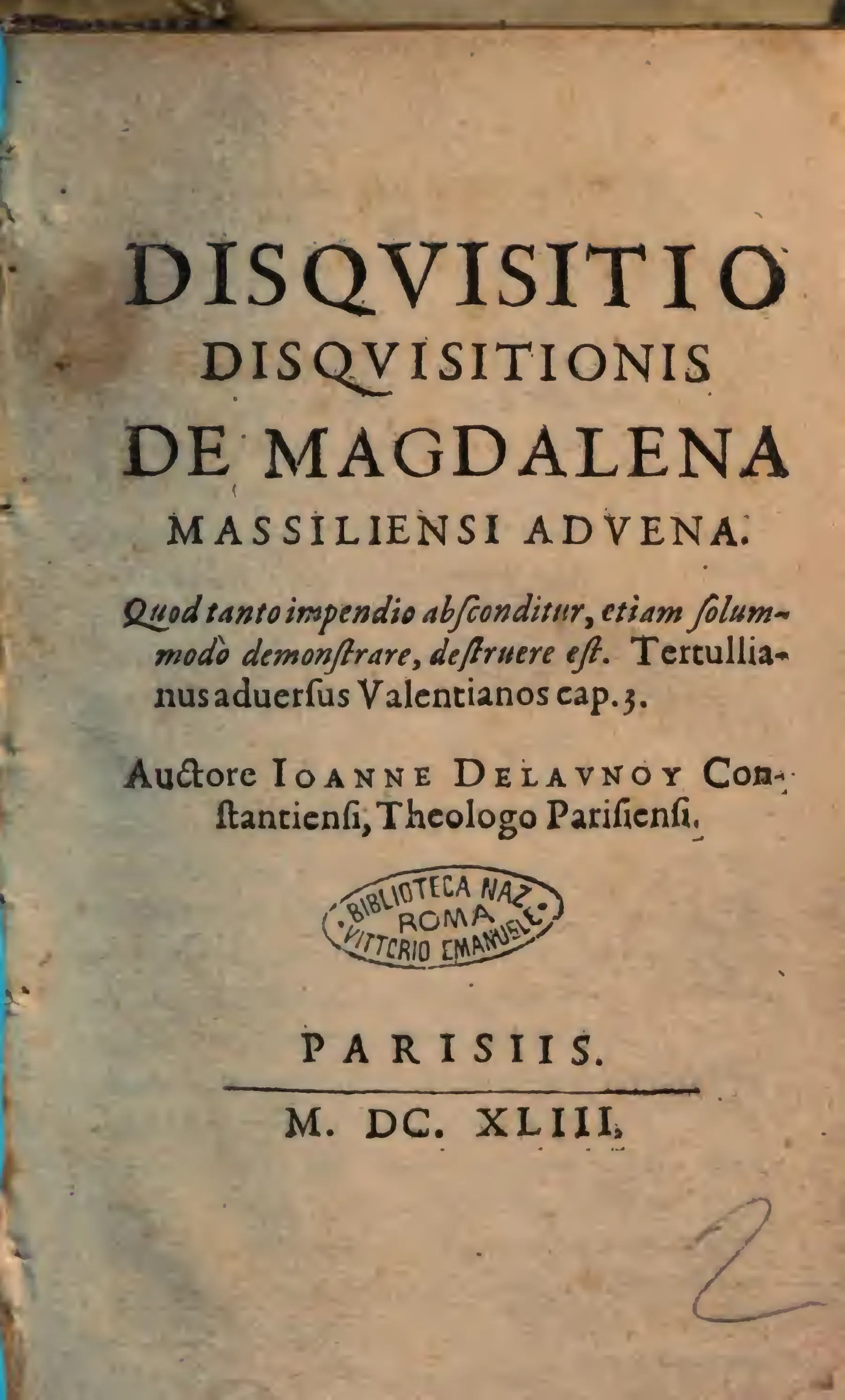
Launoy's 1643 title page makes the polemic visible before the argument begins: the doubled "Disquisitio disquisitionis" casts the book as an inquiry into Guesnay's inquiry, while "Massiliensi advena" fixes the contested claim that Mary Magdalene was a newcomer to Marseille. The austere Paris imprint without a named printer, the Tertullian epigraph, and the Roman library stamp register both the tract's appeal to primitive authority and the copy through which it survives. Source ↗.
At the center lies a problem of evidence rather than piety: by what standard does one adjudicate a contested claim about Christian antiquity when the parties agree on almost no common witness? Launoy's answer is a single controlling axiom, the principle of documentary priority, or vetus traditio — that what is handed down earliest is true, and that recent testimony unsupported by ancient authority is, in his own uncompromising formulation, to be held in contempt. From this axiom the whole edifice descends. He catalogues what he takes to be his adversary's bad-faith citations under the juridical charge of mala fides; he exposes forged chronicles and diplomas; he presses the argument from the silence of the earliest Provençal witnesses; and he assembles Eastern and Byzantine authorities for the burial at Ephesus. The refutation is marshalled with a moralist's architecture, organized around four vices — audacity, ignorance, calumny, and dissimulation — that he charges combined to build the tradition he attacks.
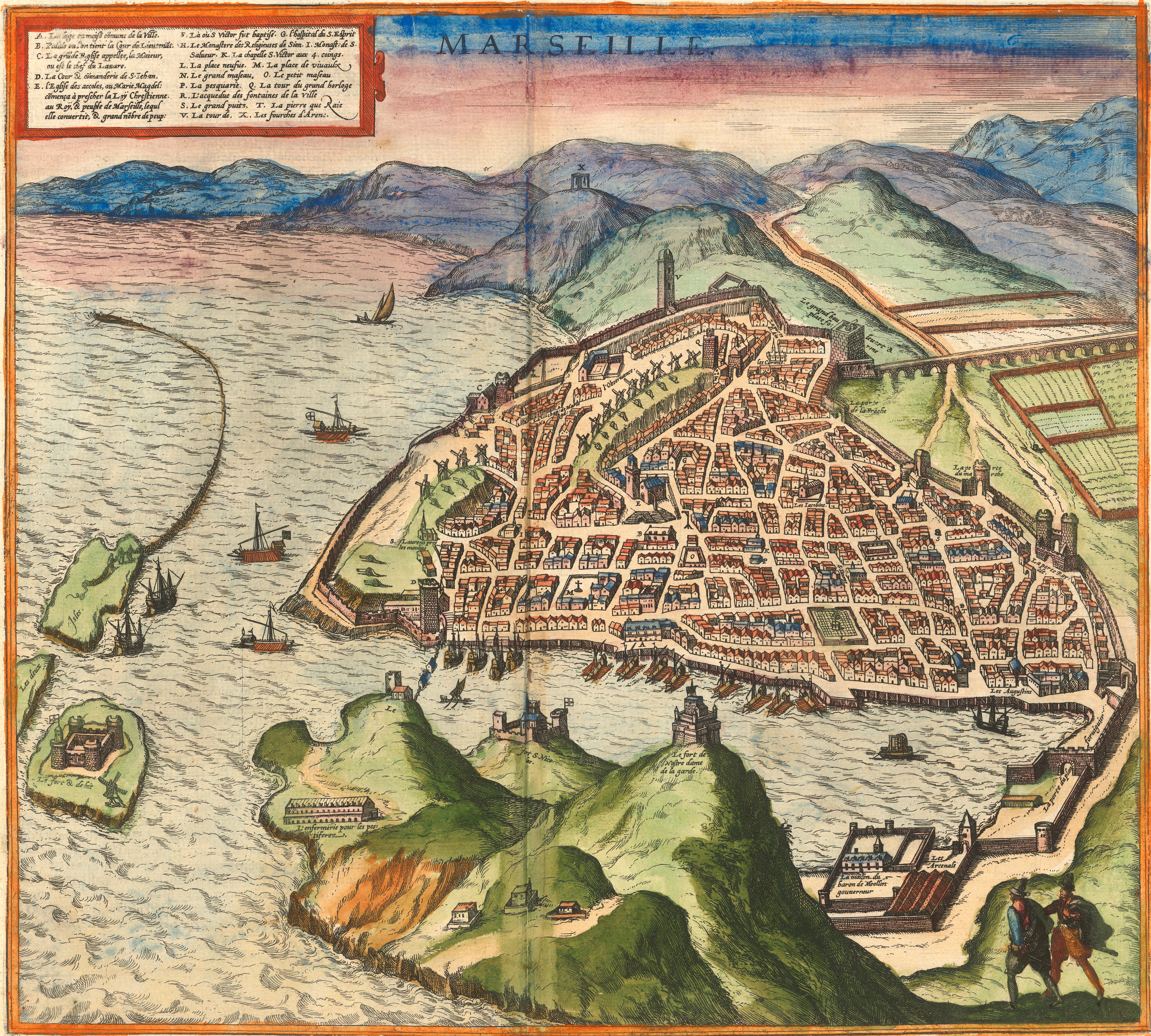
Braun and Hogenberg's engraved view of Marseille situates the controversy in the urban and ecclesiastical landscape Launoy scrutinized: the harbor city is mapped with a printed key that marks a site tied to Mary Magdalene's local cult. Against Launoy's demand for documentary priority over late Provençal testimony, the view shows how visibly that tradition could be embedded in the city's devotional self-representation. Source ↗.
The stakes of so technical a quarrel were considerable, and they reach well beyond the fate of one Provençal shrine. To subject a venerable local cult to source-criticism in 1643 was to enter the confessional and institutional battles of the age at once: the Jansenist preference for primitive testimony over medieval accretion, the Gallican wariness of Roman and Ultramontane hagiography, and the new critical erudition of the Bollandists and Maurists whose diplomatic and chronological apparatus Launoy's polemic presupposes. Launoy himself raises the confessional temperature deliberately, arguing that to credit the late-antique witness of Rufinus of Aquileia on the Provençal cult is to imperil the very Old Testament books whose canonical standing the Council of Trent had lately reaffirmed — a maneuver that binds a dispute over relics to the integrity of the Tridentine canon.
What makes the tract memorable, beyond the ferocity of its method, is the concreteness of its demolitions. Launoy names his forgeries: the pseudo-Dexter Chronicum, the Chronicon attributed to Julianus, a suspect diploma of Benedict IX. He mocks his opponent with loaded epithets, branding the defender of relics a Lipsanomastix, a "relic-flogger." He deploys the silence of Cassian, Salvian, Eucherius, and Proculus of Marseille as positive evidence that the earliest Gallic church knew nothing of apostolic founders on its soil. And he closes with a documentary appendix of Vézelay materials — papal bulls and royal charters — that folds the rival French burial claim into his dossier. Woven through the argument is a sociological intuition about how such traditions arise at all: that a "lying rumor," once begun, comes in time to occupy the seat of truth, because men find what they wish to find.
The account that follows treats the work's philological framing, its place in the history of critical hagiography, its textual and material history, and its reception, drawing throughout on the Latin text itself. Certain matters remain genuinely uncertain: the detailed reception of the tract within Provençal ecclesiastical circles is thinly documented, and the precise channel by which it entered the Bollandist response survives largely in unpublished working papers. Where the evidence is thin, it is marked as such. What is not in doubt is that this small, unillustrated polemic became a durable instrument in the long contest over how historical truth is to be established against pious tradition.
Read the full text and English translation on Leo
This text was transcribed and translated as part of the ExLatinis project, an effort by Leo to make free English translations of every text published in Latin in early modern Europe (1450–1750) available online. The complete transcription and English translation of this work can be read free of charge:
→ Read the original Latin text and full English translation on Leo
You can save a copy of this document into your Leo account to run deep text searches, conduct further analysis, or cross-reference it with your own research.
Reading the Title: Launoy's advena and the Principle of Ancient Transmission
An Inquiry into the Inquiry Concerning Mary Magdalene as a Newcomer to Marseille [Editorial title supplied for convenience; no established English rendering exists in the historiography.]
The title itself encodes the polemical architecture of the entire tract. Disquisitio signals a methodical inquiry into prior inquiry: a forensic examination of the Jesuit Father Jean-Baptiste Guesnay's defenses and, by extension, of the Provençal ecclesiastical tradition those defenses sustain. The morphologically distinct phrase Massiliensi advena — "an advena in respect of Marseille" — encodes the central claim of the work. And the paratextual attribution auctore Ioanne Delaunoy Constantiensi identifies the author geographically (Coutances in Normandy) and corporately (Paris, Collège de Navarre, of which he was a socius).
The word advena is the lever upon which the whole controversy turns. In classical and late-antique usage it signifies "one who has arrived from elsewhere," "a newcomer," or, in the juridical register that Launoy deploys, "a foreign resident" as distinct from a civis natus or incola of long standing. Etymologically composed of ad- + venire, it carries a stronger connotation of recent arrival than the cognate peregrinus (foreign/alien), and it is precisely this nuance Launoy exploits: the Provençal tradition did not simply assert that Mary Magdalene was a foreigner but specifically that she arrived in Gaul as a latecomer in the apostolic age, taking up residence in a land already evangelized, or claiming to evangelize, by earlier hands. To convict the tradition of late invention, Launoy had therefore not only to prove that no ancient witness attested the apostle's Provençal sojourn but positively to show that she was a late arrival — an advena — within the post-apostolic traditio, not an indigenous founder of the Gallic church. The polemical force of the term thus depends on distinguishing late documentary attestation from authentic primitive tradition.
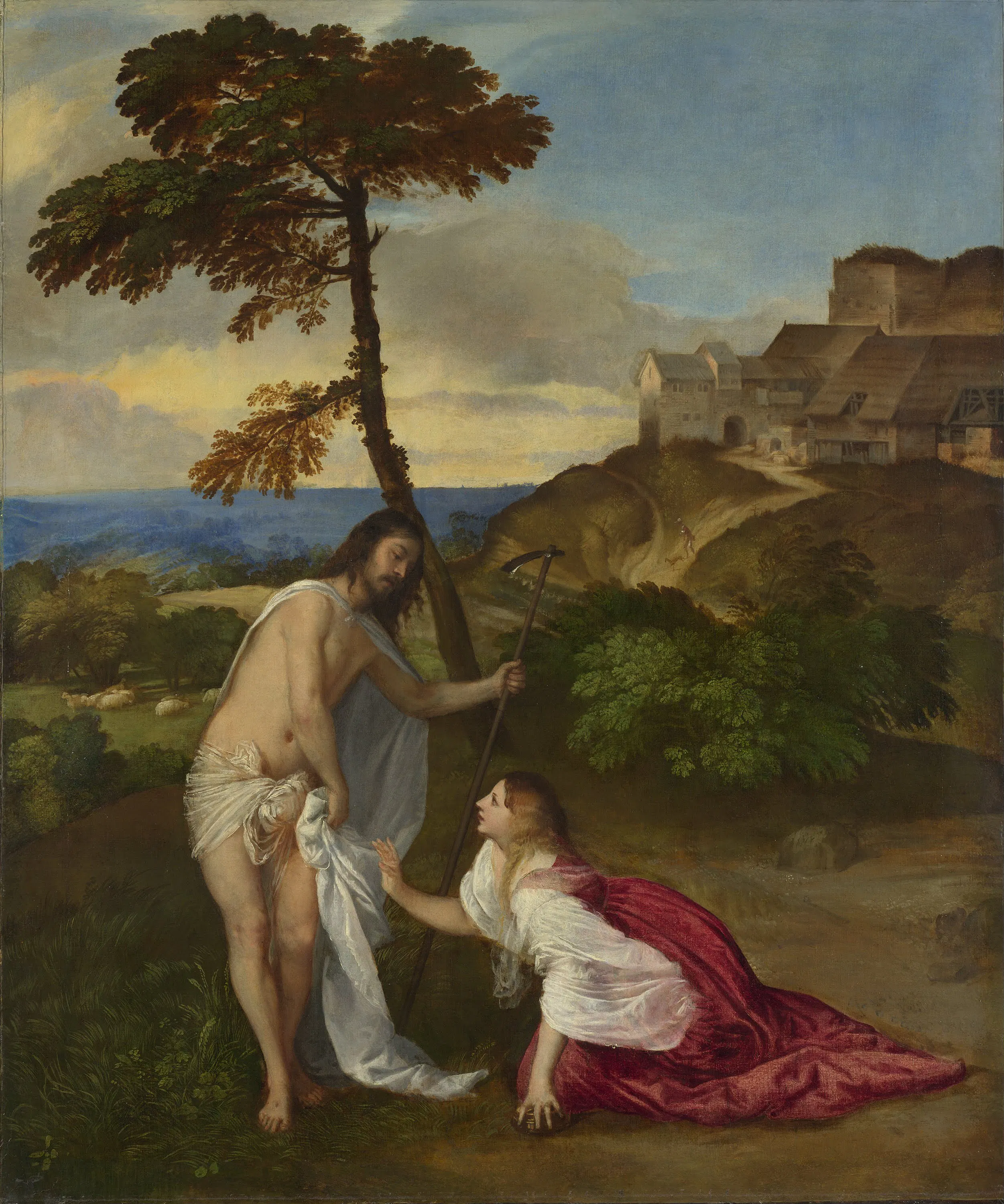
Titian's early-sixteenth-century Noli me tangere anchors Mary Magdalene in the Gospel scene that secured her scriptural identity, long before later traditions extended her story into apostolic Gaul. That gap between recognized biblical witness and contested post-apostolic biography is precisely where Launoy's charge of advena—a late-arriving figure in tradition rather than an indigenous founder—draws its polemical force. Source ↗.
Complementary to this, Launoy invokes the principle of vetus traditio — ancient transmission — as the test of authenticity: what is handed down from antiquity is presumed true; what is interpolated or inserted late is presumed foreign and false. He states the axiom in almost lapidary terms, that that is true which was handed down earlier, but that is foreign and false which was inserted later, id esse verum, quod sit priùs traditum, id autem extraneum & falsum, quod sit posteriùs immissum, and he braces it immediately with Tertullian's dictum that truth's ready virtue is content with few things and that against the many things falsehood requires, few defenses suffice, Expedita virtus veritatis paucis amat, & aduersus multa, quæ mendacio necessaria sunt, pauca defendunt. The negative corollary of the same principle governs the treatment of recent testimony: whatever is put forward by a more recent author about matters so ancient, without the authority of some older source, is held in contempt, quod à recentiore auctore de rebus adeo antiquis sine alicuius vetustioris auctoritate profertur, contemnitur. This principle, traceable to the humanist philological tradition and codified in Bollandist and Maurist method, governs his treatment of the Pseudo-Isidorian and Pseudo-Dexterian chronicles that he argues fabricated the Provençal apostolate. The principle is articulated on the title page itself through the contrast between disquisitio (rigorous inquiry) and the slighter disquisitionis (the prior defective inquiry being examined); the morphological distinction conveys Launoy's contention that Guesnay's disquisitio failed to apply the very standard of ancient transmission that a true inquiry demands.
The same philological apparatus extends to Launoy's taxonomy of scripture, on which the confessional stakes of the work partly rest. He distinguishes three ranks of books, those of the first kind held canonical, those of the second hagiographa, those of the third truly apocrypha, primi enim generis libri sunt qui Canonici consentur, secûdi generis Hagiographi, tertij verò Apocryphi — a tripartite scheme that lets him press the point of documentary priority into the domain of the biblical canon itself.
Finally, the juridical-philological charge of mala fides — bad-faith citation — is raised implicitly by Launoy throughout the work whenever he encounters citations of patristic or medieval sources that misrepresent their tenor, suppress inconvenient evidence, or forge composite readings. He does not always leave the charge implicit: where he judges his adversary to have misrepresented the burial testimony, he escalates it openly, insisting that here the man not only acts in bad faith but most audaciously lies, given that Modestus of Jerusalem, Gregory of Tours, and others attest the Ephesian burial, sed etiam audacissimè mentitur, cùm Modestus Hierosolymorum Episcopus, Gregorius Turonensis, & alij. The charge is the organizing juridical analogue of the philological argument: just as Launoy distinguishes vetus traditio from late interpolation, so he distinguishes the honest transmission of sources from their disingenuous manipulation. Mala fides is thus not a marginal accusation but the structuring moral correlate of his source-criticism, and it is what gives the Disquisitio its polemical edge against Guesnay and the wider Provençal ecclesiastical establishment.
What the Disquisitio Argues: Launoy's Case Against the Provençal Cult
The work under examination is the Disquisitio disquisitionis de Magdalena Massiliensi advena (Paris, 1643) of Jean de Launoy (Joannes Launoius, 1603–1678), doctor of the Sorbonne and socius of the Collège de Navarre, the French ecclesiastical historian known to contemporaries and posterity as le dénicheur de saints for his systematic critical scrutiny of poorly attested hagiographic traditions. Printed as an octavo of roughly ninety-five pages, it appeared the year after the Jesuit Father Jean-Baptiste Guesnay's Disquisitio historica de Magdalena Massiliensi advena, the defense of the apostolic foundation of Provence and of the late-antique legends binding Mary Magdalene to Marseille, Saint-Maximin-la-Sainte-Baume, and the grotto of La Sainte-Baume that it methodically refutes.
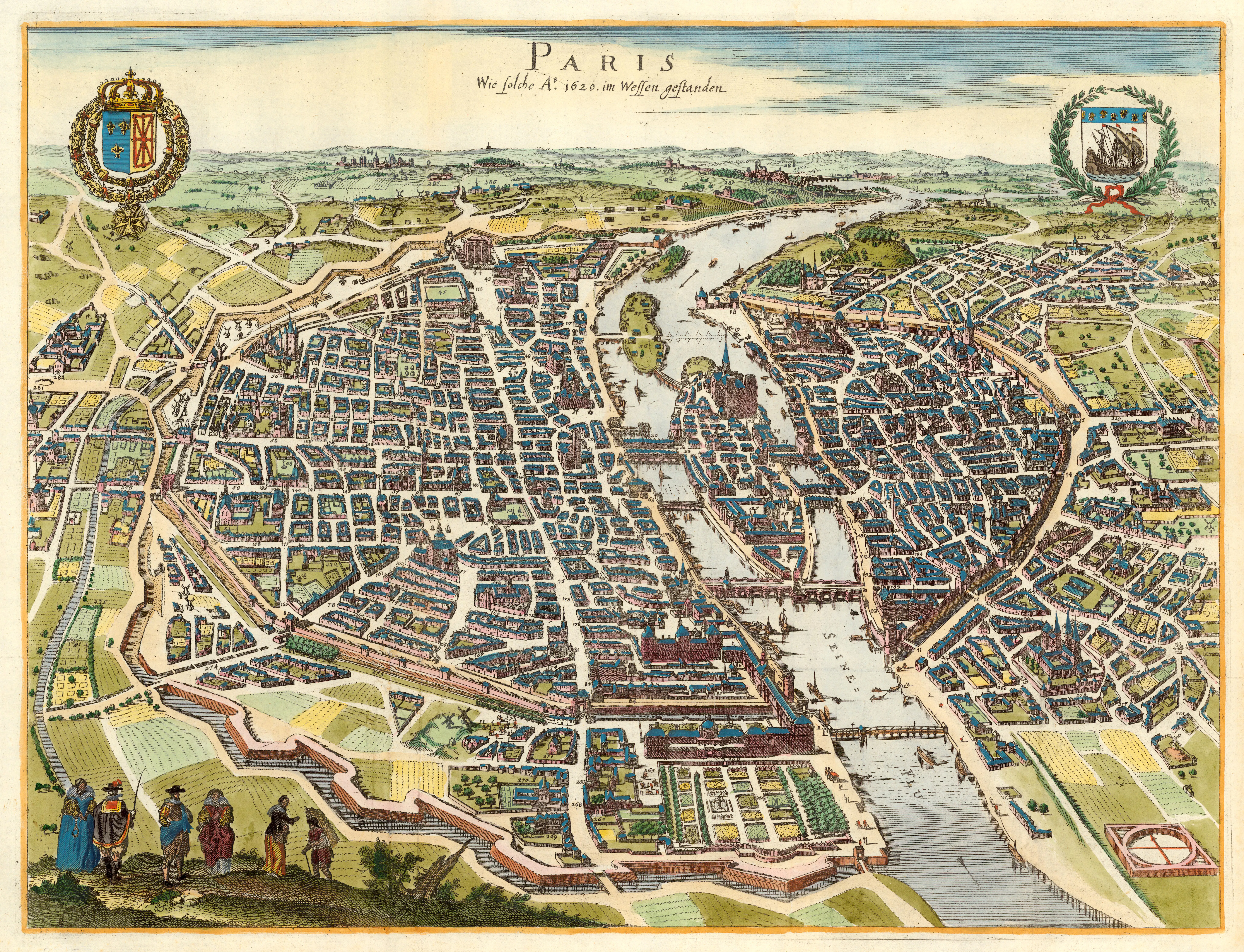
Caspar Merian's mid-seventeenth-century bird's-eye view evokes the Paris in which Jean de Launoy worked: a dense university and ecclesiastical city whose Sorbonne and Collège de Navarre framed the polemical scholarship behind the 1643 Disquisitio. Though not an image of Launoy's tract or of the Magdalene controversy itself, the panorama situates his attack on Provençal hagiographic tradition within the institutional world of Parisian theology and print. Source ↗.
The text is a point-by-point polemical disquisitio disquisitionis — a forensic examination of a prior inquiry — in which Launoy argues that no ancient witness places Mary Magdalene in Gaul, that the Provençal apostolate and the relics of Saint-Maximin are late inventions unsupported by patristic testimony, and that the older Eastern tradition locating her burial at (or near) Ephesus alone is supported by primitive evidence. Launoy signals from the outset that the task is thankless in its very abundance, conceding that the work is easier to begin than to finish because on whatever page one lights, something at once presents itself for reproof, VIVS operis, quod aggredimur, erudite Lector, longè difficilius est exitu[m], quàm principium inuenire. In quamcumque enim paginam incidas, statim occurrit, quod reprehendatur, and he frames the entire indictment around the charge that audacity, ignorance, calumny, and dissimulation combined to construct the tradition, ad illam constituendam audacia, ignorantia, calumnia, & dissimulatio cõtendisse videantur. He further argues that the argument from the silence of the Fathers — argumentum ex silentio patrum — is, in this case, decisive against the Provençal tradition. A subsidiary polemical thread contends that crediting Rufinus of Aquileia's late-antique testimony on the Provençal cult endangers the deuterocanonical status of certain Old Testament books reaffirmed by the Council of Trent, since Rufinus' biblical canon is the very list whose apocryphal status Trent had recently reaffirmed; Launoy makes plain that he means no such thing on his own account, protesting that far be it from him to imitate so notably erring a man, who would spew his bitterness were canonical authority stripped from Wisdom, Ecclesiasticus, Tobit, Judith, and Maccabees, Absit verò absit, vt virum tam insigniter errantem imitemur, qui mirum quantum acerbitatis suæ virus in nos euomeret, si libris Sapientiæ, Ecclesiastici, Tobia, Iudith & Machabæorum canonicam auctoritatem detraheremus.
The language of composition is Latin, with citation of Greek patristic and liturgical material in the original tongue. No vernacular translation from the seventeenth century is recorded in standard bibliographies; reception in German-speaking lands is documented through the Acta Eruditorum and related learned periodicals.
Launoy and the Birth of Critical Hagiography
The Disquisitio disquisitionis is significant as one of the earliest and most consequential monuments of what may be called critical hagiography: the systematic application of source-criticism, philology, and historical method to the legendary lives of the saints. Within the seventeenth-century French ecclesiastical learned world it sits at the intersection of three converging currents. The first is Jansenist moral rigorism, with its suspicion of legendary accretions and its preference for primitive testimony over medieval elaboration. The second is Gallican resistance to Roman authority, which found in the exposure of dubious local traditions a weapon against the centralized Roman hagiography that underwrote Ultramontane claims. The third is the new critical scholarship of the Bollandists and Maurists, of which Launoy was an ally rather than a member, and which supplied the technical apparatus of textual criticism, diplomatics, and chronologia that his polemic presupposed.
The historiographical significance of the Disquisitio is correspondingly threefold. First, it decisively recast the historiographical problem of the Provençal cult of Mary Magdalene: where earlier critics (notably the Dominican P. M. Pignot in the sixteenth century) had raised local objections, Launoy converted the question into a general method, articulating the principle that a disquisitio is legitimate only when grounded in primitive attestation and that the burden of proof lies upon the claimant of a tradition — the same principle of documentary priority that governs his philological practice throughout. Second, the work occupies a central place in the historiography of forgery and pseudo-epigraphy. Launoy's identification of the Pseudo-Dexter and Julián de la Higuera chronicles as the documentary scaffolding of the Provençal legend made the Magdalene question a privileged test case for the new science of detecting fabricated sources. Bound up with this source-criticism is a sociological intuition about how such traditions form: Launoy describes the process by which a lying rumor began and afterward occupied the seat of truth, once men found what they wished to find and however they wished to find it, Sic mendax fama incæpit, & postea veritatis sedem occupauit, cùm inuenerunt, quod inuenire voluerunt, & quoq modo inuenire voluerunt. Modern scholarship on early modern Iberian chronicle forgery, including the monograph-length study by Alison Frazier, routinely cites the Disquisitio alongside the better-known exposures of the Pseudo-Isidorian decretals and the Chronicon of Julián de la Higuera. Third, the Disquisitio furnishes documentary evidence for the institutional and ideological dynamics of the seventeenth-century Republic of Letters: it situates learned polemic within the Jansenist–Jesuit quarrel, demonstrates how erudition could be mobilized in confessional conflict, and illustrates the channel through which Gallican critique penetrated the hagiographic tradition.
The modern historiography of the Magdalene legend has been substantially recast in directions broadly congruent with Launoy's verdict. Susan Haskins's Mary Magdalen: Myth and Metaphor (1993) and Katherine Jansen's The Making of the Magdalen (2000) have largely abandoned the medieval synthesis of three women (Mary of Bethany, the Luke 7 sinner, and Mary Magdalene) and recognize the Provençal Mary as essentially a legendary figure. The late nineteenth-century Catholic Encyclopedia, reflecting the cautious posture of Roman Catholic scholarship in the wake of historicism, takes a more reserved position, acknowledging the late attestation while declining to rule categorically. Jean-Louis Quantin's work on Launoy specifically has rehabilitated the Disquisitio as a serious scholarly contribution rather than mere anti-Catholic polemic; his broader studies of Gallican erudition situate Launoy's method within the learned culture of his century. Frazier has brought the Magdalene dossier into the wider history of early modern Spanish chronicle forgeries. Where the secondary literature remains thin — and this must be registered honestly — is in the detailed reception of the Disquisitio within Provençal ecclesiastical circles specifically, and in the precise trajectory by which it was integrated into the Bollandist response. The latter exists chiefly in the unpublished working papers and correspondence of the Bollandist school and is only partially accessible through standard printed scholarship.
The methodological legacy of the Disquisitio is durable. Its principle of documentary priority — that primitive attestation outweighs medieval elaboration — became foundational for the Bollandist enterprise and, through the Bollandists, for modern hagiographic criticism. Its exposure of the Pseudo-Dexter chronicle anticipated the broader unmasking of Counter-Reformation forgeries. Its coupling of source-criticism with the polemical charge of mala fides established a template that would be reapplied, with variations, throughout the long eighteenth-century quarrel over historical truth and confessional identity.
From the 1643 Octavo to the Opera Omnia: The Object Biography of the Disquisitio
The textual history of the Disquisitio disquisitionis may be reconstructed from bibliographical catalogues and from a single digitized exemplar. The editio princeps is the Paris octavo of 1643, printed at Paris (Parisiis) without a named bookseller in the imprint, in a collation of approximately ninety-five pages and without recorded privilege or approbation. The exemplar bearing the Google Books identifier prefix bub_gb_8mWYS4xJZGgC is the digitized copy held by the Biblioteca Nazionale Centrale di Roma, and the second Google Books identifier (bub_gb_4dOuMuGu8scC) corresponds to a further digitized exemplar from the same institution. The Museum Bollandianum library in Brussels likewise records the 1643 Paris octavo, catalogued under Launoy.
Launoy returned to the Magdalene question at several points in his subsequent career. The collected Opera omnia published at Geneva in 1731, in five volumes, incorporates the substance of the 1643 Disquisitio into a more developed Dissertatio de Magdalena Massiliensi advena, reorganized into the dissertation format favored by eighteenth-century editors, supplemented with extended treatment of the Pseudo-Dexter chronicles and of the witness of Gregory of Tours, and furnished with marginal cross-references to Launoy's other writings on the Magdalene. That the witness of Gregory of Tours should have been so enlarged is unsurprising given the weight it already carries in 1643, where Launoy adduces Gregory's report that in the city of Ephesus Mary Magdalene rests, having no covering over herself, and that there too are the seven sleepers, In ea vrbe Maria Magdalena quiescit, nullum super se tegmen habens. In ea & septem dormientes habentur. The 1731 text is not a slavish reprint: it represents the mature, elaborated form of the position first staked out in 1643. Modern scholars must accordingly distinguish the 1643 Disquisitio as the text of record for Launoy's earliest and most pointed statement of the case, and the 1731 Dissertatio as the text of record for the developed argument.
The materiality of the 1643 octavo is conventional for mid-seventeenth-century Parisian polemical printing. Small-format gatherings, Roman and italic display type for the title and running heads, continuous signature numbering through the text, no privilege or approbation recorded, and no engraved frontispiece or illustrative woodcut attested in the catalogues or in the digitized exemplar. The absence of ornament is consistent with the polemical, unillustrated character of the work and with the semi-clandestine or at least informally authorized circumstances of its publication — a circumstance that would be entirely consonant with a text attacking an established cult and a powerful Jesuit defender. The collation has not been fully reconstructed from external catalogues, and this is a gap in which a future descriptive bibliographer could productively contribute.
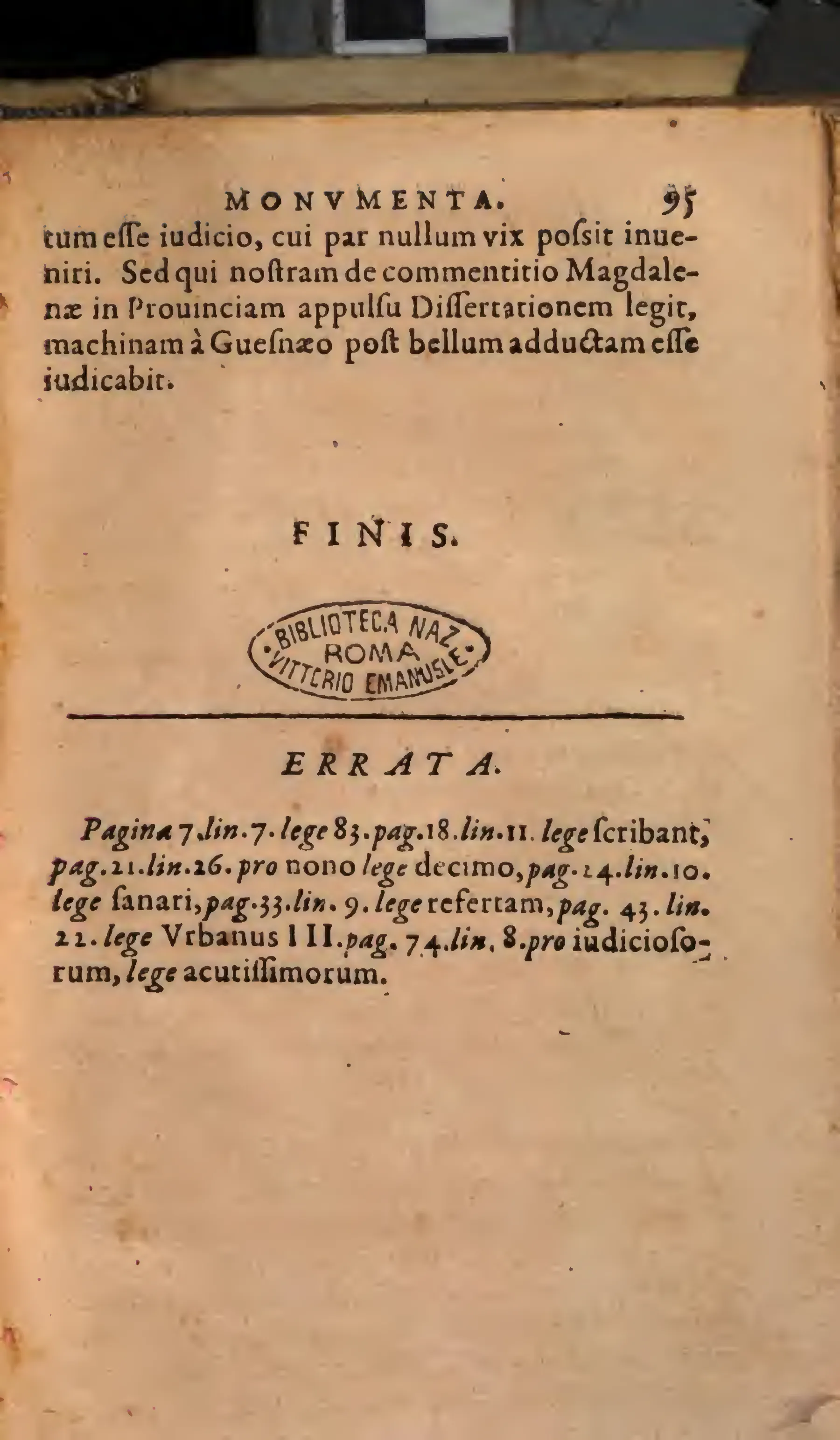
The tract's final page embodies the plain finishing habits of mid-seventeenth-century polemical print: a stark FINIS, a ruled seven-entry errata list, and the oval Biblioteca Nazionale di Roma Vittorio Emanuele ownership stamp anchoring this digitized exemplar's provenance. Even in its closing lines and corrections, the page keeps the controversy with Guesnay active while supplying the bibliographical evidence needed to reconstruct the octavo's material history. Source ↗.
The polemical network in which the Disquisitio participated is traceable through a series of titles. Guesnay's Disquisitio historica de Magdalena Massiliensi advena (Paris, 1642) is the explicit target. To it Launoy's tract is a direct response, and its Eastern counter-thesis rests on witnesses Launoy takes to be primitive: alongside Gregory of Tours he adduces Modestus of Jerusalem, transmitted through Photius, who reports that after the dormition of Our Lady the Magdalene set out for Ephesus to the beloved disciple, where the ointment-bearer Mary completed her apostolic course through martyrdom, profecta est Ephesum ad dilectum discipulum, vbi cursum Apostolicum per martyrium vnguentifera Maria perfecit. The Provençal defenders of the Saint-Maximin tradition subsequently entered the lists: the Dominican and chapter responses at Saint-Maximin and Aix are recorded in the bibliographies of the seventeenth-century Magdalene controversy, although they cannot here be enumerated exhaustively. The Bollandist reception is partially preserved in the working papers of the Museum Bollandianum; the entry under Mary Magdalene in the Acta Sanctorum for July acknowledges Launoy's argument against primitive attestation while declining to endorse the broader Jansenist critique of post-apostolic legend. German learned reception is documented in the pages of the Acta Eruditorum.
The rival French burial claim at Vézelay is met not by silence but by a documentary appendix, the Magdalenæ Vizeliacensis monumenta, gathering papal bulls and royal charters that assert the presence of the body there — among them the attestation ascribed to Lucius, invoking the reverence of blessed Mary Magdalene whose body rests there, pro reverentiæ beatæ MARIAE MAGDALENÆ, CVIVS IBI CORPVS QVIESCIT, and a royal charter opening in the name of the holy and undivided Trinity, In nomine sancta & indinidua Trinitatis, Carolus Dei gratia Rex. Launoy's broader campaign — the demolition of poorly attested hagiographic traditions that earned him the sobriquet le dénicheur de saints — situates the Disquisitio as one instalment in a sustained programme. The companion works include his treatise against the relics of St. Roch (1653), his demolition of the legend of St. Denis the Areopagite (1645), his earlier treatise against the relics and cult of St. Catherine of Alexandria (1638), and his monumental critique of the False Decretals (1662 Dissertatio, expanded 1683 Tractatus). All apply the same principle: the rejection of ungrounded legendary accretions in favour of attested primitive tradition. The Disquisitio of 1643 is in this sense not an isolated polemic but the Magdalene case-study in a systematic method.
The trajectory of the Disquisitio across the long term follows three discernible phases. In its first phase (1643 to circa 1678), it circulated as an instrument of controversy within the Jansenist-Gallican milieu and was absorbed into Launoy's expanding corpus of critical writings. In its second phase (circa 1678 to circa 1900), it entered the corpus of the Bollandist enterprise, where it served as the reference point for every subsequent treatment of the Magdalene dossier, and was reprinted in expanded form within the Opera omnia. In its third phase (twentieth and twenty-first centuries), it has become freely accessible through the digitization of the Roman copy on Google Books, and has been reappropriated as a primary source for the historiography of forgery, of pseudo-epigraphy, and of the cultural history of the Magdalene legend.
Inside the Argument: Priority, Silence, and the Ephesian Dossier
The Preface and Its Inverted Modesty
The text opens by declaring its own labor endless rather than difficult, a rhetorical posture that governs everything that follows. Launoy's opening address to his learned reader — that the work is far harder to finish than to begin because upon whatever page one chances to fall, something at once presents itself to be censured — is not the conventional modesty of a captatio benevolentiae but its inversion: the difficulty lies not in Launoy's own inadequacy to the task but in the sheer density of error in the object he examines. The trope of the omnipresent fault, already met in the opening of the report's summary, converts an admission of exhaustion into an indictment, and it establishes the exhaustive, page-by-page forensic method that the twelve chapters will enact. The refutation is total precisely because, on Launoy's telling, the material offers no page free of reproach.
From this posture the preface distills a moral taxonomy that supplies the architecture of the whole tract. Launoy's charge that four vices — audacity, ignorance, calumny, and dissimulation — seem to have conspired in the very construction of the tradition he attacks does more than rhetorical work: it maps the failings of scholarship onto the failings of character, so that a defective disquisitio becomes evidence of a defective conscience. Audacity and ignorance name errors of intellect and nerve; calumny and dissimulation name errors of will. By binding the two orders together at the outset, Launoy licenses himself to read every misquotation not merely as a lapse but as a symptom, and the chapter divisions that follow — the concealment of chronological order, the misciting of authorities gathered under the heading of bad faith — become the anatomized specimens of these vices in operation.
The Axiom of Priority and Its Sociology
Underpinning the moral taxonomy is a single epistemic axiom to which every particular judgment is referred: the priority of the older witness. Launoy states it as a principle of contempt, that what is advanced by a more recent author concerning matters so ancient, lacking the authority of any older source, is to be held in contempt, quod à recentiore auctore de rebus adeo antiquis sine alicuius vetustioris auctoritate profertur, contemnitur. The formulation is severe in its economy: recency is not merely weak evidence but disqualifying evidence, and the absence of an ancient warrant does not leave a claim neutral or unproven but positively contemptible. This is the lever by which the burden of proof is shifted entirely onto the defender of the tradition, who must produce a vetustior auctor or forfeit the case. Launoy braces the axiom with the authority of Tertullian, whose dictum that the ready virtue of truth is content with few things while falsehood must multiply its supports has already been quoted above; the Tertullianic maxim supplies a theory of proliferation, for falsehood, lacking a single ancient root, must scatter its buttresses, and the very abundance of Guesnay's citations becomes, on this logic, a mark against him. Truth is spare; a tradition that requires a scaffolding of chronicles, diplomas, and legends betrays itself by the quantity of its buttressing.
The same principle yields a sociology of pious invention, one of the most striking analytical moments in the work. Launoy's account of how a false report, once launched, comes in time to displace the truth — the lying rumor that afterward occupies truth's seat once men have found what they wished to find, and in whatever manner they wished to find it, discussed already among the historiographical stakes of the tract — moves beyond the exposure of individual errors to an account of how such traditions arise and consolidate at all. The image of the sedes veritatis, truth's seat now usurped, figures the tradition as a pretender occupying a throne not its own, and the doubled clause on wishing (inuenire voluerunt … quoq modo inuenire voluerunt) locates the engine of the error in desire rather than deception alone: the finding is governed by the wanting, and the manner of finding is bent to the same will. This is not simply an accusation of fraud but a diagnosis of the affective conditions under which fraud takes root and passes for fact — a recognition that pious credulity supplies the demand that forgery then meets.
The Confessional Turn and the Tridentine Canon
The axiom of priority sharpens, in the confessional chapters, into a weapon with Tridentine teeth. Where Guesnay had leaned on Rufinus of Aquileia as a late-antique witness, Launoy presses the consequence that adopting Rufinus's authority entails adopting his defective biblical canon, and he stages his own recoil with theatrical emphasis, protesting — in the disavowal of any wish to imitate so notably erring a man, one who would spew the venom of his bitterness were canonical authority stripped from Wisdom, Ecclesiasticus, Tobit, Judith, and Maccabees, already set out in the summary above — that far be it from him to follow such a course. The maneuver is deft and dangerous. By insisting that the very witness Guesnay invokes for the Provençal cult is the witness whose canon Trent had condemned, Launoy binds a dispute over relics to the integrity of the deuterocanonical books, and thereby threatens to align his Jesuit opponent with the Protestant position on the canon. The doubled Absit verò absit and the visceral image of vomited venom perform the distance Launoy insists upon; yet the very vehemence of the disavowal keeps the incriminating association vivid before the reader, so that the protestation of innocence functions as an accusation.
The Refutation by Reductio
The refutation of Guesnay's positive logic proceeds by reductio. Against the argument that scripture's universal statements — the gospel preached to all nations — secure the Magdalene's arrival at Marseille, Launoy turns the same universals to absurd ends, asking why one should not equally conclude from those scriptural passages that the Magdalene set out for Ephesus, or withdrew into Mesopotamia or Arabia to announce the gospel, cur non æquè ex illis scripturæ locis colligemus: Igitur Magdalena perrexit Ephesum, aut in Mesopotamiam, Arabiamve concessit Euangelium nuntiatura. The demonstration is that a premise which proves any destination proves no particular one; a universal cannot ground a specific geographical claim. The choice of Ephesus among the reductio's absurd alternatives is not innocent, for it is precisely the destination Launoy will affirm on independent ancient testimony, and the satirical thrust thus quietly prepares the positive thesis while dismantling the adversary's inference.
The Eastern Dossier and the Charge of Mendacity
That positive thesis rests on witnesses Launoy takes to be genuinely ancient, and here the charge of mala fides reaches its sharpest point. On the question of the burial, he holds that Guesnay does not merely err but lies with the utmost audacity, the escalation to audacissimè mentitur already recorded above, since Modestus of Jerusalem, Gregory of Tours, and others attest otherwise. The escalation from bad faith to open mendacity marks the point at which suppression of evidence can no longer be excused as carelessness, since the countervailing witnesses are, on Launoy's account, both ancient and plain. Gregory of Tours furnishes the keystone Latin testimony — the report, quoted earlier in the account of the work's textual history, that in the city of Ephesus Mary Magdalene rests without any covering over herself, and that there too lie the seven sleepers. The Greek support is Modestus of Jerusalem, transmitted through Photius, whose account of the Magdalene's departure for Ephesus to the beloved disciple, where the ointment-bearer Mary completed her apostolic course through martyrdom, has likewise been set out above; the epithet vnguentifera, the ointment-bearer, imports the Eastern liturgical identity of the saint and marks her firmly as an Ephesian figure, so that the very vocabulary of the witness testifies against the Provençal residence.
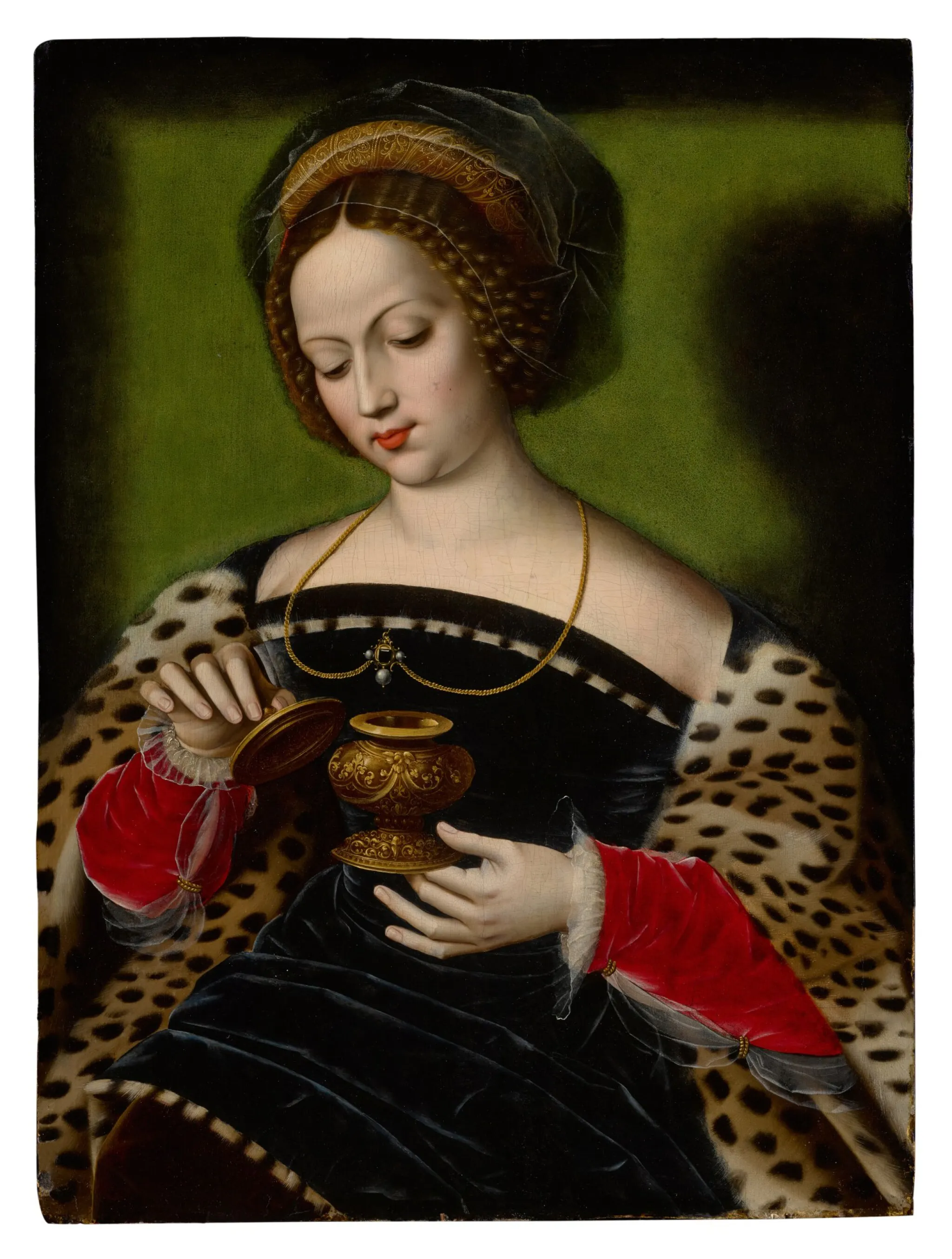
Ambrosius Benson's Mary Magdalene presents the saint by her most portable attribute, the lidded ointment jar cradled in her hands. For Launoy's argument, that familiar myrophore image gives visual force to the Eastern epithet vnguentifera—the "ointment-bearer"—by which Modestus and Photius anchor Magdalene's memory in the Ephesian rather than the Provençal tradition. Source ↗.
The Argument from Silence
Complementing this positive dossier is the argument from silence, deployed not as a concession but as decisive proof. Launoy asks how it could have happened that the earliest Provençal and Gallic writers were ignorant of the first apostles of their own people, apostles of such rank, or never extolled them with any word of praise — naming Cassian at the head of the silent, quî fieri potuit, vt primos gentis suæ Apostolos & tales Apostolos ignorassent, aut nullo vnquam præconio extulissent Cassianus. The force of the question lies in its improbability: that writers of a church allegedly founded by so illustrious an apostle should pass her over in total silence is, for Launoy, inconceivable except on the supposition that they knew nothing of her because there was nothing to know. Silence, coupled with the axiom of priority, converts an absence of evidence into evidence of absence, and the negative argument thus completes the positive one.
The polemic closes on a note of dismissive mockery once the ancient witnesses have been marshalled. Having invoked Sirmond among his authorities, Launoy invites Guesnay, if he wishes, to publish a fresh commentary on the scriptural maxim that in the mouth of two or three every word shall stand, novum commentarium edat in illud scripturæ: In ore duorum aut trium stat omne verbum. The sarcasm turns a rule of evidence back upon the adversary: the maxim requiring corroboration by two or three witnesses is precisely what the Provençal tradition, on Launoy's showing, cannot satisfy, so that Guesnay is ironically bidden to expound the very principle that condemns his case.
The Vézelay Dossier as Documentary Coda
Against the Provençal claim, and folded into the volume as documentary back-matter, stands the rival French dossier for Vézelay, the Magdalenæ Vizeliacensis monumenta. The opening bull invoking the reverence owed to blessed Mary Magdalene whose body rests there, and the royal charter opening in the solemn Carolingian formula in the name of the holy and undivided Trinity, have both been presented above in the account of the work's material make-up. The appended charters and bulls do not merely counter the Saint-Maximin relics with a competing burial site; they demonstrate the documentary texture Launoy holds the Provençal claim to lack, arraying dated papal and royal instruments in the very form of attestation whose absence from the earliest centuries he had pressed against his opponent. The dossier thus performs, in miniature, the whole method of the tract: it is by such datable, priority-bearing documents, and not by revelations and dreams, that a claim about Christian antiquity must be made to stand.
Frequently Asked Questions
What is the Disquisitio disquisitionis de Magdalena Massiliensi advena?
The Disquisitio disquisitionis de Magdalena Massiliensi advena is a Latin polemical tract published at Paris in 1643 by Jean de Launoy, a doctor of the Sorbonne. A slender octavo of roughly ninety-five pages, it dismantles, page by page, the Jesuit Jean-Baptiste Guesnay's defense of the tradition that Mary Magdalene sailed to Provence, evangelized Marseille, and died in the grotto of La Sainte-Baume. Against that claim it assembles Greek and Byzantine sources for a rival burial at Ephesus. It stands as one of the founding documents of critical hagiography.
Who was Jean de Launoy, and why was he called le dénicheur de saints?
Jean de Launoy (1603–1678) was a Norman from Coutances, a doctor of the Sorbonne and socius of the Collège de Navarre. Contemporaries nicknamed him le dénicheur de saints, "the debunker of saints," for his systematic critical scrutiny of poorly attested cults. Beyond the Magdalene tract, his campaign included treatises against the relics of St. Catherine of Alexandria (1638), the legend of St. Denis the Areopagite (1645), the relics of St. Roch (1653), and the False Decretals (1662, expanded 1683). All apply one principle: rejecting ungrounded legend in favor of attested primitive tradition.
What was Launoy's central method for judging the Magdalene tradition?
Launoy worked from a single controlling axiom, the principle of documentary priority, or vetus traditio (ancient transmission): what is handed down earliest is presumed true, while recent testimony lacking ancient warrant is, in his uncompromising phrasing, to be held in contempt. He braced this with Tertullian's dictum that truth is content with few supports while falsehood must multiply them. From this he shifted the burden of proof onto the tradition's defender, pressed the silence of the earliest Gallic writers such as Cassian, and charged his opponent with mala fides, bad-faith citation.
Why did Launoy connect a dispute over relics to the Council of Trent?
Launoy argued that crediting Rufinus of Aquileia's late-antique testimony on the Provençal cult endangered the deuterocanonical books whose canonical standing the Council of Trent had lately reaffirmed, since Rufinus's biblical canon was the very list Trent condemned. The maneuver bound a quarrel over relics to the integrity of the Tridentine canon and threatened to align his Jesuit opponent with the Protestant position. He staged an emphatic disavowal, protesting he had no wish to strip canonical authority from Wisdom, Ecclesiasticus, Tobit, Judith, and Maccabees — yet the vehemence kept the incriminating association vivid.
Is there an English translation of the Disquisitio disquisitionis?
No modern English translation has been identified; standard bibliographies record no vernacular translation even from the seventeenth century, and the editorial title supplied for convenience has no established English rendering in the historiography. Separately, the Leo edition presents the full transcription and a complete English translation of the work for the first time. This translation is generated by AI. Leo is an effort to make freely available online, at no cost, English translations of every text printed in Latin in early modern Europe between 1450 and 1750.
This report was generated by an advanced AI assistant that conducted deep research alongside an extensive interpretation of the transcribed original text. Every effort has been made to preserve fidelity to the source and to guard against inaccuracy, but corruption in the text recognition process and model hallucination may nonetheless have entered the text. Treat every claim, quotation, translation, and citation as provisional, and verify each against the original source before relying on or citing it.
Bibliography
- Delehaye, Hippolyte, The Legends of the Saints: The classic primer on the Bollandist method whose criteria Launoy anticipated and whose successors later had to reckon with him; the accompanying review notes how Launoy earned his epithet as le dénicheur de saints and how the Bollandist enterprise itself was dismantled at the end of the eighteenth century. Read it to see the disciplinary machinery of hagiographic criticism laid out in full, and to measure how far the Disquisitio prefigured it.
- Frazier, Alison Knowles, Forging the Past: Invented Histories in Counter-Reformation Spain: The definitive account of the "false chronicles" — the Higuera fabrications allegedly recovered from a monastic library in 1595 — that supplied the documentary scaffolding Launoy tore down. Consult it to understand exactly what the Pseudo-Dexter material was, who manufactured it, and why its exposure made the Magdalene question a proving ground for the detection of forgery.
- Haskins, Susan, Mary Magdalen: Myth and Metaphor: The indispensable long-range history of the Magdalene image from late antiquity onward, which treats Launoy as the hinge on which the Provençal cult swung from received fact to acknowledged legend. Turn to it for the narrative sweep that the Disquisitio only glimpses through its forensic keyhole.
- Jansen, Katherine Ludwig, The Making of the Magdalen: Preaching and Popular Devotion in the Later Middle Ages: A study of how mendicant preaching, especially Dominican, built and broadcast the very Provençal legend Launoy subjected to source-criticism. Read it to see the machinery of devotion that manufactured the tradition, which explains both the cult's popular grip and why a Sorbonne critic found it worth demolishing.
- Quantin, Jean-Louis, "Reason and Reasonableness in French Ecclesiastical Scholarship," Huntington Library Quarterly: The essential rehabilitation of Launoy as a serious critic — "a hard-working savant and a fearless critic" — rather than a mere confessional brawler, situating his method within Gallican erudition. Consult it to weigh how much of the Disquisitio is disciplined scholarship and how much is polemical theater, a distinction the tract itself works hard to blur.



.jpg)


