The Bee Among the Flowers: Johannes Loccenius's Three Books on the Law of the Sea and of Shipping
In 1651, from the Stockholm press of Johannes Janssonius the Younger, the German-born Uppsala jurist Johannes Loccenius issued De iure maritimo et navali libri tres, a systematic Latin treatise that set out to prove that the Nordic world possessed its own maritime jurist and its own canonical sources — chief among them the medieval Laws of Wisby, which he ranked beside the ancient Rhodian Sea Law. Written amid the Grotius–Selden quarrel over whether the ocean could be owned or closed, and in the decade when the Swedish crown dominated the Baltic, it argues that the law of the sea is public law, resting on natural equity and answerable to the wealth of commonwealths. Loccenius gathers Roman nautical law, northern statute, and confessional casuistry the way a bee sips flowers of every kind, drawing off the best of each and measuring the result against the fourfold standard of natural, gentile, divine, and civil law.
ExLatinis
26 July 2026

Contents
In 1651, from the Stockholm press of Johannes Janssonius the Younger, the German-born Uppsala jurist Johannes Loccenius issued De iure maritimo et navali libri tres, a systematic Latin treatise that set out to prove that the Nordic world possessed its own maritime jurist and its own canonical sources — chief among them the medieval Laws of Wisby, which he ranked beside the ancient Rhodian Sea Law. Written amid the Grotius–Selden quarrel over whether the ocean could be owned or closed, and in the decade when the Swedish crown dominated the Baltic, it argues that the law of the sea is public law, resting on natural equity and answerable to the wealth of commonwealths. Loccenius gathers Roman nautical law, northern statute, and confessional casuistry the way a bee sips flowers of every kind, drawing off the best of each and measuring the result against the fourfold standard of natural, gentile, divine, and civil law.
Among the systematic legal treatises produced in the Sweden of Queen Christina, few announce their ambition as plainly as the work that Johannes Loccenius published at Stockholm in 1651 under the Latin title De iure maritimo et navali libri tres. Loccenius (1598–1677) was a German-born jurist, philologist, and, from the year of the treatise's appearance, royal historiographer at Uppsala; the book he issued from the press of the younger Johannes Janssonius belongs to the flood of early modern maritime jurisprudence that followed the quarrel between Grotius and Selden over whether the ocean could be owned or closed. It is a systematic Latin tractatus in three books, moving from the public-juridical status of the sea and the right of navigation, through the law of ports, admiralty, insurance, and the maritime loan, to the private law of maritime contracts, delicts, and procedure. No modern-language translation is known to exist, and no monograph has yet been devoted to it; the account offered here therefore rests on the surviving text and on the adjacent scholarly literatures that touch it.
At the center of the work lies a single problem: how to constitute the whole disorderly activity of the sea — navigation, commerce, shipbuilding, dominion over the waters, wreck, insurance, partnership, and the delicts and procedures peculiar to seafaring — as a coherent body of public law on which, in Loccenius's own framing, no small part of the external wealth and power of commonwealths depends. His characteristic response is a comparative-eclectic synthesis disciplined throughout by an appeal to natural equity and divine law. He gathers his materials — Roman nautical law, Swedish and neighboring statutes, and above all the medieval Leges Wisbyenses — and, in his own bee-simile, sips from each source to draw off the best of it, then measures the result against the fourfold standard of the ius naturae, gentium, divinum et civile. The same argumentative reflex recurs at every turn: a rule is stated, its foundation in natural, divine, or gentile law is sought, and the competing authorities — Grotius against Selden, Vinnius against solidary liability, the canonists on usury, the Lutheran casuists on commerce — are weighed against one another.
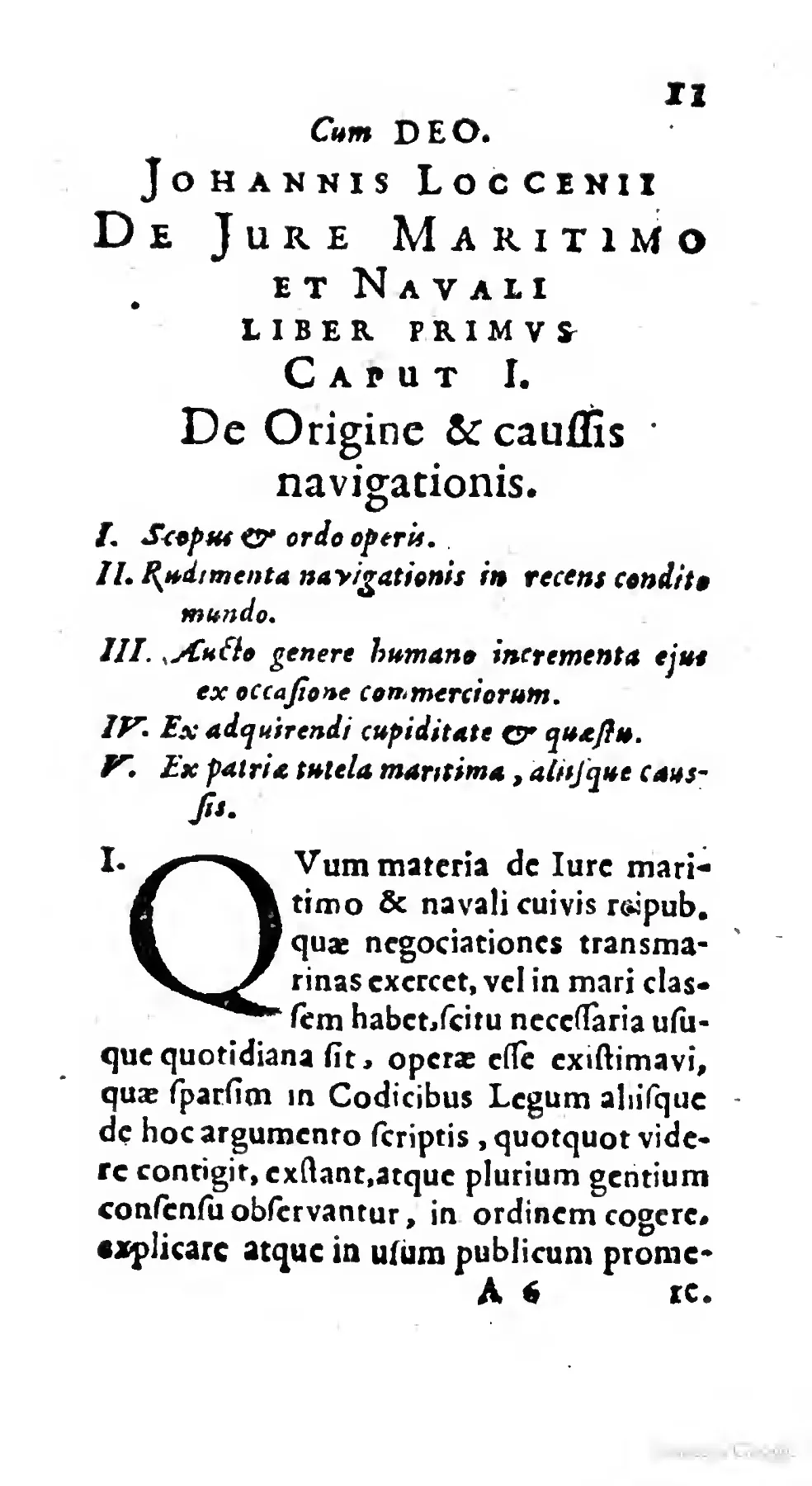
The first page of Book I turns Loccenius's subject into a matter of statecraft: after five italic headings on the origins and causes of navigation, a large woodcut initial "Q" opens the claim that maritime and naval law is necessary knowledge and of daily use for any commonwealth engaged in overseas trade or maintaining a fleet. This typographic threshold already gathers navigation, commerce, profit, and maritime defence into the public-law framework on which Loccenius makes the prosperity of states depend. Source ↗.
The stakes of this exercise were at once methodological and ideological. Methodologically, Loccenius sought to demonstrate that the Nordic world possessed its own maritime jurist and its own normative sources, and the boldest expression of that claim is his elevation of the Laws of Wisby to the authority once enjoyed by the Rhodian Sea Law that Digest 14.2 had made canonical within the civilian tradition. Ideologically, the treatise furnished the Swedish imperial state, by 1651 dominant in the Baltic, with a learned Roman-law idiom in which its command of the northern seas could be presented as the continuation of classical and medieval juristic tradition rather than as novelty. The freedom-of-the-seas controversy supplies the frame for the argument over dominion: Loccenius presupposes the civilian separability of dominium, property in the strict sense, from imperium, jurisdictional authority, and assigns to the Baltic a recognizably Nordic juridical geography that belongs to no single crown yet admits a limited coastal competence bounded by the needs of commerce.
What a first-time reader will find most striking is the sheer breadth of the material Loccenius folds into a juristic register, and the consistency of the standard against which he tests it. Genesis and Sanchuniathon, Lucretius and Tacitus stand behind his account of the origins of navigation; a maxim of Cosimo de' Medici and a Spanish adage about harborless kingdoms carry the thesis on naval power; the Ship of Theseus surfaces in the law of shipbuilding; Elizabeth I appears as arbiter between the Grotian and Seldenian positions; Samson furnishes the hard case in a quaestio on whether a vessel may lawfully be destroyed. The commercial books argue that marine insurance and the foenus nauticum are licit, non-usurious risk-contracts, resolving the older scholastic hesitation through the Roman-law pairing of periculum and commodum while drawing on Molinaeus, Santerna, and Salmasius. Alongside these run passages of a harsher cast, including a theological warning, framed in the idiom of Lutheran casuistry, against entering a shipping partnership with a Jew — a position stated here as it stands in the text, within the confessional polemics of its moment.
The throughline that unites the work is thus the subordination of positive custom to natural equity and divine law, pursued through a vocabulary — ius maritimum, ius navale, dominium, imperium, foenus nauticum, adsecuratio — in which each load-bearing term is a doctrinal instrument rather than a label. That same principle governs the book's transmission: preserved above all through Heineccius's omnibus collection of 1740, where it traveled in company with the maritime treatises of Kuricke and Stypmann, the work circulated among the civilian jurists of the Empire long after its author's death, and its guiding conviction — that the law of the sea is public law, resting on equity and answerable to the wealth of commonwealths — governs the movement of its three books from the open sea to the counting-house and the shipboard court.
Read the full text and English translation on Leo
This text was transcribed and translated as part of the ExLatinis project, an effort by Leo to make free English translations of every text published in Latin in early modern Europe (1450–1750) available online. The complete transcription and English translation of this work can be read free of charge:
→ Read the original Latin text and full English translation on Leo
You can save a copy of this document into your Leo account to run deep text searches, conduct further analysis, or cross-reference it with your own research.
Assigning an English Title to Loccenius's De iure maritimo et navali
Three Books on the Law of the Sea and of Shipping [editorial title]
The treatise published at Stockholm in 1651 under the imprint of the Jansson press and conventionally cited in its Latin form as De iure maritimo et navali libri tres belongs to the early modern literature of maritime jurisprudence that flourished in the wake of the Grotius–Selden quarrel over the freedom or closure of the ocean. No settled English-language title exists in current historiography; the rendering proposed here, Three Books on the Law of the Sea and of Shipping, is supplied as an editorial convenience and follows the diction customary in the anglophone secondary literature on early modern law-of-nations texts, where Loccenius's treatise is most commonly cited under shortened paraphrases such as "Loccenius on Maritime Law" or simply as De iure maritimo et navali. It preserves the tripartite structure (libri tres) that the author himself underscored and aligns the term ius maritimum with the glossatorial and humanist sense of "law of the sea" while reserving ius navale for the more narrowly contractual regime of shipowning, freight, and bottomry that the author treats in the third book.
The compound ius maritimum et navale that frames the title is itself doctrinally loaded. In the period usage of the later sixteenth and seventeenth centuries, ius maritimum designated the body of doctrine regulating the open sea considered as a juridical space—navigation, jettison, ports, the law of prizes, and the questions of dominium and imperium over maritime territory—while ius navale designated the law of the ship considered as a juridical person and of the contracts by which shipping was financed and conducted: charterparty, freight, bottomry, marine insurance, and the actio exercitoria by which the shipowner's liability was fixed. The juxtaposition in Loccenius's title is not a stylistic ornament but a doctrinal architecture: it registers the problem, inherited from Roman and canonist jurisprudence, of how to reconcile an imperial-jurisdictional vocabulary appropriate to the high seas with a contractual-commercial vocabulary appropriate to the commerce carried on those seas, without collapsing the one into the other. That the author conceived the entire subject as a branch of public law bearing directly on the prosperity of states is stated at the outset, when he affirms that maritime and naval law is of such a kind that no small part of the external felicity of commonwealths depends on its lawful use, asking what more augments and secures the fortunes and resources of commonwealths than the frequent yet just exercise of navigation and commerce, I Vs maritimum & navale hujusmodi esse constat, ut ex legitimo ejus usu non exigua pars externæ felicitatis Rerumpub. pendeat. Quid enim magis fortunas & opes rerumpub. auget firmatque, quam frequens, justum tamen, navigationis & commerciorum exercitium?. Loccenius's solution, as the praefatio and the disposition of the three books make plain, is to hold the two together by an artifice of definition grounded in etymology and Roman-law usage, and then to measure northern customary and statutory practice—the Laws of Wisby, Hanseatic ordinances, Belgic and Swedish statutes—against that frame. The pairing thus serves both as a taxonomic signal and as a programmatic commitment to a jurisprudence of the sea that is at once public and private, jurisdictional and contractual.
The method by which those disparate sources are drawn together is itself announced through a figure the author makes his own. He describes his procedure as an imitation of the bees, which so sip flowers of every kind that they draw off the best nectar from them, Imitari hîc apes placuit, quæ cujuscunque generis flores ita libant, ut optimum inde succum hauriant. This comparative-eclectic gathering is not indiscriminate: each source is tested against natural equity and divine law, so that the bee-simile names a governing method rather than a mere ornament of the preface. It is under this program that the Laws of Wisby acquire their central place, for the author explicitly ranks them beside the Rhodian law, remarking that he has called the maritime Laws of Wisby to witness as often as opportunity invited and the matter itself demanded, laws which today hold nearly the same authority that the Rhodian Laws once held, Ita Leges maritimas Wisbyenses, quoties oportunitas allicuit & res ipsa jussit, ad testimonium vocavi. quæ Leges eandem ferme authoritatem hodie obtinent, quam olim Leges Rhodiæ. The elevation of a Nordic customary source to parity with the canonical Rhodian law of Digest 14.2 is, as will emerge, the most concentrated instance of the whole treatise's northern-source program.
Equally charged is the dominium maris / imperium maris distinction that recurs throughout the treatise as the pivot of the law-of-nations argument. In the civilian tradition reaching back to the glossators and codified in the ius publicum literature of the sixteenth century, dominium denoted property in the strict sense—the right to use, enjoy, and dispose of a thing—while imperium denoted jurisdictional authority over persons. By the time of the Grotius–Selden controversy the two terms had been sharpened into opposed theses: Grotius's Mare liberum (1609) argued that the ocean, being incapable of appropriation by physical seizure, was res communis and bore only a ius transitendi; Selden's Mare clausum (1635) responded that the English crown's imperium over the encircled seas was a jurisdictional dominion distinct from and not defeated by any absence of physical occupation. Loccenius enters this debate neither as a Grotian partisan nor as a Seldenian apologist but as a jurist who presupposes the analytical separability of dominium and imperium and then assigns to the Baltic a recognizably Nordic juridical geography: the northern waters are not the property of any single crown, yet the coastal sea admits a limited jurisdictional competence (imperium) constrained by the necessities of commerce and by the public-law obligations of princes. The position is consistent with the ideology of Swedish maritime preponderance in the decades after the Peace of Westphalia, but it is articulated through civilian categories rather than through the political rhetoric of the Swedish empire.
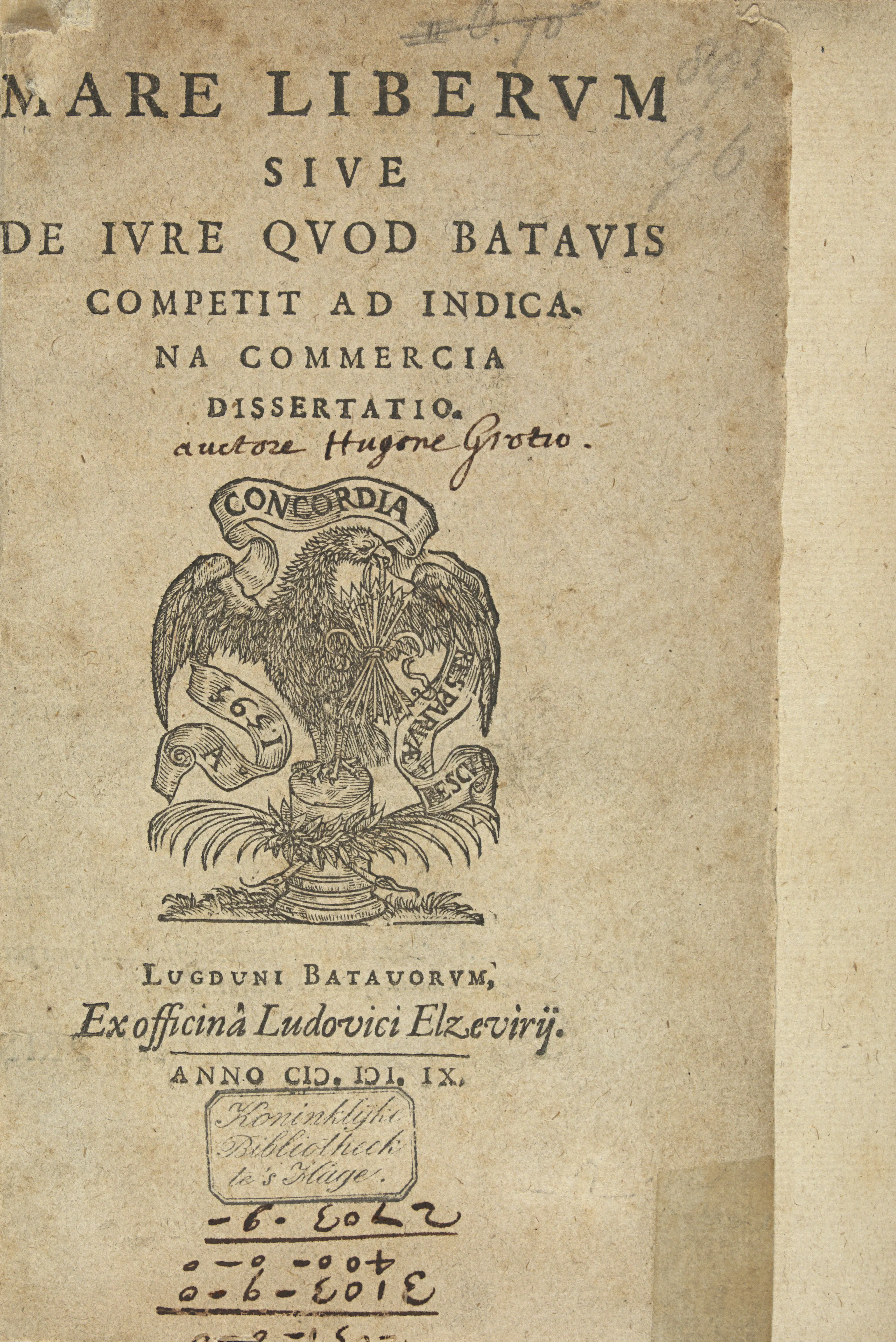
The 1609 title page of Hugo Grotius's Mare Liberum, in the spare format of an early Elzevier legal pamphlet, presents the printed manifesto that made the sea's non-appropriability a central problem of European public law. For Loccenius this Grotian pole of the controversy was not an endpoint but the adversarial premise against which he separated ownership (dominium) from jurisdictional competence (imperium) in the Baltic. Source ↗.
.jpg)
The technical vocabulary of the commercial-law books is similarly period-specific. Foenus nauticum—literally "maritime interest" or "maritime loan"—names the canonically permitted exception to the prohibition of usura for loans in which the creditor's remuneration is contingent upon the safe arrival of the ship, a doctrine debated since the medieval commentators and reopened by the jurists of the School of Salamanca. Adsecuratio, the contractual underwriting of maritime risk by premium, denotes marine insurance as it had matured in the ports of the Baltic and the North Sea by the mid-seventeenth century. Loccenius treats both as licit under the common apparatus of periculum and commodum, the Roman-law pairing of risk and profit by which the civilian tradition justified the lender's or insurer's share without recourse to the scholastic apparatus of extrinsic titles. The conceptual move is significant: by framing foenus nauticum and adsecuratio through civilian periculum rather than through the Salamancan theology of contract, Loccenius aligns the Nordic commercial-law tradition with the methodological mos italicus of the Roman-canonical school while preserving the substance of the Salamancan conclusion. The terminology of the title thus opens onto a treatise whose every load-bearing term—ius maritimum, ius navale, dominium, imperium, foenus nauticum, adsecuratio—is a doctrinal instrument rather than a mere label.
Loccenius, Uppsala, and a Systematic Law of the Northern Seas
Johannes Loccenius (1598–1677), German-born jurist, philologist, and royal historiographer resident at the University of Uppsala, composed his De iure maritimo et navali libri tres during the late 1640s and issued it in Stockholm (Holmiae) from the printing house of Johannes Janssonius the Younger in 1651 as a duodecimo of [iii], 288 pages. The treatise is a systematic Latin tract on the law of the sea and of shipping, organized in three books covering the public-juridical status of the sea and navigation, the jurisdiction of ports and admiralty, and the law of maritime contracts and delicts, and is grounded in part on Roman law and on patristic-juridical tradition and in part on the customary and statutory practice of the northern seas—notably the medieval Leges Wisbyenses, which Loccenius sought to elevate to canonical parity with the lex Rhodia de iactu. The driving purpose of the work is at once methodological and ideological: to establish that the juridical school of Sweden and the Nordic region possesses its own maritime jurist and that the Laws of Wisby stand beside the Rhodian Sea Law as a normative source rather than as a regional curiosity, a program the author pursues through the comparative-eclectic method he likens to the bee gathering nectar from flowers of every kind and disciplines throughout by the standard of the ius naturae, gentium, divinum et civile. The text is composed in Latin with technical vernacular glosses in German and Dutch (Reedare/Reeders/Schiffs-freunde), and there is no evidence on present showing that it has ever been translated into a modern European language. Its afterlife was largely bibliographic: it was reissued within Johann Gottlieb Heineccius's omnibus collection of maritime-law treatises of 1740 alongside the analogous works of Reinhold Kuricke (De adsecurationibus) and Franz Stypmann (Ius maritimum et nauticum), and so was preserved in print into the late eighteenth century before falling into neglect save for occasional citation in English admiralty decisions and nineteenth-century compendia of maritime law.

J. B. Homann's c. 1730 engraved map of Scandinavia and the Baltic renders the waters around Sweden, Denmark, Finland, Livonia, and Gotland within a dense network of coasts, settlements, fortified places, and overland routes. As contextual cartography rather than a page from Loccenius's treatise, it visualizes the northern maritime world whose jurisdiction, customs, and claims to dominion framed De iure maritimo et navali and its elevation of the Laws of Wisby. Source ↗.

Situating Loccenius Between Grotius, Selden, and the Swedish Baltic Empire
Significance in its period. The treatise occupies a deliberate position in the European jurisprudential geography of c. 1650. By the time Loccenius published, the Grotius–Selden controversy over the freedom or closure of the seas had hardened into a recognizable polemical front with two opposed doctrinal positions and an emergent third mediating position that would later be systematized by Bynkershoek. Loccenius entered this debate not as a Dutch or English polemicist but as a Swedish jurist working within the milieu of the emergent Swedish imperial state, which by 1651 had consolidated its command of the Baltic and required a juridical idiom commensurate with that command. The treatise is accordingly both a technical tractatus and an ideological intervention: it grounds Swedish maritime power in a learned Roman-law framework that permits it to be presented as a continuation of medieval and classical juridical tradition rather than as a revolutionary innovation. The claim is stated bluntly in the very definition of naval power, where Loccenius recalls that it was a familiar saying of Cosimo de' Medici that no one is to be held powerful who has not joined naval power to power on land, and that the Spaniards have an adage that a kingdom without a port is like an oven without fire, Inde Cosmo Medices familiare fuit dictum: Non habendum potentem qui potentiæ terrestri non simul etiam navalem haberet conjunctam. Et Hispanorum est adagium: Regnum sine portu, esse sicut furnum absque igne. The argument for the normative parity of the Leges Wisbyenses with the lex Rhodia is the most concrete doctrinal instance of the same strategy, furnishing the northern seas with a source of their own dignity.
Touch-points with the major debates. The treatise engages four debates central to mid-seventeenth-century maritime jurisprudence. (1) The Grotius–Selden dispute: Loccenius acknowledges both Mare liberum and Mare clausum and adjudicates between them through the dominium/imperium distinction, assigning to the Baltic a recognizably Nordic juridical geography. The starting point of his analysis is the theological reservation that universal and supreme dominion of the sea belongs to no man but to the Lord of lords alone, Dominium maris universum & summum nulli hominum, sed soli Domino dominorum competere, liquet ex Psal, from which the merely particular and jurisdictional competence of princes is then distinguished. Rather than pronounce for either polemicist, he stages a conciliation, proposing that if it is not for him to settle such great disputes among them, they should hear Queen Elizabeth of England as arbiter, who replied through her Senate to the Spanish legate in England, Si verò nostrum non est inter illos tantas componere lites, audiant Reginam Angliæ Elisabetham arbitram, quæ sic per Senatum respondit Hispanico in Anglia Legato. (2) The Leges Wisbyenses versus lex Rhodia question: Loccenius argues the Wisby laws are normative rather than merely consultative, on analogy with the lex Rhodia as Digest 14.2 had rendered it canonical within the civilian tradition. (3) The usury question on maritime loans and marine insurance: Loccenius treats foenus nauticum and adsecuratio as licit, grounding the analysis in Molinaeus (Charles Dumoulin), Santerna (Pedro de Santarém), and Salmasius (Claude Saumaise), thereby resolving the older scholastic hesitation without sacrificing the moral-theological framing. He holds insurance to be a licit contract because it is made of a thing left over and by lawful pact, since one party takes upon himself the risk of a capital which he keeps safe for the other, Est hic contractus licitus: quia sit de relicta, & ex pacto legitimo: dum unus in se suscipit sortis periculum, quam alteri salvam; and he defends the maritime loan as most just, given the multitude and magnitude of the perils at sea and the smallness and cheapness of the price, namely the hundredth part, set against such continual perils to the whole capital, Quod justissimum sit foenus nauticum, liquet propter multitudinem & magnitudinem periculorum quæ versantur in mari: & propter exiguitatem & vilitatem pretii videlicet centesima respectu tantorum & continuorum periculorum totius sortis. Both defenses turn on the Roman-law pairing of risk and reward rather than on the scholastic apparatus of extrinsic titles. (4) Lutheran casuistry on commerce: Loccenius deploys Protestant moral-theological argumentation against Catholic canonical scruples about interest, in the idiom established by Caspar Ziegler, Konrad Dedekennus, and the Jena theological faculty. The same casuistical idiom is turned to confessional ends in the treatment of the shipping partnership, where he holds that it cannot be denied that it has the appearance of evil, and is an altogether great and close conjunction, when a partnership contract is entered with a Jew, Iam autem negari nequit, quin speciem mali habeat, & prorsus magna atque arcta conjunctio sit, quando cum Iudæo contractus societatis navalis initur —a position advanced through Dedekennus, Müller's Judaismus, and the Jena faculty and belonging to the confessional polemics of its moment.
Modern historiography and the state of the field. No monograph-length study of Loccenius's De iure maritimo is presently known. The historiography on Loccenius's maritime treatise operates through adjacent literatures rather than through dedicated scholarship on the author. (a) The literature on the freedom-of-the-seas debate after 1609 (Grotius, Selden, Bynkershoek, Welwood, Vattel), in which Loccenius is treated as a peripheral but instructive Northern voice; the standard works by James Brown Scott, Wilhelm G. Grewe, and Alfred P. Rubin cite Loccenius in passing without making his argument central. (b) The literature on Swedish great-power policy under Charles X Gustav, where the maritime-law writings are mentioned as ideological adjuncts; the most recent extensive treatment of Loccenius's juridical-political work appears in the Swedish-language scholarship of Hjalmar Grönblad and in the relevant entries of the Svenskt biografiskt lexikon. Marie Schelhaas's recent studies of Swedish-imperial legal ideology contextualize the treatise without analyzing it closely. (c) The literature on the history of marine insurance and the foenus nauticum doctrine. (d) The German and Scandinavian reception-histories of the ius publicum tradition. The principal historiographical lacuna is therefore the absence of a dedicated monograph on the De iure maritimo; what is needed is a critical edition with translation and a study of the doctrinal position in relation to Grotius, Selden, and the Wisby Reception — a desideratum this account can only point to.
From the 1651 Janssonius Imprint to the Heineccius Collection of 1740
Production and transmission history. The editio princeps of De iure maritimo et navali libri tres was issued at Stockholm (Holmiae) in 1651 from the printing house of Johannes Janssonius (Jan Jansson; Stockholm and Amsterdam, 1588–1664), the Younger, the leading Swedish typographer of the mid-seventeenth century, in a duodecimo format with a collation of [iii], 288 pages. The imprint was produced during the period of consolidation of Swedish printing infrastructure under the reign of Queen Christina, shortly before Loccenius's appointment as Rikshistoriograf (royal historiographer) in 1651. A second Stockholm imprint, also dated 1651 but with minor typographical differences, has been recorded in catalogues and is generally treated as a re-issue rather than a distinct edition; the Google Books record of a 1652 edition (P. de Dobbeleer, Brussels, 334 pages) represents a Southern-Netherlandish reprint of the same textual content.
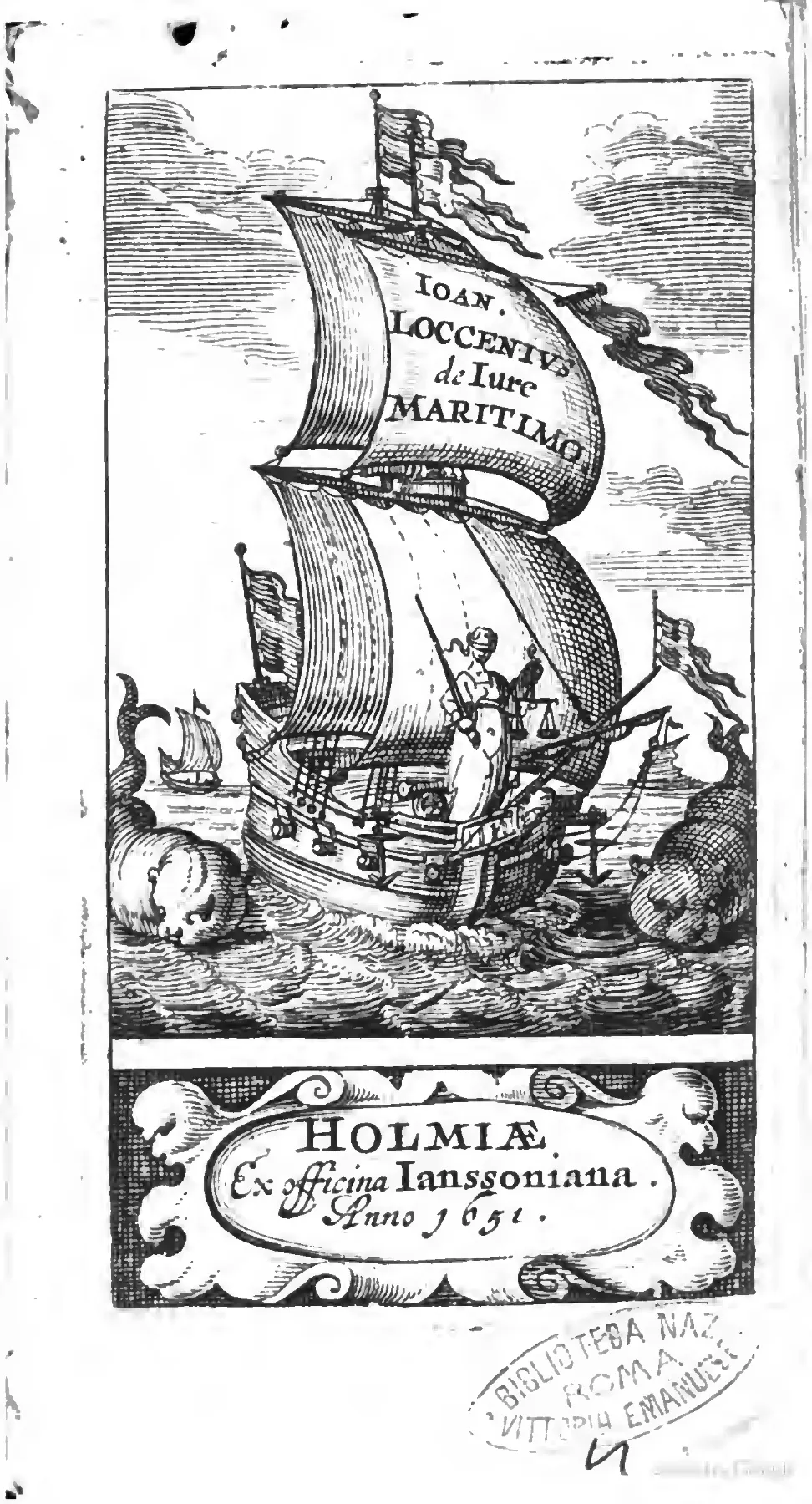
The 1651 Stockholm title page fuses bibliographical identity and legal allegory: the Janssonius imprint appears in an ornamental cartouche beneath a full-sailed vessel, while Justice stands aboard and the title is carried in the ship's sail. In making maritime law literally travel under the sign of juridical authority, the engraving presents Loccenius's treatise as both a product of Sweden's mid-seventeenth-century print culture and an argument that public law belonged at sea. Source ↗.
Later editions and the Heineccius reprint. The treatise was reprinted in 1672, 1675, and 1679, the latter appearing in two simultaneous issues—one from Stockholm and one from Frankfurt am Main—and a 1679 Frankfurt edition printed by Johann Friedrich Hoffmann. The most consequential reprint for the text's transmission, however, was the 1740 omnibus collection assembled by the Göttingen jurist Johann Gottlieb Heineccius (Heineccius), titled Scriptorum de iure nautico et maritimo fasciculus, issued at Halle by the Francke Foundations printing house (Orphanotrophei). In this collection, Loccenius's treatise was printed alongside the analogous works of Reinhold Kuricke (De adsecurationibus diatriba) and Franz Stypmann (Ius maritimum et nauticum), a Northern-German maritime jurist active in Hamburg. The Heineccius reprint standardized typographic conventions, added prefatory material, and ensured that the three texts circulated together in academic and library collections across the Holy Roman Empire until at least the late eighteenth century. The Heineccius reprint is the form in which the treatise was principally known to later civilian jurisprudence.
Material description. The 1651 Janssonius imprint is a typical mid-seventeenth-century Swedish duodecimo: small octavo format, set in roman type for the body text with italic for emphasis and occasional display capitals, with running titles and signature marks. There is no engraved title-page in the 1651 imprint; the typographic title-page follows standard Swedish academic format of the period. The work is organized into three books (libri tres), each subdivided into titles (tituli) and further into numbered paragraphs (§§ or §). The internal structure follows the scholastic tractatus convention, with definitions, distinctions, and citations of Roman-law and patristic authorities—a form in which each keyword functions as a doctrinal instrument, as when the third book opens its treatment of shipowner liability by explaining that the action is called exercitoria from the exercising of a ship, whose usefulness is so great that it pertains to the highest interest of the commonwealth, Exercitoria dicitur Actio ab exercitatione navis: cujus tanta est utilitas, ut ad summam remp. pertineat l. 1. ß. 20. h. t, again binding a private-law category to the public felicity of states with which the whole treatise opens. The treatise contains a dedicatory epistle and a methodical preface (praeambula) in which Loccenius deploys the conventional bee-and-flowers metaphor for juridical synthesis. The page layout is dense and economical, designed for use by working jurists rather than for ceremonial display.
Repositories and institutional footprint. Copies of the 1651 Janssonius imprint are recorded in the Bayerische Staatsbibliothek (BSB) Munich, the Lund University Library, and the Swedish National Library (Kungliga biblioteket) Stockholm; the 1652 Brussels imprint is held by multiple European research libraries. The 1679 Frankfurt reprint by Johann Friedrich Hoffmann is held in several German university libraries. The Heineccius 1740 reprint is widely distributed across German university libraries, the British Library, and North American research collections, including the Library of Congress. Digital surrogates are available through the Münchener Digitalisierungszentrum (MDZ) of the BSB and through Google Books; the Swedish national bibliography (LIBRIS) provides catalogue-level metadata. The physical condition of surviving copies varies, with the BSB copy showing characteristic wear to the binding consistent with active academic use in the eighteenth century.
Reception and intellectual network. The treatise entered a dense intellectual network that included Vinnius (Arnold Vinnius), the Leiden jurist whose Institutionum imperialium commentarius shaped seventeenth-century Roman-law teaching; Hugo Grotius and his circle, with whom Loccenius engaged on the freedom-of-the-seas question; John Selden, whose Mare clausum (1635) provided the principal counter-position; Claudius Salmasius (Claude Saumaise), the Leiden Hellenist and controversialist; Charles Dumoulin (Carolus Molinaeus), the French jurist whose handling of interest and contracts shaped the usury debate; Pedro de Santarém (Petrus Santerna), the Portuguese canonist; Fernando Vázquez de Menchaca (Vasquius), the Spanish jurist of the School of Salamanca; Jacques Godefroy (Jacobus Gothofredus), the great editor of the Codex Theodosianus; and Marcus Zuerius van Boxhorn, the Dutch polyhistor. Loccenius's engagement with this network was often critical rather than deferential: on the question of the shipowner's solidary liability he registers that Grotius and Vinnius deny that such liability accords with natural equity, which is satisfied if individuals are sued each for their own shares, and that they do not think it publicly useful, negant hoc naturali æquitati convenire, quæ satis habet, si pro suis singuli partibus convenientur. Nec publicè utile esse existimant, the appeal to naturalis aequitas here doing the same adjudicating work it performs throughout the treatise. The dedicatee of the 1651 imprint, if any, has not been confirmed in available sources; the printed text may include a dedicatory epistle whose addressee remains to be determined through direct consultation of a copy.
Tracing the Argument Across the Three Books: Preface, Sea, Commerce, and Ship
The Preface: Prosperity, Method, and the Elevation of Wisby
Loccenius sets the terms of his whole enterprise in the opening sentence of the preface, where he declares that maritime and naval law is of such a nature that no small part of the external felicity of commonwealths depends on its lawful use, and asks what more augments and secures the fortunes and resources of commonwealths than the frequent yet just exercise of navigation and commerce — a claim already introduced above from the treatise's opening line. The framing is deliberate: the subject is not merely a technical department of private law but a branch of the ius publicum on which the standing of states in the wider world rests. The qualifying adverb justum tamen — "yet just" — is doing quiet but essential work, for it inserts the criterion of lawfulness into the very definition of the utility that navigation confers. Commerce enriches the commonwealth only when its exercise is just, and this coupling of prosperity with legitimacy governs the treatise's method from the first line: the wealth of nations is never invoked as an end that might excuse the means, but always as a good conditioned upon conformity to the fourfold standard of natural, gentile, divine, and civil law.
That method is announced through the figure Loccenius makes his signature. Having gathered Roman nautical law, Swedish statute, and the ordinances of neighboring peoples, he characterizes his procedure as an imitation of the bees, which so sip flowers of every kind that they draw off the best nectar from them, a comparison already noted above. The topos of the industrious bee, inherited from Seneca and long domesticated in humanist accounts of compilation, is here recast as a juristic discipline rather than a mere ornament of style. The bee does not gather indiscriminately; it selects the optimum succum, and the selection presupposes a standard of the best. In Loccenius's practice that standard is the appeal to natural equity and divine law against which each harvested source is measured, so that the eclecticism of the ius maritimum et navale is principled rather than antiquarian. The simile also licenses the treatise's most consequential act of source-elevation, the ranking of the maritime Laws of Wisby beside the Rhodian law, discussed above. The comparison is precise and audacious: the lex Rhodia de iactu had been rendered canonical for the civilian tradition through its reception into Digest 14.2, and to assign the northern customary law the "same authority" is to claim for the Baltic a normative source of classical dignity. The hedging adverb ferme, "nearly," registers a scholar's caution, but the rhetorical direction is unmistakable — the flower gathered from the north yields nectar equal to that of the ancient Mediterranean.
Book I: Naval Power, the Right of Navigation, and Dominion of the Sea
The strategic stakes of the enterprise are made explicit early in Book I, where the argument for naval power is carried by two proverbs set side by side — the familiar saying of Cosimo de' Medici that no one is to be held powerful who has not joined naval power to power on land, and the Spanish adage that a kingdom without a port is like an oven without fire, both cited above. The two sayings function as complementary maxims of statecraft: the first states the positive doctrine that terrestrial and maritime strength are indivisible constituents of true potency, the second supplies its negative corollary in a vivid domestic image — a realm deprived of a harbor is as inert as a hearth without flame, possessed of the apparatus of power but lacking the element that makes it operate. That Loccenius reaches for a Medici dictum and an Iberian adage rather than for Nordic authorities is itself instructive: the thesis of sea power rests on the recognized commercial and maritime cultures of the south, and the northern reader is invited to see his own commonwealth's ambitions authorized by that broader European wisdom.

Pontormo's posthumous portrait of Cosimo de' Medici, with the laurel branch that served as a Medici emblem, evokes the dynastic authority behind one of Loccenius's few named political exempla. By grounding the indivisibility of land and sea power in a Medici maxim, Loccenius aligns northern maritime ambition with a broader European vocabulary of princely statecraft and commercial command. Source ↗.

When the treatise turns from prosperity and power to the juridical status of the sea itself, the argument proceeds by careful definitional stages. The right of navigation is first established as a natural entitlement: it is the innocent faculty of crossing to neighboring or distant peoples, permitted by natural, gentile, divine, and civil law, Ius navigandi est innoxia facultas transfretandi ad vicinos aut remotos populos, à jure naturæ, gentium, divino & civili permissa. The adjective innoxia, "innocent" or "harmless," is the load-bearing term: passage that inflicts no injury cannot lawfully be barred, and the enumeration of all four legal orders as concurrent sources of permission places the right on the broadest possible foundation. Only against this settled premise does Loccenius introduce the great controversy over dominion of the sea, and he does so by first clearing the theological ground, reserving universal and supreme dominion of the sea to no man but to the Lord of lords alone, as observed above. The move is analytically decisive: by reserving dominium universum to God, Loccenius removes total dominion of the ocean from the field of human contest altogether, so that whatever princes may claim can only ever be a dominium particulare, a limited and jurisdictional competence rather than an absolute proprietorship. This is the instrument by which he proposes to reconcile the opposed theses of Mare liberum and Mare clausum without wholly endorsing either.
Rather than pronounce a verdict of his own upon that quarrel, he stages an arbitration, deferring — as noted above — to Queen Elizabeth of England as arbiter, whose senatorial reply to the Spanish legate is invoked in place of his own judgment. The rhetorical self-effacement of nostrum non est — "it is not for us" — is a device of prudence, allowing a jurist writing under the Swedish crown to advance a position against expansive maritime claims while attributing the judgment to a recognized sovereign authority rather than to his own pen. Elizabeth's rejection of Spanish pretensions to closed seas serves as a living precedent, and the invocation of a queen's senatorial reply lends the abstract civilian distinction between universal and particular dominion the weight of an actual diplomatic settlement.

The Darnley Portrait presents Elizabeth I in the controlled courtly image that later supplied the "Mask of Youth," making visible the sovereign authority Loccenius could invoke while declining to pronounce his own verdict in the Grotius–Selden dispute. Even with its once-crimson colors now faded toward orange and brown, the portrait's formal composure suits the juridical role assigned to Elizabeth: a monarch whose diplomatic reply could stand as precedent against Spanish claims to closed seas. Source ↗.

The same fusion of doctrine and moral urgency reaches its highest pitch in the chapter on shipwreck, where Loccenius turns from definition to denunciation. That the goods of wretched shipwrecked people should be dragged into the treasury, he argues, though received as custom by some nations, nonetheless shrinks from humanity and natural equity itself, and he presses the point with an indignant question — is it not inhuman and unjust that the afflicted, through no act of their own, should be stripped of their property, ut bona miserorum naufragorum in Fiscum trahantur, licet à nonnullis gentibus more receptum fuerit, ab ipsa tamen humanitate & æquitate naturali abhorret. Nonne enim inhumanum & iniquum est, calamitosos absque suo facto re sua privari. Here the concession that fiscal seizure has been "received as custom by some nations" (à nonnullis gentibus more receptum) is precisely what the appeal to natural equity is deployed to override: positive custom, however venerable, cannot stand against the aequitas naturalis that the treatise treats as the ultimate measure of law. The rhetoric of pathos — miserorum, calamitosos, the twin epithets inhumanum & iniquum — is not decorative but argumentative, for it establishes the moral premise from which the legal conclusion follows. The point is then sealed by imperial authority, a rescript of Antoninus set out in capitals, asking what right the fisc has in another's calamity, that it should chase profit from so mournful a thing, QVOD ENIM IVS HABET FISCVS IN ALIENA CALAMITATE, VT DE RETAM LVCTVOSA COMPENDIVM SECTETVR?. The classical text converts the humanitarian sentiment into positive Roman law, so that natural equity and imperial constitution are shown to speak with one voice against the barbarous appropriation of wreck.
Book II: Insurance, the Maritime Loan, Contribution, and Reprisals
The commercial books apply the same disciplined reasoning to the contracts by which seaborne trade was financed, and here the governing task is to distinguish licit risk-contracts from the prohibited usura. Insurance is defended as a licit contract, as already noted above, because it is made of a thing left over and by lawful pact, one party taking upon himself the risk of a capital which he keeps safe for the other. The justification turns on the transfer of periculum: the underwriter's remuneration answers to the risk he assumes, not to the bare lending of money, and it is this assumption of sortis periculum that removes the contract from the category of usurious gain. The parallel defense of the maritime loan rests on the same civilian pairing of risk and reward, and Loccenius holds the foenus nauticum most just — as discussed above — from the multitude and magnitude of the perils at sea set against the smallness of the price, the mere hundredth part. The proportion is the crux of the argument: the centesima, the modest hundredth part, is a slight price weighed against the creditor's exposure to the loss of the entire sors, and the superlative justissimum signals that the contract is not merely tolerated but affirmatively righteous once measured by the balance of peril and price. In both defenses the older scholastic hesitation over interest is resolved not by the apparatus of extrinsic titles but by the Roman-law logic of periculum borne and pretium earned.
The doctrine of contribution is distilled with the same economy into a rule of two concurrent conditions. For contribution to have place, Loccenius insists, two things must here concur: the loss of goods on one side, and the preservation of goods on the other, duo hîc concurrere debere, ut contributioni locus sit, jacturam rerum ex una parte, & conservationem rerum ex altera! parte. The principle of general average is thereby reduced to its equitable core: those whose property was saved by the sacrifice of another's must share the loss, and the symmetry of iactura against conservatio expresses the reciprocity of burden and benefit that justifies the shared contribution. The treatise's characteristic prudence returns in the treatment of reprisals, where Loccenius records that princes and republics everywhere have not wished reprisals to be admitted, and that the emperors Zeno and Justinian forbade them by several constitutions, Hinc Principes & Respublicæ passim repressalias admitti noluerunt. Zeno Imp. & Iustinianus aliquot constitutionibus eas vetuerunt. The appeal to imperial legislation here reinforces a policy judgment about the dangers of private seizure between neighboring states: reprisals, however grounded in a grievance, breed the tumult and war that the whole architecture of maritime law is designed to contain, and the concurrence of ruler practice with Roman constitution again shows positive authority ratifying the equitable conclusion.
Book III: Carriage, the Naval Partnership, and Shipowner Liability
The final stretch of Book III carries Loccenius's treatise from the residual questions of freight and carriage down to the shipboard court and its summary process, and across this span the same disciplining standard that governs the whole work — the measure of positive rule against natural equity and divine law — remains everywhere in view, now applied to the most granular and the most morally fraught questions that seafaring throws up. The unit opens amid the equitable casuistry of carriage, where Loccenius harvests the Digest for rules that fix liability to substance rather than to appearance. The case of the infant born aboard yields a principle stated with characteristic economy: no fare is owed for that infant, since its carriage is not great, nor does it use those things prepared for passengers' needs, pro eo infante nihil debetur: cum ejus vectura non magna sit, nec iis omnibus utatur, quæ ad navigantium usum parantur l.19. §.7. D. loc. c. The reasoning tracks actual consumption of the ship's resources rather than mere presence on board, and it exemplifies the method by which Loccenius extracts a workable equitable rule from a Roman text and folds it into his systematic exposition.
The same casuistic register governs the more technical Sauffeius case, in which the property consequences of commingling fungibles are worked out with real doctrinal precision. Loccenius distinguishes the two scenarios by asking whether the grain has become the carrier's own: in the former case the grain does not seem to have become Sauffeius's, but in the latter it does seem to have, and to have been rightly given, in priori casu frumentum non factum videtur Saufei, sed in posteriori factum videtur & rectè datum. The distinction turns on confusio: once fungible grain is commingled so that identifiable ownership dissolves, the bailment is transformed into something closer to a loan, ownership passes to the carrier, and with that passage the actio oneris aversi — the shipper's action for cargo turned away — falls away, since one cannot claim misappropriation of what has become the master's own. The passage shows Loccenius operating comfortably within the fine property-law machinery of the civilian tradition, where the classification of a transaction determines the remedy available.
With the sixth chapter the treatise turns from carriage to the societas navalis pacata, Loccenius's own technical coinage for the peaceable, as against warlike, naval partnership. The definition is notable for its concession to the militarized reality of seventeenth-century Baltic and North Sea commerce: though the venture may carry armed ships for protection, it is nevertheless called peaceable, inasmuch as, outside the clash of arms, it is fitted out chiefly for the sake of trade, tamen pacata nuncupatur, quatenus extra conflictum armorum, præcipuè negociationis caussa adornatur. The category is defined by dominant purpose rather than by the presence or absence of weapons, a distinction that allows a defensively armed trading venture to remain juridically a commercial partnership. Loccenius grounds the antiquity and licitness of such enterprise in scriptural precedent, and here the governing standard is not the form of the venture but its motive and its partners: Solomon contracted this partnership by divine instinct, Solomon hanc societatem instinctu divino contrahebat, where the Ophir venture undertaken with Hiram and the Tyrians stands against Jehoshaphat's ruinous covenant with the impious Ahaziah, entered in reliance on merely human resources. The contrast supplies the moral frame for the whole chapter, subordinating the bare legal form of partnership to a theological assessment of the purposes and associates it embraces.
That subordination becomes sharply confessional when Loccenius poses whether a Christian may licitly enter such a partnership with a Jew. Drawing on the translated theological consilium from Dedekennus and Müller's Judaismus, he concedes the licitness of ordinary buying and selling while condemning the intimacy of partnership, holding — as recorded above — that the enterprise has the appearance of evil, and is an altogether great and close conjunction, when a partnership contract is entered with a Jew. The reasoning hinges on the character of societas as a blending of fortunes and persons rather than a discrete exchange, a quasi-fraternal bond that partnership doctrine itself recognizes when it holds a partnership to contain within itself in some manner a right of brotherhood, Societas jus quodammodo fraternitatis in se habere. The Roman characterization of partnership as quasi-fraternal, which elsewhere in the civilian tradition warrants the heightened good faith owed among partners, is here turned to a confessional end: because the communio of partnership fuses the parties into one enterprise, the argument runs, the intimacy of the union is itself the ground of objection. The passage stands within the Lutheran casuistical polemics of its moment, articulated through the Jena theological faculty and the consilia literature, and is recorded here as it stands in the text.
The chapter on the actio exercitoria forms the doctrinal heart of this stretch, and it opens by binding a private-law remedy directly to the public felicity of commonwealths that frames the whole treatise, deriving the action's name from the exercising of a ship whose usefulness pertains to the highest interest of the commonwealth, as already set out above. The definition supplies the justification for the exercitor's answerability: because shipping serves the highest public interest, the owner who appoints a master is held to those who contract with that master. The rationale for the solidary character of this liability is stated in frankly economic-functional terms, grounded in the urgency of the maritime enterprise: those who contract with the master cannot always know his condition, because of the necessity of navigating, which does not allow fuller space for inquiry and deliberation, non semper possunt nosse conditionem ejus... propter navigandi necessitatem, quæ non patitur plenius disquirendi spatium & deliberandi consilium. The pressure of navigation forecloses the due diligence a creditor might otherwise be expected to exercise, and the law responds by shifting the risk of the master's status and dealings onto the exercitor who chose to appoint him.
Yet Loccenius does not present this Roman rule as beyond challenge, and his handling of the objection to it displays the same adjudicating standard that runs through the treatise. The solidary liability has been contested precisely on the ground of natural equity — Grotius and Vinnius denying, as noted above, that such liability accords with natural equity, which is satisfied if individuals are sued each for their own shares, and doubting its public utility. The tension is instructive: the received Roman doctrine of full liability meets a reformed natural-law critique that measures the rule against naturalis aequitas and finds it wanting, and Loccenius reinforces the point by adducing the contrary practice of the Dutch courts. The same equity that elsewhere validates a rule is here invoked to unsettle one, and the report of Dutch non-observance shows how positive custom and the standard of natural equity may pull in opposite directions.
Book III concluded: Delicts, the Conscience of the Master, and Maritime Process
The eighth chapter turns to the penal law of shipboard delicts, and here Loccenius's philological training surfaces in his handling of the sources. Quoting Theoderic's Edict on losses from tavern, ship, and stable — if anything is lost from a tavern, ship, or stable, it is to be recovered from those who preside over such places, so that they swear an oath as to their own conscience and their people's, Si quid de taberna, nave vel stabulo perierit, ab his qui locis talibus præsunt, vel qui in his negotiantur, repetendum est, ita ut præstent sacramenta de conscientia sua suorumque — he engages the text critically, noting that the word nave had been dropped in the Lindenbrog edition and arguing that it must be restored, an emendation that folds the ship back into the receptum liability of those who preside over such places. The chapter also marshals classical exempla to fix the standard of diligence demanded of a master, most vividly the collision case in which Mithridates, king of Pontus, punished with the penalty of death the navarch who in a Chian ship had run into and damaged the king's flagship, Mithridates rex Pontinavarchum, qui Chia navi regis navem prætoriam incurrerat læseratq; capitis poena affecit. The exemplum, drawn from Appian, illustrates the praecipua diligentia required in navigation and the readiness of the law to impute fault to a master even where a tempest might be pleaded in excuse.
The ninth chapter isolates a discrete moral-theological quaestio — whether a master may in good conscience fire the powder magazine to destroy ship, crew, and boarding enemy rather than surrender — and its resolution shows the standard of divine law operating in its purest form. Having laid out the affirmative arguments drawn from Chytraeus and Burgersdicius, Loccenius overturns them by appeal to a single Pauline maxim: for the overturning of all these arguments let even a single saying of the Holy Spirit suffice, that evil things are not to be done that good may come, vel unicum Spir. S. dictum sufficiat: Non sunt facienda mala (sive directè sive obliq[ue] indefinite enim loquitur) ut eveniant bona Ro. 3. v. 8. The maxim forecloses any consequentialist justification of self-destruction and reframes the whole question as one of conscience rather than tactical calculation, treating αὐτοχειρία as per se unlawful. The obvious scriptural counter-example is disarmed by a methodologically revealing move: Samson's example is singular and extraordinary, which cannot give a rule, but only the word of God, Samsonis autem exeplu[m] est singulare & extraordinarium, quod regulam dare nequit, sed solum Dei verbum. By quarantining Samson as an act performed ex singulari instinctu — the same category of divine instinct that had sanctioned Solomon's venture — Loccenius preserves the general prohibition intact, allowing the extraordinary precedent no legislative force.
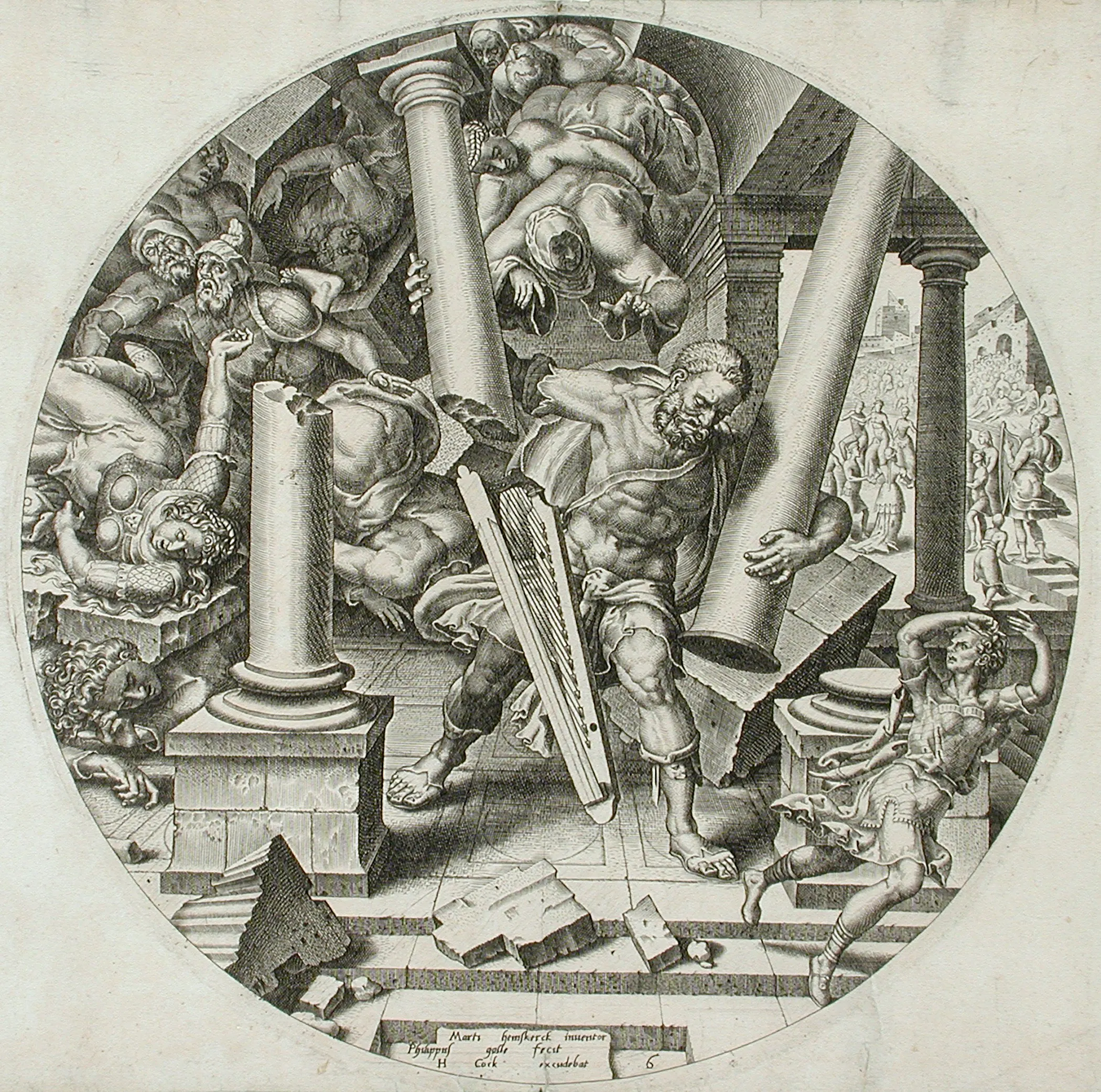
In this sixteenth-century Dutch engraving from the Story of Samson series, the collapsing temple visualizes the self-destructive violence that made Samson the unavoidable test case for Loccenius's discussion of whether a shipmaster might destroy his own vessel rather than surrender. Precisely because the scene presents a divinely exceptional act rather than an ordinary rule of conduct, it sharpens Loccenius's insistence that Samson's precedent cannot license deliberate destruction for a hoped-for good. Source ↗.

The closing chapter on jurisdiction and process draws the practical consequence of the sea's peculiar conditions for the shape of maritime justice. Citing Caesar, Loccenius grounds the demand for expedited process in the nature of the subject matter: maritime affairs have a swift and unstable motion, Res maritimæ celerem & instabilem motum habent. From this maxim flow the chapter's characteristic accommodations — arbitration conducted at sea, storm admitted as lawful cause of absence among the recognized causae forticae, and a relaxed law of proof that in wreck cases admits the testimony even of crew and children — all of them adjustments of ordinary procedure to the urgency and instability that seafaring imposes. The treatise then reaches its terminus in a figure that gathers the whole enterprise into a single nautical image: thus far, then, having been engaged in the maritime argument, now at last we see land, Hactenus ergo in argumento maritimo versati, nunc tandem terram videmus. SOLI DEO GLORIA. FINIS. The metaphor of sighting land after a long voyage closes Book III on a note of accomplishment, and the concluding doxology sets the whole labor of maritime jurisprudence within the frame of divine glory that had disciplined its every rule.
Frequently Asked Questions
What is Johannes Loccenius's De iure maritimo et navali libri tres?
It is a systematic Latin treatise on the law of the sea and of shipping, published at Stockholm in 1651 from the press of Johannes Janssonius the Younger. Organized in three books, it moves from the public-juridical status of the sea and the right of navigation, through the law of ports, admiralty, insurance, and the maritime loan, to the private law of maritime contracts, delicts, and procedure. Its governing conviction is that the law of the sea is public law, resting on natural equity and answerable to the wealth of commonwealths, tested throughout against the fourfold standard of natural, gentile, divine, and civil law.
Who was Johannes Loccenius?
Johannes Loccenius (1598–1677) was a German-born jurist and philologist resident at the University of Uppsala, who became Swedish royal historiographer (Rikshistoriograf) in 1651, the year his maritime treatise appeared. He composed the work during the late 1640s and issued it under Queen Christina, amid the consolidation of Swedish printing and Sweden's command of the Baltic. His broader output included histories and antiquarian works. The authoritative record of his life is the Swedish biographical entry, which the sparse Anglophone record does not match.
Why did Loccenius rank the medieval Laws of Wisby beside the ancient Rhodian Sea Law?
He sought to demonstrate that the Nordic world possessed its own maritime jurist and its own canonical sources rather than being a regional curiosity. He remarked that the maritime Laws of Wisby hold nearly the same authority today that the Rhodian Laws once held — a comparison made audacious because the lex Rhodia de iactu had been rendered canonical through Digest 14.2. The hedging adverb "nearly" (ferme) registers a scholar's caution, but the direction is unmistakable: a Baltic customary source is claimed as a normative source of classical dignity, furnishing the northern seas with authority of their own.
What did the treatise say about entering a shipping partnership with a Jew?
Loccenius held that a naval partnership contract entered with a Jew "has the appearance of evil" and forms "an altogether great and close conjunction," conceding the licitness of ordinary buying and selling while condemning the intimacy of partnership. His reasoning turned on the character of societas as a quasi-fraternal bond fusing fortunes and persons rather than a discrete exchange. Advanced through Dedekennus, Müller's Judaismus, and the Jena theological faculty, the position stands within the Lutheran casuistical polemics of its moment and is recorded here as it stands in the text.
Is there an English translation of De iure maritimo et navali libri tres?
No modern-language translation has been identified, and no monograph has been devoted to the work. The nearest sustained Anglophone engagement tracks its afterlife in English admiralty and insurance jurisprudence rather than translating it. Separately, the Leo edition presents the full transcription and a complete English translation for the first time; this translation is generated by AI. Leo is an effort to make freely available online, at no cost, English translations of every text printed in Latin in early modern Europe between 1450 and 1750.
This report was generated by an advanced AI assistant that conducted deep research alongside an extensive interpretation of the transcribed original text. Every effort has been made to preserve fidelity to the source and to guard against inaccuracy, but corruption in the text recognition process and model hallucination may nonetheless have entered the text. Treat every claim, quotation, translation, and citation as provisional, and verify each against the original source before relying on or citing it.
Bibliography
- Bederman, David J., The Classical Foundations of the Modern Law of the Sea: A monograph tracing the Roman-juristic substructure of early modern maritime law; indispensable for situating Loccenius's deployment of the lex Rhodia de iactu (Digest 14.2) and the actio exercitoria within the humanist reception of Roman jurisprudence. It supplies precisely the classical genealogy against which Loccenius's audacious promotion of the Laws of Wisby must be read.
- Britannica, Laws of Wisby: A compact reference entry on the medieval sea-law compilation that Loccenius ranked beside the Rhodian law. Useful as a first orientation to the corpus whose normative elevation is the treatise's boldest single claim, though it will not satisfy the reader who wants the philological detail.
- GW Law Library, The Laws of Wisby — Maritime Law Exhibit: An institutional exhibit page assembling the textual and bibliographic basics of the Wisby laws. It is the quickest route to seeing why a mid-seventeenth-century Swedish jurist would stake so much on a Baltic customary source of contested authority.
- Grewe, Wilhelm G., The Epochs of International Law: The standard narrative history of international law, translated by Michael Byers; it furnishes the indispensable framing of the Grotius–Selden quarrel over mare liberum versus mare clausum within which Loccenius's dominion argument sits. Grewe treats the Nordic voices as marginal, which is exactly the marginality this account tries to correct.
- Kennefick, Conor, "English Law's Encounters with Sweden's Loccenius," Stockholm Centre for Civil Law Studies Working Paper: The most direct sustained Anglophone engagement with the maritime treatise, tracking its afterlife in English admiralty and insurance jurisprudence from the late eighteenth century onward. For a work with no dedicated monograph, this is the closest thing to a specialist study and the natural starting point.
- Lindblad, J. Niklas, and Jan L. van der Woude, "Seventeenth-Century Sweden and the Dominium Maris Baltici: A Maritime Empire of Law," Itinerario: Places the treatise within the juridical ideology of the Swedish Baltic empire, showing how dominium maris was reconceived as a northern-juristic entitlement distinct from Iberian or English claims. It supplies the political backdrop that Loccenius himself is careful to translate into civilian rather than imperial rhetoric.
- Loccenius, Johannes, De iure maritimo et navali libris tres (Google Books digital surrogate): A freely accessible digital copy of the treatise itself, useful for verifying the Latin passages quoted throughout against the original pagination. The reader who wants to check whether ferme really hedges the Wisby claim can do so here in minutes.
- Molloy, Charles, De jure maritimo et navali: or, A Treatise of Affairs Maritime and of Commerce: The English common-lawyer's near-contemporary counterpart, sharing Loccenius's very title in translation and offering a revealing contrast in method and confessional temper. Reading the two side by side clarifies what is distinctively civilian, and distinctively Lutheran, about Loccenius.
- Münchener Digitalisierungszentrum, Search results for "loccenius iure maritimo": The Bavarian State Library's digital gateway to its holdings of the treatise and related maritime-law texts. The place to consult the BSB surrogate whose eighteenth-century binding wear testifies to the work's active academic use.
- Riksarkivet, Johannes Loccenius — Svenskt Biografiskt Lexikon: The authoritative Swedish biographical entry on Loccenius, covering his German origins, his Uppsala professorships, and his appointment as royal historiographer. It is the indispensable reference for the life behind the treatise, and the corrective to the sparse Anglophone record.
- Soyer, Olivier, "The lex Rhodia de iactu and the General Average Doctrine in Modern Maritime Law," Journal of Maritime Law and Commerce: Traces the Rhodian Sea Law's transmission into the Corpus Iuris Civilis and its early-modern reception, essential for reading Loccenius on jettison and contribution. It lets one measure the exact distance between the canonical Rhodian source and its would-be Baltic rival.
- University of Pennsylvania Libraries, Kuricke, Reinhold, 1610?-1667: A bibliographic index to the works of Reinhold Kuricke, whose De adsecurationibus diatriba traveled bound with Loccenius in the Heineccius collection. Useful for reconstructing the company the treatise kept once it entered the omnibus tradition of civilian maritime jurisprudence.
- Wikipedia, Dominium maris baltici: A serviceable overview of the Swedish doctrine of Baltic maritime supremacy that forms the treatise's ideological horizon. It gives the non-specialist the political vocabulary — Baltic dominion, great-power ambition — that Loccenius so studiously recasts in the neutral idiom of Roman law.
- Wikipedia, Jan Janssonius: A biographical sketch of the Amsterdam-and-Stockholm printing dynasty responsible for the 1651 editio princeps. Helpful for placing the physical book within the commercial print culture that carried Swedish learning into the wider European market.
- Wikipedia, Johannes Loccenius: The most accessible English-language summary of the author's career and output, covering the histories, the antiquarian works, and the maritime treatise together. A reasonable orientation for the newcomer, best cross-checked against the Svenskt Biografiskt Lexikon entry above.
- Wikipedia, Laws of Wisbuy: A short account of the Wisby sea laws under an alternative spelling, noting their disputed origins and their circulation in the Baltic and North Sea. Read alongside the GW and Britannica entries, it exposes just how contestable the "authority" Loccenius claims for them actually was.