The Baker Summoned to the Study: Guillaume Budé's On the As and Its Parts: Five Books on Roman Coinage, Weights, and Measures
In 1515 the royal librarian to Francis I published a folio on the Roman as — the humble copper penny of antiquity — and turned it into a weapon. Guillaume Budé's De asse et partibus eius libri quinque weighs surviving coins, measures cubic vessels, and interrogates a Parisian baker on his grain, all to prove that a single misread inflection in Pliny had inflated the scale of Roman public finance a hundredfold; from that correction it widens into an assault on debased coinage, clerical avarice, and the warlike pontificate of Julius II. It matters because it founded the historical study of ancient coinage and metrology as a discipline governed by evidence rather than deference, and because it dared to enthrone the numen of Truth above every ancient and ecclesiastical authority alike.
ExLatinis
July 23, 2026
Contents
In 1515 the royal librarian to Francis I published a folio on the Roman as — the humble copper penny of antiquity — and turned it into a weapon. Guillaume Budé's De asse et partibus eius libri quinque weighs surviving coins, measures cubic vessels, and interrogates a Parisian baker on his grain, all to prove that a single misread inflection in Pliny had inflated the scale of Roman public finance a hundredfold; from that correction it widens into an assault on debased coinage, clerical avarice, and the warlike pontificate of Julius II. It matters because it founded the historical study of ancient coinage and metrology as a discipline governed by evidence rather than deference, and because it dared to enthrone the numen of Truth above every ancient and ecclesiastical authority alike.
In 1515, from the Paris press of Josse Bade, there appeared a folio treatise whose subject — the Roman as, the humble copper unit of ancient coinage, together with its fractions, weights, and measures — seems at first glance a matter for the antiquary's cabinet rather than the historian's attention. Its author, Guillaume Budé (Paris, 1467/1468–1540), was no idle collector of curiosities but one of the great scholar-officials of the French Renaissance: magister libellorum supplicum in the Parlement de Paris, royal librarian to Francis I, and the moving force behind the trilingual college that would become the Collège de France. The De asse et partibus eius libri quinque — On the As and Its Parts: Five Books on Roman Coinage, Weights, and Measures — was composed in Paris between 1513 and 1515, in the charged interval spanning the death of Louis XII and the accession of Francis I, and it belongs to the genre of humanist antiquarian scholarship even as it strains that genre's boundaries at nearly every turn.
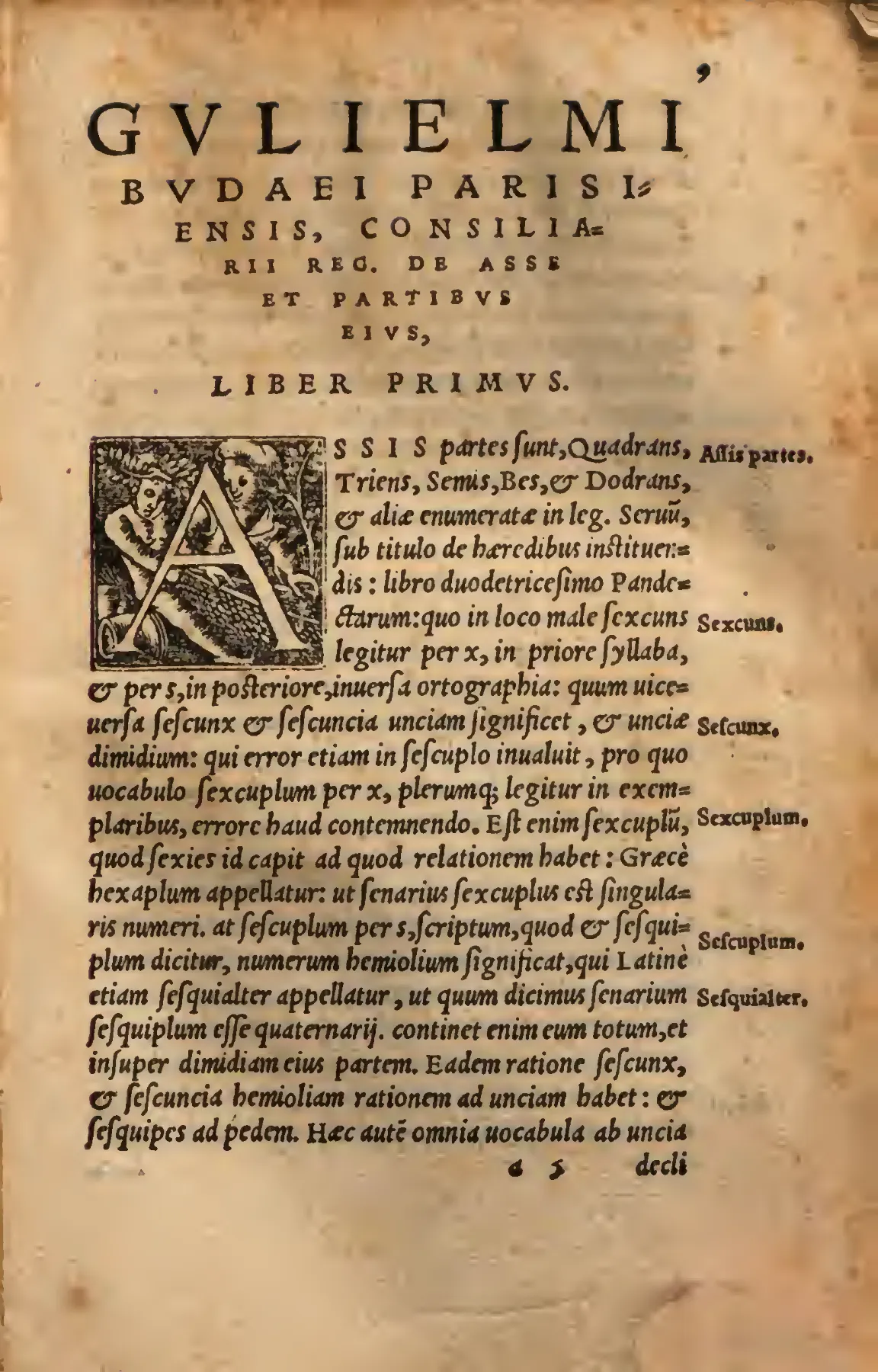
The opening of Book I grounds the fractional vocabulary of the Roman as in a title of the Digest rather than in numismatic curiosity alone, with Budé named royal councillor in the display heading above. The historiated initial and dense printed marginalia frame the treatise's characteristic procedure, in which legal citation, metrological terminology, and philological correction serve the pursuit of historical truth. Source ↗.
The intellectual problem Budé sets himself is deceptively narrow. The numerals transmitted in the classical texts are corrupt, the received authorities inconsistent with one another, and the value of ancient money therefore irrecoverable by mere deference to Pliny, Columella, or Suetonius. Budé's response is a single, insistently repeated move: to subordinate every authority, however venerable, to Veritas — the sovereign power of Truth — and to reconstruct the ancient monetary world by two disciplined means, the weighing of surviving coins and the measuring of cubic vessels on the one hand, and rigorous textual emendation on the other. No ancient writer, he holds, is sacrosanctus; even the most learned men, to whom nearly everything is owed, may have erred a hundredfold. The whole edifice turns on what he himself names the cardo totius operis, the hinge of the entire work: whether a single inflected form in Pliny is read as a substantive genitive plural or as an adverbial multiplicative, a grammatical decision that shifts the scale of Roman public finance by an entire order of magnitude.
What gives the work its lasting interest is the way this metrological core refuses to stay contained. From the settled valuation of money Budé widens outward, again and again, into terrain no numismatist need enter: the debasement of coinage as institutionalized avarice, the law of usury and interest, the fiscal machinery of Roman vectigalia and Persian satrapies, the neglect of letters by nobility and clergy, and — most combustibly — a sustained denunciation of clerical wealth, simony, and pluralism, crowned by an assault on the warlike pontificate of Julius II. The disciplining of received authority by empirical and philological truth thus becomes a general instrument, extended from numismatic fact into moral, ecclesiastical, and national critique. The treatise closes on a patriotic and religious note, dedicated not to any single patron but to the genius of France, with its hope resting on the promise of the new reign.
Several features a first-time reader will most want to know are present in full. The dedication to the genius Franciae rather than to a human patron is a gesture unusual in early-modern practice, signalling a labour offered to the kingdom as a whole. The work declares and enacts an experimental method — Budé kept a balance and small weights before him as he wrote, and interrogated a baker on the measure of grain — that would make the De asse the founding text of the historical study of Roman coinage, weights, and measures, standard in its field for roughly a century and cited by every serious successor down to the great nineteenth-century corpora. It aligns its critical posture explicitly with the ancient Ephectici, the Pyrrhonian skeptics who suspended judgment while still acting, and it closes with a dialogue between Budé and his intimate François Deloynes, a magistrate of the Parlement who is a historically attested figure and no fiction of the form. The anticlerical passages later drew the attention of the papal Index expurgatorius of 1559.
Budé's own religious position — whether Erasmian evangelical, conciliarist, proto-Reformed, or specifically Gallican — remains genuinely open, and the dating of the more pointed anticlerical insertions has been reopened by recent scholarship rather than settled. What is not in dispute is the coherence of the throughline that binds the work's conceptual vocabulary to its production and its argument alike: the as as the metrological ground of Roman public life, veritatis numen as the sacralized authority that licenses the emendation of antiquity, and philologia as the comprehensive humanist culture whose standards govern the whole. Around that spine the treatise gathers numismatics, law, moral philosophy, ecclesiology, and a defence of French ingenia into a single, unmistakably ambitious performance.
Read the full text and English translation on Leo
This text was transcribed and translated as part of the ExLatinis project, an effort by Leo to make free English translations of every text published in Latin in early modern Europe (1450–1750) available online. The complete transcription and English translation of this work can be read free of charge:
→ Read the original Latin text and full English translation on Leo
You can save a copy of this document into your Leo account to run deep text searches, conduct further analysis, or cross-reference it with your own research.
Assigning an English Title and the Three Governing Terms of the De asse
Editorial English Title (supplied for convenience): On the As and Its Parts: Five Books on Roman Coinage, Weights, and Measures.
Conventional Latin Title: De asse et partibus eius libri quinque.
Imprint Title (1542 Gryphius issue): Gulielmi Budaei Parisiensis … De asse et partibus eius libri quinque.
There is no settled English convention. The rendering above is supplied editorially to convey the work's scope and does not correspond to any historical English title page.
Philological Framing.
The treatise turns on three Latin terms whose early-modern semantic field differs markedly from any modern historiographical translation, and each must be read against its sixteenth-century horizon rather than through the lens of later economic or numismatic discourse.
First, the as — with its oblique plural assis — is, in Budé's handling, the foundational Roman copper unit from which all higher denominations of the res nummaria are computed. Its significance, however, is not exhausted by monetary function. Within the argument of the five books, the as becomes the metrological ground on which the entire edifice of Roman public finance, military stipend, taxation, and provincial revenue is reconstructed. The textual crux from which the whole inquiry springs, and which Budé himself names the cardo totius operis, is the inflection of a single noun in the elder Pliny: whether sestertia in certain passages is to be taken as a substantive genitive plural (one hundred thousand sesterces) or as an adverbial multiplicative (one hundred thousand times), the resolution of that grammatical ambiguity shifts by an entire order of magnitude the scale of Roman fiscal magnitudes. Budé states the stakes without disguise, framing the whole enterprise as turning on a single distinction, hoc est enim caput eius rei quam agimus, hic cardo totius operis, hæc deniq[ue] alea ancipitis incepti, ut ostendere aggrediamur uel demonstrare potius, quid inter festertia centu[m], & festertium centies intersit — this being the head of the matter, the hinge of the whole work, and indeed the hazard of a doubtful undertaking, namely to attempt to show, or rather to demonstrate, what stands between sestertia centum and sestertium centies. The philological correction of one inflected form is therefore presented not as a textual curiosity but as the recovery of the true magnitude of Roman economy. The semantic stretch of assis in this text therefore exceeds numismatics in any modern sense: it names the unit that, once correctly understood, restores the proportion of Roman public life.
Second, veritatis numen. Budé, in a celebrated programmatic passage, enthrones the numen — the sovereign, quasi-sacred power — of Truth above every ancient textual authority, including the canonical Greek and Roman authors themselves. He states the principle in his own terms, holding that neither Pliny's authority nor that of any of the ancients should be so sacrosanct that fair and honest judges forget the ever-present divinity of Truth, ego (quod ad me attinet) non usqueadeo sacrosanctam Plinij autoritatem, ac ne cuiusquam quidem antiquorum, debere esse censeo, ut non præsentissimum Veritatis numen fuisse semper foreq[ue] apud æquos bonosq[ue] iudices memincrimus. So central is this posture to the work's self-understanding that its own analytical apparatus names it flatly, recording that the divinity of Truth is more sacrosanct to Budé than all writers, Veritatis numen Budæo sacrosanctius omnibus scriptoribus. Numen in classical usage is reserved for divine power; Budé's transfer of the term to Truth transposes the philological enterprise into a theological register. The move is deliberately provocative: it licenses the emendation of antiquity in the name of a higher authority, and it positions the philologist not as the servant of ancient texts but as their judge. The term must therefore be heard neither as a Renaissance personification nor as a modern epistemological abstraction, but as a sacralisation of the critical enterprise itself, consistent with the Erasmian and conciliarist circles in which Budé moved.
Third, philologia. Budé claims never to have deserted the signa Philologiae, the standards of philologia, insisting that no one ever saw him, though he earned his pay through so many terms of service to Minerva, desert those standards through the blandishments of gain and ambition, Neque enim tot stipendijs Mineruæ faciendis æra unquam merentem me, nec quæstus ambitusq[ue] blandimentis à signis Philologiæ quisquam uidit emansitantem. The term in this text is not the post-Renaissance "philology" of textual criticism, but the broader Renaissance philologia that encompasses Greek and Latin letters, mathematics, antiquarian knowledge, and moral reflection. To read Budé's signa as the criteria of a method, in the sense that nineteenth-century Altertumswissenschaft would later give the word, would narrow the term beyond recognition. In Budé's mouth, philologia designates a comprehensive humanist culture whose standards govern the recovery of antiquity in all its dimensions — linguistic, metric, institutional, and moral. The three terms together — as/assis, veritatis numen, philologia — locate the work at the intersection of numismatic reconstruction, sacred criticism, and encyclopedic humanist culture.
What the De asse Argues: Genre, Date, and the Sestertius Thesis
Genre and substance. The De asse et partibus eius libri quinque is a learned Latin treatise in five books on Roman coinage, weights and measures. It is set in the genre of humanist antiquarian scholarship but is unusual in its scale: alongside the numismatic and metrological exposition it carries substantial philological, juridical and moral-political digressions, including a sustained denunciation of the warlike pontificate of Julius II and of clerical avarice more broadly. The metrological core does not remain self-contained: from the valuation of money the work widens outward into the disciplining of authority by truth across moral, fiscal, and ecclesiastical questions alike.
Authorship, place and date. Author: Guillaume Budé (Paris, 26 January 1467/1468 – Paris, 22/23 August 1540), magister libellorum supplicum in the Parlement de Paris, royal librarian to Francis I, and the principal instigator of the Collegium Trilingue (later Collège de France). The treatise was composed in Paris between 1513 and 1515, on the eve of the death of Louis XII (1 January 1515) and the accession of Francis I; its composition thus falls in the brief interlude in which the political circumstances that the book presupposes were still in flux. The text registers that turning-point directly, marking the change wrought when King Louis was taken away on the Kalends of January, sublato rege Ludouico [reading uncertain] tanta uno die / utatio rerum facta, ut qui prius digito coelum attingere — so great a change of affairs made in a single day that those who had before hoped to touch the sky with a finger now seemed to creep low upon the ground.
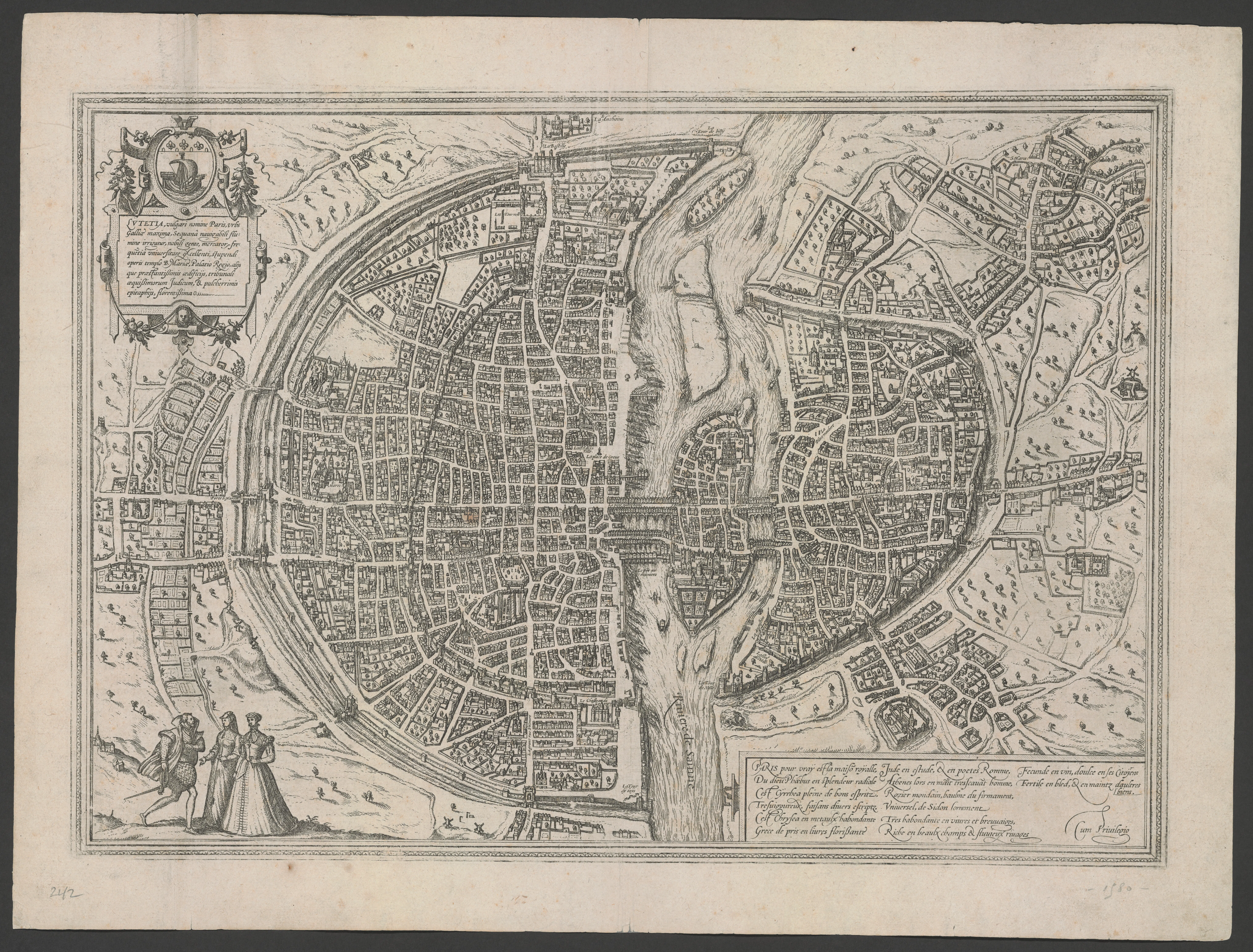
Braun and Hogenberg's 1574 city view frames Paris as the dense civic and institutional landscape in which Budé's De asse had been conceived decades earlier: the world of Parlement service, royal patronage, and humanist print. Though later than the treatise's composition, the plan gives form to the capital whose learned resources Budé set against the assumption that Italy alone could mediate the ancient past. Source ↗.
Language and translation status. The work is written in Latin, with extensive quotation of Greek authors in Greek type. Budé is explicit about why he reproduces his Greek sources verbatim rather than in Latin paraphrase alone, fearing that if he offered only his own Latin renderings he would make the credibility of nearly incredible matters too uncertain for his readers, tu uerò si Latina à me facta tantumodo proferrem, ueritus sum ne rerum penè incredibiliu[m] fidem lectoribus parum certam facerem. No complete translation into a modern language has been identified; partial translations and excerpts appear in the critical-edition programme associated with Luigi-Alberto Sanchi's 2018 edition of Books I–III for Librairie Droz. Earlier abridgements include Budé's own French epitome prepared for non-Latinist readers.
Core thesis. The recovery of the true scale of Roman public finance, military pay, taxation and provincial revenue depends upon a single philological correction: the inflection of sestertia in Pliny and analogous loci must be read as an adverbial multiplicative rather than as a substantive genitive plural. Once this cardo totius operis — the hinge of the whole work — is set right, and verified by weighing extant coins and by the experimental measurement of grain, water and the Roman foot, the whole architecture of Roman fiscal magnitude can be recomputed, and the contrast with contemporary clerical wealth thrown into sharp relief.
The De asse and the Founding of Numismatic Scholarship
Why this text matters. The De asse is the foundational document of the historical study of Roman coinage, weights and measures as a controlled discipline. Before Budé, the topic was the province of glossators and commentators; after Budé, it was reorganised around the experimental and philological method that he instantiated — weighing extant coins against contemporary standards, measuring the Roman foot and the modius cast, and submitting the canonical texts to critical emendation. That experimental posture is declared in the text itself: Budé reports that, the more exactly to weigh everything, he kept a balance and small weights in view along with quite many ancient gold and silver coins, Ego cum hæc proderem, quò magis exaetè omnia perpenderem, libellam & ponduscula in conspectu habui, nomismata que antiqua aurea argenteæ que / satis multa. The work remained the standard treatment of Roman metrology for roughly a century and was directly cited by every subsequent writer on the topic, from the late sixteenth-century Italian and French treatises down to the editorial prefaces of the major nineteenth-century corpora of Roman inscriptions and coins. Its standing as the founding text of the discipline is not in dispute.
Humanist textual criticism. Within the programme of humanist textual criticism, the De asse sits alongside Ermolao Barbaro's Castigationes Plinianae and the Adnotationes of Politian and Valla as one of the canonical monuments of the assault on the authority of the fifteenth-century Italian commentators. Budé's central argument — that a single grammatical inflection in Pliny, once corrected, restores the true scale of Roman fiscal magnitudes — supplied the practitioners of the respublica litteraria with their most legible parable of the method, and it rested on his frank estimate of the fragility of the manuscript tradition, so unstable being the reliability of the exemplars in transmitting numbers, adeò fluxa fides est exemplarium in numeris tradendis. The corollary he draws is that even the most learned are not beyond correction; he dares to affirm that men of the greatest learning, to whom nearly everything is owed, have erred by the whole heaven, that is, a hundredfold, Audeamus deniq; primi (quando eò uentum est) affirmare, homines doctissimos, quibus alioquin omnia propemodum debemus, toto (ut aiunt) cælo, id est, centuplicatò errasse. The programmatic justification of this licence is stated as a claim about the very possibility of scholarly advance: if scholars never departed a nail's breadth from received authors, posterity would have nothing to add to the discoveries of its ancestors, Quòd si semper in autorum quantumuis receptæ autoritatis uer ba adacti, ne unguem quidem latum ab eorum dictis recesserimus, nihil habebit utique posteritas quod inuentis maiorum suorum addat. The same audacity is displayed in the juridical sphere, where Budé prides himself on having dared, as the saying goes, to violate Minerva at Athens — that is, to challenge Accursius' authority among the most expert jurists, ausus ipse Mineruam (ut aiunt) Athenis uiolare, id est Accursij autoritatem inter iurisperitissimos obtrectare, quæ summa et optima pars est nostrorum magistratum. The opening pages of the work, with their programmatic enthronement of veritatis numen above every ancient textual authority, were repeatedly excerpted and anthologised by later humanists as the classic statement of critical principle.
Skeptical and religious alignment. The explicit alignment of Budé's method with the ancient Ephectici — the Pyrrhonian skeptics who suspended judgment on every impression while still acting — and the programmatic declaration that no ancient author is sacrosanctus place the De asse within the broader early-sixteenth-century reassessment of ancient authority. This is the same intellectual current that informs Erasmus's Adagia and his scriptural labours, and it is the textual correlate of the religious position that the Council of Basel had articulated and that the Pragmatic Sanction of Bourges had translated into French ecclesiastical law. The De asse's anticlerical and antipapal passages are therefore not ornamental excrescences but the political articulation of the same critical posture — the same subordination of received authority to truth carried from the numismatic into the ecclesiastical field.
Gallican ecclesiology. The denunciation of Julius II and the broader assault on clerical avarice, simony and plurality belong to the discursive field of Gallican ecclesiology as it was constituted in the generation after the Pragmatic Sanction. Budé's censure of the pope is direct, lamenting him as wretched, driven by frenzies, who thought that blind anger's indulgence must be pushed so far, Miserum uerò te tum Iu li, atque intemperijs actu, qui usqueadeo iræ cæcæ indulgedum putaris. His critique of ecclesiastical wealth rests on a juridical construction of church property, holding that such goods ought not be said to have been donated to the clergy but bequeathed to them in trust, a word acknowledging both good faith and the necessity of restoring the property, hæc non eis donata dici debent, sed / fideicem. The memorandum in defence of the Pragmatic Sanction that Budé composed in 1515 at Francis I's request is the political counterpart of the De asse's anticlerical chapters, and the two texts belong to the same conjuncture. The historiographical debate about Budé's religious position — Erasmian evangelical, conciliarist, proto-Reformed, or simply Gallican — remains open. The older scholarship (Renaudet, Delaruelle) tended to assimilate Budé to Erasmian evangelical humanism; more recent work has stressed the specifically Gallican and conciliarist inflection of his position, and the 2018 critical edition by Luigi-Alberto Sanchi explicitly situates the work in this latter frame.
Patriotic programme. Finally, the De asse belongs to the early French humanist defence of French ingenia against Italian cultural supremacy. The opening pages repeatedly insist that the resources for the recovery of antiquity lie as much in France as in Italy — a claim that the topography of Samois-sur-Seine, with Budé's library on the banks of the Seine, materially embodies. The programme rests on a general principle that Budé states plainly, that in letters everything depends upon talent and diligence, not upon birth or clime, Ingenio ac diligentia totu[m] constat in literis, non ge nere aut coelo. This patriotic programme is shared with Budé's other writings and with those of his circle, and it situates the De asse at the head of the specifically French humanist tradition that will issue in the Collegium Trilingue and the Collège de France.
Major scholars and disagreements. The foundational scholarship is Louis Delaruelle's Guillaume Budé: les origines, les débuts, les idées maîtresses (1907), which remains the indispensable starting point. The standard biographical notice is Jean-Marc Chatelain's in the Dictionnaire des lettres françaises and the Contemporaries of Erasmus entry by Jean-Marc Chatelain. The 2018 critical edition of Books I–III by Luigi-Alberto Sanchi (Droz) marks the most significant recent contribution; reviews by Andrew Burnett (International Journal of the Classical Tradition 27, 2020) and Giovannella Cattaneo (Studi Francesi 195, 2019) orient the reader to its achievements and open questions. Two axes of disagreement persist: the depth of Budé's commitment to the reconstruction of Roman fiscal magnitudes (sceptics, following elements of the older tradition represented by H. de Vocht, treat the work as a vehicle for the moral-political agenda; proponents, represented by the more recent Italian and French scholarship, treat the reconstruction as serious in its own right); and the dating of the anticlerical insertions, reopened by Sanchi's 2018 edition, which suggests that more of the polemical material than previously assumed may belong to the first edition of 1515.
The Making of the Book: Editions, the Gryphius Issue, and the Dedication to France
Production and transmission. The De asse first appeared in 1515 from the Paris press of Josse Bade (Jodocus Badius Ascensius), in folio, with a dedicatory epistle addressed to the genius Franciae — a gesture unusual in early-modern dedicatory practice and one that situates the work above any single patron. Budé states the resolution in his own words, having determined to dedicate the book to no single person but to the genius of France, his homeland, quòd nemini uni bunc librum, sed genio Franciæ patriæ que dicare constitui. The book was repeatedly reissued and revised during Budé's lifetime. The Aldine press of Venice issued the work in 1522; subsequent Paris editions appeared in 1522 and 1527; and the text was further revised by Budé himself in editions of 1522 and 1527. The final lifetime redaction is represented by the Paris edition of 1541 (issued under the imprints of Robert Estienne, Michel de Vascosan and Jean de Roigny), which Budé saw through the press in the last months of his life.
The object of the present study is the Lyon Gryphius issue of 1542 (apud Seb. Gryphium), in octavo format, with Gryphius's characteristic roman and italic types and dedicated Greek founts for the verbatim Greek citations. The volume contains the substantial Index rerum et vocum insignium that became a regular feature of the later issues and that readers from the sixteenth century onward treated as a quasi-independent analytical instrument. The text is that of the final lifetime redaction, and the Gryphius issue is the form in which the work reached the broadest continental readership in the mid-sixteenth century.
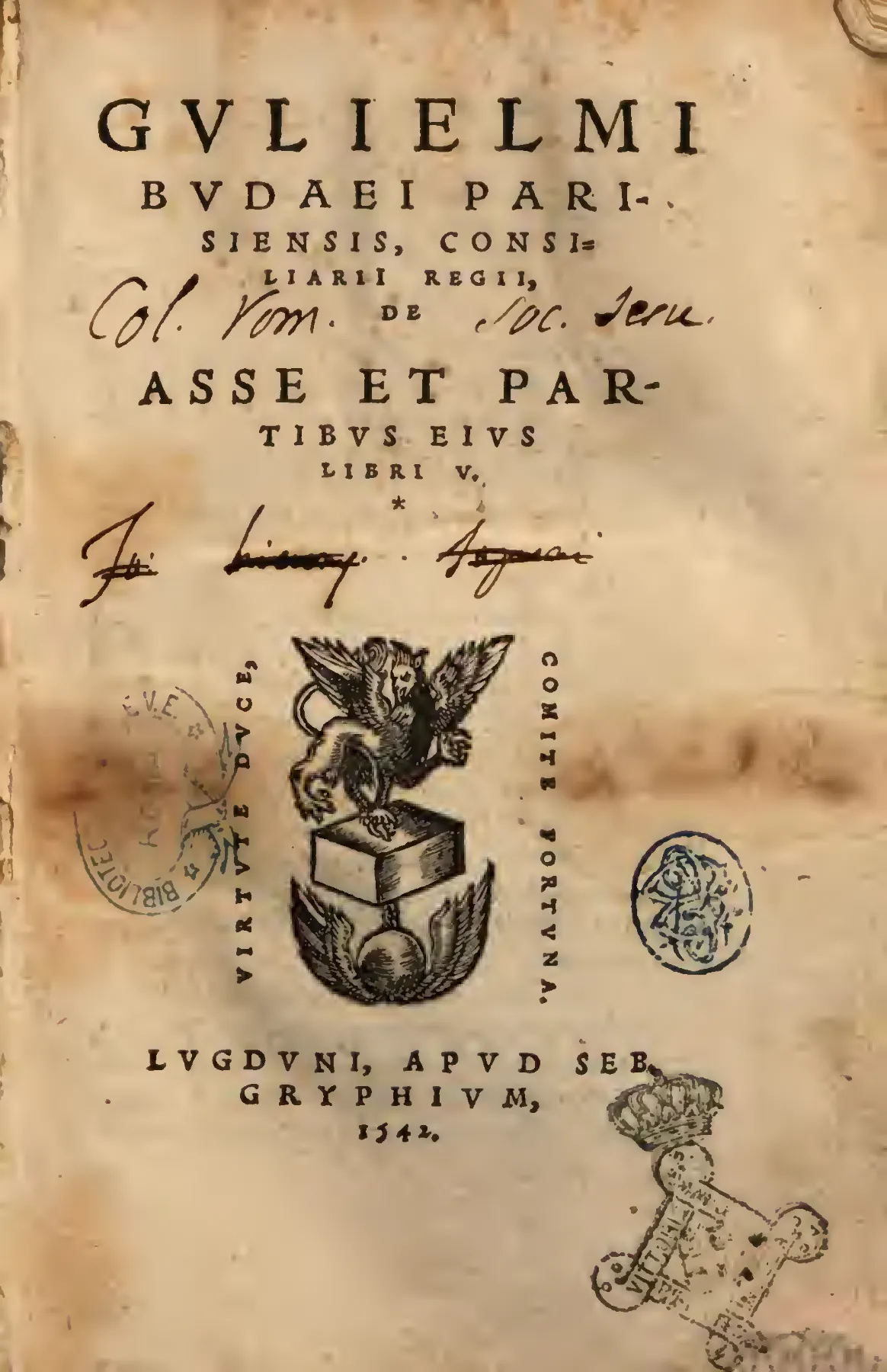
The 1542 Lyon title page presents Budé as "Gulielmi Budaei Parisiensis, consiliarii regii" and announces De asse et partibus eius libri V beneath Gryphius's griffin device and motto, fixing the octavo's authorial and printerly identity at the threshold of the book. Library stamps and later manuscript marks register the long institutional afterlife of the compact Gryphius format that carried Budé's antiquarian economics to a wide mid-sixteenth-century readership. Source ↗.
Material and institutional footprint. Gryphius's octavo was set in his standard roman and italic, with Greek quotations accommodated by dedicated Greek type drawn from the humanist typographical tradition he had inherited from his father and developed in his Lyon atelier. The Index rerum et vocum insignium is present and is paginated as part of the main text sequence. No continuous censorship of the text is recorded in the catalogues consulted, but the work was entered in the papal Index expurgatorius of 1559 specifically on account of the De asse's denunciation of Julius II and of clerical wealth; the censorial apparatus was directed at the anti-papal and anticlerical passages rather than at the metrological substance of the work. (No systematic enumeration of censored loci across surviving copies has been undertaken in the present research; the standard account is that the censorial intervention was selective rather than comprehensive.)
Dedication and closing dialogue. The prefatory address is directed not to an individual patron but to the genius Franciae, the tutelary spirit of the kingdom understood as a quasi-personified entity. The gesture has been read as a programmatic statement that the work addresses the respublica as a whole rather than any private patron, and as a token of the book's claim to a sacred rather than merely antiquarian labour — the same dedication of the enterprise to Veritas and to France that binds the metrological core to the patriotic peroration. That aspiration for the kingdom is stated in the text's closing movement, where Budé confesses he scarcely knows whether anything could be added to the greatness of the realm if honour be shown to letters and learning by the prince and the leading men, ut literis & doctrinæ honos habeatur à / principe & primoribus, haud scio an nihil sit quod addi / ad regni amplitudinem possit. The work closes with a dialogue between Budé and François Deloynes (Franciscus Deloinus), magistrate of the Parlement de Paris and Budé's near neighbour and intimate, in which the materials of the preceding books are recapitulated in conversational form. The figure of Deloynes is historically attested and is not a fiction of the dialogue form.
The milieu and reception. The De asse was composed within a dense network of royal servants and humanist scholars. Guillaume Petit (Guilielmus Parvus), royal confessor and bishop of Senlis; Antoine Duprat (Antonius a Prato), chancellor of France and later cardinal; and Guy de Rochefort (Guido a Rupeforti), another chancellor of France, appear as dedicatees of related epistles, as addressees of letters, or as figures named in the text. Erasmus of Rotterdam acknowledged receipt of the 1515 edition and entered into correspondence with Budé that helped shape the broader program of humanist textual criticism in northern Europe. The dedication of the work to the genius of France rather than to a patron must be read against the politics of the Pragmatic Sanction of Bourges (1438), which Budé defended in an official memorandum of 1515 at Francis I's request; the memorandum and the De asse belong to the same political conjuncture, even though their genres differ.
Place among Budé's works. The De asse stands at the centre of Budé's oeuvre. The Annotationes in Pandectas (Paris, 1508) and the Annotationes in Institutiones apply the same philological method to Roman jurisprudence; the Commentarii linguae Graecae (Paris, 1529) extends it to Greek lexicography; the De studio litterarum (Paris, 1527) and the De philologia (Paris, 1532) articulate the theory of humane letters on which the De asse practises; and the De transitu Hellenismi ad Christianismum (Paris, 1534) translates the philological and moral programme into a history of religion. Read across the corpus, the De asse is the technical demonstration of what the other works preach.
Reading the Five Books: From the Copper Unit to the Divine Word
Preface: The Psychology of Invention and the Dedication to France
Guillaume Budé's treatise opens not with the as but with a meditation on the nature of intellectual drive, a psychological premise that frames the whole labor to follow. It is by nature, he observes, that those who trust in their own capacity fling themselves wholly into a task, NATVRA comparatum esse uidemus, ut qui aliquid efficere se posse confidat, ij ad id aggrediendum, auspicandum, ab soluendum, toto (ut dicitur) pectore totaq; cogitatione incumbant. This is more than a rhetorical warming: by grounding scholarship in a natural impulse toward invention — the same current that leads him to invoke Homer's alphestai, men as seekers and finders — Budé casts the recovery of antiquity as an act of discovery rather than mere transmission, and thereby licenses the critical audacity that the treatise will require of him. That audacity has a documented pedigree, which he states without disguise in the Preface. Recalling his earlier Annotationes in Pandectas, he confesses to having dared, as the saying goes, to violate Minerva in her own Athens — to impugn the authority of Accursius among the most expert jurists, an emendatory boldness in the juridical sphere already discussed in the framing of the work's critical method. The gesture is precise: he presents the De asse as the sequel to a work already transgressive in the juridical sphere, so that the reader meets the new treatise pre-armed against any charge that its emendations are impious. The critical posture, in other words, is not improvised for numismatics but carried over from a prior campaign against a canonical commentator.
The Preface culminates in the dedicatory decision that gives the work its unusual public character, where Budé resolves to inscribe the book to no single man but to the tutelary spirit of his homeland — the dedication to the genius of France whose programmatic force is treated among the materials of the work's production. The choice is programmatic rather than modest: by withholding the labor from any individual patron and offering it to the genius of France, Budé signals that the antiquarian enterprise is a national one, an offering to the respublica as a whole. The stakes of that dedication will detonate later in Book I; here they are planted quietly, alongside the request that his learned judges weigh the case Areopagite-fashion, and the dated subscription that fixes the composition to a moment before the reign that would fulfill its hopes.
Book I: The Foundational Unit and the Enthronement of Truth
With the front matter concluded, the treatise proper begins in the technical register that its title promises, and it does so by immediately grounding the metrological project in a legal source. The opening thesis enumerates the fractional parts of the unit — ASSIS partes sunt, Quadrans, Triens, Semis, Bes, & Dodrans, & aliæ enumeratæ in leg. Scruiu[m], sub titulo de hæredibus instituerdis — anchoring the divisions of the as in a Pandect title on the institution of heirs. The move is characteristic: Budé does not treat coinage as an isolated antiquarian curiosity but as a matter woven through Roman law, so that the fractional vocabulary of the as is at once numismatic and juridical. From this thesis he proceeds into the philological labor that the recovery of the true unit demands, distinguishing the sixfold sexcuplum from the sesquialter ratio and noting the Greek deficiency in the matter — that the Greeks have no way to express sesqui in a single word, Sesqui Græci non habent quomodo uno uocabulo significent. The reduction of the whole edifice to its foundational unit is stated flatly a little later, where he reminds the reader that the as, also called assis, was a coin of one pound weight, As igitur, qui & assis dicitur, ut antea dictum est, libralis nummulus erat. Everything higher in the Roman monetary and metrological system is to be computed from this base.
The metrological exposition does not proceed undisturbed, and its interruptions are where the treatise reveals its true ambition. Before Budé can secure the valuation of coin, he must dismantle the reflex of deference to received authority, and he does so in the work's clearest statement of critical principle. Neither Pliny's authority, he holds, nor that of any of the ancients ought to be so sacrosanct that fair and honest judges forget the ever-present divinity of Truth — the enthronement of veritatis numen above every ancient text already set out in the philological framing of the work. The transfer of numen — a word classically reserved for divine power — to Truth transposes the whole philological undertaking into a theological key, and it does so without softening the demotion of the ancients: they are not sacrosanct, and their authority yields before a higher tribunal. Budé sharpens the point by casting the deference he refuses in the form of a mock statute. He declines to promulgate the law that whatever the first-rank writers said or left among their monuments should carry eternal and sacrosanct authority, Quod Plinius, quod prisci, quod primi meriti scriptores dixerint, scripserint, quâ rem cunq; inter monum[m]eta sua reliquerint, eiusce rei æterna ac sacrosa[m]cta autoritas esto. The parody of legislative formulae — the imperative esto, the piling of verbs — dramatizes exactly the piety Budé means to reject, exhibiting antiquarian reverence as an absurd enactment before dismissing it. In place of that reverence he aligns himself with the Ephectici, the skeptic cunctatores who suspend judgment, so that the licence to emend is grounded in a philosophical stance and not in mere presumption.
This principle is put to work in the philosophical digression on Aristotle's entelechia, where the disciplining of authority is exercised against no less a figure than Cicero. Budé argues that Cicero misconstrued the term as continuous motion, as though the philosopher had written endelechia with a d, meaning continuation, rather than entelechia, which signifies act and perfection, Entelechiam Cicero continuum motum intellexit, quasi Aristoteles endelechiam per d, literam scripserit, id est c[on]tinuationem, & non entelechiam potius, quam actum & perfectionem. The correction hinges on a single letter, and it exhibits the method in miniature: an orthographic slip, once detected, unravels a philosophical misreading transmitted for centuries. That the target is Cicero, and that Budé defends the neoteric Greeks who accused him while dismissing Politian's contrary defense as self-display, confirms that no authority — Roman eloquence itself included — stands above the tribunal of Veritas.
The most sustained departure from metrology is the patriotic polemic that grows out of the quincunx discussion of arboriculture and Budé's own estate at Samois. Here the disciplining of received opinion migrates from texts to a cultural prejudice: the claim that only Italians can be learned and eloquent. Budé locates the root of French backwardness in a social conviction, diagnosing that the chief cause of the error is the nobility's persistent belief that the knowledge of letters is unbecoming to those born to illustrious houses, Caput uerò erroris est, quòd nobilium natio indecoram esse literarum cognitionem claris penatibus ortis, semper existimauit. To refute the corollary — that the Gauls are by nature unfit for eloquence — he summons Strabo's testimony that the whole nation, though warlike, is of candid and simple mind, alioqui mente candida et simplici, et ab improbis moribus abhorrente. Itaq[ue] iniuria lacesiti, conferti coëunt in certamina. The rhetorical architecture is telling: an ancient geographer is enlisted precisely to overturn the modern presumption of Italian supremacy, so that the same subordination of contemporary opinion to verifiable authority that governs the numismatic argument now serves a national defense.
Embedded in this polemic is a moral-political thesis about the fate of rulers, voiced through a theatrical simile. Budé judges that on the day after the funeral there is no difference between a true and perpetual king and a stage-king or the mock-king of the holiday revels, quum postridie funeris inter regem uerum perpetuum que, et diurnum ludicrum que nihil interesse putem, quales sunt aut personati reges in theatro. The figure levels the distinction between real and counterfeit majesty at the point of death: what survives is not the office but memory, and memory is secured only by memorable deeds and the patronage of letters. The passage thus binds the patriotic argument to the dedication — France's genius will be honored, and its rulers remembered, only if learning is cherished — and it discloses the moral logic beneath the antiquarian surface.
Budé is candid that this expansion was not planned. He remarks that what began as a parergon, a diversion from the work he had set himself, swelled through the continuous chain of matters into a complete work, ut ex parergo, id est, operis instituti diuerticulo, plenum opus factum sit. The admission is disarming precisely because it names the compositional principle that governs the whole: the metrological core cannot contain itself, and the digressions are not ornamental but generative, the treatise growing outward from its technical center by an internal necessity.
When the polemic yields and the argument returns to its proper business, it reaches the passage Budé marks as the pivot of everything — the crux he names the head of the matter, the hinge of the whole work, and the hazard of a doubtful undertaking, already identified in the philological framing as the cardo totius operis that turns on the distinction between sestertia centum and sestertium centies. The distinction between one hundred thousand sesterces and ten million turns on whether an inflected form is read as substantive or adverbial, and Budé's language of alea, the die of a doubtful venture, registers that a single grammatical decision governs the entire scale of Roman fiscal magnitude. The payoff of the demonstration is polemical in the same register as the treatise's critical program: Budé dares to affirm, being the first to reach this point, that men of the greatest learning, to whom nearly everything is owed, have erred by the whole heaven — that is, a hundredfold, a claim whose calibrated hyperbole is treated among the monuments of humanist textual criticism. The hyperbole is calibrated to the arithmetic: the error is not incidental but exactly hundredfold, matching the order of magnitude by which the misread inflection distorts every sum. Deference to the learned is thus not merely imprudent but demonstrably ruinous of the truth.
Book II: From Lexicon to Valuation
The close of Book I claims to have settled what the sestertius, the sestertia, and the sestertium severally are, and Book II opens by refusing to let that lexical settlement stand as sufficient. Budé insists that it is not enough to hold the recovered vocabulary of ancient reckoning unless one also gathers its valuation, nisi ut antiqui pecuniæ calculi deprehensa uocabula ego me tenere considerem: sic etiam eorum æstimationem colligerem. The escalation is decisive: the project passes from lexicography to metrological economics, from knowing what the coin-names mean to knowing what they were worth in equivalent contemporary money. The method is then exhibited on a worked example drawn through Plutarch, the fine of Camillus, whose penalty of fifteen thousand asses Budé converts by relating the sum to a reckoning in silver so that it yields one thousand five hundred drachmae, cuius multa quindecim millium assium fuit: qua summa ad argenti supputatione relata, fiunt mille & quingentæ drachmæ. The cross-currency valuation, keyed to a specific historical episode and verified against a Greek source, embodies the discipline that will define the second book: not the identification of coins but the recovery, sum by sum, of the true proportion of Roman public life.
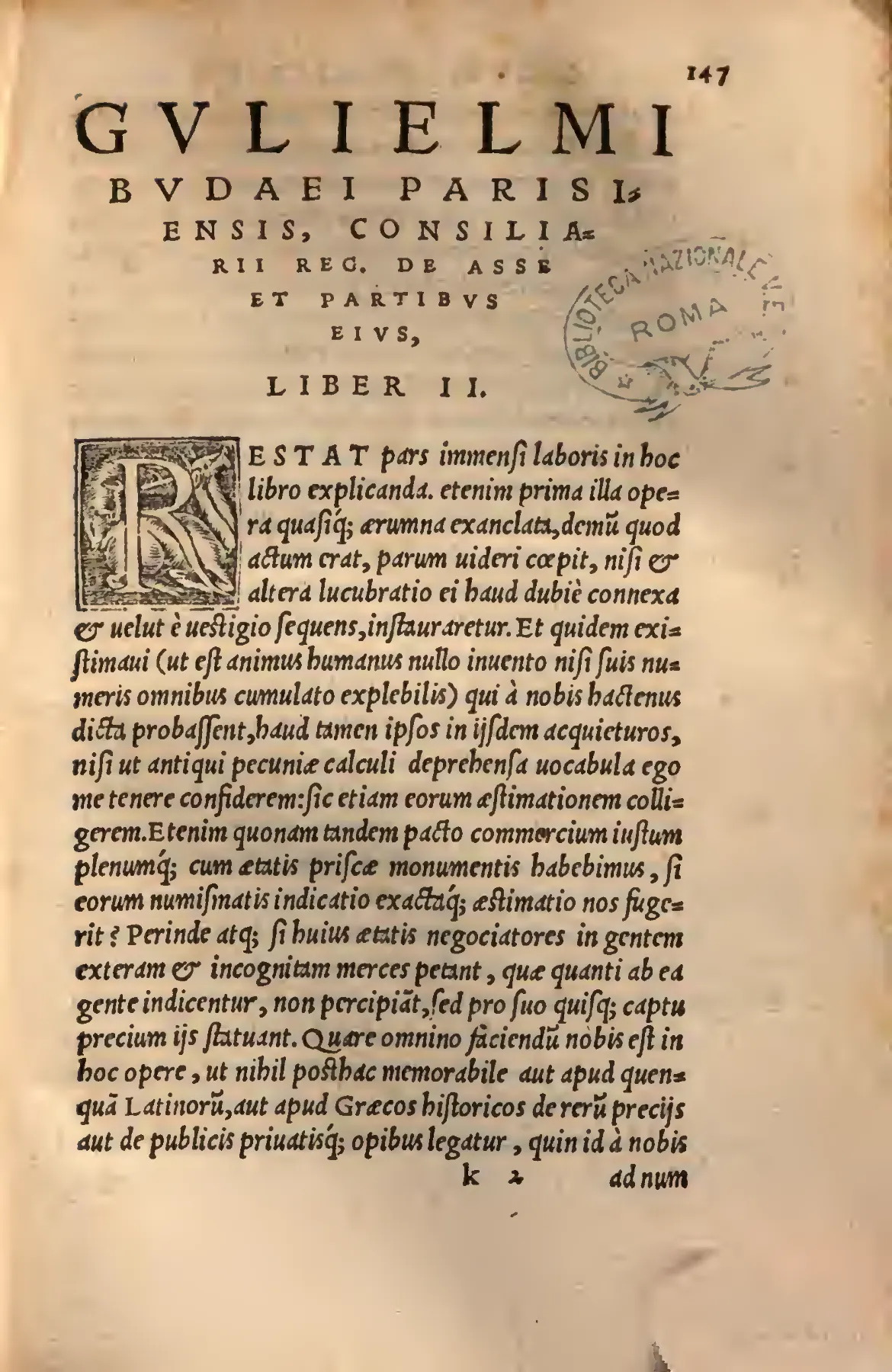
At the opening of Book II, the spaced-capital heading naming Budé royal councillor and the decorated initial mark the moment when De asse moves beyond recovered coin-names to the harder problem of their valuation. A later Biblioteca Nazionale Roma stamp overlays the page, whose printed argument turns monetary knowledge into the precondition for a fuller, more exact commerce with antiquity. Source ↗.
The books that follow enact in fine detail the very subordination of received authority to demonstrable truth that governs the treatise as a whole: here the veritatis numen is made to operate not through programmatic manifesto but through the grinding, cumulative labour of collation, conversion, and physical measurement. The exposition proceeds already mid-demonstration, with the pound established as the container of four hundred sesterces and the immediate promise of a further conversion, qua ratione patet quadringentos sestertios in libra / fuisse. < Sestertijs cætenis aureus æstimatius.> Nunc centum sestertios uno / aureo ualuisse docebo — from which the ratio that four hundred sesterces stood in a pound Budé turns at once to prove that a single aureus was worth a hundred sesterces. The verb docebo is not idle: it announces a demonstration to be conducted, not an authority to be cited, and it sets the register for everything that follows.
The most consequential conceptual move in the opening movement is Budé's dissolution of an apparent contradiction in Justinian's Institutes, where a thousand sesterces rather than a hundred are reckoned to the aureus. Rather than surrender his ratio to the imperial jurist, Budé distinguishes two orders of valuation, arguing that the figure in question is not the fair market rate but one fixed by legislative fiat, æstimatione[m] hoc in loco no[n] / iustam, & ut Græci appellant argyrognomonicam esse, / hoc est à collybo uel nummulariorum taberna petitam, sed / pro arbitrio legem condentis factam — that the valuation in this place is not the just one, nor, as the Greeks call it, the assayer's rate drawn from the collybus or the money-changers' bench, but one made at the arbitrary will of the law-maker. The Graecising coinage argyrognomonica, the silver-assayer's valuation, does precise conceptual work here: it names the empirical, market-tested value against which a merely nominal, statutory equivalence can be set aside. This is a hermeneutic of the first importance, for it establishes that a text — even a legislative one — may record a value that is true as law yet false as fact, and it licenses Budé to hold his metrological reconstruction steady against a source that, read flatly, would overturn it. The same instrument recurs in his handling of the centenarij liberti, where he observes that the class once reckoned by a hundred sesterces is nunc centenarij / dicuntur à centu[m] aureis, now called centenarii from a hundred aurei: the same numeral, a wholly different magnitude, precisely the order-of-magnitude confusion the whole treatise exists to police.
If the argument thus far proceeds by philological distinction, its decisive turn is the passage from text to the physical object. Budé declares that the recovery of ancient value cannot rest on collation alone, and reports that, the more exactly to weigh everything, he kept the instruments of assay before him along with a substantial holding of genuine ancient coin — the balance, the small weights, and the quite many ancient gold and silver coins whose presence before him is recorded among the declarations of his experimental method. The claim is not merely autobiographical colour; it converts the study into a place of experiment, where the corrupt numeral in the manuscript is checked against the mass of the surviving specimen. The payoff arrives when the weighing confirms the very equivalence on which the conversions depend: testing the coins on the balance, Budé writes, cum horum aliorumq[ue] nummorum / pondus ad libellam exigerem, id esse uerum deprehendi / quod autore Plinio diximus, & ex Plutarcho & Appiano / comprobatur, drachmam scilicet Atticam denarij Romani / pondus habere — that when he brought the weight of these and other coins to the balance, he found true what he had said on Pliny's authority and what is confirmed from Plutarch and Appian, namely that the Attic drachma has the weight of the Roman denarius. The epistemic architecture here is worth pausing over: textual authority (Pliny) proposes, the balance disposes, and the concordance of the two — not the auctoritas alone — yields uerum. The scale becomes the tribunal before which Pliny, Plutarch, and Appian are jointly vindicated.
This measured empiricism is bound to an explicit methodological self-consciousness. Budé likens his procedure to that of the exact sciences, declaring it necessary to follow in these commentaries the very method that geometers and mathematicians devised for proving their propositions, eam me rationem in his commetarijs sequi esse necesse, / quam geometra & mathematici in demonstrandis speculamentis / suis instituerunt. The invocation of geometrical demonstration is the theoretical warrant for the docebo announced at the outset: the numismatic argument aspires to the coercive necessity of proof rather than the persuasion of accumulated citation. And because proof of this kind may controvert the greatest names, Budé pauses to justify the correction of the auctores themselves, taking pleasure in recalling the luculent error of the most learned men in arduous matters, Iuuat igitur do / ctissimorum hominum luculentam culpam in rebus arduis / meminisse, non quòd uendibilius inuentum meu[m] ea re fieri / sperem — insisting that he dwells on their manifest fault not in the hope that his own discovery will thereby be made more saleable. The disclaimer is telling: Budé anticipates the charge that error-hunting is self-advertisement and forecloses it, framing the exposure of learned mistake as a service to truth rather than to reputation. On the same page he offers the celebrated concession of his own formation, that such was his fate that he gave much labour to himself and to books but resorted to teachers far more rarely than to barbers, Sed sic fuit fatum meum, ut / mihi tantum & libris operam satis multam, præceptoribus longè rariorem quàm tonsoribus dederim. The autodidact's confession is not incidental to the method: a scholar who owes his learning to books rather than to masters has, by that very fact, no inherited authority to defer to, and the personal circumstance underwrites the intellectual posture of subordinating every teacher to the evidence.
From the settled machinery of valuation the argument widens, as it does across the treatise, into moral and cultural indictment. Surveying the accumulated plunder of the Republic and Principate, Budé reports that the very image of the city rose before his mind as though he beheld a stronghold of the world's despoilers, ea mihi species urbis Romæ animo obuersabatur, quasi arcem quandam expilatorum orbis terrarum uiderem. The figure is developed lexically through the borrowed term cimeliarchium, the sacred strongroom, which he applies to Rome omnium cimeliarchiu[m] (ut uerbo Iustiniani principis utar), as the treasury of all things — a phrase in which the ecclesiastical resonance of the treasure-house sharpens the moral charge that Rome's wealth was gathered by expilation. The same widening carries a lament for the neglect of letters, focused through the price once commanded by an oration of Isocrates: at Athens, the most erudite of cities, a single speech could once be sold for as much as Gaul, richest of provinces yet most destitute of learned men, now reckons worth nothing, Isocrates / Athenis, id est in urbe eruditissima, orationem unam tanti / uendere olim potuit, quanti nunc Gallia prouinciarum loeupletissima, eadem & doctorum hominum egentissima. The antithesis of locupletissima and egentissima — richest in resources, poorest in learned men — turns a numismatic datum into a reproach to Budé's own nation and prepares the patriotic-cultural argument that the treatise carries toward its close.
Book III: Proteus and the Fiscal Present
Book III opens with a set piece that dramatises the recalcitrance of the material. The long labour is figured as a sea-voyage nearly completed when a fresh obstacle intervenes: the voyage partly rowed and partly sailed, and all the reefs seemingly passed, when Pliny unexpectedly laid hands upon him, LONGVM iam iter em[m]esis partim remigio, partim uelificatu, ... Plinius no / bis manus improuisus iniecit; the same page carries the formal division-block that names Budé as royal counsellor, GVLIELMI / BVDAEI PARISIENSIS, CONSILIARII REG. DE ASSB / ET PARTIBVS / EIVS, / LIBER III. The maritime metaphor modulates into the mythological figure that governs the book's central crux, for in wrestling with the corrupt numerals Budé seemed to himself to grapple once more with the sea-god the poets sing under the name of Proteus, marinum illu[m] / deum Protei nomine à poëtis decantatum, retentare mihi / uisus sum. Proteus, the shape-shifter who must be held fast until he yields his truth, is the perfect emblem for a textual tradition whose numbers alter under the reader's grasp; the figure is elsewhere elaborated as the Proteus ille logodædalus, id est uerboru[m] uarietate fallax, the word-cunning Proteus deceptive through the variety of his forms, binding the mythological image directly to the philologist's struggle with variant readings.
The third book's technical apparatus — the assay system, the tolerance of the mint, the refining workshop — becomes the occasion for one of the sharpest political-economic judgements in the treatise. Treating the remedium, the margin of weight and purity that Budé glosses as the term the mint-men use, remedium uiri monetales appellant, he presses the metrological detail into a moral verdict on princely priorities, holding that if princes prosecuted the crimes of debased coinage as fiercely as they prosecute treason, human affairs would be better ordered, Quod si tam animosè principes imminutæ monetæ crimina exercerent, / quàm imminutæ maiestatis exercet, melius cu[m] rebus huma / nis ageretur. The parallelism of imminutæ monetæ and imminutæ maiestatis — diminished coin set beside diminished majesty — is a calculated rhetorical equation, implying that the adulteration of the currency is an offence against the commonwealth no less grave than the crime of lèse-majesté, yet one pursued with incomparably less zeal. Here the disciplining of metrological fact opens directly onto the critique of contemporary governance.
That contemporary horizon becomes explicit in the fiscal digression that maps the ancient revenues onto the French treasury of Budé's own day. He enumerates the heads of royal exaction, reporting that there are among the French three kinds of levy from which the treasury is constituted, the Canon, the Oblation, and the Indiction, tria esse pensitationum genera ex quibus ærarium nostrum constat, Canonem, Oblationem, & Indictionem — a passage of real value for the history of French administration, since it deploys a Late Roman fiscal vocabulary to describe the exactions of the kingdom. The digression is accompanied by an unusually candid observation on the political temper of his countrymen, that such is the disposition of the French that whatever has pleased the prince, or is said to have pleased him, is forthwith believed to be right and lawful, Sic enim sunt Galli homines, ut prout quidque principi aut collibuit, aut collibuisse dictitetur, id perinde ius fasq[ue] esse credatur. The remark cuts two ways — it may register admiration for a people uniquely willing to obey (the Pitharchici of the marginal Graecism), or it may register a subtle disquiet at the collapse of the distinction between the prince's pleasure and the ius fasque, the right and the lawful — and Budé leaves the ambiguity unresolved, so that the same sentence can be read as tribute and as caution. It is precisely this hovering between praise of French obedience and unease at its excess that keeps the fiscal excursus from being mere administrative reportage and makes it part of the treatise's larger meditation on the relation of authority to truth.
The exposition across the latter reaches of Book III holds fast to the method the work has made its signature — the collation of classical testimonia, the correction of their corrupt numerals, and the conversion of ancient sums into contemporary French gold — but it is here that the metrological labour most visibly refuses to remain a merely antiquarian exercise, spilling into moral and political admonition as the sums grow too vast for the received texts to carry unaided.
The section makes the military donativum the diagnostic index of political corruption. Budé presents Pompey's largesse as a figure soon eclipsed and rendered contemptible by the escalating payments of the civil wars, noting that later donatives made the Pompeian one not merely credible but contemptible and unmemorable, those subsequent gifts that authorized legions for civil war, Hoc donatiuum Pompeianum non modò credibile, sed etiam contemnendum nec memorabile fecerunt illa quæ postea secuta sunt donatiua, ad bella ciuilia legiones autorantia, ut posthac ostendemus. The verb autorantia is doing pointed work: the soldiery is not merely paid but bound, its loyalty purchased and its swords licensed for internecine war, so that a numismatic datum becomes an indictment of the mechanism by which the Republic was dissolved. The promise ut posthac ostendemus signals that Budé conceives these fiscal magnitudes as a connected narrative of decay, not a catalogue of isolated figures.
That the whole enterprise rests on unstable textual foundations is Budé's constant refrain, and here he states it with epigrammatic compression, in the observation, treated among the monuments of humanist textual criticism, that so unstable is the reliability of the exemplars in transmitting numbers. The metaphor of fluidity — fluxa fides — captures precisely the peculiar vulnerability of numerals in the transmitted text: figures, lacking the semantic redundancy of words, corrupt silently and irrecoverably, so that the numeral is the point at which the manuscript tradition is least to be trusted and the philologist's independent reckoning most indispensable. This diagnosis licenses the whole apparatus of emendation that follows, and it is enacted with exemplary precision when Budé turns to a Plinian crux on the spoils brought to the mint. Working from an old exemplar in his own possession, he reports that in one of venerable antiquity which was among his own effects it reads thus, of bars of gold fifteen, of silver thirty-five, and in cash five hundred thousand sesterces, which he interprets as forty times a hundred thousand sesterces, In uno autem uenerandæ antiquitatis qui in rebus meis erat, ita legitur, Lateru[m] aureorum x v. arg[umen]teorum x x x v. & in numero hs. ccccc. quod ego interpretor sestertium quadringenties. Here the material witness in Budé's library — the venerable exemplar physically before him — is set against the vulgate and against Orosius, and the disputed reading is resolved by the very grammatical distinction that the work names its hinge: whether the sestertial figure is a substantive quantity or an adverbial multiplicative. The quod ego interpretor asserts the philologist's prerogative to judge among readings, precisely the subordination of received text to critical reckoning that the treatise everywhere defends.
The anxiety attending these reconstructions is not merely textual but rhetorical: the sums are so large as to strain belief, and Budé is acutely conscious that his credibility hangs on his procedure. This is why he pauses to justify his bilingual citation of the Greek authorities, confessing that he feared that if he brought forward only Latin renderings made by himself, he would make the credibility of nearly incredible matters too uncertain to his readers — the concern for the fides of rerum penè incredibilium whose bearing on his practice of quoting the Greeks verbatim is set out among the executive summary of the work. The phrase rerum penè incredibilium is the crux of his methodological unease: the magnitudes he recovers are at the very edge of plausibility, and the verbatim Greek functions as a guarantor, placing the original testimony before the reader's eye so that the burden of belief falls on Herodotus, Strabo, or Appian and not on Budé's paraphrase. The gesture reveals a scholar who understands that in a discipline reconstructing the incredible, the display of sources is itself an argument.
Where the fiscal reconstruction turns most sharply toward the present is in Budé's handling of the orator Hybreas. Narrating Antony's imposition of a fresh tribute on Asia at Ephesus, Budé quotes the orator's protest, that if Antony can exact a second tribute in the same year, then it is fair he can also make them have two summers and two autumns in one year, Si potes inquit, [n]o[n] Antoni alteru[m] uectigal eode[m] anno exigere: illud etia[m] possete æquu[m] est, binas ut eode[m] anno æstates, binosq[ue] etia[m] autu[n]nos habeamus. The argument yokes fiscal exaction to the natural order: tribute is the fruit of the harvest, and to demand it twice is to demand that nature yield twice, an absurdity that exposes the extortion as a violence against the very seasons. Budé does not leave the exemplum in antiquity. He elevates it into a monument for contemporary rulers, declaring it a history truly worthy to be inscribed in a conspicuous place of the palace in foot-and-a-half letters, or rather engraved in bronze, so that both the princes of his own day might remember their duty and those who hold the chief financial office might discharge their functions more innocently and cautiously, Digna uerò omnino historia quæ in regiæ conspicuo loco sesquipedalibus literis proscriberetur, uel in æs incideretur potius, ut & pricipes nostri meminissent quid sui sit officij. The imagined inscription in sesquipedalibus literis — letters a foot and a half high — and the preferred permanence of bronze translate the ancient rebuke into a standing admonition addressed to principes nostri and to the treasury officials of the French crown. This is the point at which the disciplining of authority by truth, which the work performs upon its texts, is turned into a lesson for governance: the metrologist becomes a monitor of princes, and the recovery of Roman fiscal history acquires an explicitly hortatory function.
The constitutional analysis of the Augustan settlement carries a comparable weight, for Budé reads the birth of the principate as a juridical transfer. Rendering Strabo, he records that after supreme power over the empire and perpetual arbitration of peace and war had been conferred on Augustus by the fatherland, he divided the whole dominion into two parts, Siquidem postqua[m] ei à patria imperij summa, & pacis belliq[ue]; arbitrium perpetuu[m] delata sunt, in duas parteis uniuersam ditionem partitus est. The formulation is precise in its legalism: imperij summa and arbitrium perpetuum are conferred à patria, by the fatherland, so that the origin of monarchical power is located in a grant from the res publica, and the ensuing bipartite division of provinces between princeps and populus becomes the administrative expression of that founding transfer. Budé's attention to the legal form of the transaction — power delegated, not seized — reflects the jurist's habit of mind that his annotations on the Pandects had trained, and it supplies the structural scaffolding for the survey of provincial revenue that the reconstruction of imperial magnitude requires.
The moralized portrait of imperial luxury reaches its sharpest formulation in the depiction of Nero, where Budé renders Suetonius on the emperor's philosophy of expenditure: he thought there was no other enjoyment of riches and money than lavishing them, holding those to be sordid and stingy for whom the account of expenses balanced, but truly magnificent those who squandered and wasted, Diuitiarum & pecuniæ fructum non alium putabat, quàm profusionem: sordidos ac deparcos esse, quibus ratio impensarum cōstaret: prælautos, uereq[ue] magnificos, qui abuterentur ac perderent. The passage inverts the very calculus that Budé's own labour embodies: where the treatise devotes itself to the ratio impensarum, the disciplined reckoning of accounts, Nero is made to despise precisely that reckoning as sordidos ac deparcos, and to locate magnificence in its abandonment. The antithesis is exact and pointed, setting the philologist's arithmetic against the tyrant's profusion, so that the moral of sound fiscal reckoning emerges by way of its monstrous negation.
Book IV: Persian Comparison, the Fiscal Reform, and the Assault on the Papacy
The transition into Book IV recasts the whole inquiry in comparative terms, taking Persian tribute as the measure against which Roman revenue is to be gauged. Budé frames the comparison conditionally, noting that if the kings of the Persians are said to have received, by way of tribute, fourteen thousand five hundred talents, whether Attic or Euboic, from Asia only and a few places of Libya, Quòd si reges Persarum quaternadena millia & quingena tala[n]ta uel Attica uel Euboica ex Asia tantum & paucis locis Libyæ tributorum nomine percepisse dicuntur. The careful qualification uel Attica uel Euboica signals that the comparison cannot proceed until the talent itself is metrologically fixed, and it is this necessity that drives the sustained disquisition on the Babylonian, Euboic, Attic, and Aeginetan talents that follows. The comparative structure is characteristic: Roman magnitude is never assessed in isolation but calibrated against an anterior imperial standard.
That the metrological foundation is not everywhere securable Budé freely concedes, and his candour on the ratio of gold to silver is instructive. Having surveyed the ancient testimonia, he concludes that in general he has shown various assay-values of gold, which cause the prices of gold also to vary, and that nothing else can be established, as he thinks, from the reading of the ancients concerning the proportion of gold to silver, In uniuersum aute[m] ostendimus uarias auri indicaturas, quæ auri etiam pretia cuariare faciunt. nec aliud statui (ut arbitror) ex antiquoru[m] lectio ne de auri ad argentum proportione potest. The refusal to fix a single ratio, against the common opinion of a tenfold proportion, is a mark of the same critical temper that the work aligns with the suspensive posture of the ancient skeptics: where the sources do not warrant a determinate conclusion, Budé declines to manufacture one, the parenthetical ut arbitror registering the provisionality of even his negative finding. This methodological honesty coexists with, and disciplines, the ambition of the reconstruction.
The turn to the Persian royal hoards demonstrates the same union of narrative amplitude and textual vigilance. Rendering Quintus Curtius on the treasure of Susa, Budé reports that as soon as Alexander entered the city, he brought out an incredible sum of money from the treasuries, fifty thousand talents of silver, not in coined form but in rude weight, incredibilem ex thesauris summam pecuniæ egessit. quinquaginta millia talentum argenti non signati forma, sed rudi pòdere. The detail that the silver was non signati forma, sed rudi pòdere — unminted, held as raw weight rather than struck coin — is metrologically consequential, for it returns the reader to the fundamental relation between weight and monetary value on which the entire De asse is built, and Budé's accompanying note that millia has dropped from the printed codices by scribal error is a final instance of the numeral-corruption he had diagnosed at the outset. The hoard's magnitude is once again incredibilis, and once again the credibility is secured by the recovery of the true reading.
The Persian and Alexandrian material draws the whole antiquarian apparatus into the service of a single controlling gesture: the subordination of the transmitted text to the reconstructed reading, even against the settled habit of the learned. Budé collates Curtius, Strabo, Arrian, Plutarch and Diodorus on the treasure Alexander seized in the Persian capitals, and where the received figures resist reconciliation he does not defer but emends, observing the older reading and declining to read one hundred and twenty thousand talents against the usage of the learned, but one hundred thousand and twenty talents, uerùm obseruata uetusta lectione, non cen tum & uiginti millia talenta lego, refragante loquendi consuetudine doctorum, sed centum millia & uiginti talenta. The phrase refragante loquendi consuetudine doctorum is the load-bearing element: Budé stakes the reading on the vetusta lectio precisely where the consuetudo doctorum would counsel otherwise, enacting in the numismatic detail the very licence that the work's programmatic pages claim for veritatis numen over any accumulated scholarly convention. The ambiguity of the unit itself is what compels this vigilance, for the talentum refuses to hold still — now standing for a weight, now for a number, now for a coin, Nunc enim pro pondere, nunc pro numero, nunc pro nummo ponitur — and it is the unstable term, not the secure one, that forces the philologist to become the judge of his authorities rather than their servant.
The Persian and Alexandrian material is not, however, mere accumulation of splendour for its own sake. Budé repeatedly wrenches the antiquarian datum toward a moral or political torque. The anecdote of Alexander discharging his soldiers' debts is framed so that the arithmetic of the surplus becomes an ethical proposition: nothing more than a hundred and thirty talents was left over from so great a sum, to such a degree did that army, victor over so many wealthy nations, carry off more of victory than of booty from Asia, nec amplius ex tanta pecunia quàm centum & x x x. talenta superfuere. adeò ille exercitus tot ditissimarum gentium uictor, plus tamen uictoriæ quàm prædæ deportauit ex Asia. The antithesis of victoria and præda converts a numismatic remainder into a lesson about the right disposition of wealth, and it prepares the pivot from Persian magnificence to the mutability that undoes it. That pivot is stated as a general law of the human condition, that when a thing has far overpassed its own summit it at once collapses, with the appended wish that kings would take sufficient note, Sic fert humana conditio, ut cum fastigium suum longè supergressa sit, continuò concidat. Quod utina[m] reges satis animaduer teret. The optative utinam addressed to reges is the seam along which the antiquarian survey opens directly onto contemporary counsel: the fall of Darius is not left in the past but held up as an admonition to living monarchs.
Even the institutional detail of Persian finance is turned to present argument. Where the Persians hoarded bullion rather than dispersing it, Budé reads the practice as a rebuke to a modern economic commonplace, holding that those men seem to him to have been ignorant of this Persian institution who think it is in the interest of the commonwealth that gold and silver vessels be as few as possible in private assessments, Institutu[m] Persarum ignorasse homines ij mihi uidentur, qui censent interesse Reipublicæ, ut uasa aurea & argentea, quàm paucissima in priuatis sint césibus. The gaza of the Persian kings, gazophylacia Persarum, quæ tot seculis congesta ac recondita fuerant, thus becomes the historical ground for a claim about the Respublica of Budé's own day, and the transition into the great courtly digression is achieved not by rupture but by this steady widening of the numismatic datum into political economy.
The fiscal digression itself is where the disciplining of authority by truth is carried furthest from its numismatic origin and pressed most combustibly into national critique. Budé stakes his own fortunes on a concrete reform, daring to promise on the strength of the princely budget and to guarantee it with all his goods that the French people would not merely bear a rightly ordered exaction but demand it as a benefit, Hanc breuiarij principalis constitutione spondere ausim & fortunis omnibus meis cauere, populu[m] Gallicum no[n] modò ferre posse si ei iniugatur, sed etia[m] benèficij loco deposci turum. The rhetorical wager — fortunis omnibus meis cauere — lends the proposal the character of a personal surety rather than an idle speculation, and it is thrown into relief by the testimony of actual exaction that follows. Budé reports that in these years the tributes of the peoples of France have swollen within a single year by successive increments, now by a half, now by a whole further amount, sometimes even by half again, sic actum esse per hosce annos cu[m] populis Franciæ scimus, ut eode[m] anno una & altera accessione tri buta, modò dimidio, modò altero tanto, nonnunqua[m] etiam sesquiplo excreuerint. The precise fractional language — dimidio, altero tanto, sesquiplo — is itself a metrological register, the vocabulary of proportion carried out of the numismatic books and into an indictment of royal extortion, so that the same exactitude that establishes the value of the as now measures the burden laid upon the peasantry. Behind this lies the moral axis Budé makes explicit, the opposition of excessive self-love and public charity, so at variance with one another, Sui autem amor nimius, et charitas publica, tam inter se dissident, which supplies the theological grammar for reading fiscal corruption as a disorder of the soul writ across the commonwealth.
It is within this widened field that the anticlerical polemic erupts, and its placement is significant: the assault on Julius II is not a detachable excursus but the ecclesiastical application of the same principle that emended Curtius and rebuked the French fisc. Budé addresses the pope with an apostrophe of lament, calling him wretched and driven by frenzies, who thought that anger's blind indulgence must be pushed so far — the same censure of Julius II already set among the materials of Gallican ecclesiology. The force of the passage lies in the contradiction it exposes between office and act, sharpened in the image of consecrating hands turned to war: that one who is the head of the priesthood, the master of the clergy, the supreme craftsman of things sacred, should bring himself to arm his consecrating hands, still warm from the altar's service, against the family of the Lord, ut sacerdotum culmè, ut cleri magister, ut sacrorum summus opifex, manus inauguratrices, ab altaris operatu adhuc calentes, in familiam domini armare sustineret.

Raphael's Uffizi portrait of Pope Julius II fixes the Della Rovere pope in the very iconography Book IV turns against him: the red-robed head of the priesthood whose authority is measured against the violence of his pontificate. Set beside Budé's image of "consecrating hands" armed for war, the portrait's still, heavy presence makes the polemic's central contradiction—sacred office against military action—visually immediate. Source ↗.
The detail of hands adhuc calentes from the altar service, redirected to arming against the familia domini, condenses the whole logic of the critique: the sacral title is measured against the profane deed and found wanting, exactly as the venerable text is measured against the reconstructed truth. The digression also names its diagnosis of French military recklessness in a Grecism, the craze for foreigners that the Greeks call Xenomania, that is an excessive and ill-considered zeal for outsiders, eo errore quæ Græci Xenomania appellant, id est nimiu[m] & incosultum externoru[m] studium, while its constructive counterpart is the juridical ideal of equitable distribution, the isonomia that is a balanced apportionment of honours and goods according to the dignity and merit of citizens, quæ est æquabilis honorum bonorumq[ue] distributio, pro dignitate ac merito ciuium temperanda. Against the corruption of patronage Budé even proposes a learned dignity for the Chancellor, whom he would call by the fuller and happier name of Nomophylax, guardian of the law, quem & pleniore & feliciore nomine Nomophylacam appellare possemus — a coinage that projects the humanist ideal directly onto the machinery of the French magistracy.
When Budé recovers his thread and returns to Hebrew, Assyrian and Egyptian wealth, the same critical posture governs his handling of the sacred and the pagan sources alike. His apologetic explanation for the silence of the Greeks on Jewish affairs is put in the mouth of Josephus, who protests that his people neither inhabit a maritime region, nor willingly engage in trades, nor for their sake mingle at all with the commerce of other nations, Nos (inquit) neq[ue] regionem maritimâ ha bitamus, nec negociationibus libētes utimur, nec omnino earu[m] causa, aliaru[m] gentium co[m]mercijs assuescimus. This isolates the classical historians' ignorance as a limit of their knowledge rather than a warrant of their authority, and it licenses the sharpest verdict Budé pronounces upon any ancient writer here, against Tacitus, whom he calls a wicked man born athwart the decrees of Providence, who, serving the sentiment of his contemporaries and not his own judgement, was not ashamed to hand down this instance of a wicked mind, Hominem nefarium Tacitum, aduersisq[ue] placitis prouidentiæ genitum, qui æqualium suoru[m] sensui seruiës, non suo iudicio, prodere hoc exemplu[m] nefariæ mentis non ueritas sit. The reproach that Tacitus followed æqualium suorum sensus rather than suo iudicio is precisely the failure Budé's whole method is built to correct — deference to received opinion over independent judgement. Conversely, the pagan record is admitted where it corroborates sacred truth, as with Tertullian's report of the darkness at the Passion, that at the same moment, with the sun marking the middle of its orb, the day was withdrawn, and those who did not know that this too had been foretold concerning Christ reckoned it an eclipse, eodem momento dies medium orbem signante sole subducta est. Deliquium utiq[ue] putaue runt qui id quoq[ue] super Christo prædictum no[n] scierunt. Most striking in this movement is the theological transfer that lets Budé read Isaiah's Cyrus as providentially anointed, thus says the Lord to my anointed, Cyrus, whose right hand I have grasped, that I may subject nations before his face, Hæc dicit Dominus christo meo Cyro, cuius apprehendi dexteram, ut subijciam ante faciem eius gentes — the numismatic problem of royal wealth resolved into a scheme of providential history in which the accumulation of treasure serves a foreordained end.
Book V: Measure, Emendation, and the Ascent to the Divine Word
The opening of Book V returns the reader from this expansive moral-historical terrain to the disciplined measurement that is the treatise's technical foundation, and it does so with an explicit statement of continuity: there remains the treatise on measures, which both has a subject connected with the foregoing and serves as a kind of appendix to the work, ESTAT mensuraru tractatus, cu causam connexam cum antedictis habes, tum uelut appendix huius operis. The formal threshold is marked by the running heading DE ASSE ET PARTIBVS EIVS, LIBER V, which identifies the author as royal councillor and confirms the printed apparatus of the edition. What distinguishes the new book is the return, in its most literal form, to the experimental method that underwrites the entire enterprise. Budé recounts having a wooden cubic vessel, that is a quadrantal, constructed so that it was a foot each way within, and trued with a little rod, quadrantal, id est uas cubicum ex tabellis quatuor co[m]pingendum locaui, ita ut intus pedale quo quouersus esset, factumq[ue]; ad rudiculâ exegi. The account of the rudicula used to true the vessel, and of filling it with wheat and water to fix equivalences, is the material correlate of the philological audacity displayed in Book IV: just as Budé refuses to defer to the consuetudo doctorum in emending numerals, so here he refuses to take the measures on the authority of the texts alone, submitting them instead to the balance and the vessel. From this foundation the exposition establishes the equivalences of capacity, so that the medimnus is a measure of six modii, medimnu[m] igitur mensura est sex modiûm, and moves outward again into the social application of measure, where Solon's census turns quantities of dry and liquid goods into ranks of citizenship: having turned to the census of the citizens, he placed those assessed in dry and liquid goods in the first order and called them pentacosiomedimni, ad census ciuium se contulit: & qui in siccis atque humidis censi erât, in primo ordine locauit, & pentacosiomedimnos uocitauit. Here the measure of grain becomes the measure of political standing, and the metrological core of the work reveals its reach into the constitution of the commonwealth itself — the same continuity between quantity and public order that governed the fiscal digression, now demonstrated on the Athenian assessment classes rather than the French estates.
The book draws together its two governing procedures — the correction of received texts and the physical verification of ancient magnitudes — into a single, self-conscious defense of the scholar's right to depart from his authorities. The methodological premise is stated as a matter of intellectual survival: if scholars, forever driven back into the very words of canonical writers, never departed so much as a nail's breadth from what those writers had said, then posterity would have nothing whatever to add to the discoveries of its forebears — the warrant for a licensed swerve away from authority already registered among the monuments of humanist textual criticism. The proverbial unguem latum renders the stakes tactile: fidelity measured to the breadth of a fingernail would freeze inquiry altogether, so that the very transmission of learning depends upon a licensed swerve away from authority. What appears elsewhere as the enthronement of veritatis numen above every ancient text is here recast in a more agonistic idiom, as a warrant for the individual investigator to move where his forebears did not. The figure Budé holds up as the model of this posture is Lorenzo Valla, dignified with the name of Hercules Alexicacus, the averter of evil, for having vindicated truth from its monsters without fear of any author's standing — yet the same Valla becomes, only a few pages on, the object of correction, a duality that captures precisely the discipline's internal logic.
That correction proceeds by arithmetic. Budé finds that Valla, a man nearly everywhere sharp and watchful, has nonetheless rendered a Herodotean passage carelessly, Quare planum fit Laurentium Vallensem, nusquam non ferè acrem hominem & uigilantem, tamen oscitanter hunc locum traduxisse. The concessive framing — nusquam non ferè, scarcely ever not vigilant — is not mere courtesy but the enactment of a principle stated elsewhere, that even the most learned men, to whom nearly everything is owed, may err; here the oscitanter, the yawning inattention, is localized in a single mistranslation, Valla's taking of the medimnus as a modius and his mishandling of the choenix count in the provisioning of Xerxes' army. The error is not idiosyncratic but systemic within the humanist tradition, for the same failing is charged against Poliziano, who is said not to have known that medimnus signifies in Latin not a modius but six modia, medimnum non Latinè modium, sed sex modia significare, quod Politianus ignorasse uidetur. The whole edifice of Roman and Greek metrology, Budé implies, has been corrupted at its foundations by a failure to hold the ratios of the measures steady, and the correction of a single term ramifies through every subsequent computation.
Against this fragility of the textual tradition Budé sets the countervailing authority of physical trial. The Roman sextarius, he reports, weighs a dipondium — and the claim is advanced with a striking evidentiary reservation, that he does not wish even this believed unless he shall have proved it by the best arguments, Satis autem habui hoc dicere, experimento me cognouisse, sextarium Romanum dipondiu[m] pèdere, id quod rursus mihi credi nolo nisi argum[m]etis optimis probauero. The phrase experimento me cognouisse, that he has learned by experiment, is the empirical counterweight to the emendatory license: authority may be departed from, but only toward a truth secured by the balance and the measured vessel. The reciprocity of the two procedures is made explicit when Budé identifies the very method by which the standard is recovered, observing that the choenix of Herodotus and the ancients corresponds without doubt to the contemporary sesquipinta, and that these matters must be traced further because the standard of measures and weights is detected only by mutual proof, Ex hoc planum fit quem modulum Herodotus & antiqui per chænicem intellexerunt, cui sesquipinta nostra haud dubiè respondet. Ancient measure and modern are calibrated against one another; neither the text nor the object is self-sufficient, and truth emerges only from their collation.
This empirical temper descends even to the interrogation of a Parisian tradesman. In one of the treatise's most concrete gestures, Budé recounts that, while writing, he ordered a baker to be summoned — one known to him because he took bread from him — and only with difficulty at last extracted from him a confession of the true proportions of his craft, Hæc ego quum scriberem, pistorem accersiri iussi... uix tandem extudi ut fateretur. The verb extudi, wrung or hammered out, dramatizes the resistance of practical knowledge to the scholar's questioning and casts the recovery of an ancient ration as a matter of present-day observation of the daily economy of bread. The choenix itself, the pivot of the arithmetical argument, is fixed by lexical authority and moral maxim together: it is, as Suidas says, a daily ration, Est enim choenix (ut ait Suidas) cibarium diurnu[m], and Budé binds the measure to the Pythagorean injunction not to sit upon the choenix — that is, having prepared one day's sustenance, not to rest content with it. The metrological unit thus carries an ethical charge, the antique symbol folding provision and prudence into a single figure.
At the argument's affective center stands a remarkable apologia that lays bare the anxieties attending so audacious a critical enterprise. Beseeching Minerva and Mercury, the presiding deities of judgments of this kind, together with all the imaginary power of the divinities, Quapropter Mineruam Mercuriumq[ue] huius generis iudiciorum præsides, potentes q[ui]s, uimq[ue] omnem imaginariam numinum, Budé stages his defense before a tribunal of lectores & iudices. The qualification imaginariam, that the power invoked is imaginary, marks a self-conscious irony: the pagan machinery is summoned and simultaneously acknowledged as fiction, a rhetorical device rather than a devotion. The self-image he defends is military and sacral at once, for he insists that no one ever saw him, though earning his pay through so many terms of service to Minerva, desert the standards of Philology through the blandishments of gain and ambition, in the profession of fidelity to the signa Philologiae set out in the philological framing of the work. The metaphor of the signa Philologiae, the military standards under which the scholar has enlisted for so many stipendia of service, transposes learning into a lifelong campaign of fidelity, and the quæstus ambitusque blandimentis, the enticements of profit and preferment, are named as the deserter's temptation he has refused — a claim that resonates directly with the treatise's broader indictment of avarice as the corruption of every office.
The same digression supplies a mythological etiology of textual corruption that is theologically freighted. Budé asks what other cause there could be for the errors that plague transmitted texts than that a certain malevolent and powerful goddess rages through all human deeds, Ata by name, Quid enim aliud causæ esse dicam, quàm quòd dea quæda[m] potentiaq[ue]; malefica per omnia humana acta bacchatur, Ata nomine. The verb bacchatur, that she rages in bacchic frenzy, personifies scribal and interpretive disaster as a demonic force loose in the world, and Budé does not leave the identification within pagan bounds: the Homeric Ata he customarily calls in Latin noxa, and the Hebrews, he notes, called her Satan. The syncretism folds Greek myth and Hebrew demonology into a single explanatory frame, sacralizing the labor of emendation as a contest against a personified principle of ruin — the negative counterpart to the veritatis numen whose service the philologist has sworn.
The philological climax of the book is the reexamination of Pliny's notice on Opimian wine, where Budé's fusion of textual criticism with financial mathematics is fully displayed. His antagonist is Ermolao Barbaro, and the diagnosis of Barbaro's error is memorably phrased: he was deceived by a fawning calculation, having found by subtraction that a figure of a hundred sixty-six coins squared exactly with eighty times twelve unciae, and having therefore admitted at once, without sifting it, a coincidence that merely pleased him, Nimirum Hermolaus bladiente calculo deceptus est. The phrase bladiente calculo, the flattering or fawning reckoning, personifies arithmetic itself as a seductive agent, and the moral drawn is epistemological: a numerical coincidence that gratifies is precisely what must be distrusted, since ease of agreement is no proof of truth. Budé's proposed resolution turns on compound interest, a device he insists was familiar to the ancients: if one reckons interest upon interest, then in the eighth year and fifth month — that is, the hundred-and-first month — the compounding is reborn, Quòd si usuras usuraru[m] reputemus, octauo quoq[ue] anno et quinto mese anatomismus renascitur, id est cētesimo & uno mese. The technical term anatocismus imports the fiscal vocabulary of usury into the reconstruction of a viticultural datum, exemplifying the treatise's characteristic movement outward from metrology into the domain of law and finance even at its most narrowly textual.
The numismatic strand of the book carries the same charge of moral indignation that animates the treatise's larger critique. Confronting an edict abolishing the older coinage, Budé breaks into open imprecation against it as a wicked invention, one to be blotted, were it possible, from the memory of men, O improbum inuentum, & si fieri posset, memoriæ hominum eximendum. The apostrophe reveals a conception of coinage as itself a monument of memory, so that the destruction of old money is an assault upon the historical record it is Budé's task to recover; the debasement of the currency is thus not merely a fiscal fault but a crime against remembrance. This valuation of coin as evidence underwrites the long antiquarian labor of correlating ancient denominations with their contemporary equivalents that occupies the surrounding pages.
As the book turns toward its close, the classical apparatus repeatedly admits the author's own region and its present life. Amid the discussion of viticulture Budé pauses to affirm, by the consensus of sound judgments, that the wines of the Île-de-France, that is of the Parisian vineyard, excel in every degree of goodness, Alioquin sanorum iudiciorum consensu constat uina Fræcica, id est uineti Parisini, omnibus numeris bonitatis præcellere. The aside embeds a patriotic claim within the fabric of Plinian and Columellan citation, of a piece with the treatise's larger insistence that the resources for recovering antiquity lie as much in France as in Italy. The agricultural excursus culminates in a proverb Budé draws from Pliny and applies to the decayed viticulture of his own countryside, that cultivation consists of labor, not expense, and that the ancients therefore called the master's eye the most fertilizing thing in a field, Profectò, inquit, opera, non impensa, cultura constat: & ideo maiores fertilissimum in agro oculum domini esse dixerunt. The maxim of the oculus domini, the owner's attentive presence as the truest fertilizer, gathers the book's ethic of diligence into a single agrarian image — one that mirrors the scholar's own vigilance over his sources — before the treatise moves to its deliberate terminus in the meditation in mentione domini nostri, closing the enterprise on the sacred note toward which its whole progression has been ordered.
The Closing Peroration: Wealth, the Church, and the Kingdom's Hope
The closing movement of the fifth book carries Budé's inquiry across a threshold that the metrological argument has been preparing throughout: from the settled weight and value of coin to the moral accounting of wealth, and from the recovery of Roman fiscal magnitude to a reckoning with the fortunes and corruptions of his own age. The transition is not abrupt but etymological, for the same discipline that reconstructs ancient money also reconstructs the institutional vocabulary that money generated. Budé grounds the terms of Roman military life in the physical fact of primitive bronze, observing that it is plain from Livy's words why soldiers are said to earn bronze and why the treasury is called the ærarium, namely from the heavy bronze, silver coin not yet being struck, His Liuij uerbis / apparet cur æra merere mulites dicantur, curq[ue] ærarium dictum sit, ab ære scilicet graui,. Here the method announced across the whole treatise — the subordination of received usage to demonstrable fact — operates at the level of the single word: ærarium and æra merere are not conventions to be glossed but sediments of a monetary history that weighing and reading together recover.
That philological recovery has a human stake, and Budé supplies it through the celebrated Tacitean datum on the value of a soldier's life. The Pannonian legionaries complain that military service itself is heavy and unprofitable, that at ten asses a day life and body are valued, Enimuero militiam ipsam grauem, infructuosam, denis in / diem assibus animam & corpus æstimari. The figure is not incidental to the argument but its confirmation: the daily rate reckoned in the humble copper unit is precisely the kind of concrete magnitude the entire work exists to establish, and the pathos of a man's anima and corpus priced at ten asses demonstrates how the abstract science of the as touches the lived economy of Roman institutions. Budé is candid, moreover, about how this material entered his book, disclosing that Franciscus Deloinus, one of the judges of the hundred-man and famous court, compelled him to add these things hastily, Hæc ut libro nostro tumultuariè adderem, / me compulit Franciscus Deloinus, iudicum unus centenariæ famigeratæq[ue] curiæ. The admission of a tumultuaria addition, prompted by the friend and magistrate who will preside over the treatise's closing dialogue, reveals a composition still in motion, responsive to the fresh recovery of Tacitus circulating among the royal servants of Paris; the scholarly text is shown to be woven from a living network of learned exchange rather than sealed in solitary authorship.
Before leaving the numismatic ground, Budé secures his claim to originality against his most formidable predecessor. He quotes Ermolao Barbaro's own words of deferral — that he could say more, but let what has been sampled cursorily as it were the seeds of a most difficult matter suffice, the fuller commentary put off to another time, Poterà, inquit, plura, sed quæ carptim cursimq[ue] uelut semina / materiæ difficilimæ libauimus, dilato in aliud tempus ple / niore commentario, sufficiant. By turning Barbarus's own confession of incompleteness against him, Budé positions the Castigationes Plinianae as a mere tasting, a scattering of seeds, and reserves for himself the systematic cultivation of the field. The gesture is characteristic of the humanist economy of credit in which he moves: the predecessor is honoured and superseded in a single stroke, and the De asse claims its place not by denying Barbarus but by completing what Barbarus deferred.
From this settled numismatic footing the treatise pivots into its great moral peroration, and the pivot is effected by the very unit of value the work has recovered. Applying Roman standards to the present, Budé argues that if we measure the appellation of "rich" by Roman standards, we would know very few today besides the leading nobles, quum si ad Romanos modulos diuitis / appellatione[m] metiamur, perpaucos hodie norimus præter / primores. The comparatio divitiarum is thus no digression but the direct fruit of the metrological labour: only because the scale of Roman wealth has been correctly reckoned can contemporary pretensions to opulence be measured against it and found wanting. The disciplining of authority by truth, established in the technical books, now becomes an instrument of moral judgement, turning the recovered magnitude of antiquity into a standard by which the present is arraigned.
That arraignment falls most heavily on the wealth and conduct of the clergy, and here the peroration reaches its polemical core. Budé indicts the transformation of ecclesiastical office, observing that clerical jurisdiction has so degenerated from ancient charity that where the bosom of equity and kindness used to be, there now seems to be a workshop of lawsuits and base extortions, No[n] pontificiam / iurisdictionem ita degenerasse cernimus ex charitate / prisca, ut ubi æqui boniq[ue] & benignitatis sinus solebat / esse, ibi litiu[m] officina capturarumq[ue] improbioru[m] nunc. The figure of the officina — the workshop or factory — converts the seat of pastoral mercy into a site of manufacture, and the antithesis between the ancient sinus of charity and the present machinery of extortion carries the whole weight of the reproach. The critique is not merely rhetorical but juridical, for Budé grounds it in the Roman law of trusts: ecclesiastical goods, he argues, ought not to be said to have been donated to the clergy but bequeathed in trust, the construction of church property as a fideicommissum already treated in the account of Gallican ecclesiology. The category of fideicommissum transforms the prelate from owner into trustee, bound by the very meaning of the word to restitutio; the philologist's attention to a single legal term thus becomes the fulcrum of an ecclesiological argument, precisely as a single grammatical inflection had earlier become the hinge of the whole numismatic reconstruction.
Budé enriches the indictment with a dense figurative apparatus drawn from agriculture and jurisprudence alike. The corrupted Church becomes the Lord's neglected vineyard, and he asks whether it has not so degenerated into wild vines that it seems it must be re-dug at the earliest opportunity and restored by censure from its neglect and decay, Quid uinea domini? non ne ita degenerauit in labruscas, ut primo quoq[ue] tempore repassinanda uideatur, & ex situ & carie negligentiæ, pastino quodam restituenda césuræ?. The vocabulary of repassinare and pastinum — the vinedresser's re-digging and trenching — figures ecclesiastical reform as an agronomic labour of pruning and replanting, the censura of canon law recast as the discipline that restores a run-wild vine. Against this stands the corruption of the canons themselves, which Budé describes in the Aristotelian image of the Lesbian rule: the pontifical canons have been made flexible, leaden and waxen according to the convenience of the Church's prelates, sic canones pontificij ex usu ecclesiæ anti / stitum flexibiles plumbei & cerei facti sunt. The leaden measure that bends to fit the stone, borrowed from the Nicomachean Ethics, becomes the perfect emblem of a law that no longer governs morals but accommodates itself to fiscal interest — the instrument of measure corrupted into a servant of what it should constrain.
The peroration then modulates from denunciation to a positive defence of learning over riches, and the governing metaphor is theatrical. Budé judges riches to be nothing other than a tragic stage-property, adapted by fortune to the use of a temporary scene, Mihi quidem diuitiæ nihil aliud quàm tragicum choragium uidentur esse, / ad usum temporariæ scenæ à fortuna accommodatum. Wealth is costume, lent for the duration of a scene and reclaimed when the play ends; against its fleeting glory Budé sets the durable goods of the mind. He marshals scriptural warrant for the primacy of wisdom through his own retranslation of the Book of Wisdom, corrected against the Greek, in which the speaker held wisdom older than scepters and the royal throne and judged riches nothing compared with it, Antiquiorem eam sceptris habui, ac solio regio: & diuitias / nihil esse duxi cum ea comparatas. The same critical labour that emended Pliny is here turned upon the Vulgate, subordinating even the received Latin of Scripture to the truth recoverable from the Greek — a striking extension of the work's founding posture into the sacred text itself.
That extension culminates in an explicit hierarchy of learning crowned by Scripture. Budé insists that to the majesty of this final and highest study, poetic and oratorical speech and all the faculty of discoursing and speaking must yield, Huius ultimæ & summæ commentationis maiestati, poëtica & oratoria oratio, copiáq[ue] omnis / disserendi, eloquendiq[ue] ratio, concedat necesse est. The image of the height of human wit lowering its fasces before the divine monuments recruits the Roman ceremony of lictors dipping their rods to figure the submission of the liberal arts to sacred study. The verse of Gregory Nazianzen states the same subordination in lapidary form, that every human speech, various and versatile, yields to the discourse of the supreme divinity, Cedit enim summi sermoni numinis omne / Humanæ mentis uarium ac uersatile uerbum. The encyclopædia, the graduated circle of the disciplines, is thus revealed as propædeumata — a preparatory ascent whose summit is theological, so that the humanist culture Budé defends is ordered finally toward the divine word rather than resting in its own accomplishment.
The treatise's closing dialogue is then interrupted by the great historical caesura that reorients the whole peroration toward hope. Budé narrates how, on the Kalends of January, King Louis having been taken away, so great a change of affairs was made in one day that those who before hoped to touch the sky with a finger now seemed to creep low on the ground — the dynastic rupture whose registration in the idiom of tragic reversal is set out in the executive summary of the work. The sudden inversion of fortunes — from touching the sky to creeping upon the ground — registers the dynastic rupture in the idiom of tragic reversal that the theatrical metaphor of wealth had already prepared. Yet the accession that follows converts elegy into aspiration, and the work resolves on a programmatic hope for learning under the new prince. If honour be shown to letters and learning by the prince and the leading men, Budé confesses, he hardly knows whether there is anything that could be added to the greatness of the kingdom — the aspiration for the realm already noted in the account of the work's dedication and closing dialogue. The whole trajectory of the fifth book — from the as of the soldier's stipend, through the moral measure of wealth and the arraignment of a Church that holds its goods in unfaithful trust, to the subordination of all eloquence beneath the divine word — resolves in this binding of the kingdom's greatness to the honour of literæ, a labour offered not to a private patron but to the fortunes of learning within the realm itself.
The Index as Retrospective Self-Description
The back-matter of the Gryphius issue is occupied almost wholly by the alphabetical Index rerum et vocum insignium, and although an index is by its nature a subordinate apparatus — a finding-instrument keyed to the pagination of the five books — the lemmata of this particular index are so tightly worded that they function as a distillation of the treatise's argument rather than as neutral locators. Read in sequence, the headwords from the letter D through the close of the alphabet rehearse in compressed form the same double preoccupation that governs the work as a whole: the metrological reconstruction of Roman and Greek money on the one hand, and the moral, juridical, and ecclesiological critique of wealth on the other. The index thus offers a rare vantage: it is the work's own retrospective self-description, the terms under which its compiler wished its contents to be retrieved and remembered.
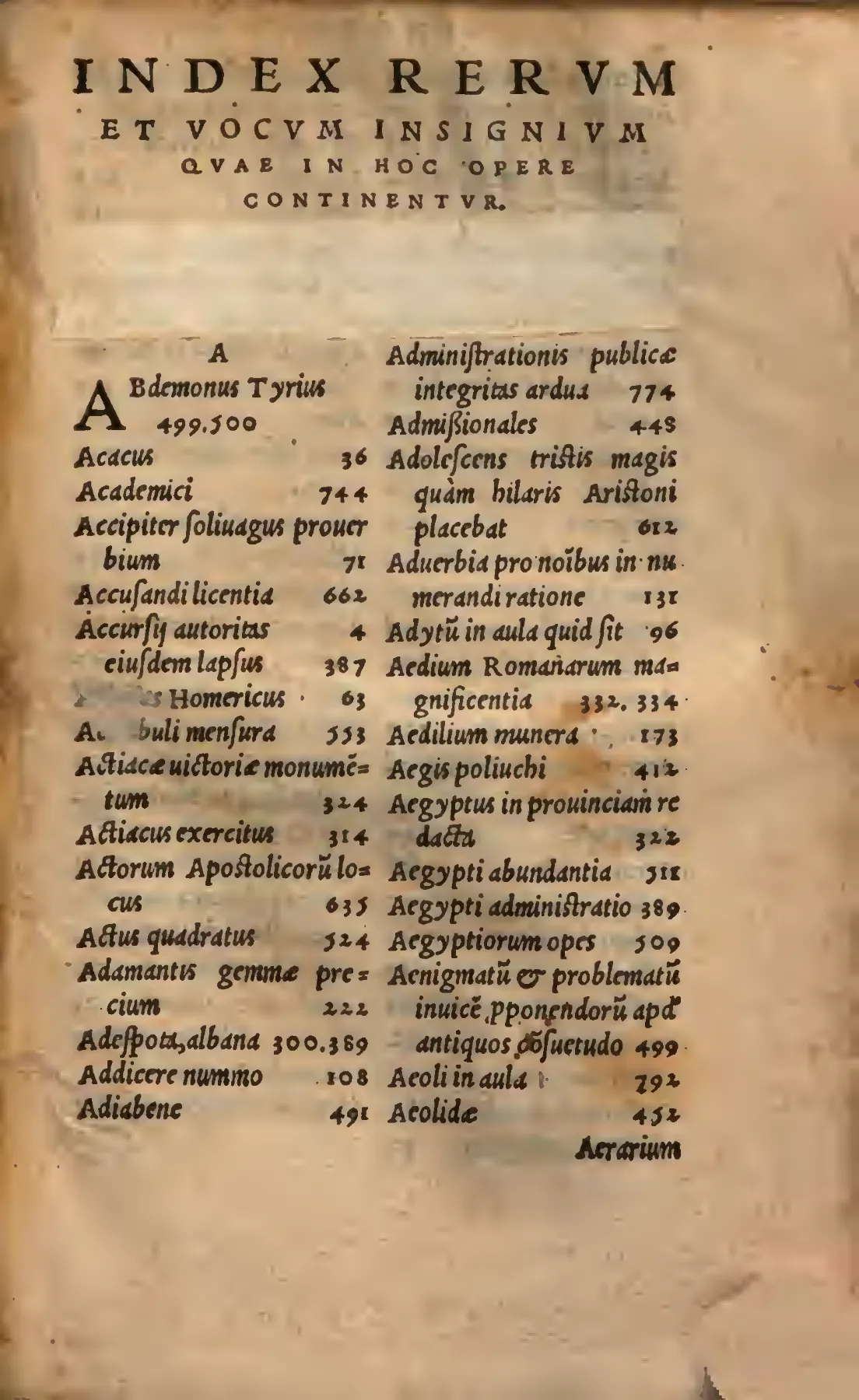
The opening of the Index rerum et vocum insignium, whose centered roman-capital heading and two-column italic entries turn the back-matter into an interpretive apparatus rather than a merely mechanical aid. Among the first A-entries, "Accursij autoritas" points back to Budé's challenge to juristic authority, showing how the index gathers the work's concerns with measurement, money, and the disciplining of received authority into a retrospective self-description. Source ↗.
The numismatic and metrological strand is visible at once in the density of entries devoted to the units of account and their equivalences. The governing identification on which so much of Budé's computation rests — that the Roman denarius and the Greek drachma are one and the same — is registered flatly as a headword, Denarius & drachma idem, the lemma reducing to a bare equation the cross-cultural equivalence that allowed the fiscal magnitudes of the Greek authors to be brought into a single reckoning with those of the Latins. The same impulse to fix the specificity of Roman fiscal vocabulary surfaces in the observation, indexed as a discrete point of learning, that the word sestertius was unknown to the Greeks, Sestertij uocabulu[m] Græcis ignotum. The entry is philologically loaded: it registers not a mere lexical curiosity but the untranslatability of a Roman unit of account, and it thereby underwrites Budé's insistence that the fiscal terms of antiquity cannot be silently equated across languages but must be reconstructed each in its own idiom. The great weight-and-money unit that ranged most widely across authors, the talent, is indexed in its regional variants, so that a reader may isolate, for instance, the Babylonian standard, Talentu[m] Babylonicu[m]; the multiplication of such entries — Attic, Euboic, Babylonian, Hebraic, Egyptian, Sicilian — silently records that the variation of the talent from author to author was among the chief cruces the treatise labored to resolve.
Interwoven with this metrological armature runs a second strand whose lemmata abandon the neutrality of a reference tool altogether and state moral theses outright. The governing proposition of Budé's digressions on riches is compressed into a single headword affirming that riches are to be despised in comparison with the pursuit of wisdom, Diuitiæ præ sapientiæ studio co[n]tenendæ. This is not the phrasing of a locator but of a maxim, and the surrounding cluster sharpens it into theological polemic. The most striking of these entries places Christ himself on the side of the poor against the wealthy, indexing him as the rejecter of the rich and the champion of the poor, Diuitum reiector Christus, pauperum assertor. That such a formula should appear as a headword in the back-matter of a treatise ostensibly devoted to Roman coinage measures the distance the work travels from its numismatic premise: the reconstruction of the as has become the occasion for a scripturally grounded indictment of riches. The compiler even turns the moralizing gaze upon the author, registering Budé under his own name as a despiser of riches, Diuitiarum contemptor Bu dæus — a rare instance of an index naming its own author to fix his ethical posture, so that the scholar's contempt for wealth is entered into the record as itself a retrievable fact of the book.
From this moral thesis the index proceeds, with no change of register, into the juridical and ecclesiological critique that constitutes the work's most combustible material. The legitimacy of clerical wealth is put in question at the level of legal title, the lemma asking by what title ecclesiastics may possess their goods, Ecclesiastici quo titulo sua[m] bona possideant. The phrasing is precise and pointed: it does not deny that churchmen hold property but interrogates the juridical ground of their possession, converting a question of law into an instrument of critique and situating the entry within the same construction of church goods as a trust rather than an outright donation that governs the polemical chapters. The critique becomes fully contemporary — and unusually daring for a work of metrological scholarship — where the index names a recent pope by number and title, registering the excommunications of Julius II, supreme pontiff, Excommunicationes Iulij 11. pontif. max. To index the coercive spiritual weapon of a named reigning-memory pontiff under the letter E, alongside the technical entries on the denarius and the drachma, is to declare that the disciplining of authority which the treatise practises upon Pliny extends without interruption to the exercise of ecclesiastical power; it is precisely this class of entry that would later draw the attention of the censors.
The national-political thread that binds the metrological and moral strands to the work's dedicatory purpose is likewise legible in the lemmata. Two entries under F state the counsel and the claim in balanced form. The first distills Budé's caution against foreign overreach into a conditional maxim, that France is happy if she keeps within herself, Francia felix, si se intra se contineat; the second elevates the kingdom to a sacral-military dignity as the standard-bearer of the Christian side, Francia Christianarum partium signifera. The two lemmata hold in tension a politics of self-containment and a rhetoric of Christian leadership, and together they index the patriotic peroration to which the work's whole apparatus is ultimately dedicated. The programmatic call for learned men in public life belongs to the same complex, entered as an exhortation that philosophers migrate into the court and toward the administering of the republic, Philosophi in aulam cōmigrent, atq; ad remp. admunistrandam — the humanist demand that letters be brought to bear upon governance, here reduced to a single retrievable precept. The claim that undergirds this demand, that learning is a matter of cultivation rather than of station, is registered as the egalitarian proposition, treated among the materials of the work's patriotic programme, that in letters everything rests upon talent and diligence, not upon birth or clime, a formula that grounds the French claim to intellectual parity in the universal availability of ingenium. To this the index adds the correlative thesis that action itself is mute without literary commemoration, entering the maxim that the praise of great deeds is nothing without the herald of letters, laus sine literarum præconio nulla est — a claim that binds the value of deeds to their recording and thereby vindicates the vocation of the scholar within the political order.
The two governing themes of the treatise, wealth and wisdom, are held together in a single biblical exemplar where the index registers Solomon as both richest and wisest, Solomon & ditissimus, & sapientissimus. The pairing is exact: the figure who unites the two attributes that the moralizing entries hold apart serves as the scriptural hinge on which the treatise's meditation on riches and learning turns, and his appearance among the headwords shows how thoroughly the biblical-historical matter has been assimilated to the work's conceptual scheme. That scheme rests, finally, on an epistemology and a method the index states in its own terms under the letter V. The gnomic lemma that truth lies in the depths, Veritas in alto iacet, compresses into four words the philological ideal of a meaning buried beneath the corruptions of transmission and recoverable only by labor; and the entry that follows fixes the hierarchy on which the whole enterprise depends, recording that the divinity of truth is more sacrosanct to Budé than all writers — the very Veritatis numen Budæo sacrosanctius omnibus scriptoribus whose bearing on the work's self-understanding is set out in the philological framing of the three governing terms. That the compiler should enter this principle as a discrete, retrievable fact about the author — cataloguing the subordination of every authority to the numen of Truth as though it were itself a res or vox insignis — demonstrates that the sacralization of the critical enterprise was understood, by the work and its apparatus alike, as the treatise's animating commitment rather than an incidental posture. The index closes upon the metrological unit that names the whole discipline of weighing, the Zygostatica libra, and the printer's FINIS, the balance-scale of the assayer sealing an apparatus that has moved, entry by entry, from the weighing of coins to the weighing of authority itself.
Frequently Asked Questions
What is Guillaume Budé's De asse et partibus eius libri quinque?
It is a learned Latin treatise in five books on Roman coinage, weights, and measures, printed at Paris in 1515 by Josse Bade. Its subject is the Roman as, the copper unit from which all higher denominations were computed, together with its fractions. Beyond the numismatic exposition it carries substantial digressions into law, moral philosophy, fiscal history, and a sustained attack on clerical wealth and the pontificate of Julius II. It is regarded as the founding text of the historical study of Roman coinage and metrology, and it remained standard in its field for roughly a century.
Who was Guillaume Budé?
Guillaume Budé (Paris, 1467/1468–1540) was one of the great scholar-officials of the French Renaissance. He served as magister libellorum supplicum in the Parlement de Paris and as royal librarian to Francis I, and he was the principal instigator of the trilingual college that became the Collège de France. He composed the De asse in Paris between 1513 and 1515, and in 1515 wrote a memorandum defending the Pragmatic Sanction of Bourges at Francis I's request. His religious position — Erasmian, conciliarist, proto-Reformed, or specifically Gallican — remains genuinely open.
What single grammatical point did Budé claim had distorted the scale of Roman finance a hundredfold?
Budé's whole inquiry turns on what he names the cardo totius operis, the hinge of the entire work: whether the inflected form sestertia in certain passages of Pliny should be read as a substantive genitive plural (one hundred thousand sesterces) or as an adverbial multiplicative (one hundred thousand times). That single decision shifts the reckoning of Roman public finance by an entire order of magnitude. Correcting it, and verifying the result by weighing surviving coins, Budé dared to affirm that men of the greatest learning had erred, as he put it, by the whole heaven — that is, a hundredfold.
How did Budé test his conclusions rather than trust the ancient texts?
Budé submitted the transmitted texts to physical trial. As he wrote, he kept a balance and small weights before him along with many ancient gold and silver coins, weighing specimens to confirm that the Attic drachma matched the weight of the Roman denarius. For measures he had a wooden cubic vessel, a quadrantal, built a foot each way and trued with a small rod, then filled with wheat and water to fix equivalences. He even summoned a Parisian baker, from whom he only with difficulty extracted the true proportions of his craft, comparing method with that of geometers and mathematicians.
Is there an English translation of the De asse?
No complete translation into a modern language has been identified; partial translations and excerpts appear in the critical-edition programme associated with Luigi-Alberto Sanchi's 2018 edition of Books I–III for Librairie Droz, and Budé himself prepared an earlier French epitome for non-Latinist readers. Separately, the Leo edition presents the full transcription of the work together with a complete English translation that is generated by AI. Leo is an effort to make freely available online, at no cost, English translations of every text printed in Latin in early modern Europe between 1450 and 1750.
This report was generated by an advanced AI assistant that conducted deep research alongside an extensive interpretation of the transcribed original text. Every effort has been made to preserve fidelity to the source and to guard against inaccuracy, but corruption in the text recognition process and model hallucination may nonetheless have entered the text. Treat every claim, quotation, translation, and citation as provisional, and verify each against the original source before relying on or citing it.
Bibliography
- Sanchi, Luigi-Alberto (ed.), Guillaume Budé, De asse et partibus eius / L'as et ses fractions, livres I–III. Édition critique du texte de 1541 et traduction française: The first critical edition of any portion of the work, superseding all previous editions for the established text of 1541 and supplying the apparatus that makes the philological argumentation around Pliny, Festus, and the Greek lexicographers legible to a modern reader. Its introduction is also the pivot on which the current reassessment of Budé's Gallican and conciliarist leanings turns, and it reopens the dating of the anticlerical insertions. The reviews by Andrew Burnett (International Journal of the Classical Tradition 27, 2020) and Giovannella Cattaneo (Studi Francesi 195, 2019) orient the reader to what it settles and what it leaves open.
- Bénassy-Berling, Marie-Claire, "Humanisme et religion: autour de Guillaume Budé," L'humanisme en Europe à la fin du XVe et au début du XVIe siècle: The essential guide to the religious framework — Erasmian, conciliarist, and Gallican — within which the De asse's antipapal chapters must be read, and to their relation to the Pragmatic Sanction. Consult it before deciding what, if anything, Budé's confessional position actually was, since it resists the older reflex of filing him under Erasmus.
- Catholic Encyclopedia, "Guillaume Budé," New Advent: A dated but usefully blunt older notice that pronounces the De asse "the best book on the subject written up to that time," confirming the treatise's century-long standing in the field. Its confessional vantage is worth noting precisely because the work it praises was placed on the Index for its anticlerical bite.
- Delaruelle, Louis, Guillaume Budé: les origines, les débuts, les idées maîtresses: The foundational intellectual biography, indispensable for situating the De asse within Budé's early humanist programme and for the analysis of the convictions that drive its moral-political digressions. It is the starting point every later study argues with, including those that now qualify its Erasmian reading of Budé.
- Huppert, George, The Idea of Perfect History: How Renaissance Humanists Invented the Past: Places Budé's weighing-and-measuring practice within the wider Renaissance project of recovering antiquity by reconstruction rather than deference, reading the De asse alongside Ermolao Barbaro and Pomponio Leto. The book explains why a treatise on the as belongs to the history of historical method and not merely to numismatics.
- Margolin, Jean-Claude, "Budé, Guillaume," Contemporaries of Erasmus: A Biographical Register of the Renaissance and Reformation: The most reliable short-form account of Budé's career and the publication history of his works, including the De asse. Turn to it first to fix dates, offices, and editions before wading into the interpretive literature.
- Renaudot, Eusèbe, Recueil des pièces d'antiquité en vers et en prose: An early-modern witness regularly cited by later bibliographers, useful for tracing the seventeenth- and eighteenth-century afterlife of Budé's numismatic arguments. Approach it as a reception document rather than as a guide to what Budé actually maintained.
- Wikipedia contributors, Guillaume Budé: A serviceable orientation to Budé's life and his part in founding the Collegium Trilingue that became the Collège de France, adequate for the non-specialist seeking bearings. Verify its particulars against Margolin or Delaruelle before citing anything, as one always should.



_%E2%80%93_Galleria_degli_Uffizi,_Florence.jpg)