Moths, Worms, and the Commonwealth of the Dead: Pieter Burman the Elder's The Letters of Marquard Gude and of the Eminent Scholars Who Wrote to Him; with Letters, Augmented from the Same Source, of Claude Sarrau
A folio of dead men's letters, printed at Utrecht in 1697 as the Marquardi Gudii et Doctorum Virorum ad eum Epistolae, makes an argument that would unsettle any historian: that the private letter tells the truth about a man more faithfully than any annal composed to burnish a reputation. Assembled by the philologist Pieter Burman the Elder from the scattered papers of the Holstein antiquary Marquard Gude (1635–1689) — a manuscript-hunter who wrestled decaying codices from moths and worms — and swelled by an appendix of the letters of the Parisian councillor Claude Sarrau (d. 1651) dedicated to Queen Christina of Sweden, the volume treats correspondence as both the evidence of learned labour and the labour itself. It is, in the end, an attempt to reconstitute a dispersed library as a printed commonwealth, and to install its editor as that commonwealth's presiding magistrate.
ExLatinis
July 26, 2026

Contents
A folio of dead men's letters, printed at Utrecht in 1697 as the Marquardi Gudii et Doctorum Virorum ad eum Epistolae, makes an argument that would unsettle any historian: that the private letter tells the truth about a man more faithfully than any annal composed to burnish a reputation. Assembled by the philologist Pieter Burman the Elder from the scattered papers of the Holstein antiquary Marquard Gude (1635–1689) — a manuscript-hunter who wrestled decaying codices from moths and worms — and swelled by an appendix of the letters of the Parisian councillor Claude Sarrau (d. 1651) dedicated to Queen Christina of Sweden, the volume treats correspondence as both the evidence of learned labour and the labour itself. It is, in the end, an attempt to reconstitute a dispersed library as a printed commonwealth, and to install its editor as that commonwealth's presiding magistrate.
In the last decade of the seventeenth century, the Utrecht scholar Pieter Burman the Elder gathered into a single folio the surviving correspondence of Marquard Gude (1635–1689), a Holstein antiquary whose life had been spent tracking manuscripts across Europe, deciphering inscriptions among the ruins of Rome, and sustaining an epistolary commerce with the most learned men of his age. Printed at Utrecht in 1697 by François Halma and Willem van de Water, the volume is a specimen of a distinctive humanist genre — the epistolae clarorum virorum, the printed letter-collection of the illustrious — into which Burman folded not only Gude's own outgoing and incoming letters but also an anthology of humanist correspondence drawn from Gude's celebrated library, and, as a substantial appendix, an enlarged corpus of the letters of Claude Sarrau (d. 1651), councillor of the Parlement of Paris, dedicated to Queen Christina of Sweden. It is a book assembled by a scholar out of the papers of scholars, and it announces at the outset the conviction that gives it coherence.
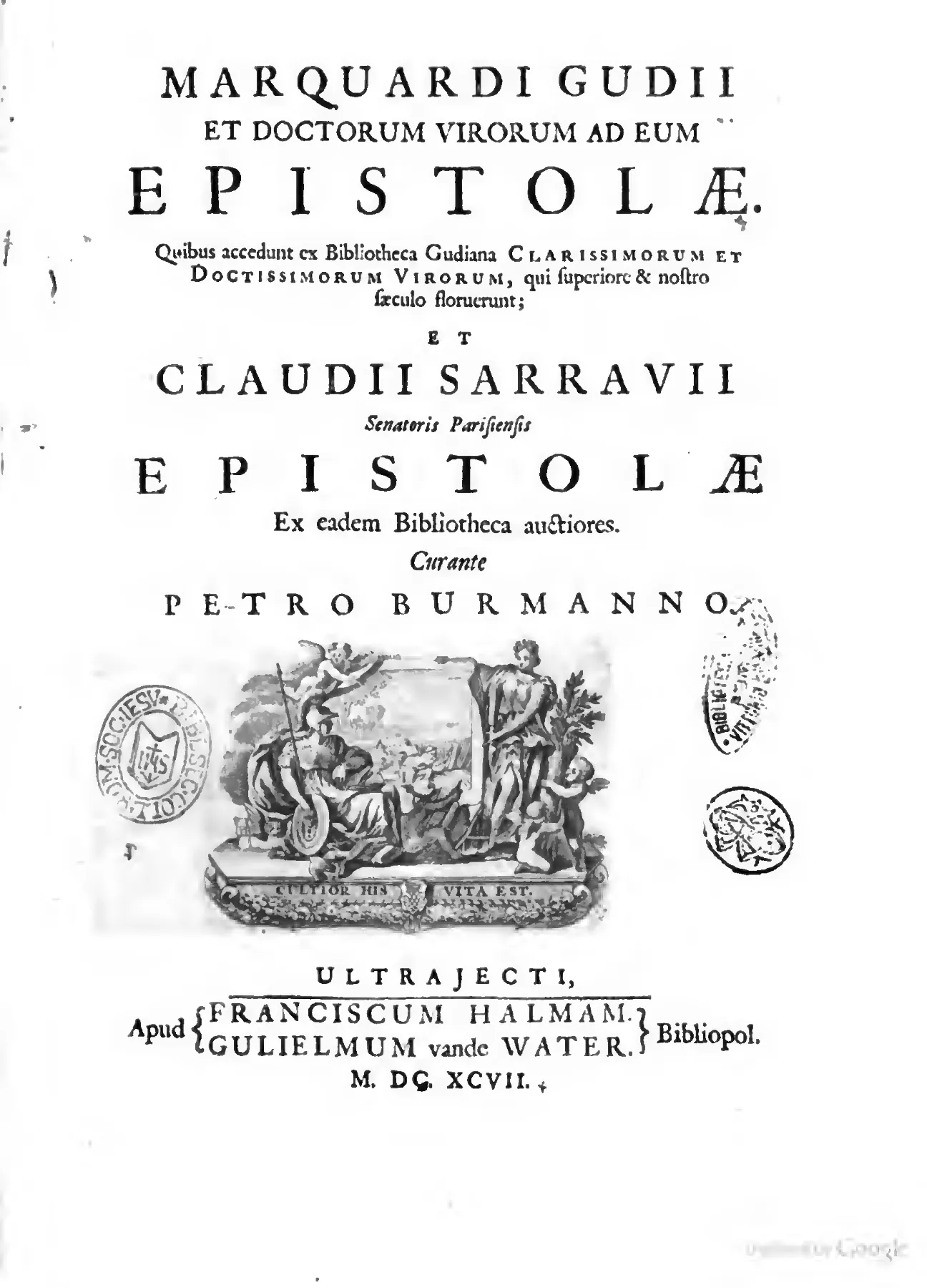
The Utrecht title page fixes the 1697 volume as Marquardi Gudii et doctorum virorum ad eum epistolae, printed by Franciscus Halma and Willem van de Water, and frames the Gudian correspondence as material drawn “Ex Bibliotheca Gudiana.” Its engraved device and motto, “CULTIOR HIS VITA EST,” turn imprint, library, and learned letters into a visual claim for the printed commonwealth of scholarship the volume preserves. Source ↗.
That conviction is an argument about knowledge itself. The letter, Burman's front matter declares, affords a truer access to a man's character and real judgments than any formal history: from private correspondence, more rightly than from annals composed to serve reputation, one perceives what men actually think, vel quod ex his rectius hominum ingenia, & quid vere sentiant de rebus plerisque, quam ex historiis & annalibus & aliis ingenii lucubrationibus, quibus & suæ & aliorum famæ magis serviunt, quam vero, perspiciatur. The recurring move of the volume follows from this claim: the letter is treated at once as evidence and as instrument. Each letter documents scholarly labour — the hunting of perishable manuscripts, the emendation and collation of classical texts, the reading of inscriptions and the reconstruction of ancient punctuation, the adjudication of confessional and juridical disputes — and, in the same gesture, performs that labour, so that the collection enacts the very commonwealth of learning it records. The governing frame for that commonwealth is the respublica literaria, the transnational polity whose citizens are the learned, whose bond is veritas rather than any sovereign or creed, and whose survival depends on the rescue of both texts and reputations from oblivion.
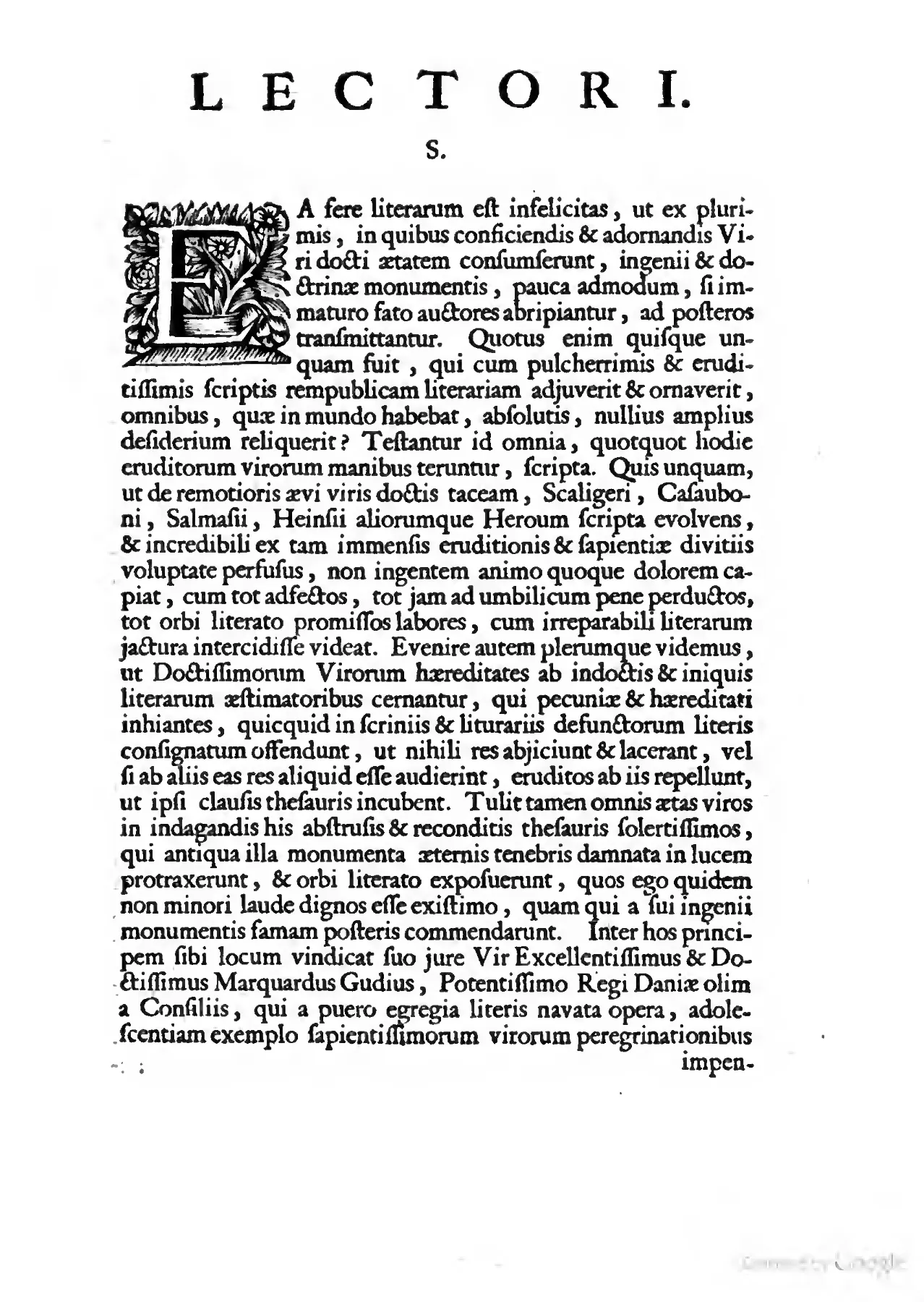
The opening page of Burman’s prefatory address, headed “LECTORI. S.” and marked by an ornamented initial, frames the 1697 Utrecht folio as an act of learned rescue rather than mere publication. Its printed argument that endangered papers must be drawn back into the light makes Gude’s correspondence the working archive of the respublica literaria, where letters preserve both texts and scholarly reputations. Source ↗.
The stakes of this argument reach well beyond the private lives of a few philologists. To claim that the letter discloses truth more faithfully than history is to stake out a position on where reliable knowledge of the human and the past is to be found, at a moment when the international community of scholars was consolidating its self-image across confessional and national divisions. The volume shows how a Lutheran antiquary in Holstein could remain in continuous learned exchange with a Catholic parlementaire in Paris through the mediating channels of Leiden and the circle around Queen Christina, and it registers the pressures — censorship, national prejudice, doctrinal suspicion, the ruin of war — under which that community laboured. The dispersal of Gude's library after his death, its documentary core passing to Wolfenbüttel and its epistolary residue into Burman's editorial workshop, is itself part of the story the volume tells: the transfer of a scholarly inheritance from one generation of caretakers to the next.
What a first-time reader will find most striking is the sheer concreteness with which these abstractions are lived out. Here Gude is praised for wresting from unworthy owners writings that were literally decaying, cum tineis & blattis luctantia — struggling with moths and worms; here the recovery of forgotten authors is figured as a resurrection, with Sannazaro's Muse and Paleario's eloquence recalled from death into life; here a correspondent ranges among the ruins of Rome resolving to examine every ancient inscription with care, and another reports the recent unearthing of the Laocoön among the ruins of the house of Titus. The volume preserves the coining of the very word Emblemata by Andrea Alciato, a printer's obscene misprint that multiplied across a thousand volumes, the debate over whether marine shells found inland are sports of nature or evidence of something more, and the reconstruction of a time before Aristophanes when words were written in one continuous stroke without interval or distinction. It carries, too, the ethical drama of learned life — the contrast of the "prince" and the "tyrant" of the learned, the danger of a society in which under nearly every stone a scorpion lurks — and the political theology of Christina's abdication, cast as a hard-won freedom. These particulars are not ornament; they are the material counterpart to the epistolary thesis, the artifact and the letter alike rescuing truth from loss.
The throughline that unites the volume is precisely this identification of the letter with the labour of salvage. Its conceptual vocabulary — respublica literaria, Bibliotheca Gudiana, epistola — its material history as the printed reflex of a dispersed manuscript collection, and its internal movement from Gude's own letters through the letters addressed to him to the wider humanist anthology and the Sarravian appendix all serve a single ambition: to reconstitute a scattered library as a printed commonwealth, and to enrol its editor as that commonwealth's magistrate. Much about the volume remains to be established — no modern critical edition exists, and the relation of Burman's printed text to the surviving Wolfenbüttel autographs awaits systematic collation — but even in its unstudied state the folio offers an unusually candid window onto how the learned of the seventeenth century understood the work, and the worth, of their own correspondence.
Read the full text and English translation on Leo
This text was transcribed and translated as part of the ExLatinis project, an effort by Leo to make free English translations of every text published in Latin in early modern Europe (1450–1750) available online. The complete transcription and English translation of this work can be read free of charge:
→ Read the original Latin text and full English translation on Leo
You can save a copy of this document into your Leo account to run deep text searches, conduct further analysis, or cross-reference it with your own research.
Assigning an English Title and Framing the Philology of the Gude Correspondence
An Editorial English Title
No fixed English title circulates in the modern historiography for this 1697 folio, which is normally cited under the Latin short-titles Marquardi Gudii Epistolae, Epistolae Gudianæ, or simply the Gude Correspondence. The following is therefore supplied as an editorial descriptive title for convenience, not as a received bibliographic designation:
The Letters of Marquard Gude and of the Eminent Scholars Who Wrote to Him; with Letters, Augmented from the Same Source, of Claude Sarrau, Councillor of the Parlement of Paris. Edited by Pieter Burman the Elder.
The Philological Frame of the Volume
Three Latin terms structure the volume and orient any reading of it. The first is respublica literaria — the late-humanist designation for an imagined commonwealth whose citizens are the learned, whose territory is litterae, and whose magistracies are the editing of texts and the adjudication of readings. The phrase appears in the prefatory matter not as a decorative flourish but as the operating assumption that private letters among scholars belong, in principle, to a public; Burman's preface is thus the performative articulation of an editorial claim that publication serves the respublica and is owed to it. The term carries a specifically post-Bodin, post-Althusian resonance: the commonwealth of letters is non-territorial, knows no sovereign but veritas, and admits no confessional boundary that learning itself does not already cross. When Gude's correspondents write as Lutheran, Reformed, or Catholic humanists to one another, the volume tacitly asserts that respublica literaria is a polity more durable than any of them. That the bond of this polity is a shared learned Latin is made explicit within the correspondence itself, where one writer insists on holding his partner to a formal covenant that they should write to one another in Latin, and would rather see the pact void than unratified, Nisi pactum conventum quod utrique nostrum placuit (ut invicem Latine scriberemus) ratum esse vellem, quia ita promisi, tuque stipulatus es, irritum ego mallem — the language of the respublica recast, tellingly, in the juridical idiom of stipulation and compact.
The second term is Bibliotheca Gudiana, which the title-page invokes as both the physical library assembled by Gude at Gottorf and Glückstadt and, by synecdoche, the dispersed corpus of manuscripts and letters that passed at his death into the hands of heirs, agents, and editors. In the humanist semantic field, bibliotheca names a curated collection that exceeds the sum of its codices: it is a portable polity, an instrument of intellectual patronage, and a quarry for editors. The dispersal of such a collection — here traced forward into Wolfenbüttel, into the Sarrau papers in France, and into Burman's Utrecht workshop — is accordingly not a private financial transaction but an event in the historia litteraria: the transfer of textual citizenship from one caretaker to another. Gude's death in 1689 is, in this sense, a constitutional moment, and Burman's 1697 volume is the protocol of its settlement. The character of the collector governs how that library was understood: Gude is celebrated for having tracked down across the most famous regions of Europe writings struggling with moths and worms, and for having wrested the treasure from unworthy and ignorant owners, mira sagacitate & solertia per celeberrimas Europæ regiones, cum tineis & blattis luctantia Clarissimorum Viorum scripta indagavit, & creptum iniquis & imperitis possessoribus thesaurum sibi vindicavit. The Bibliotheca is thus figured not as inert accumulation but as an ongoing act of salvage, the material register of the same conviction that animates the volume's treatment of letters.
The third term is epistola in its humanist-typological sense — the familiar letter cast as the privileged genre in which a scholar's ingenium and sententia appear more truly than in any polished history or panegyric. From the Epistolae obscurorum virorum through the sixteenth-century anthologies of clarorum virorum epistolae (the Epistolae of Sadoleto, Bembo, Manuzio, and the Steuco–Merula series), the genre had hardened into a convention by which posthumous publication of a scholar's letters was equivalent to a public disclosure of his character. Burman places Gude and Sarrau explicitly inside that lineage; the Sarrau appendix, with its dedication to Queen Christina of Sweden, extends the convention into the rarer register of the dedication to a princely patroness whose abdication had made her a free citizen of the same respublica. Read together, the three terms — respublica literaria, Bibliotheca Gudiana, epistola — disclose a coherent editorial programme: to reconstitute a dispersed library as a printed polity, and to enrol its posthumous editor as its magistrate.
What the 1697 Utrecht Folio Contains: An Executive Summary
The 1697 Utrecht folio edited by Pieter Burman the Elder and printed by François Halma and Willem van de Water is a posthumous epistolae corpus — that is, a printed collection of learned correspondence — built around the surviving letters of the Holstein antiquary Marquard Gude (1635–1689) and his unnamed learned interlocutors, to which is appended an enlarged body of letters by Claude Sarrau (d. 1651), councillor of the Parlement of Paris, drawn from the same Gudian manuscript holdings. Its genre is the humanist epistolae clarorum virorum — the printed letter-collection of the learned — and it belongs, in immediate provenance, to the same editorial tradition as Burman's later five-volume Sylloge epistolarum a viris illustribus scriptarum (Leiden, 1727). The language of composition is predominantly Latin, with French in Sarrau's circle and Greek embedded in philological quotation; the volume has not been translated in full into any modern language, and only excerpts of individual letters have appeared in twentieth- and twenty-first-century anthologies of the Republic of Letters.
The volume's organising claim, set out in Burman's prefatory epistle and reiterated in the dedicatory apparatus to the appended Sarrau corpus, is that the unpublished letters of a learned man reveal his character and convictions with a fidelity unavailable in formal histories — that from letters, rather than from annals written to serve reputation, one truly perceives what men think — and that the republic of letters is therefore owed the publication of such papers when their original authors can no longer speak for themselves. The same conviction underwrites the volume's recurrent figure of scholarship as rescue: the recovery of forgotten authors is described as a return from death to life, so that Sannazaro's Muse and Paleario's eloquence were recalled from death into life and their very names, pressed by oblivion and long night, brought back into human memory, Sic Sannazarii Musa, sic Aonii Palearii eloquentia a morte in vitam reducta, & nomina ipsa, quæ oblivione & longa nocte urgebantur, in hominum memoriam revocata. The architecture accordingly combines Gude's outgoing letters, incoming letters to Gude, an anthology of humanist letters extracted from the Bibliotheca Gudiana, and the enlarged Sarrau correspondence dedicated to Queen Christina of Sweden — together with prefatory verses, a tripartite index, and errata. The work is preserved in multiple copies across European libraries; a representative holding is that at Blickling Hall, Norfolk (National Trust, NT 3199789), recorded in the WorldCat record for OCLC 13608058.
Why the Gude–Sarrau Letters Matter: Scholarly Significance and Historiography
The volume is foundational for the historiography of the seventeenth-century Republic of Letters because it documents, at the level of individual letters, the working routines of an international learned community centred on Dutch printing and the Holstein-Gottorp court. Its scholarly significance operates on three axes.
First, the volume is a primary source for the sociology of early-modern scholarship as developed by the so-called Republic of Letters school, associated in the early modern period with Bots and Waquet's synthetic account, and in subsequent scholarship with the digital and prosopographical projects clustered at Stanford (Mapping the Republic of Letters) and Oxford (Early Modern Letters Online, including the Vossius correspondence). The Gude–Sarrau exchanges illustrate how a Lutheran antiquary in Holstein could maintain a continuous epistolary relation with a Catholic parlementaire in Paris through the mediating channels of the University of Leiden and the Christina circle in Stockholm and Rome. That the respublica literaria was an ideal held under strain, not a placid fellowship, is registered throughout: correspondents warn one another that they live in a viperish society, with a scorpion lurking under nearly every stone, Vivimus in viperina societate, latetque sub quovis pene lapide scorpius. The ethics of candour against flattery that Burman's front matter thematises finds its sharpest emblem in the ranking of the two great philologists as Heinsius the prince of the learned and Salmasius the tyrant of the learned, Eruditorum Princeps & Salmasius Eruditorum tyrannus — a distinction between the "prince" and the "tyrant" of learning that maps the internal politics of the commonwealth onto its most eminent citizens. National prejudice threatens the same bond, as when one writer complains that Vossius blames Heinsius for a printing delay, alleging that out of hatred of the German nation he holds back the press and thinks none wise but the Flemings, videlicet hujus moræ culpam D. Vossius imputat Heinsio, qui odio gentis Germanicæ retinet typographi ac sufflaminat propositum: putatque neminem vel sapere præter Flandros, vel scribere præter se.
Second, the volume is a primary source for the institutional history of classical scholarship. Gude's letters document the daily practice of epigraphy and manuscript collation; the ideal of learning as accurate reading is stated directly in the claim that the road to lasting fame is none other than the accurate reading of ancient authors, which produced the Budés and Scaligers, the Turnèbes and Passerats and so many mighty names, nulla certe alia quam veterum scriptorum accurata lectio. Ea Budæos, & Scaligeros: Ea Turnebos, Passeratios & tot ingentia nomina edidit. The antiquarian labour that accompanies textual work is equally vivid: a correspondent ranging with curious eyes over the ruins of the eternal City resolves to examine the ancient inscriptions of the learned with all care, mihi quidem rudera & ruinas æternæ Urbis curiosis oculis pervaganti hoc saxum imprimis voluere, vetustos literatorum lapidum titulos omni cura circumspicere placuit, and the great collaborative enterprise of epigraphy is registered in the report that the printer has begun that great work of the ancient inscriptions of the Roman empire, comprising whatever honour befell the living or the dead, auspicatus est typographus opus illud magnum Inscriptionum antiquarum imperii Romani, quo complectimur, quicquid honoris accidit, sive vivis, sive defunctis. The correspondence also preserves the reconstruction of ancient reading practices, as in the account that before Aristophanes, who first devised punctuation and invented accents, there was no distinction of letters and all words were written in one continuous stroke without interval, ante Aristophanem, qui primus excogitavit, & accentus invenit, nulla fuit literarum distinctio, neque subdistinctio. Uno ac perpetuo ductu sine ullo interstitio voces omnes exarari solebant. The appended Sarrau corpus preserves exchanges with Salmasius and his circle at the moment of the Defensio Regia (1649) and Milton's reply (1651), and with the Saumaise–Heinsius quarrel which the secondary literature treats as a paradigmatic case of intra-republican rivalry; the volume itself cautions that Sarrau is a partisan witness, warning that not all he wrote about Heinsius is to be trusted, since to please Salmasius he set down much most alien to the truth, non omnibus, quæ Sarravius de Heinsio literis prodidit, fides habenda est, ut qui, ut Salmasio ejus insensissimo adversario placerent quas scribebat Epistolæ, multa dixerit scripseritve, quæ a vero sunt alienissima. The philological school in which Burman worked — Graevius at Utrecht, Heinsius and Rutgersius at Leiden — is the institutional matrix that made the 1697 edition possible.
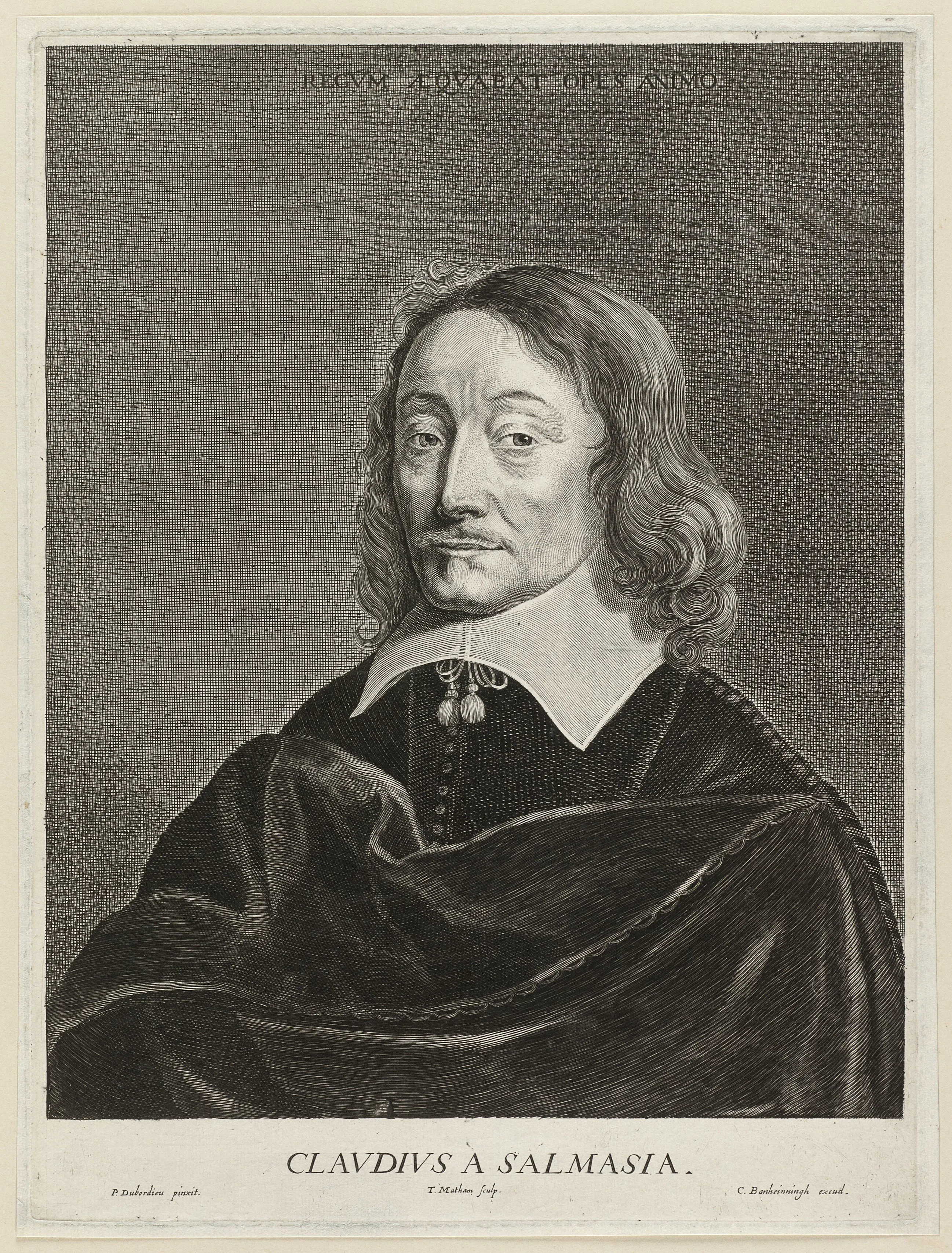
Theodor Matham’s mid-seventeenth-century engraving after Pieter Dubordieu gives Claudius Salmasius the formal authority of a learned public figure — the reputation that made him a gravitational force in Sarrau’s correspondence. As author of the Defensio Regia and antagonist in the Salmasius–Heinsius rivalry, he stands where philological prestige, patronage, and partisan testimony converged. Source ↗.
Third, the volume is a primary source for the history of confessional controversy. The Amyraut–Spanheim dispute over hypothetical universalism, originating at the Saumur Academy and answered from Leiden and Geneva, runs in the background of several letters and is foregrounded in the editorial apparatus; the fear of doctrinal infamy that such disputes engendered is voiced in the dread that Luther, the Picards, the Hussites and the other names of heretics will not be so infamous as one's own, should a certain conclusion follow, Lutherus, Picardi, Hussitæ cæteraque hæreticorum nomina, non ita infamia erunt, atque futurum est, si id sequatur, meum. The volume also transmits the erudite scrutiny of ecclesiastical legend, as in Blondel's considered judgment, having weighed the matter diligently, that it is fabulous that any woman ever sat as Pontiff at Rome between Leo the fourth and Benedict the third, existimavit fabulosum esse, ullam Romæ aliquando sedisse Pontificem feminam, inter Leonem quartum & Benedictum tertium, and it stages the confrontation of Christian and Stoic consolation, where one writer presses whether the tenets to which his correspondent clings can confer salvation, given that they hold nothing of us to survive after death, quibus te inhærere video, nobis ad salutem conferent? quippe qui neque post mortem nostri aliquid superesse credunt. The Sarrau appendix further preserves documentary traces of the regicide debates of 1649 and Christina's 1654 abdication, both of which became touchstones of late seventeenth-century European political theology. The Burman edition thus sits at the intersection of three historiographical fields: the Republic of Letters, the history of classical scholarship, and the history of confessional and political controversy.
The historiography of the specific 1697 volume is, however, thin. There is no modern critical edition; there is no monograph dedicated to the Gude correspondence as a whole; the Sarrau correspondence has been partially re-edited in modern critical form (notably by Hans-Joachim van den Berg and others) but the Burman 1697 text remains the standard printed witness. Major gaps accordingly include: a stemmatic analysis of the 1697 folio against the Wolfenbüttel Gud. Lat. autographs; a documentary edition of the Sarrau appendix; and a synthetic study of the Gude network comparable to what exists for Heinsius or for the Menasseh ben Israel correspondence. The historiography of Dutch Neo-Latin scholarship (Bloemendal, Van Miert, and others working on the Utrecht–Leiden axis) treats Burman as a central node but has not yet produced a study focused on the Gude volume.
Tracing the Text: Textual History, Materiality, and Object Biography
The 1697 Epistolae was printed at Utrecht by François Halma (c. 1653–1726) and Willem van de Water, a pairing attested by the imprint and by British Museum files on van de Water as a Utrecht publisher active 1689–1713. The volume bears the full title as transcribed in the WorldCat record for OCLC 13608058, with authors recorded as Marquard Gude, Pieter Burman, and Claude Sarrau. The imprint, language, and date are reproduced in the National Trust catalogue entry for the Blickling Hall copy (NT 3199789), which records the work's provenance to the Lothian library dispersed in the mid-twentieth century. No later edition, reprint, or translation of the 1697 volume is recorded in the consulted catalogues; the book remains the standard printed witness of the Gudian correspondence.
The textual history of the printed text is inseparable from the post-mortem dispersal of the Bibliotheca Gudiana. After Gude's death at Glückstadt on 26 November 1689, his manuscripts were sold from the estate by his heirs. The principal destination was the ducal library at Wolfenbüttel, where the bulk arrived in 1710 through the agency of Gottfried Wilhelm Leibniz and now forms the collection designated Gud. Lat. and Gud. Graec. at the Herzog August Bibliothek: 478 manuscripts in total, of which 365 are medieval, including the famous Carolingian Codex Carolinus (Gud. Lat. 212) and substantial Greek holdings. A second strand of the library passed into private and thence institutional hands; Sarrau's papers, which had entered Gude's possession through the channels of mid-seventeenth-century humanist exchange, surfaced in Burman's editorial pipeline. The 1697 volume is therefore not an editorially fabricated correspondence but the printed reflex of an extant manuscript corpus whose documentary core survives at Wolfenbüttel, with secondary deposits in Paris and elsewhere.
The materiality of the 1697 folio conforms to Dutch scholarly printing of the 1690s: a single-volume folio, edited with prefatory matter including dedicatory epistles, funerary carmina for Gude, a tripartite index, and errata. The world the volume documents is one acutely conscious of the material conditions and hazards of print. It preserves the memory of print regulation in the complaint that nothing may be printed in a given place unless first inspected and approved by the censors appointed for that very purpose, nihil hic excudere licet, nisi prius a censoribus ad hoc ipsum destinatis & inspectum & approbatum, and it records the perils of the compositor's error in the notorious anecdote of a misprint in which "mente illa" became "mentula" and so a thousand volumes were printed, ex mente illa, mentula fecit; itaque volumina mille fuere impressa. Halma, who would in 1720 become the first city printer of Utrecht, here operates in partnership with van de Water on a major humanist project, a pairing typical of the Utrecht book trade of the period. The book circulated within the learned market of the Dutch Republic and beyond; the Blickling Hall copy is bound in a manner consistent with a British aristocratic library of the eighteenth century, and the Lothian pressmark suggests acquisition no later than the early nineteenth century, when the Kerr library was being assembled.
The relationship between the 1697 Epistolae and Burman's later five-volume Sylloge epistolarum a viris illustribus scriptarum (Leiden, 1727) is one of direct continuity: the Sylloge draws upon the same manuscript and editorial resources, and reprints or cites a substantial portion of the Gude–Sarrau material first made available in 1697. The Sylloge was completed after Burman's death by his nephew Pieter Burman the Younger, who issued the final volumes. No critical edition — in the sense of a fresh re-collation against the Wolfenbüttel autographs with full textual apparatus — has been undertaken; the 1697 folio remains the editio princeps and, in practical terms, the only readily accessible printed form of the correspondence. The principal desideratum for any future editor is the systematic comparison of the printed text against the Wolfenbüttel Gud. Lat. holdings, with attention to letters omitted by Burman, to his editorial interventions in orthography and punctuation, and to the precise provenance of the Sarrau appendix.
Reading the Volume Whole: Structural Outline, Argument Progression, and Textual Evidence
The Front Matter: The Epistemic Wager and the Ethic of Salvage
The printed matter of this folio declares its governing conviction before it prints a single letter of Gude's own, and that conviction is an argument about where truth is to be found. Burman's address to the reader states the epistemic wager on which the entire enterprise rests, the claim already noticed in the framing of this report: that from private letters, more rightly than from formal histories, one discerns the real character and true opinions of learned men. The claim turns on a precise antithesis between fama and verum: annals and other polished lucubrations, Burman contends, are compromised at their root because their authors labour to serve reputation, their own and others', whereas the letter is written without that ulterior calculation and therefore preserves the writer's judgment uncorrupted. The letter becomes, on this reasoning, the more trustworthy documentary witness precisely because it was never composed for the record — an inversion that grants the ephemeral and the private a probative authority denied to the monumental and the public.
That epistemic claim is matched by an ethic of material salvage, and the two are welded together in the portrait of Gude himself, whom Burman celebrates for having tracked down, with remarkable shrewdness and skill through the most famous regions of Europe, the writings of illustrious men that were struggling with moths and worms, and for having wrested that treasure from unworthy and ignorant owners — the passage already met in the framing of the Bibliotheca Gudiana. The emblem of the tineae & blattae is doing considerable work: decay is figured as an active adversary against which the collector wages a rescue, and the moral vocabulary — iniquis & imperitis possessoribus — recasts ownership as a matter of desert rather than title. To hold a manuscript one cannot read or value is, in this frame, to be an unworthy custodian, and the antiquary's vindicatio is presented as a restitution to those who can properly steward the text. Physical preservation and intellectual understanding are thus made inseparable: the writings are saved from the worm precisely by being restored to the learned.
The salvage rationale extends beyond physical objects to the recovery of reputations from oblivion, and here Burman's rhetoric reaches its highest register in the survey of Italian humanists — the resurrection of Sannazaro's Muse and Paleario's eloquence already quoted in the summary of the volume. The metaphorical schema is deliberately funerary and then baptismal: oblivio and longa nox are the death from which the editorial act summons the humanist dead back in vitam. The letter here does double duty — it is at once the evidence that these men lived and thought, and the instrument by which their names re-enter the memory of the living. Publication is thereby dignified as an office performed on behalf of the commonwealth of the learned, a labour of remembrance owed to those who can no longer speak for themselves.
Precisely because the volume advances so strong a claim for the truthfulness of letters, it must defend the integrity of its own editorial hand, and Burman does so with a solemn protestation. Prompted by Morhof's report in the Polyhistor that Gude had gathered far larger collections, he affirms under the language of religious scruple that he published the letters of these men with such conscientiousness that he suppressed not even a single one, sancte affirmare possumus, ea religione istorum virorum, quos modo memoravimus, Epistolas edidisse, ut ne unicam quidem suppresserimus. The oath-formula sancte affirmare and the noun religio import the vocabulary of sworn testimony into the editorial preface, converting a bibliographical assurance into a matter of conscience. The claim is not idle: if the letter's evidentiary value depends on its being an uncensored record, then any editorial suppression would compromise the whole thesis. Completeness of transmission is, for this reason, a load-bearing virtue rather than a mere point of pride.
Yet the same conviction that the letter discloses truth generates its own tension, for Burman must also concede that a letter-writer may serve partisanship rather than truth. His handling of the appended Sarrau corpus is the sharpest instance. He warns that Sarrau was too much attached to Salmasius, had sworn into his very words, and had reckoned Salmasius's enemies as his own adversaries, nimis illum addictum Salmasio, in ejus verba jurasse, ejusque hostes ac adversarios suos duxisse. The idiom in verba jurare — the language of a soldier's oath of allegiance — brands Sarrau as a partisan who had surrendered his independent judgment, the very independence that made letters trustworthy in the first place. Burman presses the point into an explicit caution to the reader, warning, as noted earlier in this report, that not everything Sarrau committed to writing about Heinsius is to be trusted, since to gratify Salmasius he set down much most alien to the truth. The concession is telling: the editor who has staked the volume on the letter's superior fidelity to verum here acknowledges that a letter written to gratify a faction can be a vero alienissima. The contradiction is resolved not by abandoning the thesis but by transferring the burden of discrimination to the editor, whose critical apparatus must flag where the private record itself has been bent by animus — the magistrate of the commonwealth adjudicating the credibility of its citizens' testimony.
Gude's Own Letters: Emendation, Epigraphy, and the Ruin of War
When the correspondence proper begins, the abstractions of the front matter are borne out in the concrete texture of philological labour. The long letters to Ménage show Gude reasoning from the transmitted text toward emendation, as when he ridicules the received opening of a chapter in Valerius Maximus — behold how inept the beginning of the chapter is; he says: I will relate about dreams, because I have touched on the riches of Midas, Ecce quam ineptum initium capitis? dicit: referam de somniis, quia divitias Midæ attigi — the exclamatory Ecce quam ineptum enacting the critic's exasperation with a manifestly corrupt reading and licensing the conjecture that follows. The same letters reach into weightier matter, defending the manuscript reading of Epicharmus against emendations that would dissolve its theology: the poet affirmed these eternal elements of things, these gods, these principles without beginning, Hæc æterna rerum elementa, hos Deos, hæc principia absque principio affirmabat. Here the philological and the doctrinal converge, for to emend the text is to alter what Epicharmus can be shown to have held about the eternity of the gods and the question of creation, and the paradoxical formula principia absque principio marks exactly the metaphysical stake that the transmitted wording preserves.
The epigraphic strand of Gude's work carries the same programmatic weight. Ranging with curious eyes over the debris and ruins of the eternal City, he resolved that this above all pleased him, to examine with all care the ancient inscriptions of the learned — the resolution already cited in the account of his antiquarian practice. The stone is treated as a witness on the same footing as the manuscript — a durable text to be read omni cura — extending the salvage-mission from the codex struggling with worms to the inscription weathering among ruins. The correspondence does not, however, confine itself to the serene labour of reading; it registers the political catastrophe amid which that labour proceeded. Gude's lament for his devastated homeland is unsparing: for what is our homeland but a corpse deformed by ruins and fires, its citizens shaken, despoiled, ruined, and set at the very last edge of all their fortunes, Quid enim patria nostra nisi cadaver ruinis & incendiis deformatum? cives concussi, spoliati, perditi & in extrema fortunarum omnium linea constituti. The image of the patria as a cadaver answers, in a darker key, the resurrection rhetoric applied to the humanist dead: the same forces of ruin that consume books and reputations also consume polities, and the scholar's rescue-work proceeds against a backdrop of general dissolution.
Letters Addressed to Gude: The Fellowship Under Strain
The letters addressed to Gude sharpen the sense that the commonwealth of letters was a fellowship held under strain rather than a placid concord. Reinesius, wary of the exposure that publication brings, warns, in the proverbial figure noticed earlier in this report, that we live in a viperish society, and under nearly every stone a scorpion lurks — the scorpius sub lapide turning the very image of the inscribed stone, elsewhere a source of recovered truth, into a figure for concealed malice among the learned. The danger is at once social and specifically editorial, for it grounds Reinesius's reluctance to see his own letters printed unrevised: the same exposure that serves the respublica also lays a man open to his enemies. The lighter registers of learned exchange are present too, as when Holste closes a technical discussion of the ablative in Celsus with a Plautine pleasantry, confessing that in the Plautine phrase he is one letter more than a physician, Ego enim ut verum tibi, Plautina phrasi, hic fatear, una litera plus sum, quam medicus, the pun on medicus and mendicus deployed as a courtesy that dissolves the pedantry of the preceding grammatical dispute.
The Humanist Anthology: Alciato, the Press, and the Recovery of Antiquity
The third collection opens by dramatizing the humanist scholar's self-fashioning across the boundaries that the commonwealth of letters claimed to transcend. Alciati defends his removal to France by parading his standing, professing at Avignon to eight hundred and more auditors, among whom are bishops, abbots, counts, and other nobles, octingentis & eo amplius auditoribus profiteor. Atque in his auditoribus cum Episcopi, Abbates, Comites aliique proceres sunt. The enumeration of prelates and nobility among his hearers converts pedagogical success into a claim of social consequence, and it discloses how the citizen of the respublica literaria nonetheless measured himself by the patronage and prestige of the territorial world — the ideal of a polity bound only by veritas coexisting, in practice, with a keen accounting of auditors, ranks, and the honours a professorship could confer.
The letters gathered in this stretch open on a scene of authorial panic that discloses, with unusual candour, how the diffusion of texts through the press had come to threaten the very self-fashioning that humanist learning depended upon. Andrea Alciati, writing to the Roman printer Francesco Calvo, measures the disgrace he anticipates from the unauthorized circulation of his juvenile writings not against any ordinary standard of embarrassment but against the roster of condemned heresiarchs, protesting — in the passage already quoted in this report — that Luther, the Picards, the Hussites and the other names of heretics will not be so infamous as his own, should the feared consequence follow. The hyperbole is precisely calibrated to the confessional temperature of the early 1520s: to be published against one's will is, in Alciati's rhetoric, to be exposed to a reputational ruin on the order of doctrinal condemnation. What is at stake is not the content of the writings but the loss of control over their appearance, and the remedy Alciati proposes is correspondingly violent. He instructs Calvo to send a messenger who will consign the offending piece to the fire, that abortive and spurious oration, the cancer of his studies, to be handed over to Vulcan so that it can never come to light, mitte nuntium, qui omnino eam orationem abhortivam & spuriam, & studiorum meorum carcinoma delat, Vulcano tradat, ut nunquam in lucem emergere possit. The figure of the text as a carcinoma, a malignancy growing within the corpus of one's work, converts the disowned oration into something almost pathological, a thing that must be excised and burned rather than merely suppressed; the invocation of Vulcan classicizes the act of destruction, translating a printer's practical disposal into the idiom of ritual immolation. The letter thus performs, in miniature, the paradox that runs through the whole Alciatan sequence: the same medium that promises lasting fame also multiplies the occasions of shame beyond recall.
The concreteness of the world these letters inhabit is nowhere clearer than in the material and epidemiological pressures they record. Alciati's perpetual relocations among the Italian and French studia are driven not only by the pursuit of chairs but by the recurrence of contagion, as when he reports that on all sides pestilence rages in the neighbouring cities, at Montpellier, Nîmes, and Vienne, ita undique in vicinis urbibus, Monte Pessulano, Nemauso, Vienna pestilitas bacchatur. The verb bacchatur lends the plague a frenzied, quasi-Bacchic agency, and situates the scholar's mobility within a terrain of intermittent danger that the correspondence treats as an ordinary condition of learned life. Against this backdrop of flight and precarity runs the steady labour of textual recovery. Alciati directs Calvo to turn aside to Cesena and search the library of Saint Francis there, where Ammianus Marcellinus is reported to survive complete, Cesenam divertas, excutiasque divi Francisci, quæ ibi extat, bibliothecam... extareque præsertim Ammianum Marcellinum integrum. Such an instruction is the working substance of the philological enterprise the volume everywhere celebrates: a precise itinerary toward a named codex in a named house, the hunt for an integrum text against the ordinary expectation of mutilation, carried out through the same epistolary channels that will later transmit the report of success or failure.
It is within this same sequence that the collection preserves one of the most consequential acts of naming in the history of early modern letters. Alciati describes how, during the Saturnalia, to gratify the illustrious Ambrogio Visconti, he composed a little book of epigrams to which he gave the title Emblemata, His Saturnalibus, ut illustri Ambrosio Vicecomitimorem gererem, libellum composui Epigrammaton, cui titulum feci Emblemata. The sentence is remarkable for its casualness: the coinage that would generate an entire European genre is here reported as an occasional courtesy, a Saturnalian trifle offered to a patron, its momentousness invisible to its author. The letter form captures precisely this — the genesis of a literary category caught in the modest register of private notice, before any of the reputational weight that the term would later carry had accrued to it. The same Alciatan letters betray a constant preoccupation with the legal and commercial mechanics of getting into print, from the desire to obtain the Greek Authentics of Justinian, Cupio mirum in modum Authentica Justiniani Græca habere, the prized Novellae that underwrote his humanist jurisprudence, to anxious calculation over the cost of a printing privilege, where he weighs how much the diploma will come to and balks if it should exceed three gold pieces, quanti constiturum sit diploma; nam si tres aureos excedet. Learning, patronage, and the price of a legal patent are here inseparable strands of a single enterprise.
Alciati the jurist is on fullest display in the letters occasioned by the criminal entanglement of Calvo's brother, where technical exposition of procedure is placed at the service of a correspondent's interests. He explains the operation of fiscal seizure with the exactitude of a practising lawyer, observing that the treasury is accustomed to lay hold at once of the goods that had been subject to the administration of delinquents, and only after it has taken possession does it then hear those who object, Solet Fiscus statim res, quæ administrationi delinquentium subjectæ erant, apprehendere, & postquam earum possessionem nactus est, tum demum audit contradicentes. The letter functions here as a channel for expert counsel, the respublica literaria shading into a network of practical mutual aid in which juristic competence is a currency exchanged among friends. Alciati's own career anxieties receive a more literary treatment in the Bourges letters, where he reflects, in a fable-laced idiom, that it very nearly came about that he imitated Aesop's dog and lost the real meat for an imaginary one, Parum certe abfuit quin canem illum Æsopicum imitarer, & propter imaginariam, etiam veram carnem amitterem. The Aesopic figure classicizes the calculus of preferment, dignifying the mundane weighing of one professorial offer against another with the moralizing authority of fable.
The antiquarian and connoisseurial energies of the humanist world surface most vividly in the report of the Laocoön's discovery, transmitted as fresh intelligence: the correspondent relates that in recent months in the City, among the ruins of the house of the Emperor Titus, the statue of Laocoön was found together with his sons, proximis mensibus in urbe in ruinis ædium Titi Imp. inventam fuisse Laocoontis statuam, una cum ejus liberis. The letter does not merely record the find but immediately stages a critical controversy over it, reporting that the leading sculptors in Rome deny the statue was made from a single stone and point instead to the joins, some four more or less, Michaël Christophorus Florentinus in urbe Roma primi nominis statuari negant ex uno lapide confectam; ostendunt compagini plus minus quatuor. Here the empirical scrutiny of practising artists is set directly against the testimony of Pliny, who had described the group as wrought from a single block; the passage thus stages, within the ordinary traffic of correspondence, the confrontation of autopsy and connoisseurship with the authority of an ancient text, precisely the kind of adjudication the volume treats as the proper work of the learned.
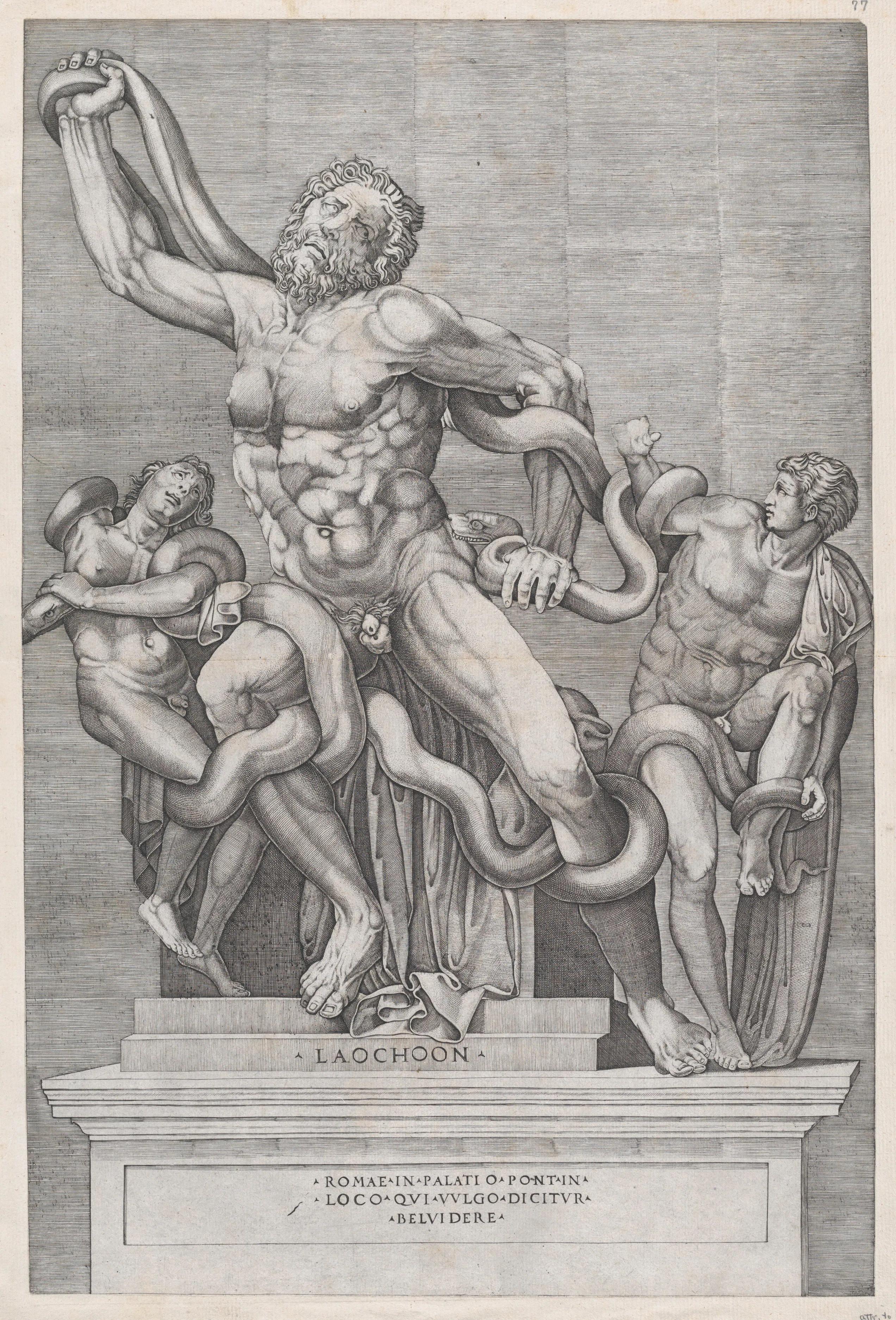
A sixteenth-century plate from the Speculum Romanae Magnificentiae fixes the Laocoön group — priest and sons locked in the coils of serpents — within the Roman visual culture that grew out of its 1506 recovery and installation in the Belvedere. Made for antiquarian scrutiny, it sharpens the letter’s point: the unearthed statue was not only admired as an ancient marvel but examined by sculptors for joins and workmanship, direct observation set against Pliny’s authority. Source ↗.
The hazards of the press, so acutely felt by Alciati, find their most celebrated expression in the letter touching Erasmus, which preserves — in the anecdote already recounted in this report — the notorious slip of the compositor who, from the innocuous mente illa, produced the obscene mentula, so that a thousand volumes were printed with the corruption. The multiplication by a thousand is the whole point: what in an earlier dispensation would have been a single scribe's slip is now propagated mechanically across an entire edition, and the author's exasperation registers the peculiar vulnerability of the learned to an error they cannot recall. The same institutional world that generates errors also polices content, as the printer Oporinus complains — in the passage already noticed among the material hazards of print — that nothing may be printed at Basel unless first inspected and approved by the censors appointed for that very purpose, the obstruction that impeded the publication of Arluno's history of Milan. The perils to books extend beyond the workshop to the collections that house them, as in the vernacular accusation, cast in Italian, that manuscripts were stolen from the Venetian public library by an infamous scoundrel, the Spanish ambassador Don Diego Hurtado de Mendoza, rubati da un scelerato infame, Ambassiadore Spagnuolo nominato Don Diego Hurtado di Mendozaza — a charge that inverts the volume's celebration of learned salvage into its opposite, the depredation of a public patrimony by a powerful collector.
The intellectual centre of the later letters is the controversy over Cicero conducted between Maioragio and Marius Nizolius, which the collection preserves as a full-dress polemic on method. Nizolius frames his defence as an inquiry into proof, asking by what argument it can best be shown that the Ciceronian Paradoxa are Socratic, quonam potissimum argumento probari potest Paradoxa illa esse Socratica?, thereby relocating the Stoic paradoxa into a Socratic genealogy and wresting them from the dialectical tradition his opponent invoked. The deeper stake of the quarrel is the standing of rhetoric against philosophy, which Nizolius makes explicit in the programmatic judgment that orators in disputing well are not only not inferior to the dialecticians and philosophers but even superior to them, arbitror Oratores in bene differendo non modo non esse inferiores Dialecticis & Philosophis tuis; sed etiam illis superiores. This is a manifesto for the priority of eloquence over the technical apparatus of the schools, an anti-Aristotelian assertion that the well-conducted speech of the orator is itself a superior mode of reasoning. The final scholarly movement of these letters turns to elegy, registering the community's sense of an irreparable diminishment at the death of the great philologist: Casaubon laments that the republic of letters has lost the great Scaliger, and asks who could sufficiently bewail that loss, magnum Scaligerum amisit. Quis satis jacturam illam deslere valeat?. The rhetorical question closes the sequence on the note that most fully expresses the volume's governing conviction — that the death of a scholar is a public bereavement, and that the letter which records it is the instrument by which the commonwealth of learning both mourns its citizens and preserves them against the oblivion that would otherwise consume their names.
The Bibliotheca Gudiana Anthology: Antiquity, the Fathers, and War
The letters gathered ex Bibliotheca Gudiana in this stretch of the volume constitute not a treatise but a prosopographical archive of the Northern European republic of letters across roughly half a century, and the movement of the material is best understood as a set of overlapping preoccupations that the letters themselves treat as continuous: the reconstruction of antiquity out of scattered loci, the collaborative editing of the Fathers, the confessional testing of pagan philosophy, and the endurance of learned exchange under the ruin of war. What binds these disparate letters into a single documentary tissue is the very conviction the volume announces at its threshold — that the private letter discloses a scholar's ingenium and real judgments more faithfully than any polished history — and in this back-matter that conviction is borne out at the level of daily labour, grief, and fear rather than in programmatic statement.
The antiquarian method that pervades the correspondence to Johann Kirchmann is displayed with unusual candour in the ring-lore assembled for his projected treatise, where the writer establishes the antiquity of the custom by stacking a scriptural locus upon the classical record, observing that how ancient the wearing of rings may be is known from sacred letters, and that in Genesis Thamar seeks the ring from her father-in-law as a pledge, Gestatio annulorum quam sit antiqua, notum e sacris literis. Genes. 38, Thamar a socero petit. The procedure is characteristic: the antiquarian object — the annulus, at once ornament, betrothal token, and mark of juridical status — is reconstructed by the accumulation of scattered witnesses from Suetonius and Xiphilinus through Clement and Scripture, so that the letter functions as a working quarry of citations placed at a fellow scholar's disposal. The same instrumental character governs the report of editorial toil that opens the sequence, where Hoeschelius accounts for his long silence by his collation of the Greek Fathers, explaining that nothing of his lucubrations has lately appeared because he was occupied in comparing the homilies of Chrysostom in the English edition with a manuscript codex for the sake of Henry Savile, Nihil jam diu mearum lucubrationum prodiit, quia fui occupatus conferendo homilias Chrysostomi editionis Anglicanæ cum M. S. Cod. in gratiam Henrici Savillii. The passage documents the Anglo-Continental division of labour that made the great patristic editions possible, and it registers, in the idiom of lucubrationes postponed, the way collation upon another's edition was understood as an act of learned service rather than of personal authorship.
That ethic of service surfaces again where the printing of a neglected Father is justified not by ambition but by duty. Rittershusius, defending his decision to edit Salvianus, disclaims any pretension to superior competence, protesting that he wished to step forward into the open not as though he could administer this province best, but lest it be left empty longer than was fitting, ego in medium prodire volui, non quasi hanc provinciam optime administrare possem, sed ne diutius æquo vacua relinquueretur. The metaphor of the editorial task as a provincia — a charge assumed for the common good rather than a field claimed for renown — belongs to the same conceptual register in which the republic of letters is imagined as a polity with offices to be filled; the scholar acts to prevent a vacancy in the shared enterprise, and the self-financed labour is framed as the discharge of a civic obligation.
The single most sustained conceptual pivot in this stretch is Torrentius's theological critique of Lipsian De Constantia, which transforms an exchange of humanist courtesies into a confrontation between pagan and Christian foundations for the moral life. Torrentius presses the incompatibility directly, asking — in the challenge already noticed in this report — whether the doctrines to which he sees his correspondent cleaving can confer salvation, seeing that they believe nothing of us to survive after death. The force of the objection lies in its exposure of a hidden structural weakness in the Stoic account: constancy premised on apatheia and the extinction of the self at death cannot, on Torrentius's reasoning, secure the eschatological good that Christian doctrine requires, and so the philosophical virtue is left without the metaphysical grounding that would make it more than an elegant composure. His counter-proposal reconstructs constancy on precisely that grounding, defining the virtue as the refusal to be cast down from the right state of mind whether in prosperity or in adversity, quippe si neque in prosperis, neque in adversis de recto mentis statu nos dejici sinamus. The redefinition retains the Stoic vocabulary of the unshaken mens while relocating its warrant in divine reward and punishment rather than in the sufficiency of reason — a move that discloses the confessional pressure under which even so admired a Neo-Stoic monument as the De Constantia was read among Catholic and Protestant humanists alike.
The Gruterus and Remus clusters turn the archive toward the two great enterprises of the age that the volume repeatedly foregrounds — the monumental recovery of the epigraphic past and the endurance of learning amid war. Gruter announces the Inscriptiones antiquae with a statement of its comprehensive ambition — the great work embracing whatever honour befell the living or the dead, already cited in this report — its totalising scope, quicquid honoris, casting epigraphy as an act of universal commemoration, the salvage of a whole civilisation's record of honour from oblivion; it is fitting that Scaliger's and Lipsius's contributions of epigrams are folded into the same undertaking. Against this monument of collective labour Gruter sets his own displaced condition, portraying himself as a recluse who has here no one with whom to converse, become so far a Timon and all but a misanthrope, Ego heic neminem habeo, quicum verfer, factus adeo Timon, ac tantum non Misanthropos. The Timonic self-image is not merely a literary conceit but the affective residue of the war that scattered the learned; the same scholar who assembles the honour of an entire empire confesses himself severed from the living community of letters, and the juxtaposition lays bare the precariousness of the very republic the volume celebrates.
That precariousness is made explicit in the war-reportage and exile-letters that dominate the later blocks. Remus renders the Bohemian catastrophe as a printed spectacle, reporting the disparity of the slain at White Mountain with the numbers of the imperial and royal forces, Cæsarianorum numerus erat LXCIO, Regiorum vero vix XXXVI — battle transmuted into a casualty tally that could be surveyed safely from the study, the engraving standing in for the field. The devastation reaches the academy itself when Caselius describes the professors of Helmstedt as exiles in their own homes, exposed to hostile violence, nos domi videmur exules, jam hostili violentiæ expositi; the paradox of being exules domi — refugees who have not left their houses — captures with painful economy the collapse of the settled conditions on which scholarship depended, the plundered library hovering as its most concrete threat. Gebhardus voices the same condition in a more intimate register, thanking Kirchmann for consolation and calling him a friend truly bearing aid amid the miseries of this exile, qua factum est, ut te ad solandas hujus exilii miseras repererim amicum vere ferentarium. Here the epistolary bond itself is figured as the last surviving ligament of the respublica literaria: when the material infrastructure of learning has been ruined, the letter remains the one instrument through which solace, and citizenship in the commonwealth, can still be conveyed.
The confessional discipline that shadowed this community appears in Piccartus's notice that the books of Photinian madness, found among certain ill-bewitched youths, were burned before the magistrates, libri Photinianæ insaniæ, reperti apud nostros male fascinatos adolescentes, concremati sunt; the pejorative insania and fascinatos mark the anti-Trinitarian threat as a contagion to be purged, and the public burning at a Lutheran academy shows the limits the confessional order imposed upon the ostensibly boundaryless commonwealth of the learned. Yet the same correspondence that records the burning of books also transmits the extravagant veneration of the age's most admired jurist, when Christenius praises those who have learned that in Grotius alone exist together all those things which singly would suffice for the perfect praise of individual men, qui didicerunt in uno Grotio existare universa, quæ singula ad perfectam laudem singulis sufficerent. The encomium concentrates in one figure the ideal of the universal scholar toward which the whole archive gestures, and its offering to Grotius in his Paris exile binds the theme of learned excellence once more to the theme of displacement.
Two features of the editorial apparatus confirm that this documentary tissue was shaped by a critical hand. The footnote flagging a passage as corrupt, Corrupta hæc est lectio, and the cross-reference directing the reader to seek the reply among Lipsius's own letters, Responsonem ad hanc Epistolam vid. in Epistolis Lipsii, together disclose an editor collating, signalling insecure readings, and threading his corpus into the wider printed record of humanist correspondence. The letters thus arrive not as raw survivals but as a curated sequence in which the labour of textual rescue and the labour of documenting a beleaguered commonwealth are performed in the same gesture.
The next stretch of the anthology moves through several self-contained epistolary clusters before opening the appended Sarravian corpus, and across the whole run the printed letter is made to carry a double burden: it registers the daily precariousness of the learned life and, at the same time, articulates the commonwealth of letters as an ideal perpetually under strain. The sequence of Janus Gebhardus's letters to Joannes Kirchmann furnishes the most concentrated view of that precariousness. When an invitation to Sweden reaches him, Gebhardus weighs a generous stipend against the confessional condition attached to it: he reports that he has been invited into the Swedish lands with a salary, as the royal legate confirmed to the court, generous enough to soften his longing for his homeland, Invitatus sum mitissimis Illustr. Dn. S. Kytteliteris in Suconas, salario (ut Legatus Regius aulicis nostris confirmavit) satis luculento, & quo Patriæ desiderium liceat mitigare. The calculus is not merely fiscal. The obstacle is doctrinal and juridical at once, since the appointment requires him to be bound by oath to the Augsburg Confession, adigendus sum juramento in confessionem Augustanam. Here the abstraction of a trans-confessional republic of letters meets its concrete limit: mobility within the learned world is real, but it is gated by the sworn subscription that a territorial church demands of anyone who would draw its salary. The itinerant Protestant scholar is thus shown negotiating between the borderless polity of litterae and the confessional frontier that cuts through it, and the letter is the instrument in which that negotiation is conducted and preserved.
The same Gebhardus correspondence exposes a second fracture in the commonwealth: national animus operating from within its own ranks. The delay in printing his Curtius is attributed, in an accusation relayed through Vossius, to Heinsius, who is charged — in the complaint already quoted in this report — with holding back the printer out of hatred of the German nation and thinking no one wise but the Flemings. The charge is telling precisely because it is lodged against one of the republic's most eminent citizens: the ideal of a fellowship bound by veritas rather than by nation is contradicted from the inside, and the mechanism of the contradiction is the printing house itself, where a scholar's control over the press can be turned into an instrument of exclusion. The letter records not the smooth functioning of learned exchange but its obstruction, and in doing so it makes the reader witness to the frictions the commonwealth's rhetoric ordinarily suppresses.
The Hofmann letters from Altdorf translate the same anxieties into the register of the medical humanist. The death of the Brussels anatomist Spigelius is mourned in terms that convert a private loss into a European one: Hofmann ventures to affirm that our Europe has no one like him in this branch of study, Ausim affirmare, Europam nostram huic similem non habere, in hoc, inquam, studii genere. The topos of the irreplaceable savant is more than conventional piety; it is the affective counterpart to the salvage-thesis that governs the volume, for if each death subtracts something Europe cannot replace, then the preservation of the scholar's letters becomes the only available stay against that loss. The learned letter thus does the work that the man himself can no longer do, holding his judgment and his labour in circulation after death.
That elegiac consciousness sharpens into a diagnosis of decline in the letters of Vossius, who surveys the thinning ranks of the great and finds few successors worthy of philology: after the passing of Scaliger, Casaubon, Lipsius, Gruter, and certain others, one finds so few to whom Philology owes much, post excessum Scaligeri, Casauboni, Lipsii, Gruteri, & quorundam aliorum, paucos adeo reperias, quibus Φιλολογία multum debeat. The insertion of the Greek noun into the Latin sentence is itself a small performance of the erudition whose decline it laments, and the roll of names functions as a canon: the founding generation is invoked to measure the poverty of the present. This is the republic of letters narrating its own genealogy and its own fear of exhaustion, a mood that lends the entire enterprise of collection and republication its urgency.
The critical labour that this genealogy honours is displayed in miniature in the Gronovius letters, where a single Martial crux is contested against Scriverius, Gronovius defending a reading whose sense he judges perfectly plain, that the meaning is most obvious in the line, sensus planissimus in illo: Cum tamen hac tua sit, Zoile, sandapila est. Such a passage is the concrete atom of the whole undertaking: the adjudication of a corrupt line is precisely the magistracy the commonwealth of letters exists to exercise, and the printed letter both documents the act of emendation and enacts it before the reader.
The theological cluster centred on Reinesius supplies the most sustained erudite argument of this stretch, and its method is as significant as its matter. Treating the Adoptianist controversy over the filiatio adoptiva of Christ, Reinesius grounds his handling in a patristic humility that subordinates speculation to obedience, quoting Alcuin to the effect that it is better for every man to praise God's goodness than to dispute his power, to obey his precepts humbly rather than scrutinise his mysteries stubbornly, and to venerate him lovingly rather than reason about him presumptuously, Est scilicet omni homini melius laudare bonitatem Dei, quam discutere potentiam ejus: humiliter obedire præceptis ejus, quam pertinaciter scrutari mysteria ejus, & amabiliter venerari illum, quam præsumtuose ratiocinari de illo. The maxim licenses a distinctively humanist procedure: the recovery of the controversy is to be conducted through the sources — Alcuin, Paulinus of Aquileia, the councils — rather than through the dialectical machinery of the schools. That preference becomes explicit polemic when Reinesius condemns the scholastic apparatus as a noxious weed, faulting the practice of glossing over what is harmful with a multitude of petty distinctions and enticements under the name of a remedy and of tolerability, tot distinctiuncularum & lenociniis noxium gramen medicaminis vocabulo & tolerabilitatis præcolorare. The diminutive distinctiuncularum carries the contempt: scholastic subtlety is figured as a poisonous growth dressed up as physic, and the antiquarian's return to patristic and conciliar witnesses is offered as the healthier alternative. The section's closing editorial notice, that the rest is wanting in the manuscript source, Catera desunt in Autographo, is a candid trace of the printed text's dependence on an imperfect documentary base, reminding the reader that this printed commonwealth is reconstructed from damaged and incomplete papers.
The Appendix Begins: Jurisprudence and the Erasmian Letters
The Appendix that follows shifts the ground to jurisprudence and to the letters of an earlier generation. Alberic Gentili opens by confessing the interpretive premise that drives his elaborate letter to Donellus, declaring himself settled in the opinion that there are no true contradictions in the law, in ea sum opinione constitutus, nullas esse in jure antinomias. The axiom is the juristic analogue of the philologist's confidence that a corrupt text conceals a recoverable sense: apparent contradiction in the Corpus is, like textual corruption, a problem to be resolved rather than a defect to be conceded, and the letter proceeds to demonstrate the resolution. Alongside these juristic exchanges the Appendix preserves letters touching the greatest names of the preceding age, including Scaliger's mordant self-deprecation over the verses his friends extract from him, where he insists that he is the first to disown and spit upon them, Ego primus illa traduco, & conspuo. The violence of conspuo is a studied performance of the scholar's disdain for his own occasional poetry, a gesture that ranks philological labour above versifying even as it displays a courtier's wit.
The Erasmian letters within the Appendix carry the volume's most charged confessional material. Judging the temper of the Reformation, Erasmus reflects that had Luther written more moderately, even if freely, he would have won more praise for himself and brought more benefit to the world, SI Lutherus moderatius scripsisset, etiamsi libere, & plus laudis ipse tulisset sibi, & plus fructus attulisset orbi. This is the irenic critique in its purest form: not a repudiation of Luther's freedom but of his tone, with moderation held up as the condition of both honour and fruit. The same letters do not spare the other party, for Erasmus brands one of the agents deployed against Luther plainly a madman, a bad and foolish man, Aloander plane maniacus est, vir malus & stultus — a judgment whose bluntness measures the danger of the correspondence and confirms the front matter's claim that the private letter discloses what men truly think, unshielded by the caution of published apology.

Holbein’s poised portrait of Erasmus, set against a Renaissance pilaster, gives visual form to the learned authority behind the Appendix’s most charged humanist correspondence. Its controlled composure heightens the force of the private judgments preserved there: a plea for Luther’s moderation, paired with an unsparing assessment of Aleander. Source ↗.
The Sarravian Corpus: Dedication, Christina, and the Political Theology of Abdication
The dedicatory apparatus of the Sarravian corpus elevates the epistolary genre into the register of address to a princely patroness and works out in full the political theology of Christina's abdication. Sarravius casts her renunciation as an act no earlier monarch achieved, praising her as the one who alone, after an innumerable series of years, has arisen to perceive how ill a diadem and sceptre consort with tranquillity of mind and true life, Nimirum Tu una post innumerabilem annorum seriem exorta es, quæ perspiceres quam male conveniat & Diademati & Sceptro cum animi tranquillitate & vera vita. Sovereignty is here recast as a burden and its surrender as a philosophical liberation, the very move that admits an abdicated queen as a free citizen of the commonwealth of letters. The dedication reinforces the point by quoting the Queen's own aphorism, set in majuscule, that royal wills may not always be safely trusted, REGIIS VOLUNTATIBUS NON SEMPER TUTO CREDI, a maxim whose self-referential edge — a sovereign pronouncing on the untrustworthiness of sovereign will — licenses the whole panegyric of renunciation.
Against this exalted frame the Sarravian letters set the personal cost of political discipline. Delegated against his will to Rouen amid the interdiction of the Norman Parlement, Sarravius laments that he is punished here though he is not said to have offended, and that he has lived one day too long, namely the day on which he was sent hither, Punior hic ego, qui non dicor deliquisse. Uno sane die plus vixi quam oportuit: eo nempe, quo huc delegatus sum. The letter here becomes the vehicle of a magistrate's grievance, registering the pressure of state power upon a member of the learned polity. That same devotional register turns consolatory in his account of a young wife's death in his family, which he describes with pious admiration, recalling how with dry eyes she bade farewell to husband, children, household, and himself, so that, God grant, he will never forget it, quam siccis oculis, marito, liberis, familiæ, mihi valedixerit, taxit Deus nunquam obliviscar. The composure of the dying woman is offered as an exemplum of Christian death, and its inclusion within a scholar's correspondence demonstrates the capacity of the learned letter to hold philological, juridical, political, and devotional matter within a single continuous fabric — the private paper serving, across every one of these registers, as the durable record of what its writers thought and endured.
The core of the Sarravian appendix presents itself, in the printed letter-headers, as a continuous run of the correspondence of Claude Sarrau, exchanged principally with Hugo Grotius at Paris and, more densely still, with Claude Saumaise at Leiden. Read against the volume's governing claim that the letter discloses a man's real judgments more faithfully than any history composed to serve reputation, this run is the practical demonstration of that thesis: it is here, in the weekly traffic between Rouen, Paris, and Leiden, that one watches the labour of the respublica literaria being transacted rather than described. The letters do not argue that scholarship is salvage and that candour is the bond of the learned; they perform both, and they do so with a self-consciousness about their own medium that repays close reading.
That self-consciousness is most explicit where Salmasius casts the very obligation to correspond in Latin as a binding legal instrument. In the passage already met at the threshold of this report, he would sooner see the compact void than merely unratified, wishing the covenant that had pleased them both — that they should write to each other in Latin — to be held good, because he had so promised and his correspondent had stipulated it. The idiom is deliberately juridical — pactum conventum, ratum, stipulatus, irritum — the technical vocabulary of Roman obligation drawn from the very field of learning (Salmasius's De Mutuo, the quaestio whether a loan is an alienation) that these two jurists share. The shared learned Latin that constitutes citizenship in the commonwealth of letters is thus not left as tacit assumption but reconstituted, between two men of the law, as an enforceable compact. The letter becomes at once the site of the obligation and its evidence, a document that binds by naming its own binding.
The ethics that animate this commonwealth surface with equal clarity in Sarrau's refusal to trim his judgment to please. Distinguishing the true friend from the assentator, he protests that he is not one accustomed to grant his opinion against his own mind to anyone, and least of all to a brave man such as his correspondent, Nec sane is ego qui cuiquam, nedum tibi viro forti, quicquid dicam, sed non duro, sententiam meam ita largiri contra meam mentem soleam. This is the credo of candour over flattery that the volume's front matter thematises, here voiced from within the correspondence itself: the value of a learned friend's judgment lies precisely in its independence from the pressures of civility, and to withhold one's true sententia would corrupt the exchange at its root. The same commitment underwrites Sarrau's willingness to press Grotius on a genuinely dangerous point. Confronting Grotius's contention that the Apostles had expected an imminent end of the world, Sarrau draws out the perilous consequence without softening it: if the Apostles believed and taught this, they were certainly mistaken in it, Si enim istud crediderint & docuerint Apostoli, certe in eo falsi sunt. The objection is grave — apostolic error would, in Sarrau's warning elsewhere, undermine all scriptural authority — yet it is lodged with the deference owed to a man he elsewhere hails in the hyperbolic register of the commonwealth. The correspondence sustains, in other words, exactly the tension the volume claims for the genre: intimate flattery and unflinching contradiction coexist because the letter is understood to be the place where a scholar says what he truly thinks.
That hyperbolic register is itself worth unpacking, for the praise the letters lavish is not idle ornament but the coin in which learned reputation is minted and ranked. Sarrau opens his commerce with Grotius by celebrating the fusion of erudition and devotion in De Veritate Religionis Christianae, the aureus libellus: this last labour, he writes, brought it about that learning should be joined with piety, and it did so by taking counsel with the fault of the age, whose palate scarcely relishes piety by itself, in quo effecit tuus hic postremus labor, ut doctrinam cum pietate conjunctam haberemus. Consuluisti nimirum sæculi vitio, cujus palato ipsa pietas per se vix sapit. The formulation is more than compliment: it diagnoses an age in which bare devotion has grown insipid and erudition must be its condiment, and in doing so it states the apologetic rationale of Grotius's whole enterprise in the terms the respublica prizes. The economy of reputation this praise sustains is made explicit in the striking report of Richelieu's estimate of his contemporaries, that the late Cardinal, keenest appraiser of talents, esteemed only three men of his age as distinguished by the highest learning — Salmasius, Grotius, and Bignon — while forcing the rest into the ranks like a nameless commons, tres tantum sæculi sui summa eruditione insignes viros magni faciebat; TE, GROTIUM, & BIGNONUM. Cæteros in ordinem cogebat veluti plebem sine nomine. The vocabulary — in ordinem cogebat, plebem sine nomine — is political, mapping the internal hierarchy of the commonwealth of letters onto the language of civic rank, and it registers how the salvage of reputation from oblivion, the volume's abiding concern, operated through such published gradations of esteem.
If candour and reputation supply the ethical register, the letters' philological and antiquarian content supplies the labour itself, and here the method is displayed at full length. Salmasius's treatment of the Nantes inscription naming DEO VOLIANO proceeds from a single stone to an entire class of Roman cult: the god Volianus, he explains, was a local numen of that municipality or of the village Portensis, one for which it would be vain to search elsewhere since it will not be found, Quod ad Deum VOLIANUM attinet, locale fuit numen illius municipii, vel vici Portensis, de quo frustra alibi quæras, quod non sis inventurus. The move is characteristic of the epigraphic method the volume elsewhere celebrates — the resolution to examine every ancient inscription with care here bears fruit in a generalisation about civic religion, grounded in Tertullian's phrase for the municipali consecratione by which single towns and villages held their own peculiar gods. The same procedure governs his explication of the Scriptum Quæstorium, which he derives etymologically as the office of the quaestor's scribe, Scriptum itaque Quæstorium est officium Scribæ Quæstoris, reasoning from the Greek grammateus to the Latin scriba and marshalling the ancient authorities to fix a term left obscure in Horace. These are not digressions but the substance of the commonwealth's work: the accurate reading of ancient authors and stones, performed in the open forum of the letter.
The most arresting instance of that method reaching beyond texts into the natural world is Salmasius's response to the puzzle of shells and oysters found inland far from any sea. He declines the easy resolution that such objects are mere sports of nature, insisting instead that he would not think them sports of nature, for that good mother created nothing except what would be useful or necessary at some time, Non illa naturæ lusus esse existimarim: nihil enim bona illa mater creavit, nisi aut utile aut necessarium aliquo tempore futurum. The rejection of the naturæ lusus — the doctrine that would treat inland shells as capricious mineral mimicry — commits him to a purposive account of the earth's generative power, and he grounds it not in Scripture or the Flood but in empirical observation of coastal Zeeland: there is a tract of several miles from which the sea receded a hundred years ago, and there, when it is dug even today, are found anchors and fragments of ships that the mud covered over, Tractus est in Zelandia aliquot milliarium, a quo mare ante centum annos recessit: & reperiuntur ibi hodieque, cum foditur, anchoræ & fragmenta navium, quæ limus operuit. The appeal to the mutability of sea and land, evidenced by buried tackle in reclaimed ground, extends the philologist's evidentiary habit — reason from the surviving trace to the vanished condition — from the antiquarian to the natural-historical.
The doctrinal register is handled with the same analytic precision. Sarrau frames the controversy over imputed sin as old and truly arduous among theologians, the question being whether, as punishment, so also the evil of guilt has been begotten in us from Adam, controversia, & sane ardua, inter Theologos, De Imputatione peccati Adami. An scilicet ut poenæ, sic culpæ malum nobis pepererit?. The formulation isolates the precise hinge of the Reformed dispute — the distinction between inherited penalty and inherited culpability — before Sarrau surveys the patristic and Reformed authorities and the crux of Romans 5:12, transacting a central confessional controversy in the same candid, evidential idiom the collection applies to inscriptions and shells.
This run preserves in its very texture the marks of its own editorial and material constitution. The compiler's hand appears where a reply is wanting: among Grotius's letters, a note records that the one he ought to have written in answer is not found, and perhaps the matter was settled in conversation, Inter epistolas Grotii illa reperta non est, quam ad hanc rescripsisse debuit. Forte ea res in sermone acta fuerit. The gap in the correspondence is thus not silently passed over but registered and conjecturally explained — an editorial candour that mirrors the epistolary candour of the letters themselves. The physical vulnerability of the documentary source is likewise noted where half a folio has been cut away and lost, Dimidia pars folii abscissa & ablata perit. That terse notice discloses the salvage operation at its limit: the printed collection preserves not only what survived of the learned commerce but the scar of what did not, so that the very act of rescuing this correspondence from oblivion carries within it the acknowledgment of loss it cannot repair.
The Saumaise Exchange: Anti-Roman Polemic, Grace, and Regicide
As the exchange with Saumaise unfolds, it binds together, in a single running correspondence, the three domains in which the commonwealth of letters was then most sorely tried: anti-Roman polemic, the Reformed quarrel over grace, and the political theology of regicide and abdication. What gives these letters their distinctive weight is the doubled posture of their author, a Catholic senator of the Parlement of Paris who is at once a partisan of the Reformed cause and a counsellor of prudence, forever tempering the boldness of his correspondent with the calculus of what the times will bear.
That posture is announced in Sarrau's response to Salmasius's assault on the papal primacy. He grants the intellectual programme entirely while withholding assent from its timing, urging that the reckoning of the times counsels less ferocity against the college of cardinals — I do not disapprove that in your Primatus you do not spare the Pope, for this is your business, but the reckoning of the times would advise that you rage less against his purpurate senate, Non improbo quod in Primatu tuo Papæ non parcas: hoc enim agis: sed suaderet temporum ratio, ut contra ejus purpuratum senatum minus sævires. The metaphor of political peril sharpens into a classicising image of ritual slaughter when Sarrau imagines the consequences of an ill-timed arrival amid a Gallican–Vatican rapprochement, warning that his friend might be offered up as a welcome victim to Capitoline Jove, Verendum est enim ne, si Romanis rebus florentibus huc adveniat, pro grata victima Capitolino Jovi mactetur. The learned idiom here is not ornamental: by casting the danger of ecclesiastical censure in the vocabulary of pagan sacrifice, Sarrau enacts the humanist habit of reading contemporary confessional politics through the templates of antiquity, and simultaneously registers the real vulnerability of the scholar whose books circulate faster than his person can be protected.
The theological centre of the exchange is the Amyraldian controversy over universal grace, and here Sarrau's letters preserve a scholastic distinction worked out with a precision the printed apparatus elsewhere only names. Deploying the recurrent solar analogy, he formulates the doctrine of hypothetical universalism as an offer made to all under condition, arguing that God offers light to all on the terms that it be life-giving to all, provided they be willing to open their eyes, so that grace is universal but grounded upon a condition, Offerat DEUS lucem, ut in eodem simili maneamus, offerat inquam, omnibus, ea lege ut sit omnibus vivifica, modo oculos aperire velint: hactenus Gratia est universalis, sed conditione subnixa. The force of the formulation lies in the phrase conditione subnixa: universality is affirmed in the offer and restricted in the effect, a compromise designed to hold the Saumur position within the bounds of the decrees of Dort rather than against them. Sarrau then guards the asymmetry that this doctrine requires, insisting that divine authorship of faith does not entail divine authorship of unbelief — for it does not follow, if God is the author and efficient cause of faith in the Elect, that he is the author and efficient cause of unbelief in the Reprobate, Nec enim si DEUS auctor est & causa efficiens fidei in Electis, sequitur eum esse auctorem & causam efficientem incredulitatis in Reprobis. The care taken to sever election from reprobation, to make God the cause of salvation but never of damnation, exposes the deep anxiety of the Reformed position: the whole edifice of predestinarian theology risked collapsing into the charge that it made the Deity the efficient cause of sin, and Sarrau's syntax is engineered precisely to forestall that inference.
Against this doctrinal labour the letters set the great human loss of the age. The death of Grotius occasions the emotional pivot of the entire corpus, an outburst of grief cast in the cadences of funeral oratory, mourning a man great in fact and name, the trusty glory of the age, and lamenting an event bitter to letters and a most grievous loss — there was then, alas the grief, a man great in fact and name, the trusty glory of our age, Hugo Grotius; O event bitter to letters, O most grievous loss, Fuit ergo proh dolor! Vir re & nomine Magnus, clarumque sæculi nostri fidus Hugo Grotius. O casum litteris acerbum, ô jacturam gravissimam!. The exclamatory apostrophes and the reflexive proh dolor convert a private notice of death into a public act of commemoration, and the immediate corollary — that Salmasius now reigns alone over the literary realm — reveals how the commonwealth of letters conceived of its own hierarchy as a succession of solitary sovereigns. Yet reverence for Grotius is not uncritical. When his posthumous annotations on the New Testament appear, Sarrau reports and endorses the charge of Roman inclination, observing that he who first said Grotius papizes said it most truly, though adding that he found little in the writing itself to wonder at — most truly said he who first said that Grotius papizes, yet in that writing I scarcely read anything that I wondered at, Verissime dixit ille, qui primus dixit, Grotium Papizare. Vix tamen in isto scripto aliquid legi quod mirarer. The coined verb papizare condenses a whole grammar of confessional suspicion, and its application to the most celebrated irenicist of the age discloses how narrow the margin for eirenic accommodation had become within the Reformed republic.
The same correspondence carries the philological method that gives the volume its scholarly spine. Salmasius's disquisition on ancient punctuation, transmitted through Sarrau, reconstructs the history of the written word from its undifferentiated origins — in the account already cited in this report of a time before Aristophanes when all words were written in one continuous stroke without any interval. This narrative of an original scriptio continua is not antiquarian curiosity for its own sake; it grounds a practical criticism, furnishing criteria by which the age of a codex may be judged. The point is made concrete in a palaeographical rule of thumb concerning the diphthong: where the AE is found written not coalesced into one but with the two letters separate, the codices are to be known as especially ancient and the work of a faithful hand — if in any manuscript books the diphthong AE be found expressed by two letters not coalesced into one but separate, know those codices to be especially ancient and made by a faithful hand, Si quibus in libris MSS. diphtongus reperiatur AE. duabus litteris non in unam coalitis, sed separatis, expressa ad hunc modum AE, aut ae, scias codices illos & vetustos esse inprimis. Here the abstract history of writing is turned into an empirical instrument for dating the very witnesses on which classical and scriptural scholarship depended, and the letter thus performs, in the act of describing method, the salvage of texts the whole volume celebrates.
The historical criticism that Sarrau prizes finds its most telling application in the treatment of Pope Joan, where confessional advantage is subordinated to evidentiary judgment. As noted earlier in this report, he records Blondel's diligently weighed conclusion that it is fabulous for any woman ever to have sat at Rome as Pontiff between Leo the fourth and Benedict the third. The significance of the passage lies in its refusal of a ready-made polemical weapon: a Reformed scholar dismantles a legend that had long served anti-Roman purposes, subordinating confessional utility to the discipline of chronology and source-criticism. The gesture is the intellectual counterpart to Sarrau's political prudence — an insistence that the commonwealth of letters is bound to veritas before it is bound to any cause.
That binding is tested most severely in the political register, in the letters surrounding Salmasius's defence of the executed Charles I. Sarrau frames the undertaking as a hazardous enterprise, warning that his friend approaches a work full of dangerous chance, the defence of the recently slain King of the Britons, all the more perilous because the Dutch estates themselves steer a middle course, periculosæ plenum opus aleæ aggrederis, Defensionem dico nuper occisi Britanniarum Regis; maxime cum vestri Ordines mediam viam secent. The borrowed Horatian phrase for a work fraught with dangerous hazard signals both admiration and dread. What follows is more remarkable still: even within a royalist commission, Sarrau enters a constitutionalist caveat, observing that few teach kings the true, legitimate, and moderate use of their power, for two reasons, of which the prior is that kings do not love to be brought to order, nor wish to suffer any reins however free, Sed istius potestatis verum, legitimum, & moderatuni usum pauci eos docent, duabus de causis Prior est, quia Reges non amant cogi in ordinem, nec volunt ullas quamvis liberas pati habenas. The image of the free reins, liberas habenas, encapsulates a whole theory of limited monarchy: defence of the murdered king does not entail the exaltation of royal power beyond its due measure, and Sarrau's willingness to counsel restraint even while abhorring regicide displays exactly the independence of judgment the volume claims for the private letter.
The institutional counterpoint to these debates is the recurring struggle over the royal library and the movement of manuscripts across frontiers. Sarrau records the royal librarian's refusal to release codices for export, reporting that he denies it to be within his authority to hand over such treasures committed to his trust, to be carried beyond the realm and across the sea, qui negat id esse suæ auctoritatis ut ejusmodi theauros suæ creditos fidei extra regnum & trans mare deferendos cuiquam tradat. The passage exposes the friction between the trans-national ideal of the commonwealth of letters, whose scholars require the free circulation of witnesses, and the territorial claims of the sovereign whose thesauri they are; the codex is at once the shared inheritance of the learned and a jealously guarded patrimony of the crown. It is fitting, then, that the correspondence should turn toward its close by resolving this tension in the person of a sovereign who chose to become a citizen of the learned polity. Queen Christina's own French reply crowns the Swedish letters with a gesture that folds royal absoluteness into learned friendship, declaring that she will never make her correspondent feel how absolute she is except by commanding him to change the quality of servant into that of friend, Et je ne vous feray jamais sentir combien je suis absolue, qu'en vous commandant de changer la qualité de serviteur en celle d'amy. The paradox is exact and deliberate: sovereignty is exercised only to dissolve the hierarchy of command into the equality of amity, and the highest political authority in the correspondence bends itself to the fellowship of letters.
The Closing Movement: The Memmian Library, Christina, and Elegy
The final movement of the Sarravian appendix stages, in the space of a few letters, the volume's most concentrated meditation on the relation between the learned and the powerful, and it does so precisely at the seam where the collector's craft, the courtier's rhetoric, and the antiquary's philology converge. The correspondence between Sarrau and the circle around Queen Christina turns first on the business of acquisition — the pursuit of the Bibliotheca Memmiana, the library of the de Mesmes family, on the queen's behalf. Sarrau reports that the enterprise is not abandoned, that as regards the Memmian library, we do not yet despair of becoming masters of our wish, Memmianam Bibliothecam quod attinet nondum desperamus voti compotes fieri, and the labour of that acquisition is rendered in the technical vocabulary of the jurisconsults. Haggling over the price of the Memmian volumes, Sarrau invokes the distinction between market value and sentimental value, conceding that we may have been ignorant even of what the jurisconsults call the price of affection, etiam, ut ajunt Jurisconsulti, affectionis pretium ignoraverimus. The guarded Bodin apograph, the manuscript de abditis rerum sublimium arcanis, is elevated by the same idiom into an object of near-sacral value, for it is kept, he writes, as a most precious heirloom, servatur enim velut pretiosissimum κειμιλιον, the Greek keimēlion lending the negotiation a register of reverence that exceeds mere commerce. Against this reverence Sarrau sets a countervailing prudence, disciplining his own eagerness with a classical commonplace, so that he always remembers the Plinian saying that a bad purchase is always displeasing, ita tamen ut semper meminerim Pliniani dicti Mala emptio semper ingrata est. The book trade of the respublica is thus shown to be governed at once by the ethics of the thesaurus — the treasure wrested from unworthy hands — and by the sober economics of the well-judged transaction.
Woven into this commerce is a domestic gesture that discloses how deeply the courtly bond had penetrated the private life of the Reformed magistrate. Sarrau recounts that at the baptism of his newborn daughter in the congregation at Charenton he wished her, while she is washed at the sacred font, to be named in honour of the Supreme and Incomparable Queen, Christina, in honorem Summæ & Incomparabilis Reginæ nominari volui CHRISTINAM. The homage folds the intimate rite of a French Protestant family into an act of public devotion to a foreign, then still nominally Lutheran, sovereign, and it prepares the ground for the two formal epistles to Christina in which the volume's political-theoretical stakes surface most sharply.
Those epistles are elaborate exercises in the rhetoric of amicitia between prince and subject, and their interest lies in the studied refusal at their heart. Christina had offered the language of equal friendship, and Sarrau declines it, insisting on the asymmetry of service: she wishes, he acknowledges, to have him not as a master a servant, not as a patron a client or freedman, but as a friend a friend, Tu vero me non ut Dominus servum, non ut Patronus clientem aut libertum, sed ut amicus amicum habere vis. The tripartite gradation of Roman social dependency — servus, cliens, libertus — is marshalled only to be set aside in favour of a professed reciprocity that the writer will nonetheless, in the very act of naming it, decline to accept on equal terms. The gesture is characteristic of the courtly epistle, in which the subject's abasement is itself the medium of his distinction. That abasement is anchored materially in a catalogue of the queen's tokens of favour, for which Sarrau renders thanks: for your most kind letters written in your own hand, for the portrait of your divine countenance, and for the golden coin of your coronation, Pro humanissimis LITERIS PROPRIA TUA MANU SCRIPTIS, PRO TABULA DIVINI VULTUS TUI, & PRO NUMMO AUREO TUÆ CORONATIONIS. The autograph letter, the painted likeness, and the coronation medal form a graded economy of royal presence, each object standing in for the person of the sovereign and each licensing a corresponding intensity of devotion.
It is the coronation medal that provokes the most substantial political statement of this closing stretch, and it is remarkable to find it embedded in a letter of courtly flattery to an absolute sovereign. Reading the medal's imagery, Sarrau reframes the coronation not as mere ceremony but as a genuine compact, arguing that it is a true covenant, which is entered into between the Prince and the subjects, whence it comes that he lawfully rules, and they are bound to render due allegiance, sed est verum foedus, quod initur inter Principem & subditos: unde sit ut ille legitime præsit, illi vero debitum cultum præstare teneantur. The formulation grounds legitimate rule — legitime præsit — in reciprocal obligation rather than in unconditioned sovereignty, and it does so in the juridical idiom native to a councillor of the Parlement, for whom foedus carries the full weight of a binding legal instrument. The contractual theory sits in productive tension with the surrounding rhetoric of self-abasement: the subject who declines the title of friend nonetheless quietly asserts that the sovereign's authority is conditioned upon a covenant to which the subject is a party.
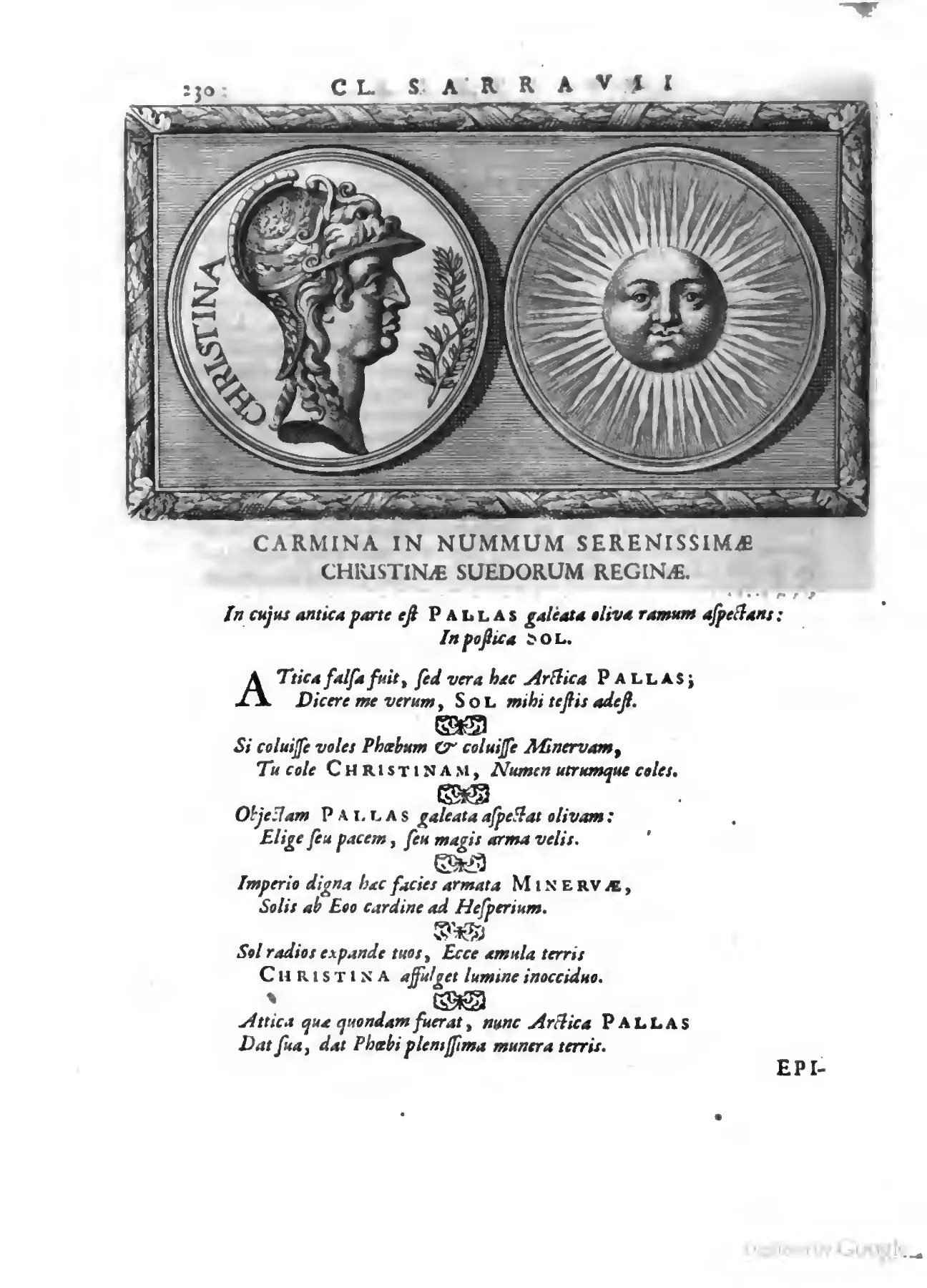
Sarrau’s printed reproduction of Queen Christina’s coronation medal sets the numismatic object at the center of the page: Christina appears as a helmeted Pallas on the obverse, while the reverse’s radiant sun gives visual force to the poems’ praise of her as a sovereign source of learned illumination. Here the medal is not decorative evidence alone but the image through which Sarrau’s courtly gratitude opens onto his juridical claim about coronation as a reciprocal covenant between ruler and subjects. Source ↗.
Christina's own reply, in French, answers Sarrau's rhetoric on its own terms and with a sharper edge. Deferring the gift of her friendship, she writes that she wishes to postpone giving him the friendship of a Queen, since those of Kings are always suspect, until her own can be beyond suspicion, je veux differer de vous donner l'amitié d'une Reyne, puisque celles des Rois sont toujours suspectes, jusqu'a ce que la mienne puisse estre hors de soupçon. The queen thus turns the topos of royal friendship back upon itself, acknowledging with unsentimental clarity that the favour of princes is structurally interested and therefore, until proven otherwise, not to be trusted. Her collecting priorities are voiced with equal directness, as she enjoins Sarrau above all to guard the ancient codices, warning that above all, Sir, take care that none of the ancient MSS. be removed, Mais sur tout Monsieur, ayés soin que l'on n'oste aucun MS. des Anciens — a solicitude for the veteres that binds the diplomatic and the philological registers of the exchange into a single anxiety about loss.
From this courtly summit the correspondence descends into the collegial warmth of pure philology in the exchange with Tanneguy Lefèvre, whose letter on Ovid opens in a register of unfeigned scholarly affection. Hearing that Ovid numbers among Sarrau's beloved authors, Lefèvre writes that he cannot, so may the gods love him, but heartily congratulate himself, P. Ovidium Nasonem tibi in amoribus esse cum accipio, Clarissime Sarravi, non possum, ita me dii ament, non mihi plane & ex animo gratulari. The comic oath ita me dii ament, lifted from Roman comedy, performs the very intimacy with the ancients that the letter goes on to theorise. Turning to the crux of the ring of Gyges in Plato, Lefèvre states his editorial method with concision, holding that everything must be sought from talent and from diligent reading of Plato, and also from the testimony of Cicero, Quamobrem omnia sunt ab ingenio & diligenti Platonis lectione, nec non Ciceronis testimonio petenda. The privileging of ingenium, sustained reading of the author, and corroborating ancient testimonium over the corrupt witness of the manuscripts is the working creed of the philological school in which the whole volume is rooted.
That creed swells into a manifesto in Lefèvre's later diatribe on the decay of learning. Asked what the road to lasting fame might be, he answers — in the roll-call already quoted in this report — that it is certainly none other than the accurate reading of ancient authors, the practice that produced the Budés and Scaligers, the Turnèbes and Passerats. The catalogue of ingentia nomina recasts close reading as the sole generative principle of humanist greatness, against which the letter measures the corruption of contemporary schooling with mordant irony, complaining that the whole of that kind of study is so arranged that the more perfect and accomplished anyone is in it, the more troublesome and burdensome he is to all, ut quo quisque in eo perfectior est atque consummatior, eo sit incommodior omnibus atque molestior. The paradox — that mastery of scholastic training produces not utility but insufferability — inverts the humanist ideal of learning as a bond of civility, and thereby defines that ideal ex contrario.
The French letters to Saumaise return the collection to the fractious human texture of the respublica, where philological grandeur coexists with wounded feeling and personal recrimination. Defending himself against Saumaise's charge of disloyalty to Grotius, Sarrau recalls their final meeting in a passage that slides mid-sentence from Latin into French, insisting that Grotius had fired his kindled spirit with love and that, if his correspondent knows nothing else than that, he is very ill informed, incensum animum inflamnavit amore. Si vous ne scavez autre chose que cela, vous êtes fort mal informé. The bilingual seam registers the emotional pressure of the vindication, the writer reaching for his vernacular at the point of sharpest self-defence.
The volume closes its correspondence with a royal gesture and then turns to elegy. In her letter of condolence to the widowed Madame Sarrau, Christina extends her patronage beyond the grave, assuring her that she will find in the queen a perfect inclination to gratify her, and the will to be constantly hers, Vous trouverez en moy une parfaite inclination à vous gratifier, & la volonté de vous estre constamment, CHRISTINE. The funerary carmina that follow translate the death of the senator into the classical machinery of civic and cosmic loss. Moisant de Brieux mourns him with the Ovidian topos of the iron age, declaring that now truly it is an age of iron, for an iron progeny is spread through the world, and Mars and crime rush headlong, Ferrea nunc vere est ætas, nam fusa per orbem Ferrea progenies, Marsque scelusque ruunt. The verse binds the passing of a single magistrate to the departure of Astraea and the collapse of learning and integrity, so that the death of Sarrau becomes the emblem of an age from which justice has withdrawn — a fitting close to a correspondence that had striven, letter by letter and manuscript by manuscript, to hold that withdrawal at bay.
Frequently Asked Questions
What is the Marquardi Gudii et Doctorum Virorum ad eum Epistolae?
It is a folio collection of learned correspondence printed at Utrecht in 1697, edited by the philologist Pieter Burman the Elder from the surviving letters of the Holstein antiquary Marquard Gude (1635–1689). Printed by François Halma and Willem van de Water, it gathers Gude's outgoing and incoming letters, an anthology drawn from his library, and an enlarged appendix of the letters of Claude Sarrau (d. 1651), councillor of the Parlement of Paris, dedicated to Queen Christina of Sweden. It belongs to the humanist genre of the epistolae clarorum virorum — the printed letter-collection of the illustrious.
Who was Marquard Gude?
Marquard Gude (1635–1689) was a Holstein antiquary who spent his life tracking manuscripts across Europe, deciphering inscriptions among the ruins of Rome, and maintaining an epistolary commerce with the most learned men of his age. He is celebrated in the volume for having tracked down, with remarkable shrewdness, writings that were literally decaying — struggling with moths and worms — and for wresting them from unworthy and ignorant owners. He died at Glückstadt on 26 November 1689; the bulk of his manuscripts passed to the ducal library at Wolfenbüttel in 1710 through the agency of Leibniz, where they form the Gud. Lat. and Gud. Graec. collections.
Is there an English translation of the Marquardi Gudii Epistolae?
No modern English translation of the complete 1697 folio has been identified; the volume has not been translated in full into any modern language, and only excerpts of individual letters have appeared in twentieth- and twenty-first-century anthologies of the Republic of Letters. Separately, the Leo edition presents the full transcription and a complete English translation for the first time. This translation is generated by AI. It forms part of Leo's effort to make freely available online, at no cost, English translations of every text printed in Latin in early modern Europe between 1450 and 1750.
What argument about knowledge does the volume make?
Its governing claim is that the private letter tells the truth about a man more faithfully than any formal history. Burman's front matter contends that from correspondence, rather than from annals composed to serve reputation, one perceives what men actually think, because a letter is written without ulterior calculation. This grants the ephemeral and private a probative authority denied to the monumental and public. The claim carries a tension Burman himself concedes: a partisan letter-writer may serve faction over truth, as he warns of Sarrau, who was so attached to Salmasius that much he wrote about Heinsius is most alien to the truth.
What memorable episodes does the correspondence preserve?
Several vivid particulars stand out. Andrea Alciato reports coining the very word Emblemata — the title of a little book of epigrams composed during the Saturnalia to gratify a patron — casually, unaware it would generate a European genre. A compositor's obscene misprint, turning mente illa into mentula, was propagated across a thousand printed volumes. Correspondents debate whether marine shells found inland are sports of nature or evidence of the sea's retreat, and report the recent unearthing of the Laocoön among the ruins of the house of Titus, with sculptors disputing whether it was cut from a single stone against Pliny's testimony.
This report was generated by an advanced AI assistant that conducted deep research alongside an extensive interpretation of the transcribed original text. Every effort has been made to preserve fidelity to the source and to guard against inaccuracy, but corruption in the text recognition process and model hallucination may nonetheless have entered the text. Treat every claim, quotation, translation, and citation as provisional, and verify each against the original source before relying on or citing it.
Bibliography
- Bots, Hans, and Françoise Waquet, La République des Lettres: Provides the conceptual scaffolding for treating Burman's editorial act as an intervention within the imagined commonwealth of letters, and clarifies why the Bibliotheca Gudiana was understood as a public-spirited, trans-confessional inheritance rather than a private estate. The synthetic survey against which any single letter-collection is best measured.
- Bibliothèque nationale de France, Claude Sarrau (15..-1651): The authority record that maps Sarrau's network of contributors and correspondents, a useful cross-check against the attributions embedded in Burman's appendix. Its list of joint contributions helps establish which of the Sarravian letters travelled through the Cabinet Dupuy before reaching Gude's papers.
- Eyffinger, A. C. H. M., Het Hollands-classicisme in de tweede helft van de achttiende eeuw: Pieter Burman de Jonge en zijn kring: Though focused on the nephew, the study reconstructs the editorial workshop in which the 1697 Epistolae was assembled and situates the elder Burman within the Utrecht philological lineage of Graevius, Drakenborch, and their pupils. Indispensable for anyone trying to distinguish the two Burmans' hands in the Sylloge.
- Grafton, Anthony, The Footnote: A Curious History: Illuminates the late-humanist culture of the scholarly footnote, index, and learned editing that underwrites Burman's apparatus criticus, dedicatory epistle, and tripartite index in the 1697 volume. It explains why an editor's Corrupta hæc est lectio is itself a claim to authority, not a mere housekeeping note.
- Herzog August Bibliothek, Marquard Gude (1635–1689) and his manuscripts: The institutional account of the surviving Gud. Lat. and Gud. Graec. holdings at Wolfenbüttel, the documentary core against which Burman's printed text must one day be collated. It is the single most direct route from the folio's quoted letters back to the autographs behind them.
- Kahn, Victoria, "Lauded and Loathed: Salmasius in Great Britain," The Oxford Handbook of Milton: Anchors the Heinsius–Salmasius polemic and the Defensio Regia / Defensio pro populo Anglicano exchange whose documentary residue survives in the Sarrau appendix. Reading it clarifies exactly why Burman warns that Sarrau, sworn into Salmasius's words, is a partisan witness on Heinsius.
- Popkin, Richard H., The Third Force in Seventeenth-Century Thought: Supplies the confessional and intellectual-historical background to the Amyraut–Spanheim controversy over hypothetical universalism, against which several of Gude's correspondents positioned themselves. It makes legible the theological stakes behind Sarrau's carefully engineered phrase conditione subnixa.
- ProQuest, Correspondance intégrale d'André Rivet et Claude Sarrau: A modern critical edition of the Rivet–Sarrau correspondence that situates Sarrau within the Cabinet Dupuy and the Reformed learned circles of Paris. It supplies the closest available point of comparison for the editorial handling of Sarrau's letters that Burman prints in appendix.