Nobody's Shop, Everywhere: The Anonymous Nugae Venales, or, Saleable Trifles, A Treasury for Laughing and Joking
A seventeenth-century Latin jestbook that sells itself at Nobody's shop, Nugae venales, sive Thesaurus ridendi & jocandi trains the entire apparatus of scholastic learning — syllogism, legal testament, medical diagnosis, etymology — upon flatulence, cuckoldry, and the latrine, and does so without ever once dropping the grave face of the schools. Assembled anonymously and issued under a false imprint through the Latin university culture of Northern Europe, its earliest surviving issue is dated 1642, with reissues running to the enlarged 1720 Editio ultima. It is a book that begins by refusing to exist, and it rewards attention precisely because its impersonation of serious method never breaks character.
ExLatinis
July 23, 2026
Contents
A seventeenth-century Latin jestbook that sells itself at Nobody's shop, Nugae venales, sive Thesaurus ridendi & jocandi trains the entire apparatus of scholastic learning — syllogism, legal testament, medical diagnosis, etymology — upon flatulence, cuckoldry, and the latrine, and does so without ever once dropping the grave face of the schools. Assembled anonymously and issued under a false imprint through the Latin university culture of Northern Europe, its earliest surviving issue is dated 1642, with reissues running to the enlarged 1720 Editio ultima. It is a book that begins by refusing to exist, and it rewards attention precisely because its impersonation of serious method never breaks character.
Nugae venales, sive Thesaurus ridendi & jocandi is a book that begins by refusing to exist. Its title page announces that these "saleable trifles" are on sale at Nobody's shop — Prostant apud NEMINEM; sed tamen UBIQUE — yet everywhere at once, and from that opening paradox onward the anonymous compilation delights in a sustained act of learned impersonation. The earliest surviving issue is dated 1642; the volume was reissued in 1689, 1703, and finally in the 1720 Editio ultima auctior et correctior, whose very colophon insists that this last and enlarged version corrects a text already some eighty years in circulation. No printing house, no city of the press, and no genuine dedicatee can be recovered from the object itself: the work names only a fictitious body of grave patres melancholicorum, the "conscript fathers of the melancholics," to whom its treasury of laughter is mockingly addressed. It is, in the plainest description, a clandestine Neo-Latin jestbook — an anthology of constraint-verse, mock-disputations, parodic testaments, macaronic poems, and paradoxical encomia — assembled anonymously and circulated under a false imprint through the learned Latin culture of seventeenth-century Northern Europe.
The intellectual problem the work sets itself is singular and unifying: how to make the full machinery of serious learning perform frivolity without once abandoning its outward forms. The compilation takes syllogism, definition, distinction, cited authority, testamentary formula, medical prescription, and etymology — the whole apparatus of scholastic, juridical, medical, and philological scholarship taught in the Protestant universities of the Empire — and trains it, with rigorous fidelity to method, upon obscene, trivial, and scatological matter. Flatulence is soberly categorized among Aristotle's predicaments; the latrine is proved the origin of all the sciences; a piglet dictates a legally impeccable testament; an entirely invented "hasible quality" is diagnosed with the gravity of a disputed medical predicament. The recurring move throughout is a formal inversion — dignified method applied to undignified content — and it is reinforced by feats of tautogrammatic and chronogrammatic virtuosity in which sense bends to constraint. The governing justification is Horatian: the reader is enjoined to misce stultitiam consiliis and to observe that sit modus in rebus, so that mirth is licensed in measured degree, the mark neither of the perpetual jester nor of the man who never laughs.
The stakes of that procedure reach across three scholarly fields that rarely meet. For the history of the book, the Nugae venales is a textbook specimen of the joco-serium anthology issued under a fictitious imprint, and its false-imprint formula is among the most frequently cited of the period. For the Neo-Latin literary tradition, it inherits and extends the maxim serio ludere — the motto Achille Bocchi affixed to his Symbolicae quaestiones (Bologna 1555) and the formula Caspar Dornau built into the title of his Amphitheatrum sapientiae Socraticae joco-seriae (Hanau 1619) — carrying the learned play of the sixteenth century into the mature Baroque. And for the social history of learning, its mockery of pennalismus and the depositio beani preserves primary matter for the study of student life at the German universities. The book thus sits at a crossing of clandestine print, humanist facetiae, and university culture, deploying a single satirical technique across all three.
What a first-time reader will find most memorable is the sheer commitment of the impersonation. The volume houses the celebrated all-P tautogram Pugna porcorum, printed under the pseudonym Publius Porcius and identified in modern scholarship with the early-sixteenth-century Netherlandish poet Johannes Leo Placentius, in which prelate-pigs war against plebeian piglets and every word begins with the same letter — down to a closing papal panegyric that sustains the constraint without a break. It preserves the macaronic Flöia, a Latin-German hybrid on fleas ascribed to the invented Griphaldus Knickknackius ex Floilandia; the late-antique Testamentum Porcelli, in which M. Grunnius Corocotta the piglet dictates his legacies; a mock regimen sanitatis; chronograms encoding the war-years of the 1630s; and a misogynist mock-definition of woman as destroyer balanced, in the same volume, by an answering Pro foeminis. Around these run an anticlerical and confessional edge — a cynical disquisition on the political utility of religious lies, satire against Anabaptists, a jest at Luther's beard, a gesture toward Cromwell — and a persistent estates satire that exalts the sleeping beggar over Croesus and Alexander.
Threading these disparate parts is a single, recoverable spine: the same inversion of grave method and trivial matter that animates a scholastic proof that a fart is an organic body also governs the juridical formalism of the piglet's testament, the apothecary's obscene prescription, and the tautogram's subordination of meaning to the letter. The conceptual vocabulary of the schools, the material fiction of a book sold nowhere and everywhere, and the internal movement from prefatory apologia through disputation, poem, and testament all serve that one procedure. Much about the object remains genuinely uncertain — the identity of its compiler is unknown, the dating of the embedded Flöia is contested, and the confirmation of individual contributors awaits evidence not presently in hand — but the coherence of its method is not in doubt, and it is that method, pursued with unrelenting formal discipline, that makes the Nugae venales reward attention.
Read the full text and English translation on Leo
This text was transcribed and translated as part of the ExLatinis project, an effort by Leo to make free English translations of every text published in Latin in early modern Europe (1450–1750) available online. The complete transcription and English translation of this work can be read free of charge:
→ Read the original Latin text and full English translation on Leo
You can save a copy of this document into your Leo account to run deep text searches, conduct further analysis, or cross-reference it with your own research.
Assigning an English Title and Reading the Title Page of the Nugae Venales
An editorial English title is supplied below, since no conventional English title is established in current historiography for this anonymous 1642 anthology: Saleable Trifles, or, A Treasury for Laughing and Joking: A Clandestine Neo-Latin Anthology (1642; Editio ultima auctior et correctior, 1720). This title is offered solely for the convenience of Anglophone readers and is not an established scholarly designation.
The Latin wording of the original title page, Nugae venales, sive Thesaurus ridendi & jocandi ad gravissimos severissimosque viros, patres melancholicorum conscriptos opus plane novum & necessarium, is a tightly woven philological surface, and three of its terms repay close reading.
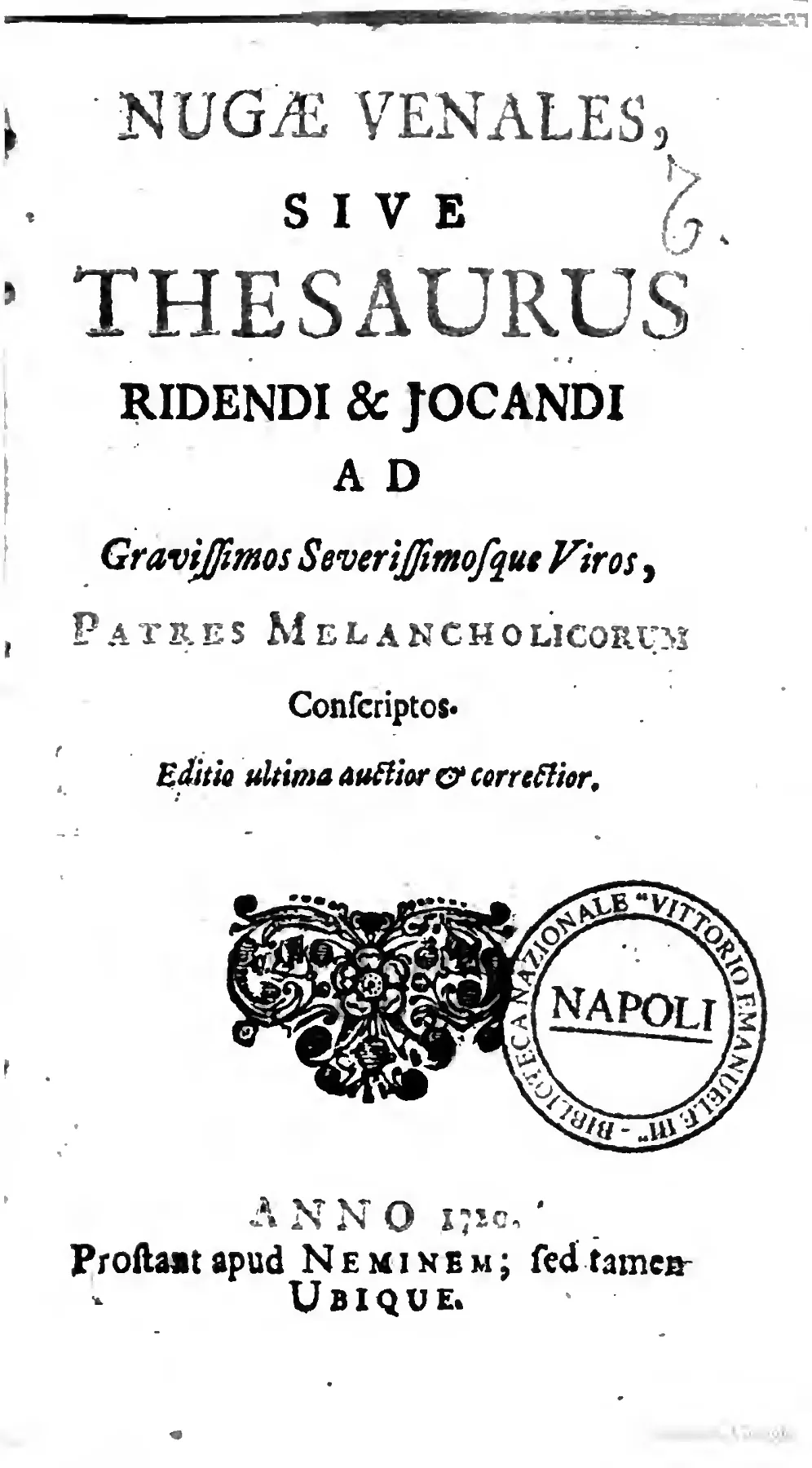
The 1720 title page makes the joke typographic as well as verbal: after the mock-dedicatory address to the "Patres Melancholicorum Conscriptos" and the claim of an "Editio ultima auctior & correctior," the imprint refuses ordinary bibliographical coordinates with "Prostant apud NEMINEM; sed tamen UBIQUE." A later circular library stamp adds a provenance trace to a leaf designed to fold place, authority, and edition history into the satire. Source ↗.
The phrase nugae venales fuses two words whose period connotations reach back through Latin literary tradition. Nugae in classical Latin names the trifles, baubles, and disposable pleasantries that Martial, Petronius, and Walter Map's twelfth-century De Nugis Curialium allowed into literary circulation under cover of literary inconsequence. By the seventeenth century the word retained that double valence of triviality and craft, and the present compilation exploits it. Nugae, on the title page, both disclaims serious ambition — a parodic disclaimer aimed at the early modern Counter-Reformation anxiety over levity in learned Latin — and signals the deliberate artfulness of what follows, since the compilation's constraint-poems (tautograms, macaronic hybrids, mock-disputations) are feats of technical virtuosity. The adjective venales reads as a marketplace metaphor: these trifles are for sale. The mock imprint Prostant apud Neminem, sed tamen ubique ("for sale at no one's shop, but nonetheless everywhere") binds venales into the title-page fiction of an offending book that refuses to disclose its own seller, and the conceit registered the early modern jestbook's habit of issuing from clandestine or at least non-genuinely-imprinted presses, a habit the Pomeranian and Netherlandish false-imprint traditions made routine. The volume opens by making this refusal of a seller its first joke, announcing that the trifles are on sale at Nobody's, but nonetheless everywhere, Prostant apud NEMINEM; sed tamen UBIQUE; the small-capital emphasis on the impossible seller and the omnipresent circulation makes venales and its self-cancelling market the governing conceit of the whole title-page apparatus.
The second term that the title-page brands is Thesaurus ridendi & jocandi: a "treasury of laughing and joking." Thesaurus in early modern bibliographic Latin is markedly more than a modern English "treasury"; it is a published anthology arranged by topic for systematic consultation, in the manner of a Ravisius Textor-style epitome or a Dornavian Amphitheatrum. To label the book a thesaurus is to promise the reader an encyclopaedic, organised collection, and the title-page exploits this implication precisely so that the contents may then mock it. The 1642 title-page's paratext adds ad gravissimos severissimosque viros, patres melancholicorum conscriptos — "to the most grave and severe men, the conscript fathers of the melancholics" — and the shift from the catalogue's promise of laughter to its dedication to a fictitious body of grave patres melancholicorum is itself the central joke. Patres conscriptos was the formal title of the Roman Senate, transferred here to the imaginary fathers of the melancholics, those labouring under the quartan humoral disease whose canonical locus was Galenic and whose humoural regimen sanitatis the compilation itself caricatures. The dedication thus stages an inversion: the most serious of Roman institutions is dubbed the senate of the melancholic, and the jestbook's compiler substitutes patrician Roman gravity for the absence of any actual patron.
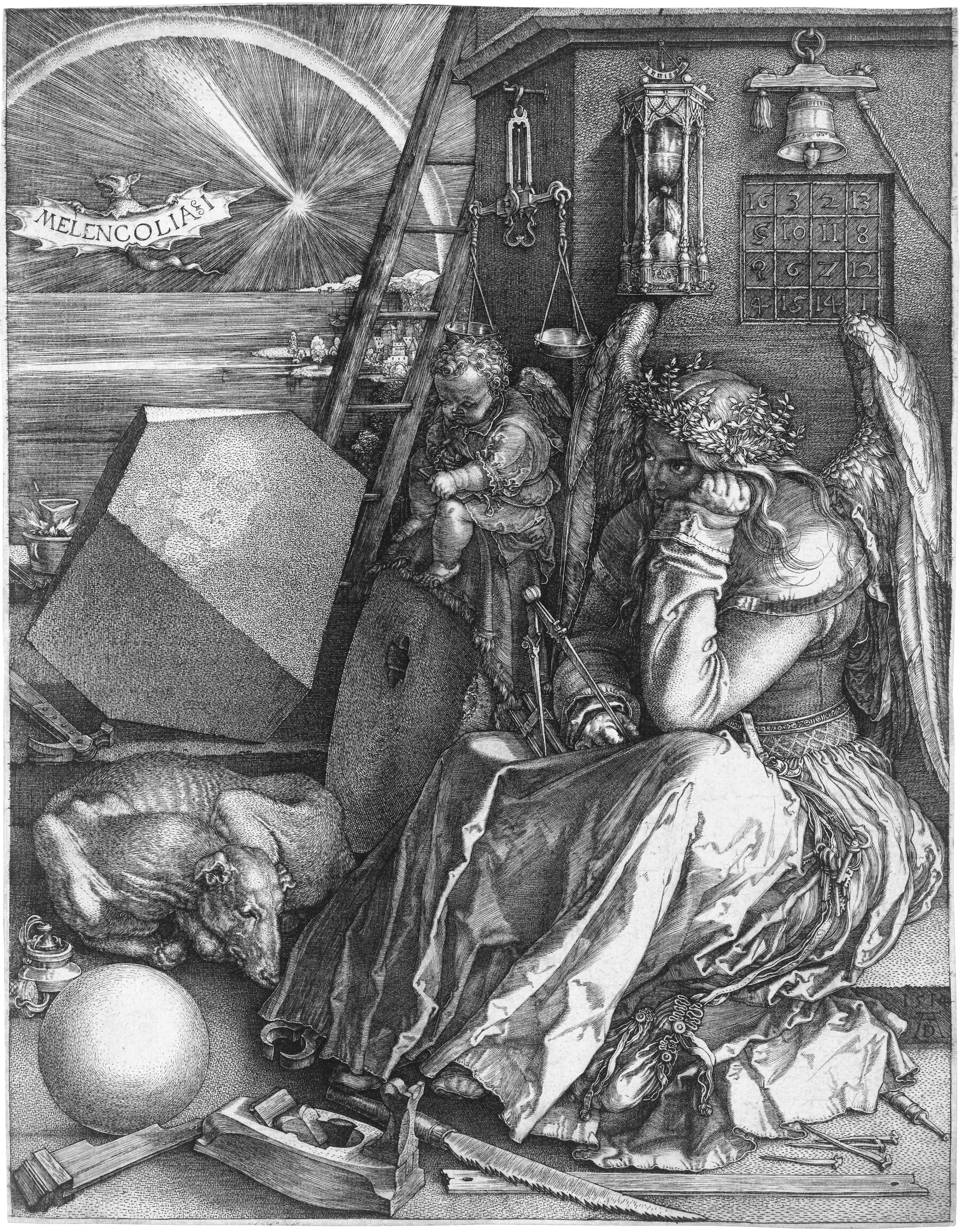
Dürer's Melencolia I (1514) gives monumental form to the humoral condition that Nugae venales converts into a mock political constituency: a brooding, winged personification surrounded by instruments of measure, craft, and stalled activity. Set beside the dedication to the "conscript fathers of the melancholics," the engraving sharpens the joke by showing how early modern melancholy could be imagined with grave, almost senatorial authority. Source ↗.
The third term, not on the title page but governing the volume's self-presentation, is the formula joco-serium or serio ludere, "seriously to play." Early modern Latin writers from Petrarch and Erasmus had invoked the figure, but the maxim becomes programmatic in Achille Bocchi's emblem book Symbolicae quaestiones (Bologna 1555), which prints serio ludere as its banderolle, and a generation later Caspar Dornau's own Amphitheatrum sapientiae Socraticae joco-seriae (Hanau 1619) carries joco-serium in its very title. Within that network, the Nugae venales compiler freely acknowledges that the work is simultaneously serious and playful: the conflation of serio and joco in the genre's self-description is the engine that allows the constraint-poems, mock-disputations on predicaments and categories, and the precision-verses of the Pugna porcorum tautogram to operate simultaneously as technical exercises and as parodies of scholastic form. The compilation states this balance as its prefatory doctrine, holding that to joke always is no less the mark of foolish men than never to devote effort to the laughter of fools, Emper jocari, stultorum nunquam risui operam dare, nonminus fatuorum hominum est — a Horatian calibration of moderated mirth as the middle path between the perpetual jester and the man who never laughs. To treat serio ludere as merely decorative misses its function; within a joco-serium anthology the maxim licenses the writer to do scholastic-looking things for non-scholastic ends and thereby to puncture the very scholastic edifice he inhabits.
What the Nugae Venales Is: An Executive Summary of the Anonymous Jestbook
Nugae venales, sive Thesaurus ridendi & jocandi (the modern editorial English title being Saleable Trifles, or, A Treasury for Laughing and Joking) is a clandestine, anonymous, Neo-Latin jestbook whose earliest extant issue is dated 1642. The first issue carries the false imprint Prostant apud Neminem, sed tamen ubique ("on sale at no one's shop, but nonetheless everywhere") and the publisher's notice Editio ultima auctior et correctior was repeated on the 1720 Editio ultima. No specific printing house, name of any city for the press, or named dedicatee appears anywhere in the work; the dedication ad gravissimos severissimosque viros, patres melancholicorum conscriptos is a mock dedication. The compilation consists of constraint-verse, mock-disputations, mock-testaments, macaronic poems, parodic panegyrics, paradoxical defences of trivial things, and full-blown humanist facetiae. The embedded authorship is heterogeneous: the universally printed Pugna porcorum is placed under the pseudonym Publius Porcius and is identified in modern scholarship with Johannes Leo Placentius, an early-sixteenth-century Netherlandish Latin poet who is reported in the modern critical edition (Fontaine 2019) to have resided at the Leuven college known as the Porcus and whose Pugna porcorum appeared at Antwerp and Augsburg in 1530; the macaronic Flöia, cortum versicale de Flöis Schwartibus, Illis Deiriculis ... is placed under the pseudonym Griphaldus Knickknackius ex Floilandia on the title of its 1662 imprint. Other embedded items (the Testamentum Porcelli, attributed by tradition to Ofilius Sergius; the Canum cum Catis Certamen; De jure et natura pennalium; the Crepundia poëtica; Pro foeminis; the mock regimen sanitatis; and assorted tautograms and chronograms) are anonymous or pseudonymous. The volume is overwhelmingly in Latin, with macaronic Latin–German insertions (especially in the Flöia piece and the Cantiuncula) and Latin–Dutch and Latin–German vocabulary glosses on games, dice, and play. The compilation's method is consistent throughout: the full syllogistic apparatus of the schools is trained on trivial and obscene matter, as when a mock-disputation proves flatulence to be an organic body — a corporeal thing, thus proved, since the definition of an organic body consists in the subtlety of the senses, but nothing is as sensible as a fart, R. Ita probatur sic; ratio corporis organici consistit in subtilitate sensuum. Atqui nihil æque sensibile est ac crepitus. Ergo crepitus est corpus organicum. The compilation is preserved in considerable numbers in early modern library catalogues and survives in 1642, 1689, 1703, and 1720 issues, with at least one English translation lineage in Nugæ venales, or, A Complaisant Companion (printed by W. D., a 17th-century English reissue), as well as National Library of Australia microform 256014 of The second edition corrected, with many new additions (a reproduction of the Harvard copy). Modern English-language scholarship on the Pugna porcorum itself exists through Michael Fontaine's 2019 critical edition The Pig War and the original John Placentius identification is now standard. A complete Dutch, German, or modern scholarly English translation of the entire anonymous compilation has not been located and is not generally known to scholarship; Fontaine's 2019 volume translates Placentius's poem in isolation. The driving purpose of the Nugae venales is the systematic parody, by way of the joco-serium tradition, of the scholastic and Aristotelian machinery then being taught at Protestant German and Dutch universities: predicaments, categories, syllogisms, the regimen sanitatis, testamentary form, and university initiation rites are all run through the grinder of serio ludere; secondarily, the manuscript layer preserves confessional and Reformation satire (against Anabaptists, against clerical mourning-for-pay, gesturing at Luther and Cromwell). Placentius's date of death is reported as c. 1550; this figure is broad-consensus biographical shorthand for a writer whose active period is the early sixteenth century, and it is presented here as consensus rather than as a directly confirmed date.
The Nugae Venales at the Crossroads of Book History, Neo-Latin Letters, and University Life
Nugae venales matters to modern academics because it sits at the intersection of three scholarly fields that seldom engage one another directly: the history of the book and clandestine print culture in seventeenth-century Northern Europe; the Neo-Latin literary tradition, particularly the mature Baroque reception of the Italian humanist facetiae and the paradox-encomium genre; and the social history of learning, especially student life at Protestant German universities. The text's significance for the discipline of early modern book history is methodological: it is one of the textbook examples of a joco-serium jestbook with a fictitious imprint. The formula Prostant apud Neminem, sed tamen ubique, attested on its title page, is among the most frequently cited specimens of the late sixteenth- and seventeenth-century false-imprint convention, and accordingly the figure of the Nugae is now routinely invoked in accounts of how ordinary readers and university copyists located clandestine-print material in the Empire. The compilation's accumulation of multiple editions within roughly eighty years (1642, 1689, 1703, 1720) also makes it a useful case study in the durability and self-conservation of the Nugae genre — a longevity that, remarking on the very title Editio ultima auctior et correctior of 1720, suggests that the work circulated as a stable, canonical specimen of the joco-serium genre well into the eighteenth century.
Within the Neo-Latin literary tradition the Nugae venales showcases the serio ludere maxim (which Achille Bocchi affixed to Symbolicae quaestiones, Bologna 1555, as its over-motto and which F.-J. Worstbrock and other German Neo-Latinists regard as constitutive of the sixteenth-century learned play tradition) and the cognate joco-serium formula (which Caspar Dornau's Hanau Amphitheatrum of 1619 built directly into its own title).
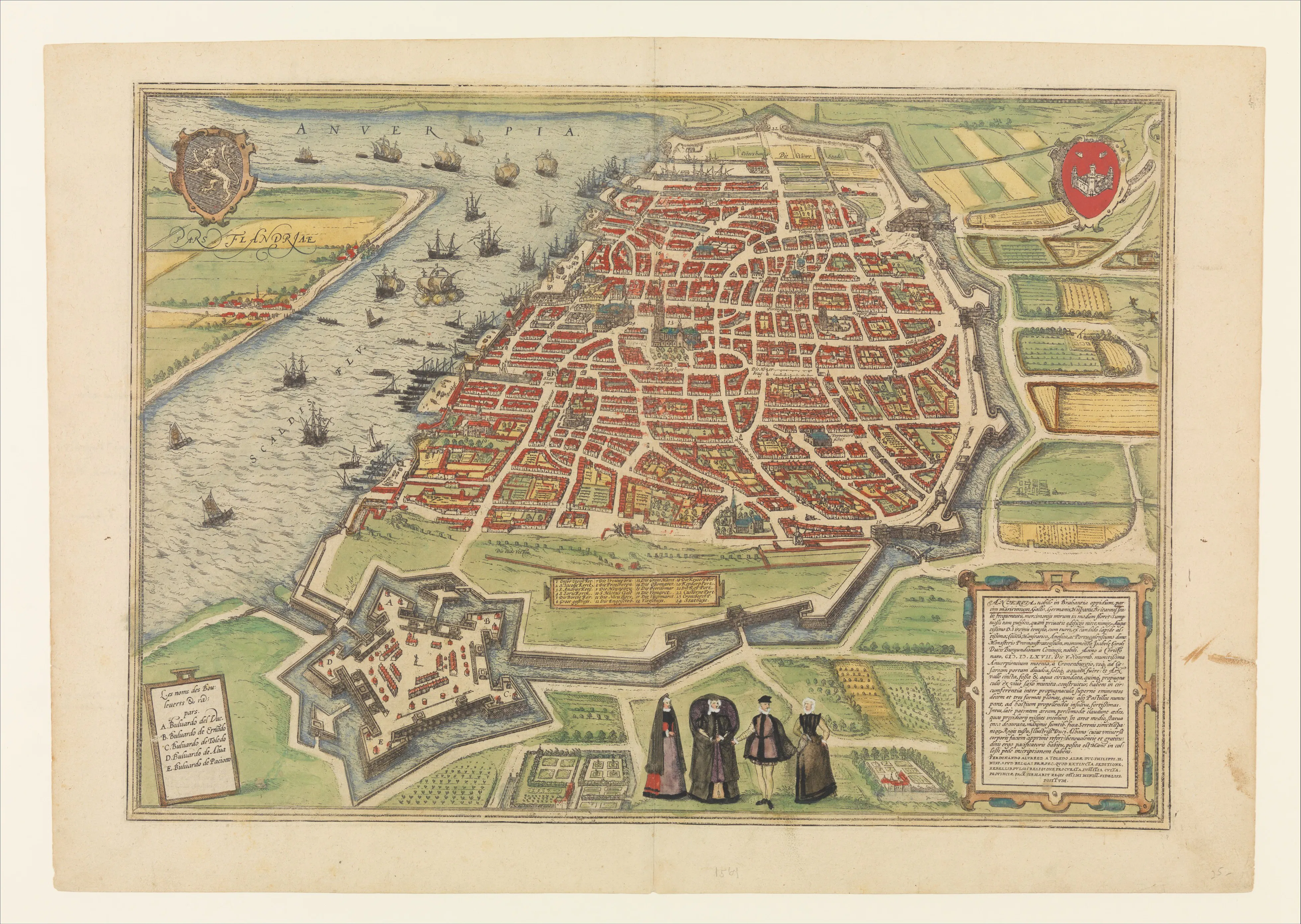
Braun and Hogenberg's panoramic view of Antwerp situates the Neo-Latin taste for learned play in the urban print world that helped circulate it: Antwerp was the city where Johannes Leo Placentius's porcine tour de force, later embedded in the Nugae venales, first appeared in 1530. The harbor, walls, and street grid evoke a commercial-humanist milieu rather than the anthology itself, making the image a contextual witness to the Northern European networks behind serio ludere. Source ↗.
The virtuosic core of that tradition is the constraint-poem, and the Pugna porcorum announces its own programme in a convivial, tautogrammatic frame that binds technical difficulty to the anthology's mirthful purpose: the reader is bidden, drinker, to read through the fairest battles of the pigs, since by drinking he will be able to bring forth gentle poetry, Perlege porcorum pulcherrima proelia, Potor, Potando poteris placidam proferre poesin. That the same all-P discipline can be sustained through a closing papal panegyric — the poem urging the father of the fatherland to go on and complete the patriarch's peace, and openly to win the palm, most gentle prince, Perge pater patriæ patriarchum perfice pacem. promereare palam palmam placidissime princeps — demonstrates the serio ludere engine at full stretch, subordinating sense to constraint across a passage of formal panegyric. The 1720 Editio ultima explicitly advertises an enlarged and corrected text, reflecting how the Neo-Latin pseudo-anthology, like the more celebrated Delitiae collections of eighteenth-century German antiquarian editors, accumulated discrete contributions over time. Although direct attribution of any embedded item in the Nugae venales to the Danish poet Henricus Harderus (Henrik Harder, 1642–1683) cannot be confirmed in available scholarship, his reputation as a contributor of witty epigrams aligns generically with the volume and is preserved by his appearance in the Delitiae poetarum Danorum (vol. II, pp. 209–368).
The historiography of student life at early modern German universities is the third field where the Nugae venales impinges. Its mock-satirical pieces on pennales — the student servants whose servitude to senior students is the topic of Matthias Asche's regional Rostock-and-Bützow study and of the empirical history presented by the University of Leipzig's Studentisches Leben — Deposition und Pennalismus exhibit — provide primary source material for a tradition whose secondary literature burdens itself heavily with the rich documentary history of the 1657 Reichsverbot of the practice at Regensburg and the 1661 Kursachsen Edikt. Asche is Professor für Allgemeine Geschichte der Frühen Neuzeit at the University of Potsdam; his volume (with Anton Schindling) Dänemark, Norwegen und Schweden im Zeitalter der Reformation und Konfessionalisierung, Münster 2003, supplies the confessional-historical ground for the work's Northern European reception in the 1528–1660 Nordische Königreiche und Konfession circuit. The same anticlerical-confessional edge that animates the work's Reformation satire also drives its most irreverent gestures toward authority in general, as in the cynical claim that the founders of religions, when they observed that truth did not suffice to tame the ferocity of the people, formed religions teeming with lies, cum animadverterent veritatem non sufficere populi ferociæ domandæ, formarunt religiones mendaciis scatentes — a passage whose placement of Minos, Lycurgus, and Mahomet within a single utilitarian frame marks the outer edge of the volume's confessional provocation.
The historiographical debates that the Nugae venales touches on divide cleanly into three. The first is the dating debate: Fontaine's 2019 reconstruction locates Placentius in Leuven and the Pugna porcorum in 1530, whereas earlier bibliographers had been content to treat the Pugna as an undated curiosity. The standard attribution of Testamentum Porcelli to Ofilius Sergius and the late-antique period, defended by E. Champlin in The Testament of the Piglet (1987), is largely uncontested but is re-examined in relation to Roman-law pedagogy; Champlin's reading emphasises the satiric purpose of the Testamentum rather than viewing it as a mere student exercise. The juridical parody the Testamentum carries into the anthology turns on faithful testamentary formalism, the piglet opening in the voice of a proper testator: I, M. Grunnius Corocotta the Piglet, made this Testament, which, since I could not write with my own hand, I dictated to be written, M. GRUNNIUS COROCOTTA PORCELLUS Testamentum feci, quod quoniam manu mea scribere non potui, scribendum dictavi, the dignified legal apparatus applied intact to an undignified testator in the anthology's characteristic manner. The second historiographical locus of dispute is the dating of the Flöia itself: one strand of scholarship (the German antiquarian trade and Google Books) settles on 1662 as the date of the earliest surviving imprint, while an older German-language catalogue tradition notes a 1593 first edition by the same pseudonym under the title Floia. Cortum versicale de flohis. Autore Griffholdo Knickknackio. Ex floilandia, leaving unresolved whether the surviving 1662 imprint is a first edition or a re-issue from an earlier draft. The third literature cluster surrounds the false imprint convention: most historians follow the reading that books bearing Prostant apud Neminem are evidence of clandestine print from the Empire region; the opposing reading — that such formulae can be entirely conventional even where genuine publication data exists — has been argued in some early-modern German book-history studies and has not yet been definitively resolved for this compilation. The state of scholarly consensus, then, is firm on the existence of an anonymous 1642 Nugae venales and a 1720 Editio ultima but presently silent on the identity of any single compiler; Caspar Dornau's overall joco-serium Amphitheatrum of 1619 is treated as the closest cognate, but a definitive attribution of a Nugae venales compilation to Dornau or any other named editor could not be located in current scholarship. The bibliographers of the standard Bibliotheca Belgica tradition of Ferdinand van der Haeghen have not been directly confirmed in the present search to have indexed Nugae venales under any specific classmark; that attribution from the Bibliotheca scatologica tradition appears only in references of the broader generic kind, and a specific Walsh Bibliotheca scatologica entry could not be located with confidence in the present research, so the date '1887' is not asserted.
Editions, Imprints, and the Object Biography of the Nugae Venales
The earliest extant issue, datable to 1642, is preserved in the Early English Books Online / Text Creation Partnership fileset at the University of Michigan, with EEBO / TCP record identifier A52575.0001.001. Its title-page reads (ligature and punctuation normalized): Nugæ venales, sive, Thesaurus ridendi & jocandi Ad gravissimos severissimosque viros, patres melancholicorum conscriptos opus plane novum & necessarium; in quo quid contineator, quævis pagina docebit. The imprint line records: Publication [S.l.] :: Anno 1642. Prostant apud neminem; sed tamen ubique, [1642]. Internal evidence on the 1642 issue places it in the digital collection Early English Books Online, and the U-M Library file shows, on at least one page, a parodic quaestio opening Avarus cui similis? / R. Est similis porco. The 1642 issue, accordingly, was sine loco, with the place of printing suppressed — a hallmark of the clandestine or quasi-clandestine press in the Empire.
The next extant issue is dated 1689. A microform of the 1689 issue is held at the Internet Archive image collection for the bim_early-english-books-1641-1700_nugae-venales-sive-the_1689 identifier, where the title-page is recorded as Nugae venales, sive, thesavrvs, with the spelling thesavrvs marking the latinate seventeenth-century v-for-u convention. The 1689 issue is also reported by the catalog.hathitrust.org record 010823547 as holding an issue of Nugae venales, sive, Thesaurus ridendi & iocandi: ad gravissimos severissimosque viros, patres melancolicorum conscriptos (note the single-l variant melancolicorum in that record). A 1703 issue is recorded by OCLC and the antiquarian trade; a 1720 issue under the title Editio ultima auctior & correctior is recorded by WorldCat OCLC 30460700 and by the ABAA antiquarian-booksellers' catalogue (#1183067648), which notes 651 pages and the relation to the 1703 text: This edition contains the same as that of 1703. The Stanford Grub Street Project also catalogues Nugæ venales, or, A complaisant companion, being new jests, domestick and foreign, bulls, rhodomontadoes, pleasant novels and miscellanies, which represents the English translation lineage produced for the English market (printed by W. D. for an undetermined bookseller; the Harvard original is reproduced at the National Library of Australia and is described as the 'second edition corrected, with many new additions'). Wellcome Collection notes material detail for one issue: Two unpaginated leaves (half-title and plate to 'Pugna porcorum') between P8 and Q1, and bookplates / signatures consistent with private library collections of the seventeenth and eighteenth centuries.
In terms of physical and book-historical materiality: the Nugae venales is, when measured against the few surviving catalogue descriptions, a small-format octavo or duodecimo volume of between roughly 320 and 700 pages, of which the 1720 Editio ultima at 651 pages (per ABAA #1183067648) is the most extensively described; the 1642 Editio princeps is described in catalogue databases at a similar small format. The work is bound uniformly with the false imprint Prostant apud Neminem, sed tamen ubique repeating at the foot of the title. The pagination, in bookbinding terms, is reported in the catalogues only at the level of 328 p.; 14 cm (University of California copy of the Complaisant Companion lineage) and is otherwise typical of a small-format jestbook of the period. The production networks cannot be specified: there is no surviving archival record of any printing house in the catalogues; the compilers' hands remain anonymous. The volume is not, in the modern catalogues, listed among the books that were formally prohibited or suppressed; in particular there is no record of an entry in the Index Librorum Prohibitorum.
The question of reception and the network around the Nugae venales is the most neglected area of historiography. None of the surviving catalogues trace a chain of replies, refutations, or defences to its publication. There is no recorded counter-volume (such as scholarly contra-nugae refutations) and no entry in the standard post-Tridentine Index records. The work's most concrete literary diffusion lies in its own reissues. The 1689, 1703, and 1720 issues form the bulk of the early modern diffusion, and the Complaisant Companion forms the English-language reception in the late seventeenth and eighteenth centuries. The natural place of the Nugae venales within the family of related joco-serious anthologies is alongside such compendia as Poggio Bracciolini's Facetiae (first printed 1470), Caspar Dornau's Amphitheatrum sapientiae Socraticae joco-seriae (Hanau 1619, ~700 comic and moral treatises and poems concerning the natural world and historical figures, preserved today in the Royal Collection Trust 1081251 and indexed in the Post-Reformation Digital Library at the Junius Institute), and — at one further remove — the macaronic tradition of Teofilo Folengo's Baldus (the green-grammar Neo-Latin epic whose Christian serio ludere metaphysical scaffolding is erected in M. L. Mason's recent study The Macaronic Epic of Teofilo Folengo Between Ariosto and Rabelais). The macaronic and multilingual layer of the Nugae venales itself extends to a mock-philology of the vernacular, as in the etymological jest deriving a Germanic term for the cuckold from the antique roots for rooster and dance — the compilation explaining that it is a purely Germanic word, but that it degenerated into Latinity long ago, from the most ancient word 'Han,' which is a rooster, and the word 'Rein,' which is a dance, Est vocabulum mere Germanicum, sed in latinitatem jam olim degeneravit, ex antiquissimo vocabulo Han qui est Gallus, & voce, Rein, quod chorea — the same procedure of grave method upon trivial matter that governs the volume's syllogistic and juridical parodies. The relationship among these joco-serious anthologies is one of family resemblance rather than single inheritance: Nugae venales cites no Facetiae edition by name and the Amphitheatrum of 1619 stands at a generational remove; yet the maxim serio ludere and the formula joco-serium are common coin across all of them.
Reading the Nugae Venales from Title Page to Tautogram: Structure and Textual Evidence
The Title-Page Fiction and Prefatory Warrant
The volume opens by cancelling its own commercial premise. The mock-imprint declares that these trifles are on sale at Nobody's shop, but nonetheless everywhere, a paradox already discussed above as the governing conceit of the title page — a formula that does double work: it withholds the material facts of publication that a legitimate title page would supply, and it converts that suppression into the first joke of the collection. The formula folds the vocabulary of the marketplace — the verb prostant, proper to wares displayed for sale — back upon a seller who does not exist, so that the reader is invited into a transaction whose vendor is a logical impossibility. The dedication printed alongside it sustains the same register of solemn misdirection, addressing the work to the most grave and severe men, the conscript fathers of the melancholics, PATRES MELANCHOLICORUM Conscriptos. The transfer of the senatorial formula patres conscripti to an imaginary college of the melancholic is not incidental colouring; it establishes at the threshold the governing procedure of the whole compilation, in which the most dignified institutional language of antiquity is placed in the service of the humoral disorder its own contents will proceed to caricature.
The prefatory apparatus then supplies the theoretical warrant for what follows, and it does so in genuinely humanist terms rather than as mere disclaimer. The preface insists that always to joke is no less the mark of foolish men than never to devote effort to the laughter of fools — the prefatory doctrine of moderated mirth already noted above. The sentence is constructed as a balanced condemnation of two extremes — perpetual jesting and total gravity alike — so that the moderated mirth of the book positions itself as the rational mean between them. This calibration is underwritten by the Horatian tag that the preface deploys as its proof-text, holding that he wins every vote who mingles the useful with the sweet, Omnetulit punctum, qui miscuit utile dulci. The invocation is significant beyond its familiarity: by grounding frivolity in the Ars poetica the compiler claims for the jestbook the same didactic legitimacy the schools accorded to serious verse, and thereby licenses the sustained impersonation of learned method that constitutes the body of the work. The apparatus that promises to instruct even as it amuses is precisely the apparatus that will be turned upon flatulence, cuckoldry, and the latrine.
The Mock-Catechism: Scholastic Method upon Base Matter
The mock-catechism that forms the core of the collection executes this programme with unrelenting fidelity to scholastic form. Its signature achievement is the syllogistic proof that the crepitus ventris is a corporeal body, an argument already introduced above, running that the definition of an organic body consists in the subtlety of the senses, but nothing is as sensible as a fart, therefore a fart is an organic body. The passage is meticulous in its observance of the demonstrative apparatus: it announces itself as a response (R.), signals its argumentative structure (Ita probatur sic), lays out major and minor premises linked by the adversative Atqui, and closes on the triumphant Ergo of the concluded syllogism. The comedy lies entirely in the friction between the impeccable form and the base matter; the reasoning is not defective, merely misapplied, and it is the very correctness of the logic — the pun on sensibile, at once "perceptible" and "sensory" — that carries the parody. The same object receives a textbook Aristotelian definition, that a fart is wind of the belly, which provident nature expels through the anus for the sake of preserving health, its matter being somewhat thick, Crepitus est flatus ventris, quem natura provida sanitatis tuendæ causa per podicem ejicit: materia ejus existens paulum crassa. Here the definitional machinery is exact — genus (flatus), differentia (ventris), final cause (sanitatis tuendæ causa), and material cause (materia ejus... crassa) are all supplied in their proper places — and the invocation of natura provida dresses the subject in the teleological piety of Galenic physiology. The joke is not a failure of method but a demonstration of it, the parody residing in the gravity of the diction applied to what the schools would never dignify.
The same inversion structures the collection's estates satire, most fully in the mock-encomium of poverty, which concludes that the man content with little is perfectly rich, indeed richer than if he possessed the wealth of Croesus and Alexander, Breviter mendici quiete dormiunt... Et ut id quod res est, dicam, homo qui paucis contentus est, perfectè dives est, imo ditior quam si possideret opes Cræsi & Alexandri. The passage recruits the Cynic and Stoic commonplaces of self-sufficiency to invert the social hierarchy, exalting the sleeping beggar over the archetypal potentates of wealth and empire; the paradoxical encomium here operates in earnest philosophical currency even as its placement among scatological quaestiones deflates its own solemnity. Adjacent to it runs the collection's sharpest gesture against authority, the disquisition on the political utility of falsehood, which reports that certain founders, observing that truth did not suffice to tame the ferocity of the people, formed religions teeming with lies — the utilitarian reduction of religion already remarked above as the outer edge of the volume's confessional provocation. The reduction of religion to an instrument of civil control — a cynical commonplace with a long pedigree in discussions of Numa and the ancient lawgivers — is delivered in the same measured expository voice that elsewhere defines flatulence, so that the provocation is smuggled in under the guise of neutral doxography rather than announced as attack.
The scatological inversion of learning reaches its logical extreme in two parallel encomia. The latrine is proposed as the seat of every science, so that if someone wishes to be a Mathematician, Philosopher, or Astrologer, let him go to the latrine, there he will perceive when the sky will rain, Si quis desiderat esse Mathematicus, Philosophus aut Astrologus, adeat latrinam, ibi percipiet, quando coelum pluet. The passage makes the privy the true schola, displacing the university from its monopoly on the liberal arts by the crude physiological pun on prognostication. Its companion piece systematically confers the dignities of the learned professions upon the anus, arguing that it is a philosopher, because it bears a beard, and a distinguished advocate, because it so clearly expresses the mind's meaning, Nam 1. Est philosophus, quia gerit barbam. 2. Est advocatus insignis, quia tam clarè animi sui sensa exprimit. The numbered enumeration mimics the orderly division of a formal encomium, and each attribute turns on a deliberately literalised metaphor — the philosopher's beard, the advocate's power of expression — reduced to its most corporeal sense. This is the collection's method distilled: the apparatus of praise, faithfully reproduced, trained upon the least praiseworthy of objects.
The Appended Disputations of the Faculties
The appended disputations extend the same procedure into the full formal machinery of the university faculties.
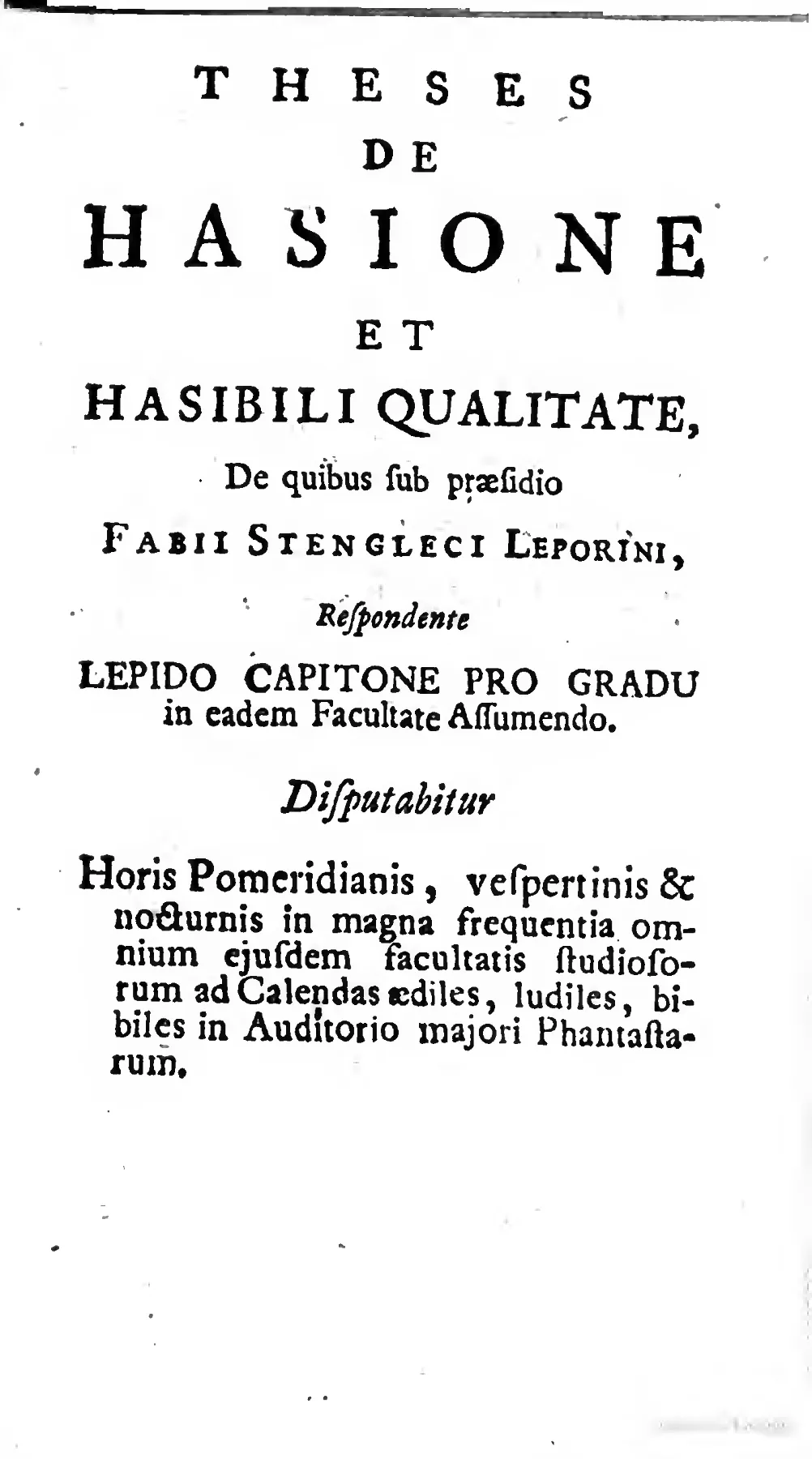
The title page of the mock-disputation on "HASIONE ET HASIBILI QUALITATE" turns the conventions of a university exercise—praeses, respondent, degree candidacy, appointed hours, and formal venue—into the paratextual machinery of parody. Before the theses define the Hasible quality as a mock-medical disorder, this page already stages the central joke: scholastic form applied with full solemnity to an invented and ridiculous subject. Source ↗.
The mock-medical theses on buffoonery define the Hasible quality as a disease arising from a superfluity and privation of white intelligence in the brain, Est autem Hasibilis qualitas morbus ortus ex superfluitate & Privatione intelligentiæ albæ in cerebro. The construction is doubly parodic, inventing a wholly fictitious predicament and then subjecting it to the aetiological vocabulary of humoral pathology, with its paradoxical pairing of superfluity and privation. The juridical register governs the treatise on freshmen, which defines its subject as a brute animal having neither measure nor mode of its rusticities, Definitur autem quod sit animal brutum habens neque modum neque mensuram rusticitatum suarum — the Aristotelian definitional formula (genus animal, differentiae supplied by negation) placed at the head of a disputation on university initiation, so that student slang acquires the dignity of a defined term. The natural-philosophical mode returns in the treatise on Cornelius, the personification of melancholy supposed to be a corporeal spirit conflated from an abundance of black bile, which, exacerbated by certain causes, disquiets a man, putamus Cornelium esse spiritum corporeum ex atræ bilis copia conflatum, qui certis exacerbatus causis hominem inquietat. The demonic-humoral hybrid, invoking the authority of Lactantius on demons, treats despair as a physical entity generated from the fourth humour, and the gravity of the construction is precisely what renders it comic.
The misogynist satire pervading the volume operates through the same mock-learned definitions. The prostitute is furnished with an etymology and a genealogy at once, said to be rightly called by some the Saddle of the Republic, her grandfather having been a rustic knight, Meretrix rectè à quibusdam dicitur Ephippium Reipublicæ: ejus avus fuit eques rusticus, where the mock-heraldic pedigree and the demeaning metaphor of the saddle are delivered with the assurance of a definitional authority. The vernacular receives comparable treatment in the mock-philology of cuckoldry — the derivation from the Germanic roots for rooster and dance already discussed above — which fuses German folk-material with the apparatus of learned etymology, tracing a supposed derivation and lamenting a fall into latinitas with all the solemnity of a genuine philological history.
That the parody hugs its serious models closely is nowhere clearer than in the dietary rules of the appended theses, which state that the concern for health is not to be sated with food, to be diligent for labours, Sanitatis studium est, non satiari cibis, impigrum esse ad Labores. Detached from its burlesque surroundings the sentence would pass without remark as a precept from a genuine regimen sanitatis, and this proximity is itself instructive: the collection's method succeeds because its imitation of scholastic, medical, and juridical form is close enough to the originals that only the matter, and never the manner, betrays the jest. Across front matter, catechism, and appended disputations alike, the volume never abandons the outward discipline of the schools; it is the unbroken fidelity to method, sustained through obscene, trivial, and scatological subjects, that constitutes both the coherence and the comic force of the compilation.
The Mock-Prophecy and Its Anticlerical Jests
That fidelity to grave form governs the sequence that follows, which begins as one burlesque piece resolves into its own interpretive apparatus, an alphabetically lettered Explicatio Hujus Prophetiæ that decodes a mock-apocalyptic vision as nothing more portentous than a catalogue of common gaming. The device is exemplary of the volume's governing procedure — the machinery of grave exegesis trained upon trivial matter — and it opens by construing the ominous "bones of the dead" as ordinary dice, glossing the image in both learned and vernacular registers, the bones of the dead being, that is, a die, a cube, Würffel, dobbelstein, A. Ossa mortuorum) id est, tessera, cubus Würffel, dobbelstein. The macaronic yoking of the Latin tessera and cubus to the German Würffel and dobbelstein is itself doing satirical work: the solemn allegorical lemma, the sort of thing one expects to unlock prophetic Scripture, discharges into the vocabulary of the gaming table, and the bilingual gloss advertises the trans-regional, university-Latin readership in which such play circulated. The two prose jests appended here sharpen the anthology's anticlerical edge with deadpan economy. The peasant who rations his pig, believing that a laboring man ought to eat more than a pig, Credens hominem laboriosum plus debere esse, quam porcum, turns an act of miserliness into a syllogistic conclusion, the humor lying precisely in the mock-rational form the reasoning assumes. The funeral jest is more pointed: the fool who sings for free skewers the economy of paid clerical mourning, protesting that his father is hardly sane, since he hires priests for pay to sing, but the fool will sing along gratis, Haud esse te sanum credo pater: cum precio conducas Sacerdotes, qui canerent, ego vero gratis concinam. The barb rests on an implied equation of the salaried cleric with the artless amateur, both merely making noise over the grave, and it belongs to the confessional-satirical vein that runs beneath the volume's ostensible frivolity.
The Pugna Porcorum: Constraint at Full Stretch
With a fresh title-page the sequence arrives at the celebrated Pugna Porcorum of the pseudonymous P. Porcius, Poeta, where the volume's method of subordinating sense to constraint reaches its most sustained expression. The mock-imprint that governs this piece is itself a compressed jest, assigning the poem to a fictitious Neverstadt and to three "publishers" whose names — Myrrh, Frankincense, and gold recast through the Magi — are frankincense-and-gold conceits, NIVERSTADII, Apud CASPARUM MYRRHEUM MELCHIOREM THUREUM, & BALTHASARUM AUREUM, 1720, the date alone corresponding to the genuine edition while place and printers dissolve into learned play.
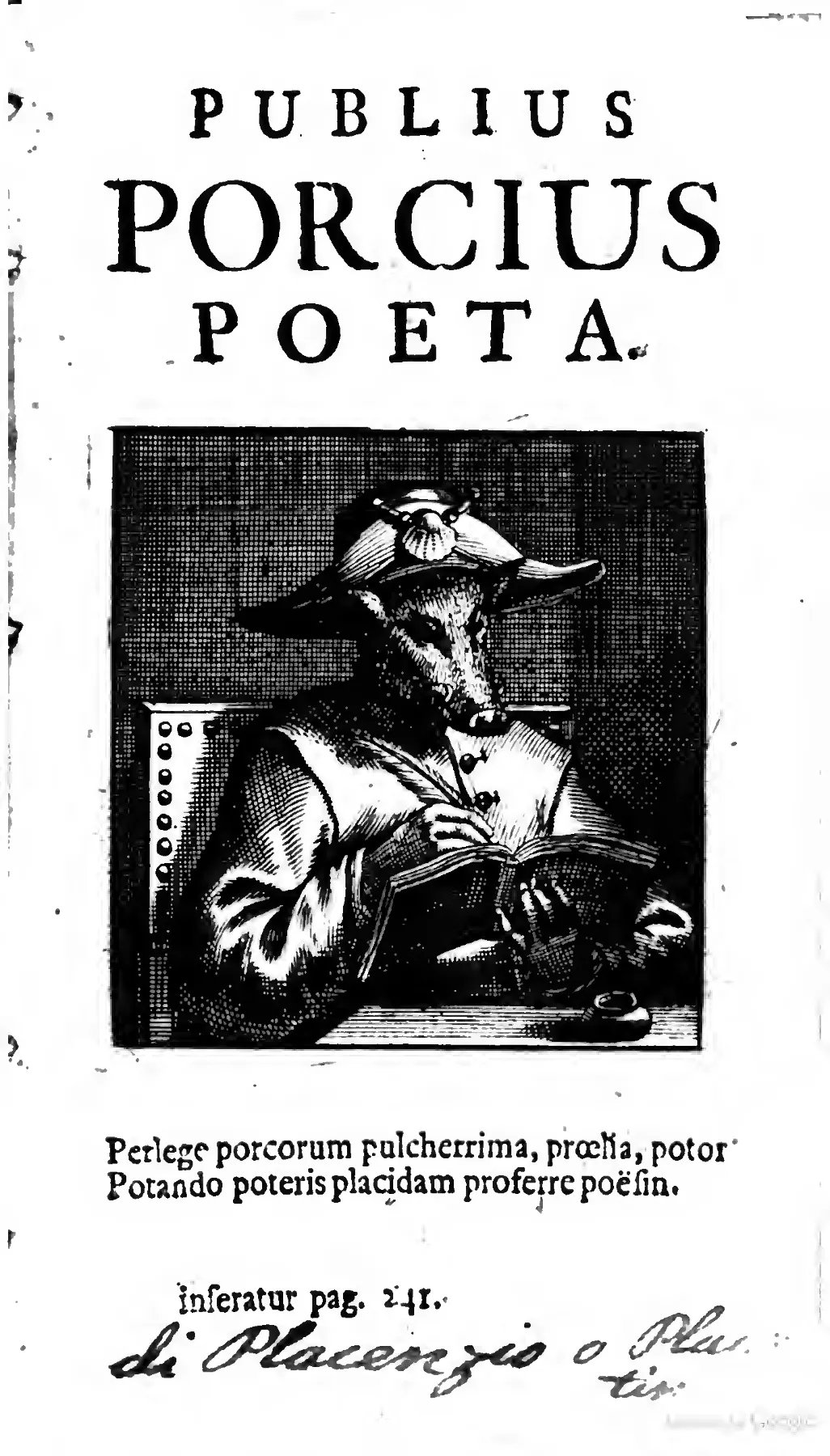
A fresh internal title page names the mock author in emphatic display type as PUBLIUS PORCIUS POETA, while the bespectacled pig at his desk turns learned authorship into the anthology's central joke: scholarship, quill, and book are all present, but assigned to a porcine poet. The printed distich below—"Perlege porcorum pulcherrima, prælia, potor / Potando poteris placidam proferre poësin"—announces the all-P constraint and the bibulous poetics through which the Pugna Porcorum makes formal virtuosity inseparable from comic self-parody. Source ↗.
The tautogrammatic discipline is announced at the threshold in a convivial distich that binds the all-P constraint to the poem's bibulous frame, the reader being bidden to read through the fairest battles of the pigs and, by drinking, to bring forth gentle poetry — the programmatic couplet already quoted above. The pairing of potor and poesin is not incidental ornament: it makes the wine-cup the enabling condition of the very virtuosity the poem performs, so that technical difficulty and mirthful occasion are declared inseparable at the outset. That the constraint holds even where the poem turns to direct address is demonstrated in the prose dedication, which sustains the P-alliteration into the language of patronage, the pig-poet explaining that since pigs are publicly reckoned so, it pleased him, most excellent patron, to compose the battle of the pigs in a poem, POSTQUAM publice porci putamur; præstantissime patrone, placuit porcorum pugnam poëmate pangere. Here the fiction folds back on itself: the author accepts the very insult ("we are reckoned pigs") as the occasion for his art, and the acceptance is itself performed under the letter that the whole piece obeys, so that the constraint becomes an emblem of the self-mocking learned identity the poem inhabits.
The narrative body of the Pugna deploys this discipline upon an allegory of estate and office, casting the fat porci as prælati against the plebeian porcelli. The class conflict is not merely decorative but is articulated in the juridical and hierarchical vocabulary of a genuine constitutional dispute, as when the poem declares it better for the prelates to offer the first wrestling-ground, Præstat prælatis primam præbere palæstram.
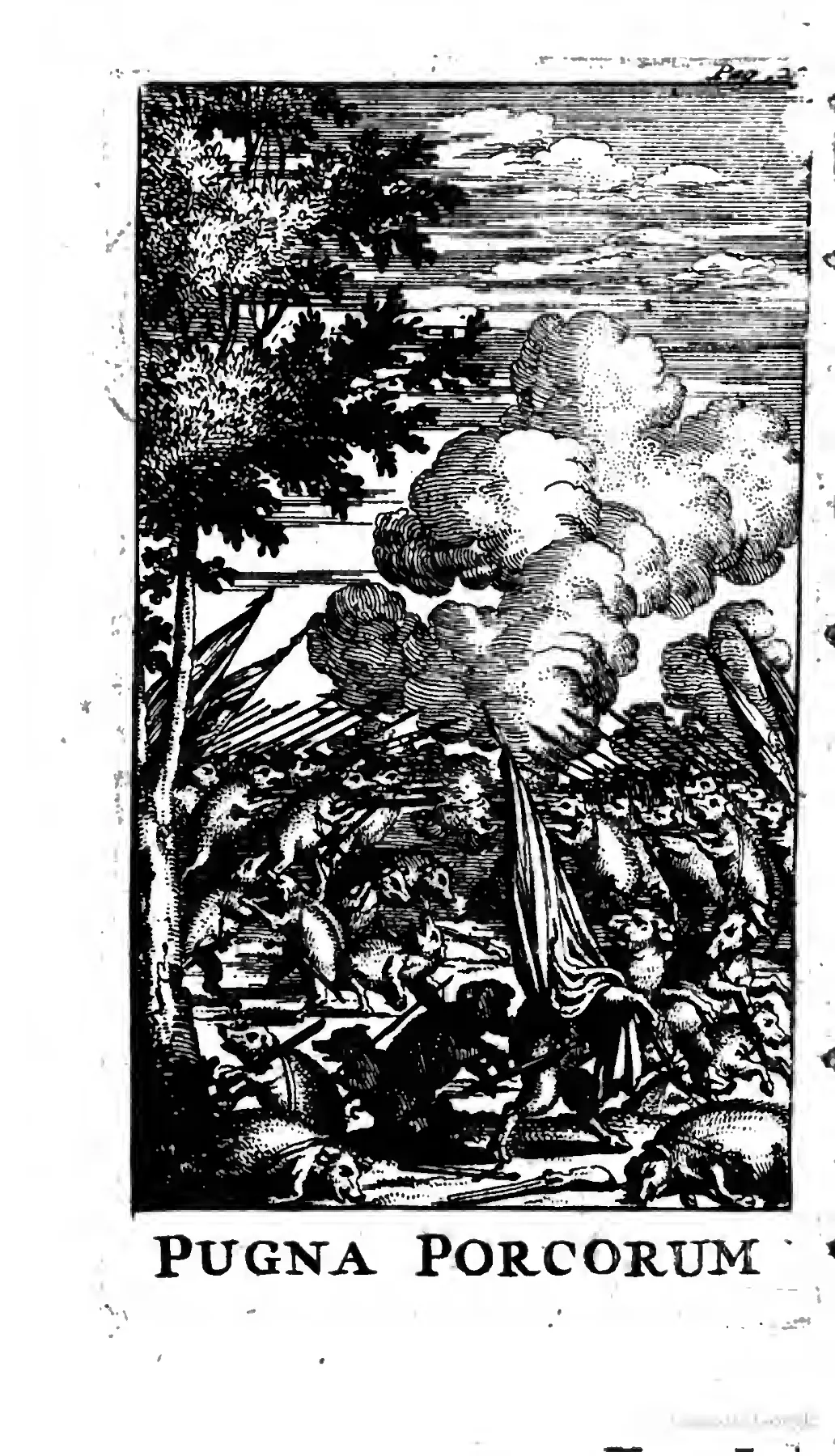
At the threshold of the Pugna Porcorum, this plate turns the all-P poem's mock-constitutional conflict into epic spectacle: armed pigs mass beneath banners and smoke across an open battlefield. The printed title "PUGNA PORCORUM" fixes the scene to the poem's serio ludere, where comic porcine warfare carries the vocabulary of hierarchy, office, and social dispute. Source ↗.
The mock-heroic idiom, the appeal to precedence and the language of ancient privilege, maps the porcine quarrel onto the ecclesiastical and social hierarchies of the day, and the piglets' insurgency is given openly seditious voice in the exhortation to go, piglets, and cast down the officers, pergite porcelli præfectos præcipitare. What is most telling in the piece's architecture is that this satirical energy, having built to open confrontation between prelates and commons, is finally sublimated into panegyric: the poem resolves its farce not by deflating the ecclesiastical target but by elevating its address, closing with an exhortation to the pontiff to complete the patriarch's peace and win openly the palm — the closing distich already discussed above as the serio ludere engine at its fullest stretch. The maintenance of the P-constraint across a formal papal panegyric, and the modulation from porcelli casting down their prefects to a pater patriæ completing a patriarch's peace, exposes the ideological ambivalence at the heart of the piece: the same letter that armed the plebeian revolt now dresses the papal peace, and the constraint's neutrality to content lets both gestures stand without resolution.
The Testamentum Porcelli and Estates Satire
Immediately following, the sequence revives the late-antique Testamentum Porcelli, framed by a reference to Jerome's letter to Eustochium, where the pig assumes the posture of a proper Roman testator. The juridical formalism applied intact to the doomed piglet — who declares in the voice of law that he could not write with his own hand and therefore dictated his testament — has been examined above; the comic charge lies precisely in the exactitude of the legal apparatus, the acknowledgment of an impediment to autograph subscription and the resort to dictation, deployed on behalf of an animal about to be slaughtered. The device is extended into the estates-satire of the bequest catalogue, which distributes the piglet's anatomy to social types by grimly apt correspondence, leaving to cobblers his bristles, to brawlers his gristle, to the deaf his ears, and to pettifoggers and the verbose his tongue, Sutoribus setas, Rixatoribus capitinas; Surdis auriculas: Caussidicis & verbosis linguam. The legacy of the tongue to lawyers and chatterers extends the volume's anticlerical and anti-professional needling, the testamentary form serving as the vehicle for a compact anatomy of social vice.
The Crepundia Poëtica and the Chronographic Verses
The bulk of the section is occupied by the Crepundia Poëtica, a large verse anthology whose miscellaneous topics are unified by the same procedure of grave form upon trivial or transgressive matter. Its moral-didactic strain surfaces in the anaphoric indictment of avarice, where for the sake of wealth a merchant gives himself to a thousand dangers and exposes himself to the sea, Propter opes se mercator dat mille periclis. Exponitque mari se, sua propter opes, the reiterated propter opes driving the poem toward its culminating exemplum of Judas's betrayal. Alongside this run the collection's convivial and satirical registers. The species of drunkenness are enumerated with mock-scholastic rigor, the verse asking whether one believes there are six kinds of drunkenness, the first base, the second wise and rich, Is sex credatis species sunt ebrietatis? Est vilis primus; sapiens est alter opimus, the taxonomy then swelling beyond its announced number in parody of scholastic division. The anti-feminine commonplace receives its most rhetorically ordered statement in the verse holding that woman pollutes, annihilates, kills, snatches, robs, and embitters the body, wealth, soul, strength, eyes, and voice, Fæmina corpus, opes, animam, vim, lumina, vocem Polluit, annihilat, necat, eripit, orbat, acerbat, the paired hexameters distributing six objects across six verbs with correlative precision — a display of technical symmetry that a later Pro foeminis answers, so that the anthology stages both sides of the topos as occasions for wit rather than settled doctrine.
The confessional edge sharpens in the epigram against the Anabaptists, whose alleged community of wives is attacked in the report that wives are said to be common among them, COmmunes vobis uxores esse feruntur, the polemic aligning the collection with the Reformation-era satire threaded through the wider volume. The most technically dazzling artifacts of this section are its chronographic verses, in which the capital letters resolve into a year. The peace-prophecy encodes 1633 in a line that professes to foretell good things, this year, not warring, not slipping away, VatIClnor bona, non beLLans hIC LabItVr annVs, and its paired retrograde counterpart reverses the very sense while preserving the numerical sum — a feat of constraint that binds the levity of the anthology to the historical pressure of the Thirty Years' War. The Crepundia closes on its most transgressive note, a mock apothecary's prescription that parodies the recipe genre by directing one to take two handfuls of virginal breasts and press until the resurrection of the flesh takes place, R. id est, Recipe mamillarum virginalium manipulos duos, Et comprime, donec fiat resurrectio carnis, the medical formula's clinical imperative colliding with theological vocabulary to produce a doubly irreverent conceit.
The Canum cum Catis Certamen: The Tautogram Renewed
The section ends with a formal mirror of the Pugna Porcorum, the Canum cum Catis Certamen credited to Henricus Harderus under the punning pseudonym C. Catulli Caninii, a tautogram in C that stages a war of dogs and cats. Its invocation launches the constraint from the first line, asking Calliope to grant the lyre for the clear canine contests of the dogs, Attorum caninus certamina clara canumque Calliope concede chelyn, transposing the epic apparatus of the muse-invocation into a single relentless letter.
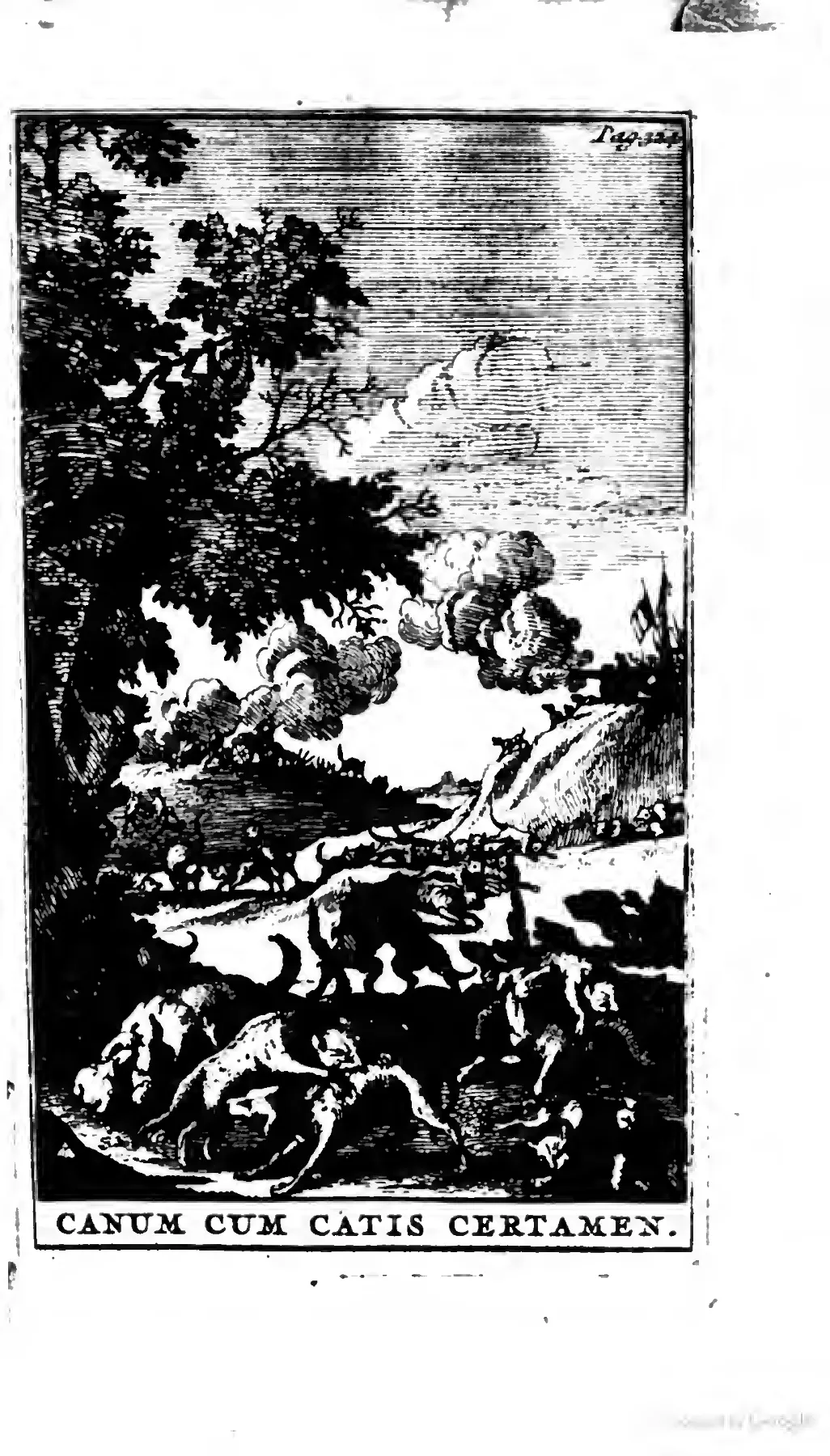
The engraved frontispiece to Canum cum Catis Certamen turns the poem's all-C mock epic into a fully staged battlefield: dogs and cats clash amid trees, smoke or dust, and distant standards, while the printed title at the foot gives the animal skirmish the dignity of a formal martial subject. Like the Pugna Porcorum frontispiece it mirrors, the plate makes the anthology's joco-serious method visible, applying the grand apparatus of epic conflict to deliberately comic animal matter. Source ↗.
The appearance of Cromwell among the feline combatants, named as a comrade of the lame Cromwell, commilito claudi Cromvelli, situates this piece in the later seventeenth century and shows the tautogrammatic mode absorbing contemporary political reference without ever loosening its formal grip, the constraint proving as capacious for topical satire as it was for porcine allegory and papal panegyric.
Frequently Asked Questions
What is the Nugae venales, sive Thesaurus ridendi & jocandi?
It is a clandestine, anonymous Neo-Latin jestbook whose earliest surviving issue is dated 1642, reissued in 1689, 1703, and finally in the 1720 Editio ultima auctior et correctior. Its title page bears a false imprint, declaring the "saleable trifles" on sale at Nobody's shop, but nonetheless everywhere. The compilation gathers constraint-verse, mock-disputations, parodic testaments, macaronic poems, and paradoxical encomia, trained upon obscene and trivial matter. Its method is consistent: the full apparatus of scholastic, juridical, and medical learning taught at the Protestant universities of Northern Europe is applied, with rigorous fidelity to form, to flatulence, cuckoldry, and the latrine.
Is there an English translation of the Nugae venales?
No complete modern scholarly English translation of the entire anonymous compilation has been located or is generally known to scholarship, though a seventeenth-century English reissue lineage exists as Nugæ venales, or, A Complaisant Companion, printed by W. D., and Michael Fontaine's 2019 volume The Pig War translates the embedded Pugna porcorum in isolation. Separately, the Leo edition presents the full transcription and a complete English translation of the whole work, freely available online at no cost. That translation is generated by AI. Leo aims to make English translations of every text printed in Latin in early modern Europe between 1450 and 1750 available online.
How does the Nugae venales prove that a fart is an organic body?
Through an impeccably formal syllogism whose comedy lies entirely in the correctness of its logic applied to base matter. The argument runs that the definition of an organic body consists in the subtlety of the senses, but nothing is as perceptible as a fart, therefore a fart is an organic body. It observes every demonstrative convention — response, major and minor premises linked by the adversative Atqui ("but"), and the concluding Ergo — and turns on the pun in sensibile, at once "perceptible" and "sensory." The reasoning is not defective, merely misapplied; that fidelity to method carries the parody.
What is the Pugna porcorum and who wrote it?
The Pugna porcorum is a celebrated tautogram in which every word begins with the letter P, staging a war of fat prelate-pigs against plebeian piglets. Printed under the pseudonym Publius Porcius, it is identified in modern scholarship with the early-sixteenth-century Netherlandish poet Johannes Leo Placentius, reported to have resided at the Leuven college known as the Porcus, whose poem appeared at Antwerp and Augsburg in 1530. The constraint holds unbroken even through a closing papal panegyric, urging the father of the fatherland to complete the patriarch's peace — a demonstration of serio ludere, "seriously to play," at full stretch.
What does the phrase serio ludere mean in the Nugae venales?
Serio ludere means "seriously to play," and it supplies the theoretical warrant for the whole compilation. The maxim was printed as its over-motto by Achille Bocchi on the Symbolicae quaestiones (Bologna 1555), and the cognate formula joco-serium was built into the title of Caspar Dornau's Amphitheatrum sapientiae Socraticae joco-seriae (Hanau 1619). Within such an anthology, the formula licenses a writer to perform scholastic-looking operations for non-scholastic ends, puncturing the very edifice he inhabits. Its calibration is Horatian: to joke always is no less the mark of foolish men than never to court the laughter of fools.
This report was generated by an advanced AI assistant that conducted deep research alongside an extensive interpretation of the transcribed original text. Every effort has been made to preserve fidelity to the source and to guard against inaccuracy, but corruption in the text recognition process and model hallucination may nonetheless have entered the text. Treat every claim, quotation, translation, and citation as provisional, and verify each against the original source before relying on or citing it.
Critical Further Reading and Contextual Resources
- Michael Fontaine, ed. and trans., The Pig War: Pugna Porcorum by John Placentius: The first modern critical edition and English translation of the Pugna porcorum, the all-P tautogram embedded in Nugae venales, with an introduction that reconstructs Placentius's Leuven and Antwerp-Augsburg milieu of 1530. Nothing else in print will teach a reader how to take the constraint-verse of the Nugae seriously as craft rather than curiosity, and Fontaine's identification of the pseudonymous "Publius Porcius" is now the standard one.
- Matthias Asche, Von der reichen hansischen Bürgeruniversität zur armen mecklenburgischen Landeshochschule: A dense empirical study of the social and regional recruitment of Rostock and Bützow between 1500 and 1800, and the sober documentary counterweight to the volume's pennalismus burlesque. Read it to see what the actual student servitude looked like before the Nugae turned the freshman into a "brute animal having neither measure nor mode."
- Matthias Asche and Anton Schindling, eds., Dänemark, Norwegen und Schweden im Zeitalter der Reformation und Konfessionalisierung: A confessional-historical survey of the Nordic kingdoms from 1500 to 1660 that supplies the doctrinal ground for both the Danish contribution of Henrik Harder and the Reformation satire threaded through the compilation. It is the place to situate the volume's anti-Anabaptist jabs and its needling of paid clerical mourning within their actual denominational quarrels.
- E. Champlin, "The Testament of the Piglet," Classical Philology: The standard scholarly treatment of the late-antique Testamentum Porcelli of M. Grunnius Corocotta, arguing for a genuine satiric purpose behind the Roman-law testamentary parody rather than a mere schoolroom exercise. Since the Nugae reprints the piglet's will intact, Champlin explains precisely what juridical form is being impersonated and why the impersonation bites.
- Cornell University, Professor publishes Placentius' pugnacious pig poem: A brief institutional notice on Fontaine's edition that frames the Pugna as a fable of privileged "hogging" porci against the piglets who want their share. Useful chiefly as an accessible entry point that names the poem's estates-satire politics in plain terms before a reader confronts the Latin tautogram.
- Columbia University Press, Serious Play: Three Medieval Games of Wit, Chance, and Sleight of Hand: A study organised around the Renaissance principle of serio ludere, the maxim Achille Bocchi printed on his Symbolicae quaestiones and the exact register in which the Nugae operates. It supplies the theoretical vocabulary for reading the jestbook's mock-disputations as calculated play rather than idle nonsense.