The Closed and Round Garment: Ottavio Ferrari's Seven Books on the Vestiary Art of the Ancients
In 1654, at the Paduan press of Paolo Frambotto, the Milanese classicist Ottavio Ferrari (1607–1682) issued Octavii Ferrarii de re vestiaria libri septem, a seven-book reconstruction of how the ancient Greeks and Romans dressed and what their garments meant. Ferrari, who held the chairs of Latin and Greek Humanity at Padua and ran its University Library, argued that statues and coins outrank grammarians in settling questions of antique costume, and that a garment is never inert cloth but a legible claim about its wearer's status, virtue, and citizenship. Illustrated with thirty-two engraved plates drawn from Cassiano dal Pozzo's paper museum, the volume matters both as a document of seventeenth-century material philology and as a foundation stone of the history of dress as a scholarly field.
ExLatinis
July 23, 2026
Contents
In 1654, at the Paduan press of Paolo Frambotto, the Milanese classicist Ottavio Ferrari (1607–1682) issued Octavii Ferrarii de re vestiaria libri septem, a seven-book reconstruction of how the ancient Greeks and Romans dressed and what their garments meant. Ferrari, who held the chairs of Latin and Greek Humanity at Padua and ran its University Library, argued that statues and coins outrank grammarians in settling questions of antique costume, and that a garment is never inert cloth but a legible claim about its wearer's status, virtue, and citizenship. Illustrated with thirty-two engraved plates drawn from Cassiano dal Pozzo's paper museum, the volume matters both as a document of seventeenth-century material philology and as a foundation stone of the history of dress as a scholarly field.
Ottavio Ferrari's De re vestiaria libri septem, printed at Padua in 1654 from the press of Paolo Frambotto, is a work that a modern reader is likely to meet for the first time without any settled sense of what it is or why it should command attention. Its author, Ottavio Ferrari (Octavius Ferrarius, 1607–1682), was a Milanese-born classicist who held successively the chairs of Latin and then Greek Humanity at the University of Padua and directed the University Library from 1646 to 1663; the treatise is his principal antiquarian-philological undertaking, a systematic reconstruction, across seven books, of the dress of the ancient Greeks and Romans. It is composed in Latin, threaded with Greek citation, and built upon an unusually catholic evidentiary base — Roman jurists, patristic authorities, the numismatic and sculptural record, and the accumulated philological tradition from Aldo Manuzio the Younger through Joseph Scaliger. To the three books of a first issue of 1642, treating the toga, the praetexta, and the tunica, the 1654 volume adds four wholly new books on the lacerna, the paenula, military dress, and the pallium, reissuing the earlier three in corrected and augmented form.
The intellectual problem the work confronts is the recalcitrance of its own materials: how a body of fragmentary, contradictory, and mutually incompatible testimony — literary, juristic, numismatic, epigraphic — can be adjudicated into a coherent account of what the ancients actually wore and what their garments meant. Ferrari's recurring answer is an act of philological arbitration. He sets rival authorities against one another — Manuzio, Salmasius, Sigonio, Baronius — weighing older Roman witnesses above later Greek ones, dissenting with studied modesty from great names, and enforcing throughout an ethic of proper attribution against those who would transcribe a predecessor without acknowledgement. Running beneath this method is a single connective conviction: that dress is never merely material. Garment forms encode legal status, civic identity, and moral condition. The toga, which Ferrari argues to have been round and closed rather than quadrate and open, becomes the visible emblem of Roman libertas and republican gravitas; the stola marks the matron, the pallium the citizen or the philosopher, the threadbare tribonium the sage. And because each of these signs can be counterfeited, dress emerges as a site where authenticity and imposture are perpetually contested — antiquarian recovery doubling, at every turn, as an argument about virtue, citizenship, and the reading of appearances.
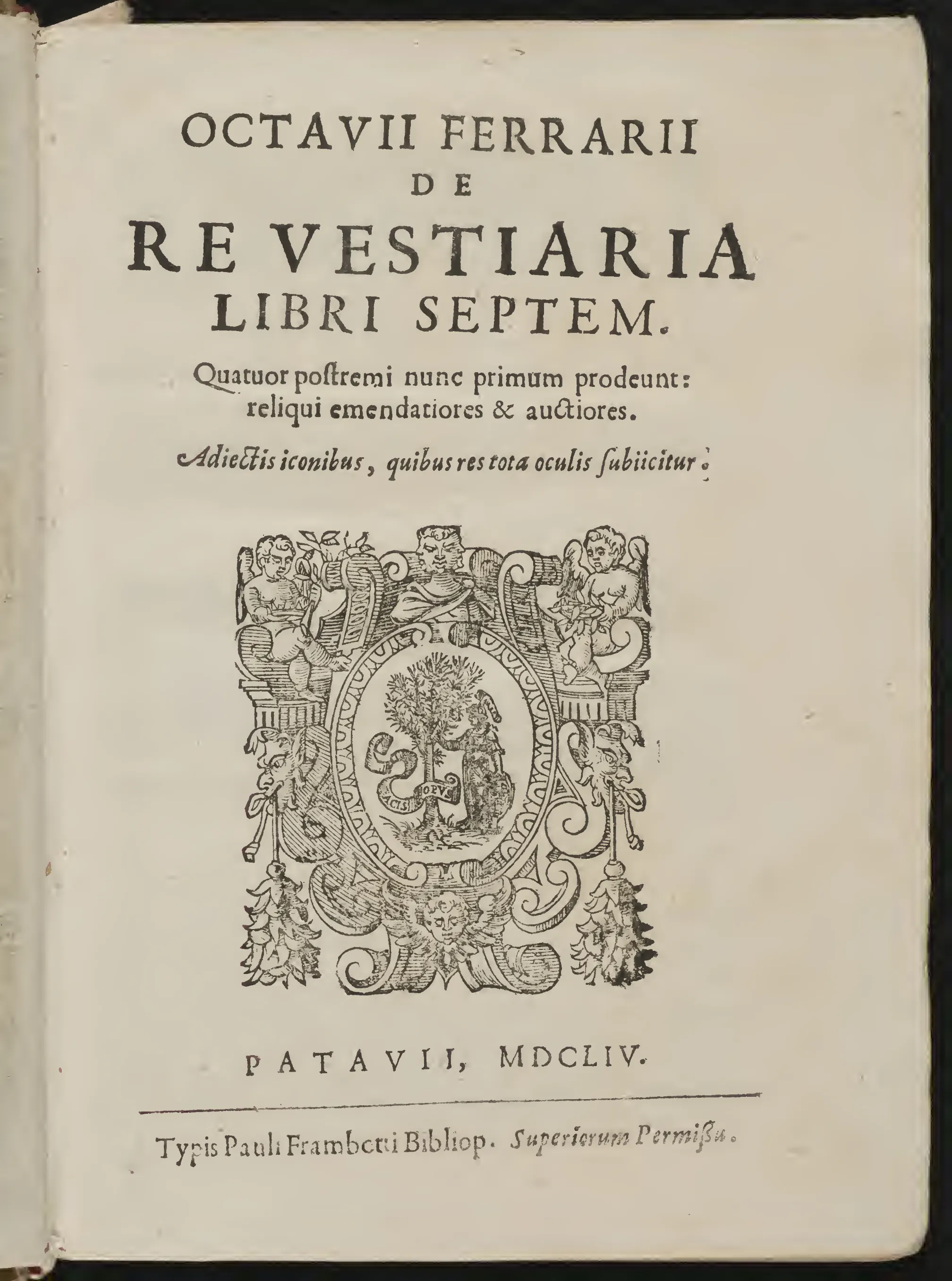
The 1654 Padua title page presents Ferrari's De re vestiaria as both continuation and expansion: four books newly issued, the earlier three corrected and enlarged, and images added so that the subject might be set "before the eyes." Its typographic hierarchy and Frambetti imprint set the method at the threshold, joining philological arbitration to the evidentiary force of monuments, coins, and engraved forms. Source ↗.
The stakes of this enterprise are both historical and disciplinary. Ferrari's methodological wager — that statues, coins, and monuments outrank the testimony of grammarians in resolving questions of antique dress — places the volume at the centre of seventeenth-century Realphilologie and of the wider antiquarian project of reconstructing the ancient res publica through its surviving material culture. The concern that organizes the book, tripartite in its attention to literary testimony, juridical taxonomy, and monumental evidence, would furnish the matrix within which later writers on Roman costume situated their own work, from Montfaucon through the great antiquarian thesauri of the following century. The book is at once a document in the history of classical scholarship and a foundational text in the history of dress as a field of learned inquiry.
What is most distinctive about the volume is the way its argument, its production, and its polemics converge on that single throughline. The engraved apparatus — thirty-two full-page plates drawing on the drawings and prints of Cassiano dal Pozzo's Museo Cartaceo and the collection of Francesco Pozzo — is not decoration but the visual limb of the method that privileges the monument over the word. The dedications enact the argument as much as they seek patronage: the first part is offered to the Venetian Republic under a conceit by which Rome, having surrendered its liberty, surrendered its toga with it, while Venice is figured as the surviving heir of republican gravitas in civic costume; the second part, dedicated to Christina of Sweden, frames itself through a Penelopean image of weaving sustained across ten years of labour. The polemics, too — the quarrel with Sigonio over the toga's form, with Baronius over whether the ecclesiastical planeta descends from the Roman paenula, with the recently deceased Claude Saumaise over the etymology of holoverae — are not incidental skirmishes but the working-out of the same commitment to adjudicating appearances against the weight of evidence. Even the moral charge of the material — the critique of transparent silks that defend neither body nor modesty, the insistence that a philosopher is not made by beard and cloak — belongs to the argument that a garment is a claim about its wearer that may be true or false.
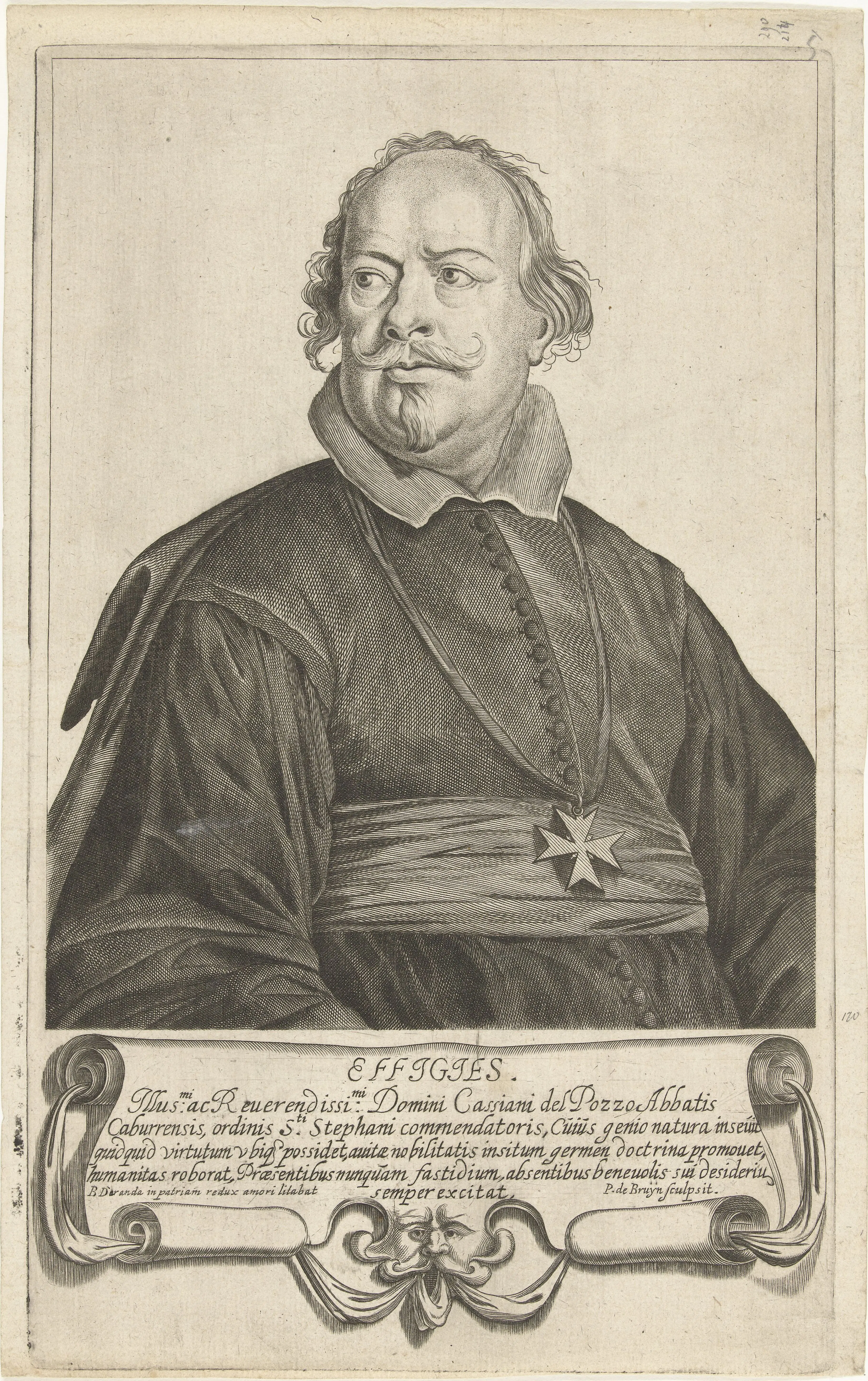
Pieter de Brune's mid-seventeenth-century engraved portrait shows Cassiano dal Pozzo in clerical dress with the chain of the Order of St Stephen, marking the learned status behind the antiquarian authority Ferrari invokes. In De re vestiaria, dal Pozzo's Museo Cartaceo supplied more than illustrations: it underwrote the claim that surviving monuments and images could discipline, and sometimes overrule, inherited literary explanation. Source ↗.
Much about the work rests on secure ground, and some does not. The modern scholarly literature engaged directly with Ferrari is sparse, concentrated in the work of Damiano Acciarino; the three great controversies are transmitted as established consensus, though the original counter-texts, if any were printed, have not been located and the immediate polemical afterlife of the volume remains, on the surviving record, thin. No modern vernacular translation of the Latin has been identified, and an announced English-language companion commentary could not be confirmed. What follows takes the work on its own early modern terms — philological, juristic, antiquarian — and lets Ferrari's own Latin carry the burden of demonstrating how, for him, the recovery of ancient dress was inseparable from the reading of the ancient self.
Read the full text and English translation on Leo
This text was transcribed and translated as part of the ExLatinis project, an effort by Leo to make free English translations of every text published in Latin in early modern Europe (1450–1750) available online. The complete transcription and English translation of this work can be read free of charge:
→ Read the original Latin text and full English translation on Leo
You can save a copy of this document into your Leo account to run deep text searches, conduct further analysis, or cross-reference it with your own research.
Assigning an English Title and Reading Ferrari's Loaded Latin
Title (editorial, supplied for convenience, not an established conventional title): Seven Books on the Vestiary Art of the Ancients: An Antiquarian-Philological Reconstruction of Greco-Roman Dress, with Engraved Plates Drawn from the dal Pozzo Paper Museum (Padua, 1654).
No settled English-language scholarly title for Ferrari's treatise is recorded in the catalogues or in the modern historiographical literature retrieved for this report; the title above is therefore an editorial construction offered for bibliographic convenience. The conventional short forms De re vestiaria and De re vestiaria libri septem are used throughout the secondary literature, the standard catalogue records at EDIT16/SBN, WorldCat, and HathiTrust, and in the bibliographical notes of the relevant critical essays.
The philological and ideological architecture of the work is governed by three loaded Latin terms whose early-modern resonances cannot be recovered from any single dictionary entry but only from the way in which Ferrari deploys them in dialogue with his sources and antagonists. The first is the pairing toga et libertas. Within the book's antiquarian argument the toga is not a mere garment but the visible body of the Roman res publica: the round, closed form which Ferrari assigns to it on the evidence of statues and coins is made to bear the symbolic weight of Roman civil status, and the historical disrobing of the citizen body—the abandonment of the toga for the lacerna and the paenula—is read as the material equivalent of a falling-away from public virtue. Ferrari states the formal thesis plainly, that from the evidence adduced it is sufficiently clear that the toga was a closed and round garment, Ex his quæ suprà adduximus satis liquidò apparet, Togam vestimentum fuisse clausum, & rotundum; and he binds that formal claim to a political one, observing that when the fates handed the world's empire to one man's caprice Rome changed its dress and at once put off both liberty and the toga, pristinum quoque cultum mutauit, simulque libertatem exuit, & togam. The second loaded term is tribonium (and its Greek cognate τρίβων). Where the Cynic tradition had restricted the tribonium to the philosopher's threadbare cloak, Ferrari severs the garment from its sectarian affiliation and absorbs it into his typology of Roman over-garments, citing it alongside the pallium and the chlamys as a class rather than as a badge of a sect; the move is philologically motivated (he must justify placing Tertullian's De pallio within his scheme) and ideologically significant, since it allows a Christian Latin writer to be admitted to the antiquarian canon of antique dress on equal terms with pagan authorities. Ferrari makes the de-sectarianizing move explicit, insisting that they are gravely mistaken who hold the tribonium to have been the garb of the Cynic sect alone, since Socrates too, the Pythagoreans, and the Stoics preferred this garment to all the robes of kings, Valde enim falluntur, quicumque Tribonium solius Cynicæ sectæ gestamen fuisse tradiderunt. Nam & Socrates, & Pythagorei, Stoici item, & reliqui seuere philosophantes hanc vestem peplis omnibus Regum, que indumentis prætulerunt. The third term is the compound Veneta gravitas, in which the Venetian Republic is figured as the heir of Roman republican gravitas materialized in civic costume; this collocation operates in the prefatory epistle dedicating the earlier part of the book to the Serenissima, and aligns the Paduan publication with the ideological self-presentation of the Venetian patriciate as a body whose dignity is at once political and sartorial. None of these three terms is glossed in the modern scholarly apparatus; each must be recovered from Ferrari's own usage in the prefatory letters, in De toga, in De pallio, and in the Tabula captions.
What Ferrari's De re vestiaria Argues, in Brief
The work is an antiquarian-philological treatise in seven books reconstructing the dress of the ancient Greeks and Romans from literary, juristic, numismatic, and sculptural evidence. It was composed by Ottavio Ferrari (Octavius Ferrarius, Ferrarius Mediolanensis), the Milanese-born classicist who held the chair of Latin Humanity (1634) and then of Greek Humanity (1639) at the University of Padua and directed the University Library from 1646 to 1663, and was printed in Padua at the press of Paolo Frambotto (Typis Pauli Frambotti Bibliop.) in 1654 under the expanded title Octavii Ferrarii de re vestiaria libri septem: quatuor postremi nunc primum prodeunt: reliqui emendatiores & auctiores. The work is the expanded successor to a three-book first issue (De re vestiaria libri tres, Padua, 1642) which had treated the toga, the praetexta, and the tunica; the 1654 issue adds four new books De lacernis, De paenulis, De veste militari, and De pallio while reissuing the three earlier books in corrected and augmented form. The text is composed in Latin with embedded Greek citations and draws upon Roman jurists (Ulpian's Digest, book XXXIV tit. 2, on the categories of garments), patristic authorities, and the classical philological tradition from Aldo Manuzio the Younger through Joseph Scaliger; the juristic base is visible where Ferrari reproduces the jurist's taxonomy, that male garments are those prepared for the paterfamilias himself, such as togas, tunics, cloaks, coverlets, and the like, Virilia sunt quæ ipsius patris familiæ causa parata sunt, veluti togæ, tunicæ, palliola, vestimenta stragula, amfitapa, & saga, reliquaque similia. An apparatus of thirty-two full-page engraved plates (with one further small in-text plate) and engraved titles for each part constitutes the visual argument. The driving thesis of the work is that statues, coins, and monumental evidence outrank the testimony of grammarians in resolving questions of antique dress, a methodological commitment which situates Ferrari's volume at the centre of seventeenth-century Realphilologie and of the contemporary antiquarian reconstruction of the res publica through its material culture. No modern vernacular translation of the Latin text has been identified; the work survives in its original Latin and in partial twentieth- and twenty-first-century scholarly paraphrase (Acciarino 2018 and 2022), and an English-language companion commentary has been announced on the ExLatinis platform, though its availability could not be confirmed at the time of this report.
Ferrari, Antiquarianism, and the History of Dress as a Field
The work matters to modern academics on three intersecting axes. First, it is a principal seventeenth-century document of antiquarianism in its Latin, Italian, and pan-European Realphilologie form, taking its place within a tradition that includes Lazare de Baïf's De re vestiaria (the work whose inadequacy, according to Acciarino, prompted Carlo Sigonio to plan a competing treatise), Aldo Manuzio the Younger's De quaesitis per epistolam libri III, the Tertullian edition and De pallio commentary tradition, and the res publica literaria network of Lipsius, Casaubon, the two Scaligers, and their heirs. Ferrari's engagement with this lineage is conducted under an explicit ethic of acknowledgement: he professes that Manuzio lit his way more than once and that he intends to note the debt when the matter requires, defrauding no one of his honour, Ceterum Manutium non semel in hoc opere præluxisse initio profiteor, & cùm res poposcerit indicabo, nec alium quemquam honore suo fraudare animus est; and he sharpens the same principle into a rebuke of the recent writers who did Manuzio great injury by transcribing his dissertation on the tunic without once naming him, magnam Manutio iniuriam nuperifecerunt cuius dissertationem de Tunica transcripserunt eo tamen ne semel quidem laudato. This attribution-ethic is the connective tissue of his method, and it is of a piece with his sense that the field had been left unfinished: since the blessed predecessors paid their debt to the fates sooner than to scholars' hopes, he resolved not to suppress any longer what he had long pondered, Sed quoniam beati illi ante fatis, quàm studiosorum voto debitum persoluerunt, quæ diu in hanc rem commentatus sum non ultra supprimere constitui, pro viribus posteritati consulere. Second, it is a foundational document in the history of dress as a modern scholarly field, since Ferrari's tripartite concern with literary testimony, juridical taxonomy, and monumental evidence became the matrix within which later writers on Roman costume (from Montfaucon through the Thesaurus Antiquitatum Romanarum of Johann Georg Graevius and the antiquarian thesauri of the late seventeenth and eighteenth centuries) situated themselves. Third, it is a primary document for the Cassiano dal Pozzo circle and its visual programme, given that the engraved apparatus is documented to draw upon drawings and prints from Cassiano dal Pozzo's Museo Cartaceo and from the collections of his relative Francesco Pozzo.
The principal scholarly friction to which the work is attached is the toga-form controversy. Ferrari argues, against the inheritance of Sigonio's planned but unfinished De re vestiaria (mentioned by Acciarino in Engramma and confirmed in the broader literature on Sigonio), that the toga as shown on statues and coins is a round and closed garment, not a quadrate and open one; the disagreement turns on the relative weight to be granted to monumental versus literary evidence, and Ferrari's stated preference in evidentiary conflict is to trust a Roman and more ancient authority that tribunes wore the praetexta rather than a Greek one, Malumus ergo Romano homini, & antiquiori, / Tribunos prætextatos, quàm Græco, & non semel / aliquid humani passo, credere. The vestment quarrel with Cesare Baronio is conducted over the identification of the late-antique ecclesiastical planeta or casula with the Roman paenula and with the question of the continuity between the secular Roman and the Christian sacred wardrobe; Ferrari frames the disagreement directly, noting that Baronius contends this was not a toga but a paenula, Hanc tamen Baronius non togam, sed pænulam fuisse contendit. The third quarrel, with the philological inheritance of Claude Saumaise (Claudius Salmasius, d. 1653), concerns the etymology of holoverae / ὑλοπόρφυρα and the related vocabulary of silk (bombyx, sericum, dibapha Tyria) and thus lies at the intersection of lexicography and material-culture history; Ferrari's lexical thesis is that he has always believed holovera to be not half-Latin but a pure Greek word, contracted and then corrupted, nothing other than Holoporphyra, Nam holouera, non semilatinam, sed puram vocem Græcam, contractam, mox, & corruptam semper credidimus: nec aliud esse, quam ὑλοπόρφυρα, Holoporphyra, and the polemical temperature of the exchange is registered in his portrait of an adversary marked by an arrogance sought through merits, an immoderate self-appraiser and contemner of others, enemy of every opinion of which he was not himself the author, Sed quæsita meritis superbia immodicus sui æstimator, aliorum contemptor, omnisque sententiæ, cuius ipse auctor non esset, inimicus. (These three controversies are reported in the standard modern literature as part of the established scholarly consensus on Ferrari's De re vestiaria; the present report has not located the original counter-texts themselves, if such exist in printed form, and the immediate documentary trace of the disputes in print must be regarded as awaiting further archival confirmation.)
The contemporary historiographical literature directly engaged with the work is sparse but identifiable. Damiano Acciarino has written the principal modern treatments of the work: "De re vestiaria. Renaissance discovery of ancient clothing" in Engramma 154 (March 2018), which places Ferrari within the lineage of Renaissance and Baroque vestiary scholarship from Baïf to Vecellio; and chapter 8 ("Fashion Ancient Clothing") of the Atlas of Renaissance Antiquarianism (Edizioni Ca' Foscari, 2022), which situates the 1642 and 1654 editions in the broader European antiquarian production of vestiary treatises. A specifically biographical treatment is supplied by the proceedings of the Classico Contemporaneo conference ("Un classicista barocco e il suo pubblico: Ottavio Ferrari (1607-1682) tra Umanesimo e Antiquaria"), which presents Ferrari as a Baroque classicist operating tra Umanesimo e Antiquaria. The dal Pozzo side of the context is treated in the standard literature on the Paper Museum (Brepols series; the Warburg Institute's Paper Museum project; The Print Collection of Cassiano dal Pozzo, I: Ceremonies, Costumes, Portraits and Genre); Christina of Sweden's patronage is treated in the standard political-cultural literature on her court and in Brill's Passages through the Reformation and kindred reference works. The historiography of seventeenth-century Italian classical scholarship more broadly, on which this text is a touchstone, is the domain of works such as the contributions of Jean-Michel Racault and others to the Dizionario biografico degli Italiani tradition and to the res publica literaria literature, though the present report has not located a monograph devoted exclusively to Ferrari.
A historiographical disagreement relevant to the work concerns the precise weight to be given to Ferrari's visual evidence. The Engramma article and the Acciarino chapter characterize the engraved apparatus as "meagre but effective," whereas older French and German antiquarian traditions (which the present report has not located in primary form) tended to discount the Paduan plates in favour of later eighteenth-century compilations. This disagreement—over whether Ferrari's plates constitute an autonomous visual argument or merely an illustrative supplement to the text—is not yet resolved in the literature surveyed here. The stakes of the disagreement are heightened by Ferrari's own naming of his visual authority, the knight Cassiano dal Pozzo, never to be passed over in silence by himself or by their descendants, most fortunate champion of all antiquity in the Roman light, nunquam nobis, populisque nepotum silendus Eques Cassianus / a Puteo, in Romana luce totius antiquitatis assertor / felicissimus, a tribute that frames the plates as the fruit of a documented antiquarian collaboration rather than as mere ornament.
Tracing the Editions, Materiality, and Object Biography of De re vestiaria
The textual transmission of Ferrari's De re vestiaria falls into two states. The earlier state is the three-book De re vestiaria libri tres (Padua, 1642), a first nucleus treating the toga, the praetexta, and the tunica through a multiplicity of philological references. The expanded state is the 1654 issue under the title Octavii Ferrarii de re vestiaria libri septem: quatuor postremi nunc primum prodeunt: reliqui emendatiores & auctiores, in which the three earlier books appear in corrected and augmented form ("emendatiores et auctiores") and four further books (De lacernis, De paenulis, De veste militari, De pallio) are added. The imprint is that of Paolo Frambotto (Typis Pauli Frambotti Bibliop.), a Paduan printing house active across the middle decades of the seventeenth century and which also issued Ferrari's later Origines linguae italicae (Padua, 1676, by then under Pietro Maria Frambotto); the imprint statement is given as "Patavii", the Latin form of Padua.
The physical book, in 8vo format and measuring 23 cm, has the collation [20], 261, [17]; [16], 213, [27] p. as recorded in the HathiTrust catalogue record (OCLC 82948212) and in dealer records. The work is in two parts: the first (Books I–III, the corrected nucleus on toga, praetexta, tunica) and the second (Octavii Ferrarii de re vestiaria pars altera. Libri quatuor, comprising the four new books). The volume is accompanied by thirty-two full-page engraved plates and a single small in-text plate (HathiTrust gives the format as "ill. (engravings)"); each part carries its own added engraved title-page, distinct woodcut title devices, woodcut head- and tail-pieces, and historiated initials; the text is set in Roman and Italic type and is bound in old vellum in surviving copies. The plates are documented, in the title-page tradition and the standard literature, as drawing upon drawings and prints from Cassiano dal Pozzo (Cassianus a Puteo) and his brother or relative Francesco Pozzo (Francisci Putei); the direct attribution of individual plates to the dal Pozzo archive is recorded in the standard literature on the Paper Museum (Brepols series; The Print Collection of Cassiano dal Pozzo, vol. I). No evidence of formal ecclesiastical censorship, suppression, or inclusion in the Index Librorum Prohibitorum has been located for this text.
The institutional footprint of surviving copies is distributed across European and North American research libraries. Open digital surrogates include the Getty Research Institute's scanned copy held on the Internet Archive (record identifier octaviiferraride00ferr; Clark Art Institute scans at identifier JSH.31962001408982Images); the HathiTrust digital record (record 100789284; OCLC 82948212; digitized under identifier gri.ark:/13960/t6zw5150n); the WorldCat aggregated record (record 930056686); and a fuller bibliographic description of the author in OCLC's authority file (entity E39PBJgcX3PYXRQRtVBkrK3mh3). The Italian union catalogue service EDIT16/SBN records Ferrari's oeuvre including a separate bibliographic record for Octauii Ferrarii Analecta de re vestiaria siue Exercitationes ad Alberti Rubenii Commentarium de re vestiaria, & lato clauo (a related but distinct work, an exercise on Rubens's De re vestiaria), confirming Ferrari's continuing engagement with the vestiary theme into the 1670s. No later seventeenth- or eighteenth-century independent editions or translations have been located in the catalogues surveyed; the later twentieth-century reprintings visible on Amazon and Open Library are reproductions of the 1654 sheets, not new editions.
The immediate reception and dedicatee structure of the work situate the volume within the patronage networks of the Venetian patriciate and the Roman-Catholic learned courts of the mid-seventeenth century. The first part is dedicated, in the prefatory epistle, to the Republic of Venice (Serenissima Repubblica, or Aeterna Venetorum Respublica in the Latin idiom of the dedication), under the conceit that Rome, having surrendered its liberty, surrendered its toga with it while Venice preserved both — a conceit that gives the political charge to Ferrari's report that under Augustus the toga was nearly disused, if one excepts the duties of clients, and that the lacernae succeeded in its place, Quæ satis declarant, sub Augusto penè desuetam togam, si officia clientum excipias, & in earum locum lacernas successisse. The second part is dedicated to Christina of Sweden (Christina Augusta), at that point already converted and resident in Rome, with the framing of a decade of labour alluding to the twelve years separating the 1642 first issue from the 1654 expansion; Ferrari casts the dedication through a Penelopean weaving conceit, declaring to the Augusta that to this web, such as his slenderness is and amid the injuries of unfavourable health, he devoted ten solid years, Huic ego telæ. Augusta, quæ mea tenuitas est, & improsperæ valetudinis iniuriæ, solidos decem annos impendi. The dedication of Pallas Svecica (a panegyric recited by Ferrari in honour of Christina in 1651, for which he received, according to the German Wikipedia article on Ferrari, a golden chain worth one thousand ducats) lies behind the dedication of the pars altera. The named opponents are Sigonio (over the form of the toga), Baronio (over the identification of the planeta with the paenula), and the late Claude Saumaise (over the etymology and lexical reach of holoverae / ὑλοπόρφυρα); no published counter-text by Sigonio, Baronio, or Saumaise specifically directed against Ferrari has been located in the catalogues surveyed, and the immediate contemporary polemical afterlife of the volume remains, on the documentary record retrieved, thin.
Within the author's own corpus the work occupies the place of his principal antiquarian-philological treatise of the 1640s and 1650s. Ferrari's other published works are: De re vestiaria libri tres (Padua, 1642); Origo et stemma gentis Martinenghae (1671), a dynastic-genealogical piece; Origines linguae italicae (Padua, Pietro Maria Frambotto, 1676), a Latin etymological dictionary of the Italian vernacular; and Octavii Ferrarii Electorum libri duo. Accesserunt epistolae & inscriptiones (1679), a philological-anthological work with letters and inscriptions appended. The vestiary treatise is the earliest of these and establishes the antiquarian method which the lexicographic and genealogical works extend into the lexical and onomastic domains; the Frambotto press, with which Ferrari maintained his relationship across more than three decades, is the institutional constant linking the works.
Following Ferrari's Argument from the Toga to the Tribonium
Ferrari's treatise opens not with a garment but with a political thesis, and the sequence is deliberate: the dedicatory epistle to the Venetian Republic establishes the ideological grammar within which every subsequent philological determination about the toga will be read. Addressing the ÆTERNÆ VENETORVM REIPVBLICÆ, Ferrari develops a conceit in which the fate of a garment and the fate of a constitution are made to coincide absolutely. Rome, he argues, did not merely lose its liberty under the caprice of one-man rule; it shed its very costume in the same gesture, for after the envy of the fates handed over the empire of the world to the caprice of a single man, it also changed its former dress, and at once put off both liberty and the toga — the conceit of the doubled disrobing, that Rome put off libertatem and togam under one verb, is the passage already set out in the report's framing. The rhetorical force of that yoking is not incidental: it collapses the distance between the political and the material so that disrobing becomes indistinguishable from disenfranchisement. This is the seed of the entire treatise's method, in which a garment is never an inert object but a legible claim about the civic condition of its wearer, and it furnishes the polemical energy that will drive the reconstruction of the toga's form. The Venetian dedicatee is thereby positioned as the surviving custodian of a gravitas that Rome forfeited, and the antiquarian labor that follows acquires a contemporary charge: to recover the true form of the toga is to recover the visible sign of a liberty that the addressee still embodies.
The preface to the reader converts this ideological framing into a disciplinary program. Ferrari locates the work in a lacuna left by the greatest names of the preceding generation, whose promises outran their performance: since those blessed men discharged their debt to the fates sooner than to scholars' hopes, he resolved not to suppress any longer what he had long pondered on the subject — the resolution non ultra supprimere, laid down in obligation to posterity, already stands among the passages the report has canvassed. By invoking the unfulfilled undertakings of Lipsius, Casaubon, and Salmasius, Ferrari at once claims the prestige of their lineage and asserts his own necessity: the field is not merely open but abandoned. Yet the intervention is calibrated by an ethic of attribution that Ferrari announces with equal care, professing that Manuzio lit his way more than once and that he will name the debt when the matter requires, defrauding no one of his honour — the profession of the predecessor as torch-bearer whom he will not defraud, likewise already discussed above. This is the connective tissue of Ferrari's practice: dissent from great names is permitted, even required, but only under the discipline of acknowledgment, so that independent judgment and deference are held in a studied equilibrium.
Before the treatise proper begins, the juristic apparatus supplies the taxonomic scaffolding on which the whole enterprise rests. The Ulpianic excerpt classifies the wardrobe by legal-domestic function, defining male garments as those prepared for the paterfamilias himself, such as togas, tunics, cloaks, coverlets, and the like — the jurist's roster of virilia that opens the volume's evidentiary base and has already been quoted in the report's summary of that base. The placement is strategic. By opening with the jurist's categories—virile, puerile, muliebral, common, familiaric—Ferrari grounds his antiquarian reconstruction in a Roman system of legal definition rather than in the caprice of grammarians, and he establishes at the outset that dress is a matter of status and law, not of mere fashion. The garment enters the treatise already juridically marked, its meaning fixed by the household and the person of the paterfamilias, and this legal substratum will underwrite the later claims about the toga as the sign of citizenship and the praetexta as the sign of consecrated office.
Book I: The Toga, Its Form and Its Fortunes
With Book I the argument turns to its central object, and Ferrari states his governing thesis with the flat confidence of a demonstration completed: from what he has adduced above it clearly appears that the toga was a closed and round garment — the round-and-closed thesis, asserted with the adverb liquidò that claims a transparency of proof, is the formal determination the report's framing has already registered. That transparency is precisely what the chapter has had to construct against Sigonio's contrary view that the toga was quadrate and open. The thesis is not a lexical inference but the product of Ferrari's evidentiary hierarchy, in which the mute testimony of statues and coins is weighed above the reports of the grammarians, and the whole subsequent architecture of Book I—the exegesis of the sinus, the umbo, the mode of wearing, the girding—depends on this initial determination of the garment's shape. To establish that the toga was rotundum ac clausum is to establish the physical premise from which every question of drapery, fold, and belting can then be resolved.
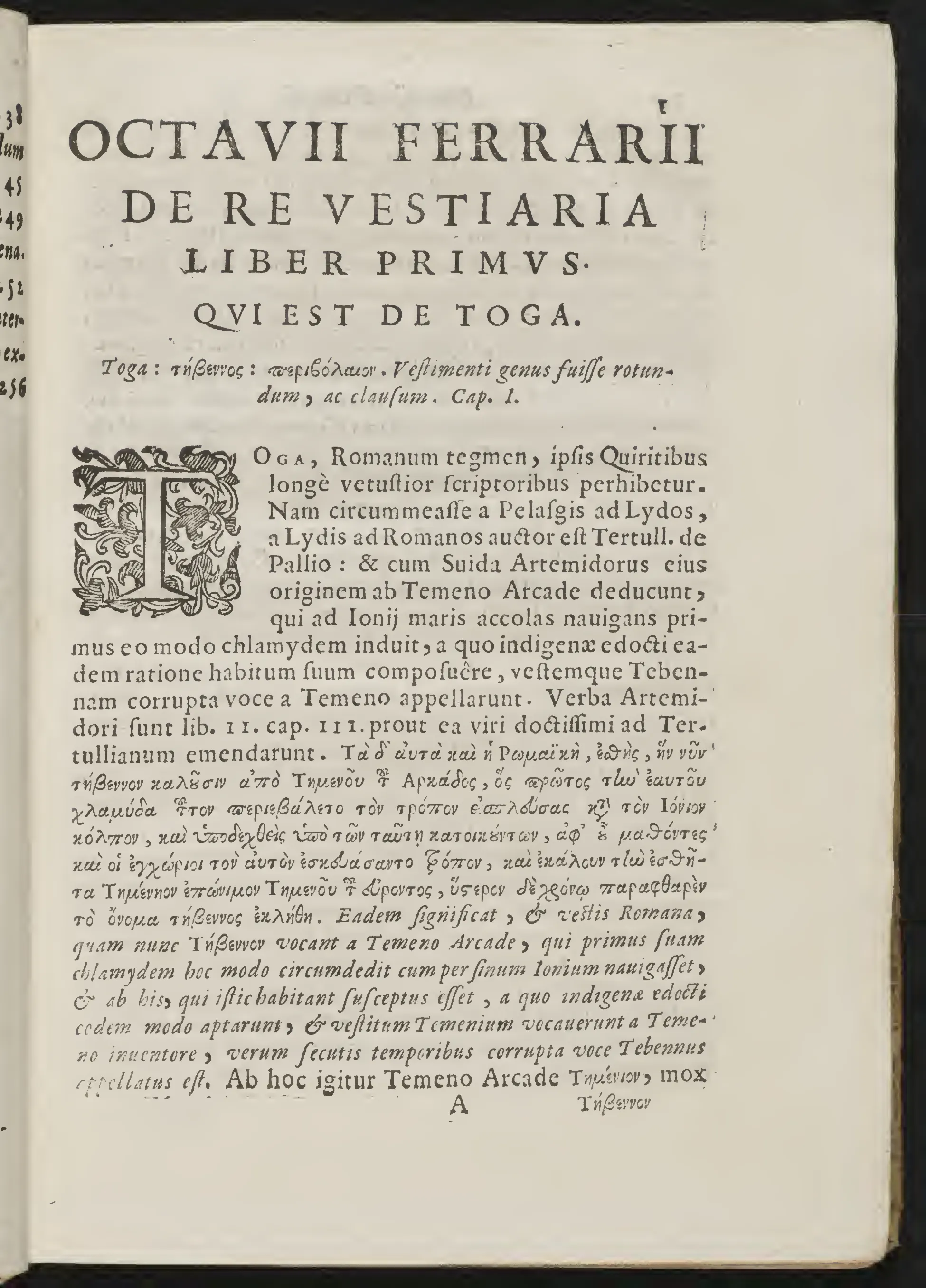
The formal opening of Book I, "De toga," sets the treatise's central claim at the threshold: the chapter heading defines the toga as a round and closed kind of garment before the argument proceeds into authorities and evidence. The large ornamental initial that begins the prose marks this as more than a new section—it is the point from which the reconstruction of Roman drapery, folds, and modes of wearing will unfold. Source ↗.
The reconstruction of the toga's decline gives the political conceit of the dedication its historical demonstration. Tracing the garment's fortunes into the imperial period, Ferrari concludes that under Augustus the toga was nearly disused, save the residual ceremonial of clientage, the lacernae succeeding in its place — the report has already drawn out the political charge of this observation about officia clientum. The qualification is telling: the toga does not vanish but shrinks into the residual ceremonial of clientage, surviving as a badge of dependence rather than as the common dress of a free people. This is the material fulfillment of the dedication's claim that Rome put off liberty and toga together, for the garment's contraction to a client's obligation is the sartorial trace of the disappearance of the res publica. The historical narrative and the political thesis are thus not separable strands but a single argument pursued at two registers.
Complicating this account is Ferrari's insistence that the toga's original condition was neither exclusively male nor invariably honorable. He records that in the first times of the City both men and women went about in the toga, and the whole Roman people was truly togate, Prrimis Vrbis temporibus tam viros, quam mulieres in toga incessisse, totamque Romanam gentem vere togatam fuisse veteres critici adnotarunt. The claim that the gens togata originally embraced both sexes sits in productive tension with the later development by which, once matrons had abandoned the toga for the stola, the garment came to mark the harlot; the sign that in one epoch denoted the whole free people could, in another, denote disgrace. This instability is characteristic of Ferrari's argument, which repeatedly discovers that a garment's meaning is historically contingent, its moral valence reversible, and its reading dependent on the epoch in which it is worn.
The moralizing charge latent in this reading of dress surfaces most sharply in the treatment of silk, where philology of material becomes a critique of luxury. Ferrari mobilizes the Senecan denunciation of transparent fabrics, recording the complaint that he sees silken garments, if they are to be called garments, in which there is nothing by which the body or modesty could be defended, Video sericas vestes, si vestes vocandæ sunt, in quibus nihil est, quo defendi corpus, aut denique pudor possit. The parenthetical hesitation, si vestes vocandæ sunt, performs the argument it advances: a fabric that conceals nothing forfeits the very name of clothing, since it fails in both of a garment's offices, the protection of the body and the protection of pudor. Here the antiquarian's concern with the technical vocabulary of Coan and Assyrian silk is inseparable from a moral judgment about the wearer, and the transparency of the material becomes a figure for the transparency of a laxity it neither covers nor excuses. Dress, once again, is a claim about the person, and a false or immodest garment betrays a false or immodest condition.
The philological method that adjudicates these questions is displayed in its most granular form in the correspondence with Johann Friedrich Gronovius appended to Book I, where the technical anatomy of the toga is contested authority against authority. Resolving the vexed relation of the sinus to the umbo, Ferrari argues that the phrase in Fabius, that is Quintilian, is nothing other than the umbo named by others, for that "like a baltheus" of Fabius is nothing other than the umbo of Persius, of Curius Fortunatianus, and of Tertullian, Nec vero ille velut baltheus Fabio aliud est, quam vmbo Persio, Curio Fortunatiano, & Tertulliano. The procedure is exemplary of Ferrari's cross-authority collation: a single physical feature of the garment is identified across a series of writers who name it differently, so that Quintilian's simile, Persius's noun, and the usage of the grammarian and of Tertullian are shown to converge on one object. The method assumes that the ancient testimony, however scattered and terminologically various, describes a real and reconstructible thing, and that the scholar's task is to align the vocabulary until the object stands revealed—precisely the discipline that the round-and-closed thesis had required.
The most consequential controversy of this portion carries the antiquarian method into the domain of sacred history. Identifying the Christian priestly vestment with the ancient toga, Ferrari registers the resistance of a formidable authority, for Baronius contends this garment was not a toga but a paenula — the quarrel over whether the ecclesiastical planeta descends from toga or paenula, with its contendit marking an open contest of judgment, has already been laid out in the report's account of the controversies. Ferrari's willingness to dissent from Baronius on this point extends into ecclesiastical antiquity the same evidentiary discipline he applies to pagan monuments, consistent with the preface's ethic that great names may be resisted where the evidence directs.
Book II: The Praetexta and the Consecration of Rank
Book II opens by transferring this apparatus of status and meaning to the praetexta, whose purple border Ferrari defines by its threefold sacral and civic function. Invoking the vestment's consecrating power, he cites its very sacredness, with which priests are veiled, with which magistrates, with which the weakness of boyhood is made sacred and venerable, quo sacerdotes velantur, quo magistratus, quo infirmitatem pueritiæ sacram facimus, ac venerabilem. The tricolon distributes the praetexta across priesthood, magistracy, and childhood, and the striking phrase infirmitatem pueritiæ sacram facimus discloses the logic that governs the whole treatise: the garment does not merely signify a condition but confers one, transforming the very weakness of boyhood into something venerable. Dress is thus not the passive index of status but its active instrument, a claim consonant with the juristic definitions that opened the work and with the political conceit that made the toga the visible body of Roman liberty. In the praetexta as in the toga, Ferrari finds a garment that reads its wearer and, in reading, constitutes him.
The completion of Book II and the whole of Book III together display the operative logic by which Ferrari converts scattered and mutually contradictory testimony into a governed account of Roman dress, and the seam between these books and the Pars Altera exposes with unusual clarity how his method, his ethic of citation, and his polemical temper are bound to a single conviction: that a garment is a legible sign of the status and moral condition of its wearer, and that reading it correctly is a matter of weighing witnesses in the right order.
The controlling principle surfaces at the close of the praetexta discussion, where Ferrari confronts a conflict between a Roman and a Greek source over whether tribunes wore the bordered toga. His resolution is not to reconcile them but to rank them, preferring to trust the Roman and more ancient witness over the Greek one who has not seldom suffered something merely human — this calibrated hierarchy of witnesses, credited for nationality and antiquity against a Greek dismissed with the barbed aliquid humani, is the evidentiary preference the report has already singled out. It is not a general contempt for Greek testimony but a rule applied at the point where the evidence forks, and it recurs as the silent principle behind nearly every adjudication that follows.
Book III: The Tunic, the Stola, and the Reading of Persons
That evidentiary ranking is inseparable from a thesis about identity: the garment is what it is because the sources, correctly weighed, say what it is, and getting the identification right matters because the garment carries civic meaning. So in the chapter on the trabea Ferrari does not merely describe the striped ceremonial toga but insists on its classification, correcting an anonymous recent commentator on Cicero who had confused it with the military paludamentum. From what has been said, he writes, it clearly appears the trabea was a toga, the more he wonders at the recent interpreter of Cicero's orations, Ex dictis trabeam togam fuisse manifestò apparet; Quò magis miror nuperum Orationum Ciceronis interpretem. The stakes of the correction are taxonomic and, beneath that, ideological: to call the trabea a paludamentum would be to file a civic-sacral garment of kings, knights, and augurs under military dress, dissolving precisely the distinction between the toga's world and the soldier's that organizes the whole treatise. The chapter on the triumphal toga performs the same operation diachronically, using Verrius Flaccus to show that a single honorific garment passed through successive forms, since the picta now so called was formerly called purpurea, and that older one was without embroidery, Picta inquit, toga quæ nunc dicitur, purpurea antè vocata est, eaque erat sine pictura. The apparent multiplicity of names resolves into one object developing over time — a characteristic move by which Ferrari tames a confusing lexical field into an intelligible history.
The same discipline extends to the vocabulary of purple itself, where he proposes a Greek etymology for the wholly-purple garments against the reading of Salmasius, holding holovera to be no half-Latin coinage but a pure Greek word, contracted and corrupted from Holoporphyra — the lexical thesis already noted in the report. It is worth registering the measured register of semper credidimus, always believed, for it marks this as a settled conviction stated without heat; the significance of that calm will become plain only when the same dispute resurfaces in the front matter of the second part in an altogether different key.
Book III opens by making Ferrari's ethic of citation explicit, and it does so as an accusation, charging that the recent writers did Manutius great injury by transcribing his dissertation on the tunic without once naming him — the rebuke of unacknowledged transcription that the report has already quoted. The placement is deliberate: the charge stands at the threshold of the very book most indebted to Manutius, so that Ferrari's own practice of naming his predecessor becomes the demonstrated counter-example to the theft he denounces. Attribution here is not politeness but the connective tissue of a method that proceeds by weighing named witnesses; to suppress a source is to corrupt the very ledger of authorities on which the adjudication of dress depends.
Within Book III the treatise's governing conviction — that dress encodes status — receives its juristic grounding. On the clavi, the purple stripes of rank, Ferrari overturns Scaliger's notion that they were suspended ornaments by invoking Ulpian, citing the borders, embroideries, and clavi which are sewn onto garments, quæ sunt institæ, picturæ, clauique, qui vestibus insuuntur. The verb insuuntur — are sewn in — carries the whole argument: if the clavus is a sewn patch rather than a pendant amulet, then it is an integral property of the garment and thus a fixed mark of the senatorial body, and the jurist's language settles the material question that the antiquarian debate could not. The juristic frame does its heaviest work in the chapters on female dress, where the distinction of garments becomes a distinction of legal persons. Ferrari draws on Valerius Maximus to invest the matron's robe with civic weight, reporting that the Senate confessed more safety of the Republic lay in the stola than in arms, confessus plus salutis Reip. in stola, quam in armis fuisse — the stola, mark of the matron's chastity, made into a bulwark of the commonwealth on a par with its legions. The corollary is that misidentifying a woman's dress misidentifies her status before the law, which is exactly the point Ulpian is summoned to make: one who accosts women dressed in servile garb seems to sin less, and much less still if the women were dressed in meretricious garb, not as matrons, si tamen ancillari veste vestitas, minus peccare videtur: multominus si meretricia veste fæminæ non matris familias vestitæ essent. Here the treatise's central claim is at its most exposed: legal culpability is calibrated to the reading of a garment, and dress is not the sign of status but very nearly its substance, so that the stola protects the matron and the meretricious dress forfeits that protection. The antiquarian recovery of what the ancients wore is thus, in the same motion, a recovery of how they distinguished persons.
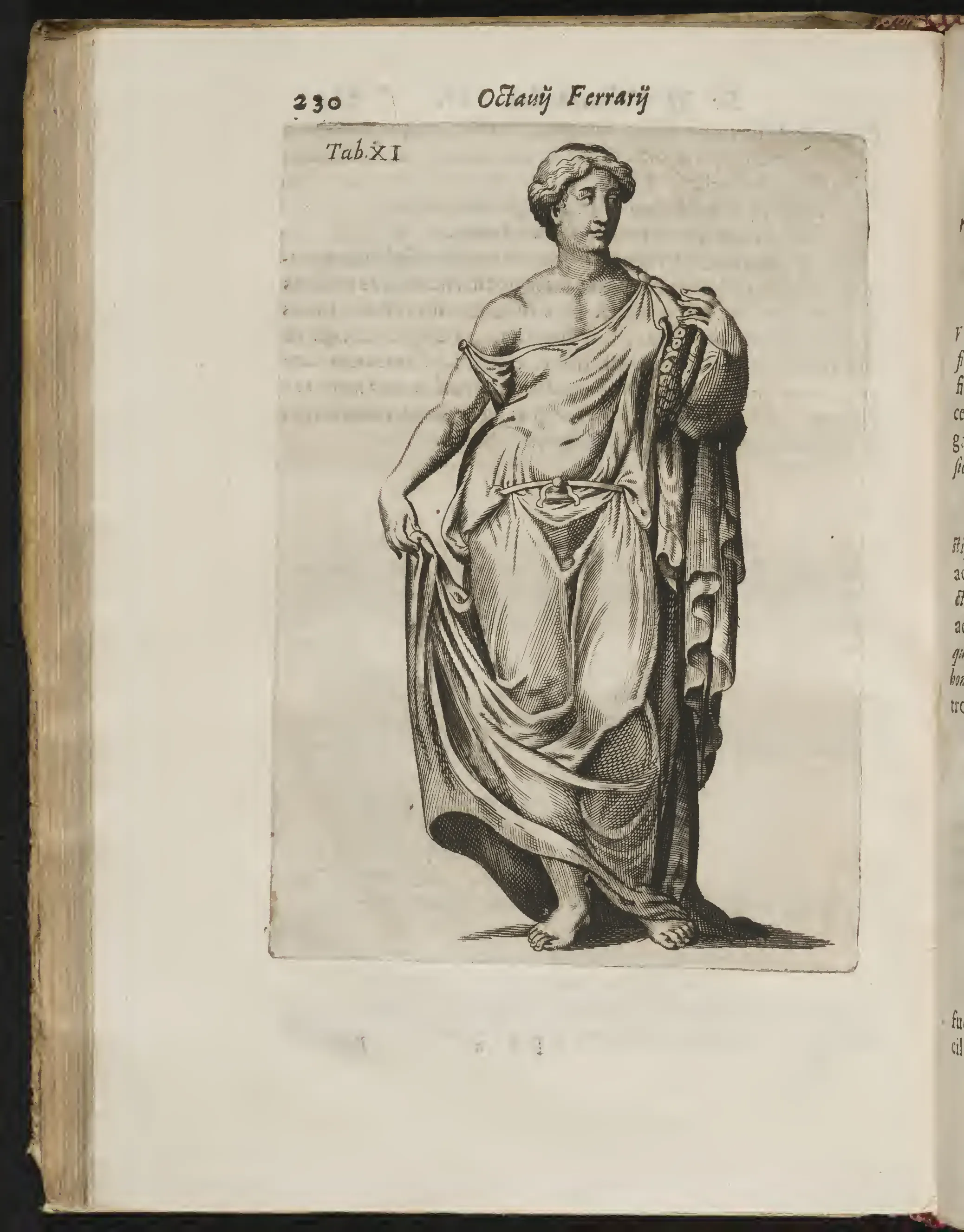
Tab. XI gives the argument about female dress a body: the barefoot woman's long, bordered drapery is presented not as ornament but as evidence for distinguishing the palla or stola in the chapter that follows. Drawn into the same evidentiary system as juristic citation, the garment's folds become part of the inquiry into how Roman law and civic status were read on the clothed female body. Source ↗.
The chapter on the seamless tunic shows the method turned upon a sacred text. Ferrari grounds a sustained refutation of a most learned man in the wording of John, that there was a tunic without seam, woven from the top throughout, and that they said therefore, let us not divide it but cast lots for it, Erat autem tunica inconsutilis desuper contexta per totum. Dixerunt ergo adinuicem non scindamus eam, sed sortiamur de illa cuius sit. The scriptural locus functions exactly as a Ciceronian or Plinian one does elsewhere: a fixed verbal datum from which the true sense of a technical term, here inconsutilis, must be reconstructed against a rival reading. That the same evidentiary discipline governs Gospel and grammarian alike is itself a statement about the reach of Ferrari's philology.
The Pars Altera: Dedication and Polemic
The front matter of the Pars Altera recasts this labour in a wholly different idiom. Dedicating the second part to Christina of Sweden, Ferrari sustains a weaving conceit in which the treatise itself becomes a web, telling the Augusta that to this web he devoted ten solid years amid the injuries of unfavourable health — the Penelopean tela and the topos of tenuitas, already set out in the report's account of the dedication. The metaphor is apt to the matter — a book on woven garments figured as a woven thing — and it converts the decade separating the first issue from the expanded one into an emblem of Penelopean fidelity, while the topos of precarious health performs the expected modesty before a royal patron. The self-presentation is the reverse of the polemical voice that erupts a few pages later.
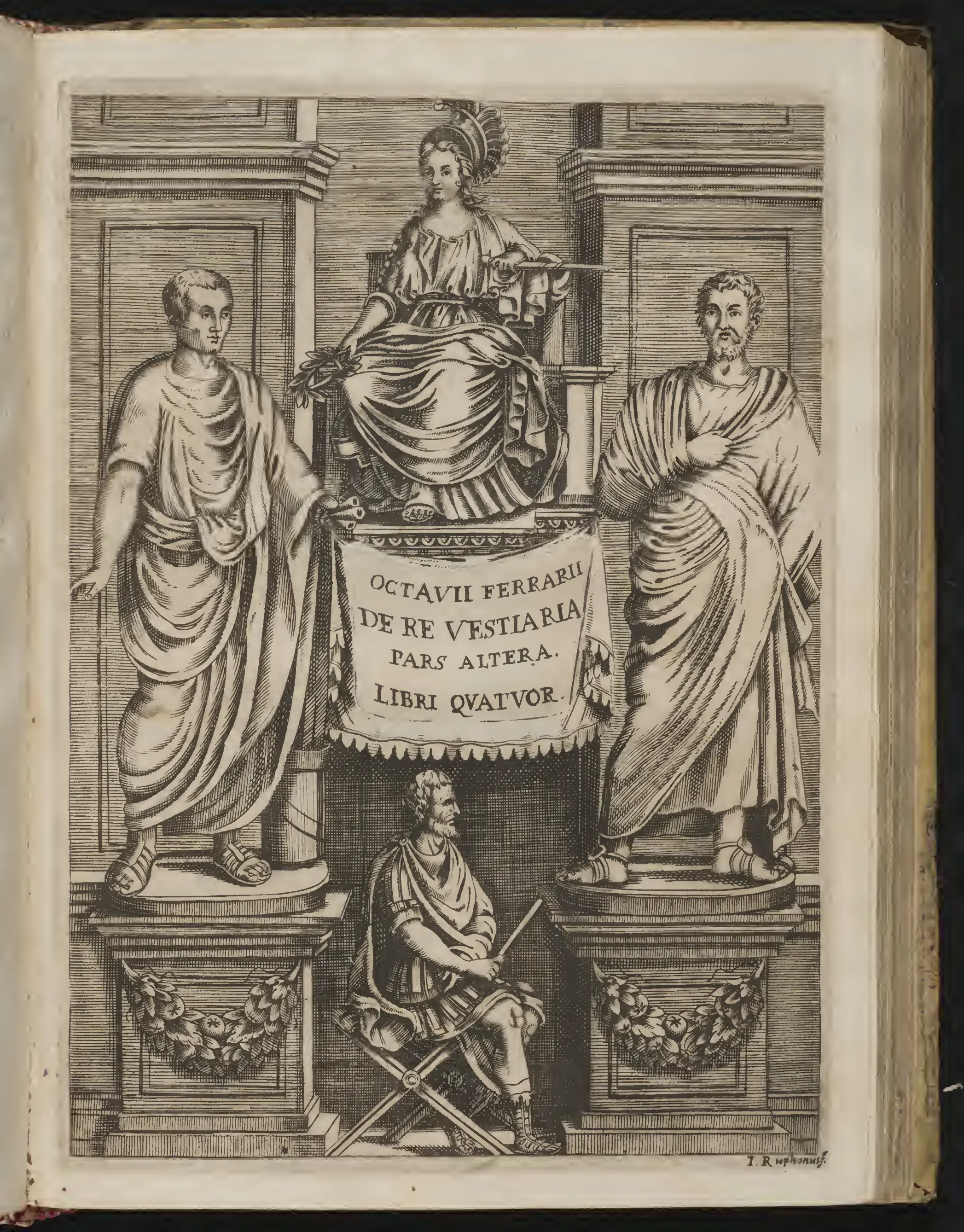
The engraved title page to the Pars Altera turns the second part's four new books into a visual program: draped antique figures frame the cartouche naming De re vestiaria, Pars Altera, Libri Quatuor. Its staged array of toga, pallium, and military dress gives pictorial form to the same premise that underlies Ferrari's woven self-presentation before Christina of Sweden—that garments, like texts and monuments, can be read as signs of status, office, and civic meaning. Source ↗.
For the holoverae dispute returns in the preface to the reader with an entirely altered temperature. The calm semper credidimus of Book II gives way to a personal reckoning with the recently deceased Salmasius, drawn as an immoderate self-appraiser and contemner of others, enemy of every opinion of which he was not himself the author — the portrait of the adversary that the report has already reproduced. The concession quæsita meritis grants that the arrogance rests on genuine attainment even as it condemns it, and the closing clause locates the fault not in error but in a temperament that cannot tolerate authorship other than its own — the exact vice of which Ferrari had accused the anonymous plagiarists of Manutius, now inverted into a man who will own no opinion he did not father. The contrast between this bitter obituary and the serene etymological note of the second book measures how far the Pars Altera's stakes had become personal as well as scholarly.
Book I of the Pars Altera: The Lacerna and the Fibula
The opening of Book I of the second part, on the lacerna, returns to the settled procedure of building from the earliest datable witness. Ferrari fixes the garment's disreputable urban debut in Cicero's charge against Antony, that he came into the City with caligae and a lacerna, adducing the answer that one returned first by daylight, not in darkness, then with shoes and toga, with no caligae nor lacerna, primum luce, non tenebris, deinde cum calceis & toga, nullis nec caligis, nec lacerna. The moral geography is embedded in the vocabulary: toga and calcei belong to daylight and the city's civic order, while caligae and lacerna — soldier's boots and campaigning cloak — belong to darkness and impropriety, so that the garment's history opens on a note of transgression against the toga's proper domain. Against this Ferrari defends the transmitted text of Seneca where Lipsius would emend, and does so with characteristic irony, venturing though not admitted into that College and ignorant of the Sibylline books to defend and explain the old reading, ipse licet in illud Collegium non allectus, & Sibyllinorum ignarus veterem lectionem tueri, atque explicare ausim. The self-deprecating disclaimer of priestly initiation is a pointed defence of the received reading against conjectural emendation, aligning Ferrari with a conservative textual instinct that prefers the witness as transmitted to the critic's improvement of it. The same instinct for resolving muddle by chronology closes the surviving portion, where he uses Pliny to distinguish the one-sided from the double-sided villous fabrics, holding that gausapa began in his father's memory and amphimalla came into use in his own, Gausape patris sui memoria coepisse, Amphimalla autem ætate sua venisse in vsum. As with the picta and the purpurea, a knot of overlapping terms is untangled into an ordered sequence of introduction, so that the confusion in the sources becomes itself a historical datum about when each fabric entered Roman use.
Ferrari's excavation of ancient dress reaches, in the stretch that follows, its most granular and its most methodologically self-conscious phase, moving through the residue of Book I on the fibula into three fresh treatises on the paenula, on military dress, and on the pallium. The material here is not the toga's grand civic emblem but the accessory and the over-garment, and it is precisely in these lesser articles that Ferrari's characteristic method—the adjudication of discordant testimony and the weighing of the monument against the word—shows itself most plainly at work.
The residue of Book I turns on whether golden fibulae marked the tribunate, and Ferrari resolves the question not by asserting a thesis but by staging a contest of authorities and preferring the one whose cited text carries greater evidentiary force. Against those who would read the golden clasp as an insignia of office, he ranges Pliny's complaint about the encroachment of gold, citing the more sober scholars who invoke Pliny, in his thirty-third book, lamenting that the luxury of gold had grown up even amid that hard and rough military life, Saniores Plinium aduocant qui lib. / xxxIII. cap. III. conqueritur auri luxum / adeo in militia quoque dura illa, atque horrida adoleuisse. The rhetorical labelling of his allies as the saniores, the sounder heads, quietly enacts the arbitration: the fashion for golden fibulae is referred not to the dignity of magistracy but to the contagion of military luxury spreading through the civil wars, so that a garment-clasp becomes evidence for moral decline rather than for constitutional rank.
The chapters on the fibula theatralis extend this reading of dress as bodily discipline. Here the clasp is not ornament but constraint, its function common knowledge: everyone knows, Ferrari observes, that its use among the ancients was to keep singers and whoever pleased by voice in the theatre away from Venus, Eius vsum apud veteres fuisse, vt Cantores, & quicumque in Theatro voce placebant, a Venere arcerentur / omnes sciunt. The device that fastens the body is understood to preserve the voice by preserving continence, and the passage exemplifies the treatise's persistent conviction that an article of dress or attachment is never inert: it acts upon its wearer, disciplining and declaring the condition of the body it binds. That the precise form of the object eludes him—he concedes that of what sort it was is not so well established, Sed qualis ea fuerit non ita compertum est —does not weaken the point but sharpens it, for it is the function, not the shape, that carries the moral and juristic weight.
The long sequence on the hood is governed by the same insistence that a garment's form encodes its social meaning. Ferrari fixes the cucullus against a series of misreadings of Martial, establishing that the hood was a covering of the head, so shaped that it might also veil part of the shoulders, Sed cucullus capitis tegmen fuit, vt & partem humerorum velaret. From this formal determination he draws the garment's double valence—its capacity to conceal, which attaches it to nocturnal disguise and to the notorious concealments of Messalina, and its more honourable monastic and free-man's uses—so that the same physical contrivance can signify either shame or ascetic gravity depending upon its wearer. The lengthened Gallic caracalla is handled with the treatise's most confident etymological-historical reasoning, in which the name of a garment and the name of an emperor are shown to have generated one another: because he had sought caracallae from Gaul and wore them himself and among his soldiers, and soon compelled the citizens to put them on, he was thence called Caracallus, Quod igitur Caracallas e Gallia petierit, / easque gestaret ipse, & milites, moxque ciues induere / coegerit Caracallus inde dictus est. The garment migrates from province to imperial body to citizenry and finally into a sobriquet, and the philological chain, assembled from Dio, Victor, and Spartian, demonstrates how a foreign fashion imposed from above leaves its trace in the very onomastics of the principate.
Book II of the Pars Altera: The Paenula and the Monument
Book II opens on the paenula with a definitional economy that is itself an argument. Ferrari grounds the whole treatise on a single lexicographic authority, citing Nonius to the effect that the paenula is a garment which we take on over the tunic, Nonius. Penula est vestis, quam supra tunicam accipimus. From this spare definition follows the garment's whole character as an itinerant, rain-repelling over-garment, and the subsequent debates over its material, its admissibility within the city, and whether senators and emperors might wear it all radiate from that initial placement of the paenula above the tunic and outside the settled civic wardrobe. It is in this book, moreover, that the treatise's dependence on monumental rather than merely textual evidence becomes most explicit and most emphatically acknowledged. Unable to recover the form of the paenula from words alone, Ferrari names the collector whose visual archive supplied what the texts could not, in his tribute of extraordinary warmth to Cassiano dal Pozzo, never to be passed over in silence, the most fortunate champion of all antiquity — the declaration the report has already cited in its account of the plates. It is not mere courtesy: it locates the evidentiary authority for the garment's shape in the drawn and engraved record rather than in the grammarians, and so makes visible the methodological wager that runs through the entire work—that the monument, faithfully transmitted through the antiquarian's collection, outranks the word where the word falls silent on matters of form.
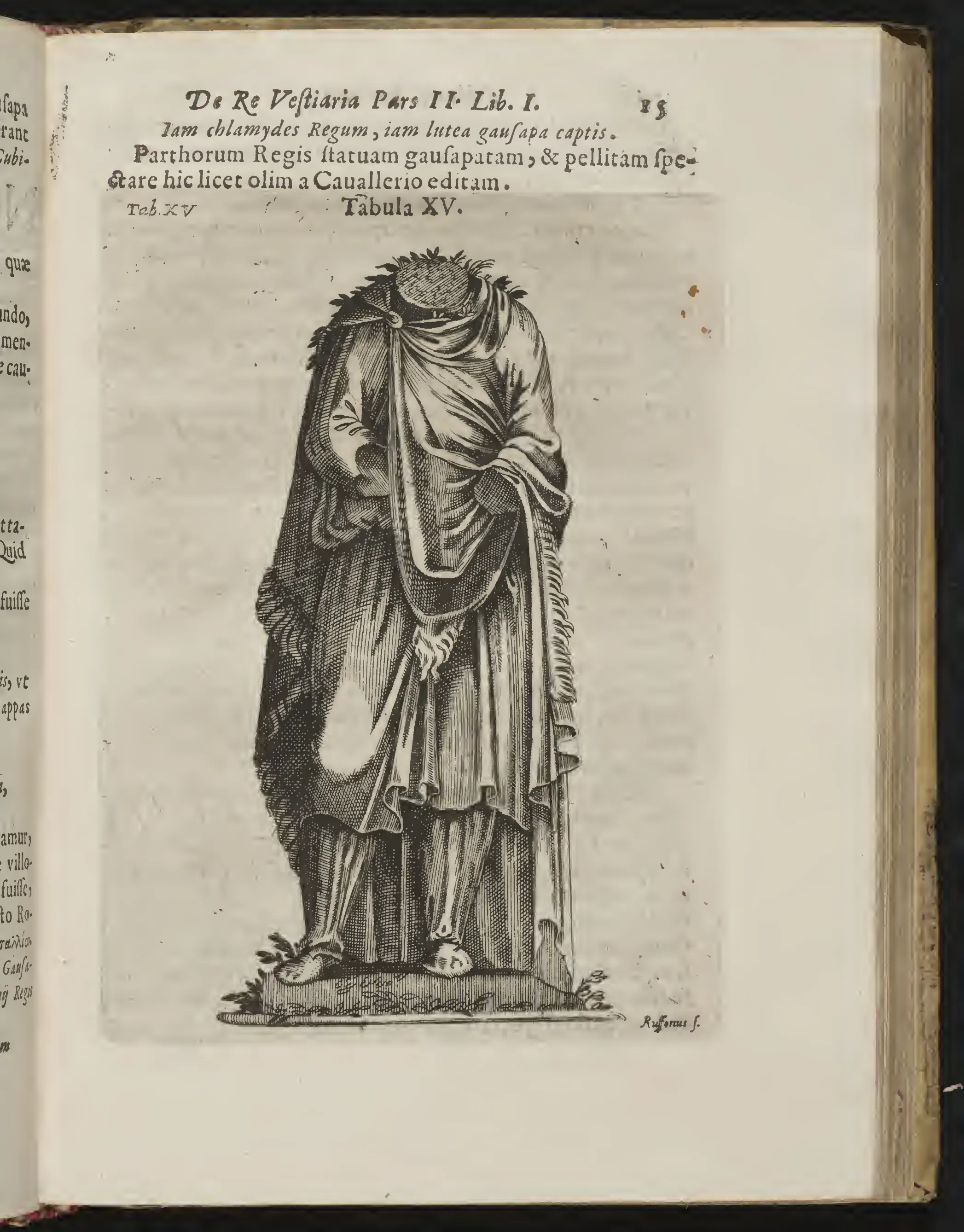
Plate XV turns the method into an image: a full-length engraved statue of a Parthian king, identified in the printed caption as wearing a gausapa and a fur-lined garment, is made to answer a question that words alone could not resolve. Drawing on the visual archive associated with Cassiano dal Pozzo, the plate embodies Book II's wager that monuments could define the form—and the foreign, luxurious associations—of antique dress more securely than grammarians. Source ↗.
Book III of the Pars Altera: Military Dress and the Reduction of Names
Book III performs a reduction of terminological plurality to substantial identity, the analytical counterpart to the fibula chapters' contest of authorities. The multiplicity of names for military over-garments is collapsed into a single form differentiated only by wearer and rank, for the sagum, or as the ancients said sagus, was nothing other than a chlamys, Verum nihil aliud / sagum, siue vt veteres loquebantur sagus, fuit quam chlamys. Having established that the open, fibula-fastened cloak is one thing under many names, Ferrari can treat the paludamentum as its highest register, the mark of command, and here his handling of etymology turns openly critical. He reports the derivation—that paludamenta are so called because they are seen and made openly, quæ propterea quòd conspiciuntur, & fiunt palam / Paludamenta dicta —and then, rather than endorse Varro's account, invites the learned to see and laugh, an aside that registers his refusal to accept a received etymology merely because it descends from an ancient and honoured name. The critical temper that elsewhere weighs Pliny against Alexander here declines to be bound even by Varro.
Book IV of the Pars Altera: The Pallium, the Citizen, and the Philosopher
The final book, on the pallium, returns the treatise to its governing preoccupation with dress as the visible sign of civic and legal status, now articulated as the opposition between the Greek cloak and the Roman toga. Ferrari fixes the juristic charge of that opposition through a forensic scenario in which a defendant's foreign status provokes a dispute over whether he ought to plead his cause in the toga or in the pallium, togatumne, an palliatum dicere causam oporteret. The garment is here a claim about citizenship adjudicated in a court of law: the toga is the exclusive right of the Roman citizen, the pallium the badge of the Greek and the foreigner, and to appear in the wrong one is to make a false assertion about one's own legal person. To this juristic opposition Ferrari joins its ideological register, drawn from Valerius Maximus, recording that the Romans thought the pallium ought in no matter whatsoever to be subordinated to the toga, sed nulla non in re pallium / toge subijci debere arbitrabantur. Dress here carries the whole weight of Roman gravitas asserting the precedence of Latin over Greek, of citizen over stranger, so that the sartorial hierarchy encodes a cultural and political one.
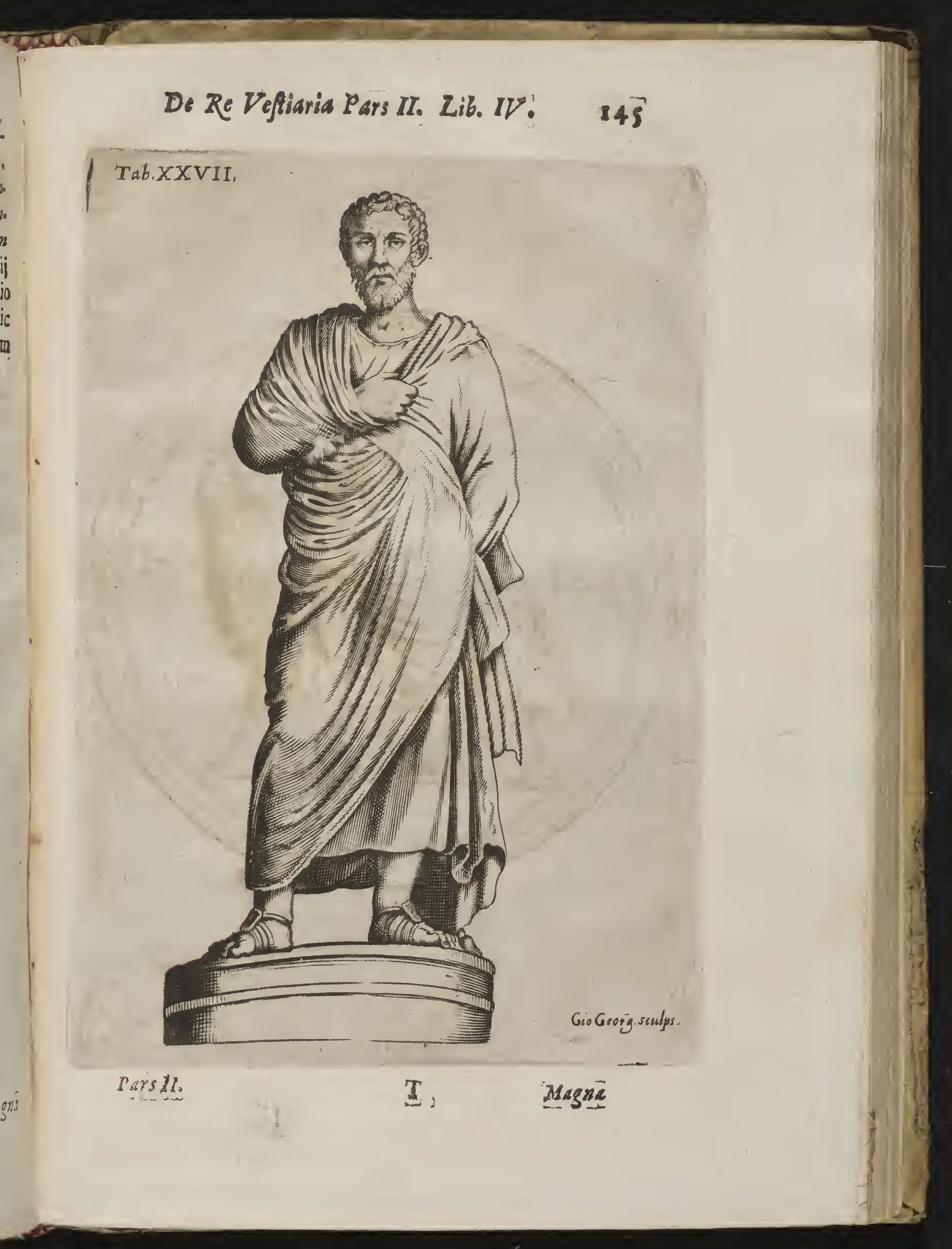
Tab. XXVII turns the pallium from a word in dispute into a visual and antiquarian argument: the cloak is shown on a bearded statue, swept up across the shoulder and leaving the right arm partly free, as material evidence for how the Greek garment was worn. The signed engraving, "Gio. Georg. sculps.", embodies Ferrari's preference for statues and monuments over grammatical testimony in adjudicating the civic and cultural meanings carried by ancient dress. Source ↗.
Yet the pallium is also the philosopher's garment, and in its most degraded form the emblem of a whole ethic. Ferrari defines the tribonium as a pallium worn out and nearly torn, especially that of the Cynics, Tribonium igitur pallium detritum, ac ferme lacerum, / præcipuè Cynicorum, binding the threadbare cloak to the Stoic-Cynic discipline of endurance so that a garment's very dilapidation becomes a statement of virtue. The philosophical chapters also disclose Ferrari's relish for the verbal wit lodged within dress-history, as when Stilpon, seeing Crates stiff with the winter's cold, remarked that he seemed to stand in need of a new cloak, Videris mihi, inquit [χρειαν] ἐχε�� ἰματίε na[tur]a[n] / indigere pallio nouo, where the pun turns on the near-identity of the new cloak and the acquisition of mind. The colour of civic dress is settled by the same evidentiary procedure, an Artemidorus citation establishing that white garments benefit only the sacrificers and the slaves of the Greeks, Alba vestimenta solis sacrificis conferunt, & / seruis Græcorum, from which Ferrari argues that ordinary Greek civic wear was white, purple being reserved to luxury and royalty.
Ferrari brings the treatise to its close by pursuing a single problem across the terminal chapters of Book IV: how a garment that signifies austere wisdom can be prised apart from the sectarian legend that had attached it too narrowly to one school, and how, once that garment becomes a legible sign of virtue, it becomes equally available to counterfeit. The controlling gesture is a correction of prior scholarship, his insistence that they are gravely mistaken who hold the tribonium to have been the garb of the Cynic sect alone, since Socrates, the Pythagoreans, and the Stoics preferred it to all the robes of kings — the de-sectarianizing thesis whose full Latin the report's philological framing has already given. The antithesis between the worn cloak and the royal robes it is preferred above is not incidental ornament: it converts a philological point about the extension of a term into a moral proposition, that the deliberate election of poverty in dress is itself an act of the severe philosophy (seuere philosophantes) that Ferrari means to vindicate. Before it can be a badge of any school, however, the tribonium is the garment of honorable poverty, and Ferrari grounds this stratum of the argument in an Aelian anecdote of arresting concreteness: Epaminondas had but one tribonium, and that a filthy one, so that whenever he sent it to the fuller he was obliged to keep to the house, having no other, Epaminondas vnum modo Tribonium habebat, illudque sordidum. Quando vero illud ad fullonem mittebat, necesse habebat se domi continere, quod alterum non haberet. The single filthy cloak that confines its owner indoors while it is cleaned is offered as the material substrate onto which philosophical meaning was later grafted; poverty precedes emblem.
That the emblem is precisely a later graft, and a detachable one, is the pivot on which the whole ensuing polemic turns. Ferrari states the principle in a Plutarchan register, that a philosopher's thick beard and the wearing of a tribonium do not make one, Neque enim philosophorum densa barba, & tribonij gestatio facit. The sentence is deliberately left grammatically open — the object of facit, the philosopher whom beard and cloak fail to constitute, is suppressed so that the negation falls with full weight on the outward signs themselves. This is the conceptual hinge of the terminal chapters: if the sign does not make the thing, then the sign can be worn without the thing, and the door to imposture stands open. The genealogy Ferrari then constructs is designed to fix the moment at which the cloak acquired its philosophical charge, and he assigns the origin unambiguously to Socrates, the first parent of the holier discipline, who fitted the tribonium to wisdom and was accordingly mocked in it by Amipsias, Primus sanctioris disciplinæ parens Socrates Tribonium sapientiæ aptauit. Quapropter ab Amipsia hac etiam parte Aristophanis æmulo in Tribonio traducitur. The verb aptauit, fitted or adapted, is precisely chosen: the cloak is not native to wisdom but adjusted to it, an accommodation rather than an essence, and the comic poet's mockery is admitted as evidence that the association was already visible enough to be ridiculed.
The reading of that mockery furnishes one of the sharpest displays of Ferrari's polemical method. Against a prior translator he objects that the interpreter grasped neither the words nor the sense, for while the interpreter says merely that the poet introduces Socrates cloaked, everyone then was cloaked, Nec verba, nec sententiam Interpres assecutus est. Eum inquit palliatum inducens. Atqui omnes tunc palliati. The correction is philologically exact and characteristic of the book's evidentiary ethic: a joke that turned merely on Socrates being palliatus would have no point in a society where all wore the cloak, so the barb must lie in the specific opposition between the thin, worn τρίβων and the thick, shaggy χλαῦνα that the careless interpreter has flattened away. Ferrari extends the color of the garment to match its poverty, arguing at the head of the relevant chapter that just as the tribonium was a worn and torn garment, so its color was dark and shabby, Sicut Tribonium vestis detrita ac lacera fuit, ita eius color fuscus, atque obsoletus. The parallel construction (Sicut… ita) binds chromatic dinginess to material wear as a single expressive fact, so that the very drabness of the cloak becomes semantically loaded — a visible declaration of the contempt for luxury that the philosopher professes.
Having established the sign and its meaning, Ferrari broadens its social reach before turning to the crisis of its abuse. From the testimony he adduces it is gathered that grammarians too, and rhetors and other professors of the liberal disciplines wore the tribonium at Rome, Ex quibus colligitur Grammaticos etiam, & Rhetores aliosque literalium disciplinarum professores Romæ tribonium gestasse. This widening of the cloak from the philosophical sects to the entire learned order at Rome — the passage rests on Tertullian's De pallio, whose admission into the antiquarian scheme is itself one of the book's ideological maneuvers — sets up the reversal that follows. For once the cloak marks not a rare vocation but a whole professional class, it becomes wearable by those who lay claim to learning they do not possess, and Ferrari registers the consequence in the most morally weighted sentence of these chapters: after the majesty of philosophy was violated by charlatans and rogues, sycophancies and impostures for the most part lurked beneath the pallium, so that what was once the mark of frugality and continence began, through the fraud of the wicked, to be the veil of every wickedness and shamelessness, sycophantias, & imposturas plerumque sub pallio latuisse, vt quod olim frugalitatis, & continentiæ index erat, sceleratorum fraude, omnis nequitiae, atque impudentiæ velamen esse coeperit. The metaphorical schema here is exact and damning: the cloak that once served as index, an honest pointer to the virtue within, is converted into velamen, a screen that hides the vice beneath. The same fabric performs opposite semiotic functions depending on the truth of the wearer, and this inversion — from disclosure to concealment — is the precise mechanism by which Ferrari's governing anxiety about counterfeited appearances is realized in the domain of the philosopher's dress. The impostor motif is not decorative; it is the logical culmination of the earlier premise that beard and cloak do not make the philosopher.
This anxiety about false signification governs Ferrari's most delicate maneuver, his refusal to draw the sacred wardrobe of Christianity into the sect's disreputable orbit. He concedes readily that the Lord Christ and his followers were cloaked after the manner of the nation, but he will not concede that this cloak was a tribonium: Christum quidem Dominum, & sectatores more gentis palliatos fuisse credimus: id pallium fuisse tribonium, credere non possumus. The balanced antithesis of credimus against credere non possumus enacts the discrimination the whole argument has been building toward: to be palliatus is merely to follow national custom, an ethnographic fact carrying no philosophical freight, whereas to wear the tribonium is to make the specific, elective claim of Cynic austerity, and that claim Ferrari declines to attach to the Apostles. The distinction protects the sacred garments from assimilation to a garb that, by his own account, had become the veil of imposture, and it does so by means of the same tool he applies everywhere — the insistence that a general term (pallium) and its loaded species (tribonium) must not be silently conflated. The regulation of ascetic dress by the Synod of Gangra, whose canons his surrounding argument invokes, supplies the institutional counterpart: the cloak is licit for the true ascetic and anathematized as a pretense in others.
The final chapters turn from the moral to the mechanical, cataloguing modes of wearing with the same attention to the physical logic of the garment. The Cynic manner is explained as a consequence of privation: since the Cynics lacked a tunic, they were obliged to put on the cloak differently from the tunic-wearers, Quod igitur tunica Cynici carerent, necesse habuerunt diuerso more a tunicatis pallium induere, the doubling of the cloak thus arising not from affectation but from the necessitas of the tunicless (αχιτωνες) condition. That the tribonium alone could clothe even a woman of the sect Ferrari establishes through Hipparchia, quoting the challenge that she shall walk about wearing the tribonium, as lately the wife did with Crates the Cynic, Mecum ambulabis gerens tribonium, vt nuper vxor cum Cratete Cynico — a datum that, set beside the Gangra canon's anathema against women adopting male dress, shows how the same garment could be at once the emblem of a philosophical marriage and the object of ecclesiastical censure.
From the philosopher Ferrari descends to the slave, reading the stage-business of Roman comedy as evidence for how the cloak was actually handled: slaves, when hurrying, so that the flowing cloak should not hinder their running, were accustomed to throw it onto the neck, seruos cum properarent, ne fluens pallium cursuram impediret, solitos illud in collum conjicere. The gesture recovered from Plautus and Terence ties dress to dramatic convention and confirms that the pallium, so freighted with philosophical meaning above, remained at bottom a common garment worn by the lowest of the household. The concluding etymological chapters press the same materialist logic into the origins of words: the hide-garment, he explains, the Latins called scortea, for scorta means hides, whence, on Festus's authority, prostitutes were so named, because like a little skin they are worked, Eam scorteam Latini appellarunt, nam scorta pelles. Vnde auctore Festo meretrices sic appellatæ, quia vt pellicula subiguntur. The derivation binds garment, hide, and the vocabulary of debasement into a single lexical node, exhibiting Ferrari's conviction that the history of a word carries the history of the thing. The one-shouldered laborer's tunic receives a comparably austere definition against the grammarians' fuller reading: the word itself, he insists, signifies nothing other than a tight and narrow garment, from which the shoulders projected or were seen bare, Vox ipsa nihil aliud significat, quam vestem strictam & angustam, ex qua humeri exererentur, siue nudi conspicerentur. With the modes of veiling the head treated last, the book comes to rest on a devotional colophon, Lauds Deo, Deipara Virgini, ac D. Antonio, before the terminal apparatus of author-index, subject-index, and errata closes the volume — the pious dedication of a decade's philological labor standing as the final gesture over a book that has argued, from the toga to the tribonium, that every garment is a legible claim about the person it clothes.
Frequently Asked Questions
What is Ottavio Ferrari's De re vestiaria libri septem?
It is an antiquarian-philological treatise in seven books, printed at Padua in 1654 by Paolo Frambotto, reconstructing how the ancient Greeks and Romans dressed and what their garments signified. Ferrari drew on Roman jurists, patristic authorities, coins, statues, and the philological tradition from Aldo Manuzio the Younger through Joseph Scaliger. To an earlier three-book issue of 1642 (on the toga, praetexta, and tunica) the 1654 volume added four books on the lacerna, paenula, military dress, and pallium, illustrated with thirty-two engraved plates drawn from Cassiano dal Pozzo's paper museum.
Who was Ottavio Ferrari (1607–1682)?
Ottavio Ferrari (Octavius Ferrarius) was a Milanese-born classicist who held the chair of Latin Humanity from 1634 and then Greek Humanity from 1639 at the University of Padua, and directed the University Library from 1646 to 1663. De re vestiaria is his principal antiquarian-philological work; he also wrote Origines linguae italicae (1676) and Electorum libri duo (1679). He recited a panegyric, Pallas Svecica, in honour of Christina of Sweden in 1651, for which he was reportedly rewarded with a golden chain worth one thousand ducats.
Why did Ferrari argue the toga was round and closed?
Ferrari held that statues and coins outrank the testimony of grammarians in settling questions of ancient dress, and on that evidence he concluded the toga was a closed and round garment rather than the quadrate, open form defended by Carlo Sigonio. The claim carried political weight: for Ferrari the toga was the visible body of Roman libertas, so that when Rome surrendered its liberty to one-man rule it put off both liberty and toga together. Under Augustus, he found, the toga was nearly disused except in the ceremonial of clientage.
What did Ferrari mean by saying beard and cloak do not make a philosopher?
Ferrari argued that the philosopher's threadbare cloak, the tribonium, was a detachable sign that could be worn without the virtue it advertised. Once the cloak marked not a rare vocation but the whole learned class at Rome, charlatans could assume it: what was once an honest pointer to frugality and continence became, through the fraud of the wicked, a veil concealing every vice. He also severed the tribonium from the Cynics alone, noting that Socrates, the Pythagoreans, and the Stoics preferred it to all the robes of kings.
Is there an English translation of De re vestiaria libri septem?
No modern vernacular translation of Ferrari's Latin has been identified, and an announced English-language companion commentary could not be confirmed; the work survives in its original Latin and in partial scholarly paraphrase by Damiano Acciarino (2018 and 2022). Separately, the Leo edition presents the full transcription alongside a complete English translation generated by artificial intelligence. Leo is an effort to make freely available online, at no cost, English translations of every text printed in Latin in early modern Europe between 1450 and 1750.
This report was generated by an advanced AI assistant that conducted deep research alongside an extensive interpretation of the transcribed original text. Every effort has been made to preserve fidelity to the source and to guard against inaccuracy, but corruption in the text recognition process and model hallucination may nonetheless have entered the text. Treat every claim, quotation, translation, and citation as provisional, and verify each against the original source before relying on or citing it.
Bibliography
- Damiano Acciarino, "De re vestiaria. Renaissance discovery of ancient clothing," Engramma: The principal modern analytic essay reconstructing the lineage of Renaissance and Baroque vestiary scholarship from Lazare de Baïf through Carlo Sigonio to Ferrari, and the place to confirm the otherwise elusive detail that Sigonio planned but never finished a rival De re vestiaria. Read it first if you want to understand why Ferrari thought the field had been abandoned to him.
- Damiano Acciarino, "Fashion Ancient Clothing," Atlas of Renaissance Antiquarianism: The standard scholarly account situating Ferrari's 1642 and 1654 editions within the broader European antiquarian production of vestiary treatises. It supplies the most reliable bibliographic narrative of the work's place in the history of dress and the surest orientation to which of the "previous positions on ancient clothing" Ferrari meant to supersede.
- Anne Eitel Porter et al. (eds.), The Paper Museum of Cassiano dal Pozzo. Series B: Natural History: The multi-volume critical catalogue indispensable for tracing the visual sources on which Ferrari's engraved plates drew. Consult it to see how the Tabulae sit within the systematic graphic programme of the Museo Cartaceo, and to weigh for yourself whether the Paduan plates are "meagre but effective" or merely illustrative.
- Francis Haskell and the Warburg Institute, The Paper Museum of Cassiano dal Pozzo (1588-1657): The standing Warburg reference for Cassiano's Roman antiquarian graphics, and the corrective to any assumption that the plates were commissioned casually — it records that Cassiano and his brother rarely had printmakers engrave what they preferred to have drawn. Useful precisely because it clarifies the difference between the drawn archive Ferrari drew upon and the engravings he printed.
- Classico Contemporaneo, Un classicista barocco e il suo pubblico: Ottavio Ferrari (1607-1682) tra Umanesimo e Antiquaria: The principal modern biographical treatment, presenting Ferrari as Padua's primo umanista from 1634 until his death and situating him between late humanism and antiquarianism. The natural first stop for anyone wanting the man behind the treatise rather than the treatise alone, given that no monograph devoted exclusively to Ferrari has surfaced.