The Hairy Star and the King of the Parthians: Erycius Puteanus's On the Comet of the Year 1618, a New Spectacle of the World: Two Books of Paradox-Discourse
When a bright comet crossed the skies of Europe in November 1618, most who wrote about it saw a warning of war, plague, and the death of kings; the Louvain humanist Erycius Puteanus—successor to Justus Lipsius in the chair of Latin eloquence—wrote instead to argue the fear itself into absurdity. His two-book Neo-Latin treatise, printed in 1619 as De cometa anni 1618. Novo mundi spectaculo, libri duo. Paradoxologia and dedicated to the Habsburg sovereigns of the Spanish Netherlands, reclassifies the comet as a citizen of heaven rather than a portent, and relocates the only true prodigies from the sky to the human soul. Composed on the eve of the Thirty Years' War, when the claim that a comet foretold conflict carried immediate confessional and dynastic weight, it turns natural philosophy, forensic polemic, and moral theology to a single end: stripping the heavens of their power to terrify.
ExLatinis
23 July 2026

Contents
When a bright comet crossed the skies of Europe in November 1618, most who wrote about it saw a warning of war, plague, and the death of kings; the Louvain humanist Erycius Puteanus—successor to Justus Lipsius in the chair of Latin eloquence—wrote instead to argue the fear itself into absurdity. His two-book Neo-Latin treatise, printed in 1619 as De cometa anni 1618. Novo mundi spectaculo, libri duo. Paradoxologia and dedicated to the Habsburg sovereigns of the Spanish Netherlands, reclassifies the comet as a citizen of heaven rather than a portent, and relocates the only true prodigies from the sky to the human soul. Composed on the eve of the Thirty Years' War, when the claim that a comet foretold conflict carried immediate confessional and dynastic weight, it turns natural philosophy, forensic polemic, and moral theology to a single end: stripping the heavens of their power to terrify.
In November of 1618, as a bright comet crossed the skies of Europe and printing houses from Rome to the Low Countries hurried tracts into circulation, the Louvain humanist Erycius Puteanus—the Latin name adopted by Hendrik van den Putte of Venlo (1574–1646), who held the chair of Latin eloquence at the University of Louvain as the immediate successor to Justus Lipsius—composed a two-book Neo-Latin treatise that refuses to read the apparition as a warning. Printed in 1619 under the running title De cometa anni 1618. Novo mundi spectaculo, libri duo. Paradoxologia and dedicated jointly to Archduke Albert VII of Austria and the Infanta Isabella Clara Eugenia, sovereigns of the Spanish Netherlands, the work belongs to a recognizable genre: the paradoxologia, a discourse of paradoxes argued against received opinion in the Ciceronian tradition, which Puteanus had inherited directly from his master in the Louvain classroom. Its subject is the comet; its true target is the fear that the comet inspires.
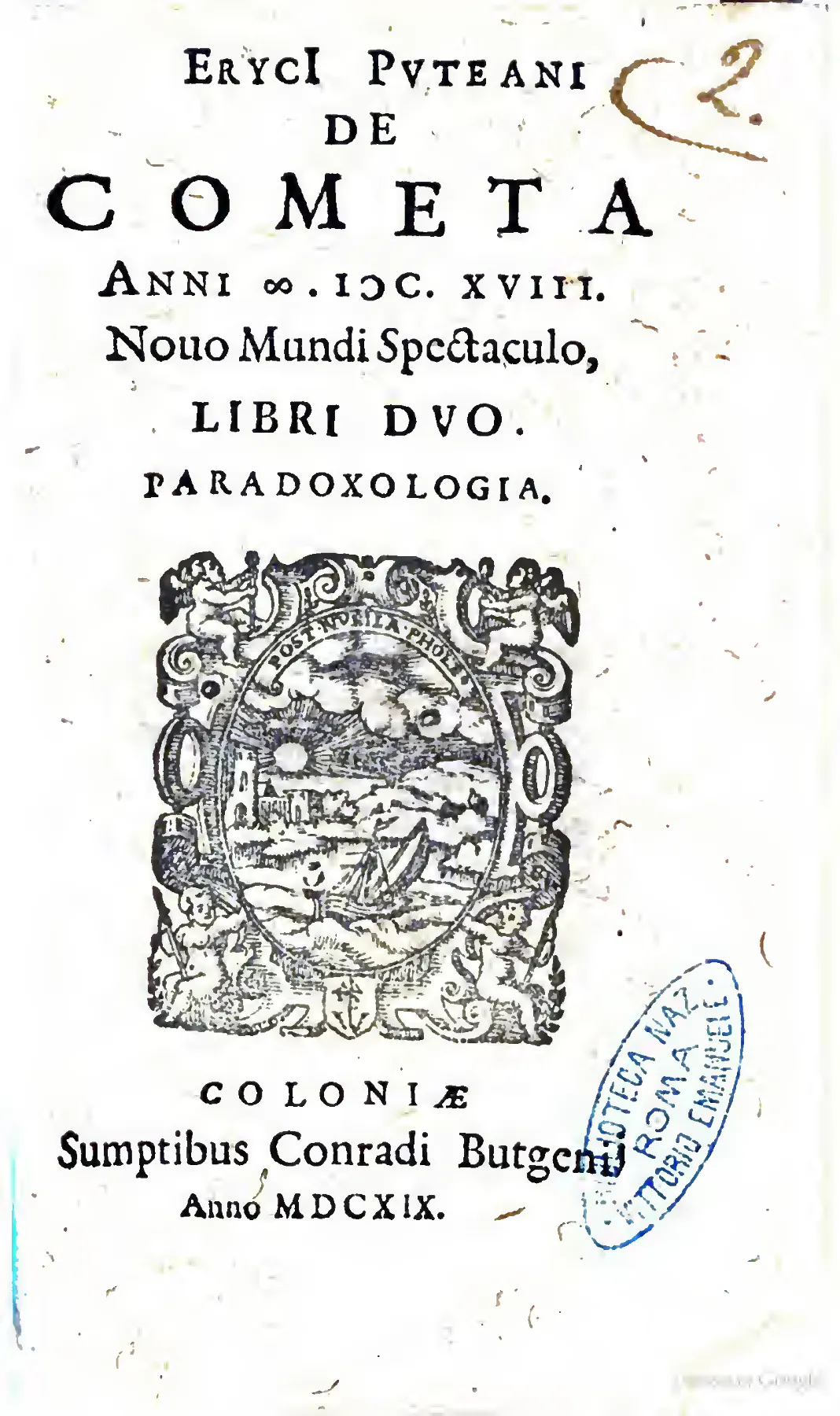
The Cologne title page stages the treatise's argument before the reader reaches the first proposition: "PARADOXOLOGIA" names a Ciceronian practice of arguing against received fear, while the Bütgen imprint fixes this as the 1619 issue central to the work's transmission. Its printer's device, carrying the motto "POST NVBILA PHOEBUS"—after clouds, the sun—turns the comet's interpretive problem into an emblem of illumination, anticipating Puteanus's refusal to treat the apparition as portentous fire rather than celestial light. Source ↗.
The intellectual problem the treatise confronts is stated with disarming economy: whether celestial novelty warrants human fear, and whether a comet is an object of terror or of reassurance. Puteanus answers by a single recurring move—inversion by argument, taking the common belief and reversing it through appeal to evidence and reason. What others named a conflagration he reframes as an innocuous light; what others named a portent he reframes as a star and a pledge of well-being. The root of the inversion is epistemic: fear, on this account, springs from ignorance, the comet being (in the treatise's own phrasing) more investigated than known. From that premise the work moves outward in widening arcs—first to a natural-philosophical claim that the comet is a celestial body rather than a terrestrial exhalation, its location argued from parallax and duration and its physics supported by the telescopic novelties of the preceding generation; then to a juridical polemic against the astrologers and diviners who read comets as omens of war, plague, and the death of kings; and finally to a moral relocation of the portentous, in which not stars but sins are declared the true prodigies, lodged in animo, non in caelo—in the soul, not in the sky.
The stakes of that argument, in 1618, were neither merely astronomical nor merely academic. The comet appeared in the same season as the Defenestration of Prague and the opening moves of the Bohemian revolt, and the claim that it portended war carried immediate confessional and dynastic weight. To dedicate a treatise denying the comet's ominous force to the Habsburg sovereigns of the Spanish Netherlands was to enter that contest, and Puteanus does so explicitly, observing that the Bohemian troubles had begun before the comet ever appeared and turning the observation into a polemic against providential readings of the event. At the same time the treatise sits astride the larger cosmological transition of its age, in which the Aristotelian doctrine of comets as sublunary exhalations was giving way, under the pressure of the parallax argument and telescopic discovery, to a supralunar and post-Tychonic arrangement of the heavens. Puteanus's affiliation with the Lipsian pedagogy of Louvain, his position within the Habsburg-Catholic court culture of the Spanish Netherlands, and his engagement with the new astronomy of Tycho Brahe and Galileo Galilei all converge on this single occasional work.
What a first-time reader will find most striking is the concreteness with which Puteanus presses the inversion. The comet is not merely reclassified but renamed—caeli civis, citizen of heaven, and Solis soboles, offspring of the Sun—and its new dignity is argued from the nova that shone in Cassiopeia in the previous century, from the comet of 1577, and from what the treatise calls the miracle of the glass: the phases of Venus and the newly observed companions of the planets, brought to the eyes where formerly only the mind's edge had reached. The polemic against diviners is cast in the language of the courtroom, the author declaring that he accuses the astrologers and augurs by name; and the whole edifice is capped by a carmen reciprocum, a reciprocal verse that reads the same forwards and backwards, in which the comet is at last dismissed with the line TV NON OCCIDIS, OCCIDIT COMETA—you do not set, the comet has set. Alongside these set-pieces run a warm commendation of the author's native Venlo on the Meuse and a candid notice of his own illness, so that the treatise carries its learning with a marked personal and patriotic coloring.
The throughline that binds these elements is a single semantic and moral operation carried through the work's conceptual vocabulary, its production in the confessional culture of Habsburg Louvain, and its internal architecture of paired paradoxes: the deliberate stripping of divinatory efficacy from the heavens and its transfer to the human will. The comet's reassignment from incendium to lumen, from prodigium to sidus and salutis pignus, is at once a claim in natural philosophy and a claim in moral theology, and it is offered to the Habsburg sovereigns as a felicitous presage rather than a threat. How securely each strand of the argument can be fixed against the surviving text—and how the traditionalist estimate of the work as rhetorical inflation is to be weighed against more recent readings of it as serious moral-political positioning—remains a question the historiography has not settled, and one that rewards a first encounter with the treatise itself.
Read the full text and English translation on Leo
This text was transcribed and translated as part of the ExLatinis project, an effort by Leo to make free English translations of every text published in Latin in early modern Europe (1450–1750) available online. The complete transcription and English translation of this work can be read free of charge:
→ Read the original Latin text and full English translation on Leo
You can save a copy of this document into your Leo account to run deep text searches, conduct further analysis, or cross-reference it with your own research.
English Title and Philological Framing of Puteanus's De Cometa anni 1618
Editorial English Title
On the Comet of the Year 1618, a New Spectacle of the World: Two Books of Paradox-Discourse [Editorial title supplied for the convenience of anglophone readers; no conventional English-language title is currently established in the historiography, since all modern treatments continue to cite the work under the Latin running title De cometa anni 1618. Novo mundi spectaculo, libri duo. Paradoxologia.]
Philological Framing: The Latin Idiom of the De Cometa anni 1618
Sidus, incendium, and prodigium: The Reframing of the Comet as lumen and salutis pignus
The work's most consequential philological intervention lies in its inversion of a triad inherited from the Aristotelian meteorologica — sidus (celestial body), incendium (fiery exhalation), and prodigium (portent or prodigy) — to recast the comet as lumen (light) and salutis pignus (pledge of well-being). In the Latin vocabulary of late sixteenth- and early seventeenth-century cosmology, sidus was a term of art that designated not any bright object in the sky but a member of the supralunar heavens: a star, planet, or other body belonging to the celestial, immutable, non-generative region above the moon. Incendium, by contrast, named the species of hot dry exhalation that Aristotelian natural philosophy assigned to the upper air and identified as the matter of comets, meteors, and the Milky Way — a phenomenon strictly sublunary and generable from terrestrial vapors. Prodigium, finally, was a term drawn not from natural philosophy but from Roman sacral and augural language: a prodigy was an event, including an unusual celestial appearance, that demanded interpretation by the augurs or haruspices and signified divine displeasure. By the time Puteanus wrote, the inherited Augustinian and Tridentine consensus had naturalized prodigium into the commonplace reading of comets as signs of divine wrath against human sin, especially in time of war, plague, or heresy.
Puteanus's text works within and against this inherited Latin idiom. The programmatic force of the reframing is stated by the author himself, who declares that for what others showed to be a conflagration he showed a light, and for what others a prodigy he showed a star and, as it were, a pledge of well-being, QVODENIM ALII INCENDIVM, EGO LVMEM; QVOD ALII PRODIGIVM, EGO SIDVS ESSE OSTENDI, ET SALVTIS VELVT PIGNVS. The lexical opposition of ignis and lumen is pressed elsewhere in equally terse form, the author preferring to call the object not fire but an innocuous light, Alij Ignem, ego innoxium malo Lumen appellare. Throughout the two books of the treatise, sidus is denied of the comet only provisionally — the author concedes the standard Aristotelian position that ordinary comets are sublunary exhalations, then withdraws the concession through the parallax argument, the telescopic observations of Galileo Galilei and the Medicea Sidera (the Jovian satellites first published at Florence in 1610), and the phases of Venus. The comet is then reassigned to the celestial sphere and termed caeli civis ("citizen of heaven") and Solis soboles ("offspring of the Sun"). The shift is not merely physical but moral: because the celestial region is held to be impassible and incapable of being the efficient cause of terrestrial events, prodigium is stripped of its astronomical efficacy. The comet is therefore reformulated not as an incendium but as a lumen, a piece of celestial radiance, and is cast as salutis pignus, a pledge or earnest of well-being — language drawn from Roman civil theology in which pignus denoted the hostage or token given to guarantee the good faith of a future compact. The reframing thus converts the comet from a prodigy (prodigium) into a sign of divine benignity (salutis pignus), on the model of the star of Bethlehem or of the prophetic visions in Deutero-Isaiah in which the rising light of righteousness is contrasted with the darkness of the nations. The semantic inversion is the rhetorical pivot of the entire treatise, and it is sustained by the typological reading of celestial bodies as created lights (luminaria) rather than as the matter of meteorological fire.
Paradoxologia: The Genre-Marker and Its Significance
The internal subtitle Paradoxologia — the term under which the work is catalogued in Bibliotheca Belgica (Roersch–Vanderhaeghen) and in modern secondary literature — names the work's generic identity and its inherited rhetorical-philosophical tradition. Paradoxologia denotes a rhetorical exercise of arguing against received opinion (vulgi opinio or opinio vulgata) by means of a numbered sequence of paradoxa or paradoxical theses, in the tradition of Cicero's Paradoxa Stoicorum. In the Lipsian classroom at the Collège des Trois Langues (the Collegium Trilingue of the University of Louvain), the form had been a staple of moral and intellectual training, and Puteanus had inherited the practice directly from his master Justus Lipsius (d. 1606). The genre is not merely decorative: it governs the work's polemical architecture. Each book of the De cometa contains nine numbered paradoxa, the ninth of Book II serving as the Conclusio or general conclusion; each paradoxum is argued in utramque partem by gathering evidence from biblical, patristic, classical, and contemporary astronomical sources before turning against the received opinion. The paradoxologia form is therefore, by its Latin name, a discourse of paradoxes (paradoxa + logos) in the Ciceronian sense: not a defence of paradox for its own sake but an exercise in reasoning against common opinion in order to recover an older or more adequate judgment. Puteanus's chosen form, marked explicitly in the subtitle, signals at once his affiliation with the Lipsian pedagogical tradition and his deliberate inversion of the conventional opinio communis about comets — the popular belief that comets portend evil. The epistemic ground of that inversion is disclosed early, where Puteanus locates the source of error in the limits of human knowledge, observing that to err is human, and that by this one sign chiefly we learn that the nature of most things is unknown, ERRERI humanum est: quo vno potissimum signo discimus, pleramque rerum naturam ignorari — a diagnosis that makes fear of the comet a symptom of ignorance rather than a response to the thing itself.
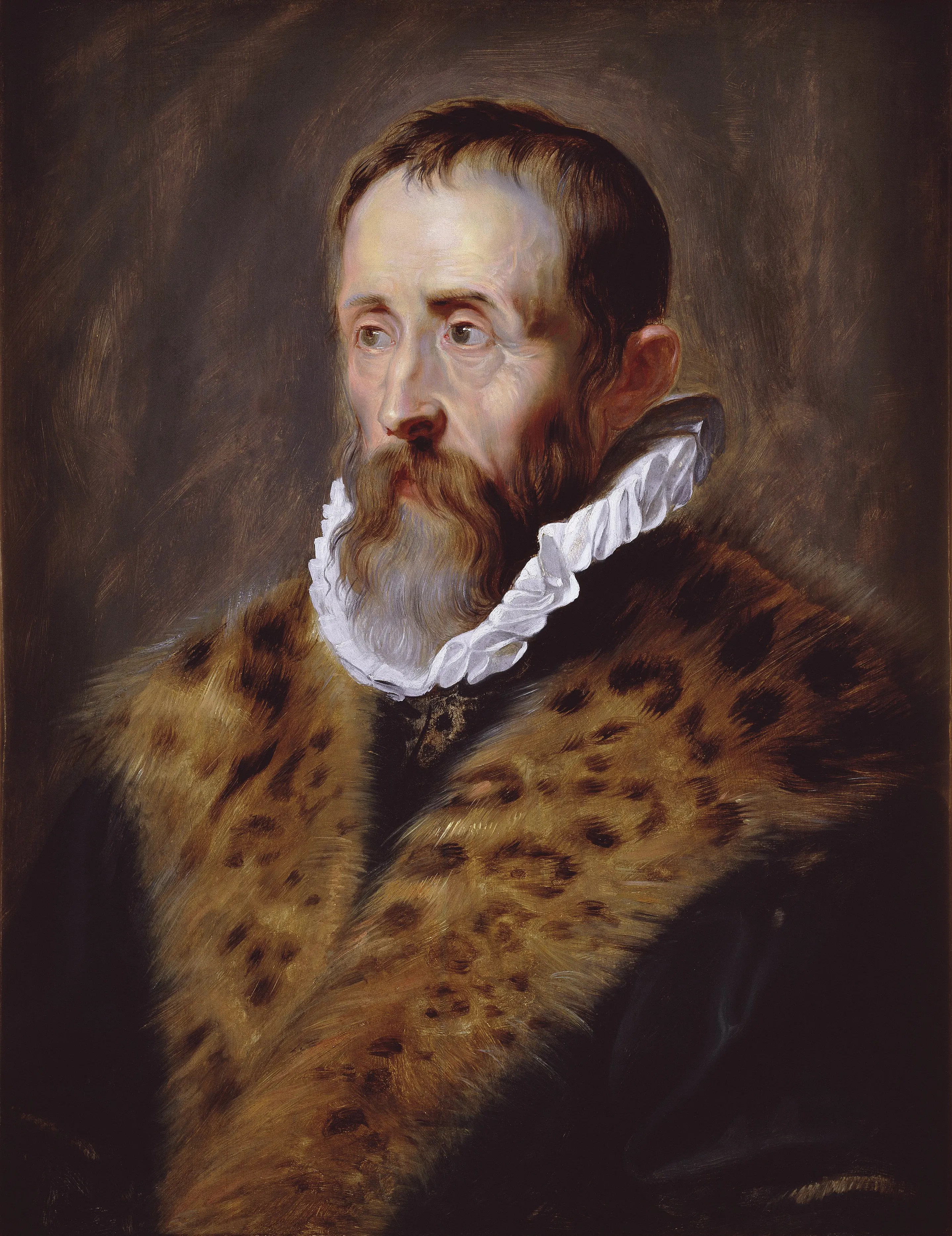
Rubens's portrait of Justus Lipsius presents the Louvain humanist whose classroom methods gave Puteanus both an institutional inheritance and a rhetorical discipline. Set beside the discussion of paradoxologia, the likeness frames De cometa anni 1618 as a work shaped by Lipsian training in arguing against vulgi opinio, rather than as an isolated response to the comet of 1618. Source ↗.

The Inversion of sidera against scelera: Non sidera, sed scelera prodigia
The moral-theological climax of the De cometa is the inversion articulated in the closing books, in which sidera (stars, celestial bodies, taken in this passage to denote all portentous heavenly phenomena) are opposed to scelera (crimes, sins, impieties, taken in its classical Roman sense of moral evil). The formula that not stars but sins are prodigies is stated in the treatise's own compressed diction, Non sidera, sed sceleraprodigia esse, and its correlate, that one should fear and dread not the prodigies of the world but those of greed, injustice, and impiety, prodigies in the mind and not in the sky, is spelled out at the close, non mundi, sed auaritiæ, iniustitiæ, impietatis portenta; in animo, non in cælo prodigia. Together these relocate the source of true prodigium from the heavens to the human animus. The formulation belongs to a long-standing Augustinian tradition, traceable through Bede and Isidore, that distinguishes between natural portents and moral portents: the former may be recorded but require no expiation, while the latter — injustice, greed, impiety — require repentance. Puteanus's text deploys this tradition polemically against the divinatory astrologi, haruspices, augures, and vates whom the work repeatedly identifies as the ideological and political antagonists of the treatise. The semantic shift is total: sidera are stripped of any divinatory efficacy by being relegated to created natural bodies in the celestial sphere, and scelera are elevated to be the true prodigia, the real portents that require moral response. The inversion is reinforced by the closing philological flourish, in which the comet is renamed in classical verse — TV NON OCCIDIS, OCCIDIT COMETA ("you do not set, the comet has set"), a carmen reciprocum or reciprocal verse in which the words read equally forwards and backwards. The moral inversion of sidera against scelera and the rhetorical closure of the carmen reciprocum together establish the work's distinctive philological signature: a learned Christian humanist restating the Augustinian doctrine of true portents, in Ciceronian paradox form, against the divinatory use of comets on the eve of the Thirty Years' War.
Executive Summary of the Paradoxologia and Its Central Claims
Erycii Puteani De cometa anni 1618. Novo mundi spectaculo, libri duo. Paradoxologia (1619) is a Neo-Latin cosmological-polemical treatise in the paradox tradition, composed by the Louvain humanist Erycius Puteanus (the Latin pen name of Hendrik van den Putte of Venlo, 1574–1646), who occupied the chair of Latin eloquence at the University of Louvain as the immediate successor to Justus Lipsius. The work was produced at Louvain in the Spanish Netherlands and printed in 1619 in two near-contemporary issues: a quarto of approximately 156 pages at Cologne (Coloniae), bearing the imprint Sumptibus Conradi Butgeni (i.e., at the expense of Conrad Bütgen), and a second issue of approximately 167, (9) pp. at Louvain (Lovanii), bearing the imprint of Bernardinus Masius; a third localization identifying the Masius issue as a Milan issue (apud Bernardinum Masium) has been registered in some secondary accounts and digital repositories. The text is dedicated jointly to Archduke Albert VII of Austria and the Infanta Isabella Clara Eugenia, sovereigns of the Spanish Netherlands and members of the Habsburg dynasty, to whom Puteanus was honorary counsellor from 1612.
The treatise's driving thesis is that the comet of November 1618 (commonly designated C/1618 W1 in modern astronomical catalogues) was not a sublunary exhalation but a supralunar celestial body — a positive claim Puteanus states as his own daring conviction, that he holds the comet to be a citizen of heaven, offspring of the Sun, part and progeny of the ether, in eam venire sententiam audeo, vt statuam, Cometam cæli ciuem esse, Solis sobolem, ætheris partem & partum; that fear of comets springs from ignorance, popular prejudice (vulgi opinio), and divinatory superstition rather than from the celestial phenomenon itself; and that the true prodigia lie not in the sky (non sidera, sed scelera prodigia; in animo, non in caelo) but in human greed, injustice, and impiety. The work is composed throughout in Latin, with a specialized verse corollary, the Carmen Reciprocum or reciprocal/palindromic verse, that closes the second book and constitutes an integrated paratextual cap. The internal apparatus recorded in surviving copies includes the title-page, the dedication, an elenchus (tabular summary) of the paradoxa, two books of nine paradoxa each, the Carmen Reciprocum, and a censura (critical approbation or judgment).
The treatise has not been translated, so far as the surviving historiography records, into any modern language. The 1909 monograph of Théophile Simar, the 2010 article of Demmy Verbeke, the 2026 archaeopoetic chapter of Clifford J. Cunningham, the 1998 monograph of Tabitta van Nouhuys, and the digital catalogues of the British Library, the BEIC (Biblioteca Europea di Informazione e Cultura, Milan), the Internet Archive, the Bayerische Staatsbibliothek (Munich Digitization Center), and the University of Illinois Urbana-Champaign Bassanio collection all consistently cite the work in its original Latin only.
Scholarly Significance and Historiography of Puteanus's Comet Treatise
The 1619 De cometa anni 1618 of Erycius Puteanus matters to modern academics because it sits at the conjunction of four distinct historiographical currents whose interaction can be reconstructed only through this single Louvain document: (i) the 1618–1619 European comet-literature wave, in which more than one hundred Latin and vernacular works were produced across Europe in response to the autumnal comets of 1618, including the celebrated Italian controversy among Galileo Galilei, Mario Guiducci, Orazio Grassi, and Johann Kepler; (ii) the contest between Aristotelian sublunary meteorology and post-Tychonic supralunar cosmology, in which the parallax argument of Tycho Brahe and the early telescopic discoveries of Galileo were brought into the orbit of a Latin humanist treatise; (iii) the reception of early telescopic observation, particularly the Medicea Sidera (the Jovian satellites announced at Florence in 1610), the phases of Venus, and the apparent companions of Saturn; and (iv) the humanist anti-astrological and anti-divinatory tradition descending from Augustine, Bede, Isidore, and Pico della Mirandola, and reactivated by Lipsius's circle at Louvain in the generation after Trent. Puteanus's engagement with the new astronomy is explicit and enthusiastic: he registers the epochal shift from inference to direct observation, marvelling that whither ingenuity alone and the mind's edge once went, the eyes now reach, Ecce quo ingenium tantummodo ibat, aciesque mentis, nunc oculis peruenitur, and he cites the Cassiopeian nova of the previous century as proof that a new star can shine in the heavens and that very many things stand otherwise than Aristotle handed down, at last explored by the senses, Sed quid? nouum in cælo fidus fulgere posse, superiori sæculo Cassiopea ostedit: imò verò pleraq[ue], aliter se habere, quam ab Aristotele prodita sunt, sensu tædem exploratum est. In the same paradox he goes so far as to entertain a Tychonic arrangement of the heavens, confessing that he now begins to believe that the Sun and Moon alone revolve about the earth while the remaining planets revolve about the Sun, credere iam incipio, Solos circa terram Solem Lunamque volui, circa Solem reliquos Planetas — a semi-heliocentric commitment that undergirds the reclassification of the comet as caeli civis. Puteanus's text is a particularly useful site of intersection because it deploys the Lipsian exercise of the paradoxologia against the divinatory consensus of the comet literature and gives institutional form — through its dedication to Archduke Albert VII and the Infanta Isabella Clara Eugenia — to the Habsburg dynastic-confessional panegyric on the eve of the Thirty Years' War, when the Defenestration of Prague (May 1618), the Bohemian revolt of Frederick V of the Palatinate, and the early Habsburg counter-offensive together created a political atmosphere in which any claim that the comet of 1618 portended war had immediate ideological implications. Puteanus's argument that the Bohemian revolt antedated the comet (Sileo Bohemicum, cœptum priusquam Cometes emersit) is therefore not merely a chronological observation but a polemical intervention against Protestant-Providentialist providential readings of the celestial event.
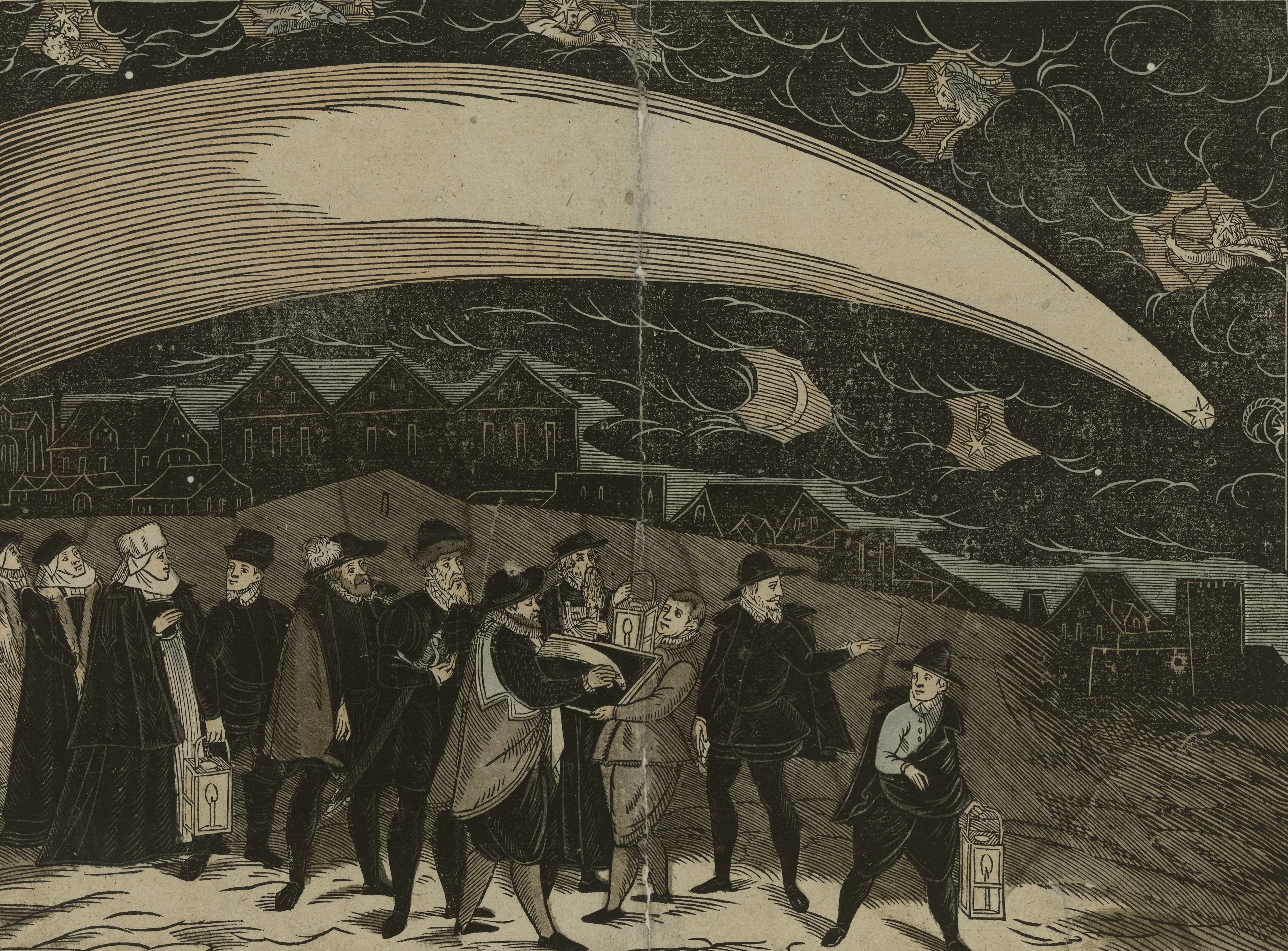
A period woodcut of the great comet of 1577 shows its blazing tail suspended above a Netherlandish town while onlookers below react with alarm—the very culture of prodigy and fear Puteanus set out to reframe. For his paradoxologia the comet's importance lay not in ominous interpretation but in its place among the sensory and observational evidence, alongside the Cassiopeian nova and telescopic discoveries, that made a supralunar ether-dweller thinkable against Aristotelian physics. Source ↗.

This anti-divinatory dimension is conducted in strikingly juridical terms, and it connects directly to the moral inversion that is the work's spine. Puteanus casts himself as prosecutor, declaring that he accuses the astrologers, soothsayers, augurs, and all the raving, who cloak opinion with the appearance of science, Astrologos, Hariolos, Augures, & furentes omnes accuso, qui, vt opinionem scientiâ velent. The charge is sharpened by a critique of the reasoning by which comets are made to portend war: everyone cries wars, dread wars, whenever a comet has shone, as though deriving a voice from heaven, Bella, horrida bella clamant omnes, si Cometes affulserit, vocem velut à cælo deriuantes, whereas the true order of events is the reverse, wars not following because comets shine but being assigned to comets because they follow, Non certe quia Cometæ fulgent, sequuntur bella, sed quia sequuntur bella, Comeris assignantur. Puteanus reinforces the point with the authority of Seneca, invoking the prophecy that the time will come when posterity will marvel that things so open were unknown to us, Veniet tempus, quo posteri nostri tam aperta nos nescisse mirentur, and the whole polemic drives toward the relocation of the portentous from sky to soul that Section 1 traces in its treatment of sidera against scelera.
The principal modern scholarship relevant to the work clusters in three bodies. First, on Puteanus himself and Louvain humanism after Lipsius, Théophile Simar's Étude sur Erycius Puteanus (1574–1646) considéré spécialement dans l'histoire de la philologie belge (Louvain, 1909) remains the standard biographical and bibliographical monograph and is supplemented by the entries of Alphonse Roersch and Ferdinand Vanderhaeghen in Bibliotheca Belgica (1904–5), nos. 166, 167, 168, and 171, which catalogue his principal works including the De cometa. The 2010 article of Demmy Verbeke ("'Condemned by some, read by all': the attempt to suppress the publications of the Louvain humanist Erycius Puteanus in 1608," Renaissance Studies 24, no. 3: 353–364) reorients the historiography by treating Puteanus's troubled institutional position — including the suppression of his De conviviorum luxu epistola by Habsburg-Spanish ecclesiastical authority at Louvain in 1608 — and by tracing the practical implications of his role as honorary counsellor to Archduke Albert VII. Verbeke's study should be read in conjunction with the supplementary Lipsius en Leuven (eds. Gilbert Tournoy, Jan Papy, and Jeanine De Landtsheer; Leuven University Press, 2001, Supplementa Humanistica Lovaniensia 13), which provides the broader Lipsian context in which Puteanus's succession (from 1607) was negotiated.
Second, on the 1618 comet literature and its cosmology, the foundational study is Tabitta van Nouhuys, The Age of Two-Faced Janus: The Comets of 1577 and 1618 and the Decline of the Aristotelian World View in the Netherlands (Brill, 1998, Brill's Studies in Intellectual History), which catalogues the Latin and vernacular tracts published in the Low Countries on the comets of 1577 and 1618 and explicitly identifies Libertus Fromondus, Thomas Fienus (Feyens), and Erycius Puteanus as the principal Louvain contributors to the 1618 wave. The cosmological transition from Aristotelian sublunary meteorology to Tychonic supralunar arrangement is treated in the classic monograph of C. Doris Hellman, The Comet of 1577: Its Place in the History of Astronomy (Columbia University Press, 1944). The most recent and most wide-ranging treatment is Clifford J. Cunningham, "The Great Comet of 1618: An Archaeopoetic Study," in Cosmic Events: The Three Comets of 1618, Historical & Cultural Astronomy (Springer, 2026), chap. 4, pp. 81–170, which situates Puteanus's Paradoxologia alongside the more than one hundred contemporary printed works on the comet and reads them as a unified archaeopoetic corpus.
Third, on the Italian Galilean controversy and its Louvain reception, Roger Ariew, "Fromondus versus Galileo on Comets," in History of Universities XXXIII/2 (Oxford University Press, 2020), treats the joint Louvain De Cometa Dissertationes of Thomas Fienus and Libertus Fromondus (Antwerp, 1619) as a Low Countries rejoinder to Galileo's Discorso delle Comete (1619), and Sara J. Schechner's compendium of comet studies (Harvard University, scholarly site) provides bibliographical orientation across the broader Anglophone historiography of comets from 1577 to 1618.
The historiography on the Paradoxologia itself is thin and divided. The traditionalist reading, deriving from Simar and inherited in Catholic and philological scholarship through the early twentieth century, judges the work as a piece of rhetorical inflation (satis supervacua) characteristic of Lipsian occasional writing; the revisionist reading, represented by Bracke (2020), by Borowski, and implicitly by Verbeke's 2010 article, treats it as evidence of a moral-theological positioning within Counter-Reformation Habsburg culture and of the strategic use of the paradoxologia form for theological and political purposes. The two readings have not been fully reconciled, and the work awaits a dedicated monographic treatment that would integrate the Lipsian pedagogical context, the Antwerp–Louvain printerly network, and the Habsburg court dedication into a single interpretive framework. No dedicated chapter on the Paradoxologia is known in the modern scholarly literature, and the historiography of the De cometa in Puteanus studies must be reconstructed chiefly through its citation in Simar (1909), in Bibliotheca Belgica, and in the secondary literature on the Low Countries comet tracts.
Textual History, Materiality, and Object Biography
Production and Transmission History
The De cometa anni 1618 survives in a single year of publication (1619) but in two near-contemporary quarto issues. The principal issue bears the imprint Coloniae, Sumptibus Conradi Butgeni (i.e., "at Cologne, at the expense of Conrad Bütgen"), dated 1619, and is recorded by Alphonse Roersch and Ferdinand Vanderhaeghen in Bibliotheca Belgica (1904–5) and survives in multiple research libraries. The second issue, recorded by the British Library, by WorldCat (OCLC and Open Library identifiers), and by the BEIC (Milan) digital repository, bears the imprint of Bernardinus Masius and is catalogued variously as published Lovanii (Louvain/Leuven) or as a Milan production; the Paradoxologia appears to have been issued from Louvain as a sumptibus imprint, and the Masius name is attested both as a Louvain printer in the early seventeenth century and (in some bibliographical traditions) as a Milanese house.
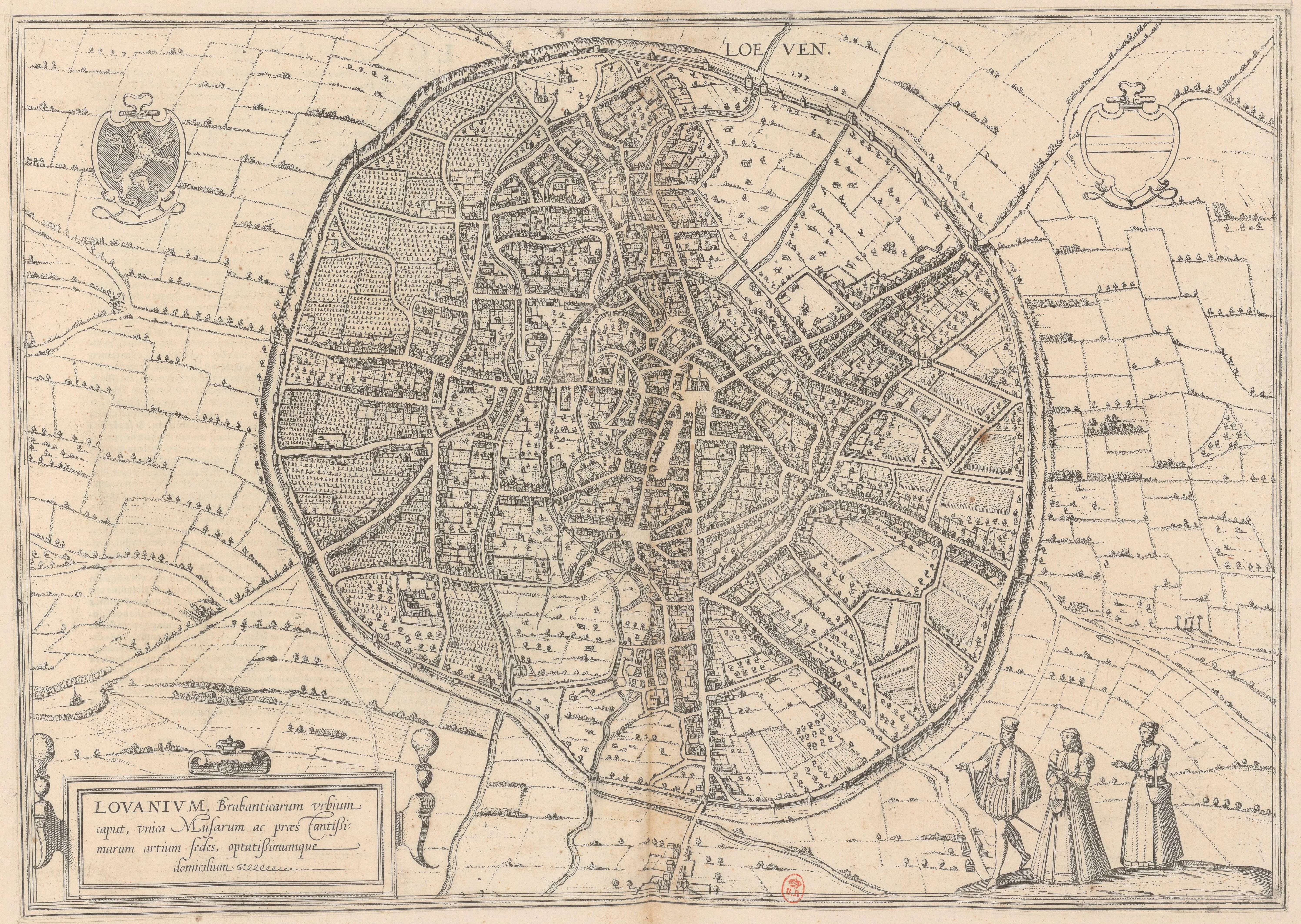
This Cologne-published engraved plan of Louvain/Leuven, framed by heraldic arms and ornamental cartouches, situates Puteanus's comet treatise in the university city whose printers and patrons complicate its 1619 bibliographical trail. Its printed Latin civic rhetoric, praising Louvain as a seat of the Muses and learned arts, evokes the Collège des Trois Langues milieu from which the Paradoxologia emerged. Source ↗.
.jpg)
The AbeBooks record ("Lovanii: Masius, 1619, Hardcover, 167, (9) pp.") in private hands at Moroccobound Fine Books (Lewis Center, Ohio) preserves a representative copy in early vellum; the Tryleo bibliographic reconstruction registers the Cologne Bütgen issue at c. 156 pages. The two issues share collation in quarto and present the same internal apparatus: title-page, dedication, elenchus (tabular summary), two books of nine paradoxa each, the closing Carmen Reciprocum (a reciprocal or palindromic verse corollary), and a censura (critical approbation or judgment). No printer's privilege notice or ecclesiastical approbatio is recorded on either issue. No English Short Title Catalogue (ESTC) or Universal Short Title Catalogue (USTC) record could be resolved at the catalogue-record-number level during research; the British Library catalogue number 44BL_MAIN/n6kovr/alma99216875368209251, the WorldCat entity E39PBJrChkC6bXhjm9FVryJxDq, and the Open Library identifier OL331592A provide the principal English-language catalogue anchors. The 1619 imprint date of the Bütgen issue has been corroborated by a 1620 Bütgen re-imprint listed at musicologie.org.
Material and Institutional Footprint
No privilege notice or ecclesiastical approbatio survives on either title-page; the censura apparatus of the treatise is accordingly an internal scholarly document rather than an external ecclesiastical approval. The book was not suppressed in its own right, but Puteanus had already in 1608 experienced an institutional suppression of his De conviviorum luxu epistola at Louvain at the instance of the Habsburg-Spanish ecclesiastical authorities (as documented by Verbeke 2010), and the absence of any privilege in 1619 may reflect the residual sensitivity of an author still in tension with the Habsburg-Spanish Censorship regime of the Spanish Netherlands. The book circulated in the Iberian and Low Countries through Louvain-centred humanist networks (the Collegium Trilingue, the Louvain theology faculty, and the Bibliothèque royale de Bruxelles / Koninklijke Bibliotheek van België), and in the German-speaking lands through Cologne as a press and as a market. No manuscript lineage survives for the paratext; the only known transmission is the printed quarto.
Institutional Holdings and Catalog Identifiers
Surviving copies are recorded in the BEIC (Milan), shelfmark BEIC 4660677; in the British Library (catalogue identifier 44BL_MAIN/n6kovr/alma99216875368209251, originally digitized as Google Books id hc9lAAAAcAAJ, December 2015); in the Internet Archive (bub_gb_DOGvehgu3UoC); in the University of Illinois Urbana-Champaign Bassanio collection (digital.library.illinois.edu/items/a4ca7e20-73cd-0134-1deb-0050569601ca-7); and through the Post-Reformation Digital Library (PRDL) of Calvin Theological Seminary (a_id=2790). The Bayerische Staatsbibliothek / Munich Digitization Center (MDZ) records Puteanus's works in its digitized holdings, and the work is catalogued in the OPAC of the Istituto Nazionale di Astrofisica (INAF, id 135016). The KU Leuven (Université catholique de Louvain) and Ghent University library catalogues register the work in their union catalogues. No USTC, VD17, or STCN catalogue-record-number could be resolved at the catalogue-record-number level during research; the existence of these records is attested in catalogue metadata but the full identifier could not be located.
Immediate Reception and Network
The dedicatees were Archduke Albert VII of Austria (the Habsburg sovereign of the Spanish Netherlands, d. 1621) and Isabella Clara Eugenia (Infanta of Spain, sovereign of the Spanish Netherlands in her own right, d. 1633), to whom the work is jointly inscribed in the Latin titulature Serenissimis Potentissimisque Principibus Alberto et Isabellae Clarae Eugeniae, Austriae, Burgundiae, Belgicae. Puteanus had been Albert's honorary counsellor since 1612, and the treatise belongs to the Lipsian-occasional corpus of panegyric and political counsel produced by the Louvain Collège des Trois Langues for the Habsburg court in the lead-up to the Thirty Years' War. This panegyric register surfaces directly in the treatise, where the comet is bound to a celebration of Habsburg dynastic felicity and the emperor is hailed as the Hercules of the world who presses the concord and felicity of empire with highest auspice, Mundi Hercules, quis nisi Cæsar Augustus AVSTRIACVS, Imperij concordiâ & felicitatem, summo auspicio vrgens?, so that the natural-philosophical reclassification of the comet as a felicitous presage is fused with the dynastic-confessional frame. Alongside this public register the treatise carries a patriotic and personal note, notably in the author's commendation of his native town on the Meuse as a place beautiful in situation, more beautiful in faith and constancy, yet not sufficiently adorned unless it also be safe, Opulchrum situ, pulchrius fide & constantia, oppidum! sed non satis ornatum nisi & tutum sit. The implied antagonists are divinatory astrologi, haruspices, augures, and vates of the early modern European Republic of Letters; no named opponent appears as a direct named antagonist within the treatise itself, and the historiography has not located a chain of contemporary named replies.
The principal Louvain parallel treatise is Thomas Fienus (Thomas Feyens, 1567–1631), De Cometa anni 1618 Dissertationes (Antwerp: apud Gulielmum à Tongris, sub signo Gryphi, 1619), published jointly with a response by Libertus Fromondus (Libert Froidmont, 1587–1653). The Fienus–Fromondus De Cometa Dissertationes is an octavo and was produced as a paired Louvain response to the Galileo–Grassi controversy of 1618–1619; Fienus used the parallax observations of Tycho Brahe and the telescopic observations of Galileo to argue against the Aristotelian theory of comets as burning terrestrial vapours and against the incorruptibility of the heavens, and Fromondus's companion dissertation openly defended the 1616 decree against Copernicanism (as documented in Roger Ariew, "Fromondus versus Galileo on Comets," History of Universities XXXIII/2, 2020). The work also exists in Latin in the Bamberger collection (Bayerische Staatsbibliothek; Google Books id 0K1RAAAAcAAJ). No chain of direct responses to Puteanus's Paradoxologia by Kepler, Grassi, or Iberian scholars is known in the historiography.
Relation to Puteanus's Other Works and to Lipsius
The De cometa anni 1618 belongs to the Lipsian-occasional corpus of Erycius Puteanus and is contemporary with his series of Lipsian commentaries, panegyrics, and pedagogical exercises. It is catalogued in Bibliotheca Belgica (Roersch–Vanderhaeghen) alongside his commentaries on Lipsius (notably the Lipsian Tacitus and Seneca), his De conviviorum luxu epistola (Louvain, 1608), his Thyrsi Philothesii (Louvain, 1609), and his more occasional Lipsian-Ovidean and epistolary works. The treatise is therefore best understood not in isolation but as a 1619 entry in a Lipsian pedagogy of the paradoxologia, undertaken from the Louvain Collège des Trois Langues, where Puteanus occupied the chair of Latin eloquence from 1607 to 1646. Within the Lipsian corpus, the De cometa also testifies to Puteanus's habit of bilingual Latin-Vernacular occasional writing (his Comus siue Phagesiposia Cimmeria. Somnium is the subject of W. Nijs, "The Use and Misuse of an Epicurean Dictum in Erycius Puteanus' Somnium," KU Leuven / Lirias, 2022), and of his lifelong attention to the philosophical authority of Seneca, an authority on which the De cometa also draws for its parallax and meteorology. The volume dedicated jointly to Archduke Albert VII and Isabella Clara Eugenia places Puteanus in the immediate sphere of Habsburg court counsel and identifies the De cometa as a learned panegyric addressed to the sovereigns of the Spanish Netherlands.
Structural Outline, Argument Progression, and Textual Evidence
The Programmatic Antithesis of the Dedication
The treatise announces its whole intellectual program in a single antithesis lodged in the dedicatory epistle to the Archdukes. There Puteanus rehearses the move already noted at the head of the philological framing — that for what others showed a conflagration he showed a light, and for what others a prodigy a star and, as it were, a pledge of safety — but the analytical weight of the passage lies in its construction rather than its content. The compression is deliberate: the entire two-book architecture is folded into a pair of balanced clauses, each turning on a verb of demonstration (ostendi) that stakes the author's authority not on assertion but on proof. The lexical pairs — incendium against lumen, prodigium against sidus — are not casual synonyms but terms of art drawn from opposed regions of natural philosophy: the one belongs to sublunary combustion and to the augural language of portent, the other to celestial radiance and to the stable bodies of the ether. That the inversion is offered first in the dedicatory register, addressed to sovereigns styled ALBERTO ET ISABELLAE CLARÆ EVGENIAE, AVSTRIACIS, BURGVNDICIS, BELGICIS, establishes at the outset that the reclassification of the comet carries a political charge alongside its physical claim; the pledge of safety is proffered to the very rulers whose dominions the divinatory literature was declaring imperilled.
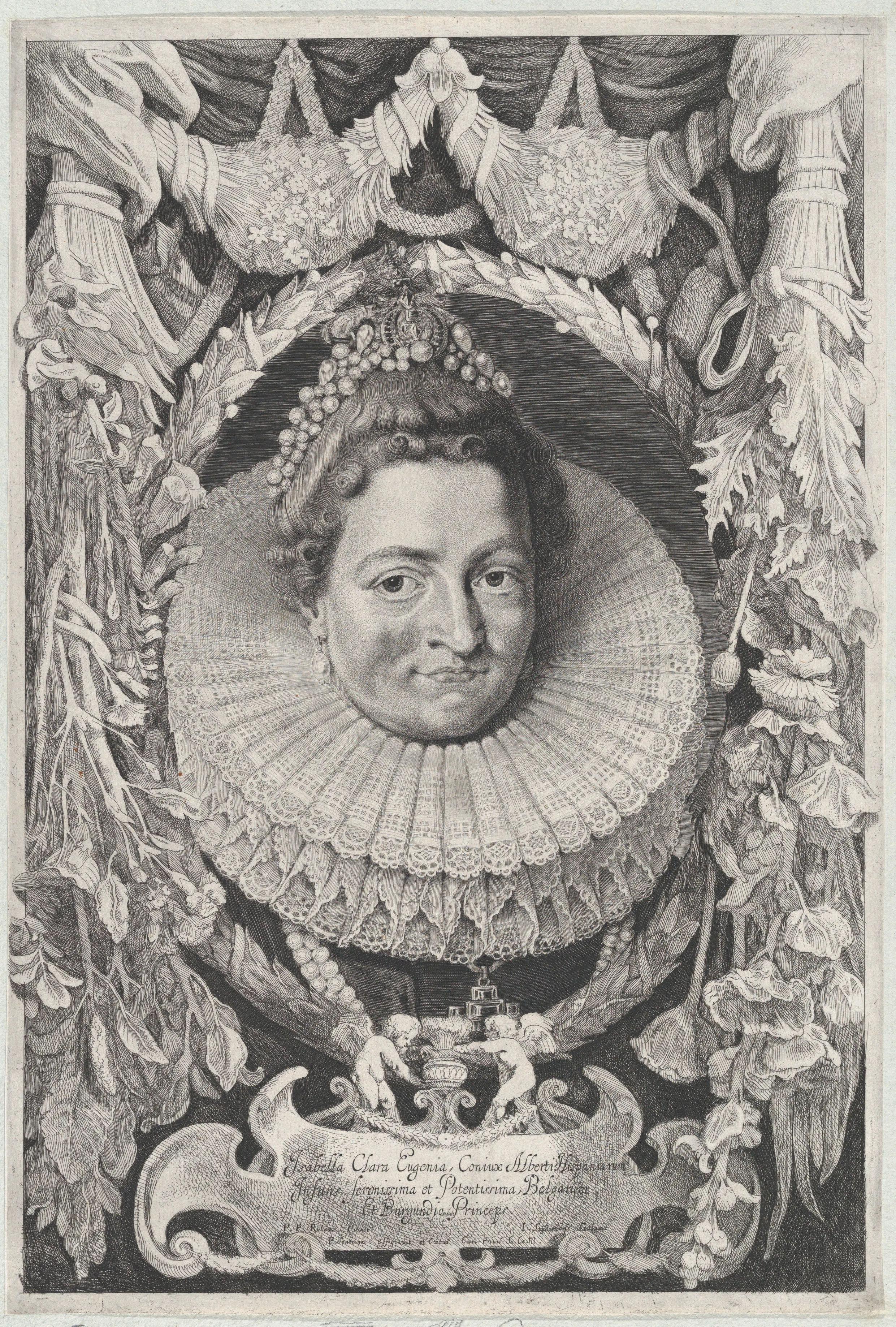
This engraved portrait of Archduke Albert VII evokes the sovereign audience named with Isabella Clara Eugenia in Puteanus's dedication, where the comet's meaning is recast from ominous prodigy into a pledge of Habsburg security. The formal dynastic image underscores how a natural-philosophical argument could also serve as political reassurance, addressed to rulers whose territories were imagined to be under celestial threat. Source ↗.

The Epistemic Foundation: Fear as Ignorance
The epistemic foundation on which this inversion rests is laid in the first paradox of Book I, whose opening axiom converts fear into a diagnosis of ignorance. To err is human, Puteanus writes, and by this one sign chiefly we learn that the nature of most things is unknown, a diagnosis already flagged in the philological framing as the treatise's premise that fear of the comet is a symptom of not-knowing rather than a response to the thing itself. The move is subtle and consequential: rather than dispute any particular prognostication on its own terms, the treatise relocates the source of cometary terror to a defect in the observer. Fear is not a response proportioned to the thing but a symptom of not-knowing, so that the remedy is not consolation but instruction. This premise licenses the whole subsequent procedure, in which each successive paradox supplies a portion of the knowledge whose absence generated the dread. The generic self-description follows from the same logic: the author defends his chosen form on the ground that theses argued against common opinion will thereby come nearest to the truth, ita veritati maxime accedent, and later, in the address to the reader, justifies the very name of the work, explaining that with this confidence he claimed the title of paradoxes, Hac fiduciâ Paradoxorum titulum vsurpaui. The paradox is thus not a rhetorical ornament but the instrument fitted to an epistemology in which received opinion is presumptively the residue of ignorance.
The Forensic Indictment of the Diviners
From this diagnostic premise the treatise names its antagonists and casts the naming in the language of the courtroom. Puteanus accuses the astrologers, soothsayers, augurs, and all the raving who, in order to cloak opinion with the appearance of science, burden their dogmas with fatal threats — the same forensic indictment discussed in the historiography of the work's anti-divinatory dimension. The verb accuso is precise and forensic, converting a natural-philosophical disagreement into an indictment; the charge is not that the diviners are mistaken about a detail but that they commit a species of fraud, dressing opinio in the borrowed garments of scientia. The distinction between opinion and knowledge is exactly the distinction the first paradox had drawn, so the juridical framing is continuous with the epistemology rather than a separate polemical flourish. The same paradox records the reflex it means to dismantle: the vulgar cry every unexplained appearance a portent and a sign of celestial wrath, portentum clamar, & celestis iræ signum, so that the accusation against the learned diviners and the diagnosis of popular terror converge on a single object — the reading of the sky as a register of divine displeasure.
The Positive Cosmological Thesis: The Comet as caeli civis
Having cleared the ground, the treatise advances its positive cosmological thesis with a marked gesture of intellectual daring. In the fifth paradox of Book I Puteanus states that he dares to come to the opinion that he holds the comet to be a citizen of heaven, offspring of the Sun, part and progeny of the ether, a formulation already cited as the executive statement of his conviction. The metaphor of cosmic citizenship (caeli civis) is doing considerable work: to enroll the comet as a citizen of the heavens is to grant it membership in the impassible supralunar region and thereby to strip it of the transience and corruptibility that made it, in the Aristotelian scheme, a fit vehicle of terrestrial omen. The paired alliterative nouns partem & partum — part and progeny — insist that the comet is not an intruder upon the ether but its own generation, native to the region rather than exhaled into it from below. The claim is grounded in the authority of the ancients turned against Aristotle, for the same paradox summons Seneca's famous prophecy that the time will come when our descendants will marvel that we did not know things so open — the prophecy invoked in the historiographical section — a text deployed to frame the demonstration of Tycho Brahe, hailed as the very eye of astronomy, as the prophecy's fulfilment.
The Evidence of the New Astronomy
The evidentiary support for celestiality is drawn explicitly from the new astronomy, and the treatise registers the epochal shift from inference to sight in a single arresting exclamation, that whither ingenuity alone once went, and the mind's edge, now the eyes reach — the passage already treated in the account of Puteanus's engagement with telescopic observation. The contrast of acies mentis, the mind's cutting edge, with oculis, the bodily eyes, marks the passage from speculative reasoning to instrumental observation as a transfer of the same faculty of sharpness from intellect to sense. That transfer is what warrants the overturning of the received authority, for Puteanus argues that a new star could shine in the sky, as Cassiopeia showed in the previous century, and that very many things stand otherwise than they were handed down by Aristotle, at last explored by sense — the twin appeal to the Cassiopeian nova and to the tribunal of the senses noted earlier. The nova of the preceding age and the telescopic revelations are made to work in concert: sense is the tribunal before which the Peripatetic tradition is now arraigned, just as the diviners were arraigned before the tribunal of the distinction between knowledge and opinion. In the same paradox Puteanus goes further than mere refutation, confessing that he now begins to believe that the Sun and Moon alone revolve about the earth while the remaining planets revolve about the Sun — the semi-heliocentric, Tychonic commitment discussed in the historiographical treatment of the work. The tentative verb incipio is characteristic of the treatise's method — the cosmological commitment is offered as a growing conviction rather than a settled dogma — but the arrangement it describes furnishes exactly the physical framework in which a comet can be a genuine ether-dweller rather than a burning vapour.
The Refutation of War-Prognostication
The second book turns from the comet's nature to its signification, and here the polemic against war-prognostication receives its sharpest logical form. Puteanus first stages the reflex he means to break, the outcry of wars, dread wars whenever a comet has shone, as though a voice were derived from heaven — the Virgilian clamour already quoted in the historiographical section. The borrowed grandeur of the echo is immediately deflated, for the treatise exposes the reasoning as a confusion of sequence with cause: not because comets shine do wars follow, but because wars follow, they are assigned to comets, the chiastic reversal likewise cited earlier. The structure of the sentence enacts the reversal it argues, turning the prognosticators' inference inside out so that the appearance of predictive power is shown to be an artifact of retrospective attribution — wars are always to be found somewhere, and the comet is credited after the fact. The refutation is not confined to abstraction; it is anchored in contemporary conflict, and the treatise's most pointed intervention concerns the war whose confessional stakes were most acute, the Bohemian revolt, which is noted as having begun before the comet appeared, so that the chronology itself defeats the providential reading.
This deflation of celestial threat to rulers is carried by a well-chosen classical anecdote. Against the notion that the hairy star menaces kings, Puteanus recalls Vespasian's jest that the King of the Parthians should fear the hairy star, since he is the one who is hairy, Crinitam, inquit, Rex Parthorum timeat, qui crivitus est. The play on crinita (the hairy comet) and crinitus (the hairy king) reduces the whole apparatus of royal prognostication to a pun, and the emperor's self-possessed levity models the very freedom from cometary fear the treatise means to instil.
The Personal and Dynastic Turn
Two passages disclose how the impersonal argument opens onto the personal and the dynastic. In the second paradox of Book II Puteanus interrupts the disputation to commend his native town, addressing it as a place beautiful in situation, more beautiful in faith and constancy, yet not sufficiently adorned unless it also be safe, the apostrophe to Venlo already quoted in the account of the treatise's personal and patriotic register. The exclamatory apostrophe folds a plea for the fortification of Venlo into the refutation of war-portents, so that the argument against fearing the sky becomes an occasion to direct attention to the real, human means of security; the sequence quietly proposes that safety is a matter of walls and constancy rather than of averted omens. The dynastic counterpart appears in the eighth paradox, where the astronomical refutation is at last converted into panegyric and the comet is bound to Habsburg felicity, the author asking who but the Hercules of the world, Caesar Augustus of Austria, presses the concord and felicity of empire with highest auspice — the panegyric hail to the sovereigns treated in the account of the dedication. The word auspicio is pointedly recuperated: the language of augury, everywhere else in the treatise the target of the accusation, is here redeployed as a figure of dynastic good fortune, so that the comet, denied all ominous force, is nonetheless permitted to shine as a felicitous presage for the Catholic sovereigns.
The Moral Relocation of the Portentous
The whole edifice is capped by the moral relocation of the portentous that gives the treatise its ultimate purpose. In the concluding ninth paradox Puteanus exhorts the reader to fear and dread not the prodigies of the world but those of greed, injustice, and impiety, prodigies in the mind and not in the sky — the inversion of sidera against scelera whose Latin is set out in the philological framing. The transfer completes the movement begun in the dedicatory antithesis: having stripped the heavens of divinatory efficacy through natural philosophy and forensic accusation, the treatise reassigns the category of prodigium to the human animus, where the true portents — the moral evils enumerated in a rising tricolon — demand not interpretation by augurs but repentance. The antithesis in animo, non in cælo is the precise inversion of the popular reflex recorded at the outset, the cry of portentum at every celestial novelty, and it discloses that the entire natural-philosophical apparatus has served a moral end: to redirect the fear misplaced upon the sky toward the sins genuinely worthy of dread.
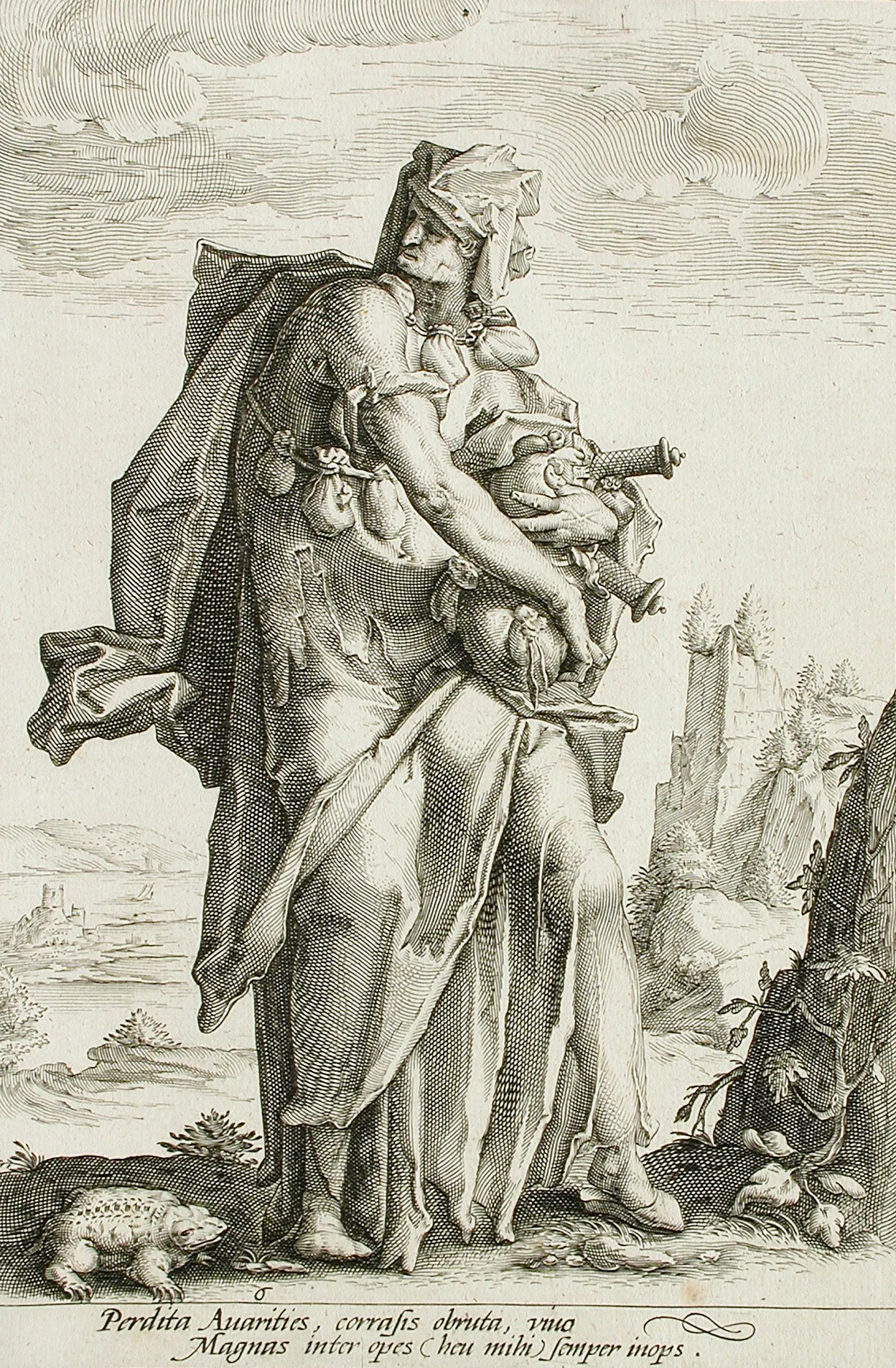
In this late-sixteenth-century engraving from a series on the Vices, Avarice is made visible as an allegorical figure rather than a celestial sign—the moral category Puteanus treats as a truer portent than any comet. Its emblematic staging and printed Latin frame belong to the same moralizing culture in which fear could be redirected from the heavens to the vices lodged in the human animus. Source ↗.

Frequently Asked Questions
What is Erycius Puteanus's De cometa anni 1618?
It is a two-book Neo-Latin treatise, printed in 1619 and running under the title De cometa anni 1618. Novo mundi spectaculo, libri duo. Paradoxologia, that argues against the widespread fear of the bright comet seen across Europe in November 1618. Rather than reading the apparition as a warning of war, plague, or the death of kings, it reclassifies the comet as a celestial body—a "citizen of heaven"—and relocates the only true portents to human sins. It is dedicated jointly to Archduke Albert VII of Austria and the Infanta Isabella Clara Eugenia, sovereigns of the Spanish Netherlands.
Who was Erycius Puteanus?
Erycius Puteanus was the Latin name adopted by Hendrik van den Putte of Venlo (1574–1646), a humanist who held the chair of Latin eloquence at the University of Louvain as the immediate successor to Justus Lipsius, from 1607. He had been honorary counsellor to Archduke Albert VII since 1612. His career carried friction: in 1608 his De conviviorum luxu epistola was suppressed at Louvain by Habsburg-Spanish ecclesiastical authorities. His comet treatise belongs to a wider Lipsian occasional corpus of commentaries, panegyrics, and pedagogical exercises produced from the Collège des Trois Langues.
Why did it matter that a comet was said to foretell war in 1618?
The comet appeared in the same season as the Defenestration of Prague and the opening of the Bohemian revolt, so the claim that it portended war carried immediate confessional and dynastic weight on the eve of the Thirty Years' War. Dedicating a treatise denying the comet's ominous force to the Habsburg sovereigns entered that contest directly. Puteanus turned chronology into polemic, observing that the Bohemian troubles had begun before the comet ever appeared—wars, he argued, do not follow because comets shine, but are assigned to comets because they follow.
What did Puteanus mean by calling the comet a "citizen of heaven"?
He renamed the comet caeli civis, citizen of heaven, and Solis soboles, offspring of the Sun, to argue it was a supralunar celestial body rather than a burning terrestrial exhalation. This enrolled it in the impassible region above the moon, stripping it of the corruptibility that made it, in the Aristotelian scheme, a fit vehicle of omen. He grounded the claim in the parallax argument, the Cassiopeian nova of the previous century, the comet of 1577, and telescopic novelties—the phases of Venus and the newly observed planetary companions—even entertaining a Tychonic arrangement in which the planets circle the Sun.
Is there an English translation of De cometa anni 1618?
No modern translation into any language has been identified; the surviving scholarship—including Simar (1909), Verbeke (2010), van Nouhuys (1998), Cunningham (2026), and the major digital catalogues—consistently cites the work in its original Latin only. Separately, the Leo edition presents the full transcription together with a complete English translation for the first time. That translation is generated by AI. Leo is an effort to make freely available online, at no cost, English translations of every text printed in Latin in early modern Europe between 1450 and 1750.
This report was generated by an advanced AI assistant that conducted deep research alongside an extensive interpretation of the transcribed original text. Every effort has been made to preserve fidelity to the source and to guard against inaccuracy, but corruption in the text recognition process and model hallucination may nonetheless have entered the text. Treat every claim, quotation, translation, and citation as provisional, and verify each against the original source before relying on or citing it.
Bibliography
- Roger Ariew, "Fromondus versus Galileo on Comets," History of Universities XXXIII/2: The one indispensable study for placing Puteanus alongside his Louvain colleagues, treating the Fienus–Fromondus De Cometa Dissertationes as the Low Countries' more cautious answer to Galileo. Read it to see how differently two Louvain camps handled the same telescopic evidence — and how Fromondus's defence of the 1616 decree throws Puteanus's semi-Tychonic daring into relief.
- Catholic Encyclopedia, Erycius Puteanus: A compact, older biographical entry giving the bare vital data — born at Venlo on 4 November 1574, died at Louvain on 17 September 1646, a Belgian humanist and philologist. Useful only as a first orientation, and to be corrected against Verbeke and Simar wherever it flattens the frictions of Puteanus's career.
- Clifford J. Cunningham, "The Great Comet of 1618: An Archaeopoetic Study," Cosmic Events: The Three Comets of 1618: The most recent and most panoramic survey of the print storm the 1618 comets provoked, setting the Paradoxologia among more than a hundred contemporary works. Consult it to size Puteanus's contribution against the whole European field rather than mistaking it for a solitary performance.
- C. Doris Hellman, The Comet of 1577: Its Place in the History of Astronomy: The classic account of how the parallax argument dislodged comets from the sublunary sphere, tracing Tycho Brahe's reasoning and its afterlife. It supplies the exact cosmological genealogy Puteanus borrows when he enrolls the comet as a citizen of heaven.
- Tabitta van Nouhuys, The Age of Two-Faced Janus: The Comets of 1577 and 1618 and the Decline of the Aristotelian World View in the Netherlands: The foundational catalogue of the Low Countries comet literature, which names Fromondus, Fienus, and Puteanus as the principal 1618 writers and charts the slow retreat of Aristotelian meteorology. Begin here to understand why Puteanus's reclassification of the comet was a regional as well as a personal argument.
- Théophile Simar, Étude sur Erycius Puteanus (1574–1646) considéré spécialement dans l'histoire de la philologie belge: The standard century-old biography that catalogues the De cometa within Puteanus's Lipsian occasional output and supplies the dismissive "rhetorical inflation" verdict later scholars push against. Dated in judgment but still the fullest single account of the man, and the baseline the revisionists are answering.
- Demmy Verbeke, "'Condemned by some, read by all': the attempt to suppress the publications of the Louvain humanist Erycius Puteanus in 1608," Renaissance Studies: The essential study of Puteanus's collisions with Habsburg-Spanish ecclesiastical authority, recording that even admirers of Lipsius thought him too young and unworthy to inherit the chair. It furnishes the institutional context that explains both the 1619 dedication to the Archdukes and the conspicuous absence of any privilege on the title-page.