The Tiny Commonwealth of the Roman Household: Lorenzo Pignoria's Commentary on Slaves and Their Offices among the Ancients
A Paduan antiquarian and a Frisian jurist, bound between the same covers by an Amsterdam reprinter in 1672, set out to reconstruct the entire servile labor force of the ancient Roman household office by office and rank by rank. Lorenzo Pignoria's De servis, et eorum apud veteres ministeriis, commentarius, paired with Titus Popma's treatise on the labors slaves owed, treats the domus as a pusilla respublica — a miniature commonwealth whose every function could be defined by law and documented from inscriptions, coins, poems, and the Church Fathers. For anyone curious about how slaves actually lived, worked, and were classified in Rome, this is one of the foundational catalogues on which modern scholarship still rests.
ExLatinis
27 July 2026

Contents
A Paduan antiquarian and a Frisian jurist, bound between the same covers by an Amsterdam reprinter in 1672, set out to reconstruct the entire servile labor force of the ancient Roman household office by office and rank by rank. Lorenzo Pignoria's De servis, et eorum apud veteres ministeriis, commentarius, paired with Titus Popma's treatise on the labors slaves owed, treats the domus as a pusilla respublica — a miniature commonwealth whose every function could be defined by law and documented from inscriptions, coins, poems, and the Church Fathers. For anyone curious about how slaves actually lived, worked, and were classified in Rome, this is one of the foundational catalogues on which modern scholarship still rests.
To open a duodecimo volume bearing on its half-title the words De servis, et eorum apud veteres ministeriis, commentarius is to enter one of the more methodical experiments of late-humanist erudition: an attempt to reconstruct, function by function and rank by rank, the servile labor force of the ancient Roman household. Its principal author, Lorenzo Pignoria (Padua, 1571–1631), belonged to the antiquarian circles of the Veneto and Rome — the world of Cassiano dal Pozzo, Nicolas-Claude Fabri de Peiresc, and the Barberini — and he brought to the subject the combinatorial method for which that milieu is known: philological recovery of vocabulary set beside legal, epigraphic, numismatic, and pictorial testimony. First printed at Augsburg in 1613, the commentary was later bound together with a second treatise, the De operis servorum liber of the Frisian jurist Titus Popma, and issued at Amsterdam in 1672 under the imprint of Andreas Frisius. It is this composite — a Paduan antiquarian commentary yoked to a Dutch legal-humanist systematization — that constitutes the object under examination.
The intellectual problem the work confronts is one of recovery from disorder. The offices, ranks, and daily labors of Roman slaves survive only in a scattered and heterogeneous record — a lexicographer's gloss here, a jurist's ruling there, an inscription, a line of poetry, a patristic aside. To make this legible as a system, the author proceeds headword by headword, and the recurring move is at once definitional and evidentiary: each servile office or status is defined, frequently by etymology, then grounded in Roman legal citation — the Digest, the Codex, the jurists Ulpian, Pomponius, and Caelius — and corroborated from literary, patristic, and epigraphic sources. From the foundational concept of operae, labor conceived as a service existing only on the day it is owed, the account builds outward through nested distinctions: public slaves against private, urban households against rustic (distinguished, in Pomponius's phrase, not by location but by kind), and a graded internal hierarchy of ordinarii, vicarii, mediastini, and the lowest quales quales. The distinctions extend to the recursive peculium of the slave who is himself owned by a slave, and to the special penal and civil statuses — the servus poenae reckoned as one of the dead in law, the fugitivus defined by the intention to flee, the branded literatus, the late-Roman adscripticius.
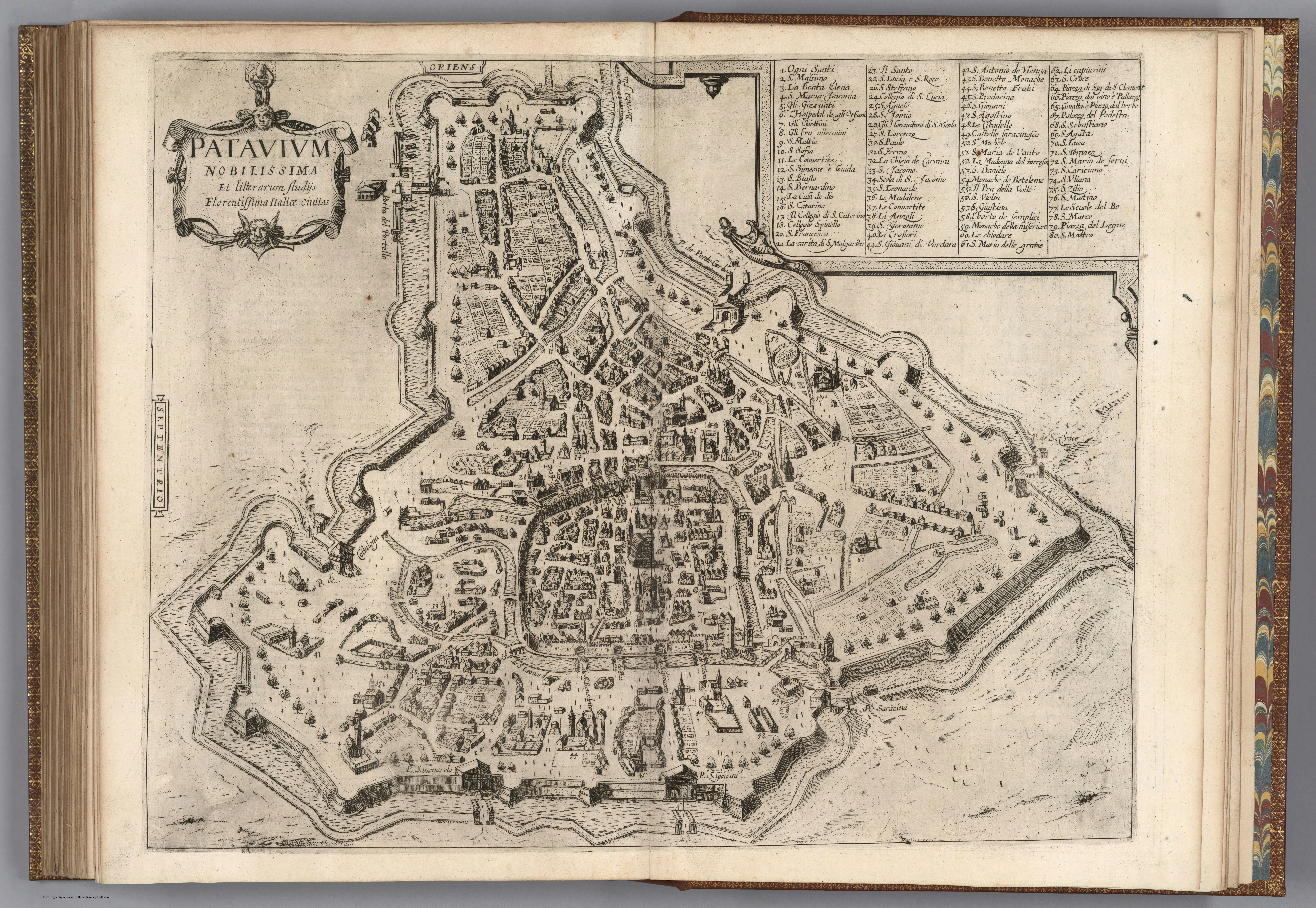
This engraved view of Patavium (Padua), in the Braun and Hogenberg tradition, places Pignoria's antiquarian labor within the civic world that formed him — the Veneto scholarly milieu in which scattered legal, literary, and epigraphic traces could be reorganized into learned systems. It offers no evidence for Roman slave offices, but visualizes the Paduan environment behind his method of recovery from disorder. Source ↗.
_Patavium_(Padua)._(IA_dr_vol-vi-55-patavium-padua-12126745).jpg)
Binding these enumerations together is a single governing image: the Roman household as a pusilla respublica, a tiny commonwealth, whose every rank can be juristically defined and philologically documented. Borrowed from Seneca's fourteenth letter to Lucilius and transmitted through the late Stoic revival associated with Justus Lipsius, the figure licenses the whole enterprise, authorizing the treatment of the domestic slave personnel as an analyzable polity rather than an undifferentiated mass. The stakes of the exercise are considerable. The reconstruction of the daily economy of Roman private life from the surviving vocabulary of service is a project that modern scholarship on Roman slavery — from M. I. Finley through K. R. Bradley and W. V. Harris — continues to build upon, and the composite's catalogue of ministeria remains a foundational prosopographic and functional source for that research.
What a first-time reader will find most striking is the sheer granularity of the catalogue and the confidence with which it is assembled. Whole classes of servile life are named and pinned to evidence: the actores to whom the sum of household affairs was entrusted; the dispensator associated with the weighing out of money; the food-taster or praegustator set before the emperor's table; the measured grain-ration, the demensum, of four modii a month; the abject mediastini of the baths, placed neither among the ordinarii nor among the vicarii; the branding of foreheads with a hot iron as a penalty. The method is visibly collaborative across the two treatises — Pignoria anatomizing the slave as functionary within the household, Popma systematizing the labor legally owed — and it draws on a shared canon of sixteenth-century legal humanism, from Jacques Cujas and Guillaume Budé to Adrien Turnèbe, Marc-Antoine Muret, Barnabé Brisson, and Andrea Alciato.
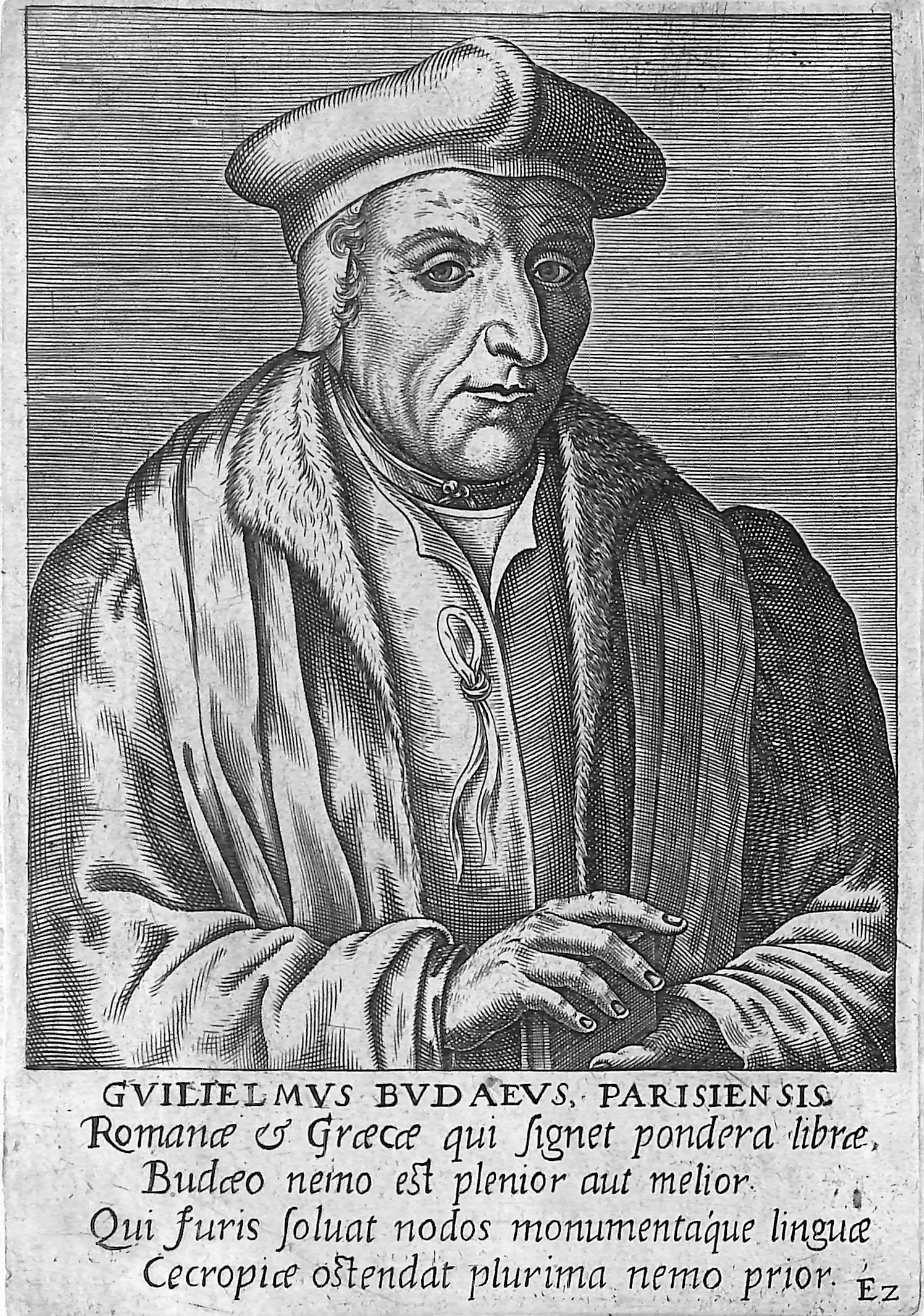
Guillaume Budé, in an engraved portrait, was a forebear of the mos gallicus — the legal-humanist tradition that treated Roman law as a problem of language, antiquarian evidence, and historical context. His place in the same canon as Cujas, Turnèbe, Muret, Brisson, and Alciato frames Pignoria's and Popma's studies of slavery as products of a philological-juridical method, not antiquarian curiosity alone. Source ↗.

The composite rewards attention precisely where its three registers meet. Its Latin is at once juridical, antiquarian, and rhetorical; its production history carries Italian antiquarianism into the Northern learned market through the Amsterdam reprint trade; and its internal argument moves from a single foundational definition of labor outward to an entire graded society of service. That the volume has never been translated in full into any modern language, and that the editorial decisions behind the 1672 pairing remain undocumented, means much about it still awaits confirmation against the surviving text and the fragmentary record of its making. What follows takes the measure of the work along each of these registers in turn.
Read the full text and English translation on Leo
This text was transcribed and translated as part of the ExLatinis project, an effort by Leo to make free English translations of every text published in Latin in early modern Europe (1450–1750) available online. The complete transcription and English translation of this work can be read free of charge:
→ Read the original Latin text and full English translation on Leo
You can save a copy of this document into your Leo account to run deep text searches, conduct further analysis, or cross-reference it with your own research.
Assigning an English Title and Framing Pignoria's Latin
Editorial English Title (supplied for convenience; not an established English-language usage)
"Commentary on Slaves and Their Offices among the Ancients, Together with an Appendix on the Labors of Slaves"
(Editorial rendering offered for convenience; the composite's Pignoria portion bears the half-title De servis, et eorum apud veteres ministeriis, commentarius and its Popma appendix bears De operis servorum liber; for the composite as a whole there is no settled English-language title in current scholarship.)
Philological Framing
The composite operates simultaneously within three registers of early modern Latin, and its philological texture must be calibrated to that tension. First, the juridical register of the mos gallicus: terms such as peculium, vicarius, mancipium, and publicus servus carry the technical freight of the humanist reception of the Digest and Codex, codified by Jacques Cujas and his school. Second, the antiquarian register of the late Italian Cinquecento, in which Pignoria's prose crosses from the juridical into the descriptive and philological: the slave is classified not only by legal status but by named function (atripennis, topiarius, capsarius, cellarius, cubicularius, lactarius, pulverarius, structor, triclia), in a manner indebted to Pollux's Onomasticon, Festus, Nonius, and Athenaeus. Third, a rhetorical register inherited from Seneca's fourteenth letter to Lucilius, in which the household (familia) is articulated as a pusilla respublica: this image — quoted by Pignoria in his prefatory matter and re-circulated by his successors — frames the entire treatise, since it licenses the project of cataloguing the ministeria of slaves as a micro-political anatomy rather than a juridical commentary alone.
The Latin term operae, central to the composite, is in this text pressed into a tripartite division — officiales, artificiales, and (in the operae animalium discussion in the appended Popma) ferorum — that is partly Pignoria's invention and partly inherited from the Digest categories. In its standard juridical sense, operae denotes the personal services owed by a freedman to his former master under the contract of patronage, classically classified by jurists into operae officiales (services attaching to a status, such as those of an atriensis or dispensator) and operae artificiales (services consisting in a craft or skilled labour). This juridical baseline is fixed at the outset in the text's own terms, where labor is defined as a daily service, consisting in the act and given day by day, having no existence in the nature of things before the day on which it falls due, OPERA sunt diurnum a officium, b quæ in actu consistunt, & per singulos dies dantur; nec ante in rerum natura sunt, quam is dies venit, quo præstandæ sunt — a definition on which the entire outward-building taxonomy then rests. Pignoria extends the term beyond its strictly legal provenance into a typology of daily domestic function. Where operae in this text diverges from its conventional meaning, then, is precisely in this extension: Pignoria treats operae not as a contractual obligation between patron and libertus, but as a taxonomic genus that subsumes the duties of servi.
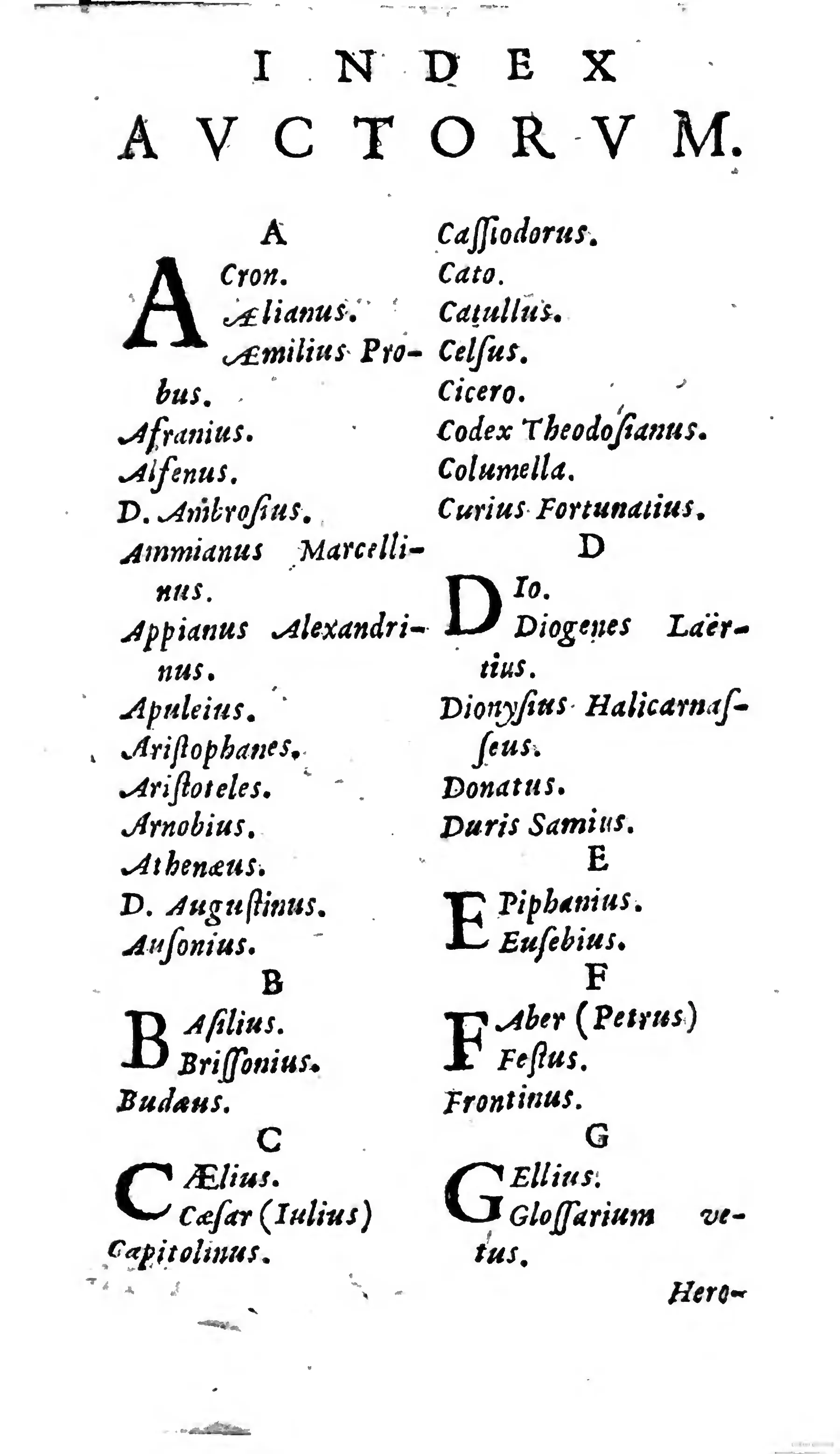
The opening leaf of the Index Auctorum, running alphabetically from A into G, makes visible the source-machine behind Pignoria's expansion of operae from a juristic obligation into a taxonomy of servile function. Its printed roll call sets legal-humanist authorities such as Budaeus and Brissonius beside classical, patristic, and antiquarian witnesses, underscoring the composite's method of treating all textual testimony as usable evidence for Roman domestic service. Source ↗.
Alongside operae, ministerium carries a related but distinct freight. While ministerium in classical usage denotes an office or service in general — and was used by Christian and late antique writers of ecclesiastical offices — in Pignoria it is pressed into a specifically antiquarian service: each ministerium is a named, catalogued function with philological and material evidence behind it. The convergence of operae and ministerium in the composite thus reflects the merger of two streams of Roman social vocabulary: the contractual-juridical stream of the Digest and the descriptive-antiquarian stream of the lexicographers and grammarians.
The figure of the household as pusilla respublica — Seneca's image of the micro-political state within the domus — underwrites the entire enterprise. The image is not merely alluded to but developed as an institutional claim, the text recording that the ancients instituted a festal day on which masters not only dined with their slaves but permitted them to hold honors in the house and to render justice, so that the household was judged a tiny republic, Instituerunt diem festum, non quo solum cum servis domini vescerentur, sed quo utique honores illis in domo gerere, jus dicere permiserunt, & domum pusillam rempublicam esse judicaverunt. By framing the slave personnel of the household as an analyzable polity — one capable, at the Saturnalia, of a temporary inversion of its own ranks — Pignoria authorizes the systematic enumeration that follows. The same figure, transmitted through Lipsius and the late Stoic revival, is also the conceptual hinge that connects Pignoria's antiquarian commentary to the political thought of the Northern humanists.
In sum, the composite's Latin is not a single register but a negotiated conversation between juridical Latin, antiquarian Latin, and rhetorical Latin — a conversation whose negotiation constitutes the text's distinctive contribution to early modern Roman social history.
What the Pignoria–Popma Composite Is: A Summary
The object is a composite early-modern learned book in Latin, comprising two distinct treatises bound together: the De servis, et eorum apud veteres ministeriis, commentarius of Lorenzo Pignoria (Padua, 1571–1631), first printed at Augsburg in 1613 by Anton Welser at the sign of the Pine, and the De operis servorum liber of Titus Popma, a Frisian jurist of the late sixteenth and early seventeenth century, here first printed in conjunction with Pignoria. The 1672 Amsterdam issue is the imprint under examination: published by Andreas Frisius (Andries Fries, 1630–1675), whose programme of learned Latin reprints in the years 1664–1675 has been reconstructed in modern book-historical scholarship.
The genre is antiquarian-juristic commentary: a lexicon-cum-commentary that organizes the slave personnel of the Roman household — urban and rustic — under the heading of ministeria (offices/functions), drawing on literary, legal, epigraphic, numismatic, and pictorial evidence, and pairing this with Popma's juridical systematization of the operae (the services owed). The distinction between the two great classes of household is drawn in the text not spatially but essentially: private slaves, procured by the master for his own use and destined to guard his body and attend his person, fall into the urban and rustic households, which are distinguished not by location but by kind, PRIVATI servi, qui usus sui causa à domino parati, & ad ejus corpus tuendum, atque ipsius cultum destinati erant: quo in genere urbanorum & rusticorum familiæ, quæ non loco, sed genere distinguuntur. Against these stand the public slaves, defined as those who displayed public office and service to the priests, the magistrates, and the people, P V B L I C I servi dicebantur, qui officium, & ministerium publicum sacerdotibus, aut magistratibus, & populo exhibebant. The composite's driving thesis, articulated in Pignoria's preface and Popma's prefatory letter, is that the institutional and material texture of Roman private life — its daily economy of service — can be reconstructed only by combining philological recovery of vocabulary with juridical precision about status and obligation.
The language of composition is Latin throughout, with Greek, biblical, patristic, and legal testimonia embedded. The text has never been translated as a whole into any modern language; partial Italian paraphrases and modern discussions exist in the scholarly literature but no full vernacular translation. The modern English-language title proposed above is supplied by the present editor and is not an established usage.
Situating the Composite in Roman Slavery Studies and Book History
Why the Composite Matters
The 1672 Frisius composite sits at the intersection of three scholarly currents that modern Roman-history research treats as foundational. First, the late Italian humanist antiquarianism of the Paduan and Roman circles around Pinelli, Peiresc, and the Barberini (within which Pignoria worked from the late sixteenth century); second, the Dutch tradition of critical legal humanism, in which Frisian and Groningen jurists (the Popma brothers, the Schulting circle, the later Heineccius line) re-edited the Roman legal corpus with philological rigour; third, the Amsterdam reprint trade of the second half of the seventeenth century, which disseminated Italian and Frisian Latin scholarship across Europe and into the libraries of the German Gelehrten and the English virtuosi.
For modern Roman slavery studies, the composite remains a foundational prosopographic and functional source: its catalogue of ministeria underlies the modern reconstruction of the labor structure of Roman households in works such as K. R. Bradley's Slavery and Society at Rome (Cambridge, 1994) and W. V. Harris's studies of the Roman economy. The functional gradations the composite recovers — the internal ranking of a single household's slaves — are stated in the text as a matter of ancient testimony, that from their differing labors and services the slaves of the same household once held differing condition, so that, as the poet says, there are certain distinctions among servants and each has his own splendor, A diversis autem operis, & ministeriis diversa olim fuit servorum ejusdem familiæ conditio, & ut a poëta ait: discrimina quædam Sunt famulis splendorque suus; it is exactly this graded articulation of servile function that the modern functional analyses take up. For early modern historiography, the composite is a textbook case of how Italian antiquarianism was packaged for the Northern European market by the Amsterdam reprinters. For book history, the Frisius imprint is part of the documented corpus of Andries Fries's programme of 1664–1675, which Maclean has reconstructed from surviving publisher's catalogues and stock lists.
Major Historiographical Fault Lines
Three substantive debates of modern scholarship touch this text directly. First, the Finley–Bradley debate on the comparative sociology of Roman slavery: M. I. Finley's Ancient Slavery and Modern Ideology (1980; expanded 1998) treats Roman slavery as a structurally distinct mode of production and was answered by Bradley's more empirical-functionalist account; the Pignoria/Popma composite is one of the early modern sources both sides cite. Second, the Harris demographic and economic-history school, which has questioned the Finley-Bradley consensus on the productivity and supply of Roman slave labor; Harris's articles collected in Rome's Imperial Economy (2011) take the Pignoria ministeria typology as a starting point for functional analysis of slave labor. Third, the historiography of early modern antiquarianism itself has rehabilitated the cognitive claims of the late Cinquecento antiquaria, of which Pignoria is a paradigmatic instance. The Popma appendix, by contrast, rests on the Dutch legal-humanist tradition surveyed by R. C. van Caenegem and Hans Erich Troje.
Where the Historiography Is Thin or Silent
The 1672 composite in particular has not been the subject of a dedicated modern monograph study; the Frisius reprint programme as a whole has been mapped by Maclean (2020), but the editorial decisions behind this specific pairing of Pignoria with Popma remain undocumented in the surviving Frisius archive. Whether the composite was a one-off or whether Frisius issued multiple impressions before his death in 1675 is also not established in the secondary literature; the Oger-Blanchet 1674 lot suggests the latter.
Editions, Exemplars, and the Object Biography of the 1672 Volume
The 1613 Augsburg Princeps
Pignoria's De servis was first printed in Augsburg in 1613 by Anton Welser at the sign of the Pine (ad insigne pinus), in a small-format volume — catalogues record duodecimo — running to several gatherings with the standard preliminaries of a Paduan humanist production: a dedicatory letter to Cassiano dal Pozzo, prefatory matter, and an apparatus of citations from the jurists and antiquarians of the previous century. The 1613 edition is rare in surviving copies; it is recorded in the major German library catalogues and is digitally available through the Bayerische Staatsbibliothek exemplar. The Augsburg imprint is significant because the Welser firm had by 1613 become a leading German vehicle for Italian antiquarian scholarship, and the choice of Anton Welser as printer signals the intended market: the German Gelehrten public, whose appetite for Paduan antiquarian erudition had been cultivated by a generation of Welser publications.
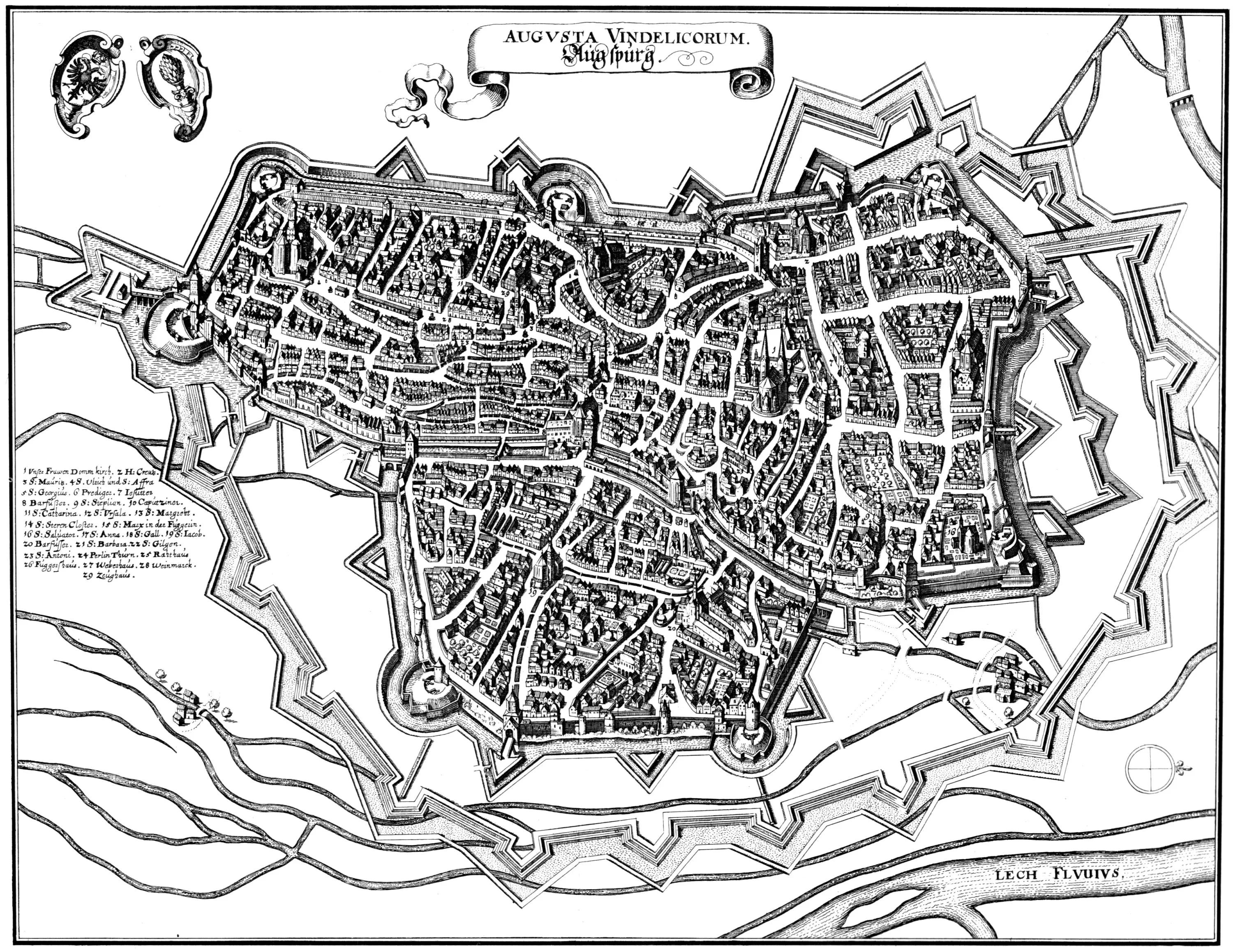
This engraved plan of Augsburg — dense with streets, fortifications, waterways, and civic landmarks — evokes the urban setting in which Anton Welser issued Pignoria's De servis in 1613. It anchors the book's movement from Paduan antiquarian scholarship into the German learned market served by the Welser press, without standing in for the printed volume itself. Source ↗.

The 1656 Padua Edition
A second, augmented edition was printed in Padua in 1656 by Paolo Frambotti, under the editorial care of Gian Filippo Tomasini (the biographer of Galileo and the literary executor of several Paduan antiquarians). The Tomasini/Frambotti edition added a double index (indice gemino), engraved plates, and a biographical preface on Pignoria; it is this text that became the standard reference for the next century of Roman social history. The Augsburg princeps and the Padua second edition together establish the two principal streams of transmission: a German printing and an Italian re-edition, each with its own apparatus and target audience.
The 1672 Amsterdam Composite
The volume under study binds Pignoria's commentary with Popma's De operis servorum liber into a single Amsterdam issue under the imprint of Andreas Frisius (Andries Fries). The composite format is characteristic of Frisius's publishing programme: rather than commissioning new editions, Frisius (a bookseller-publisher rather than a printer in his own right) typically commissioned reissues of existing texts, often recombining two related treatises into a single volume to create a new commercial product for the learned market. In this case, Pignoria's commentary on the slave as functionary within the household (ministeria) and Popma's commentary on the labor owed (operae) form a natural conceptual pair, and their recombination under one cover is conceptually coherent as well as commercially practical. That the two treatises share not only a subject but an integrated method is visible in the way Popma closes his own contribution, in an authorial envoi that states the labor of the enterprise and the deliberate limits of its documentation — these being the things he had to say concerning the labors of slaves, though he is not unaware that many more testimonies of authors could have been adduced concerning them, ATQVE hæc quidem habui, quæ de operis servorum dicerem: de quibus multo plura adduci potuisse auctorum testimonia non ignoro — a candid acknowledgment of selectivity that pairs naturally with Pignoria's antiquarian accumulation.
Surviving Exemplars and Shelfmarks
Surviving copies are recorded in the major European and American research libraries. The Bayerische Staatsbibliothek holds the 1613 Augsburg imprint; the Biblioteca Apostolica Vaticana and major Italian university libraries (Bologna, Padua) hold the 1656 Padua imprint; the Getty Research Institute, the British Library, and several North American university libraries hold exemplars of the 1672 Frisius composite. Copies appear regularly in the antiquarian book trade. A 1674 reissue is recorded at the Oger-Blanchet auction house (Lot 386), in contemporary vellum with the Frisius imprint, confirming the bibliographical details of an exemplar.
Materiality and Format
The 1672 composite is in small duodecimo (12°), in the modest format typical of learned books intended for the private library rather than the lectern. The USTC records the collation as A-H12 (H12 blank). The HathiTrust and Internet Archive digitizations reproduce the Getty exemplar in contemporary vellum with lapped foredges (a Dutch binding of the period); another exemplar is recorded in modern boards. The text is set in roman and italic types with running titles and marginalia; there are occasional engraved illustrations of utensils and inscriptions reproducing the visual evidence cited by Pignoria.
Censorship, Suppression, and Survival
No record of formal ecclesiastical censorship or inclusion in the Roman Index librorum prohibitorum has been located for either the 1613 Augsburg or the 1672 Amsterdam imprint. The text's subject — the reconstruction of Roman private life from pagan literary sources — was theologically innocuous in the eyes of post-Tridentine censors, who were principally exercised by overtly heterodox material. That the treatise moves freely between pagan antiquarian material and Christian testimony without friction is evident where Pignoria illustrates the ad pedes service of the table by the Gospel scene of the woman standing behind at Christ's feet, who, as St. Luke says, began with her tears to bathe his feet, Stans retro, ait S. Lucas, ad pedes ejus, lacrimis coepit rigare pedes ejus — patristic and biblical testimony marshalled as evidence for a servile function alongside the classical sources. The composite survives in multiple exemplars across European and American libraries and is openly available in digitized form (Internet Archive, HathiTrust, Getty Research Institute), confirming its post-polemical status.
Reception and Network
Pignoria's network in 1613 included Cassiano dal Pozzo (the dedicatee), Nicolas-Claude Fabri de Peiresc (the great Provençal polymath, who had urged the publication), Galileo Galilei (a Paduan correspondent), Paolo Gualdo (Pignoria's epistolary confidant), and Cardinal Cesare Baronio (to whom Pignoria dedicated his Egyptian work). Popma's network included the Groningen and Franeker circles of Dutch legal humanism; Ausonius van Popma (1563–1613), his philologist brother, was active at Leiden and Franeker. The pairing of the two treatises under the Frisius imprint thus brings together the Paduan antiquarian tradition with the Frisian legal-humanist tradition in a single Amsterdam composite volume aimed at the international market of late seventeenth-century scholarly readers.
Situation Among Pignoria's Other Works
The composite occupies a defined place within Pignoria's wider antiquarian production, of which his Mensa Isiaca — first printed in his lifetime (1605 and subsequent reissues) and reissued posthumously by Frisius in Amsterdam 1669 — is the other major Egyptological/antiquarian work. The Mensa Isiaca sets the methodological template for the 1613 De servis: both works combine philological evidence, material culture, and engraved plates in a systematic reconstruction of the past; both belong to the Paduan-Roman antiquarian circle around dal Pozzo; both circulated through Frisius's Amsterdam programme in the 1660s and 1670s.
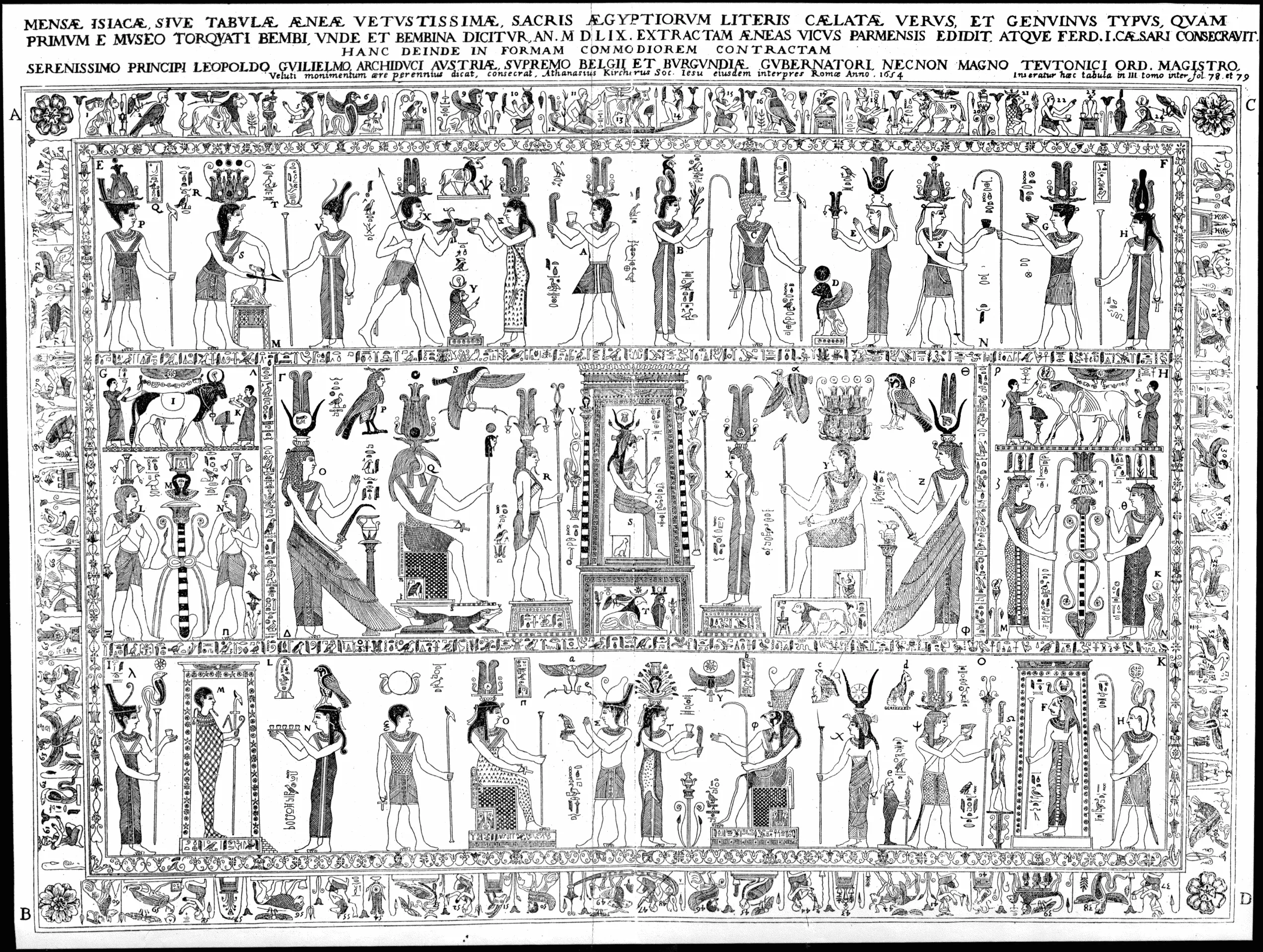
Athanasius Kircher's engraved rendering of the Bembine Table, or Mensa Isiaca, presents the artifact as an ordered field of Egyptianizing figures, ritual emblems, and compartmented signs — the kind of visual evidence early modern antiquaries made legible through print. For Pignoria, whose own Mensa Isiaca was reissued by Frisius in Amsterdam in 1669, this way of reading objects alongside learned commentary formed the methodological counterpart to De servis, though the plate illustrates the parallel Isis project rather than the 1672 composite itself. Source ↗.

Reading the Argument: From the Definition of Operae to the Graded Society of Service
The Title-Page Claim and the Method of the Page
Titus Popma's De operis servorum liber, printed here in the composite's 1672 Amsterdam issue and announcing itself on the title page as a revised setting, an Editio novissima, ab innumeris mendis expurgata, & diversitate characterum exornata, the newest edition, purged of countless errors and adorned with a diversity of type, proceeds from a single juristic premise toward an exhaustive lexicon of servile function. The claim of typographic diversity is not idle self-advertisement: the treatise's method depends on the visual apparatus it names, since each office is introduced by a headword set in spaced capitals and each definition carried by superscript letters keying it to marginal citation from the Digest and Codex. The book's argument, in other words, is inseparable from the way it is set on the page, and the diversitas characterum is the instrument by which juristic definition and antiquarian illustration are held distinct yet adjacent.
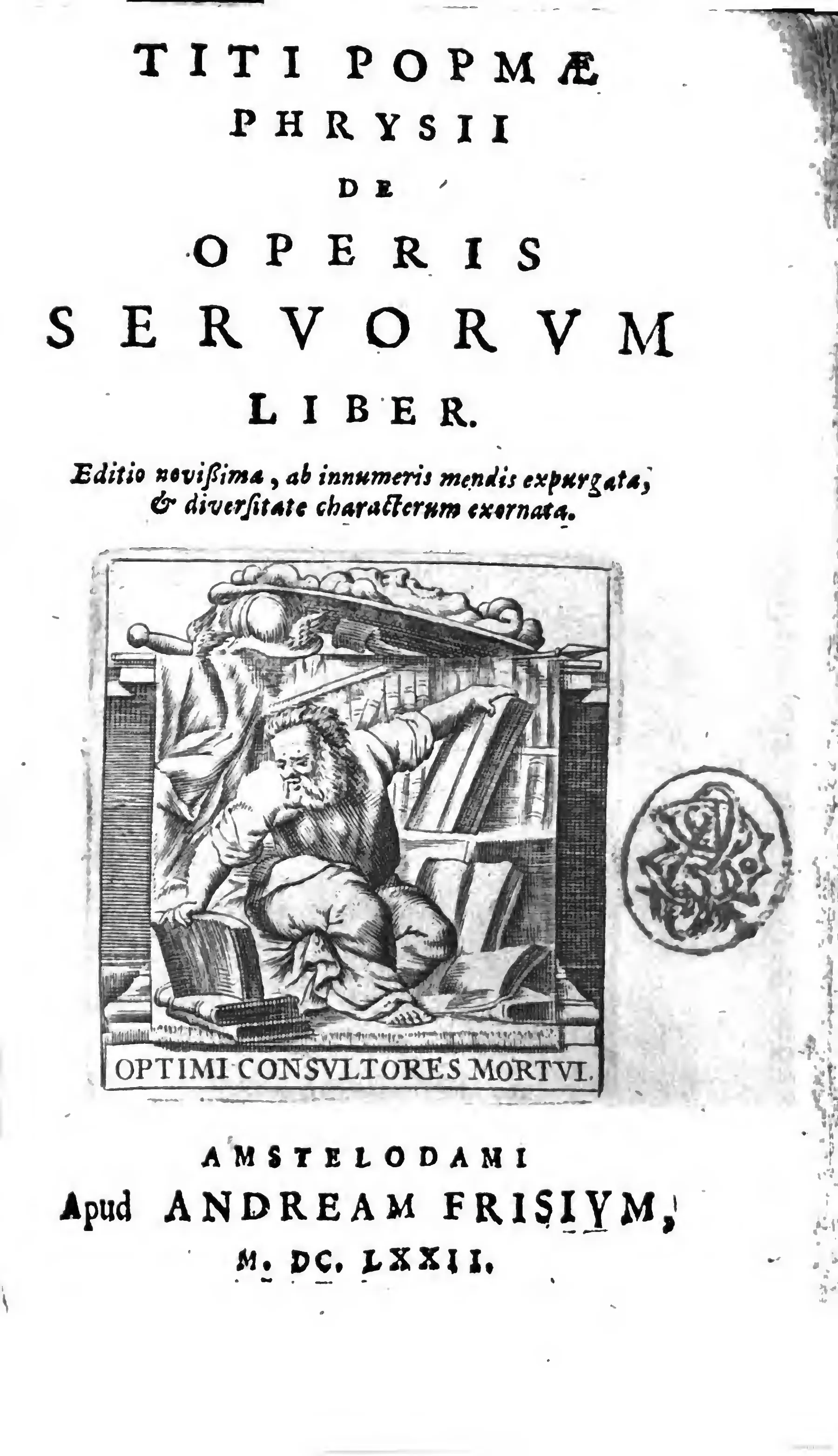
The title page of Popma's De operis servorum liber in Andreas Frisius's 1672 Amsterdam composite makes its editorial program explicit, presenting the work as an Editio novissima "purged" of errors and "adorned" by typographic variety. Beneath the display title, the engraved scholar surrounded by books and the motto OPTIMI CONSSVLTORES MORTVI turn the page itself into a methodological emblem: Roman servile life is to be reconstructed through the disciplined consultation of ancient authorities. Source ↗.
The Definition of Operae
The whole edifice rests on a definition of striking conceptual economy. Popma opens by fixing what labor is before he catalogues who performs it. The treatise's opening formula — labor conceived as a daily service, consisting in the act and given day by day, with no existence in the nature of things before the day of its performance arrives — has already been set out as the juridical baseline on which the outward-building taxonomy rests. The temporal ontology encoded there is more than lexical scruple. To say that operae have no existence in rerum natura until their appointed day is to treat labor not as a possession or a stored capacity but as an event that comes into being only in the moment of performance and expires with the day — a conception drawn directly from the Digest titles named in the margin. This is the fulcrum on which the entire treatise turns: because labor is defined as an act realized day by day rather than as a fixed thing, the servile person can be classified exhaustively by the function he discharges, and the catalogue that follows becomes a taxonomy of realized acts rather than of static conditions.
The Primary Bifurcation: Public and Private, Urban and Rustic
From this definitional base the treatise erects its primary bifurcation. Public slaves are marked off first, in the definition already noted of those who displayed public office and service to priests, to magistrates, and to the people. Against these Popma sets the private category, again in terms encountered above: private slaves procured by the master for his own use and destined for guarding his body and for his personal service, with the crucial qualification that urban and rustic households are distinguished not by location but by kind. The Pomponian dictum non loco, sed genere is load-bearing: it converts a spatial intuition — the city house against the country estate — into a functional principle, so that the familia urbana and familia rustica are defined by the character of the labor rather than by where it is performed. This is the same operation the opening definition performed on operae, now applied to the household as a whole, and it is what permits Popma to treat the domestic labor force as an analyzable order rather than a mass sorted by geography.
The Vertical Axis: Gradation and the Fourfold Spine
Having drawn the horizontal division, the treatise erects its vertical axis, and here the antiquarian's evidentiary instinct fuses with the jurist's precision. Popma states the programmatic principle of gradation by yoking poetic authority to social fact, in the observation — already cited above — that from differing labors and services there was once a differing condition among the slaves of the same household, and that, as the poet says, there are certain distinctions among servants and each has his own splendor. The phrase splendorque suus is telling: even the servile order is imagined as possessing internal dignity and rank, an anatomy of distinction rather than an undifferentiated servitude. Popma then grounds this poetic intuition in the jurist's own vocabulary, quoting Ulpian's threefold gradation to the effect that it matters greatly what sort of slave one is — a good and honest one, an ordinarius, a steward, or on the contrary a common one, a mediastinus, or a quales-quales, Etenim multum interest, qualis servus sit, bona frugi, ordinarius, dispensator; an vero vulgaris, vel mediastinus, an qualis, qualis. That the poetic splendor is immediately underwritten by the locus classicus from Ulpian exemplifies the treatise's characteristic move: the descriptive-antiquarian stream and the contractual-juristic stream are made to converge on a single graded schema, which then supplies the organizing spine for the sequential lexicon.
The Descending Catalogue: From Actores to Mediastini
The catalogue itself descends that spine from apex to base. At the summit stand the actores, defined as slaves to whom the sum of all affairs was committed and who, set over the bailiffs, the household's business, and the domestic accounts, held the most honorable place and rank above the remaining slaves, ACTORES servi, quibus rerum omnium summa commissa; quique villicis rebus, & rationibus domesticis præpositi, honestissimo præservis reliquis loco, & gradu fuerunt. Below the managerial offices the treatise reaches the recursive stratum of the vicarius, defined as the slave of a greater slave in the household, one who serves an ordinarius slave, VICARIVS est servus servi majoris in familia, qui nimirum servit servo ordinario. The definition opens onto the juridically intricate question of the sub-peculium — the quasi-property held by a slave who is himself the property of a slave — and it is precisely such recursion that demonstrates how far the graded schema can be pressed: servitude nests within servitude, and the jurist's categories follow it down without breaking. The descent terminates at the base of the household order with the mediastini, defined as the most worthless servants of the baths and of the house, who constitute a certain fixed class of slaves neither among the ordinarii nor among the vicarii, MEDIASTINI, vilissimi balnearum atque ædium ministri sunt, qui nec inter ordinarios, nec inter vicarios certam quandam servorum constituunt differentiam. The paradox in the phrasing — a certam differentiam that falls between the two named ranks — captures the taxonomist's difficulty at the bottom of his scale, where the abject servant is defined negatively, by the ranks he does not occupy.
Sacred and Profane Testimony: The Table Offices
Throughout this descent Popma layers his juristic definitions with testimony drawn indifferently from pagan and sacred sources, and the seam between the two registers is never marked as a difficulty. Illustrating the servile posture of the ad pedes attendants, he enlists the Gospel scene of the penitent woman standing behind at Christ's feet, who begins with her tears to bathe them — the same scriptural exemplum discussed above in connection with the treatise's easy movement between pagan and Christian material. The scriptural testimony is marshalled as functional evidence for a servile office on precisely the same footing as a line of Plautus or a ruling of Ulpian — a fusion of sacred and profane realia that testifies to the antiquarian's confidence that all textual testimony, whatever its provenance, bears equally on the reconstruction of ancient service. The same evidentiary appetite governs the treatment of the ceremonial offices near the imperial table, where the praegustator is defined simply as a slave who tastes beforehand the food and drink of the emperor, PRÆGUSTATOR servus, qui cibos, potumque principis prægustat — a definition that at once opens onto the imperial anxiety of poison, so that a single household office becomes a window onto the political history of the principate.
The Extreme Margins: Penal, Fugitive, and Branded Statuses
It is at the extreme margin of servile status, however, that the treatise's juristic register reaches its most arresting formulations. Popma treats the penal slaves as a category apart, recording that some are slaves of the penalty, such as those condemned to the mine and to the labor of the mine, and that these, condemned either in perpetuity or for a time, are in all law truly and always like the dead, Quidam sunt servi poenæ, ut in metallum damnati, & in opus metalli. Atque hi quidem vel in perpetuum, vel ad tempus damnari solent, qui in omnijure vere, ac semper similes sunt mortuis. The formula similes sunt mortuis marks the outermost limit of the schema: civil death, the point at which servile status shades into legal non-existence, where the person survives biologically but has been extinguished as a subject of law. Adjacent to this limit Popma places statuses defined by interior disposition rather than external condition, refining the runaway's definition around intent: Caelius holds him to be one who departs with the mind not to return to his master, one to be judged from the mind and disposition of flight, not from the very act of flight, Cælius eum, qui ea mente discederet, ut ne ad dominum rediret: qui ex animo, & affectu fugæ, non ex ipso fugæ actu æstimandus. The distinction is jurisprudentially delicate — the fugitivus is constituted by the animus fugae, not by physical absence, which separates him from the merely wandering erro — and it shows the treatise attending to the interior state of the servile person even within a taxonomy otherwise built on outward function. The physical counterpart to these mental and civil markings is the branded slave, whose disgrace is inscribed on the body: the ancients used to burn the foreheads of their slaves, if they had committed some graver offense, by way of penalty, with a red-hot iron, with letters or with certain other marks, to their disgrace, Nam veteres servorum suorum frontes, si quid gravius deliquissent, poenæ nomine, aut literis, aut aliis quibusdam notis per ignominiam ardenti ferro inurebant — the stigma that both punishes and permanently classifies, and, as the following pages record, bars its bearer from citizenship.
The Late-Antique Edge: The Adscripticius
The treatise also registers the historical mutability of servile status at its late-antique edge, where the bound colonate approaches the condition of slavery. Popma quotes Justinian's own puzzlement at the collapsing distinction, asking what difference is understood between slaves and adscripticii, since each is placed in the power of his master, who can both manumit the slave with his peculium and expel the adscripticius with the land from his ownership, Quæ enim differentia, inquit Justinianus, inter servos, & adscripticios intelligatur, cum uterque in domini sui potestate est positus, & possit servum cum peculio manumittere; & adscripticium cum terra dominio suo a expellere [IMAGE ID: bub_gb_Y93USUjzXr4C-png-155.png]. The passage documents the near-assimilation of the land-bound cultivator to the chattel slave, and it complicates the treatise's otherwise architectonic scheme by admitting that the categories it so carefully separates were, in their own late history, drifting toward one another.
The Saturnalian Inversion and the Closing Envoi
Against the harshness catalogued throughout, the treatise closes its substantive arc on the annual inversion of servile order. Here Popma returns to the festal day already discussed in connection with the household as pusilla respublica — the day on which masters not only dined with their slaves but permitted them to hold honors in the house and to render justice, so that the domus was judged a tiny republic. The Saturnalian license — masters serving slaves, slaves holding honors and rendering justice — presupposes precisely the graded polity the treatise has spent its length constructing: only a household already articulated into ranks and offices can undergo a temporary inversion of those ranks, and the festal day that judges the domus a pusilla respublica thus confirms, even in overturning it, the miniature commonwealth that the whole lexicon has anatomized. Popma then declines to press further, closing with an envoi that at once claims comprehensiveness and concedes selection — the acknowledgment, noted above in the account of the composite's production, that these were the things he had to say concerning the labors of slaves, though he was not unaware that many more testimonies of authors could have been adduced. The acknowledgment is characteristic of the antiquarian's posture: the catalogue is offered as sufficient for its purpose while explicitly disclaiming exhaustiveness, a candid admission that the surviving record of servile function is deeper than any single lexicon can drain.
Frequently Asked Questions
What is Lorenzo Pignoria's De servis, et eorum apud veteres ministeriis, commentarius?
It is a late-humanist Latin commentary that reconstructs the servile labor force of the ancient Roman household, office by office and rank by rank. Organizing slaves under the heading of ministeria, or functions, it defines each servile office — often by etymology — and grounds it in Roman legal citation from the Digest and Codex alongside literary, patristic, epigraphic, and numismatic evidence. First printed at Augsburg in 1613, it treats the domus as a pusilla respublica, a tiny commonwealth whose every rank could be juristically defined and philologically documented.
Who was Lorenzo Pignoria?
Lorenzo Pignoria (Padua, 1571–1631) was a Paduan antiquarian who belonged to the erudite circles of the Veneto and Rome, working alongside Cassiano dal Pozzo, Nicolas-Claude Fabri de Peiresc, and the Barberini. He brought to his subject a combinatorial method that set philological recovery of vocabulary beside legal, epigraphic, numismatic, and pictorial testimony. His other major antiquarian work, the Mensa Isiaca, first printed in 1605, set the methodological template for his 1613 commentary on slaves. Peiresc had urged the commentary's publication, and Pignoria dedicated it to dal Pozzo.
Why did the 1672 Amsterdam edition pair Pignoria's commentary with Titus Popma's treatise?
The Amsterdam publisher Andreas Frisius (Andries Fries, 1630–1675) bound Pignoria's commentary with the De operis servorum liber of the Frisian jurist Titus Popma to create a new saleable volume for the Northern learned market. The pairing is conceptually coherent: Pignoria anatomizes the slave as functionary within the household, while Popma systematizes the operae, the labor legally owed. Recombining two related treatises under one cover was characteristic of Frisius's programme of 1664–1675. The specific editorial decisions behind this pairing, however, remain undocumented in the surviving Frisius archive.
How did the treatise define the runaway slave and the penal slave?
It defined both by legal reasoning that reached striking extremes. Following Caelius, the fugitivus was constituted not by physical absence but by the animus fugae, the intention never to return to his master — judged from the mind and disposition of flight rather than the act itself, which separated him from the merely wandering erro. The servus poenae, condemned to the mine either perpetually or for a time, was reckoned in all law as truly and always like the dead: civil death, the point at which servile status shaded into legal non-existence.
Is there an English translation of De servis, et eorum apud veteres ministeriis?
No full translation into any modern language has been identified; partial Italian paraphrases and modern scholarly discussions exist, but no complete vernacular translation has been found. Separately, the Leo edition presents the full transcription and a complete English translation for the first time, freely available online at no cost. This translation is generated by AI. It forms part of Leo's effort to make English translations of every text printed in Latin in early modern Europe, between 1450 and 1750, available to readers.
This report was generated by an advanced AI assistant that conducted deep research alongside an extensive interpretation of the transcribed original text. Every effort has been made to preserve fidelity to the source and to guard against inaccuracy, but corruption in the text recognition process and model hallucination may nonetheless have entered the text. Treat every claim, quotation, translation, and citation as provisional, and verify each against the original source before relying on or citing it.
Bibliography
- Bradley, Keith R., Slavery and Society at Rome: The standard Anglophone synthesis of Roman slavery in its social and legal context, and the natural first stop for anyone reading Pignoria's ministeria typology, since Bradley reworks precisely the graded hierarchy the composite recovers — the fourfold spine grounded in Ulpian's ruling that it matters greatly what sort of slave he is, an ordinarius, a steward, or a common mediastinus or quales-quales, Etenim multum interest, qualis servus sit, bona frugi, ordinarius, dispensator; an vero vulgaris, vel mediastinus, an qualis, qualis. Read it to see how a seventeenth-century lexicon of function became twentieth-century social history.
- Harris, William V., Rome's Imperial Economy: Twelve Essays: Harris's collected essays on the demography, geography, and economic integration of Roman slavery treat Pignoria's ministeria and Popma's operae as foundational early-modern typologies, and they mine exactly the quantifiable detail the composite preserves — the ration of four measures of grain each slave received monthly, the demensum, At quaternos frumenti modios servi quolibet mense à dominis suis accipiebant; & id Demensum dicebatur. Indispensable for placing the volume within the modern quarrel over the productivity of slave labor.
- Joshel, Sandra R., Slavery in the Roman World: A comprehensive overview built from literature, law, and material culture, drawing on the Pignoria–Popma typology as an antiquarian forerunner of modern prosopographic analysis — a lineage visible in the composite's own reach from the apex actores, to whom the sum of all affairs was committed, ACTORES servi, quibus rerum omnium summa commissa, down to the recursive vicarius, the slave of a greater slave, VICARIVS est servus servi majoris in familia, qui nimirum servit servo ordinario. The best single volume for the reader who wants the ancient reality behind the early-modern catalogue.
- Maclean, Ian, "Andreas Frisius (Fries) of Amsterdam and the Search for a Niche Market, 1664–1675," Episodes in the Life of the Early Modern Learned Book: The authoritative reconstruction of Frisius's Amsterdam publishing programme, from which nearly everything defensible about the 1672 composite's commercial logic derives — the recombination of two related treatises into a single saleable volume for the Northern learned market. Consult it before crediting any claim about who decided to pair Pignoria with Popma, since Maclean also marks the limits of what the surviving archive can tell us.
- Haskell, Yasmin, "Pignoria and the Mensa Isiaca," Journal of the Warburg and Courtauld Institutes: The leading modern reconstruction of Pignoria's antiquarian method, his Paduan and Roman milieus, and his collaboration with Cassiano dal Pozzo and Peiresc; the essential entry-point to the intellectual history behind the commentary. Haskell's account of that combinatorial method illuminates the composite's finer discriminations among degraded and penal statuses — the abject mediastini who belong neither among ordinarii nor vicarii, MEDIASTINI, vilissimi balnearum atque ædium ministri sunt, qui nec inter ordinarios, nec inter vicarios certam quandam servorum constituunt differentiam; the servi poenae who in all law are like the dead, Quidam sunt servi poenæ, ut in metallum damnati, & in opus metalli. Atque hi quidem vel in perpetuum, vel ad tempus damnari solent, qui in omnijure vere, ac semper similes sunt mortuis; the fugitivus defined by the animus fugae, Cælius eum, qui ea mente discederet, ut ne ad dominum rediret: qui ex animo, & affectu fugæ, non ex ipso fugæ actu æstimandus; the branded literatus, whose forehead the ancients burned with a red-hot iron by way of penalty, Nam veteres servorum suorum frontes, si quid gravius deliquissent, poenæ nomine, aut literis, aut aliis quibusdam notis per ignominiam ardenti ferro inurebant; and the praegustator who tastes the emperor's food beforehand, PRÆGUSTATOR servus, qui cibos, potumque principis prægustat.