The Handmaid Worthy of the Whip: Lorenz Scholz von Rosenau's A Volume of Philosophical, Medical, and Chymical Letters by the Foremost Philosophers and Physicians of Our Age
Late-sixteenth-century learned medicine argued with itself in Latin letters, and Lorenz Scholz von Rosenau gathered the best of that argument into a single folio. His Epistolarum philosophicarum, medicinalium ac chymicarum volumen (Frankfurt 1598; Hanau 1610) collects the correspondence of Crato, Erastus, Mercuriale, Zwinger, and their peers and arranges each exchange as a disputed question — above all the question of whether the new chymical art could be admitted to medicine without dethroning Galen. The correspondents' answer, memorably put, was that chemistry deserved honour as medicine's handmaid but the whip should she presume to set herself before her mistress.
ExLatinis
July 27, 2026
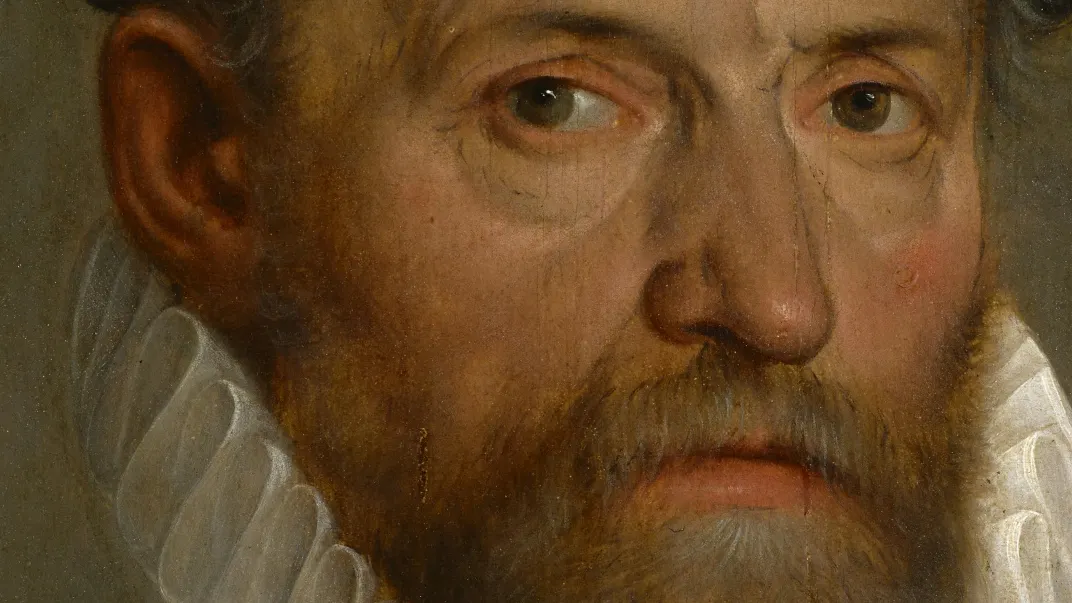
Late-sixteenth-century learned medicine argued with itself in Latin letters, and Lorenz Scholz von Rosenau gathered the best of that argument into a single folio. His Epistolarum philosophicarum, medicinalium ac chymicarum volumen (Frankfurt 1598; Hanau 1610) collects the correspondence of Crato, Erastus, Mercuriale, Zwinger, and their peers and arranges each exchange as a disputed question — above all the question of whether the new chymical art could be admitted to medicine without dethroning Galen. The correspondents' answer, memorably put, was that chemistry deserved honour as medicine's handmaid but the whip should she presume to set herself before her mistress.
Among the folio anthologies through which late-sixteenth-century learned medicine took stock of itself, the Epistolarum philosophicarum, medicinalium ac chymicarum volumen occupies a distinctive place. Compiled by the Breslau physician and botanist Lorenz Scholz von Rosenau (1552–1599) and first issued at Frankfurt am Main in 1598 by the heirs of Andreas Wechel with Claude de Marne and Johann Aubry — then reissued at Hanau in 1610 as the Wechel firm continued under Aubry's heirs — it is not a treatise but an edited archive: a gathering of Latin letters exchanged among the foremost physicians and natural philosophers of the Empire and Italy, arranged so that each exchange reads as a disputed question of learned medicine. The correspondents are the leading names of the imperial and Paduan medical world — Crato von Krafftheim, Andreas Dudith, Peter Monau, Theodor Zwinger, Thomas Erastus, Girolamo Mercuriale, Girolamo Capivaccio, Giulio Cesare Aranzi, Thomas Moffet — and their letters are presented less as documents of sociability than as printed instruments of inquiry.
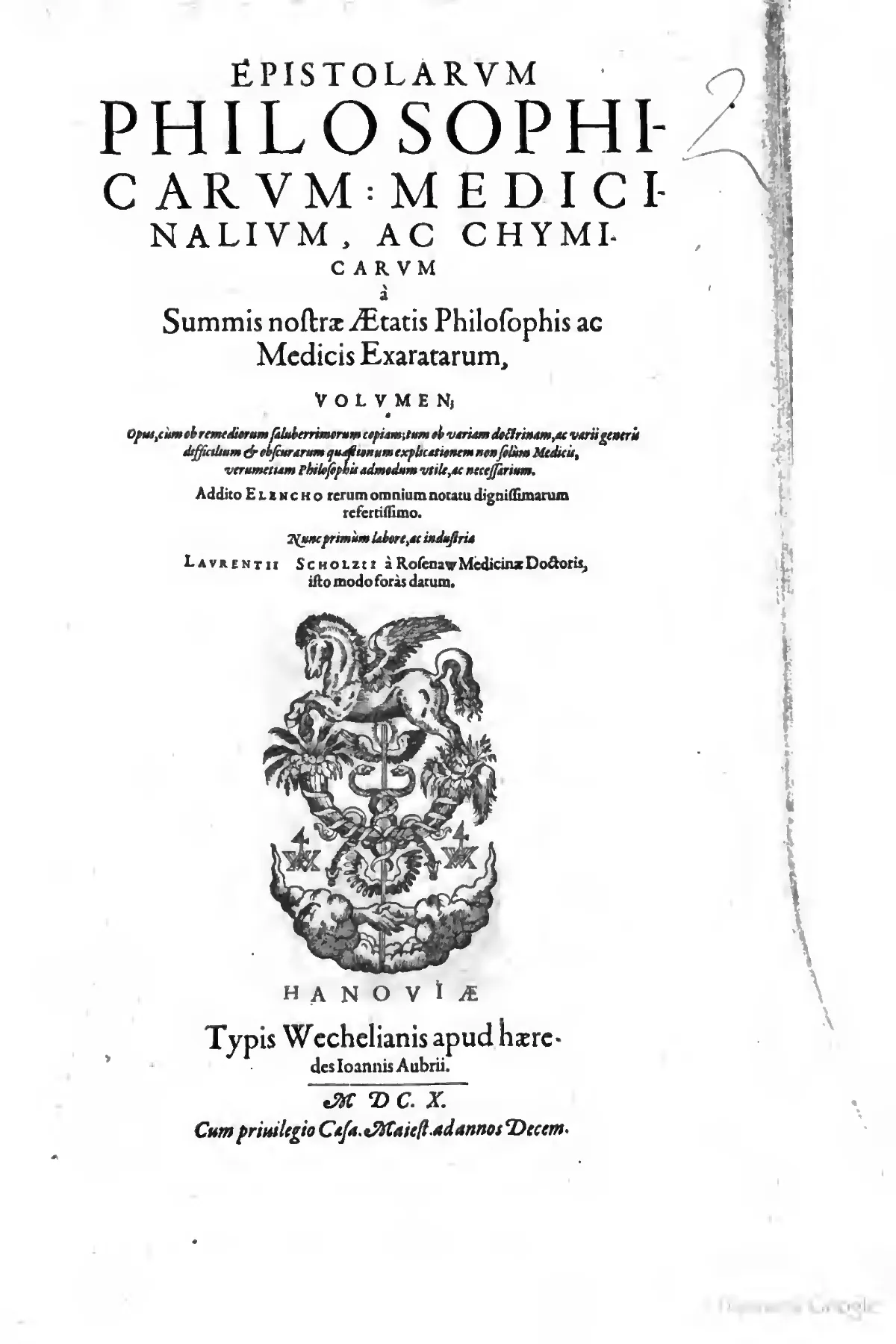
The 1610 Hanau title page frames Scholz von Rosenau's anthology as an edited archive of learned medical inquiry, its display title and utility-minded subtitle promising both philosophical disputation and an abundance of health-giving remedies. The Wechel Pegasus-and-caduceus device, Hanau imprint under Aubry's heirs, and imperial privilege notice together place the volume within the migrated Wechel network and under the sanctioning authority that shaped its circulation. Source ↗.
The intellectual problem that gives the collection its spine is the standing of the new chymical and Paracelsian art against the inherited authority of Galenic-Hippocratic medicine. The recurring move by which the correspondents confront it is neither wholesale rejection nor wholesale embrace but a precise act of subordination: chymistry is welcomed as ministra medicinae, the handmaid of medicine, its distillations and mineral preparations defended as genuinely ancient rather than Paracelsian novelties, while Paracelsus himself and his asseclae, his followers, are repudiated as fraudulent. One correspondent states the settlement with memorable sharpness, esteeming chemistry highly as the handmaid of medicine but judging her worthy of the whip should she presume to set herself before her mistress. That single image — technique honoured in its place, disciplined the moment it claims doctrinal primacy — governs the whole volume, and it extends well beyond pharmacy: across debates on contagion, poison, materia medica, physiology, and cosmology, the letters stage the same confrontation, in which received authority must yield firm reasons, experience is allowed to "enervate" a syllogism that had seemed secure, and novelty is scrutinized for fabrication even as defensible innovation is quietly absorbed into a reformed Galenism.
The stakes of that negotiation were considerable. The decades bracketing this correspondence saw Thomas Erastus mount his systematic polemic against Paracelsian chemical pharmacology, and the question of whether chymistry could be integrated into academic medicine without dissolving its Galenic foundations was live and unsettled. Historians have disagreed about the pace and character of that integration — whether it was a slow absorption or a contested boundary defended into the 1590s — and the volume furnishes documentary evidence usable on more than one side of that debate. It also preserves, in passing, a rich record of the late-humanist medical respublica litteraria that linked Padua, Breslau, Basel, and the imperial court at Prague, and a dense textual culture of materia medica — potable gold, antimony, theriac, mummy, guaiac, bezoar, terra sigillata — debated recipe by recipe and cargo by cargo.
What a first-time reader will find most striking is how much conceptual work is carried inside the Latin itself. The volume turns on a small set of load-bearing terms whose ambiguity is the very substance of the controversy: contagium, which oscillates between an aerial vapor doing damage to a susceptible body and a Fracastorian seminarium that multiplies within it; venenum, argued to be not a hidden essence but a relatum ad aliquid, a relation to a particular body, so that one and the same matter may be nutriment, medicine, or poison depending on whom it meets; and the disciplinary tag ministra medicinae itself. The correspondents range from the coolly analytic — one insists that neither Hippocrates nor Galen is to be believed merely because he said a thing, but only for the good and firm reasons behind it — to the polemically charged, as when a Paracelsian voice is quoted professing a medicine not sprung from the brain of Galen, "a man blasphemous against Moses, against Christ, and so against God himself." Ethnographic and experiential arguments sit beside scholastic ones: whole peoples whose daily tables are steeped in sugar yet scarcely know the name of kidney-stones are marshalled against a received doctrine, and rhubarb that has lost its virtue is dismissed as no true rhubarb but its "cadaver."
Uniting the work's conceptual vocabulary, its production, and its internal argument is a single editorial conviction: that the learned letter, poised between rhetoric, dialectic, and philology, is itself a method of medical adjudication. Scholz orders the correspondence as a sequence of citable questions — dialectical, erotematic, didascalic, in the rhetoricians' terms he invokes — furnished with a prosopographical Catalogus Auctorum, an Interpretatio Graecorum to gloss the Greek of Galen and Hippocrates, and a full Index rerum et verborum, and dedicated to the Silesian officers of Rudolf II's imperial chamber. The result places a Reformed, Paduan-inflected, anti-Paracelsian medical humanism in print under imperial patronage. That Scholz's editorial hand shaped these letters is not in doubt; how far he preserved authentic texts and how far he reconstituted them remains an open question, and the volume stands as a representative case in the study of early-modern epistolary editing. No modern critical edition or translation yet exists, and the work remains undertreated relative to its importance for the Galenic–chymical controversy it so vividly documents.
Read the full text and English translation on Leo
This text was transcribed and translated as part of the ExLatinis project, an effort by Leo to make free English translations of every text published in Latin in early modern Europe (1450–1750) available online. The complete transcription and English translation of this work can be read free of charge:
→ Read the original Latin text and full English translation on Leo
You can save a copy of this document into your Leo account to run deep text searches, conduct further analysis, or cross-reference it with your own research.
Assigning an English Title and Framing the Latin of the Epistolae philosophicae, medicinales, et chymicae
The full imprint announces that the letters were a summis nostrae aetatis philosophis ac medicis exaratarum, "written by the foremost philosophers and physicians of our age," while the compiler's name appears in the Latinized form Laurentii Scholzii à Rosenaw. This title is editorial, supplied for bibliographic convenience; no conventional English-language title is in current scholarly use.
Three Latin formulae bear the principal philological weight of the volume and require close exposition.
Chymia ministra (vel famula) medicinae. The collocation designates chemistry as a subaltern, instrumental discipline with respect to medicine: chymistry prepares, analyses, and refines materia medica — distillations, elixirs, quintessences — but does not legislate the theory of health, sickness, or temperament. The formula presupposes the late-medieval and Renaissance hierarchy of the artes, in which medicine is classed among the productive or mechanical arts whose principles are borrowed from natural philosophy, and inserts chymistry as a still more subordinate operation within the officina of the pharmacist. Its polemical force in this volume is precisely calibrated: the correspondents admit the utility of chemical preparations (and even praise them) while denying chymistry any claim to overturn the Galenic doctrine of the res naturales. In that sense, ministra functions less as a neutral descriptor than as a disciplinary settlement — a verbal clause in a boundary-drawing act by which late-humanist Galenists concede technique without conceding principle. The formula receives its most vivid articulation when a correspondent avows that he greatly esteems chemistry as the handmaid of medicine but holds her worthy of the whip should she dare set herself before her mistress, MAXIMI facio ministram medicinæ chi miam, eandem si dominæ suæ tese anteponere audeat, flagris etiam dignam censeo; the mistress–handmaid grammar converts a hierarchy of the artes into a disciplinary sanction. The same settlement is stated positively elsewhere, where chymistry is praised so far as it pursues distillation but condemned so far as it promises the transmutation of base metals into gold and silver, Sed nec reprehendi ego voquam chimiam, quatenus in diuam perseq[ui]tur, sed laudo eâ & celebro. Quatenus traosmutationem villoru[m] metalloru[m] in auru[m] arg[umen]tumq[ue] promitit, & tentat, hactenus eaodem damno, with the added observation that transmutation has for several centuries been attempted in vain by many thousands and gone unpunished for none, Hoc autem aliquot iam seculis à multis millib[us] frustra tentatum est nec cuiquam impuore fuit. The defence of mineral remedies as ancient rather than Paracelsian belongs to the same manoeuvre: the strongest remedies suit the strongest diseases, and such are those drawn from minerals, falsely ascribed to Paracelsus, since chemistry was familiar to the ancients, Valentiorib[us] enim morbis potentissima remedia optima sunt. Talia sunt, quæ ex mineralib[us] compatantur, quæ falso Theophrasto illi Patacelso adscribuntur. Notum enim est veterib[us] chemiam fuisse familiarem.
Contagium and seminarium. In several letters, the contagion debate of the second half of the sixteenth century is staged by opposing two technical vocabularies. The Galenic-Aristotelian tradition, represented especially by Erastus and the Paduan-trained correspondents, frames contagion as a vapor commixtus, an aerial alteration affecting the ambient air or the body's humoral mixture, in continuity with the meteorology of Meteorologica IV and with Galen's De differentiis febrium. The letters themselves carry the definition in just these terms, holding that contagion is a strongly mixed vapor and, being a vapor, possesses the power to heat, Est enim contagium vapor fortitet commixtus, cum contagium sit vapor, habet vim calefaciendi. Against this, Fracastoro's alternative (which the letters intermittently invoke even when they do not endorse it) construes contagion through seminaria, imperceptible reproducible agents that enter the body, multiply within it, and pass to another. The volume's Latin thus keeps two competing ontologies of disease agent in play within a single term: contagium as a relational accident (vapor doing damage to a body disposed to receive it) and contagium as a positive quasi-substance (seminarium). The Galenic writers here ask whether pagan and Christian antiquity recognized contagious pestilential fevers at all — a question Erastus pursued across the very years of this correspondence, and one that surfaces in the letters when a correspondent reports that he does not find the cause in question to excite contagious pestilent fevers, imo quod febres pestilentes / contagiosas excitet, non reperio. The same debate generates the distinction between a private and a public plague, the private arising from depraved humors through faulty regimen or from a bad constitution of the air, pestem aliam priuatam, aliam publicam esse statuo. Priuatam vel à pranis humoribus ob victus prauitatem ortam, vel ex aëris constitutione mala. The philological tension between the two senses is the textual form the question takes.
Venenum as a relatum ad aliquid. The volume's pharmacology repeatedly returns to a scholastic-Aristotelian insight, drawn ultimately from the Categoriae: a single substance can be alimentum, medicamentum, or venenum according to the temperament of the recipient; what makes a thing poison is not its substantial form but the relation it enters with a particular body. Venenum is therefore a relatum ad aliquid, an extrinsic denomination, not a hidden essence. This is precisely the position the letters commend, judging Galen the more correct philosopher who pronounces in express words that the three — nutriment, medicine, and poison — are relative to something, namely to man, Rectius mihi philosophari: Galenus nositer videtur: qui & 3, de temperamentis 4. & 1. simpl. 1. expressis verbis tria hæc: alimentu[m] videlicet, medicamentum, & venenum, relata esse ad quid. This relational logic explains the volume's evident interest in theriac, mumia, terra sigillata, potable gold, antimony, and bezoar: each is debated not as to its intrinsic nature but as to the conditions under which it preserves or destroys life. The Latin of the letters carries this point inside its grammar; the same matter can carry three names, and the name it wears is determined by the body it meets. Saluberrima remedia in the prefatory matter is itself a relational predicate (health-giving with respect to a diseased condition), and the reader is invited to read the letters through the relational grammar that organizes their matter.
Within the same philological horizon, virtus occulta, quinta essentia, and aurum potabile mark further sites of conceptual strain. Virtus occulta names those operations whose mechanism is not visible to the senses — magnetic attraction, the sympathetic action of mumia, the purgative virtue of a bezoar — and is a scholastic placeholder for causal chains awaiting analysis, not an appeal to magic. Quinta essentia denotes the most subtle, spirituous, and balsamic part of a substance, separable by chemical operation, on which the virtus of the whole is held to depend; the term carries Paracelsian coloring but is also used here in a Galenic register compatible with the doctrine of active principles. Aurum potabile names the dissolved or suspended gold that alchemists and chymists proposed as a noble medicine; here it is advanced with confidence, the moisture extracted from gold and rightly administered being called the most excellent safeguard for preserving health and life and expelling diseases, hoc humidum ab auro extractum eoipoti humano recte exhibitum erit præstantissimum sanitatis & vitæ conseruandæ, & morborum expellendorum præsidium, and the volume preserves the term precisely so that it can be discussed without either endorsement or repudiation by the collection as a whole. In each case, the Latin of the letters functions less as transparent window and more as the medium in which the volume's negotiation between learned Galenism and chymical pharmacy is conducted.
The Volume in Brief: An Edited Archive of the Galenic–Chymical Controversy
The Epistolarum philosophicarum, medicinalium ac chymicarum volumen (Frankfurt: heirs of Andreas Wechel, Claude de Marne, and Johann Aubry, 1598; reissued Hanau: typis Wechelianis apud heredes Ioannis Aubrii, 1610, USTC 2106666) is an edited scholarly anthology of learned Latin medical-philosophical correspondence compiled by the Breslau physician and botanist Lorenz Scholz von Rosenau (1552–1599). Issued in folio with the collation pp. [12], cols. 536, [14], it gathers letters from the leading medical respublica litteraria of the Empire and Italy — among them Crato von Krafftheim, Andreas Dudith, Peter Monau, Theodor Zwinger, Thomas Erastus, Girolamo Mercuriale, Girolamo Capivaccio, Giulio Cesare Aranzi, and Thomas Moffet — and orders them as printed disputations on contested questions of learned medicine. The editorial premise is that the learned letter is itself a dialectical instrument: an old practice, as the preface has it, of interrogating a proposed problem, disputing it, and submitting the answer to examination, such letters being called by the rhetoricians dialectical, erotematic, and didascalic, Vetus est ratio de problemate proposito interrogare, disputare, ac percunctanti & sciscitanti respondere, quodq[ue] responsum est ad examen reuocare. Tales Epistolas, suo quodâ iudicio, Rhetores in scholis Dialecticas, Erotematicas, & Didascalicas appellare consueuerunt. Its central thesis is the documentary adjudication, through the very exchange of the letters, of the Galenic–chymical controversy then agitating imperial learned medicine, while binding chymistry to medicine in the subordinate role of ministra rather than allowing it the doctrinal primacy claimed by Paracelsian iatrochemistry. The volume is composed in Latin, with the editorial Greek terminology glossed in the appended Interpretatio Graecorum; occasional vernacular traces survive in materia medica asides. No portion of the work has yet received a modern critical edition or translation, and the principal modern access route remains digitized facsimiles via the BSB Munich and the Wolfenbütteler Digitale Bibliothek.
Why the Scholz Letters Matter: Historiography of the Respublica Litteraria and the Paracelsian Controversy
The collection's significance to modern scholarship operates on three intersecting axes. First, as a monument of the late-humanist medical respublica litteraria, it preserves a documentary cross-section of the learned correspondence network linking Padua, Breslau, Basel, and the imperial court at Prague in the late sixteenth century: Crato von Krafftheim and the imperial-physician nexus at Rudolf II's court, the Paduan clinical-philosophical tradition descending from Mercuriale and Capivaccio, the Reformed medical milieu of Basel through Zwinger, the Bohemian-Silesian axis through Dudith, and the Galenist anti-Paracelsian campaign of Erastus. The dialectical epistemology that underwrites this network is stated plainly within the letters: neither Hippocrates nor Galen is to be believed in the art because they said a thing, but because they have good and firm reasons for what they said, Nec Hippocr. nec Galeno in arte credendum est, quia dixerunt, sed quia bonas ac firmas rationes dictorum habent — the principle that turns a body of correspondence into a tribunal of reasons rather than a register of authorities. Second, as a primary source for the Galenic–Paracelsian controversy of the 1560s–1590s, it furnishes documentary evidence for the period contemporary with Erastus's systematic polemic against Paracelsus's chemical pharmacology and for the integration of chymical remedies into learned medicine — a process Debus treated as a slow absorption rather than a clean rupture, and against which Pagel and Shackelford argued for a more contested boundary still in the late sixteenth century. The volume's own posture in that controversy is unambiguous even as it defends chemical technique: one correspondent disavows any wish to patronize the raving and insane followers of Paracelsus, the greatest part of whom, he charges, conduct their experiments through the slaughter of men, nequaquam agytis illis, & insanis Paracelsæ asseclis patrocinari volo; quorum multo máxima pars per oeces hominum experimeota agit, and the same charge of imposture is levelled at Paracelsian nomenclature, in which at one moment sulphur is oil, at another antimony, at another something else, Modo enim illis sulphur est oleum, modo Antimonium, modo aliud, sed / imposturas istas & fraudes. The polemical extremity of the position the volume opposes is preserved in the mouth of a Paracelsian who professes a medicine not sprung from the brain of Galen, a man blasphemous against Moses, against Christ, and thus against God himself, Medicinam profiteor non eam quidem quæ ex cerebro Galeni, hominis & in Moyien, & in Christu[m], ideoq[ue] in Deum ipsum blasphemi, radices egit. Third, as evidence for early modern trade in materia medica, the letters preserve recipes, commercial correspondence, and clinical reports touching potable gold, antimony, theriac, mummy, guaiac, bezoar, and terra sigillata, allowing historians of pharmacy to reconstruct the textual culture of the late-sixteenth-century pharmacopeia.
The debates in which the volume intervenes are well-rehearsed in the secondary literature. On the status of chymistry as ancilla or minister medicinae, the foundational studies remain Debus's The English Paracelsians (1966) and The French Paracelsians (1991), together with Piyo Rattansi and Antonio Clericuzio's collection on sixteenth- and seventeenth-century alchemy and chemistry; the Pagel–Shackelford position emphasizes the conceptual distinctness of chymical from Galenic medicine into the 1590s, while Debus's broader thesis argues for the gradual chymical colonization of academic medicine. On contagion and the academic reception of Fracastorian seminaria, the relevant context is provided by the standard treatments in Vivian Nutton and in the histories of early modern epidemiology, with the specific Breslau-Padua-Prague axis documented in the studies collected by Wear, French, and Lonie. On the metaphysics of poison and the relational ontology of venenum, the relevant scholarship is the late-scholastic and early-modern literature on the relatum ad aliquid tradition as applied to medicine, including the studies collected in the Wear volume. On occult qualities and the novae/comets debate, the volume offers primary material for the reception of Tycho Brahe's 1572 and 1577 observations in medical circles, a question treated by both scholarly and scientific-historians of Renaissance cosmography.
Where Scholz himself is concerned, the historiographical situation is thin. There is no dedicated modern monograph on Scholz comparable to the standard biographies of Crato, Erastus, or Mercuriale; the standard biographical article is that in the Allgemeine Deutsche Biographie (and its revision in the Neue Deutsche Biographie), with supplementary notices in Silesian medical-historical literature. The historiographical debate over how to characterize Scholz's editorial practice is bound up with the broader debate over the ethics of early-modern epistolary editing: Did Scholz preserve authentic texts, or did he reconstitute letters from rough drafts, drafts, or memory in ways that obscure their philological status? This is an open methodological question in early-modern epistolary studies, and the present volume stands as a representative case. The historiographical disagreement is in part between those who treat late-humanist letter-collections as documentary archives of learned sociability and those who treat them as literary artifacts shaped by editorial design; Scholz's volume can be cited in evidence on both sides. That the letters were shaped to press their questions is signalled by the recurrent appeal to experience over inherited demonstration: the correspondents acknowledge that their whole art is conjectural and, as the saying goes, makes its experiments through the deaths of men, Coniecturalis est ars vestra tota, & per mortes hominum, vt ille inquit, experimenta facit, and they let observation override the schools, so that it happens that experience enervates syllogisms which otherwise seemed firm, Ita sit nimirum vt experientia syllogismos, qui alioqui firmi videbantur, eneruet. That same evidentiary preference takes ethnographic form when a correspondent proposes to bring forward peoples, regions, and kingdoms whose daily tables have nothing more frequent than sugar, and where scarcely the name of kidney-stones is known, proferam tibi populos, regiones, regna, in quibus mensæ quotidianæ nil saccharo frequentius habent, ac vix renum calculorum nomen scitur.
Tracing the Editions: Textual History, Materiality, and the Wechel Firm
The bibliographical transmission of the Epistolarum volumen divides into two issues. Editio princeps. The editio princeps appeared at Frankfurt am Main in 1598 from the heirs of Andreas Wechel in partnership with Claude de Marne and Johann Aubry (Apud Andreae Wecheli haeredes, Claudium Marnium et Joan. Aubrium); the 1610 Hanau issue (USTC 2106666) was printed typis Wechelianis apud heredes Ioannis Aubrii, the firm having shifted its operative centre from Frankfurt to Hanau between 1598 and 1603. The two issues share the folio collation pp. [12], cols. 536, [14] reported in catalogues, and the 1610 issue is best characterised as a reissue with a new general title page and corrected preliminaries rather than a re-edited or expanded edition. No substantive textual differences have been documented in catalogues, and no modern critical edition distinguishes variant readings between the two issues.
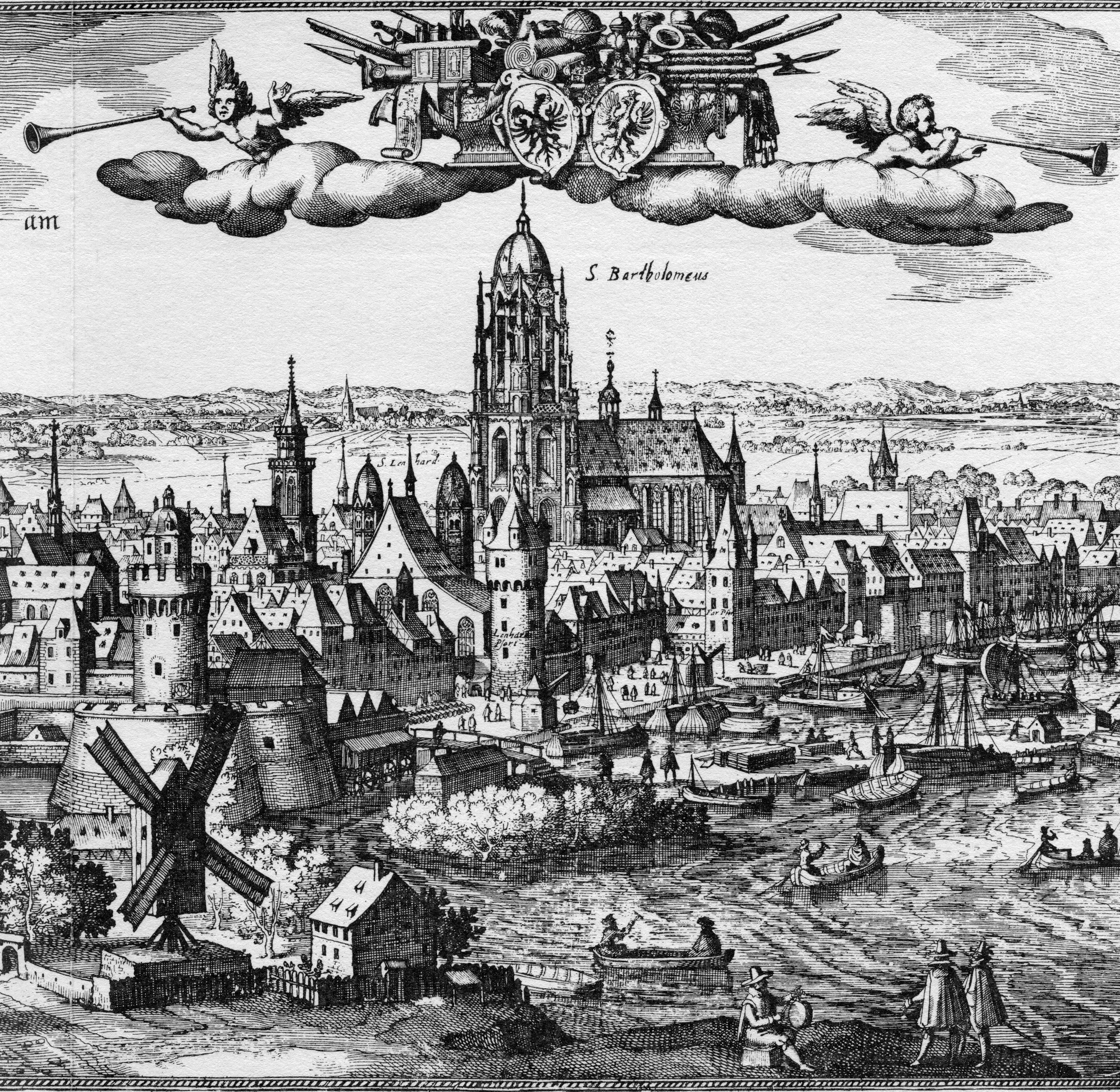
Matthäus Merian's near-contemporary view of Frankfurt am Main, seen across the Main toward its dense skyline and fortifications, situates the 1598 editio princeps in the commercial city that first carried it into circulation. The same urban economy that sustained the Frankfurt book fair made the Wechel heirs, de Marne, and Aubry a major continental channel for learned medical printing in the 1590s. Source ↗.
The paratext is composed in humanist-medical convention. The volume opens with a dedicatory epistle addressed to Silesian officers of the imperial chamber under Rudolf II; this is followed by commendatory verses addressed variously to the compiler, the printer, or the dedicatee, composed by Silesian and Paduan humanists. A Catalogus Auctorum supplies a prosopographical index of correspondents and contributors and serves as a table of the learned network from which the letters were drawn. An Interpretatio Graecorum glosses the Greek medical terminology carried over from Galen and Hippocrates, accommodating readers whose Greek was imperfect. A final Index rerum et verborum permits topical and lexicographical navigation through the printed disputations. The pagination runs by columns — a typographical device inherited from legal and theological polemic and adopted here to allow rapid comparative reading of question and response across the folio opening. The organizing conceit governing this apparatus is the programmatic claim that the learned letter is a form of disputation: it is an old practice, the preface holds, to interrogate a proposed problem, to dispute it, and to submit the answer to examination, such letters being called by the rhetoricians dialectical, erotematic, and didascalic, Vetus est ratio de problemate proposito interrogare, disputare, ac percunctanti & sciscitanti respondere, quodq[ue] responsum est ad examen reuocare. Tales Epistolas, suo quodâ iudicio, Rhetores in scholis Dialecticas, Erotematicas, & Didascalicas appellare consueuerunt, and the column-by-column layout materializes precisely that method of citable question and response.
The Wechel firm had long served as one of the principal continental outlets for classical, juridical, and learned-medical scholarship. Under Johann Wechel and his heirs, and through the partnership with Marne and Aubry, it became the principal printer of Galenic and anti-Paracelsian medical works in the Empire during the 1590s. The migration to Hanau around 1598–1603 was driven by a combination of disruption to the Frankfurt book fair and confessional-political pressures affecting Calvinist-leaning publishers under imperial Lutheran sentiment. Hanau, under Count Philipp Ludwig II of Hanau-Münzenberg, offered a more permissive confessional environment for Reformed and crypto-Calvinist publishers, and the Wechel-Aubry firm accordingly re-established there. The firm's medical and humanist programme intersected directly with Rudolfine imperial medicine and the Breslau-Padua-Prague axis around which Scholz's correspondence network turned.
The editorial paratext also signals the volume's confessional-intellectual placement. The dedication to Silesian imperial officers situates the work at the interface of imperial administration and learned medicine; the Catalogus Auctorum foregrounds correspondents whose Paduan, Reformed, or imperial-court affiliations align with a Galenic-Reformed, anti-Paracelsian polemical posture; the commendatory verses by Silesian and Paduan humanists anchor the volume in the Breslau-Padua-Bohemian corridor of late-humanist medical humanism. This Reformed devotional register surfaces within the letters themselves, most memorably in Crato's Pauline profession that now he lives, not he, but Christ lives in him, Viuo iam non / ego, sed viuit in me CHRISTVS, a note of illness and resignation that discloses the confessional temper of the network. The format and collation match the folio conventions of learned-medical anthologies of the period; no copy appears to record censorship interventions, although the inclusion of letters touching on Michael Servetus and on anti-Galen polemic would have rendered the volume sensitive in both Catholic and Lutheran markets.
The relation of the Epistolarum volumen to Scholz's other editorial productions is bibliographically tight. In the same year, 1598, the same Frankfurt firm issued Scholz's edition of the Consiliorum medicinalium … liber, a compilation of medical consilia associated principally with Crato von Krafftheim. A second, corrected edition of the consiliary volume appeared at Hanau in 1610 in parallel with the Epistolarum reissue. Together the two volumes — consilia and epistolae — form a paired editorial project: the consiliary case-letter genre and the learned-letter genre are presented as complementary instruments of late-humanist medical scholarship. Scholz's own Aphorismorum medicinalium (Breslau 1589) and Catalogus plantarum (Breslau 1594) round out his editorial canon and contextualize the Epistolarum volumen as the most ambitious and the most directly addressed to a learned-medical audience of his works.
Surviving copies of both issues are widely distributed across European libraries. WorldCat records identify copies of the 1598 Frankfurt edition in Brussels (Bibliothèque royale), Paris (BnF, Bibliothèque Sainte-Geneviève), Reims, Strasbourg, Amberg, Bamberg, Darmstadt, Erlangen, Jena, Munich (BSB and UB), Regensburg, Padua, Utrecht, Barcelona, Basel, Cambridge, Glasgow, and London. The Wolfenbütteler Digitale Bibliothek and the Münchener Digitalisierungszentrum (MDZ) host digitized facsimiles, with the BSB Munich copy providing the most complete record of the 1610 sheets. No modern critical edition or translation is known, and the volume remains editorially undertreated relative to its importance for the Galenic–chymical controversy of the late sixteenth century.
Reading the Letters as Disputations: Structure, Argument, and Textual Evidence
The Prefatory Programme: The Letter as Instrument of Inquiry
The volume opens by making its own genre the first object of argument, and the prefatory statement that governs everything after it is a claim about method rather than about medicine. Scholtz frames the learned letter not as a document of civility but as a formal instrument of inquiry, invoking the rhetoricians' taxonomy to license the transformation. The three adjectives with which he classes the letters — dialectical, erotematic, and didascalic — are not ornamental. Each names a distinct pedagogical operation — the disputational, the interrogative, and the instructional — and by classing the letters under them Scholtz asserts that private correspondence, once gathered and ordered, performs the same adjudicatory work as the scholastic quaestio. The letter becomes citable; the exchange becomes a tribunal; and the reader is positioned less as an overhearer of learned friendship than as an assessor of arguments submitted ad examen, that whole programme of interrogating, disputing, and submitting the answer to examination which the preface sets out at the head of the collection.
That editorial ambition carries a philological warrant, which Scholtz states with the precision of a man staking his volume's authority on textual condition. Distinguishing the previously unpublished letters from those merely reissued, he claims that those marked with an asterisk were never before printed, while the rest, though earlier committed to type, appear here in an edition far more correct than the prior one and more distinguished by the restitution of a number of passages, Quarum e[ss]e quæ asterisco sunt nocatæ, nunquam antea edica sunt: Reliquæ vero prius quidem typis expressæ: virum editio præsens priore multo correctior, ac nonnullorum locorum restitutione præstantior est. The vocabulary of restitutio is telling: it is the language of the textual editor who repairs corrupt readings, and its appearance in a collection of contemporary correspondence signals that Scholtz means the letters to be received as edited texts with a recoverable better state, not as raw transcripts. The claim of superior correctness is precisely the point at which the editor's hand becomes both most valuable and most opaque, since the reader is asked to trust an emendatory labour whose extent the printed page does not disclose.
The Opening Settlement: Chymistry Antedated, Skepticism Provoked
Once the letters proper begin, the negotiation the whole volume conducts between inherited authority and chymical technique is announced early and in its characteristic form. Seyller, defending mineral remedies, executes the move that recurs throughout: he detaches chymistry from its Paracelsian association by antedating it, arguing that the strongest remedies are best for the strongest diseases, and that such are those compounded from minerals, which are falsely ascribed to that Theophrastus Paracelsus, since it is well known that chemistry was familiar to the ancients — the passage on the antiquity of the mineral art already discussed in the philological framing above. The rhetorical economy of the sentence is worth dwelling on. It concedes the potency of mineral preparations and even their appropriateness to the gravest illnesses, but it purchases that concession by denying Paracelsus any proprietary claim upon them: the technique is admitted precisely because it can be shown to be ancient, and therefore compatible with a reformed Galenism, rather than a novelty imported under a suspect name. The dismissive demonstrative illi — "that Theophrastus" — performs the polemical distancing grammatically, while the appeal to what is notum … veteribus reclassifies chymistry from innovation to inheritance. This is the volume's signature manoeuvre in miniature: the substance of the new art is absorbed, its ideological patron repudiated.
Against this settlement, the Dudith correspondence introduces a corrosive skepticism that tests the discipline at its foundations. Dudith's provocation is cast as a dilemma designed to spur a defense: every disease is either lethal or curable, and on either horn medicine proves not merely unnecessary but wholly useless, since what is by nature lethal can be cured by no art, while what is curable will not require the physician's labour, Omnis morbus vel est lethalis, vel curabilis. Vtrum vis capias, non esse necessariam medicinam concludes, imo prorsus inutilem. Nam qui natura lethalis est, nulla arte eurari poterit. qui vicissim curabilis, non requiret Medici operam. The argument is a deliberately sophistical exhaustive division, and its function within the epistolary machinery is generative rather than destructive: by pressing the extreme case, Dudith obliges his correspondent to articulate the conjectural, probabilistic middle ground on which practical medicine actually operates. The same skeptical temper produces the collection's most quoted epistemological indictment, in which Dudith grants that the whole of the physicians' art is conjectural and, as the man says, makes its experiments through the deaths of men — the coniecturalis ars whose grim self-accusation was noted earlier among the collection's appeals to experience over demonstration. The word coniecturalis is doing heavy conceptual work: it locates medicine among the arts of estimation rather than of demonstration, and the clause about experiments conducted per mortes hominum converts the physician's clinical experience into a moral liability, the accumulated evidence of failed cures.
That preference for evidence over inherited demonstration hardens into a methodological principle when Dudith turns to the vexed questions of amulets and occult properties. Reflecting on cases that do not conform to the received reasoning, he concludes that experience enervates syllogisms which otherwise had seemed firm — the principle, again registered above, on which the collection lets observation override the schools. The verb eneruet — to drain of sinew, to unstring — is a precise metaphor for the epistemic reversal Dudith proposes: the syllogism, the very type of secure deductive knowledge, is figured as a body whose strength observation can sap. What had seemed firmus is shown to be only apparently so, and the criterion of firmness migrates from the formal validity of the inference to the testimony of experientia. This is not a repudiation of reason but a reordering of its subordination to observation, and it is precisely the kind of pressure that, applied across the volume, allows defensible innovations to lodge themselves within the Galenic frame.
The Contagion Debate and the Extremity of the Paracelsian Voice
The counterpoise to Dudith's dissolving skepticism is the Galenic architecture that Capivaccius reasserts in the contagion debate. Denying that any disease is contagious in its formal cause, he grounds his position in the consensus of the authorities, who unanimously affirm the formal cause of disease to be a bad constitution of the animate organ, and who distribute this into intemperance, bad composition, and dissolved unity, causam foriualem morbi esse malam constitutionem organi animati: hancque distribuunt in intemperiem, in malam compositionem, & in solutam vnitatem. The tripartite division — intemperies, mala compositio, soluta vnitas — is the classical Galenic taxonomy of disease, and by insisting that the causa formalis resides in the organ's constitution rather than in any transmissible agent, Capivaccius forecloses the ontological space into which a Fracastorian seminarium might otherwise be inserted. Contagion, on this view, is at most a vapor strongly mixed and dissimilar to the human body, an efficient occasion of disease rather than its form. The philological stakes of the whole controversy are visible here in the grammar itself: whether contagium names a relation or a substance turns on where the causa formalis is located, and Capivaccius answers by anchoring it firmly in the patient's own frame.
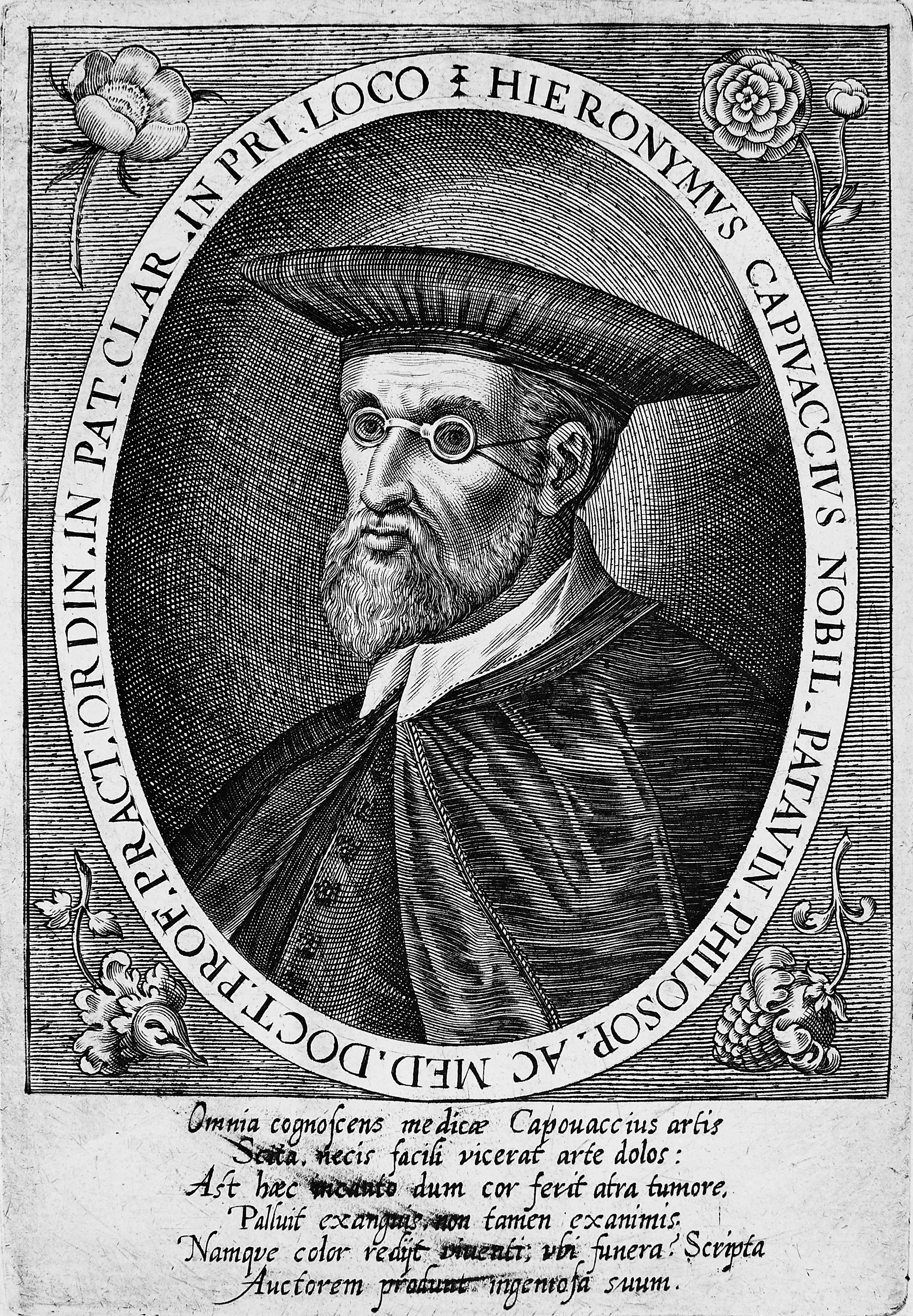
In this engraved likeness, Girolamo Capivaccio appears as the kind of authoritative Paduan physician whose Galenic commitments shaped Scholz's learned medical network. The portrait gives a face to the position that contagion was not a disease-form in itself, but an external occasion acting upon the patient's own bodily constitution. Source ↗.
The volume does not soften the extremity of the position it opposes. In the Pithopoeus–Barth exchange, the Paracelsian voice is preserved in its most inflammatory register, professing a medicine that is not the one which took root from the brain of Galen, a man blasphemous against Moses, against Christ, and therefore against God himself — the theological escalation already set beside the volume's other polemical extremes. The rhetorical escalation is theological rather than medical: Galen is attacked not for the falsity of his physiology but for an impiety climbing a ladder from Moses to Christ to God, so that adherence to Galenic medicine is made to implicate the physician in blasphemy. Preserving this passage serves the volume's editorial design precisely because its violence discredits the speaker; the confessional overreach of the Paracelsian is exhibited as the antithesis against which the measured Galenism of the collection defines itself. Barth's reply supplies that measure. Distinguishing usable findings from frivolous polemic, he grants what deserves acceptance but refuses to countenance the overturning of rightly discovered and demonstrated things by empty words, which he can call by no milder name than trifles, neque modestiore, quam nugarum vocabulo possum appellare. The reduction of the adversary's claims to nugae is a calculated deflation, the calm dismissive counterweight to Pithopoeus's theological thunder, and it models the accommodating posture the volume commends: chymical results that are recte inventa & demonstrata may be admitted, but the wholesale repudiation of demonstrated medicine is beneath serious refutation.
Relational Pharmacology at the Bedside
Between these poles the collection situates its concrete pharmacological controversies, and two clinical passages show how the same relational logic that governs poison governs therapeutics. Hoffmann's case against Paracelsian preparations is empirical and vivid: writing to princely readers, he reports that he saw that from the heavy use of those vitriolic preparations patients coughed up corroded lungs the colour of vitriol, Vidi quia multo vsu vitriolatorum istorum corrotos pulmones colore vitrioli eiecerint. The force of the testimony lies in its ocular directness — vidi — and in the grotesque literalism of the image, the substance stamping its own colour upon the tissue it destroys, so that the harm is legible on the expelled matter itself. The opposite valuation of a mineral preparation appears in the alchemical treatise transmitted under Arragosius's name, which reaches its climax in the identification of gold's extracted moisture as a panacea, the aurous moisture rightly administered being called the most excellent safeguard for preserving health and life and for expelling diseases — the aurum potabile passage examined in the philological framing. The qualifying adverb recte — rightly administered — is the hinge on which both cases turn: the vitriolic preparations harm through multo vsu, immoderate use, while the aurous moisture preserves only when correctly exhibited, so that the difference between poison and safeguard rests not in the substance's essence but in the manner and measure of its meeting with a particular body.
The gynecological material closes this movement on a note that displays the volume's method at its purest, where a clinical anomaly is deliberately posed as a quaestio against textual authority. Chrysaeus observes that his case runs counter to the received teaching, noting that it is manifest that this is contrary to Galen's doctrine, since all physicians agree, as Galen asserts in the sixth book of De locis affectis, that this affliction befalls widows for the most part, Hoc esse contra Galeni doctrinam manifestum est. Nam conuenit inter omnes Medicos, prout Galenus asserit, 6. de loc. affect. hunc affectum magna ex patre viduis euenire. The rhetorical structure is exemplary of the whole collection's procedure: an authoritative doctrine is stated with its precise textual citation, an observed case that contradicts it is set beside it, and the tension between doctrina and observed fact is left open as a problem submitted for disputation. The anomalous instance — suffocation of the womb arising where Galen's aetiology of widowhood and retained seed does not obtain — does not overturn the authority so much as oblige it to yield firmer reasons, which is exactly the discipline the prefatory programme demanded when it promised to submit each answer ad examen. The letter thus enacts, in the register of a single case history, the same subordination of received authority to reasoned examination that organizes the volume from its first prefatory sentence.
Soul, Faculty, and the Vaporous Definition of Contagion
The next stretch of correspondence opens in the middle of a disputation concerning the relation of facultas to anima, and its resolution sets the metaphysical pattern that governs the physiological reasoning to follow. Rather than admitting a plurality of really distinct powers, the correspondent grounds all bodily operation in the soul's simplicity: the soul, being one simple substance indivisible in itself, has not many faculties but one, indifferent to all operations that must be undergone, Anima cum sit substantia vna, & simplex ex se indiuisibilis, non habet plures facultates, sed vnam tantum, qua indifferens est ad omnes obeundas operationes. The single faculty is not multiplied but "contracted" and restricted in each organ by the proportion of elementary forms there, so that sanguificatio in the liver is one and the same soul-power narrowed by the local complexion. The philological weight falls on contracta: a term that lets the writer preserve the Aristotelian-Galenic unity of the animating principle while accounting for the observable specialization of the organs. The whole physiological edifice of the letters — digestion, blood-making, the seat of the several concoctions — rests on this refusal to reify the faculties into separate agents, and the argument is characteristically resolved not by appeal to authority but by a demonstration from the nature of the soul itself.
From this metaphysical footing the correspondence turns to its most consequential technical term, the definition of contagion, stated here in the vaporous and qualitative register of the Galenic-Aristotelian tradition: contagion is a vapor strongly mixed and, being a vapor, has the power of heating — the syllogistic definition already registered in the discussion of contagium and seminarium. The construction is deliberately syllogistic — contagion is a vapor; a vapor heats; therefore contagion heats — and it locates the morbid principle in the meteorology of exhalation and mixture rather than in any positive seed. This definition is the pivot on which the entire later plague correspondence turns, for it establishes the qualitative account that Crato's substance-based theory will subsequently strain against. Bound to it is a sharp methodological refusal: pressed on whether diseases of the whole form exist and can be reached by method, the correspondent answers flatly that these do not exist, Ego constanter affirmo, hos non dari. The stakes of this denial are precisely disciplinary. To admit morbi à tota forma would be to admit a class of disease acting by the whole substance, opaque to manifest qualities and therefore beyond the reach of methodus and indicatio; to deny them is to keep the whole of pathology within the rational physician's demonstrative grasp.
Yet the same letter that defends method concedes, with revealing candor, that the discovery of remedies is not itself a work of method but of experience, instancing the New World cure for the French disease: thus in the French contagion is found that antidote called Indian wood, by experience, Sic in contagio Gallico inuenitur illud antipharmacum, quod appellatur lignum Indicum experientia. The tension here is not a lapse but the productive fault line of the whole collection: guaiacum is found by experientia and only afterwards administered by rational art, so that experience furnishes the matter which method then governs. This subordination of finding to reasoning recurs across these letters and marks the reformed Galenism these physicians practise, in which novel and even extra-European remedies are absorbed without surrendering the claim that reason retains jurisdiction over their use.
Experience Against Doctrine: The Sugar Controversy and the Warrant of Reasons
The empirical strain sharpens into a genuine instrument of refutation in Mercuriale's contribution to the debate over whether sugar breeds the stone. Against the causal claim he sets a demographic counter-example, offering to bring forward peoples, regions, and kingdoms whose daily tables have nothing more frequent than sugar and where scarcely the very name of kidney-stones is known — the ethnographic refutation already noted among the collection's appeals to observed nations. The force of the argument lies in its structure: a universal causal proposition is broken by producing whole populations in whom the alleged cause is abundant and the alleged effect absent. That the counter-instances are named as distant peoples — Neapolitans, Sicilians, Turks — gives the refutation an ethnographic breadth that the syllogism alone could not command, and it exemplifies the collection's willingness to let observation of nations override a received doctrinal linkage between diet and disease.
The methodological warrant for such overriding is stated as a general principle in the letters ascribed to Montanus: neither Hippocrates nor Galen is to be believed in the art because they said a thing, but because they have good and firm reasons for what they said — the principle already identified as the tribunal of reasons on which the network rests. This converts the authority of the ancients from a ground of belief into a claim that must itself be underwritten by reasons; the physician owes assent not to the name but to the demonstration behind it. The same letter carries the correlative disclaimer that disarms merely terminological disputes, the writer professing that he does not fight about names, holding with Plato as reported by Galen that no care is to be taken about names when the investigation of such great matters is proposed, Nee ego de nominib[us] pugno, quin Platonis sententiam, quam refert Galenus, teneo, non esse habendam de nominibus curam. Together these two moves clear the ground for redefinition: if authority binds only through reasons, and names are indifferent where great matters are at issue, then a term as freighted as contagium may be reconstituted without impiety toward Galen.
Crato's Plague Theory: Contagion Recast as Venom
That reconstitution is the intellectual center of this movement. Crato's plague theory recasts contagion from a heating vapor into a destructive assault on substance itself, adopting Montanus's formulation that contagion is an affect destructive of the substance, to which putrefaction cannot subserve unless it be such and so great that it reaches a venomous quality of a fixed form, Est enim contagium affectus destructiuus substantiæ, vt Montanus ait, cui putredo non possit subuenite, nisi sit talis & tanta, vt perueniat ad venenatam qualitatem certæ formæ. The shift is decisive: the earlier qualitative definition located the danger in heat, a manifest quality answerable to cooling; here the danger is a venenata qualitas of a determinate form, a poison acting on the whole substance and not reducible to ordinary putrefaction. This is precisely the category of disease "of the whole substance" that the opening letter had denied for ordinary pathology, now readmitted at the level of pestilence — a telling internal complication, for the collection both refuses morbi à tota forma as a general class and requires something very like it to explain the plague.
The therapeutic consequences follow directly from the redescription. Because the pestilential putrefaction is itself venomous, it demands a counter-poison, whereas putrefaction as such demands drying — for since this putrefaction is venomous, the poison requires its antidote, but putrefaction requires drying, Na[m] cum hæc putredo sit venenata, venenum requirit suam antidotum. Putredo autem... exiccationem. The division of the therapeutic object into two — a venom to be met by alexipharmaca and a putrefaction to be met by exsiccatio — is what licenses Crato's insistence on antidotes and diaphoresis over the cooling regimens and venesection favored by his opponents. The nosology that organizes this therapy is his distinction between two kinds of plague, one private and one public, the private arising either from depraved humors through faulty regimen or from a bad constitution of the air — the taxonomy already set out among the volume's competing accounts of pestilence. Reserving the venomous, substance-destroying action for the public plague alone allows the private disorders to remain within the ordinary qualitative pathology, so that the two frameworks coexist by division of jurisdiction rather than by outright contradiction.
The poison-centered theory drags the materia medica of the earthen antidotes into view, and with it the period's acute anxiety over adulteration and provenance. The correspondent scrutinizes the identity of the sealed earths, observing that the sealed earth brought from Lemnos is always pale and commonly called Anatolian chalk, whereas Galen describes his own Lemnian seal as reddish in color, Terra sigillata, quæ è Lemno affertur, semper est pallida, & Creta Anatolica vulgo dicitur. Galenus suum sigillum Lemnium colore rubescente describit. The philological and the commercial converge here: a discrepancy of color between the drug now sold under the Lemnian name and the drug Galen described becomes evidence that the article of trade may not be the article of the text, so that the physician must adjudicate the authenticity of his remedies as carefully as the meaning of his authorities. In a controversy where the remedy is a specific counter-poison against a specific venomous form, such doubts about identity are not incidental but strike at the efficacy of the whole therapeutic scheme.
Framing these confident redefinitions is a recurrent epistemic modesty regarding the hidden causes at issue. On the ultimate matters — the venomous form, the seed-beds of putrefaction, the occult constitution of the air — the writer confesses that to know even a little of the highest things is above all precious and befitting the study of wisdom, Hoc tamen teneo, de summis rebus parum etiam scire in primis esse vile & sapientiæ studio conueniens. The concession is characteristic of the collection's temper, in which bold theoretical commitments about the nature of pestilence are held alongside an admission that the deepest causes remain only partially known. That admission also governs the parallel adjudications running through Crato's polemical letters — his ranking of the medical sects, where Galen is said to relate that there were three sects of physicians and to show by firm and clear reasons why, the methodists and empirics being set aside, the rational is to be followed, Tres sectas fuisse medicorum Galenus tradit, & ostendit firmis ac perspicuis rationibus, cur neglectis methodicis atque empiricis rationalis sit sequenda, and his subordination of chance to skill, that he who rightly knows the medical art least regards fortune and acts rightly both with it and without it, Qui medicam artem recte nouit, minime fortunam respicit, & cum hac & sine hac recte facit. In each case the same reformed Galenism is at work: the rational sect is preferred, and fortune subordinated to art, on the ground of firmae rationes rather than of name, so that the very principle that authorizes the redefinition of contagion also organizes the physician's self-understanding as a practitioner of demonstrative rather than fortunate cure.
Crato Between Chymistry and Confession
The letters dominated by the voice of Johannes Crato von Krafftheim enact the collection's central settlement — technique honoured, doctrine defended — with a directness that his own biography sharpens into paradox. His polemic against the Paracelsists opens on the terrain of language itself, where he treats their nomenclature not as difficult but as deliberately deceitful, charging that with them at one moment sulphur is oil, at another antimony, at another something else — the diagnosis of imposturae already cited among the volume's charges against Paracelsian usage. The force of the accusation lies in its diagnosis of imposturae and fraudes as the very method of the school: instability of reference is read not as an accident of an emergent vocabulary but as an epistemic vice, a screen behind which no stable knowledge can be held to account. This is the philological argument turned into a weapon — a physician trained to gloss the Greek of Galen treating terminological slippage as prima facie evidence of bad faith.
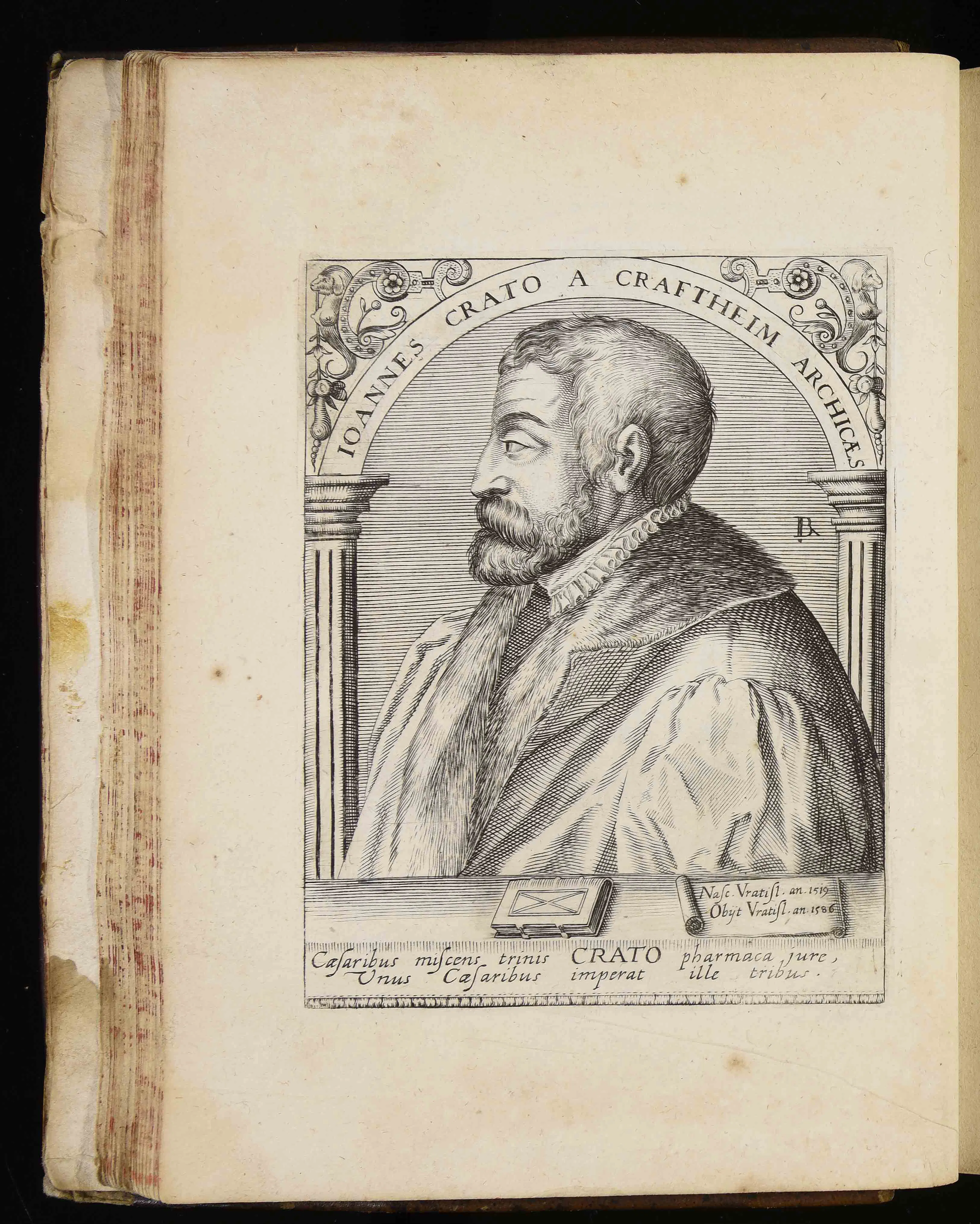
This 1627 engraved portrait of Johannes Crato von Krafftheim, printed in Jean Jacques Boissard's compendium of learned worthies, gives a face to the correspondent whose letters most sharply police the boundary between useful chemical technique and Paracelsian doctrinal fraud. The formal, inscribed likeness suits Crato's role as an authority figure: an imperial physician whose philological discipline made unstable terminology appear not merely obscure but morally and epistemically suspect. Source ↗.
Yet the same letters complicate any reading of Crato as a mere adversary of chemical pharmacy. In a striking act of self-attribution he claims personal authorship of the pharmacy's chemical repertoire, recalling that nothing of distilled oils, no extract, no juice was found in the pharmacies forty years ago, but that by him the apothecaries and physicians were so instructed, Nihil ante quadraginta annos oleorum destillatorum, nullum extractum, nullus succushic in Pharmacopiis est repertus. A me autem ita & Pharmaceopæi &. The passage discloses the precise seam along which the volume's settlement runs: the distilled preparation is not the property of Paracelsus, and its introduction is claimed as the achievement of a Galenist working within the officina rather than against it. Crato's defence of the technique is therefore inseparable from his repudiation of the men who would make the technique into a doctrine — chymistry welcomed as instrument, disowned as principle. He fixes the governing hierarchy in a methodological credo that subordinates all pharmacy to nature and art, insisting that by nature as guide and by art, not by the force of medicaments, we rightly and safely obtain victory over diseases, natura duce arte, non medicamento / rum robore victoriam in morbis recte / atq[ue] tute consequimur. The antithesis between natura duce arte and medicamentorum robore is the whole Galenic settlement in miniature: the robur of aggressive chemical remedies is admitted into the pharmacy but denied the office of legislating cure, which belongs to regimen and to the healing tendency of nature.
That his engagement with chymical vocabulary is a controlled appropriation rather than a rejection becomes explicit where he seizes the alchemists' most freighted term for his own distillation theory. Identifying the natural spirit drawn off by distillation, he declares that this spirit he reckons the fifth essence, and if it is anything else, he desires it to be demonstrated to him, Hunc spiritum ego / quintam essentiam duco, & si / quid aliud est, mihi / demonstrat cupio. The manoeuvre is characteristic: quinta essentia, a word saturated with Paracelsian resonance, is emptied of its metaphysical charge and reassigned to a demonstrable product of chemical operation, with the burden of proof — demonstrari cupio — thrown back upon anyone who would claim more for it. The same disciplined agnosticism governs his handling of transmutation, where he neither endorses nor derides but professes not to know, allowing that whether the philosophers' stone can render imperfect metals perfect, he does not know, Sed an lapis Philosphorum ... imperfecta metalla / perfecta reddere queat, haud scio. The haud scio is not the flat condemnation he reserves for Paracelsian medicine but a suspension of judgement proper to a question he regards as unsettled rather than fraudulent — a distinction that shows the volume's polemic to be calibrated by object rather than blanket.
The most sustained intellectual labour in this run of letters is Crato's theory of plague, developed in his exchange with Monavius, and it turns on a taxonomic cut between two species of pestilential disease. He posits one plague as private, arising from an internal cause and lacking any morbid exhalation, and another as public, in which from infected bodies a morbid exhalation emanates and the seeds of this are left behind in the air, Alia vero publica, in qua / ex corporibus infectis emanat morbida exspiratio, & reliquuntur semina huius in aëre. Here the volume's oscillation between an aerial vapor and a seminal agent is compressed into a single sentence: the morbida exspiratio is a relational emanation from diseased bodies, but its semina persist in the air as something that reproduces and transmits, so that Crato holds both ontologies of the disease-agent at once without resolving them into one. He reinforces the categorical separation with a causal grammar that assigns each kind to its own order of cause, contagion referred to external causes and putrefaction to internal, contagium ad causas externas; putredo ad / internas causas resertur — a distribution that keeps the non-contagious putredo of the private plague firmly apart from the transmissible contagium of the public one. The boldest consequence he draws is historical: the specifically contagious species is not to be found in the ancient authorities, and he reports that whether it excites contagious pestilent fevers, he does not find — the philological non reperio already registered above among the definitions of contagium. The philological negative — non reperio, I do not find it in the texts — is deployed as a substantive medical claim, converting the silence of Galen and Hippocrates into evidence that a genuinely new disease-species confronts the moderns. It is a delicate move for a Galenist, since it concedes that received authority does not exhaust the field of disease, and it does so precisely by the method of textual search that constitutes his authority.
The analogical reasoning that supports this contagion theory surfaces in the anecdotal material Crato marshals from the imperial court, where a hunting-poison is observed to be harmless in one channel of the body and lethal in another: it is not harmful if tasted on the tongue, but communicated to the blood it is deadly, si lingua degustetur, nulli noxium / esse, sanguini vero communicatum, exitiosum. The observation that the same matter is innocuous by mouth yet deadly in the blood furnishes a naturalistic template for reasoning that the disease of the baths entered not through ingestion but through the wounds opened by cupping-instruments and scalpels — the mode of entry, not the substance alone, determining the harm. This is the relational logic of the volume's pharmacology applied to contagion: the effect of a matter depends on the body and the channel it meets.
Running beneath the technical disputation is a confessional and autobiographical register that the collection does not suppress. Writing repeatedly from his sickbed amid chronic catarrh and wasting, Crato reaches for Pauline consolation, professing that now he lives, not he, but Christ lives in him — the profession already noted in connection with the volume's Reformed devotional temper — and he frames his decline as a matter of preparing for death, so that he must deliberate about rendering his spirit to God, vt de reddendo spiritu Deo / meo sit agitandum. These interpolations are not ornamental: the Reformed devotional temper of the network is here made continuous with its medical labour, the physician who theorizes the exhalation of the plague contemplating the exhalation of his own spirit in the same breath. The epistolary decorum that frames even the most pointed technical counsel is likewise on display where Crato closes a difficult communication with the assurance that he has written these things in the friendliest spirit, though they in no way concern the recipient, Hæc / ad te amicissimo animo, cum nihil ad te / pertineant, scribo, & me tibi quo ad vixero / amicum futurum polliceor — the diction of learned friendship cushioning the disputation and marking the letter as an instrument of a respublica litteraria as much as of medical argument.
This same run of correspondence carries the more purely scholastic physiology of Monavius, whose letters press the theoretical foundations on which the contagion debate rests. Reconciling the authorities on decay, he notes that Aristotle expressly mentions a double putrefaction, Duplicis enim putredinis expresse meminit, and from a parallel duplication of heat he builds a doctrine of two temperaments, reasoning that a double heat being given, of necessity he posited also a double temperament, calore / duplici dato, ex necessitate duplex etiam tepetamentum statui. The distinction of calor innatus from calor influens supplies the physiological substrate for distinguishing kinds of putrefaction, and thus for the very taxonomy of plague that Crato defends — the two correspondents' concerns dovetailing at the level of natural-philosophical principle. Monavius's letters extend the same rationalist temper to matters of regimen and instrumentation, deploying the anecdote of Alfonso of Aragon, who replied that he preferred to die within ten years rather than reach a hundred by such a way of life, subiecit: Mori se malie intra decem / annos ... quam ad centum tali vitæ genere / peruenite, against unduly austere dietary prescriptions for men of affairs, and commending the use of spectacles as greatly beneficial to the eyes, so far from bringing them any detriment, illorum vsum convenientem oculis / plurimum commodare, tantum abest, vt / detrimenti, aut noxæ quid eisdem adferat. Across both voices the letters function as printed disputations in which received authority is made to yield reasons, experience and anecdote are admitted as evidence, and chemical technique is granted its place only on the condition that it renounce any claim to govern the doctrine of health.
The Metaphysics of Poison and the Domestic Hierarchy of the Arts
The next sequence of numbered letters turns first upon a categorial dispute that goes to the metaphysical foundations of learned pharmacology: whether venenum names a substance in its own right or a relation contracted between an ingested matter and the body that receives it. The correspondent engaging Mercuriale's De venenis fastens upon what he takes to be an internal instability in Mercuriale's own formulation, observing that the definition offered a few lines earlier had made poison nothing other than a certain poisonous efficacious force placed in some body, Et tamen paucis ante lineis ipse affirmas; Nihil aliud esse venenum, quam vim quandam effectricem veneficam in corpore alioquo positam. The force of the objection is precisely dialectical: a vis lodged in corpore has the grammar of an accident inhering in a subject, and cannot without contradiction be classed among substances. The writer therefore prosecutes the point through the resources of the Aristotelian praedicamenta, and does so in the characteristic humanist-medical manner of pinning a contemporary authority to specific textual loci in the ancient corpus — Galen philosophizing the more correctly, as the philological framing above has already shown, in pronouncing nutriment, medicine, and poison to be relative to something, namely to man. The move consigns poison to the category of the ad aliquid: it is not a hidden essence but an extrinsic denomination, a name a matter wears only in respect of the body it meets.
This relational logic is not left abstract but is worked out into a graduated physiological scheme. The definitional core sorts the whole class of ingesta by the outcome of a contest between the body's nature and the thing taken in, so that foods are those overcome by our nature both in substance and in qualities, Cibi seu alimenta dicuntur, quæ à natura nostra, tum secundum substantiam; tum secundum qualitates vincuntur, while at the far end of the scale poisons are those which, in both substance and qualities, not merely resist but destroy and corrupt the body outright. What distinguishes the three members of the triad is thus not any intrinsic property fixed once for all but the direction and completeness of mastery in a particular encounter — precisely the reasoning that a relational ontology of venenum demands. The same letter extends the analysis to the puzzle of why particular poisons strike particular organs, insisting that there is no doubt that different poisons are by a certain peculiar power more noxious to different parts, venena quoque diuersa, diuersis partibus peculiari quadam virtute magis esse noxia. A catalogue of part-specific affinities — hemlock to the brain, cantharides to the bladder and kidneys, quicksilver to the nervous and bony parts — is marshalled against the received claim that all poisons make their primary assault upon the heart. The rhetorical procedure is empirical and enumerative: observed regularities of organ-specific damage are set as counter-instances against a general doctrine, and the peculiaris virtus invoked to explain them functions as a placeholder for a causal affinity not yet resolved into manifest qualities.
The same preference for scrutinizing operations that exceed simple quality governs the letters on metallic medicine. In the debate over how fire separates the pure from the impure parts of a metal, the writer refuses to reduce the action of fire to calefaction alone, arguing that in fire not only the heating power is to be considered but also that further force which so prevails in it that on its account, rather than on the definition of the hot, it enters the reckoning, In igne non tantum vim calefactoriam considerandam esse, sed etiam. Here the physics of preparation is being defended as more subtle than a crude Galenic account of the four qualities would allow, and the concession opens directly onto the volume's most delicate boundary-work. For the defence of prepared mineral remedies is at once coupled with an emphatic repudiation of the sect associated with them. The writer brings his metallurgical observations forward, he insists, by no means wishing to patronize those raving and insane followers of Paracelsus, the greatest part of whom conduct their trials through the slaughter of men — the disavowal of the asseclae already cited among the volume's central polemical postures. The disciplinary settlement is thus visible in miniature: technique is admitted, even praised, while the asseclae are cast out as practitioners of butchery rather than physicians. The concession to practice is qualified further by an epistemological admission that no one can rightly and without error pronounce on these matters who has not himself set his hand to the work, neminem de his recte atque sine etrore pronuociare posse, qui ipse manum operi noo admouerit — placed immediately after a citation of Aristotle to the effect that to deny the senses on account of reason is a weakness of judgment. The letters here negotiate openly between Galenic rationalism and manual expertise, allowing hands-on operation a probative authority that inherited demonstration alone cannot supply.
The Basel correspondence of Theodor Zwinger states the boundary between chymistry and medicine with the sharpest figure the collection affords. Esteeming chemical preparation genuinely, he nonetheless subjects it to a domestic hierarchy of mistress and servant that converts a ranking of the arts into a threat of correction — the mistress-and-handmaid image, worthy of the whip should the servant presume, that opened the philological framing of this report. The grammar of ministra and domina does the argumentative work: chymistry retains its office so long as it remains subaltern, and the moment it presumes to doctrinal primacy it forfeits its standing and invites discipline; the ensuing simile likening Paracelsus to a would-be tyrant extends the same political vocabulary of usurpation. That this settlement was reached through personal revision, and not simply inherited, is disclosed by an unusually candid autobiographical concession in the same letter. Confronted with his own earlier writings adduced to condemn chemistry wholesale, Zwinger wishes that by frequent repetition of tears he could delete the sins of his youth, & delita iuuentis vtnam crebra lacrymarum repetitione delere possem. The penitential register — the lacrymae that would wash away youthful peccata — recasts an intellectual shift as a moral correction, and shows the anti-chemical position being repudiated from within the Reformed Basel milieu rather than merely opposed from without.

Merian's 1642 view of Basel presents the Rhine city as a fortified, densely built scholarly centre, evoking the Reformed milieu in which Theodor Zwinger recast chymistry as medicine's subordinate handmaid. As one pole of the Padua–Breslau–Prague–Basel correspondence network, the city supplied not merely a backdrop but an institutional setting for revising anti-chemical polemic from within. Source ↗.
Erastus on Putrefaction and the Accommodation of Regimen
The correspondence with Thomas Erastus supplies this movement's most systematic reduction of contested categories to orthodox doctrine, and it proceeds by grounding disease-explanation in the physics of innate heat. Erastus lays down as his keystone that every putrefaction, whether it occurs by nature or is induced by disease or a violent cause, is a corruption of the heat implanted in any thing, proceeding from an adventitious heat, Omnis enim putredo, siue natuta eueniar, siue à morbo, aut violenta causa inducta sit, corruptio est insiti in re qualibet caloris ab aduentitio profecto calore. By defining all putredo as a single mechanism — native heat overwhelmed by an alien heat — he leaves no room for an occult mode of corruption operating outside the doctrine of qualities. The premise is secured on Aristotelian ground, that a thing remains safe just so long as it retains its own proper heat, Rem quamcunque tantisper saluam esse, quantisper proprium suum calorem retinet, with death defined as the deprivation of that same heat. Upon this footing Erastus brings even contagion within the compass of temperament, arguing that all diseases which contaminate other bodies through a seminarium necessarily first offend their temperament, omnes morbi, qui per seminarium aliena corpora contaminant, necessario temperationem eorum primo offendunt. The Fracastorian vocabulary of the seminarium is admitted only to be subordinated: whatever a contagious seed may be, it can do its damage solely by first corrupting the heart's temperament, and there is accordingly no room for a disease of the whole substance that would act by some inexplicable route. The reductive program is uncompromising, refusing occult disease-categories the standing of methodical doctrine and insisting that pestilence and contagion answer to the same account of quality and heat as any ordinary corruption.
Alongside these philosophical disputations runs a continuous vein of clinical prudence in which the relational logic already established for poison reappears as a principle of therapy. In matters of regimen the writer holds that, as in pharmacy so also in diet, regard must be had not only to the disease but also to the nature and custom of the patient, sicut in pharmacia: ita etiam in diæta nun tantum ad morbum: sed etiam ad naturam & consuetudinem ægri respiciendum. The Hippocratic accommodation of natura and consuetudo — a defence of moderate indulgence of habitual tastes against rigid prescription — belongs to the same conceptual family as the doctrine that a matter is food, medicine, or poison only in relation to the body that meets it: in both the individual constitution, not the abstract nature of the thing, determines the outcome. The therapeutic letters thus enact at the bedside the relational grammar that the opening dispute over venenum established in the schools, binding the volume's metaphysics of the ingested to its practice of prescription.
Erastus's Nominalist Foundation and the Fiction of the Whole-Substance Disease
The final movement of the correspondence, dominated by the voice of Thomas Erastus writing to Peter Monau, converts the volume's governing settlement — technique honoured in its place, disciplined the moment it claims doctrinal primacy — into a sustained metaphysical demonstration. Erastus does not begin from pharmacy but from the ontology of the particular, laying down a nominalist foundation on which everything else is built: truly, he insists, it is Peter, Paul, and the other single men who exist, while the species subsisting separately does not exist, Vere igitur existunt Pettus, Paulus & cæteri singuli homines, ipsa species seorsim subsistens non existit. The principle is not incidental. By denying that species and genera possess any freestanding reality — they are, as the surrounding argument makes explicit, constructs of the mind rather than things subsisting of themselves — Erastus deprives in advance any doctrine that would locate disease in an abstract "whole substance" of the very metaphysical footing it requires. The individual body, and the individual action performed through it, becomes the only site where health and sickness can be predicated.
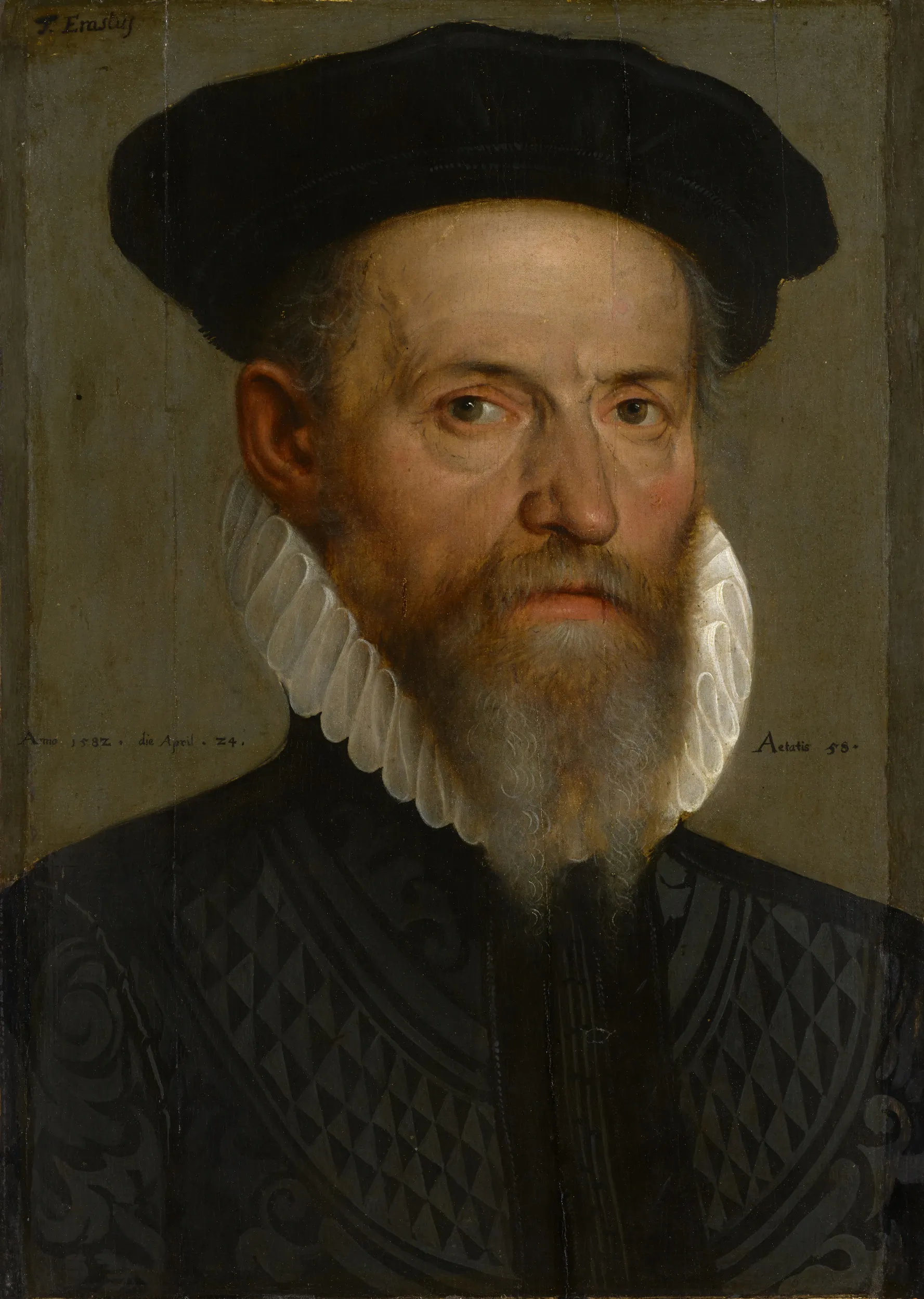
In this 1582 Basel portrait attributed to Tobias Stimmer, Thomas Erastus appears in the sober black dress of a learned physician-theologian, a fitting likeness for the correspondent whose letters turn disputes over medicines into questions of ontology. His role in the Monau exchange lay precisely in that move: denying freestanding universals in order to strip "whole-substance" disease and Paracelsian metallic cures of their metaphysical warrant. Source ↗.
From this base the argument moves to the relation of soul, instrument, and action. The soul is the principle of action only when taken generally; it becomes the efficient producer of a determinate operation only when joined to a determinate bodily organ, the soul insofar as it is the form of the body being merely the principle of action taken in general, whereas united with a fixed instrument it is the producer of a fixed action, Anima igitur quo ad forma est corporis, duntaxat generatim acceptæ actionis principium existit. Eadem cum instrumento certo vnitæ effærix certæ actionis est. This instrumentalist thesis is what allows the whole subsequent debate over loci affecti to proceed on Galenic terms: if every determinate action requires a determinate organ, then a damaged action must point back to a damaged organ, and the search for the seat of disease becomes a search for the injured instrument rather than for some diffuse corruption of the entire body. The Galenic axiom that anchors the exchange with Monau follows directly, that no action is injured while its instrument remains unharmed, Nullam actionem lædi, instrumento eius non læso — the principle around which the correspondents labour to reconcile apparently contradictory passages of De locis affectis.
The polemical target of this metaphysical scaffolding is the doctrine of the morbus totius substantiae, the "disease of the whole substance," and here the register sharpens into open combat. Erastus refuses these diseases the status of realities and brands them contrivances of two named authors, casting the pair in metaphors of manufacture: they are fictions which the architect of these diseases, Fernelius, and Argenterius the smith, have devised, Quate figmenta sunt, quæ horum morborum architectus Fernelius, & Argenterius faber commenti sunt. The choice of architectus and faber is not ornamental; it frames the disputed nosology as something built and hammered together rather than discovered, a fabrication in the literal sense. The charge is then given a genealogy that ties it to the volume's central controversy. The category is not merely false but recent, first devised by Fernel and — crucially — seeming to have sprouted first from chymistry, Est enim recens figmentum, à Fernelio primu[m], vt arbitror, exogitatum. Videtur autem è chimia pullulare primum coepisse. The horticultural verb pullulare, to bud or germinate, quietly implies an alien and creeping growth; by tracing the total-substance disease back to a chymical root, Erastus binds a nosological dispute to the Galenic–Paracelsian confrontation that gives the whole collection its spine, so that to reject the category is at once to reject a mode of natural philosophy. Underpinning the argument is a philological insistence, developed against Fernel and Argenterio alike, that the confusion arises from a mishandling of temperamentum in its double signification, the absolute against the singular temperament, which some call the property of temperament, singulare temperamentum (quod à nonnullis temperamenti proprietatem; the adversaries are convicted of trading on a homonym, and their disease of the whole substance dissolves back into ordinary intemperies.
When the argument turns explicitly to pharmacy, the same subordinating logic governs the treatment of metals and their chymical preparations. Erastus states his working hypothesis as a flat prohibition: metals and their cognates — misy, sory, quicksilver, stimmi — are not rashly to be swallowed in whatever manner they are prepared, and least of all when cooked by the force of fire, Hæc hypothesis nostra est, metall & his cognata, Mysi, Sery, Hydrargyrum, Stimmi, temere no[n] esse deuoranda, quouis modo sint præparata, præsertim vero si ignis vi sint cocinnata. The reservation about fire-concoction is pointed, since it is precisely the operations of the chymical officina that promise to render such minerals safe; the whole apparatus of preparation is denied the power to transform a dangerous substance into a nourishing one. This is the negative face of a settlement whose positive face is stated with unusual candour a few pages later, where Erastus distinguishes the operative chemistry he accepts from the alchemy he rejects, protesting that he has never reprehended chymistry insofar as it pursues distillation but praises and celebrates it, condemning it only insofar as it promises and attempts the transmutation of base metals into gold and silver — the exact formulation of the ministra medicinae posture set out at the head of this report, backed there too by the observation that transmutation has for several centuries been attempted in vain by many thousands and gone unpunished for none. Here that settlement receives one of its most exact formulations from the pen of the volume's fiercest anti-Paracelsian: distillation, the genuine art of separation, is welcomed; transmutation, the metaphysical overreach, is repudiated. The two are held apart by a clean conceptual line, and the argument against transmutation is emphatically empirical and historical rather than merely doctrinal, the weight of accumulated failure, not a syllogism, made to carry the verdict.
The relational, act-and-potency logic that runs through the volume's pharmacology surfaces vividly in Erastus's handling of degraded materia medica. A drug that has lost its active virtue is no longer the thing it is named, and he presses the point to a memorable extremity: though a certain root is called rhubarb, it is nonetheless truly not rhubarb but the cadaver of rhubarb, Etsi. n. Rhabarbarum nomi[n]o[n]atur radix , habarbarum tamen vere non est, sed rhabarbari cadauer. The word cadauer does more than dismiss spoiled stock; it insists that a medicine is defined by its operative power and not by its persisting external form, so that the empty husk of a once-effective simple stands to the living drug as a corpse to a man. This is the same denial of hidden, form-bound essences that governs the treatment of poison and metal elsewhere in the collection, here turned to the practical adjudication of what counts as a true remedy.
The metaphysical thread is drawn to its resolution in the dense scholastic pages on universals, where the problem of humanitas is settled in the same nominalist key that opened the sequence. Humanity is not a fourth thing added to a man but is the man himself, or rather the nature of man considered by the mind after the manner of an idea, Humanitas igitur est homo seu hominis natu ramente per modum ideo co[n]sidetata. By locating the universal in the mind's mode of consideration rather than in any subsisting reality, Erastus completes the arc begun with Peter and Paul: neither humanity nor the disease of the whole substance enjoys existence apart from particulars, and the metaphysics of the opening pages and the pharmacology of the middle pages are shown to rest on a single ontological commitment.
The Closing Letters and the Scholarly Apparatus
The collection's final letters shift the voice to Thomas Mouffet the Englishman, whose contribution complicates any impression that the volume speaks with one mouth against chymical preparation. Writing on the magistery of pearls and on mummy, Mouffet defends the medicinal use of mumia against the scruple of impiety and turns the objection back upon his correspondent, professing that he does not see why one should so dread its use in men with such religion, not to say superstition, neq[ue] video cur tanta cum religione, ne dicam superstirione ipsius in bominibus vsum pertimescas. The barbed ne dicam superstirione recasts the pious hesitation as itself a species of superstition, and the exchange preserves, within the same collection that so firmly disciplines chymistry, a defence of a chymically prepared remedy that presses in the opposite direction — evidence of the genuine disputation the volume stages rather than a settled verdict imposed upon it. The correspondence closes on a note of pharmaceutical policing with the letter of Valerius Cordus, whose testimony on viper-troches warns that there is great fraud in this matter, and that they ought to be made about the end of spring before the beginning of summer, Nam magna est in hæc re impostura. Fieri autem debent circa veris exitum ante initiu[m] æstatis; the concern with adulteration in the Venetian drug trade, and the exacting specification of the proper season of manufacture, restate at the level of the marketplace the same insistence that a remedy is what it does, not what it is called.
After this letter the collection reaches its FINIS, and the folio turns to its scholarly apparatus. The INTERPRETATIO GRÆCORVM OCCVRENTIVM PASSIM IN HIS EPISTOLIS renders into Latin the Greek terms scattered through the letters, keyed by column and line, so that the Galenic and Hippocratic vocabulary carried over in the correspondence is made accessible to readers whose Greek was imperfect. The INDEX RERVM ET VERBORVM IN HIS EPISTOLIS MEDICINALIBVS MEMORABILIVM follows as an alphabetical subject register running from Actio to Zuinger, tied to the text by the same column-and-line system; its very headwords — apoplexy, cantharides, contagion, gemstones, mumia, pestis, podagra, transmutation — preserve in miniature the thematic range of the whole volume and confirm that the letters were designed to be read not as a sequence of private communications but as a body of citable questions, retrievable term by term for the ongoing adjudication of learned medicine.
Frequently Asked Questions
What is the Epistolarum philosophicarum, medicinalium ac chymicarum volumen?
It is an edited anthology of learned Latin medical-philosophical correspondence, first issued at Frankfurt am Main in 1598 and reissued at Hanau in 1610. Compiled by the Breslau physician Lorenz Scholz von Rosenau, it gathers letters from the foremost physicians of the Empire and Italy — among them Crato von Krafftheim, Thomas Erastus, Girolamo Mercuriale, and Theodor Zwinger — and arranges each exchange as a disputed question of learned medicine. Rather than a treatise, it is an edited archive, printed in folio and furnished with prosopographical and lexical indices to make the letters citable question by question.
Who was Lorenz Scholz von Rosenau?
Lorenz Scholz von Rosenau (1552–1599) was a physician and botanist of Breslau, whose name appears in the volume in the Latinized form Laurentii Scholzii à Rosenaw. Beyond this collection of letters, he edited a companion volume of medical consilia associated principally with Crato von Krafftheim (Frankfurt 1598; Hanau 1610), and issued an Aphorismorum medicinalium (Breslau 1589) and a Catalogus plantarum (Breslau 1594). No dedicated modern monograph on him exists; the standard biographical notice remains that in the Allgemeine Deutsche Biographie, with supplementary entries in Silesian medical-historical literature.
What did the phrase "handmaid worthy of the whip" mean in the controversy over chymistry?
It captures the volume's central settlement toward the new chymical art. One correspondent avows that he greatly esteems chemistry as the handmaid of medicine — ministra medicinae — but holds her worthy of the whip should she presume to set herself before her mistress. The image converts a hierarchy of the arts into a disciplinary sanction: chemical preparations such as distillations and mineral remedies are welcomed and even defended as genuinely ancient, but chymistry is refused any claim to overturn Galenic doctrine, and Paracelsus and his followers are repudiated as fraudulent.
How does the volume argue that a single substance can be food, medicine, or poison?
Through a scholastic-Aristotelian insight drawn from the Categoriae: poison is not a hidden essence but a relatum ad aliquid, a relation to a particular body. The letters commend Galen for pronouncing nutriment, medicine, and poison to be relative to something — namely to man — so that the same matter may nourish, heal, or destroy depending on whom it meets and by which channel it enters. A hunting-poison harmless on the tongue proves deadly in the blood; degraded rhubarb, having lost its virtue, is dismissed as no true rhubarb but its "cadaver."
Is there an English translation of the Epistolarum philosophicarum, medicinalium ac chymicarum volumen?
No modern critical edition or translation has been identified; the principal access route has remained digitized facsimiles held at the BSB Munich and the Wolfenbütteler Digitale Bibliothek. Separately, the Leo edition now presents the full transcription and a complete English translation for the first time. That translation is generated by AI. Leo is an effort to make freely available online, at no cost, English translations of every text printed in Latin in early modern Europe between 1450 and 1750. Given the collection's importance to the Galenic–chymical controversy it documents, this fills a genuine gap in access.
This report was generated by an advanced AI assistant that conducted deep research alongside an extensive interpretation of the transcribed original text. Every effort has been made to preserve fidelity to the source and to guard against inaccuracy, but corruption in the text recognition process and model hallucination may nonetheless have entered the text. Treat every claim, quotation, translation, and citation as provisional, and verify each against the original source before relying on or citing it.
Bibliography
- Allen G. Debus, The French Paracelsians: The Chemical Challenge to Medical and Scientific Tradition in Early Modern France: Supplies the indispensable framework for reading Scholz's Epistolae as a documentary archive of the Galenic–Paracelsian controversy. Debus's account of how chemically oriented physicians negotiated the boundary between chymistry and medicine maps directly onto the volume's chymia ministra medicinae posture, and his broader thesis of a gradual chymical colonization of academic medicine is one of the two positions the letters can be marshalled to support.
- Charles D. Gunnoe, Jr., Thomas Erastus and the Palatinate: A Renaissance Physician in the Second Reformation: The authoritative treatment of Erastus's anti-Paracelsian campaign, attentive to his disputations against Paracelsian pharmacology and to his placement within the Heidelberg–Basel network. Since Erastus supplies the volume's most systematic metaphysical demolition of the whole-substance disease, Gunnoe is the surest guide to why Scholz gave him such prominence and what that inclusion was meant to signal.
- Bruce T. Moran, The Alchemical World of the German Court: Occult Philosophy and Learning in the Circle of Moritz of Hessen (1572–1632): Focused on the Hessian court but broadly applicable, Moran's study lays out how German princely courts absorbed chymical medicine and the politics that governed that absorption. It supplies the institutional context in which a Rudolfine, imperially dedicated compilation such as Scholz's would have circulated and been read.
- Jole Shackelford, A Philosophical Path for Paracelsian Medicine: The Ideas, Intellectual Context, and Influence of Petrus Severinus (1540/2–1602): Situates the chymical wing against which the Breslau–Padua correspondents defined themselves and traces how Paracelsian iatrochemistry entered learned discourse. Essential for grasping why the volume can defend chemical pharmacy while refusing its Paracelsian metaphysics — precisely the contested boundary Shackelford insists was still live in the 1590s.
- Andrew Wear, Roger K. French, and Iain M. Lonie, eds., The Medical Renaissance of the Sixteenth Century: The standard collection for situating the learned medical letter, the Padua-trained physician, and the place of chymical remedies within sixteenth-century learned medicine. It furnishes the conceptual vocabulary for the Galenic–chymical boundary-work the volume performs, and its essays touch the relational ontology of venenum and the reception of Fracastorian contagion that the letters repeatedly stage.
- Wikipedia contributors, "Thomas Erastus," Wikipedia: A serviceable orientation to the physician whose polemics against astrology, alchemy, and the system of Paracelsus shape the volume's final movement. Useful as a first bearing on Erastus's career and controversies before turning to Gunnoe's monograph, though not a substitute for it.