Pits in Tallow, Alike and Equal: Giovanni Poleni's On River Headworks with Converging Sides, by Which River Waters Are Diverted: A Book Containing New Experiments on Flowing Waters and the Forces of Percussion
Giovanni Poleni's De castellis per quae derivantur fluviorum aquae habentibus latera convergentia liber (Padua, 1718) asks a question every Venetian water magistrate needed answered — how much water actually passes through a river intake — and returns the destructive answer that no table computed from orifice area and elapsed time can be trusted, because the shape of the parts beside an opening alters the discharge. Along the way its author, a professor at Padua and fellow of the Royal Society, drops two balls of equal size and unequal weight into tallow before Vallisneri, Morgagni and a Bernoulli, and pronounces the European quarrel over the forces of moving bodies decided by the two identical pits they leave. It is a treatise on sluices that claims Roman names, adjudicates a Leibnizian dispute, and then closes by conceding the one figure it could not make its measurements yield.
ExLatinis
August 3, 2026
Contents
Giovanni Poleni's De castellis per quae derivantur fluviorum aquae habentibus latera convergentia liber (Padua, 1718) asks a question every Venetian water magistrate needed answered — how much water actually passes through a river intake — and returns the destructive answer that no table computed from orifice area and elapsed time can be trusted, because the shape of the parts beside an opening alters the discharge. Along the way its author, a professor at Padua and fellow of the Royal Society, drops two balls of equal size and unequal weight into tallow before Vallisneri, Morgagni and a Bernoulli, and pronounces the European quarrel over the forces of moving bodies decided by the two identical pits they leave. It is a treatise on sluices that claims Roman names, adjudicates a Leibnizian dispute, and then closes by conceding the one figure it could not make its measurements yield.
Giovanni Poleni (Venice, 1683 – Padua, 1761) was, in 1718, a professor in the University of Padua — the Gymnasium Patavinum — and already a fellow of the Royal Society of London and of the Royal Prussian Academy of Sciences in Berlin when he published, from the press of Giuseppe Comino, a slim Latin quarto with a title that promises two things at once: De castellis per quae derivantur fluviorum aquae habentibus latera convergentia liber, a book on river headworks with converging sides, containing new experiments on flowing waters and the forces of percussion. It is a technical treatise of the Venetian terraferma, written for magistrates and mathematicians alike, and it belongs to a moment when the management of rivers, the antiquarian recovery of Roman hydraulic vocabulary, and the most contentious dispute in European mechanics could still be conducted inside a single set of covers.
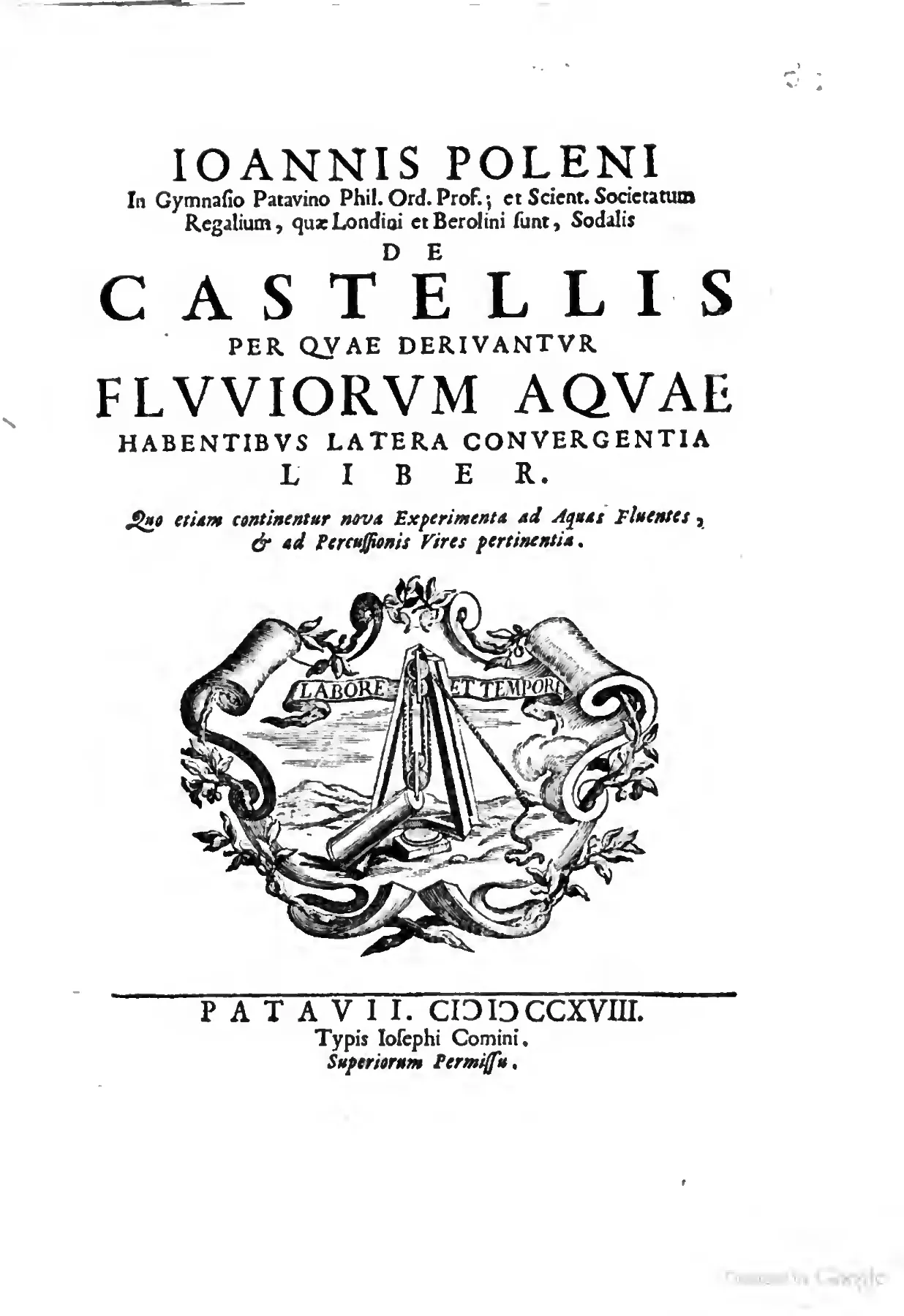
Poleni's 1718 title page announces the book's dual ambition: his Paduan professorship and membership of the London and Berlin scientific societies frame a Latin title joining hydraulic engineering to new experiments on percussion, while the Padua imprint and "Superiorum Permissu" place it within the licensing world of Venetian learned printing. Source ↗.
The problem the book confronts is deceptively simple: how much water actually passes through an opening, and whether that quantity can be computed from the geometry of the opening alone. Poleni takes up the case he judges neglected — a diversion structure whose inner faces converge toward the outflow — and argues that the quantity delivered is governed not by the entry from the river but by the exit-mouth, and, more damagingly for administrative practice, that the figure of the parts adjoining an aperture defeats any universal table of discharge computed from area and elapsed time. The recurring move by which he presses this case is consistent from first page to last: authority, verbal dispute and the practitioners' appeal to usus are displaced by measured trial conducted before named witnesses, and nothing is asserted beyond what the trial licenses. The sub-duplicate relation of discharge to head is offered as a law of Nature because it was measured; the contracted vein of water is defined operationally, by its smallest measured circumference; the celebrated question of the forces of moving bodies is submitted to cavities punched in tallow. Where experiment cannot reach — whether there is any true attraction, or something like a magnetic pulsion, behind the adhesion of water to tubes — the cause is left explicitly suspended, the phenomenon recorded and its explanation deferred.
Much of the book's interest lies in the specificity of its particulars. Poleni measures with a pendulum clock and in Paduan feet, pollices and lineae, maintaining constant head with a tapered rod in a three-vessel apparatus, and records his contraction ratio as 52:41 against the 25:21 that Newton had published in the second edition of the Principia. His percussion trial sets two balls of equal size but unequal weight — two pounds of lead, one pound of hollow brass — falling from heights in the ratio 1:2, and finds that they leave pits in tallow that are alike and altogether equal; earlier trials by Riccioli with Montanari, by Gassendi, by Mersenne and by Francesco Lana Terzi are dismissed as vitiated by unequal causes compared with unequal effects. The domestic series of trials was attested by witnesses of standing in the Paduan and Venetian learned world, among them Antonio Vallisneri, Giovanni Battista Morgagni, Nicolaus (I) Bernoulli and a Giovanni Gratiano whose Italian form has not been securely established. And the book ends not in triumph but in an admission: the velocity of efflux he measures, even after allowing for contraction, falls well short of what the Torricellian rule published in the Acta Eruditorum of 1716 requires. Foundations, he says, are what he has laid; the pinnacle belongs to a happier time.
The stakes of this posture are larger than the sluices of the Chiana or the Brenta. On one side lies the long divorce, traced across two centuries of modern scholarship, between a practical hydraulics of measured discharge and a mathematical hydrodynamics of derived velocities; Poleni stands at the point of separation, refusing to let calculation outrun trial. On the other lies the vis viva controversy, where his careful table of terms — Motus Caussa, pressio, impressio, effectus integer, Vis Viva, impulsus — is not ornament but the apparatus by which a dispute alleged to be merely about words is made to answer to a piece of tallow. Between these lies a third stake, juridical and administrative: if no table of discharge from orifice area and time can be trusted, then the assessment of water rights, the sale and allocation of measured water, and the certification of intakes by magistrates rest on a foundation the book has just shown to be unsound.
What unites the treatise's vocabulary, its making and its argument is the transfer of authority from precedent to trial, performed in a language of precedent. The word castellum is lifted from the distribution chambers of the Roman aqueducts and fixed upon a river headwork; Columella and Ulpian's incilia are set aside, the ditch for draining Lake Fucino is invoked from Suetonius to license a new coinage for diversion channels, and Art is described as needing to join its industry to Nature's laws rather than coerce them. Yet each of these antiquarian gestures is immediately followed by a measurement, and the Latin itself is defended as the medium in which the greatest number may both understand and correct what is proposed. That the volume passed the Riformatori dello Studio di Padova, carried a Dominican approbation, and was deposited in the public libraries of Venice and Padua is part of the same picture: a book that claims Roman names, Venetian jurisdiction, a specialist university press and a contested Leibnizian lexicon in order to say, with unusual insistence, what can and cannot be known about water from controlled trial.
Read the full text and English translation on Leo
This text was transcribed and translated as part of the ExLatinis project, an effort by Leo to make free English translations of every text published in Latin in early modern Europe (1450–1750) available online. The complete transcription and English translation of this work can be read free of charge:
→ Read the original Latin text and full English translation on Leo
You can save a copy of this document into your Leo account to run deep text searches, conduct further analysis, or cross-reference it with your own research.
Titling De castellis: Poleni's Castellum, Ostium, and the Lexicon of Impact
Editorial English title (supplied for convenience, not established in the historiography): On River Headworks with Converging Sides, by Which River Waters Are Diverted: A Book Containing New Experiments on Flowing Waters and the Forces of Percussion.
Philological framing of De castellis (Padua, 1718). The introductory constructions themselves mark the projected scope of Poleni's enterprise. Castellum is the term on which the entire title hinges, and its weight cannot be reduced to 'sluice', 'lock', or 'intake'. In Roman hydraulic vocabulary — and especially in Frontinus' De aquaeductu — castellum designates a distribution reservoir, the cistern into which the aqueduct delivers its water and from which the household or municipal lead-pipes (fistulae) are fed. The word thus belongs simultaneously to the technology of conduit-water and to the public architecture of the Roman civitas. Poleni's text begins, however, by displacing that meaning. The very opening passage announces that Columella and Ulpian call the places at which water is first led away from a river incilia, and reserves castella for the constructed intake or headwork with its diverging inner faces, the object of his own analysis. The act of naming is performed explicitly and with its warrant stated: on account of the fortification of its parts, and on account of its likeness to the castella of aqueducts, the fortified opening under discussion is to be called by the name of castellum, nos tamen propter partium munitionem, & propter similitudinem cum Aquæductuum Castellis, lumen CIRD munitum, de quo modo verba fecimus, Castelli vocabulo nuncupabimus. The displaced term is given its juridical pedigree in the same breath, the older usage being credited to Ulpian, in the law 'Prætor ait' I, in the section Secta, of the title de Rivis, where such places are named incilia, ab Vlpiano, Lege Prætor ait I. in S. Secta ff. de Rivis, nominantur Incilia. The noun therefore transfers the institutional and architectural authority of the aqueduct castellum onto a river-diversion structure: the hydraulic apparatus is named as if it were a regulative public work, and the river intake is described as if it inherited the curatorial responsibility of the Roman distribution chamber. The transference is not casual. It evokes enclosure, controlled admission, the regulation of flow; it makes the castellum a juridical as well as a technical object. To render it 'castle' in the ordinary modern sense would obscure exactly this antiquarian and hydraulic double charge.
The same naming discipline governs the internal anatomy of the structure, and it is here that the vocabulary carries the book's central claim. Poleni fixes two terms upon the two parts of the opening — the part CD, through which the river's water flows into the castellum, is called the castellum's entry from the river, and the other part EF, through which the water flows out of the castellum into the ditch, is called the exit-mouth, luminis pars CD, per quam Fluminis aqua Castellum influit, dicetur Castelli Aditus a Flumine: luminis pars alia EF, per quam aqua ex Castello effluit in Fossam, dicetur exitus Ostium — and the whole subsequent argument that discharge is governed by the ostium rather than the aditus is already prepared by this act of definition. A third coinage extends the antiquarian method to the channels themselves: ditches of the kind commonly called diversivi are named diversion ditches, with the conjecture that they might also be termed emissaria, since Suetonius so called the ditch for draining the Fucine Lake, Hujuscemodi Fossas (vulgo Diversivi) diversionum Fossas appello. Emissaria dici potuisse suspicor, quod a Svetonio fossa, ad derivandum Fucinum Lacum, Emissarium dicta fuerit. The Latin place and institutional forms are transparent but historically significant: Patavii is Padua, Gymnasium Patavinum the University, Venetiae Venice, Clanis the Chiana, and Lacus Fucinus Lake Fucino. The author signs Ioannis Poleni on the title page and Ioannes Polenus at the close of the dedication; no pseudonym or anagram is attested.
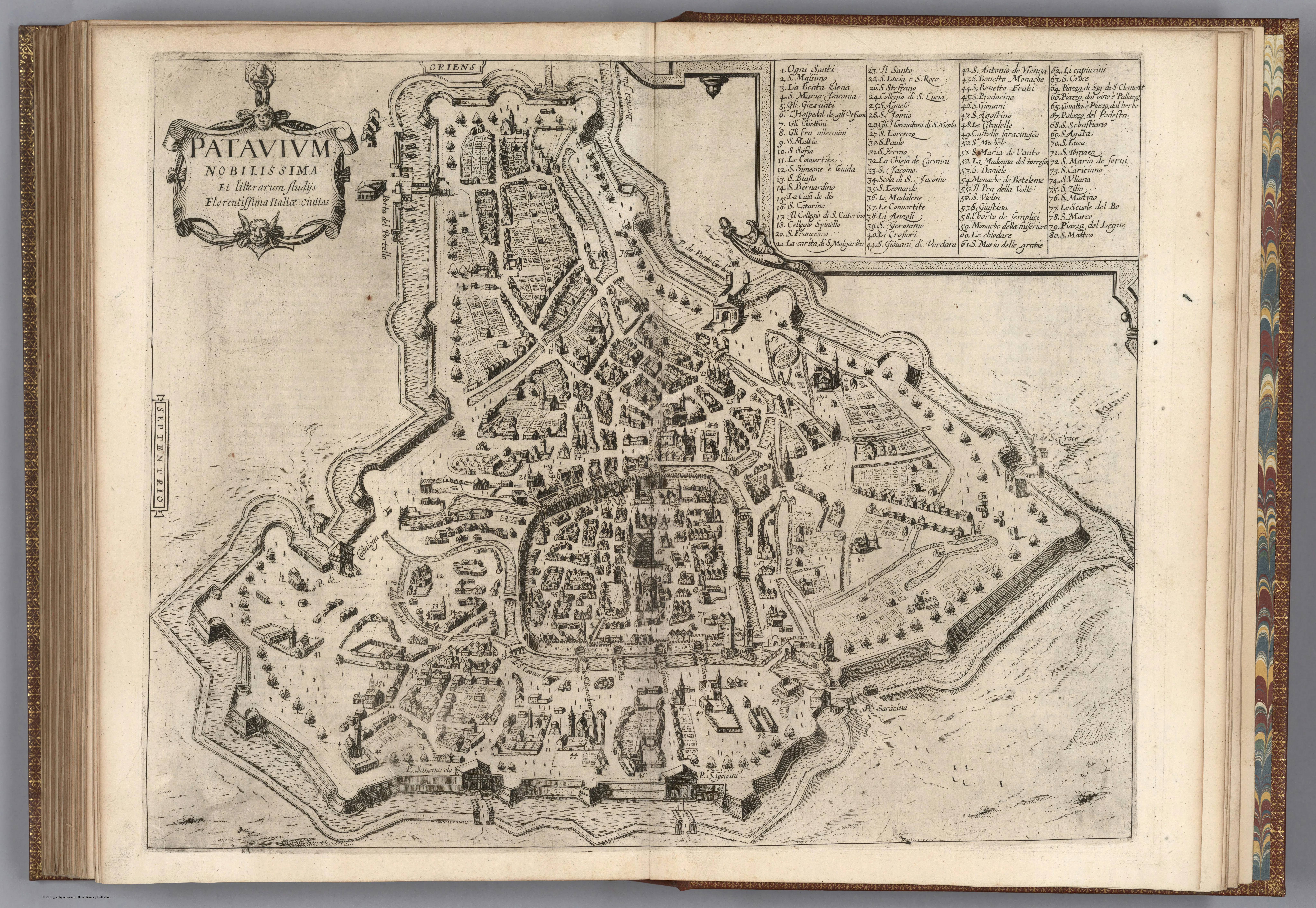
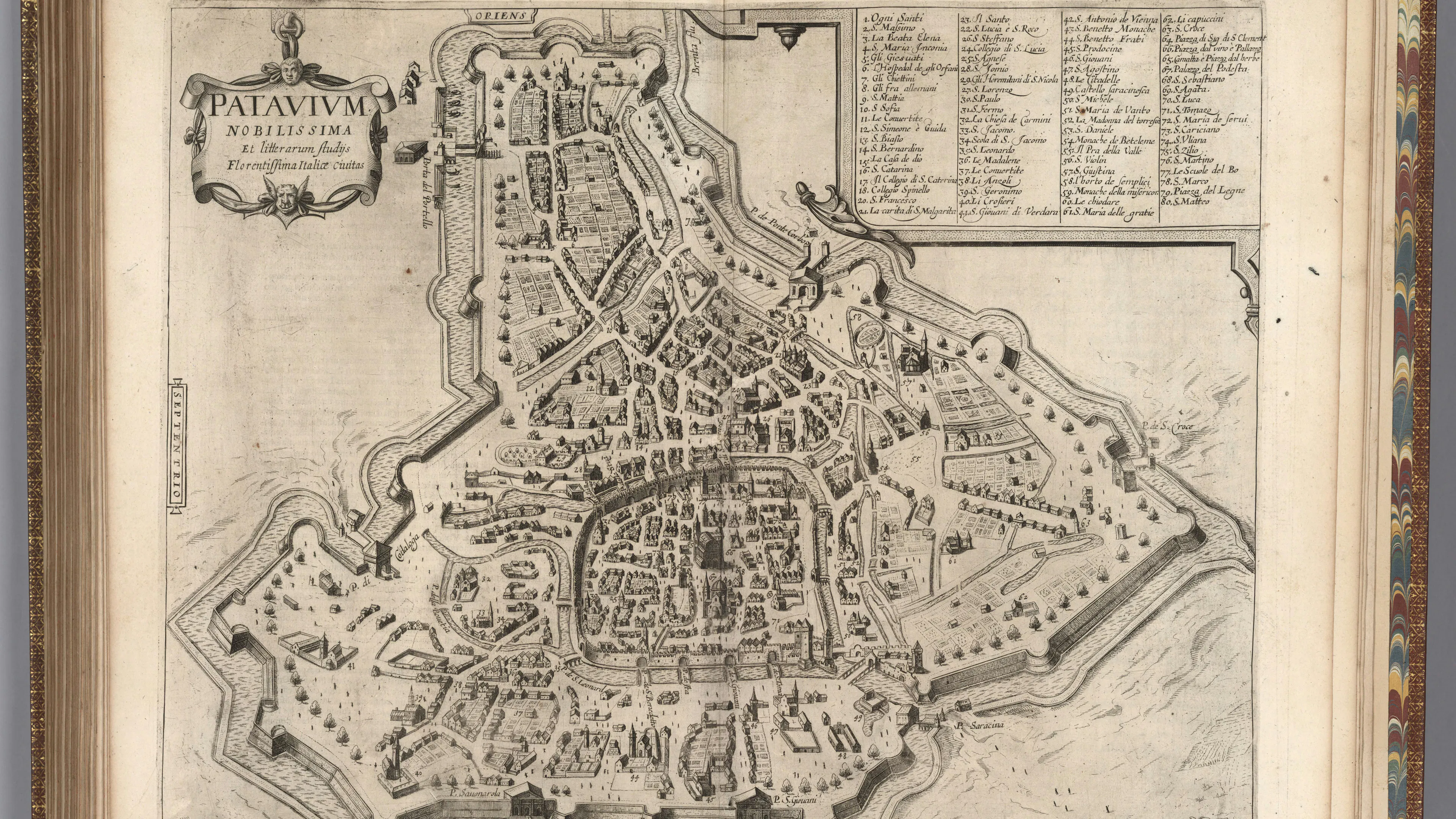
A period city view of Patavium — Padua — giving visible form to the Latin geography behind Poleni's institutional world: a dense university city set among bridges, channels and the cultivated Venetian terraferma. Its waterways are the hydraulic landscape within which the Gymnasium Patavinum, the Comino press and Padua's learned administration framed the problems of De castellis. Source ↗.
Against this background, vis viva and its accompanying vocabulary belong to an early-eighteenth-century lexicon of impact that cannot simply be rewritten as eighteenth- or nineteenth-century 'kinetic energy'. Poleni's text states that the cause of the whole effect (effectus integer) is to be called Vis Viva — the definition is given in the barest possible form, that the cause of this whole effect shall be called Living Force, Et caussa hujus effectus integri dicetur Vis Viva — and distinguishes within this nexus of terms Motus Causa (the cause by which bodies are driven), pressio (the action or impulse when a moving body strikes another), impressio (the effect produced by that pressure), and impulsus (the motion transferred or lost in impact). These distinctions show that the word operates inside a theory of action, impact, and measurable effect — not as a decorative Latin equivalent of 'force'. The lexical scaffolding is consistent with the historiographical reading that the vis viva controversy was not merely verbal but concerned with the meanings attached to 'force' and 'effect', the metaphysical commitments of Leibnizian and Cartesian mechanics, and the status of demonstrations and experiments: Carolyn Iltis's reconstruction of the Leibnizian dispute and David Papineau's direct interrogation of the 'merely verbal' reduction situate the controversy precisely here. Poleni's tallow-cavity percussion trial — equal-sized lead (2 lb) and hollow brass (1 lb) balls dropped from the heights in the ratio 1 : 2 — is therefore not a decorative display but the experimental device through which the lexical distinction is calibrated against nature.
Two further terms deserve attention as matters of philological caution rather than thematic flourish. Ratio subduplicata — the 'subduplicate' or square-root relation to the height of the overlying water that Poleni presents as a 'law of Nature' guiding measurement of discharge — belongs to early-modern ratio vocabulary, in which ratio is a relation between quantities rather than a formal abstract number, and subduplicata states the kind of proportionality observed in experiment. The formulation in the text is emphatic in exactly this idiom, namely that Nature preserves this law: that the quantities of waters flowing by the force of superincumbent water are always in the sub-duplicate ratio of the height of the superincumbent water, servari nempe a Natura hanc legem; ut aquarum, ob vim aquæ superincumbentis fluentium, quantitates semper sint in subduplicata ratione superincumbentis aquæ altitudinis, and it is offered as a corollary of measurement rather than as a deduction from principles. It is therefore best rendered against the wider question of how practical hydraulics became separated from mathematical hydrodynamics — a divide that Michael Eckert traces across Daniel and Johann Bernoulli, Torricelli, Mariotte, Newton and the Acta Eruditorum (1716) debate, and that Antonio Malcherek re-examines in Poleni's 1717 De motu aquae mixto as the dependence of discharge on the 'dead water' or weir height. Finally, ars aemula naturae and hydrometria have been treated as terms of art that Poleni might be expected to claim for his discipline, and neither formula was securely located in the OCR of the surviving 1718 copy; on the evidence of the text as read, the two stand differently. The disciplinary label does occur in the accusative, in the deprecatory formula about anyone who has tasted hydrometry, as they say, with the tips of his lips, tamen, qui primis, ut dicitur, labris gustaverit Hydrometriam, where it names a competence assumed in the reader rather than a discipline being founded. The ars aemula naturae formula, by contrast, is not verbatim attested in a securely read passage, although the relation it compresses is stated at length in the text's own words: the industry of Art ought not to aim at compelling Nature to what Art contrives, but at so joining its industry with Nature's laws and rationales, Quare eo spectare Artis industria non debet, ut Naturam ad res illas, quas ipsa Ars molitur, cogat; sed ut suam industriam cum Naturæ legibus atque rationibus ita conjungat. Neither term should be pressed into service as a programmatic declaration on the strength of the formula alone; any reading built simply on their presence would be conjectural rather than philological.
What Poleni's De castellis (Padua, 1718) Sets Out to Establish
De castellis per quae derivantur fluviorum aquae habentibus latera convergentia liber (Padua, 1718) is a printed Latin technical treatise combining practical hydraulic design and early-modern natural philosophy, with experimental findings on impact and percussion. The author, Giovanni Poleni (Venice, 23 August 1683 — Padua, 15 November 1761), later professor of astronomy and meteorology, physics, mathematics and experimental philosophy at the University of Padua (Gymnasium Patavinum), and fellow (socius) of the Royal Society of London and the Royal Prussian Academy of Sciences in Berlin, signed the volume on the title page as Ioannis Poleni in Gymnasio Patavino phil. ord. prof.. The book was printed at Padua in the press of Giuseppe Comino (Typis Iosephi Comini) in 1718 and addresses, in its Latin dedication, the three Riformatori dello Studio di Padova then in office.
The driving purpose of the volume is twofold. First, Poleni defines and analyses castella with converging sides — the structures through which river water is admitted and diverted — relating their geometric form to the quantity, velocity, pressure and impact of water. He presents the undertaking as the continuation of a programme and as the deliberate choice of a neglected object: after having in a manner discovered and treated that part of the doctrine of flowing waters which concerns mixed motion, he resolved with himself upon a further task, iccirco postquam fluentium aquarum Doctrinæ eam partem, quæ ad Mixtum aquæ Motum attinet, adinveni quodammodo, & tractavi, mecum ipse statui, and the topic is described as having presented itself, the motion of water flowing through a castellum whose sides converge offering itself, as it were, for investigation, Sese quasi obtulit investigandus Motus aquæ fluentis per Castellum, cujus latera convergant. The governing result on that object is stated as a rule of estimation: in estimating the quantity of water passing through a castellum CDEF having converging sides, one must not greatly attend to the size of the entry CD from the river, but to the size of the exit-mouth EF, pro æstimanda quantitate aquæ transeuntis per Castellum CDEF latera habens convergentia, non debere magnopere attendi Aditus CD a Fluvio magnitudinem; sed magnitudinem Ostii exitus EF. Secondly, the book contains 'new experiments on flowing waters and the forces of percussion', including comparative efflux through orifices and tubes, the shape and contraction of the water vein, and a tallow-cavity trial of falling bodies that calibrates the technical lexicon of vis viva, pressio, impulsus and effectus integer; that trial is announced in the preliminary matter as decisive, the famous controversy about the forces of moving bodies, agitated by most learned men many years before, being settled by a clear and most certain experiment, celebris & a Viris Doctissimis agitata plures ante annos de viribus motorum corporum controversia Experimento claro certissimoque dirimitur. The volume repeatedly refers back to Poleni's De motu aquae mixto libri duo (Padua, 1717), making De castellis a textual continuation of his hydraulic programme even though its title is independently framed.
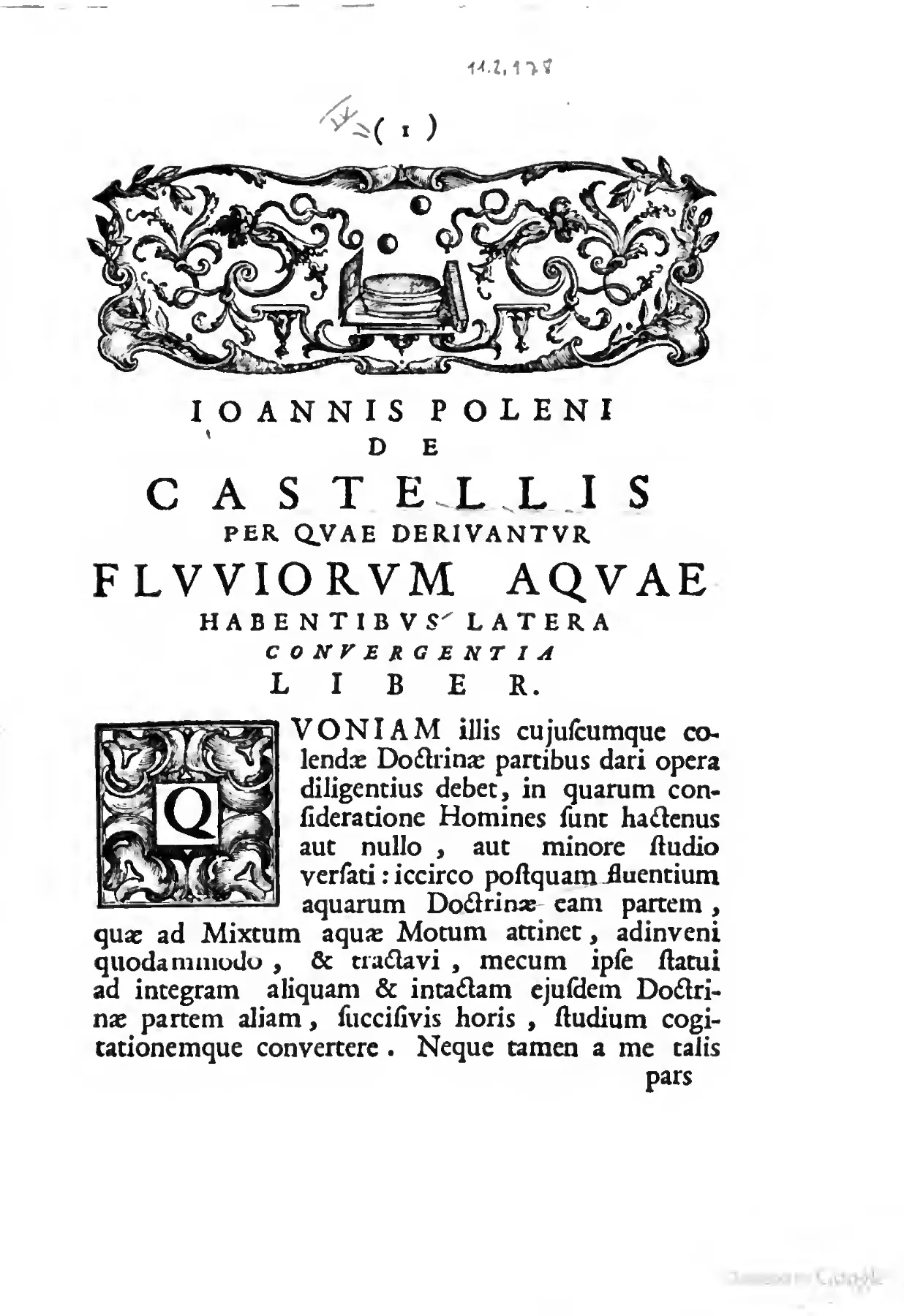
The opening of Poleni's body text: a foliate headpiece of vessels and a large ornamental initial introduce the title and the "QVONIAM" sentence in which he presents the work as a deliberate continuation of his earlier hydraulic investigations. Intended to face the plate of castella diagrams, this page gathers the volume's verbal and visual argument at the point where inherited authority gives way to neglected problems put to trial. Source ↗.
The work is a Padua print production rather than a manuscript or private correspondence; the final Italian licence is dated 13 June 1718, and the dedication at Padua on the tenth day before the Kalends of July 1718, prior to publication. The language is Neo-Latin; the administrative apparatus is Italian (Venetian). No complete modern translation or critical edition was located in the accessible bibliographic and digital records, and the editorial English title is therefore a working convenience for reference, not an established translation.
Poleni Between Venetian Water Management and the Vis Viva Controversy
Poleni's book matters because it joins several activities that are often separated in retrospective histories: the regulation of river water, the antiquarian and juridical naming of hydraulic structures, the design of intake works, experimental measurement of flow and impact, and the use of a contested mechanics vocabulary inside a single learned Paduan object. The book's importance does not rest on supplying a completed modern theory of fluid motion but on demonstrating how a professor-antiquary assembled Roman precedent, local administrative needs, geometrical comparison, experimental apparatus and a Leibnizian-inflected lexicon into a single published work. Practical water management is not treated here as inferior to mathematical natural philosophy; this matters for the history of knowledge, because Poleni is neither simply a hydraulic practitioner nor a partisan of one side of the mechanician disputes. The book is explicit that this joining will be resented from the practitioners' side, recording that some are greatly displeased by this whole manner of philosophizing about matters they hold must be learned solely by long use and practical exercise, quibusdam magnopere displicet hoc totum genus philosophandi de rebus, quas unice longo usu et) operandi exercitatione addisci debere, opinantur, with the demand that objections be argued rather than merely asserted from experience. The method proposed in place of usus is stated as a procedure: that first some conjecture be formed about all the things sought, and, that being formed, that trial then be made of those which are thought capable of being known more easily and certainly, ut in primis de omnibus quæsitis rebus conjectura aliqua capiatur; qua capta, deinde periculum fiat rerum illarum, quæ putentur posse facilius certiusque cognosci — the tractable quantities, aperture and volume delivered, being measured in order to infer the intractable one, velocity.
The vis viva controversy supplies the principal conceptual frame. Carolyn Iltis's reconstruction of the dispute (Isis, 1971) situates Leibniz's Brevis demonstratio erroris memorabilis Cartesii and subsequent exchanges as a historical controversy with intellectual and polemical stakes rather than a notation problem; David Papineau (Studies in History and Philosophy of Science, 1977) directly interrogates the claim that the controversy can be dissolved as a verbal disagreement and forces attention back onto the meanings of 'force' and 'effect', the status of experimental demonstrations, and the metaphysical commitments attached to Leibnizian and Cartesian mechanics. The continuing historiographical disagreement touches the relation between mv and mv², the status of experiments, and the question of whether later mathematical resolutions of momentum and kinetic energy retrospectively erase the eighteenth-century lexical distinctions between vis viva, pressio, impulsus and effectus integer. Poleni's own terminology — Motus Causa, pressio, impressio, impulsus, effectus integer, with Vis Viva defined as the cause of the whole effect — is evidence against treating early modern nomenclature as an empty verbal shell: he defines the terms in relation to impacts and tests the resulting relations experimentally with the tallow-cavity trial of equal-sized lead (2 lb) and hollow brass (1 lb) balls dropped from heights in the ratio 1 : 2, the outcome being reported in terms of the marks themselves, that falling perpendicularly into the tallow they made pits alike and altogether equal in the tallow itself, in sevum cadentes ad perpendiculum foveas similes, ac prorsus æquales fecerunt in ipso sevo:. He rehearses the polemical stakes of the dispute in the received form, reporting the charge that the Cartesian opinion leads to mechanical perpetual motion, which is reckoned the same as leading to an absurdity, Cartesianam sententiam ad motum perpetuum mechanicum adducere, quod idem reputatur, ac adducere ad absurdum, and he sets his own trial against the earlier percussion experiments of Riccioli with Geminiano Montanari, of Gassendi, of Mersenne with the ball and balance, and of Francesco Lana Terzi, all of which he judges vitiated by the comparison of unequal causes with unequal effects. Jakob Hermann's Phoronomia and Christian Wolff's Elementa, which transmits Johann Bernoulli's spring proof, are the contemporary mechanics against which his results are matched. The 'merely verbal' reduction of the controversy is therefore a contested historiographical reading, not a neutral description.
Hydraulic historiography supplies a second, equally central context. The book belongs to the long efflux problem that connects Torricelli's law of discharge, Mariotte's Traité du mouvement des eaux, Newton's observations on the contracted stream in the second edition of the Principia (1713), the rival mechanical interpretations of Daniel and Johann Bernoulli, and the Torricellian rule published in the Acta Eruditorum of 1716. Newton's priority on the contraction is acknowledged in the text in so many words, the most eminent man Isaac Newton having observed the contraction of water passing through a hole cut in a plate, Porro aquæ transeuntis per foramen in lamaña insculptum contractionem observaverat Vir Summus Isaacus Newtonus, after which Poleni substitutes an operational definition of the vena contracta by its smallest measured circumference and reports a ratio of 52:41 where Newton had given 25:21. The destructive consequence he draws from the series is of direct administrative moment: far too much does the figure of the parts adjacent to the apertures, or of the remaining parts of the apertures, avail to make unequal the quantities of water flowing from equal orifices in equal times, Nimium profecto aut vicinarum luminumibus, aut reliquarum luminum partium figura valet ad quantitates aquæ fluentis ex orificiis æqualibus, & temporibus æqualibus, inæquales efficiendas, which denies any universal table of discharge computed from orifice area and time and therefore unsettles the measures by which water rights were assessed. Michael Eckert's The Efflux Problem: How Hydraulics Became Divorced from Hydrodynamics (Archive for History of Exact Sciences 78, 2024) traces this divide across two centuries; Antonio Malcherek's 2018 International Symposium on Hydraulic Structures contribution, '300 Years De motu aquae mixto: What Poleni Really Wrote and a New Overflow Theory Based on Momentum Balance', argues that subsequent accounts of Poleni forgot the dependence of the overflow relation on the 'dead water' or weir height — a technical but directly relevant Poleni-specific study that must be treated as a conference contribution rather than as a definitive history of De castellis. Newton and a Bernoulli are named in the accessible Poleni OCR; direct citations of Torricelli and Mariotte were not located and should not be inserted into Poleni's text without a secure reading. The Bernoulli named among the witnesses to the domestic experimental series appears as Nicolaus (I) Bernoulli, alongside Antonio Vallisneri, Giovanni Battista Morgagni and Giovanni Gratiano.
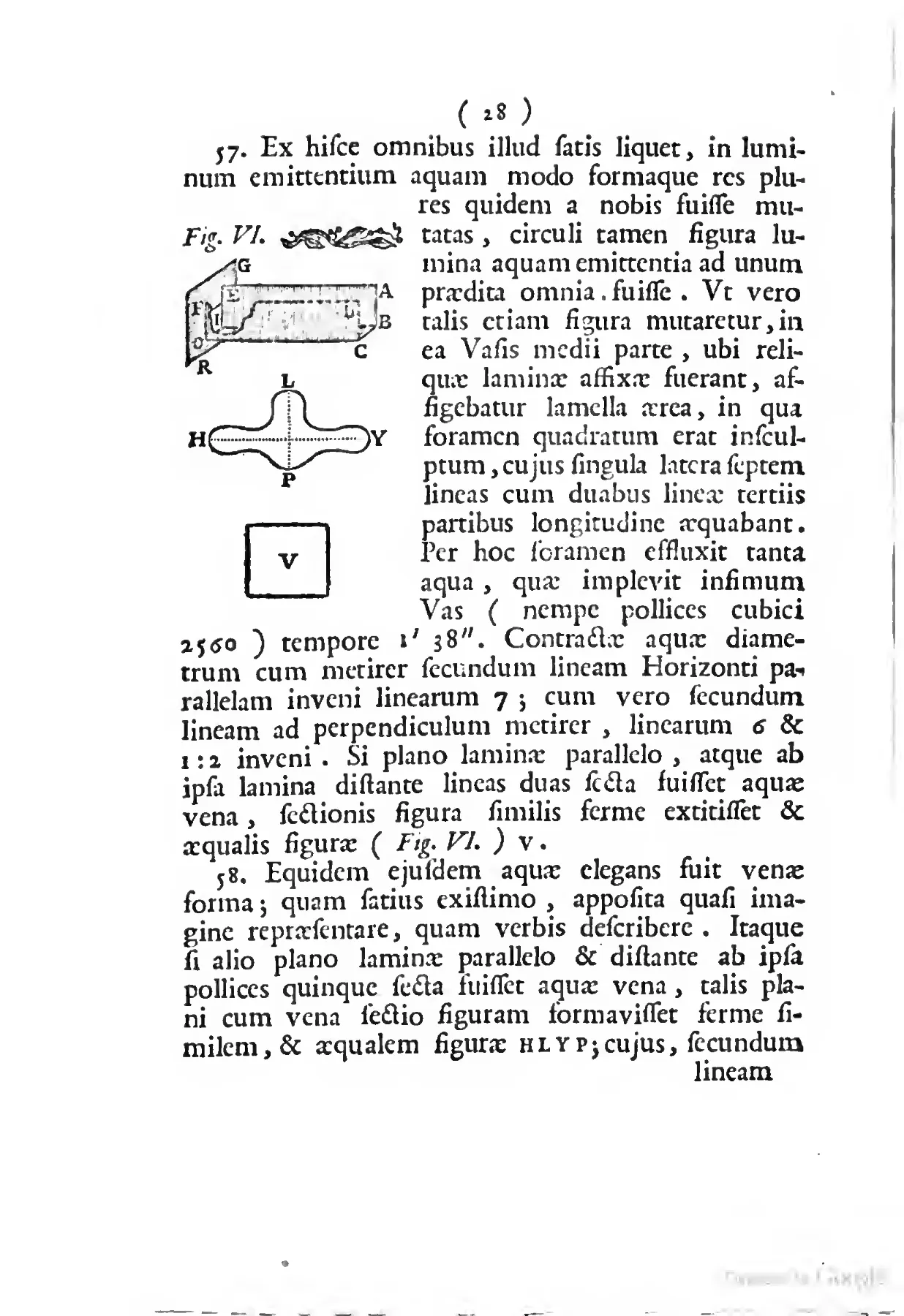
In §57–58 the square-orifice trial makes the vena contracta an operational object: Fig. VI sets the brass plate, three-vessel apparatus and lettered cross-sections inside the printed argument, while the surrounding measurements in pollices and lineae record the jet's contracted diameters. The page's preference for a diagrammatic "quasi-image" marks a method in which aperture shape becomes evidence for unequal efflux rather than illustration of theory. Source ↗.
Epistemic restraint is itself one of the book's programmatic commitments, and it is stated as a doctrine rather than left as a manner. Adjudication among rival accounts of the origin of rivers is declined on grounds borrowed from Huygens, that we shall seem to have achieved something great if we understand how those things stand which exist in Nature, from which we are even now very far off, mihi (inquit Vir Doctissimus) magnum quid consecuti videbimur, si quemadmodum sese habeant res, quæ in Natura exstant, intellexerimus; a quo longissime etiam nunc absumus. The causal question raised by the behaviour of water in tubes is posed and then deliberately suspended — whether there be any true attraction, or, as it pleases others to call attractions by the name of pulsion, whether it be some quasi-magnetic pulsion, an aliqua sit vera attractio; aut, quemadmodum placet aliis attractiones pulsionis vocabulo nominare, sit quasi magnetica aliqua pulsio? — and the separation of phenomenon from cause is defended with a topos drawn from Pliny the Younger on the intermittent spring, asking why it should not be abundantly enough for a man of slender talent, at least for the present, if he has observed what is effected, Quidni mihi exigui ingenii Homini non abunde erit (saltem in præsentia) si quod efficitur observaverim?. The architectural figure in which the whole undertaking is finally cast makes the same point without apology, the author believing he has done enough if he has laid new and solid foundations, the pinnacle to be set on in a happier time, Equidem credam, satis me fecisse, si nova & solida jecerim fundamenta; fastigium tempore feliciore imponetur.
The Paduan institutional setting is legible in the object itself. The Latin dedication addresses the rei literariae moderatores — Francesco Soranzo (Procurator of St Mark, Aedis D. Marci Procurator), Giovanni Pasqualigo and Michiel Morosini — and the final Italian licence is issued by the Noi Riformatori dello Studio di Padova, with the theological approbation attributed to P. Fr. Tommaso Maria Gennari and the administrative certification attributable to the Riformatori's secretary. The Riformatori certify that, after review, the volume contains nothing contrary to Catholic faith, princes or good morals, grant permission to print to Giuseppe Comino, and require the customary deposit of copies in the public libraries of Venice and Padua. The continuing historiographical question is how Paduan philosophical chairs and Venetian censorship intersected in the years around 1717–1718; the archival record group Riformatori allo Studio di Padova in the State Archive of Venice (chronological extent 1550–1797, with documents continuing to 1803) is the principal documentary witness, although an exact shelfmark for the 1718 Poleni licence was not located.
The press context complements the institutional evidence. The Volpi-Cominiana enterprise was established in 1717 in association with the brothers Giovanni Antonio and Gaetano Volpi and operated with Giuseppe Comino, with a declared editorial programme of carefully produced classical, literary, medical and scientific books; the same network is associated with Poleni's De motu aquae mixto (1717) and with Giovanni Battista Morgagni's Adversaria anatomica. Modern press-history resources give the institutional narrative but do not constitute a single modern monograph devoted to Comino. Andrea Bocchi's 2019 history of the Comino press and the standard biographies of Giovanni Antonio Volpi frame the print milieu; the MacTutor and Wikipedia summaries of Poleni's career should be treated as tertiary.
Language choice requires historical rather than presentist interpretation. Sietske Fransen (Isis, 2017) argues that the Galileo-era opposition between Italian and learned Latin cannot be read as a simple replacement of one language by another: language marked audiences, authority, disciplinary identity and claims to participation in the wider respublica literaria. Poleni's Neo-Latin, combined with the Italian Venetian licence, makes that dual setting concrete: the title-page Latin presents him as professor and transnational associate; the licence addresses the local administrative and ecclesiastical officers that controlled printing. The frequently-cited claim that Poleni explicitly defended Latin as the medium by which 'very many' might understand and improve the subject was not secured in the accessible OCR and is therefore not to be treated as a settled quotation; the text as read does, however, carry a statement of just this shape, the author having wished to set these things out in that language which, since very many will understand it, very many may also be able to improve what is proposed, hæc voluisse ea lingua proponere, quam cum plurimi intelligent, plurimi etiam quæ proponuntur meliora possint efficere. The justification is thus framed as one of correction and international scrutiny rather than of prestige, and it stands in implicit contrast with the Galilean vernacular hydraulic tradition.
Three further historiographical absences deserve statement as limits. First, no direct contemporary review of De castellis was securely identified in the Acta Eruditorum, the Giornale de' letterati d'Italia, the Philosophical Transactions, the Journal des Sçavans or the Bibliothèque italique. Second, no counter-treatise, refutation or formal proceeding demonstrably provoked by this particular volume was located. Third, modern reading of 'Giovanni Gratiano' (Latinised) as an Italian Graziani/Graziano was not securely established, and the absence is stated as a limit rather than closed by plausible name-conflation. The silence in the contemporary record should be reported as a limit of the located evidence, not as proof that the book had no reception. The major historiographical opportunity is therefore relational: Poleni is neither simply hydraulic practitioner nor Leibnizian partisan, but a professor using the authority of Roman terms, the jurisdiction of Venetian magistrates, the resources of a specialist press, and a lexicon of impact and effect to make a claim about what can be known of nature through controlled water and percussion experiments.
Tracing the 1718 Comino Edition: Copies, Plates, and the Venetian Licence
The 1718 Padua first edition, printed by Giuseppe Comino as Typis Iosephi Comini, is documented by a small constellation of converging witnesses. The MPIWG ECHO record describes Poleni's De castellis, per quae derivantur fluviorum aquae habentibus latera convergentia liber with '[6], 65, [5] S. : Ill.' and identifies the holding as the collection of the Giusti family; its digital identifier is MPIWG:SQ978SXE, reached through the ECHO permanent-library pointer 4TPYNQBM. WorldCat records the same Latin print as OCLC 75385307, Typis Iosephi Comini, Patavii, 1718. A Google Books copy (zE_9_tVP7ykC) preserves a scan originally drawn from the Deutsches Museum; an Internet Archive scan (bub_gb_9EGabUApVrEC) is identified by its source collection as the National Central Library of Florence; and the BEIC image record 2045611 provides a third image witness. These are record and digital identifiers; they do not substitute for an authoritative physical shelfmark for the Giusti, Deutsches Museum or Florence copies.
The complete collation formula cannot be reconstructed from these witnesses alone. ECHO's '[6], 65, [5] S.' gives a physical-description statement: a preliminary gathering of six leaves, a sixty-five-page body, and a terminal gathering of five leaves, with illustrations; it is not a full signature formula. The scan exposes preliminary matter (title page, Latin dedication, Superiorum Permissu), a substantial body text, an errata list, illustrations and a FINIS, followed by the Italian licensing leaf of 13 June 1718. The Internet Archive metadata lists 88 pages, a discrepancy from the ECHO pagination that should not be treated as evidence of a separate state or edition. The typography and signature running are partially visible in the scan but were not confirmed against a fully checked copy; the noisy OCR and the ligature conventions of the period frustrate any attempt to assert a definitive A2–I formula or to specify paper, typeface, watermark or press device.
The illustration evidence is stronger but still incomplete. The body refers to figures I through VI, and the preliminary or closing material contains the placement instruction TABVLA D PONATVR e regione paginae 11 — the plate is to be inserted opposite page 11. The text describes diagrams of the castella itself, conical and cylindrical openings, attached tubes, and the contracted water vein; the engraving is at least partly embodied in the Internet Archive and Google Books scans. No engraver's name, plate signature, separate paper-stock description, or issue/state distinction was located. The OCR cannot establish whether figures I–VI were all engraved on a single folding plate or distributed over more than one plate; the placement instruction indicates an inserted or separately handled illustration, which is consistent with the description '[6], 65, [5] S. : Ill.' in ECHO. The lettered points of these figures are the same letters that carry the terminological argument, the aditus CD and the ostium EF of the converging-sided castellum being defined by reference to the diagram rather than in the abstract.
The front matter gives the volume a clear institutional biography. The Latin dedication addresses the rei literariae moderatores by name as Francesco Superantio (Procurator of St Mark, Aedis D. Marci Procurator), Ioanni Paschalico and Michaeli Mavroceno, 'and the whole most ample order of the literary triumvirate'. The final Italian licence of 13 June 1718 resolves the three names as Francesco Soranzo (Procurator of St Mark), Giovanni Pasqualigo and Michiel Morosini (or Morosini), the three Riformatori allo Studio di Padova. The dedication closes with Ioannes Polenus S. P. D. and is dated at Padua on the tenth day before the Kalends of July 1718. The names and offices are secure as printed; the exact Venetian family branches, individual magistracy dates and fuller careers of the dedicatees — for which the Treccani Dizionario Biografico entries on Soranzo and Morosini provide only partial coverage — are not presented here as established.
The licence itself records the ordinary pre-publication authorisation. It is issued by Noi Riformatori dello Studio di Padova, attributes the theological approbation to P. Fr. Tommaso Maria Gennari of the Order of Preachers, attributes the administrative certification to the Riformatori's secretary (Agostino Cadaldini in the recovered form), grants Giuseppe Comino permission to print in Padua, and orders the customary presentation of copies to the public libraries of Venice (the Marciana) and Padua. The date is 13 June 1718 and the instrument is signed by Francesco Soranzo, Giovanni Pasqualigo, Michiel Morosini and the secretary. Sabagh's reconstruction of the Paduan Dominican inquisitorial sequence places Vincenzo Maria Mazzoleni da Bergamo as the inquisitor covering Poleni's published volume (1717–1718) and Giuseppe Maria Galli da Como (1718–1728); the Tommaso Maria Gennari in the printed approbation is to be located within that sequence rather than read as a generic inquisitorial name. The formula is evidence of ordinary confessional, political and moral authorisation; there is no evidence that the work was ever suppressed or lost, and the survival of multiple digital surrogates argues for continued bibliographic visibility. No archival box or fascicle reference for the specific 1718 Poleni licence was located within the Riformatori allo Studio di Padova record group (described as 595 boxes, files and registers, 1550–1797, with documents to 1803).
The press is part of the Volpi-Cominiana production network. Standard press-history accounts date the enterprise to 1717 in association with Giovanni Antonio Volpi and Gaetano Volpi, with Giuseppe Comino as printer; the declared editorial programme emphasised carefully produced classical, literary, medical and scientific books. The same network is associated in the surviving records with Poleni's De motu aquae mixto (1717) and with Morgagni's Adversaria anatomica (1717); Italian Wikipedia and the archivio.arcadelsanto.org obituary of Giovanni Antonio Volpi place the press at Padua and underline its learned university-facing character. A definitive reconstruction of Comino's house style, paper stock, typefoundry and workshop personnel for this individual volume, however, is not possible from the accessible sources.
The colophon leaf closes the volume with an armorial device and the imprint "PATAVII. CIƆ IƆ CCXVIII. / EXCUDEBAT IOSEPHVS COMINVS" — Padua, 1718, Giuseppe Comino as printer. Its emblem and spare typographic authority make visible the Volpi-Cominiana network that turned a contested inquiry into a licensed and materially finished book. Source ↗.
The 1718 book's transmission is at present a print-to-digital lineage rather than a documented manuscript lineage: first-edition paper copies were scanned, catalogued and, in one Internet-Archive case, machine-OCRed. The OCR preserves the title page, dedication, licence, body, figures, errata and FINIS, but ligatures and long-s confound exact transcription. No complete vernacular or English translation, no modern critical edition and no later collected reissue of the volume was confirmed in the accessible records. The work is frequently retrieved alongside De motu aquae mixto (1717) because Poleni's 1718 text explicitly refers back to the 1717 Libri de motu aquae mixto — the terminological cross-reference is made in the body of the text, where a species of motion is recalled as the one that in the books on the mixed motion of water we named Simple Motion, in Libris de Motu aquæ Mixto Simplicem Motum nuncupavimus; that cross-reference is textual evidence of programmatic continuity, not evidence that the two books were issued as a single volume.
The immediate learned network is more legible than the later reception. Poleni's biographical record places him at Padua's chairs of astronomy and meteorology, physics, mathematics and experimental philosophy, and his later output includes the antiquarian and Vitruvian Utriusque thesauri antiquitatum Romanorum Graecorumque (1737), the Exercitationes Vitruvianae (1739–1741) and the Institutionum philosophiae mechanicae experimentalis specimen (1740/1741). The Basler Edition of the Bernoulli-Briefwechsel confirms three letters between Jakob Hermann and Poleni, all dated 1732 onward and addressed to Poleni; that confirms a later correspondence link, not an exchange about the 1718 volume. Specific 1718-era reviews of De castellis in the Acta Eruditorum, the Giornale de' letterati d'Italia, the Philosophical Transactions, the Journal des Sçavans and the Bibliothèque italique, and a chain of replies or refutations, could not be located. The named figures in the treatise — Columella, Ulpian, Suetonius, Kircher, Newton, Leibniz, a Bernoulli — are therefore better characterised as cited authorities and interlocutors in mechanics and hydraulic experimentation than as the participants in a demonstrable controversy over this particular volume. The manner of citation supports that characterisation: Kircher, for instance, is transcribed and then set aside with a stated reason, since the difficulty of such a work is great and Kircher does not name those many nations, so that it will suffice to have transcribed his words, At cum magna sit talis operis difficultas; neque Kircherus multas illas Nationes nominet, satis erit ipsius verba descripsisse — an authority weighed rather than either followed or refuted, in keeping with the book's general subordination of testimony to trial.
Following the Argument: From the Riformatori Dedication to the Tallow Cavities
The dedication: philosophizing against usus
The exposition begins not with water but with a defence of the right to reason about it. The dedicatory epistle to the Riformatori dello Studio di Padova opens by naming the constituency the book expects to offend, conceding — in the sentence already examined above — that some are greatly displeased by this whole manner of philosophizing about matters they hold must be learned solely by long use and practical exercise. The construction is precise in its concession: the objection is registered as a matter of displeasure (displicet) and of opinion (opinantur), never of argument, and Poleni's rejoinder is that he has yet to hear the position defended by reasoning rather than asserted from experience. The polemical field so drawn is that of the Venetian hydraulic periti, the surveyors and proti whose competence rested on inherited practice at the Brenta and the lagoon mouths; by making usus answerable to demonstration, the dedication converts a difference of professional standing into a difference of epistemic warrant. The same page justifies the choice of Neo-Latin, not on grounds of dignity but of correction — the language in which the greatest number may both understand and emend what is offered — so that the two apologies are of one piece: the book submits itself to a wider tribunal than the one that would judge it by practice alone.
The prospectus of the second article then makes an unusually strong promise, announcing, in the terms already cited from the preliminary matter, that the famous controversy about the forces of moving bodies, long agitated by most learned men, is settled by a clear and most certain experiment. The verb is juridical: dirimere is to decide a suit, to cut a dispute in two, and its choice signals that the dynamical excursus is not appended as an ornament to a treatise on intakes but is presented as the adjudication of a long-pending case. That a monograph on diversion works should undertake such an adjudication is licensed by the treatise's own economy: the impulses of water on the walls of the castellum are what make the forces of moving bodies a hydraulic question in the first place.
Art, Nature, and the refusal to explain the origin of rivers
Between the programme and the experiments stands the prolegomenal doctrine of Art and Nature, stated as the charter of the whole undertaking in the sentence discussed above, where the industry of Art is told not to compel Nature to what Art contrives but to join itself to Nature's laws and rationales. The sentence is built on an antithesis between cogere and conjungere, coercion and conjunction, and its force is polemical as well as philosophical, since it is followed by the sociological observation that popular applause attends precisely those engineers who boast of mastering Nature even against her will. The doctrine has an immediate methodological consequence in the survey of the origin of river-beds, where three accounts — chance alternation of wet and dry regions, coeval creation, post-diluvian erosion — are rehearsed and none adopted, on the Huygensian principle that the constitution of things in Nature is still very far from being understood. Speculation about the genesis of channels cannot regulate the cutting of new ones; what the engineer must establish is the far humbler question whether a given watercourse was laid by Nature or by Art.
Conjecture, apparatus, and the measured vein
The transition to trial is governed by the explicit statement of experimental design already set out, that conjecture be formed first about everything sought and that trial then be made of those things thought capable of being known more easily and certainly. This is a triage of quantities rather than a general theory of induction. Of the three terms in play — the size of the aperture, the quantity delivered, the velocity of the water — the first two submit to rule and vessel and clock; the third, which Poleni notes deceives even men expert in such matters, is to be inferred and never assumed. The apparatus answers to the same discipline: three vessels, a tapered rod to hold the head constant, a pendulum clock reading minutes and seconds, measurements in Paduan feet, pollices and lineæ. So too does the treatment of the contracted vein, which is not defined by any hypothesis about the paths of particles but stipulated by what can be measured, since for ease we shall name the diameter of the smallest circumference, as VA, the diameter of the contracted water, facilitatis caussa, minimi ambitus diametrum, ut VA, nominabimus contractæ aquæ diametrum. The phenomenon Newton had observed in the second edition of the Principia is thereby converted into an operational quantity, and Poleni's divergent ratio of 52:41 becomes a report of measurement rather than a contradiction of authority.
The domestic campaign that follows was conducted before witnesses, among them the celebrated Antonio Vallisneri, first professor of theoretical medicine, Celeberrimi Antonius Vallisnerius Theor. Med. Prim. Professor, with Morgagni and Nicolaus Bernoulli beside him. Their attestation that the trials were perspicuous and little liable to error performs in a Paduan household what collective witnessing performed in the assembly rooms of learned societies: it substitutes named, competent observers for the anonymous authority of usus, and it does so with men whose standing lies outside hydraulics altogether.

Giovanni Battista Morgagni, engraved in the formal guise of a Paduan anatomist: the kind of named academic authority Poleni enlisted to witness his household percussion trials. Credibility for the tallow-cavity experiments rested on competent observers drawn from Padua's wider learned community rather than from hydraulics. Source ↗.
The negative finding and the rule of the exit-mouth
The destructive result extracted from the series is stated with rhetorical exasperation — nimium profecto, far too much indeed — and its substance has already been given above: the figure of the parts adjoining the apertures, or of the remaining parts of the apertures, suffices to make the quantities flowing from equal orifices in equal times unequal. The finding is negative in form and administrative in consequence: if geometry of area and elapsed time do not determine discharge, no universal table can certify how much water an intake delivers, and the assessment of water rights loses the arithmetic on which it had rested. Against this negative stands the book's constructive thesis, likewise already recorded as a rule of estimation, that in judging the quantity passing through a converging-sided castellum one must attend not to the entry from the river but to the exit-mouth. The lettered points carry the argument because the definitions had already been fixed upon the figure; and the passage is followed by a self-correction rare in the literature of intakes, the admission that his own earlier conjecture had still conceded too much to the aditus. The wonder is compounded rather than dispelled by the tube: it will seem far more wonderful, Poleni writes, that more water flows through tubes than through holes cut in plates, sane multo magis videbitur mirum, per tubos plus aquæ effluere, quam per foramina insculpta in. The result offends both received opinion and mechanical reason, since friction along the tube ought to retard the jet, and its retention despite that offence is the clearest measure of how far measurement has been given precedence over plausibility.
From foundations to the lexicon of impact
The hydraulic half closes on the builder's figure noticed earlier, which concedes incompleteness without conceding method: enough will have been done if new and solid foundations have been laid, the pinnacle left to be set on in a happier time. The metaphor is apt to a treatise on works of masonry and earth, and it licenses the pivot into dynamics, where the same refusal to build above the evidence governs a lexicon rather than an apparatus. The definitions of the impulse-articles are stipulative, culminating in the terse ruling, already quoted, that the cause of the whole effect shall be called Living Force. Defining vis viva as the cause of the effectus integer — the effect produced when motion is wholly consumed — is what makes the dispute measurable at all, since a whole effect is exactly what a body sinking into tallow leaves behind.
That measurability is the point of the sharpest sentence in the book, the complaint recorded above that the controversy was carried on by words and arguments rather than by the thing itself, and the question why Leibniz had bidden Papin meditate and had not bidden him experiment. The reproach turns the charge of verbal disputation back on the disputants and converts it into a procedural demand. Poleni's own design meets that demand by equalizing effects rather than causes, the fault he finds in Riccioli with Montanari, in Gassendi, in Mersenne's ball and balance and in Lana Terzi: two balls of equal size but unequal weight, dropped from heights in the inverse ratio, left behind, as already reported of the outcome, pits alike and altogether equal in the tallow. The whole weight of the intervention rests on the visible identity of two cavities in a soft, retentive medium, and the generalization that living forces are as mass into the square of velocity is drawn from that identity alone.
The unresolved efflux and the closing apparatus
The volume does not end on the strength of that result. Its last substantive movement records the shortfall already noticed: even allowing for the contraction of the water, the velocity he observed in the experiments is far less than expected, and therefore, by his own ergo, these matters must be further inquired into. The rule affirmed in the Acta Eruditorum of 1716 is not refuted, and the measurements are not adjusted to meet it; the discrepancy is simply entered, with that inference directing labour forward rather than closing the account. A book that had promised to decide one controversy by trial declines to decide another by calculation, and the printed apparatus that follows — the instruction for placing the plate, the errata, the Venetian licence and Comino's colophon — returns the reader from the unfinished inquiry to the finished object in which it was issued.
Frequently Asked Questions
What is Giovanni Poleni's De castellis (Padua, 1718) about?
It is a Latin treatise on river intake works whose inner faces converge toward the outflow, printed at Padua in 1718 by Giuseppe Comino. Poleni argues that the quantity of water delivered must be estimated from the exit-mouth rather than from the entry from the river, and reports new experiments on flowing water and on the forces of percussion. His most damaging finding is negative: the shape of the parts adjoining an aperture makes equal orifices deliver unequal quantities in equal times, so no universal table of discharge computed from area and elapsed time can be trusted.
Who was Giovanni Poleni?
Giovanni Poleni (Venice, 23 August 1683 – Padua, 15 November 1761) was a professor at the University of Padua and a fellow of the Royal Society of London and of the Royal Prussian Academy of Sciences in Berlin. He held Paduan chairs successively in astronomy and meteorology, physics, mathematics and experimental philosophy, and signed the 1718 title page as professor of philosophy in the Gymnasium Patavinum. His earlier hydraulic work, De motu aquae mixto libri duo (1717), is repeatedly recalled in the later book; his later output includes the Exercitationes Vitruvianae (1739–1741).
What did Poleni's tallow experiment claim to settle?
It claimed to decide the long dispute over the forces of moving bodies. Two balls of equal size but unequal weight — two pounds of lead and one pound of hollow brass — were dropped from heights in the ratio 1:2 and left pits in tallow that were alike and altogether equal. Poleni faulted earlier percussion trials by Riccioli with Geminiano Montanari, by Gassendi, by Mersenne with ball and balance, and by Francesco Lana Terzi for comparing unequal causes with unequal effects. The domestic trials were attested by named witnesses, among them Antonio Vallisneri, Giovanni Battista Morgagni and Nicolaus (I) Bernoulli.
Why does Poleni call a river intake a castellum?
Because he deliberately transfers a Roman term. In Roman hydraulic vocabulary, and notably in Frontinus, a castellum — a distribution reservoir — is the chamber into which an aqueduct delivers water for onward piping. Poleni states his warrant openly: on account of the fortification of its parts and its likeness to the castella of aqueducts, the fortified opening he studies takes that name. He notes that Columella and Ulpian had called such river offtakes incilia, and coins "diversion ditches" for the channels, conjecturing emissaria on the ground that Suetonius so named the ditch draining Lake Fucino.
Is there an English translation of De castellis?
No complete modern translation, critical edition or later collected reissue of the 1718 volume has been identified in the accessible bibliographic and digital records; the English title in circulation is a working convenience rather than an established rendering. Separately, the Leo edition presents the full transcription together with a complete English translation for the first time, and that translation is generated by AI. Leo is an effort to make freely available online, at no cost, English translations of every text printed in Latin in early modern Europe between 1450 and 1750.
This report was generated by an advanced AI assistant that conducted deep research alongside an extensive interpretation of the transcribed original text. Every effort has been made to preserve fidelity to the source and to guard against inaccuracy, but corruption in the text recognition process and model hallucination may nonetheless have entered the text. Treat every claim, quotation, translation, and citation as provisional, and verify each against the original source before relying on or citing it.
Critical Further Reading on Poleni, Hydraulics, and the Vis Viva Dispute
- Eckert, Michael, "The Efflux Problem: How Hydraulics Became Divorced from Hydrodynamics," Archive for History of Exact Sciences: Eckert follows discharge through orifices and over weirs from Torricelli to the Bernoullis and beyond, which is exactly the terrain of Poleni's experiments on the contracted vena, on tubes versus plate orifices, and on the sub-duplicate relation of quantity to head. Read it to see why Poleni's refusal to derive velocity from principle, and his willingness to report a measured regularity as Nature's own law, sits at the fault line between two disciplines that were still one book in 1718.
- Fransen, Sietske, "Latin in a Time of Change: The Choice of Language as Signifier of a New Science?" Isis: Fransen dismantles the tidy story in which Galileo's Italian simply retired learned Latin, showing instead how language selected audiences and staked claims to authority. It supplies the frame for the double register of Poleni's volume — a Latin title page addressed to the European republic of letters, an Italian licence addressed to three Venetian magistrates — and for his own defence of Latin as the language in which the greatest number might correct him.
- Google Books, Ioannis Poleni ... De castellis per quae derivantur fluviorum aquae habentibus latera convergentia liber (Deutsches Museum copy): A second image witness to the 1718 Comino print, catalogued from the Deutsches Museum copy, useful chiefly for collating pages where the Florence scan's ligatures defeat legibility. Its bibliographic record is thin — publisher given simply as 'Cominus' — so treat it as pixels rather than as description.
- Iltis, Carolyn, "Leibniz and the Vis Viva Controversy," Isis: The foundational modern reconstruction, and the surest way to keep Poleni's vis viva, pressio, impulsus and effectus integer inside their own quarrel instead of translating them prematurely into kinetic energy. It is particularly useful for testing the claim that the controversy was merely verbal, and for reading Poleni's percussion experiments as the experimental discipline of a contested lexicon. It also clarifies the metaphysical premise on which Poleni rests his treatment of elastic impact, namely that not a whit of the living forces can perish in such a concourse of bodies, since where a cause able to destroy a thing is not present, there the same thing must remain entire, in tali corporum concurfu ne hilum quidem virium vivarum perire posse: ubi enim caussa, quæ valeat rem aliquam destruere, non adsit, ibi rem eandem integram manere necesse est, an argument he supplements with momentum on Newton's authority.
- Internet Archive, Ioannis Poleni ... De castellis per quae derivantur fluviorum aquae (National Central Library of Florence scan, bub_gb_9EGabUApVrEC): The scan on which the present report's readings and page tokens depend, complete with title page, dedication, body, figures, errata, FINIS and the licensing leaf of 13 June 1718. Its machine OCR is noisy and its page count (88) disagrees with the ECHO pagination, so consult the images rather than the derived text whenever a reading matters.
- Malcherek, Andreas, "300 Years De motu aquae mixto: What Poleni Really Wrote and a New Overflow Theory Based on Momentum Balance," Proceedings of the International Symposium on Hydraulic Structures: The closest thing to a modern technical audit of Poleni's hydraulics, arguing that later handbooks quietly dropped the dependence of the overflow relation on the dead water or weir height. Its conference-paper format warrants using it alongside, rather than in place of, the broader peer-reviewed histories by Eckert and the historiography of early-modern mechanics by Iltis and Papineau. It is also the closest modern counterpart to the unresolved question on which the 1718 volume ends, where Poleni records that he observed in the experiments, even allowing for the contraction of the water, that the velocity of the water itself is far less, and that these matters must therefore be further inquired into, at me in Experimentis animadvertisse, habita etiam contractionis aquæ ratione, velocitatem ipsius aquæ valde esse minorem: ergo in hasce res amplius esse inquirendum.
- Max Planck Institute for the History of Science, Poleni, Giovanni — De castellis, per quae derivantur fluviorum aquae habentibus latera convergentia liber (ECHO digital library record 4TPYNQBM): The most informative single catalogue record for the edition, giving Padua 1718, Comino, the physical description '[6], 65, [5] S. : Ill.' and the Giusti family provenance under identifier MPIWG:SQ978SXE. It is the basis for everything the report says about the volume's gatherings and plate, and equally the reason a full signature formula remains out of reach: a physical description is not a collation.
- OCLC WorldCat, Ioannis Poleni ... De castellis per quae derivantur fluviorum aquae habentibus latera convergentia liber (record OCLC 75385307): The union-catalogue record, valuable for the full title-page transcription including the promise of nova experimenta on flowing waters and the forces of percussion, and for confirming Comino's imprint. Use it to locate surviving paper copies, since none of the digital surrogates supplies an authoritative shelfmark.
- Papineau, David, "The Vis Viva Controversy: Do Meanings Matter?" Studies in History and Philosophy of Science: Papineau's formulation directly engages the 'merely verbal' reduction and forces attention back onto the meanings of 'force' and 'effect', on demonstrations and experiments, and on the metaphysical commitments of rival mechanical philosophies. As a counterpoint to retrospective readings that treat vis viva as an uncomplicated precursor of nineteenth-century kinetic energy, it clarifies what is at stake in Poleni's careful terminological table. It is the natural companion to Poleni's own methodological reproach, reported as the objection that the controversy was one of words rather than of the thing itself, and that Leibniz had bidden Papin meditate and had not bidden him experiment, esset controversia potius, quam re; curque Leibnitius Papinum jussisset meditari, non autem jussisset experiri, which converts the verbal-dispute charge into a demand for trial.
- PICRYL, Giovanni Poleni – Ioannis Poleni ... De castellis per quae derivantu, 1718 – BEIC 2045611: A downloadable BEIC image witness to the 1718 title page, mainly of use for checking typography and the imprint line against the other two scans. It carries no descriptive apparatus whatever, which is a reminder of how much of this book's bibliography still rests on images without shelfmarks.
- Signorelli, Bruno, "Poleni, Giovanni," Dizionario Biografico degli Italiani, vol. 84: The authoritative modern biography, fixing the dates and family (Venice, 23 August 1683, son of Giacomo and Isabella Brugnol) and tracking the succession of Paduan chairs from astronomy and meteorology through to experimental philosophy. Prefer it to the tertiary MacTutor synopsis, especially for the later antiquarian and Vitruvian output that makes sense of the Roman vocabulary in De castellis.



_Patavium_(Padua)._(IA_dr_vol-vi-55-patavium-padua-12126745).jpg)
,_Italian_anatomist_Wellcome_V0004123.jpg)