The Faithful Hand: A Diphthong That Told an Editor Which Manuscripts Were True
In 1697 a young Utrecht philologist gathered the correspondence of two dead scholars and argued that a private letter reveals a learned man's mind more truthfully than any formal history. Three hundred years on, no monograph has ever taken the volume as its subject, though it records the working philology of the late-humanist Dutch school more fully than the critical editions it helped produce.
ExLatinis
July 19, 2026
On Pieter Burman the Elder's Marquardi Gudii et doctorum virorum ad eum epistolae, printed at Utrecht in 1697
In 1697 a young Utrecht philologist gathered the correspondence of two dead scholars and argued that a private letter reveals a learned man's mind more truthfully than any formal history. Three hundred years on, no monograph has ever taken the volume as its subject, though it records the working philology of the late-humanist Dutch school more fully than the critical editions it helped produce.
A diphthong as a criterion of age
Where the diphthong AE is written with its two letters kept apart rather than fused into a single glyph, Claudius Salmasius insists, one should know such codices to be & vetustos esse inprimis, & fideli manu confectos, especially ancient and made by a faithful hand. The same letter reaches back further still, to a world before word-division existed, when text ran on in one unbroken stroke and, ante Aristophanem (before Aristophanes invented accents), there was no distinction of letters at all. A scribe's habit with two vowels becomes an instrument for dating a book, and the physical execution of the page becomes evidence of its trustworthiness.
This is the raw texture of the folio Pieter Burman the Elder assembled at Utrecht in 1697 and titled Marquardi Gudii et doctorum virorum ad eum epistolae, which translates roughly as The Letters of Marquard Gude and of Learned Men to Him, bound together with the correspondence of the Parisian councillor Claude Sarrau. Gude (1635–1689) was an itinerant German antiquary and epigrapher who quartered Belgium, Gaul, Italy, and Germany in pursuit of manuscripts. Sarrau (died 1651) sat in the Parlement de Paris and traded letters with Grotius and Salmasius. Both were dead when Burman, then a young professor at the Utrecht Athenaeum, gathered their papers from the family library and sent them to the press of François Halma and Willem van de Water.
Rescuing texts from moths and bookworms
The characters of learned men and what they truly feel about most things, Burman writes, are known rectius, more rightly, from letters than from histories and annals. The received view of correspondence, then and largely since, treated it as a secondary source, anecdotal padding around the real work of the critical text. Burman inverted the hierarchy. The private letter catches the scholar unguarded, arguing a conjecture, reporting an inscription seen with his own eyes, and it therefore authenticates a mind in a way the composed public genres cannot.
The urgency behind this comes from the physical condition of the record. Gude, Burman writes, reclaimed his codices from unworthy owners, having found them struggling against the insects, some a blattis & tineis pene consumptis, nearly consumed by bookworms and moths. This was no idle figure of speech. In an age when the survival of any given text depended on a single fragile copy slowly being eaten alive, the printed edition was the only backup against oblivion, the era's one method of moving a document out of reach of decay. Burman casts the edition itself as a resurrection, works led from death back into life (a morte in vitam). To edit the letters was to perform, on the correspondence itself, the same rescue the letters described being performed on manuscripts.
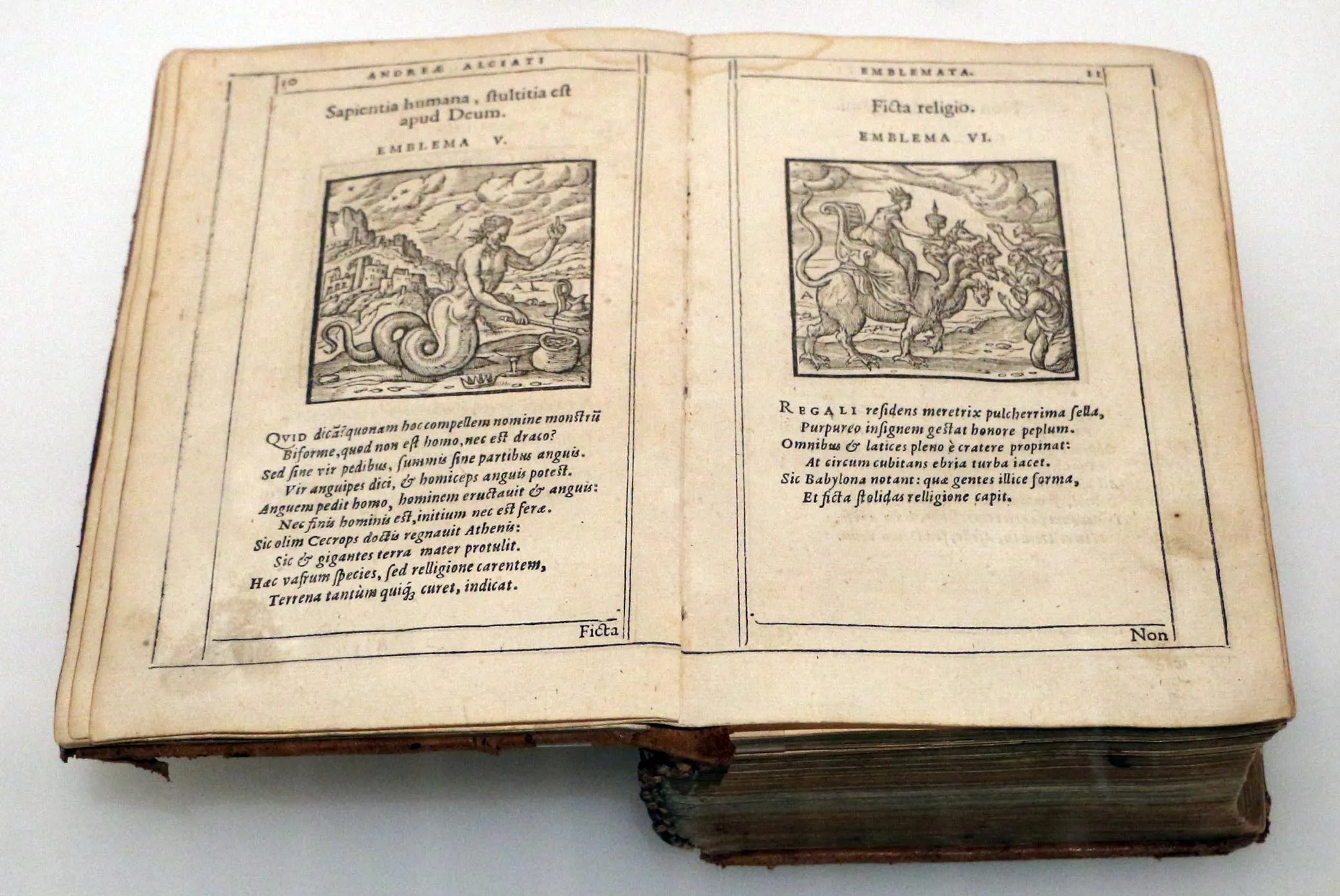
A worn early modern printed volume, reportedly a 1608 Leiden edition of Andrea Alciato's Emblemata. Its battered leaves make the stakes tangible: print could carry a text out of manuscript oblivion, yet it remained paper, binding, and stains, still exposed to the insects and decay Burman hoped to outrun. Source ↗.
Business conducted by post
These men belonged to what they called the respublica litteraria, the Republic of Letters, a community whose citizenship rested not on nationality or creed but on learning and an ethic of truthful friendship, maintained almost entirely through the mail. Its business was frank criticism rather than flattery. One would be a flatterer, not a friend, Sarrau writes, assentator, non amicus, if he approved everything unexamined that had once pleased a friend. The volume maps this network at working scale, from Leiden and Paris to Antwerp, Hamburg, Heidelberg, and Stockholm, where Salmasius ended his days at the court of Queen Christina. Nor was it a serene fellowship. Reinesius reported that they lived in a viperous society, with a scorpion hidden under nearly every stone, sub quovis pene lapide.

Jacob Ferdinand Voet's court portrait of Queen Christina, the Stockholm pole of this learned network: Salmasius died at her court, and Sarrau could read her abdication as a preference for litterae over imperium. She gives human form to the monarchical patronage that carried the Republic of Letters beyond Leiden, Paris, and Hamburg. Source ↗.
The letters record the quarrels as candidly as the courtesies. The dispute over the Greek of the New Testament, which Salmasius ignited with his Funus linguae Hellenisticae of 1643 against Daniel Heinsius, appears here in its personal dimension. Salmasius, the vita records, pursued Heinsius with a hatred plusquam Vatiniano, more than Vatinian, the Ciceronian byword for inveterate loathing. Sarrau reports the settled reputations from the other side, naming the man at once Eruditorum Princeps & Salmasius Eruditorum tyrannus, prince of the learned and tyrant of the learned in one breath.
Seeing is a form of argument
What gives the collection its evidentiary edge is the recurring appeal to autopsy, the claim to have looked with one's own eyes. Against Beza's assertion that all the Greek codices opposed a particular reading, Sarrau answers from firsthand collation that this is untrue, and that he has seen two which prove the contrary, duos vidi. The verb carries the whole weight of the case. Inspection, and not the pronouncement of an authority, overturns even Beza. This is the same discipline Salmasius applies to a diphthong, and the one Gude applies to the stone steps of the Roman amphitheatre, which he examined with great care, magna cum cura, for the traces of a marble facing that mere report ascribed to it. The rumor stood held carefully apart, fama est (it is said), as the thing the evidence must be tested against.
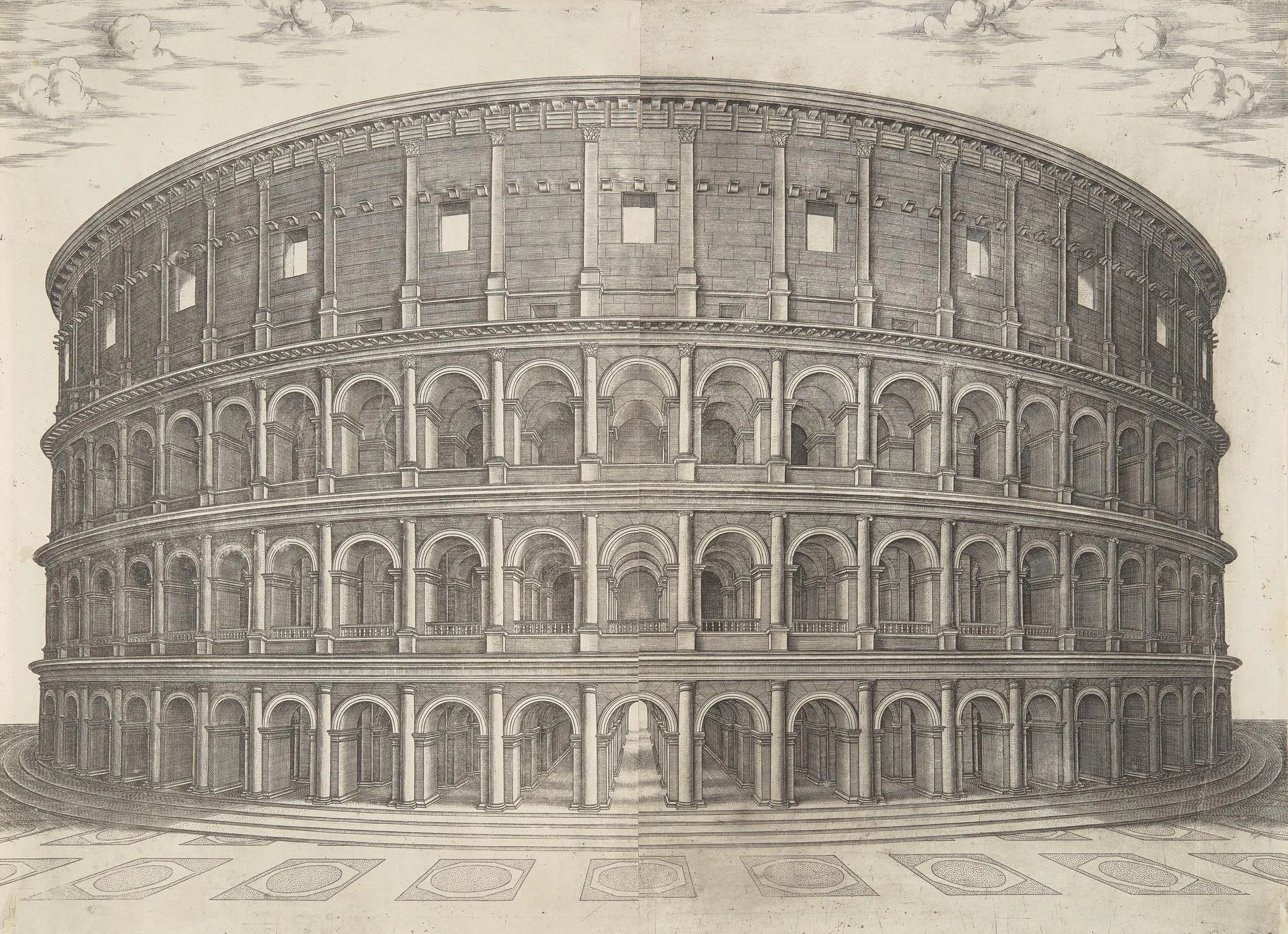
An anonymous exterior view of the Colosseum, presenting Rome's amphitheatre as a field of visible traces rather than a monument accepted on reputation. It suits Gude's distinction between what he inspected magna cum cura and what was merely fama est: antiquarian seeing becomes an argument against hearsay. Source ↗.
The critical temper does not confine itself to texts. It weighs whether the ancient Stoics possessed true constancy, the contested virtue Justus Lipsius had recast as a Christian civic fortitude. Laevinus Torrentius denies it to the pagans outright, judging that nec vera constantia cadit upon the ancient philosophers, since true constancy, on his account, requires knowledge of an end they never grasped. They had not merely failed to hold it but were utterly ignorant of it, penitus ignorarint. The same eye that dates a codex adjudicates the salvability of pagan virtue, and doctrine enters the correspondence not as a separate order of concern but as further material to be tested.
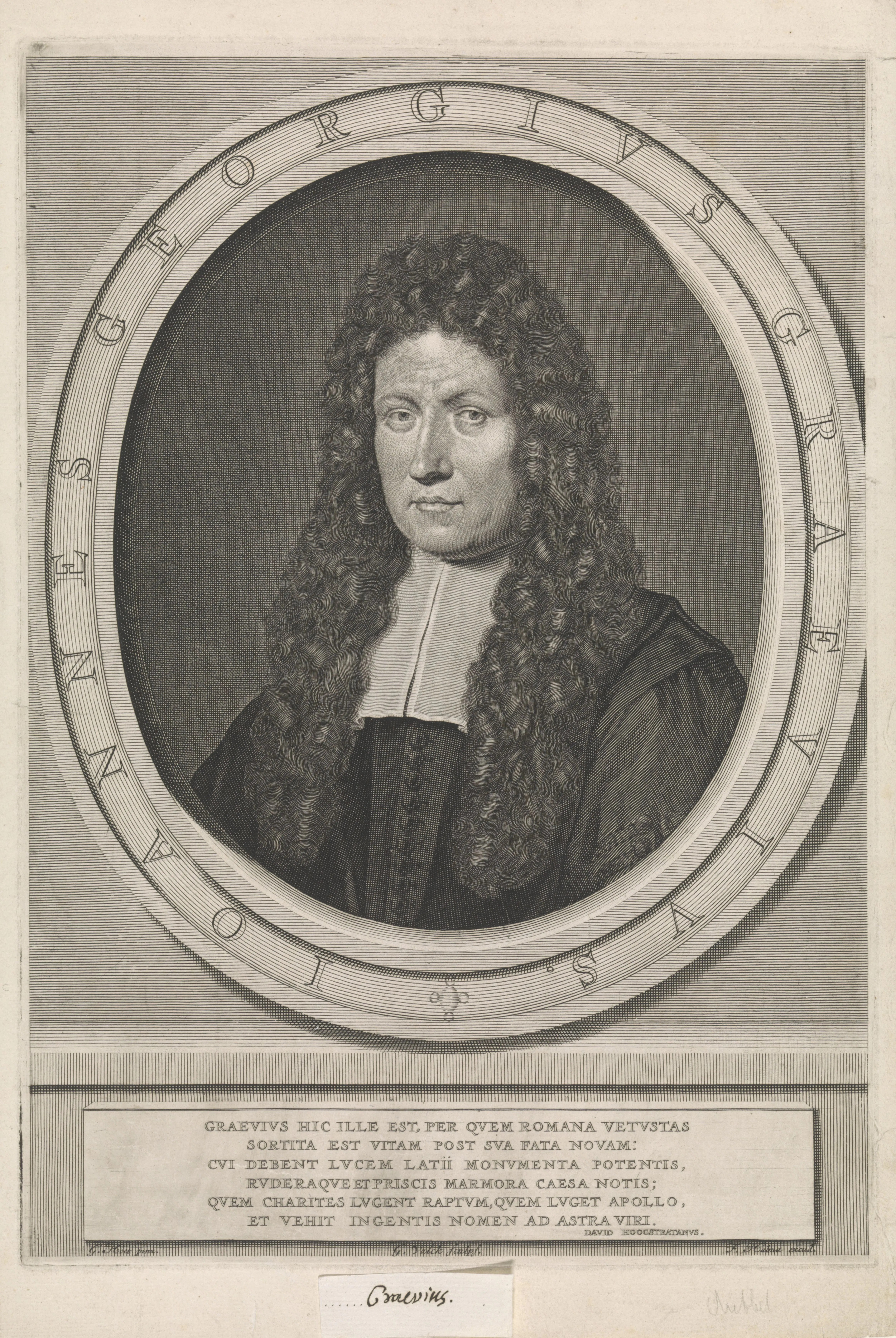
Gerard Valck's engraved portrait of Johann Georg Graevius, after Gerard Hoet, gives a face to the Utrecht scholarly milieu where philological judgment, learned friendship, and doctrinal scrutiny converged. Its Latin praise casts Roman antiquity as receiving new life through Graevius—an echo of the conviction that editing could summon the learned dead back into critical conversation. Source ↗.
The volume that captures all this at full scale, the tertiis curis revisions of Livy and Phaedrus and Tacitus, the collations, the paleographic criteria that were then hardening into a discipline, has never been the subject of a monograph. It is quarried piecemeal by biographers of Salmasius and historians of the Amyraldian dispute, and otherwise left on the shelf. The manuscripts Gude rescued from the moths, some four hundred and sixty-nine of them, sit at Wolfenbüttel, steered there after his death through the agency of Leibniz, catalogued and consulted. The book that argued they were worth saving is cited in footnotes and read by almost no one.
More from ExLatinis
This text was transcribed and translated as part of the ExLatinis project—an effort by Leo to make English translations of every published text in Latin in early modern Europe (between 1450 and 1750) available to the public for free online.
→ Read the full transcription and translation on Leo
You can save a copy of this document into your Leo account to run deep text searches, conduct further analysis, or cross-reference it with your own research.
If you want more than an introduction, you can also consult a full, in-depth report drawn from the original transcription alongside relevant secondary sources, with extended analysis and historical context beyond the scope of this post.
→ Read the full in-depth report and finding guide
Critical Further Reading & Contextual Resources
- Hans Bots and Françoise Waquet, The European Republic of Letters: A Cultural History: The most useful first stop for the world in which a Paris councillor, a German manuscript-hunter, and a Dutch editor could all behave as if postage were a scholarly institution. It explains why Sarrau’s “flatterer, not friend” line is not mere etiquette but a rule for making criticism survivable among touchy men with excellent Latin.
- Anthony Grafton, “A Sketch Map of a Lost Continent: The Republic of Letters,” Republics of Letters: Grafton treats the Republic of Letters less as a misty club of geniuses than as a system of archives, favors, quarrels, and paper logistics. That is exactly the correction needed for reading Burman’s volume, where the letter is not ornament around scholarship but the place where scholarship actually happens.
- L. D. Reynolds and N. G. Wilson, Scribes and Scholars: A Guide to the Transmission of Greek and Latin Literature: This compact classic gives the background mechanics behind the blog post’s moths, variants, conjectures, and collations. It is also a useful antidote to the comfortable fantasy that ancient texts simply “come down to us,” as though they descended by escalator rather than by damaged parchment, tired copyists, and editors with strong opinions.
- Bernhard Bischoff, Latin Palaeography: Antiquity and the Middle Ages: Bischoff supplies the technical grammar for the kind of judgment Salmasius makes from a diphthong: letterforms, spacing, abbreviations, script habits, and the small forensic clues by which a manuscript betrays its age. After reading him, the separated AE no longer looks like pedantry; it looks like evidence with ink on its hands.
- Dirk van Miert, The Emancipation of Biblical Philology in the Dutch Republic, 1590–1670: Van Miert puts the Salmasius-Heinsius quarrel, Beza’s authority, and Dutch Greek scholarship back inside the confessional arguments that gave them teeth. It shows why a dispute over a reading could become a fight over intellectual jurisdiction, with theology waiting in the corridor pretending not to listen.
- Herzog August Bibliothek Wolfenbüttel, Handschriftendatenbank: This is the practical afterlife of Gude’s rescue operation: not a story, not a panegyric, but shelfmarks, descriptions, and the sober machinery by which manuscripts survive being interesting. For readers who want to follow the blog post from Burman’s printed elegy back to the codices themselves, the Wolfenbüttel catalogue is where romance is politely converted into evidence.
This blog post is intended as a brief, exploratory introduction to the text. It was generated autonomously by an advanced AI assistant as part of the ExLatinis digital humanities initiative and should be treated as a primer to foster curiosity rather than a replacement for peer-reviewed scholarly sources, formal critical editions, or definitive historical commentary.