The Set Square at the Gate: Girolamo Vitale's Lexicon Mathematicum Astronomicum Geometricum
A Theatine cleric of Capua named Girolamo Vitale spent years compiling a single alphabetical dictionary, the Lexicon Mathematicum Astronomicum Geometricum (Paris, 1668), meant to hold the entire technical vocabulary of the seventeenth-century mathematical arts — arithmetic, geometry, optics, astronomy, and all their kin — within one Catholic reference apparatus. His governing aim was neither purely scholarly nor purely devotional: to prove that the whole of mathesis could be transmitted intact, without hazard to faith or morals, provided every term was admitted, glossed, and, where dangerous, quarantined one entry at a time. The result is an unusually clear record of how a sophisticated cleric-mathematician drew the boundary between licit astronomy and condemned judicial astrology, between natural sympathy and forbidden magic, in the deliberately undramatic medium of the lexical definition.
ExLatinis
24 July 2026

Contents
A Theatine cleric of Capua named Girolamo Vitale spent years compiling a single alphabetical dictionary, the Lexicon Mathematicum Astronomicum Geometricum (Paris, 1668), meant to hold the entire technical vocabulary of the seventeenth-century mathematical arts — arithmetic, geometry, optics, astronomy, and all their kin — within one Catholic reference apparatus. His governing aim was neither purely scholarly nor purely devotional: to prove that the whole of mathesis could be transmitted intact, without hazard to faith or morals, provided every term was admitted, glossed, and, where dangerous, quarantined one entry at a time. The result is an unusually clear record of how a sophisticated cleric-mathematician drew the boundary between licit astronomy and condemned judicial astrology, between natural sympathy and forbidden magic, in the deliberately undramatic medium of the lexical definition.
Girolamo Vitale — Hieronymus Vitalis Capuanus, a Theatine cleric regular born at Capua in 1623 or 1624 — set out, in a single dense octavo printed at Paris in 1668, to do something at once modest in form and ambitious in aim: to compile an alphabetical dictionary that would hold the entire technical vocabulary of the seventeenth-century mathematical arts within one Catholic-glossary apparatus. The Lexicon Mathematicum Astronomicum Geometricum runs from A to Z through arithmetic, geometry, optics, music, mechanics, chronology, geodesy, navigation, hydrography, astronomy, and astrology, together with the cosmological, meteorological, and natural-philosophical terms that touch upon them. Its form is that of the encyclopedic mathematical lexicon — a genre with distinguished mid-century exemplars — but its governing purpose is confessional as much as reference-bearing: to demonstrate that the whole of mathesis, in the capacious early modern sense that reaches far beyond number and figure, can be transmitted intact and without hazard to faith or morals.
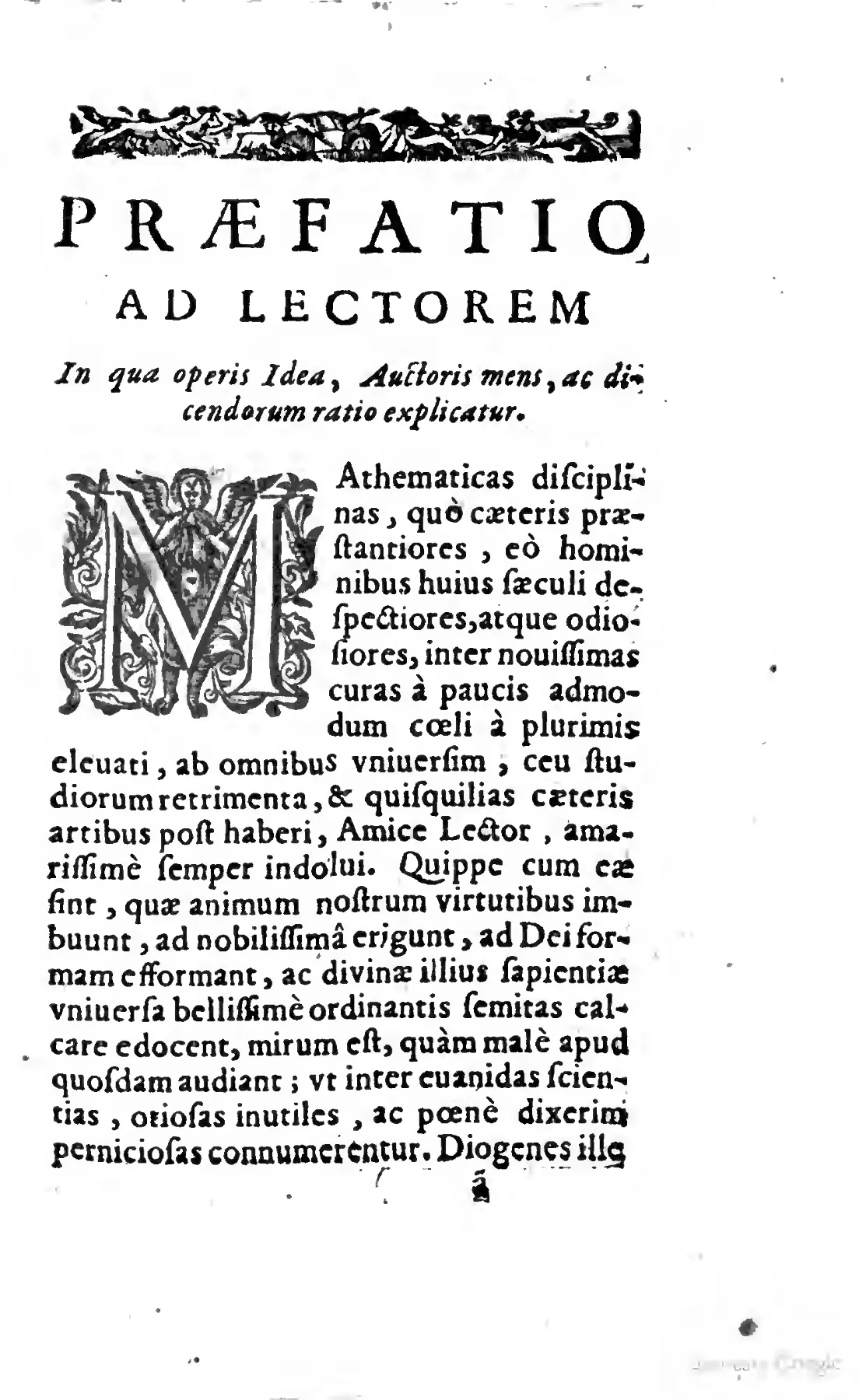
The opening of Vitale's "Præfatio ad lectorem," framed by a decorative headpiece and a historiated initial M, sets out the lexicon's programmatic key: mathematics is defended not merely as useful knowledge but as a discipline that forms the mind toward virtue and divine likeness. The alphabetical apparatus that follows is cast as a Catholic ordering of mathesis, preserving legitimate arts while marking off the superstitious corruptions later sorted entry by entry. Source ↗.
The intellectual problem Vitale confronts is precisely that the mathematical disciplines, which he holds to be dignifying and demonstratively certain, had in his age fallen into contempt through their entanglement with superstition — above all with judicial astrology. His recurring move is one of demarcation and controlled transmission, conducted one lemma at a time. He proposes to separate the wheat from the tares, transmitting even Arabic, Egyptian, and what he calls "barbarous" doctrines for the sake of completeness, neque approbando, neque improbando — neither approving nor disapproving — while repudiating what the Church has condemned and restricting the licit precepts he adduces to Ptolemy or to authors the Church has approved. The dictionary form is not incidental to this project but constitutive of it: the discrete entry becomes the unit at which a term can be admitted, glossed, and, where necessary, quarantined. Licit natural astrology is set against proscribed astrologia iudiciaria; the post-Tychonic fluid heavens and the novelties disclosed by the telescope are set against the condemned Copernican system and the motion of the earth; the astral causation of secondary effects is affirmed while any denial of the freedom of the will is excluded; occult qualities and the sympathetic cure are entertained as natural even as demonic pact is refused. A casuistic presumption governs the whole boundary — that in doubtful cases the verdict falls for Nature.
The stakes of this undertaking are those of Catholic learning in the decades after 1633. By the time the first edition appeared, the Roman prohibition of Copernicus's De revolutionibus still stood, and the Catholic astronomical mainstream — shaped by the Jesuit astronomers of the Collegio Romano, and above all by Riccioli's Almagestum Novum of 1651 — had settled into a careful middle position that preserved the earth's centrality while conceding the empirical force of the new astronomy. Vitale writes as a representative of that generation: he treats the Tychonic fluid heaven as the legitimate teaching of the skies, entertains the Copernican alternative only as a hypothesis foreclosed by ecclesiastical decree, and reads the new stars of 1572, 1600, and 1604 as genuine changes in an incorruptible firmament. The Lexicon thus offers historians of science a granular, taxonomic record of how a sophisticated cleric-mathematician proposed to make his century's mathematical vocabulary safe for Catholic use — the boundary-work between astronomia and astrologia iudiciaria, between natural sympathy and magia, carried out in the deliberately undramatic medium of lexical definition.
What a first-time reader will find most striking is how far the ambition of controlled transmission carries Vitale into contested and even startling terrain. The heavens are liquefied after Tycho, so that the stars are said to swim through a single vast heaven like fish in the sea; the new stars are lodged among the fixed stars by the argument from parallax; the squaring of the circle is pronounced not impossible in principle even if no one has achieved it; the antipodes are declared so certain that to deny them is now merely to rave. The cosmos is held to live by a superior grade of life, harmonized with conciliar anathema; hell is placed at the center of the world with volcanoes as its breathing-holes; and — hedged carefully as spoken only disputandi gratia, for the sake of disputation, not affirmed out of his own head — the earthly Paradise is entertained upon the surface of the Moon. These are not the flourishes of a controversialist but the byproducts of an encyclopedist determined to register every term his century used and to assign each its place on the near or far side of the licit. The appended Digressio physio-theologica on the sympathetic powder and the weapon-salve brings the same casuistic instrument to bear on action at a distance, distinguishing legitimate natural sympathy from magical superstition.
Running through the whole is a single throughline that binds the work's conceptual vocabulary, its production under formal approbation, and its internal argument: the conviction that the dignity of mathesis can be recovered only if its corruptions are named precisely and cordoned precisely, and that a Theatine cleric writing with the approval of censors of his own and a second religious order is well placed to draw those lines. The polysemy of mathesis, the juridical force of the Church's condemnations, the patronage context of a dedication to a prince-archbishop, and the entry-by-entry movement of the lexicon all serve that one demarcating purpose. The account that follows traces it through the work's title and key terms, its material history and censorship, its place in the historiography of post-Tridentine science, and the primary text itself.
Read the full text and English translation on Leo
This text was transcribed and translated as part of the ExLatinis project, an effort by Leo to make free English translations of every text published in Latin in early modern Europe (1450–1750) available online. The complete transcription and English translation of this work can be read free of charge:
→ Read the original Latin text and full English translation on Leo
You can save a copy of this document into your Leo account to run deep text searches, conduct further analysis, or cross-reference it with your own research.
Naming the Whole of Mathesis: The Title and Its Load-Bearing Terms
Editorial Title (supplied for convenience; not an established form): A Mathematical, Astronomical, and Geometrical Lexicon: A Collection and Explanation of All Things Pertaining in Any Way to Both—indeed to Almost Every Branch—of Mathematics, by Girolamo Vitale, Theatine, of Capua.
Authentic Latin title as printed on the title page of the 1668 editio princeps: Lexicon Mathematicum Astronomicum Geometricum. Hoc Est Rerum Omnium ad Utramque, Immo & ad Omnem Fere Mathesim Quomodocumque Spectantium, Collectio, & Explicatio. Auctore Hieronymo Vitali Capuano, Clerico Regulari Theologo.
Philological Framing
The Lexicon's full title performs in miniature the entire taxonomic programme of the work. Three Latin terms in particular require careful unfolding if the reader is to grasp the book's intellectual design and its place within the post-Tridentine Counter-Reformation learned world.
Mathesis is the first and most expansive of the title's three load-bearing nouns. In the seventeenth century, and especially in the encyclopedic-lexicographic tradition to which Vitale's work belongs, mathesis denoted not 'mathematics' in the modern restricted sense of abstract quantitative disciplines but the entire ordered body of knowledge that can be formally demonstrated or quantitatively treated: arithmetic, geometry, optics, astronomy, music, mechanics, chronology, geodesy, navigation, hydrography, and the mathematical portions of natural philosophy. The Latin term derives from the Greek μάθησις, 'learning' or 'discipline,' and was used in late-antique and medieval classifications of the sciences to designate the quadrivium (arithmetic, geometry, music, astronomy) and its later accretions. The clause ad omnem fere mathesim quomodocumque spectantium — 'to almost every branch of mathematics, in whatsoever manner pertaining' — is therefore not redundant ornament; it signals that Vitale conceives his lexicon as an instrument of universal reference for the entire mathematical-artificial knowledge-order, not as a mere dictionary of arithmetic and geometry in the modern sense. To render mathesis as 'mathematics' in a twentieth-century sense would be a serious category error; the term belongs to the wider encyclopedic-mathematical tradition descending from the Aristotelian–Boethian quadri-vial curriculum and inherited by Renaissance writers on the mathematical arts such as Pappus, Proclus, and the compilers of the great Renaissance mathematical lexica. Vitale himself gives the term a technical footing when he defines the object proper to the whole family of disciplines, holding that quantity is the proper and widest object of all the mathematical disciplines, not as an accident bound to matter but as it expresses the extension of parts, QANTITAS est proprium, & latissimum omnium Mathematicaum disciplinarum obiectum, non quidem quâ accidens est, materiæ addicta, & sensibilibus qualitatibus implicita ... sed provt dicit extensionem partium. He grounds the term's dignity in the same demonstrative certainty, observing that those arts are called mathemata which rest on firm demonstrations and are therefore best fitted to instilling discipline in the mind, Mathemata enim dicuntur artes, quæ firmis demonstrationibus constant: quæ quidem idcircò ad disciplinam animo inserendam aptissimæ inveniuntur. This demonstrative dignity is the positive pole against which the polysemy of the title's remaining terms is policed: mathesis names the encyclopedic scope precisely because it is knowledge fit to be recovered from the corruptions that had degraded it.
Astrologia iudiciaria is the second term requiring philological care, and it carries the entire polemical charge of the Counter-Reformation debate over the legitimacy of the divinatory arts. Following the condemnation of Pico della Mirandola's Disputationes adversus astrologiam divinatricem (1496) and the subsequent incorporation of that condemnation into the Roman Index, the phrase astrologia iudiciaria came to designate specifically the divinatory, prognosticatory branch of astrology: the casting of nativities, the election of auspicious hours, the reading of planetary configurations as causal signs of contingent future events such as the outcomes of battles, the duration of illnesses, the recovery of stolen goods, or the dispositions of souls. The earlier bull of Sixtus V, Coeli et terrae creator Deus (1586), and the Index of Clement VIII (1596, with successive redactions) placed such arts under ecclesiastical suspicion; later the Sacred Congregation of the Index and the Holy Office maintained the prohibition through the seventeenth century. Vitale's lexicographic method — cataloguing the terms of judicial astrology while marking them as illegitimate or morally suspect — is a precise instantiation of what historians of science have called the boundary-work by which Counter-Reformation Catholicism demarcated licit astronomy (astronomia, the natural mathematical science of celestial motions) from illicit astrology (astrologia iudiciaria, the divinatory art). Vitale states the ground of the prohibition in his own terms, holding that that part of astrology was justly proscribed by the Church which deals with things in any way free, Hinc jure proscripta fuit ab Ecclesia ea Astrologiæ pars, quæ de rebus vtcunque liberis — the criterion of demarcation being the freedom of the human will, which no astral reading may claim to determine. That the corruption of so noble a discipline should be diabolical in origin is, for Vitale, of a piece with the devil's characteristic strategy, since he holds that the devil wishes nothing more than to ape God and corrupt the most perfect things in contempt of God, nil magis affectet, quam Dei simiam facere, & perfectissima quæque in Dei contemptum corrumpere. The Lexicon's segregation of these two vocabularies into distinct lemmata is therefore not lexicographic pedantry but a small monument of post-Tridentine intellectual discipline.
Caelum fluidum is the third term whose period connotation requires unpacking. By caelum fluidum Vitale means the doctrine that the celestial spheres are not solid crystalline orbicles but a fluid or ethereal medium capable of transmitting light, motion, and influence without the mediation of solid wheels. This doctrine, associated above all with Tycho Brahe's cosmological reform and adopted by the Jesuit astronomers of the Collegio Romano — most prominently Giovanni Battista Riccioli in his Almagestum Novum (1651) — became, by the second half of the seventeenth century, the orthodox Catholic compromise between the geostatic Biblical cosmos and the Copernican heliocentric alternative. The fluid-heaven doctrine allowed Catholic astronomers to preserve the earth's centrality and stability while accepting the empirical adequacy of Copernican-Ptolemaic hybrid models (geo-heliocentric systems in which the sun orbits the earth but the other planets orbit the sun). Vitale's lexical entry on caelum, like his entries on orbis and firmamentum, reflects and transmits this Tychonic-Ricciolian consensus. He states the doctrine in vivid terms, asserting that after Tycho, who first established the fluid heaven, one must now assert not many heavens but a single vast heaven through which the stars swim like fish in the sea, atque adeò non | plures cæli, sed vnum tap| tum vastissimum per quod stellæ non secus ac pisces in mari | discuriant, jam modò videarur procul omni dubio asserendum, and the Lexicon may thus be read as a documentary witness to the post-1633 Catholic settlement on cosmology.
These three terms — mathesis, astrologia iudiciaria, caelum fluidum — together constitute the ideological perimeter of the work. Mathesis names the encyclopedic scope; astrologia iudiciaria names the boundary the lexicon polices; caelum fluidum names the cosmological consensus the lexicon presupposes. The clustering of the three within the title-page apparatus and the body of the lexicon is a precise index of how a Counter-Reformation cleric-mathematician of mature formation might hope to make the entire mathematical vocabulary of his century safe for Catholic use.
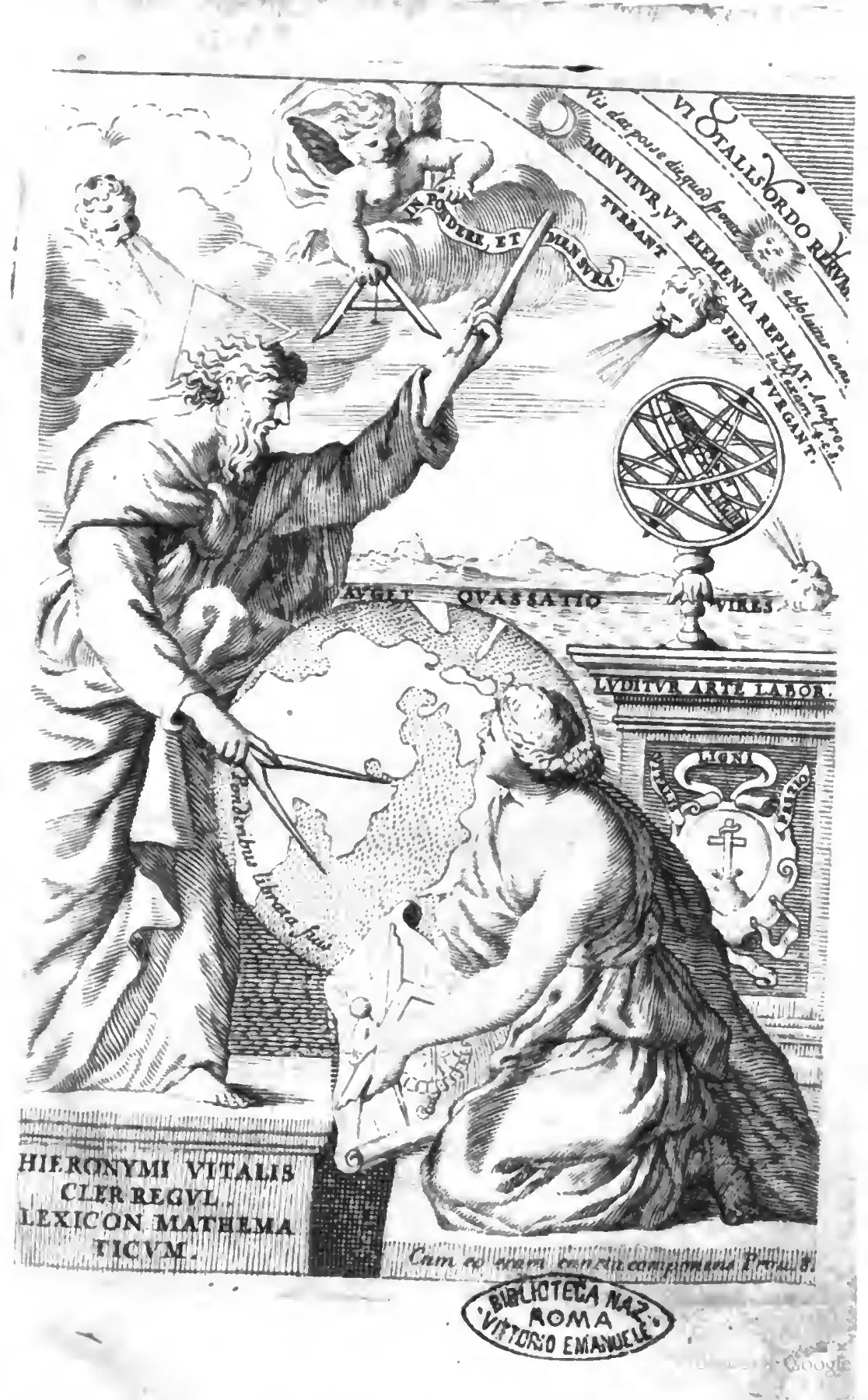
Vitale's engraved frontispiece turns the lexicon's ideological perimeter into an image: a personification of Mathesis measures the terrestrial globe, while an armillary sphere, balance, and compasses link geometry, astronomy, and mathematical discipline. The printed motto "PONDERE ET MENSURA" presses the same claim as the title-page apparatus—that legitimate celestial knowledge rests on weight, measure, and demonstrative order rather than the illicit certainties of judicial astrology. Source ↗.
What Vitale's Lexicon Contains and Why He Wrote It
The Lexicon Mathematicum Astronomicum Geometricum of Girolamo Vitale (Hieronymus Vitalis Capuanus) is a single-volume encyclopedic alphabetical dictionary of the mathematical sciences, issued from Paris in 1668 under the imprint of Louis Billaine, imprimeur-libraire ordinaire du Roi, in the great entrance-hall of the former Jesuit college of Clermont (the future Louis-le-Grand). The author, born in Capua in 1623 or 1624 and active as a cleric regular of the Theatine order at least into the early 1690s, describes himself on the title page as Hieronymus Vitalis Capuanus, Clericus Regularis Theologus.
The Lexicon treats, in alphabetical sequence from A to Z, the entire technical vocabulary of the seventeenth-century mathematical arts: arithmetic, geometry, optics, music, mechanics, chronology, geodesy, navigation, hydrography, astronomy, and astrology, together with the cosmological, meteorological, and natural-philosophical terms that intersect with these disciplines. Each entry is constructed by definition, by enumeration of species or kinds, and by reference to the standard modern authors — Galileo, Kepler, Descartes, Riccioli, Kircher, Schott, Gassendi — alongside the older Ptolemaic-Arabic inheritance. The text is set in Latin throughout, drawing its technical nomenclature from Greek, Arabic, Hebrew, and the Chaldaean oracular tradition as was conventional in such lexica. The volume is prefaced by a dedicatory letter to Guidobald, Count of Thun, Prince-Archbishop of Salzburg (whose death on 1 June 1668 falls in the very year of publication), by a Praefatio ad lectorem, and by formal approbations granted by a Theatine father-censor and a Dominican father-censor, dated August 1666. An appended Digressio physio-theologica treats the sympathetic cure — the sympathetic powder and the weapon-salve — as a case study in the demarcation of legitimate natural sympathy from illicit magical practice.
Vitale states the aim of the whole in the preface, declaring that he had set himself to show not so much the principles of mathematics grounded in true philosophy as the vanities with which it had been corrupted, vt non tam Mathesis principia veræ Philosophiæ innixa, quam etiam vanitates, quibus conspurcata fuit, ostenderem. The dignity that motivates this labour of purification is stated at the outset, where he holds that the mathematical disciplines are those which imbue our mind with the virtues, raise it to the noblest things, and form it to the likeness of God, Quippe cum eæ fint, quæ animum nostrum virtutibus imbuunt, ad nobilissimâ erigunt, ad Dei formam efformant. The editorial method by which he keeps that purpose is one of controlled transmission: the licit precepts he admits are, by his own account, taken only from Ptolemy or from authors approved by the Church, since the purer and more innocent precepts of astrology he adduces are drawn from no source but these, quæ hic puriora, atque innocentiora præcepta ex Astrologicis allegauero, ea non nisi ex Ptolemæo, aut ab Ecclesia probatis scriptoribus sumpti. Where he transmits proscribed or foreign doctrine for the sake of completeness, he does so at arm's length, inserting such material neither approving nor disapproving, but only for the completeness of the work and to satisfy the curiosity of the curious, placuit eos & hic inserere, neq[ue] approbando, neque improbando, sed solùm ad operis complementum, atque vt curiosorum desiderio satisfacerem.
A second printing was issued at Rome in 1690 by Giuseppe Vannacci, carrying a slightly modified title (Lexicon Mathematicum Hoc Est Rerum Omnium ad Universam plane Mathesim quoquo modo, directe vel indirecte spectantium, Collectio, et Explicatio) and new Roman approbations, but otherwise essentially a reissue of the 1668 text. The Roman printing brought the work into the Italian Catholic book market under post-Index conditions in which locally produced Catholic lexica were especially valued.
The driving thesis of the work, recoverable from the preface, the approbations, and the appended digression, is that the entire mathematical vocabulary of the seventeenth century can be presented within a single Catholic-glossary apparatus without hazard to faith or morals, provided the lexicon's taxonomy rigorously distinguishes the natural-mathematical disciplines (astronomia, geographia, optica, mechanica) from the divinatory arts (astrologia iudiciaria, geomantia, onomantia, the cabalistic arts), and provided the phenomena of action at a distance (the sympathetic cure, the weapon-salve) are treated as legitimate subjects of natural-philosophical investigation while their moral and theological implications are authoritatively circumscribed. This demarcating purpose is the throughline that binds the work's conceptual vocabulary to its confessional framing and its entry-by-entry method.
The Lexicon is composed in Latin throughout and has never been translated, in whole or in part, into any modern language. It survives in research-library holdings across Europe and North America and is accessible in digitized form through the Google Books copy digitized from the Ghent University Library, the Internet Archive, and the digitized collections of the Bayerische Staatsbibliothek and other major European libraries.
Situating Vitale in the Historiography of Post-Tridentine Science
The Lexicon Mathematicum Astronomicum Geometricum occupies a distinctive position at the intersection of three vigorous currents in the current historiography of early modern science.
First, the Lexicon is a central document for the history of the post-Tridentine demarcation between licit and illicit astral knowledge. Since the publication of H. Darrel Rutkin's studies on astrology and the boundaries of legitimate natural philosophy, and the foundational work of Dario Tessicini on the Roman censorship of divinatory literature, scholars have come to understand the boundary between astronomia and astrologia iudiciaria as a fluid rather than static one — a boundary maintained by careful lexical, methodological, and contextual work rather than by absolute prohibition. The Lexicon is a particularly valuable witness to this boundary-work because it systematically catalogs the full technical lexicon of judicial astrology even as it marks that discipline as illegitimate, and because its appended Digressio physio-theologica carefully distinguishes what it regards as licit natural sympathy from what it condemns as magical superstition. That the criterion of demarcation is the freedom of the will, and the corruption of astral learning diabolical mimicry, gives the Lexicon its characteristic granularity: it records, term by term, how a sophisticated Catholic cleric-natural-philosopher of mature Counter-Reformation formation proposed to police the boundaries of legitimate learning. The doctrine of astral causation that Vitale admits stops precisely at the will, and he articulates the compatibilism through Kircher, holding that nature is ruled by two principles, nature and will — nature being subject to the stars, the will free, Natura, inquit, duobus principiis regitur, natura, & voluntate: Natura subiecta est sideribus, voluntas libera.
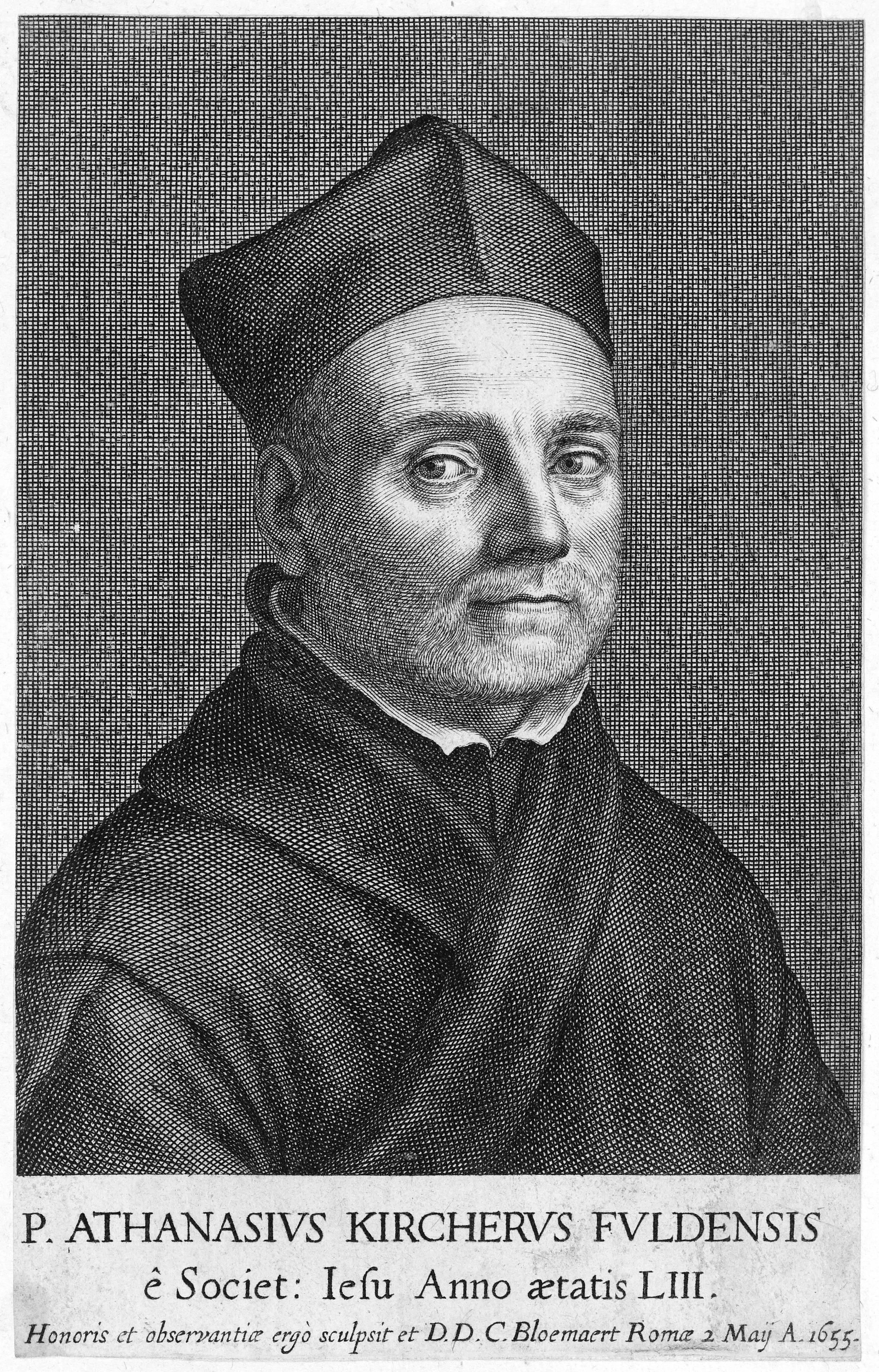
This 1655 engraved portrait presents the Jesuit polymath Athanasius Kircher in the learned iconography of the Roman Counter-Reformation milieu from which Vitale drew one of his central authorities. Kircher's distinction between a nature subject to celestial influence and a will that remains free helped Vitale articulate the Lexicon's line between permissible natural philosophy and condemned judicial astrology. Source ↗.

Second, the Lexicon illuminates the post-Galilean, post-Index (1633) settlement between Catholic theology and Copernican cosmology. By 1668, when the first edition appeared, the Roman Index of 1633 still officially banned Copernicus's De revolutionibus and a small set of pro-Copernican works; the Piana Congregation's decree of 1664, confirmed by Alexander VII, had extended the prohibition to two specific propositions attributed to Galileo. The Catholic astronomical mainstream of the second half of the seventeenth century, dominated by the Jesuit astronomers of the Collegio Romano — most prominently Giovanni Battista Riccioli in his Almagestum Novum (1651) and Athanasius Kircher in his various works — was forced into a careful middle position. Vitale, as a Theatine cleric and a textbook author for the mathematical sciences, is a representative specimen of this generation: he accepts the Tychonic (geo-heliocentric) compromise as the legitimate teaching of the heavens, entertains the Copernican alternative as an unresolved hypothesis, and excludes the absolutely geokinetic proposition from the lexicon's permissible range. He records the condemnation in unambiguous terms, holding that rightly and deservedly this Copernican system, as false, contrary to sacred scripture, and alien to the principles of true philosophy, was condemned by the sacred Congregation of Cardinals by a special decree, iure meritò hoc systema Copernicum, tamquam falsum, sacræ scripturæ aduersum, atque à veræ Philosophiæ principiis alienum, damnatum fuit à sacra Congregatione Cardinalium peculiari decreto, and he installs in its place the figure of Tycho Brahe the Dane, the true restorer of astronomy, who after more than fifty years' observation first of all liquefied the heaven and constituted the whole ethereal region as fluid, Tandem Tycho Brahe Danus verus Astronomiæ instaurator, post longam quinquaqinta ampliùs annorum obseruationem, adiutus à pluribus petitissimis Mathematicis primus omnium cælum liquauit. This Tychonic settlement is bound up with the empirical arguments the Lexicon transmits: the new stars are lodged in the incorruptible heavens by parallax, so that the new star which appeared in the Seat of Cassiopeia in 1572 and that in the Swan in 1600 were believed produced not in the elementary or lunar region but in heaven itself and the region of the fixed stars, Et ideo noua stella, quæ apparuit in Sede Cassiopææ anno 1572. & quæ in Cygno anno 1600. creditæ fuerunt non in regione elementari, neque in lunari ... sed in ipso cælo & regione fixarum. The Lexicon therefore documents the post-1633 theological settlement of cosmology in granular, lexical form.
Third, the appended Digressio on sympathetic cure situates Vitale within the early modern debate over action at a distance and occult qualities — what we would now call the weapon-salve and powder-of-sympathy controversy, following Kenelm Digby's Of the Sympathetic Powder (1644–1658) and the long Italian debate on sympathia and antipathia that runs from Fracastoro through Telesio to the Jesuit magnetic philosophy. Vitale's Digressio is an early Italian Catholic theological pronouncement on the sympathetic cure, and serves as a touchstone in the historiography of seventeenth-century mechanism, magnetism, and occult qualities. The demarcating logic here turns on a casuistic presumption for Nature: it is, as Vitale puts it, the common axiom of all theologians that whenever it is doubted whether an effect is superstitious or natural, arising from a natural cause even if unknown to us, it must always be judged natural, vt quandocumque dubitatur an effectus sit superstitiosus, an naturalis à causa naturali etsi nobis ignota proueniens, censendus semper est naturalis. He reinforces the presumption with Caramuel's counsel that if you see something rare you should give thanks to the Author of Nature, and that unless he evidently sees some pact or demonic intervention underlying it he will not believe it present, Si quid rarum vides, gratias age Natura Conditori. Potentissimus potententissimum condidit: hoc suppono. Sub latere aliquod pactum, aut Damonis interuentum quovisque videam euidenter, non credam. Crucially, Vitale does not thereby endorse action at a distance; he refers the magnetic cure to an immediate natural agency, saying that the magnetic cure is done by Nature acting immediately and intrinsically, yet excited extrinsically by the motion of the medicated blood and by the vitriol, Dico igitur Magneticam curationem fieri à Natura immediatè & intrinsecus operante, excitata tamen extrinsecus à motu sanguinis medicati, & à vitriolo. Recent scholarship (notably Hedrick on Digby, and the work of Stephen Clucas and Guido Giglioni on the broader natural-magic debates) has stressed how Catholic writers such as Vitale sought to retain a doctrine of natural sympathy without lapsing into what the Index condemned as magia.
In the secondary literature, the Lexicon is treated principally in the standard histories of early modern mathematics and astronomy (Thorndike, VIII, 192 ff.; Rose, The Italian Renaissance of Mathematics, 1975; the relevant articles in the Dictionary of Scientific Biography), in the dedicated biographical study by Andrea Rabassini cited above, and in the historiographical literature on post-Tridentine astrology (Rutkin; Tessicini). The historiographical consensus treats Vitale as a minor but representative figure of the late-seventeenth-century Catholic textbook tradition — neither a creative scientist nor a controversialist, but a careful compiler whose lexicographic method makes him an unusually clear witness to the post-1633 boundary-work of the Catholic mathematical sciences.
The Object Biography: Printing, Censorship, and the Two Editions
Two printings of the Lexicon Mathematicum Astronomicum Geometricum are known and constitute the entire documented textual history of the work.
The editio princeps was issued at Paris in 1668, printed by Louis Billaine (Ludovicus Billaine or Billanus; died 25 August 1681), imprimeur-libraire ordinaire du Roi, whose shop stood in the magno Iesuitarum aulae vestibulo — the great entrance-hall of the former Collège de Clermont, the principal institutional foyer of post-Tridentine Catholic scholarship in Paris. The volume is an octavo, collating [22], 540, [60] folios, signatures a–o, A–Z8, Aa–Mm8, with preliminary leaves, the body of the lexicon, and an index of cited authors. The type is roman for the main text, with italic for cross-references; the title-page is printed in red and black and bears a woodcut vignette of the divine geometer on its verso. The volume opens with a dedicatory letter to Guidobald, Count of Thun and Prince-Archbishop of Salzburg (1616–1668; archbishop from 1654 until his death on 1 June 1668), proceeds through the Praefatio ad lectorem and the formal approbations, and concludes with the Digressio physio-theologica on the sympathetic cure. The choice of Guidobald as dedicatee situates the Lexicon within the patronage complex of Catholic-princely support for mathematical and astronomical learning in the second half of the seventeenth century, a pattern visible also in the dedications of Riccioli, Kircher, and Schott. The fact that the dedicatee died in the very year of publication lends the volume a poignant biographical coincidence.
The front matter further records the dual censorship through which the work passed before printing. The first approbation was granted by a Theatine father-censor of the Congregation of Clerks Regular (Clerici Regulares), the order to which Vitale himself belonged, on 8 August 1666; the second by a Dominican father-censor of the Order of Preachers (Ordinis Praedicatorum) on 22 August 1666. The dual approval, one from the author's own order and one from a second mendicant order, reflects the standard late seventeenth-century Catholic practice of requiring two religious approvals for works touching on potentially theologically sensitive matter — particularly, in this case, anything touching judicial astrology, sympathia, or the Cabala. This confessional apparatus is not external decoration but the institutional counterpart of the demarcating method that governs the entries themselves: the same criterion that quarantines proscribed doctrine within the lexicon is the one the censors were asked to certify.
The Digressio physio-theologica appended at the end of the volume is the historiographically most distinctive component. It treats the sympathetic cure (pulvis sympathicus) and the weapon-salve (unguentum armarium), two closely related recipes that, in the seventeenth century, were believed to heal wounds by action at a distance — either through the application of a powder to the weapon that had caused the wound or through the application of a salve to the weapon itself. Vitale uses the digression to draw a careful line between what he regards as legitimate natural sympathy (a property of bodies acting upon one another at a distance through subtle effluvia, in the tradition of Fracastoro and of Jesuit magnetic philosophy) and what he condemns as magical superstition (the deployment of the same phenomena in explicitly demonic or divinatory contexts). The medical principle underlying his account is Hippocratic: one must suppose that Nature is the healer of diseases and that the physician diligently serves her as Nature's servant, supplying each thing in its season, Naturam esse morborum medicatricem... Huic profectò Medicus sedulò inferuit (est enim vt addit idem Hippocrates, Naturæ famulus) opportunè singula suppeditando. The boundary he draws even permits the continued use of knowledge whose origin was suspect, for he follows the theologians in holding it licit to use knowledge once acquired through the demon's aid, provided the use itself does not depend on the demon's help, licitum mihi esse vti scientia, seu rerum naturalium notitia semel à me, siue ab alio ope Dæmonis acquisita, dummodo tamen vsus à Dæmonis auxilio non dependeat. The Digressio is therefore a primary document for the history of the weapon-salve controversy as it was adjudicated within Catholic theological mainstream in the 1660s, and it constitutes one of the earliest Italian Catholic theological pronouncements on the sympathetic cure before the great Jesuit treatises of the late seventeenth and early eighteenth centuries.
The second printing was issued at Rome in 1690, printed at the press and expense of Giuseppe Vannacci (or Vannacci). It is a quarto, collating [12], 612, [40] pages. It carries a slightly modified title — Lexicon Mathematicum Hoc Est Rerum Omnium ad Universam plane Mathesim quoquo modo, directè vel indirectè spectantium, Collectio, et Explicatio — replaces the Paris imprimatur with new Roman approbations, and is otherwise essentially a reissue of the 1668 text with corrected typographical errors and a slightly re-ordered sequence of preliminary matter. Bibliographers treat the 1690 imprint as a reissue rather than a new edition; the text is essentially that of the 1668 princeps. The Roman printing extended the circulation of the work into the Italian Catholic book market, where post-Index restrictions of 1633 made locally produced Catholic lexica especially valuable.
No further printings, editions, translations, or modern critical editions are known. The Lexicon has never been translated, in whole or in part, into any modern language, nor has it been re-edited with scholarly apparatus. The work is accessible to researchers chiefly through the digitized copies now provided by Google Books (the 1668 issue digitized from the Ghent University Library copy), the Internet Archive, and the digitized holdings of major European research libraries including the Bibliothèque nationale de France, the Bayerische Staatsbibliothek, and the Vatican Apostolic Library.
In its transmission the Lexicon belongs to the genre of the polymath mathematical lexicon whose mid-seventeenth-century exemplars include the Lexicon Technicum of Johann Heinrich Alsted (1634, expanded 1662), the Lexicon Universale of Johann Jacob Hofmann (Basel, 1677), and the Jesuit and Oratorian dictionaries of mathematics produced in France and the German-speaking lands. Vitale's work is distinguished from these by its specifically Counter-Reformation theological framework, its single-author character (it is conceived as the work of one scholar rather than a compilation), and its lexical quarantine of judicial astrology. That the demarcating method extends even to the technical apparatus of mathematics proper is visible in the entry on logarithms, where Vitale explains that when four numbers have a proportion to one another, the sum of the logarithms of the first and last number equals the sum of the middle ones, Hinc est, vt quando 4 numeri habent proportionem ad inuicem, summa logarithmorum primi, & vltimi numeri sit æqualis summæ mediorum, and in his cautious verdict on an ancient problem, that the squaring of the circle is therefore not impossible, though perhaps no one has actually squared it, Non ergò impossibilis est quadratura Circuli, licet fortè nemo fuerit, qui eum actu quadraverit.
In its immediate reception and after-life, the Lexicon appears to have circulated principally as a reference work for theological and philosophical students, for teachers of mathematics in the Catholic colleges of the Theatine and other regular clergy, and for the mathematically literate prince-bishop or patron. No known contemporary controversy, condemnation, or rebuttal attaches specifically to the Lexicon; the work's defensive provisions (the dual censorship, the dedicatory letter, the appended digression) appear to have been sufficient to forestall post-publication objection. The work survives as a printed text of fixed seventeenth-century form, accessible chiefly through digital surrogates and through the holdings of major European and North American research libraries.
Inside the Alphabet: How Vitale's Entries Sort the Licit from the Forbidden
The Preface and the Opening of the Alphabet: A Method Declared
Vitale's opening apparatus and the first reaches of the alphabetical dictionary together lay out the intellectual scaffolding on which the entire lexicon rests: a defense of the mathematical disciplines conducted in an explicitly theological register, followed by an editorial method for admitting, glossing, and quarantining the terms of a discipline he holds to be at once most excellent and most despised. The preface functions as the manifesto of the whole, and its affective thesis is stated in unmistakably elevated terms — that the mathematical disciplines are those which imbue our mind with the virtues, raise it to the noblest things, and form it to the likeness of God, a claim already registered in the summary of the work's aim above. The verb efformant is the load-bearing term there: mathematics does not merely instruct but shapes the soul toward its divine exemplar, a claim that lifts the disciplines out of the merely utilitarian and installs them within a program of spiritual formation proper to a cleric regular. This is not incidental rhetoric but the ground on which Vitale can later justify the labor of purification — a knowledge capable of divinizing the soul is precisely the sort of thing whose corruption must be exposed and cordoned.
The dignity so asserted is immediately given an epistemic footing. Vitale grounds the prestige of the disciplines in their demonstrative certainty, observing that those arts are called mathemata which rest on firm demonstrations and are thereby best fitted to instilling discipline in the mind, Mathemata enim dicuntur artes, quæ firmis demonstrationibus constant: quæ quidem idcircò ad disciplinam animo inserendam aptissimæ inveniuntur. The etymological move — from mathemata as "things learned" to the arts that rest on firmæ demonstrationes — is the criterion that will do the polemical work throughout: what is demonstratively certain is licit and dignifying, while what is merely conjectural or "experimental" falls under suspicion. The utility of the disciplines is then rehearsed across the civic and professional spectrum, culminating in a pointed rhetorical question concerning medicine, which without astronomical direction, Vitale asks, would it not be harmful and deadly to the sick, Medicina nonne sine Astronomiæ directione ægris esset incommoda atque exitialis?. The example is carefully chosen: the astronomical timing of medical intervention represents exactly the kind of licit, natural application of celestial knowledge that Vitale wishes to rescue, an application that touches the stars only as natural causes and never trespasses upon the contingent freedom of the human will.
Having established the dignity and utility of mathesis, the preface pivots to the problem that motivates the entire lexicon: the historical and moral slide by which so noble a body of knowledge fell into contempt. The engine of this degeneration is diabolical. The devil, having once sought God's likeness, now wishes nothing more than to ape God and to corrupt the most perfect things in contempt of God, nil magis affectet, quam Dei simiam facere, & perfectissima quæque in Dei contemptum corrumpere. The figure of the Dei simia supplies the theological logic of the whole polemic: corruption operates precisely upon the best things, so that the very excellence of astronomy is what makes its perversion into astrology so grievous and so plausible. The corruption is then narrated as a genuine historical succession. Hence astrology succeeds astronomy, Vitale writes, and because this knowledge was merely experimental and too curious, Hinc Astronomiæ Astrologia succedit, & quia hæc notitia experimentalis tantum erat, & curiosa nimis. The characterization of the corrupted art as experimentalis tantum and curiosa nimis is the exact obverse of the earlier definition of mathemata: where legitimate mathematics rests on firm demonstration, the divinatory art rests only on accumulated observation ungoverned by reason, and it is driven by an illicit curiositas that oversteps the bounds of natural knowledge. The Chaldeans, archetypal originators of the superstition, are named as those who beyond all others, more superstitious, gave themselves wholly to it, Chaldæi super omnes superstitiosiores in eam toti incubuerunt, fixing the geographical and ethnic origin of the corruption in the ancient East.
From this diagnosis Vitale derives his editorial program, and it is here that the dictionary form reveals itself as constitutive rather than incidental. The preface declares that he set himself to show not so much the principles of mathematics grounded in true philosophy as the vanities with which it had been corrupted — the same programmatic statement of aim quoted above. The lexicon is thus conceived not merely as a positive register of licit doctrine but as a controlled display of the vanitates themselves — a display whose purpose is to let the reader recognize and reject them. The governing figure for this operation is drawn from the Gospel parable: Vitale undertakes to separate the tares from the wheat, zizania à tritico segregarem. The wheat-and-tares image is exact for his method, for in the parable the two grow together until the harvest and are separated only at the end; so too Vitale's entries transmit licit and illicit doctrine side by side within a single alphabetical field, the separation effected not by omission but by the discriminating gloss attached to each term. The orthodoxy of the enterprise is then secured by a restriction on sources: the purer and more innocent astrological precepts he adduces are drawn, as noted above, from no source but Ptolemy or authors approved by the Church. This declaration accounts for the recurrent handling of bolder authors such as Pontano and Firmicus, who are tolerated for their style but moderated in their claims, and it is confirmed institutionally by the Theatine censors, who record that they read the lexicon and found in it nothing offensive to the Catholic faith or good morals, nihilque ineodatum est offendere, quod Catholicæ Fidei, aut bonis moribus adversetur. The censura is the institutional counterpart of the zizania method: the same discriminating judgment that Vitale exercises entry by entry is what the reviewers of his own order were asked to certify.
The dictionary body opens by making even its alphabetical premise carry doctrinal weight. The letter A, Vitale explains, is familiar to all mathematicians not as the first letter but as the gate of mathesis and the chief instrument of all the mechanical arts that proceed from it, sed quà Mathesis janua, præcipuumque MechaniCorum omnium, quæ à Mathesi prodeunt: instrumetum. By reading the shape of the letter as the carpenter's square, Vitale converts the arbitrary starting point of an alphabetical arrangement into an emblem of the discipline's practical instrumentality, so that the dictionary begins not with a word but with a tool — the janua through which one enters the whole edifice.
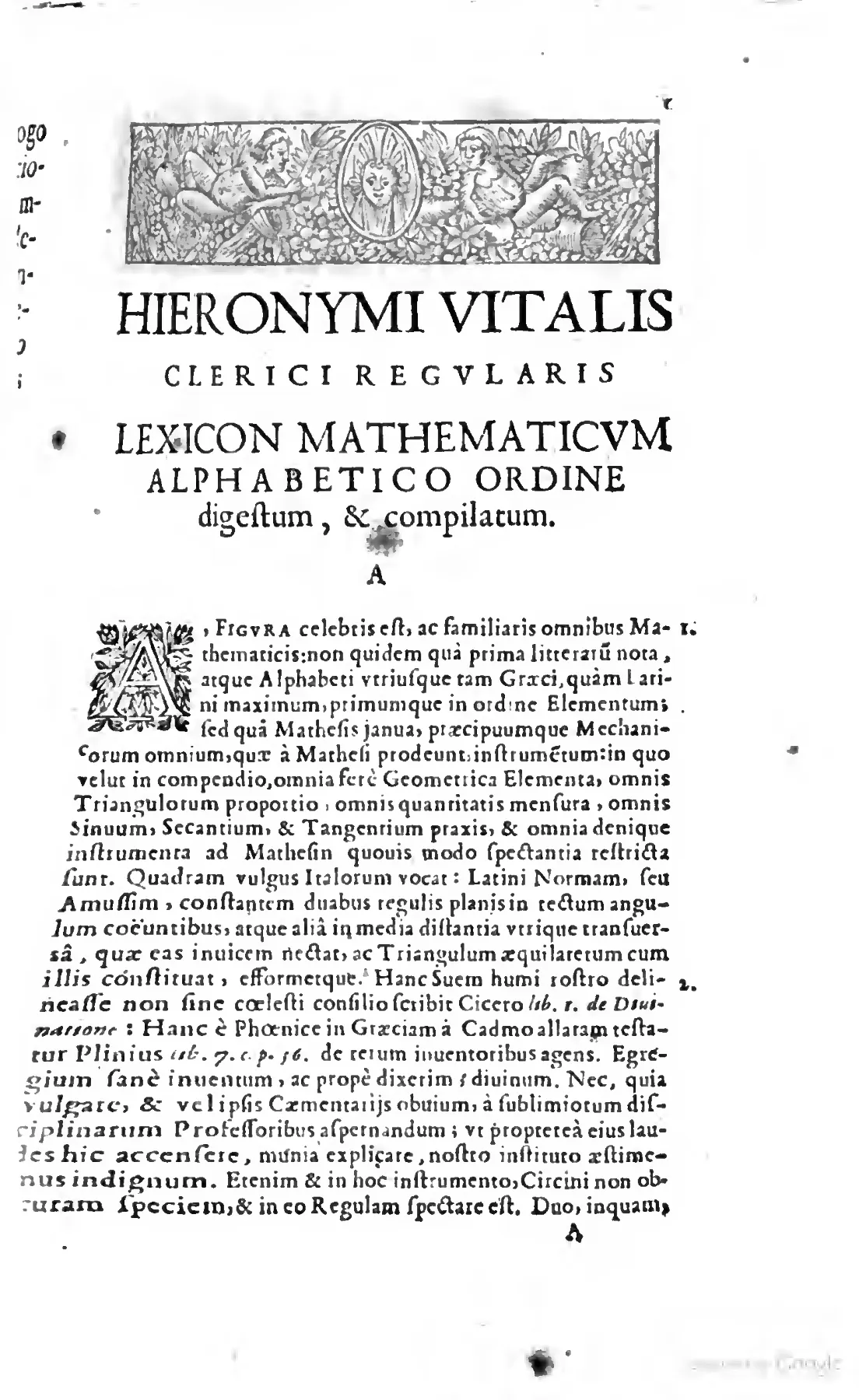
At the opening of the Lexicon's alphabetic body, Vitale surrounds the display title and oversized "A" entry with emblematic woodcut ornament, the historiated initial making the letter itself into a set-square. The visual conceit turns alphabetical order into argument, presenting A not merely as the first sign but as the practical "gate of mathesis" through which geometry, mechanics, and newer instruments such as Galileo's sector enter the lexicon. Source ↗.
Within the alphabetical run the zizania method is applied with striking consistency. Under the Decan doctrine, Vitale transmits the Arabic teaching in full and then repudiates it as a vain, superstitious thing and mere trifling of the Arabs, cum aliàs, res sit euanida, superstitiosa, & mera Arabum nugamenta. The pattern is instructive: the doctrine is preserved for the completeness of the reference and the satisfaction of curiosity, then disowned by an explicit verdict that names it superstitiosa — the precise charge that the preface had traced to the Chaldean corruption. The same demonstrative criterion is turned against a modern authority when Vitale examines Cardano's claims about the Sun's apogee, demanding to know on what foundation he asserts this — whether led by reason, as a good philosopher, or by repeated experiment, as an astrologer, At quo tandem fundamento id profert? Ratione forsitan ductus, vt bonus Philosophus; an verò experimento pluries repetito, vt Astrologus?. The disjunction between ratio and experimentum rehearses in miniature the preface's opposition between demonstrative mathematics and merely experimental astrology, and Vitale enlists Riccioli's Almagestum novum to show the supposed observation impossible.
The doctrinal center of this stretch is the long entry on astrology, where the criterion of demarcation is stated with juridical precision: that part of astrology was justly proscribed by the Church which deals with things in any way free, a verdict already recorded in the philological framing of astrologia iudiciaria above. The phrase de rebus vtcunque liberis fixes the boundary at the freedom of the will: natural and necessary effects — in medicine, agriculture, navigation — remain open to legitimate astrological consideration, while the contingent acts of free agents lie beyond any certain prediction and their divination is condemned. The same preference for demonstrative and observational certainty over patristic authority governs the cosmographical entries. Vitale concedes that in our times it is so certain that Antipodes exist that to deny them now is simply to rave, nostris temporibus vsq[ue] adeò certum est dari Antipodas — a remarkable subordination of Augustine and Lactantius to the testimony of New World navigation and Spanish evangelization. The systematizing impulse is equally visible in the treatment of the ocean, where Vitale enumerates that in the sea or ocean there are six wholly distinct motions, Hinc in mari, seu Oceano, sex sunt motus omninò diuersi, organizing the tidal and hydrographic phenomena into a discrete taxonomy of the kind the lexicon everywhere favors.
The celestial novelties receive the same discriminating treatment, now with an eschatological dimension held firmly at arm's length. Reporting the 1572 nova, Vitale records that Beza rashly opined this star was of the kind of comets, indeed the very one that had guided the Magi, Theodorus Beza... opinatus est hanc stellam fuisse de genere Cometarum, and he rehearses the prophetic readings of Tycho and others before noting dryly that the predicted upheavals, said to arise out of Muscovy, had never in fact come to pass. The verb opinatus est and the adverbial framing consign these prognostications to the domain of unverified conjecture, exactly the curiositas the preface had condemned, while the new star itself is retained as a genuine celestial fact. Across this opening stretch, then, the same instrument operates without interruption: a term is admitted for completeness, its demonstrative or observational credentials are weighed, and it is assigned by explicit verdict to the licit or the illicit side of a boundary drawn always at the point where free will, superstition, or ungrounded conjecture begins.
From C to G: The Method Enacted Entry by Entry
The letter-run gathered here — articles from the middle of C through the opening of G — shows the Lexicon's demarcating programme not as a set of prefatory promises but as a discipline enacted entry by entry, in the very grain of definition, etymology, and adjudication among authorities. What the front matter announces in principle, these lemmata perform: each technical word is admitted, glossed, and then either licensed as natural knowledge or held at a wary distance as the vanity that had corrupted a noble discipline. The cumulative effect is a working demonstration that the whole vocabulary of the celestial arts can be handled without hazard, provided the boundary between nature and superstition is drawn afresh at every term.
The lexicon's characteristic method is visible already in its manner of grounding a definition in ancient authority through etymology. The great cosmological article opens by deriving the very name of the heavens from the engraver's art, holding that the heaven is called from cælare, to engrave, because it bears the impressed lights of the stars like a work engraved with various images, Dicitur | cælum à cælando, vt habet Ambrosius lib. 2 examiner. eò quod | impressa stellarum lumina habeat, quasi cælarum varijs imaginibus | opus. The etymology is not ornamental: by lodging the definition in Ambrose it enlists a Father of the Church at the threshold of a treatise that will proceed to some of the boldest cosmological claims in the volume, so that the patristic authority underwrites the natural-philosophical exposition to follow. This is the lexicon's signature gesture — the ancient auctor cited not for decoration but as warrant that the term about to be unfolded belongs safely within the compass of licit learning.
Nowhere is the substantive daring of that exposition more evident than in the treatment of the celestial matter itself. Following the reform of Tycho, the article on the heavens abandons the solid orbs altogether, asserting that one must now hold not many heavens but a single vast one through which the stars move like fish in the sea — the vivid image already introduced in the philological framing of caelum fluidum above. The simile of fish swimming in the sea does more rhetorical work than its brevity suggests: it renders the fluid heaven intuitively, converting an abstruse cosmological reform into a vivid image of unimpeded motion through a continuous medium, and it registers the confidence — procul omni dubio — with which the post-Tychonic consensus had settled the question for a Catholic mathematician of Vitale's generation. That confidence is not idiosyncratic bravado but the received teaching of the skies, installed here as the natural-philosophical default against which the older apparatus of nested spheres is quietly retired.
Yet the same article that liquefies the heavens does not simply discard the older cosmic harmonics. The music of the spheres is admitted in a carefully hedged form, on patristic warrant: the seven heavenly orbs are said to turn with sweet-sounding harmony, and their sweetest concord is effected by their revolution, Sep[er]em calorum | orbis cum dulcisona harmonia voluuntur, ac suauissimi concentus | eorum circuitione efficiuntur. The manoeuvre is instructive for the lexicon's method of controlled transmission: the harmony-of-the-spheres tradition is rehabilitated precisely by being purged of its heretical accretions — it is admitted as long as it is separated from the Marcosian excess that Irenaeus had condemned. The doctrine survives, in other words, only after the demarcating instrument has sorted the licit remainder from the proscribed corruption, a small enactment of the whole work's governing casuistry within a single lemma.
The controlled transmission is equally legible in the astrological entries, where the author repeatedly interposes patristic or theological cover to license a practice that might otherwise fall under suspicion of superstition. The doctrine of climacteric years is defended in exactly these terms, with the theologians and Fathers marshalled as guarantors: observing climacteric years is neither superstitious nor useless, as the theologians commonly teach, and among the Fathers Ambrose, Augustine, Bede, and Boethius, Porrò id | obseruate, neque superstitiosum esse, neque inutile docent | communiter Theologi, & ex Partibus Ambrosius, Augustinus, | Beda, Boëhius, alijque. The negative construction — neque superstitiosum ... neque inutile — is itself the tell: the author anticipates the charge of superstition and pre-empts it by piling up authorities, so that the licit natural core of the practice is defended by the very witnesses whose names close the door on the illicit divinatory extension. This is the boundary between natural astrology and forbidden prognostication drawn in miniature, and drawn with the theologians standing guard over the licit side.
The physical entries on transient celestial phenomena show the same double movement of natural explanation and portent-doctrine held together. The comet is defined as a material meteorological body with a signifying office: an earthy vapour whose dense parts cohere strongly, ascending by the power of some star to the upper region, and signifying a great alteration of realms and of other things in this world, quod sit | vapor terrenus habens grossas partes fortiter conjacentes, ascenden| ses per virtutem alicujus astri ad superiorem partem, astus, regno| rum, &c aliarum rerum magnam alterationem significans in hoc | mundo. The definition binds a wholly physical account of the comet's material constitution to its portentous signification without any sense of strain, for the two operate at different registers — the meteorological explaining what the comet is, the portent-doctrine explaining what it means — and the lexicon's task is to record both while assigning the significatory claim to the province of natural influence rather than divination.
That the causal doctrine underlying such significations is meant to remain within natural bounds is clearest in the exposition of primary directions, the technical heart of the astrological apparatus. Here the author distinguishes the passive receiver from the active agent with scholastic precision, explaining that the significator behaves as a passible subject because it signifies something in general — life, diseases, fortunes — and receives into itself the impressions of the stars that come to meet it, eò quia significat in genere | aliquid, vt vitam, morbos, fortunas &c. et recipiat in se im| pressiones siderum occursantium, while the promissor is the efficient cause that decrees and promises. The vocabulary of causa efficiens, impressiones, and passive reception situates the entire doctrine within the Aristotelian physics of natural causation: directions are presented as the operation of celestial bodies upon a receptive terrestrial subject, a species of natural influence rather than fatal decree — the crucial distinction that keeps the practice, in the author's construction, on the near side of the line that the freedom of the will guards.
Against this scaffolding of licit doctrine the author sets his polemical dismissals, and the sharpest of these fall upon the Arab devices he regards as empty ingenuity. The fridariae doctrine is dispatched by way of an Aesopic fable, the fox before the beautiful but brainless statue crying out, O what a work! but it lacks a brain, O quale, inquir, | opus! sed cerebro | cares. The wit is doing methodological work: the fable concedes the formal elegance of the Arab arrangement — quale opus — while denying it any substantive content, and so performs in a single stroke the sorting operation that the whole lexicon undertakes, admitting a term for the sake of completeness while marking it as vanity void of the philosophical rigour that alone dignifies a discipline. The criterion of judgment here is the same one that governs the author's ranking of sources generally: elegance is no substitute for philosophy.
That criterion is applied even to a canonical astrological authority. Firmicus Maternus is subordinated to the standard of philosophical rigour with the frank observation that we know Firmicus wrote more in a Latin than in a philosophical manner, Et scimus | Firmicum Latinè magis, quàm Philosophicè scripsisse. The judgment discriminates between literary accomplishment and demonstrative substance, and it reveals the principle by which the lexicon assigns weight to its authorities: an author's standing depends not on eloquence or antiquity but on the degree to which his teaching answers to true philosophy — the same measure that separates the licit precepts drawn from Ptolemy from the nugae of the Arabs.
The empirical and computational reach of the lexicon is registered in its incorporation of the newest telescopic evidence and its confident forward projections. The article on the fixed stars enlists Galileo's testimony directly, reporting that in his Sidereal Messenger Galileo attests to having seen more than fifty stars gathered into one within a space of eighty-five minutes, Galilæus in suo nuncio | sidereo intrà spacium 85. minutorum quinquaginta plus stellas | in vnum colligatas; se vidisse testatur. The telescopic multiplication of the stars is absorbed without anxiety and harmonized with the scriptural language of stars innumerable, an instance of the lexicon accommodating the instruments of the new astronomy even as it excludes the geokinetic conclusions some drew from them — the observational novelty is licit, the cosmological heresy is not. The same computational confidence projects forward to a dated prediction: of this kind, the eclipse article declares, will be the wondrous and portentous solar eclipse that will occur in the year 1684, on the twelfth of July, about the third hour after noon, Eiusmodi erit mira, & portentosa Solis eclipsis, quæ | accidet anno 1684. die 12. Iulij, hora circiter tertia post Me| ridiem. The precision of the reckoning — year, day, and hour — advertises the demonstrative certainty that the lexicon claims for the mathematical disciplines, even as the epithets mira and portentosa retain the portentous frame within which such phenomena are read.
The portent-doctrine is anything but abstract, for the author roots it in the calamities of his own lifetime. He recalls that recently, to our own harm, we have had experience of two solar eclipses, one celebrated in Aries in 1652, the other in Leo in 1654, nosque malo | nostro nuper experti sumus, ex duabus Solis, quarum altera | celebrata fuit in Ariete anno 1652. altera in Leone anno | 1654 — the eclipses to which he ties the plague that ravaged Naples and Genoa. The first-person malo nostro converts the doctrine from a scholastic abstraction into lived testimony, the author writing as one who suffered the effects he now catalogues, and thereby lending the portent-reading an evidential weight that mere authority could not supply. Yet the lexicon does not present this providentialist reading as uncontested. It records the dissenting view of Riccioli, who thinks in his Almagestum that eclipses import into the world not so much calamities as goods, and those the greatest, though unknown to us, Opinatur autem Ricciolus in Almagesto, Eclipses non tam | calamitates in mundum importare quàm bona, eaque maxima, | licet nobis ignota. The juxtaposition is characteristic of the lexicon's engagement with contemporary Jesuit astronomy: the author registers a reading directly opposed to his own eclipse-portents, allowing the providentialist optimism of Riccioli to stand alongside his own calamitous experience, and leaving the reader with the competing verdicts rather than suppressing the one that unsettles the other.
At the outer edge of the mathematical arts the lexicon marks the point where natural knowledge yields to revealed doctrine, and it does so in the article on the empyrean. This supreme immobile heaven, the seat of the blessed, is expressly the province of the theologians and Fathers rather than the philosophers, and the article culminates in Augustine's rapturous apostrophe: this is your heaven, O Lord, the heaven of heaven, above the arcane, above the intelligible, above the rational, Hoc est, inquit, Calum tuum | Domine, calum calans superarcanum, superintelligibile, superrationale, &. The piling of super- compounds enacts the very transcendence it names, and the passage functions as a boundary-marker within the taxonomy: the empyrean is the heaven the mathematician can name but not measure, the term at which the lexicon's demonstrative apparatus defers to what lies above reason. The empyrean thus stands at one pole of the same demarcating labour that elsewhere separates natural astrology from superstition — here the line runs not between the licit and the corrupt but between what mathematics may treat and what it must consign to revelation, and the lexicon draws it as carefully as any other.
From G to N: The Dignity of Geometry and the Extremes of Cosmography
Girolamo Vitale's alphabetical progress from the tail of G through N reveals, entry by entry, how the Lexicon's demarcating programme operates not only across the great cosmological terms but in the fine grain of every technical lemma, where the dignity of mathesis is asserted and the contamination of judicial astrology is quarantined even as it is preserved. The letter G closes on a panegyric to geometry that states the elevating power he attributes to the whole discipline: it is no small praise of geometry, he writes, that it carries human minds creeping on the ground and fixed to the earth into that celestial seat, and sets before the intellect the admirable constitution of this world, the order of things, and the magnitude, distance, situation, and regular motion of the celestial bodies, Vt proinde non minima laus Geometriæ sit, quod humanas mentes humi repentes ac terræ infixas in illam coelestem sedem innehat, & admirandam mundi huius constitutionem, rerum ordinem, corporum coelestium magnitudinem, distantiam, situm, regularem incessionem intellectui tostro exponat. The metaphor of ascent — minds that creep on the ground raised to a celestial seat — is not incidental ornament but the positive theological pole against which the entire lexicon's suspicion of divinatory astrology is measured: geometry, and the demonstrative disciplines it exemplifies, do the very work of dignifying the mind that superstition perverts. The same entry subdivides the discipline technically, naming solid geometry by its proper title, ac proprio, & peculiari nomine stereometria appellatur, and the letter proceeds through the instruments of shadow-measurement, where Vitale invokes Pliny's designation of the gnomon as the navel of the sun, illum meritò Plinius lib. 2. cap 72. Solis vmbilicum vocat.
It is in the constellation-entries that the demarcating labour becomes visible under strain. Under the head of Medusa's head, Vitale reproduces verbatim the harshest specimen of deterministic prognostication he will handle, the pseudo-Ptolemaic aphorism that where the Sun is found with the head of the Gorgon, if it is neither aspected by a benefic star nor a benefic presides over the eighth place, and the lords of the luminary's condition are opposed to Mars or struck by it from a quartile, the native's head will be cut off, Sol vbi repertus fuerit cum capite Gorgonis, si neque aspicitur à beneficia stella, neque benefica octavo loco præest; Dominisque conditionarij luminaris Marti opponetur, aut eum è quadrato percutit, nato caput truncabitur. Having set down so absolute a claim, Vitale immediately tempers it with the Thomist doctrine of non-necessitating inclination — the standard Catholic instrument for admitting astral influence while denying astral compulsion — so that the entry performs in miniature the compatibilism that governs the whole work: the stars incline, they do not necessitate, and the aphorism is quoted not as doctrine received but as material catalogued. The naming of the constellations themselves he then defends through the sympathy argument, contending that not in vain, nor without design, did those ancient astronomers, well knowing the nature of the stars, gather them into so many diverse forms mostly drawn from fables, but because they saw their nature and qualities very like these earthly things, Neque enim frustra, aut sine consilio antiqui illi Astronomi stellarum naturam probè callentes, eas in tor diuersas formas ex fabulis plerumque desumptas coadunarunt, sed quia videbant eatum naturam, & qualitates terrenis his rebus persimiles. The mythological names of the sky, on this reading, are not fable but a coded natural philosophy of celestial-terrestrial sympathies, a doctrine Vitale aligns with the Egyptian mode of concealing wisdom, expounding things only through hieroglyphs, non nisi per hieroglyphica explicate.
The entry on the degree brings the demarcating method to its most explicit editorial articulation. Confronted with the Arab doctrine of lucky and unlucky, full and empty, light and dark, pit degrees, gradus in signis, quos vocant vacuos, plenos, lucidos, tenebrosos, masculinos, Vitale reproduces the tables in full and then discloses the stance that governs his transmission of proscribed or foreign matter throughout: it pleased him to insert these here too, neither approving nor disapproving, but only for the completeness of the work and to satisfy the curiosity of the curious, placuit eos & hic inserere, neq[ue] approbando, neque improbando, sed solùm ad operis complementum, atque vt curiosorum desiderio satisfacerem. This formula is the hinge of the lexicon's entire editorial logic: the alphabetical entry becomes the unit at which a suspect doctrine may be admitted for completeness while its author holds it at arm's length, registering scholarly distance without either endorsing or destroying the material. Encyclopedic totality and confessional caution are here reconciled by the discrete lemma, which can hold what it does not sanction.
That the lexicon is the record of a living observer, and not merely a compilation of received doctrine, surfaces under the human signs, where the astrological schema of pestilential conjunctions collides with recent memory. Vitale wishes that he had not learned the truth of the doctrine to his cost in the most recent times, with pestilence depopulating nearly all Italy, and above all the greatest cities, Rome, Naples, Genoa, Quod vtinam proximis hisce temporibus nostro malo expetti non fuissemus, pestilentia vniversam penè Italiam depopulanre; præcipuè verò amplissimas vibes, Romam, Neapolim, Genuam. The lament ties the Saturn–Mars conjunction in Virgo of 1654 and the solar eclipse repeated in 1656 to the Italian plague, and in doing so it exposes a tension the demarcating apparatus never fully resolves: the astral causation of physical epidemics falls, for Vitale, on the licit side of the boundary — it touches bodies, not the free will — and so the very schema he elsewhere quarantines here supplies a natural-causal frame for catastrophe he himself witnessed.
The letter I furnishes the most audacious extension of mathematical cosmography into theological terrain, where hell is treated as a topic of measured astronomy. Vitale opens the entry by claiming the subject for his own labour: hell too, he declares, is the subject of our undertaking, for it is the center of this universe, whence Isidore called it as though a furnace within, that is, black, the lowest place of all, dark and most abject, INFERNVS: & hic nostræ molitionis subiectum. Est enim Vniuersi istius centrum... Locus omnium infimus, obscurus, & abjectissimus. To place hell at the geometric center of the cosmos is to make it a coordinate rather than a mystery, an object that would be subject to observation were the density of the earth not in the way. From this cosmographic placement Vitale proceeds to the patristic dispute over the materiality of hellfire, resolving it against any spiritualizing reading with Gregory the Great: he does not doubt the fire of Gehenna is corporeal, in which it is certain that bodies are tormented, Ignem gehennæ corporeum esse non ambigo, in quo certum est corpora cruciari, going so far as to argue that a contrary reading of incorporeus in the Moralia must be a copyist's error. The synthesis culminates in a striking naturalistic-theological identification, in which he holds it more than certain that these clefts of the earth, whence we everywhere see fires erupt, are nothing other than the breathing-holes of Hell, immò certo certius habeo, hos terræ hiatus, vnde passim videmus ignes erumpere aliud non esse quani Inferni spiracula, naming Vesuvius, Etna, Hecla, and the Peruvian Arequipa as literal vents of the infernal fire. The entry is a compact demonstration of the lexicon's governing conviction that no term, however theological, lies outside the reach of a disciplined mathematical cosmography.
Within the same letter the demarcating knife cuts decisively against horary astrology, the branch Vitale condemns most sharply. Following Placido Titi, he denies that interrogational prediction can claim any natural footing, for no natural reason is evident, he writes, how the position of the heavens should have any connection with the chance encounter of the questioner, Neque enim naturalis ratio elucet, quomodo cum fortuito interrogantis occursu connexionem ullam habeat cæli positus. The criterion is precisely the one that runs beneath the whole lexicon: licit astral doctrine requires a natural connexion between sign and thing signified, and the fortuitous moment of a query supplies none. Horary astrology therefore stands, in his judgement, at the summit of astrological folly — the clearest instance of a term admitted to the alphabet only to be marked as void of the natural causation that would justify it.
The letter L exhibits the other face of the Lexicon, its genuine engagement with the most advanced computation of the age. The entry on logarithms states the fundamental identity with clarity — that when four numbers have a proportion to one another, the sum of the logarithms of the first and last is equal to the sum of the middle ones, the relation already noted in the account of the work's technical apparatus above — and grounds the doctrine in current tables, noting those lately produced by Adriaan Vlacq at The Hague in 1661, nuper ab Adriano Vlacq. Hagæ comitum anno 1661. That a lexicon so preoccupied with quarantining Arab degree-doctrine should transmit Briggsian logarithms from a dated Dutch edition confirms that the demarcation is not a rejection of novelty as such but a discrimination between demonstratively grounded and divinatory knowledge. The same discriminating instinct governs the lunar mansions, whose origin Vitale calls once innocent but corrupted, so that one would more rightly call them, with Kircher, the stables of demons, rectius cum Kirchero dixeris, Dæmoniorum stabula. The Moon-entry also polices the plurality of worlds on theological grounds, holding that those who say the Moon is an earthy body where inhabitants dwell and animals run about plainly rave, Nam qui dicunt Lunam esse corpus terreum ibique habitatores degere, atque animantia. quæ hac illac discursiant... planè delirant — the argument being that such inhabitants could be neither descended from Adam nor redeemed by Christ, even as Vitale entertains, speculatively, a Lunar location for the earthly Paradise of Enoch and Elias.
This stretch reaches its philosophical climax in the Mundus entry, a scholastic quaestio on whether the world is alive. Vitale anchors the inquiry in the shared definition of life as the intrinsic principle of its own motion, Vita, ex communi omnium Philosophorum, Theologorumque acceptione definitur esse Principium intrinsecum sui motus, and from the premise that the heavens move from an intrinsic principle he infers that they live. The resolved conclusion is affirmed in full: the world therefore lives — the heaven, the stars — by a certain higher grade of life, to which one cannot find a parallel or a like among these lower things, Viuit ergo Mundus, cælum, sidera, gradu quodam vitæ superiore, cui profecto parem, aut similem in inferioribus hisce non sit inuenire. The care of the formulation is doctrinally load-bearing: by assigning the cosmos a superior grade of life, neither vegetative nor sensitive, Vitale means to harmonize a vitalist cosmology with the Fifth Ecumenical Council's anathema against animate heavenly bodies, admitting a substantial universal form while denying the ensouled stars the Council condemned. The underlying microcosm-macrocosm analogy is invoked explicitly, man being called by the Philosopher a microcosm because he is in all things like the macrocosm, quem Philosophus 8. Physic. Microcosmum dixit, eo quod sit in omnibus Macrocosmo similis. The letter N then carries the compatibilism into its clearest ethical statement under Natura, where the Centiloquium aphorism teaches that the wise soul cooperates with the celestial operation, as the best farmer does with nature by ploughing and clearing, Sapiens anima, inquit, confert calesti operationi, quemadmodum optimas Agrico a arando, expurgandoque confert Natura. The image resolves the whole tension the astrological entries have accumulated: man cannot annul the virtue of the stars, but he can, like a diligent husbandman, dispose the lower causes to receive or deflect it — astral influence real and natural, human freedom preserved, and the boundary between licit astronomy and proscribed divination drawn once more at the threshold of the will.
From N to Q: The Fluid Heaven at Work and the Boldest Speculation
The alphabetical march from N through Q shows Vitale's demarcating instrument at work in its most characteristic setting: the discrete entry, where a term is defined, its authorities marshaled, and its place on the near or far side of the licit quietly assigned. What is striking across this stretch is how the undramatic medium of the gloss carries commitments that are cosmologically bold, methodologically pointed, and — in one instance — genuinely startling, without ever abandoning the encyclopedist's posture of controlled transmission.
The methodological temper of the whole is nowhere clearer than in the entry on the ninth sphere, where the received Alfonsine machinery of the eighth sphere's slow oscillation, the motions the astronomers call those of libration or trepidation, quas vocant librationis; seu trepidationis, is rehearsed only to be refused. Vitale declines to multiply the celestial machinery, declaring that he can in no way admit these distinct motions and consequently distinct spheres, since it is repugnant that one and the same movable body be moved by two contrary motions, Ego vero hos motus distinctos, proindeque distinctas sphæras admittere nullatenus possum, quoniâ repugnat vnum & idem nobile duobus motibus contrariis moueri. The argument is not empirical but from the impossibility of contrary motions in a single body, and its resolution is precisely the cosmological commitment the framing sections identify as the work's settled position: the appearances are saved in the fluidity of the heaven alone and by a single motion, in sola cæli fluxibilitate, & vnico tantum motu. The liquefied post-Tychonic heaven is thus not merely asserted at the entry on caelum but put to work as a parsimonious solvent that dissolves the very spheres a rival tradition had erected. The economy of the move is characteristic: what the solid-sphere cosmology handled by adding wheels, the fluid heaven handles by subtraction, and Vitale sides with subtraction.
That same fluid, incorruptible heaven is populated with novelties that the older Aristotelian physics could not admit, and here the demarcating argument is empirical rather than metaphysical. The new stars are lodged among the fixed stars by the argument from absence of parallax, so that the novae of 1572 and 1600 were believed produced not in the elementary or lunar region but in heaven itself — the landmark, anti-Aristotelian concession already registered in the historiographical account above. A firmament long held incorruptible is here conceded to have undergone genuine change, and the concession is licensed by a measurement rather than an authority. The lexicon transmits the technical criterion openly, invoking parallax as the keystone that separates the celestial from the sublunary — the novae qualify as truly heavenly precisely because, like the other fixed stars, they received no parallax, quia profectò vt reliquæ stellæ fixæ nullam recipiebant parallaxim. The entry-by-entry method thus proves able to absorb the most disruptive observational data of the preceding century by assigning them, term by term, their proper region.
The conceptual center of gravity in this stretch is the long article on nature, where Vitale builds the metaphysical scaffolding on which his entire treatment of astral influence rests. The Augustinian architecture is imported wholesale: the eye of thought is raised to the world as to a great tree of things, in which a twofold providence is found, partly natural, partly voluntary, Hinc iam in ipsum mundum velut in quamdam magnam arborem rerum oculus cogitationis attollitur, atque in ipso quoque gemina operatio prouidentia reperitur partim Naturalis, partim Voluntaria. This bifurcation of providence is the hinge on which the licitness of astrology turns, for it opens a domain — the natural — within which secondary causes operate by a God-given necessity without impugning the freedom that belongs to the voluntary order. Within that natural domain the celestial bodies are granted the highest rank, claiming for themselves the chief place among natural causes, acting by their universal power upon all sublunary things, producing, conserving, altering, and destroying by their influxes, Porrò inter naturales causas principem sibilocum vendicant corpora cælestia, quæ sua vniuersali potentia in omnia isthæc sublunaria agunt, suis influxibus producunt. This is the thesis statement of the work's astral physics, and it is unequivocal: the stars are real, universal, efficient causes of terrestrial change.
Precisely because the claim is so strong, it requires the counterweight that keeps it orthodox, and Vitale supplies it through Kircher's formula that nature is ruled by two principles, nature and will, nature being subject to the stars, the will free — the compatibilist distinction already set out in the historiographical account of the work's astral causation above. The distinction does the load-bearing work of the whole demarcation: astral causation may extend to the entire order of nature and yet stop short at the free will, which no configuration of the heavens can determine. The tension between a determinism potent enough to produce, conserve, and destroy and a freedom fully exempt from it is not resolved by weakening either pole but by the Centiloquium image of cooperation, in which the wise soul cooperates with the celestial working just as the best farmer by ploughing and clearing cooperates with nature, Sapiens anima, inquit, confert cælesti operationi, quemadmodum optimus Agrico'a arando, expurgandoque confert Natura. The stars incline and dispose the material ground; the soul, like the husbandman, works with that disposition rather than being coerced by it — the classic compatibilist settlement that permits a Catholic mathematician to affirm astral influence and free will in one breath.
The natura entry pushes further still, into the vitalist thesis that the cosmos itself is animate. Weighing the question against Aquinas and conciliar authority, Vitale concludes that the world lives — heaven, the stars — by a certain higher grade of life, to which one will surely find nothing equal or similar in these lower things, Viuit ergo Mundus, cælum, sidera, gradu quodam vitæ superiore, cui profectò parem, aut similem in inferioribus hisce non sit inuenire. The careful qualification — a superior grade of life, unlike anything vegetative below — is the demarcating instrument operating on a doctrine the conciliar anathemas rendered dangerous: the cosmos may be granted life so long as that life is defined as sui generis and lodged above the terrestrial orders, safely distinct from the animist propositions the Church had condemned.
The same instrument governs the treatment of the constellations, where Vitale defends the classical figures against Schiller's project of rebaptizing the sky with saints and apostles. His verdict is blunt: setting aside religious zeal, everything will be found frigid, insipid, and fabricated out of the brain — for what proportion, he asks, has the Innocents with the Dragon, omnia frigida, omnia intulsa, omnia è cerebro facta comperientur: quæ enim proportio, exempli gratia, Innocentium cum Dracone?. The criterion invoked is natural fittingness rather than piety, and the rhetorical question exposes the arbitrariness of a Christianized sky whose figures bear no proportion to the stellar patterns they are made to overlie. Here the confessional impulse is, remarkably, held at arm's length in favor of the astronomical tradition — a reminder that Vitale's boundary-work cuts in more than one direction and does not simply baptize whatever wears a devout dress.
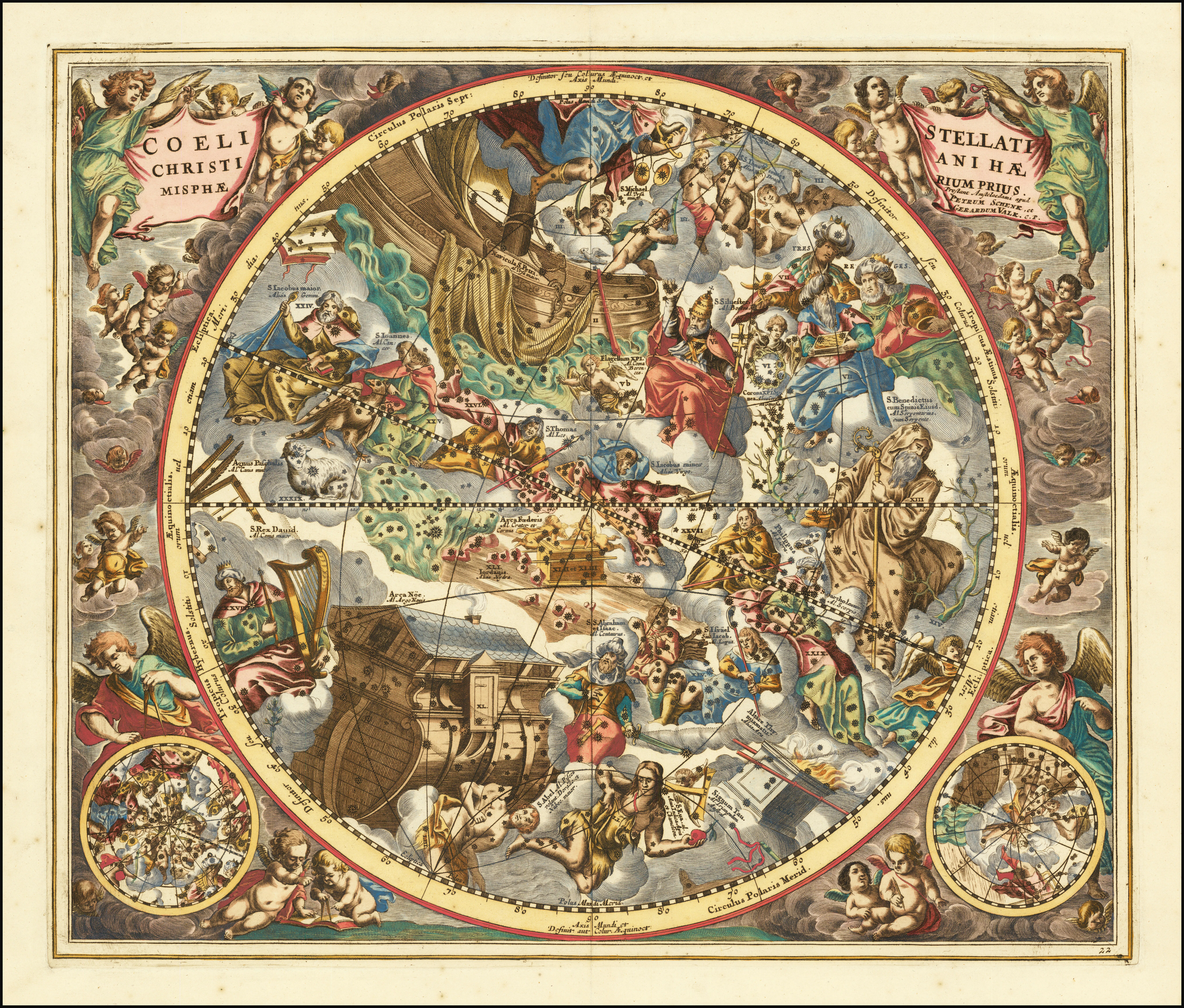
This 1660 celestial map exemplifies the Christianized-sky tradition against which Vitale directs his sharpest criticism, its familiar stellar field overlaid with sacred figures in place of the inherited classical constellations. Its crowded devotional cartography makes visible the very problem he names—whether pious renaming can supply the natural "proportion" between stars and figures that astronomical tradition claimed for itself. Source ↗.

The most arresting passage in this stretch is the article on the earthly Paradise, which after canvassing the standard geographies advances a thesis of real daring: that Paradise lies, with the veil removed, on the very surface of the lunar globe, in ipsa superficie Lunæ ... in ipsa inquam superficie lunaris globi Paradisus ille est constitutus. The scriptural flaming sword is folded into Aristotelian elemental cosmology, reinterpreted as the sphere of fire encircling the lunar seat on every side, romphæa ignea, hoc est sphæra ignis vndique circumfeptum, so that Genesis exegesis and elemental physics are fused into a single image. Yet the boldness is immediately hedged by the prudential retreat that the framing throughline names as characteristic: these things are said for the sake of disputation, not that he should dare to affirm anything hitherto unheard out of his own head, Cæterùm hæc disputandi gratia dicta sint, non vt noui quicquam hactenùs inauditum è meo capite audeam affirmare. The disclaimer shields the claim under the Augustinian rule that such matters lie outside the faith, converting a startling proposition into a licit exercise of disputatio — the demarcating apparatus operating not to exclude a doctrine but to license its entertainment at arm's length.
The purely mathematical entries in this portion show that the same controlled, verdict-rendering method extends to the technical core of mathesis. On the ancient crux of the squaring of the circle Vitale, having surveyed the attempts from Antiphon and Bryson through Archimedes and Cusanus, delivers the measured judgment — that the squaring of the circle is not impossible, though perhaps no one has actually squared it — already noted among the work's technical verdicts above. The distinction between possibility in principle and unachieved fact is itself a demarcating move, refusing both the enthusiast's claim and the dogmatic denial. The instrumentation of the mathematical arts is likewise ranked: the geometric quadrant is declared the instrument which rightly holds the chief place among all mathematical instruments, QVADRANS GEOMETRICVS est instrumentum Mathematicum, quod iure inter omnia Mathematica instrumenta principatum obtinet, because through it nearly all the operations of geometry and astronomy are both completed and grasped. Underwriting the whole architecture is the programmatic definition of the discipline's proper object — that quantity is the proper and widest object of all the mathematical disciplines, taken not as an accident bound to matter but as it expresses the extension of parts, the definition already unfolded in the philological framing of mathesis above. This abstraction of quantity from sensible matter is what secures the demonstrative dignity of mathesis, and it stands at the far end of the same boundary along which the occult qualities are placed: those celestially derived powers such as magnetism are said to surpass the primary qualities of the elements, if not in intensity of degree, yet in excellence of acting and a more eminent power, eas primas elementorum qualitates, etsi fortè non graduum intensione, nihilominus excellentia agendi & eminentiore virtute longè exuperare. The occult is thereby naturalized rather than banished, granted a place within the natural order as an effect of celestial influence and so kept clear of the magical — the same demarcation between natural sympathy and magia that governs the appended digression, here performed within the entry on quality itself.
From Q to Z: New Aspects, the Copernican Verdict, and the Turn to Sympathy
The alphabetical run from Q to Z exhibits the lexicon's demarcating method operating at the level of the individual lemma, where the discrete entry becomes the unit at which a term is admitted, glossed, and, where necessary, assigned its place on the near or far side of the licit. The entries under Q and R establish that the mathematical scaffolding of the work is not merely inherited from Ptolemaic-Euclidean tradition but is actively receptive to the newest determinations of the disciplines. The entry on the quintile aspect registers the incorporation of Keplerian harmonic astrology into an apparatus otherwise governed by Counter-Reformation caution: Vitale describes it as a ray auspicious and happy by its very nature, newly discovered by Kepler through experience and reason yet less efficacious than the sextile and trine, Est radius de sui natura Faustus, & Felix, de nouo à Keplero experientia & ratione repertus, minus tamen effleax quam sextilis, & Trinus. The dual justification — experientia & ratione — is significant: the new aspect is admitted not on traditional authority but on the twinned grounds of empirical observation and rational demonstration, precisely the demonstrative certainty that dignifies mathesis against the vanities corrupting it. That a novel departure from classical Ptolemaic aspect doctrine can be received on these terms shows how the criterion of demonstrative warrant, rather than mere antiquity, regulates admission to the astral vocabulary.
The optical entries under R display the same architectural instinct, mapping the physics of light onto a disciplinary taxonomy. Vitale sets out that the threefold consideration of rays founds a threefold science, dioptrics, catoptrics or anacamptics, and anaclastics, Hæc autem triplex radiorum consideratio fundat triplicem scientiam, Dioptricam, Catoptricam, seù Anacampticam, & Anaclasticam, de qui. The tripartition of the ray into direct, reflected, and refracted is not a descriptive convenience but a generative principle: each mode of the ray founds (fundat) a distinct science, so that the encyclopedic scope of mathesis is shown to arise from the internal structure of its objects. This same optical physics carries a cosmological thesis, for Vitale holds that from the reflection of the sun's rays the heaven is adorned with as many lights as there are stars in it, since the stars have no light in themselves but are opaque bodies, ex reflexione solarium radiorum habemus, quod tot luminibus cælum exornetur, quot sunt in eo sidera: ipsa enim in se lucem vllam non habent, sed sunt corpora opaca. The opacity of the fixed stars and their dependence on solar illumination integrates the optical vocabulary into the post-Tychonic astronomical synthesis the work presupposes, subordinating the whole starry region to a single luminous economy.
Yet the R entries also transmit doctrine of a more precarious kind, admitted under the transmissive licence the preface reserves for foreign or curious matter. In the entry on the regulus, Vitale relays Campanella's astral-political prophecy correlating the precession of the fixed stars with the translation of empires: because Italy is subject to Leo as Greece to Virgo, when the stars in Leo pass into Virgo the dominion of Italy passes to Greece, quia Leoni Italia subiecta est, sicut Græcia Virgini, propterea quando stellæ, quæ sunt in Leone transierunt in Virginem, tunc imperium Italiæ in Græciam transit. Such astral determination of the fate of nations sits at the very edge of what the demarcating criterion — the freedom of the will — permits, since it construes contingent political futures as legible from celestial motion. Its inclusion illustrates the transmissive posture the work adopts toward reported doctrine: the material is registered for completeness and referred to its author, without the endorsement that the licit precepts drawn from Ptolemy or Church-approved writers receive. The methodological aphorism attributed to Tycho, that he rightly called the rectangle the master of all mathematics, Meritò igitur Tycho Rectangulum vniuersæ Mathesis Magistrum dixit, by contrast, belongs to the secure demonstrative core, elevating the right angle to a foundational role in mathematical practice and confirming Tycho's standing as the presiding authority of the work's astronomical method.
The stretch under S carries the lexicon's most sustained cosmological and philosophical commitments, and here the demarcating work becomes explicitly confessional. The apocalyptic anxieties gathered around the new stars surface in the treatment of the 1604 nova, where Vitale reports that Kepler greatly doubts whether it portends the ending of the Mahometan sect, whether the Indians were to be universally converted to the faith, whether some monarchy is to rule over all the rest, or finally the end of the world, scribit Keplerus, se magnoperè addubitare, num importet Mahometricæ sectæ desitionem, num Indi vniuersaliter conuertendi essent ad fidem; num monarchia aliqua reliquis omnibus imperatura sit. The passage fuses eschatology, confessional hope, and astronomy, treating the nova as a genuine celestial change laden with providential meaning; that the doubts are reported as Kepler's own, and framed interrogatively, again keeps the prognosticatory content at the arm's length the transmissive method requires while preserving the underlying claim that the firmament is capable of harboring such novelties.
It is under Systema that the work's cosmological orthodoxy is stated without hedging. Vitale records the ecclesiastical verdict — that rightly this Copernican system, as false, contrary to sacred scripture, and alien to the principles of true philosophy, was condemned by the sacred Congregation of Cardinals by a special decree — and installs in the vacated place the figure of Tycho Brahe the Dane, the true restorer of astronomy who first of all liquefied the heaven, both passages already quoted in the historiographical account of the post-1633 settlement above. The threefold indictment — falsity, scriptural contrariety, and philosophical alienation — reproduces the language of the condemnation itself, so that the lexical entry functions as a conduit for the juridical force of the Church's determination. The verb liquauit is the pivot on which the whole cosmological programme turns: the dissolution of the solid crystalline orbs into a single fluid heaven is the empirical achievement that allows the earth's centrality to be preserved while the new astronomy's observations are conceded, and Tycho is honored as instaurator precisely because his reform is the one that reconciles observation with orthodoxy.
The entry on Sympathia discloses the metaphysical substrate beneath the astrological doctrine dispersed through the lexicon. Quoting Campanella, Vitale gives voice to a vision of universal cosmic affinity, confessing that he knows not by what sympathy there is in us a kinship with the whole series of Nature, for when a vine is trodden battles are wont to rage and human blood to be shed, Nescio inquit, qua sympathia nobis cum tota Natura serie inest: nam cum vna calcatur, solent grassari pralia, & sanguis humanus effundi. The professed ignorance of the mechanism — nescio qua sympathia — is characteristic of the occult-quality tradition, which posits a real affinity binding the parts of Nature into a single series while conceding that its manner of operation escapes demonstration. This entry supplies the theoretical ground that the appended digression will later mobilize, and its placement within the lexicon proper shows that the vocabulary of sympathy is admitted as a genuine object of natural-philosophical inquiry rather than being consigned wholesale to the proscribed arts.
The entries under T deepen the work's philosophical and physical commitments. The lengthy meditation on time opens with the celebrated Augustinian aporia, that if no one asks him what time is he knows, but if he wishes to explain it to one asking he knows not, Quid est tempus, si nemo ex me quarat scio, si quarenti explicare velim, nescio. The recourse to Augustine locates the lexicon's treatment of temporal measure within a theological-philosophical horizon, refusing to reduce time to a merely astronomical parameter and acknowledging the conceptual difficulty at the heart of a term the mathematical arts must nonetheless employ. Under Terra the defense of geocentrism is conducted in physical and scriptural registers at once: the Copernican error is rejected, both because earth is the heaviest of all elements, to which all bodies must naturally be superior, Reiicitur inquam hic error, tum quia terra est elementum omnium grauissimum; cui naturaliter debent omnia corpora super esse. The Aristotelian doctrine of elemental gravity is marshalled to secure terrestrial immobility, so that the cosmological conclusion already fixed juridically under Systema is here underwritten by the physics of the elements, the two arguments reinforcing one another across widely separated lemmata.
The treatment of earthquakes marks the point at which natural philosophy yields to theology outright. Vitale judges that against earthquakes no protection exists in Nature, for it is the scourge of God the Avenger, just as pestilence, against which no antidote at all is given, contra terremotus præsidium nullum in Natura extare rectiùs existimauerim. Est enim Dei Vindicis flagellum, quemadmodum & pestilentia, aduersus quam nullum planè datur antidotum. Though the entry rehearses the Aristotelian exhalation theory of subterranean vapors, the final verdict places the earthquake beyond the reach of natural remedy and refers it to divine punishment, coupling it with pestilence as a scourge of the Deus Vindex. The move exemplifies the casuistic hierarchy governing the whole: where a natural cause is available it is entertained, but the ultimate causation of catastrophe is reserved to providence, and the recent Neapolitan tremors give the pronouncement its immediate urgency.
The closing matter turns from the impersonal register of the lexicon to a rare autobiographical disclosure and a sustained theological excursus. In the address to the reader, Vitale explains the truncated state of his work on sympathy by recounting a personal misfortune, that while returning from Apulia to Naples with his little baggage he discovered his manuscripts wretchedly lost, whether by chance or stolen by theft, Dum Apulia Neapolim cum sarcinulis meis regredior, miserè eas, vel casu deperditas, vel furto sublatas ingenui. The disclosure accounts for the survival of his theological reflections on sympathy only in the compressed form of the appended digression, and lends the closing pages a documentary immediacy uncharacteristic of the lexicographic body. The Digressio physio-theologica then states its subject: among all things the sympathetic powder is most celebrated throughout the whole world, which applied to the blood of the wounded adhering to linens, though these be far removed from the sick man, wonderfully aids the cure, celeberrimus toto orbe est Puluis ille Sympathicus qui vulneratorum sanguini linteaminibus adherenti applicitus; quamuis hæc ab ægro valdè remota sint, mirum in modum curationi confert. The phenomenon of cure at a distance, drawn out of the metaphysics of sympathy articulated earlier under its own lemma, becomes the test case on which the demarcating instrument is finally brought to bear — the same casuistic labor of separating a natural affinity acting through subtle effluvia from the magical or demonic operations the Church proscribes, now conducted not entry by entry but in the sustained form of an appended treatise that carries the work's governing purpose to its close.
The Digressio physio-theologica: The Presumption for Nature
The appended Digressio physio-theologica opens by disclosing its own occasion and its architecture in a single movement. The author reports that a disputed question had once been raised and left hanging without resolution, and that, consulted at Padua, he resolved to set down the present inquiries; he then lays out a tripartite plan whose divisions govern everything that follows. He will proceed, he explains, first by a purely theological examination of whether the powder may be used with a safe conscience and its use permitted to physicians and soldiers, then by the same examination of the Weapon-Salve, and finally by a philosophical inquiry into the manner of operation: solum Theologicè discutio num possit tuta conscientia adhiberi, & Medicis ac Milibus, (quibus frequens esse solet, ac facilis) liber eius vsus possit permitti. Secundò id etiam quæro de Vnguento Armario, quod licet eadem vi polleat, tamen diuersa ac longe abstrusioni via procedit.
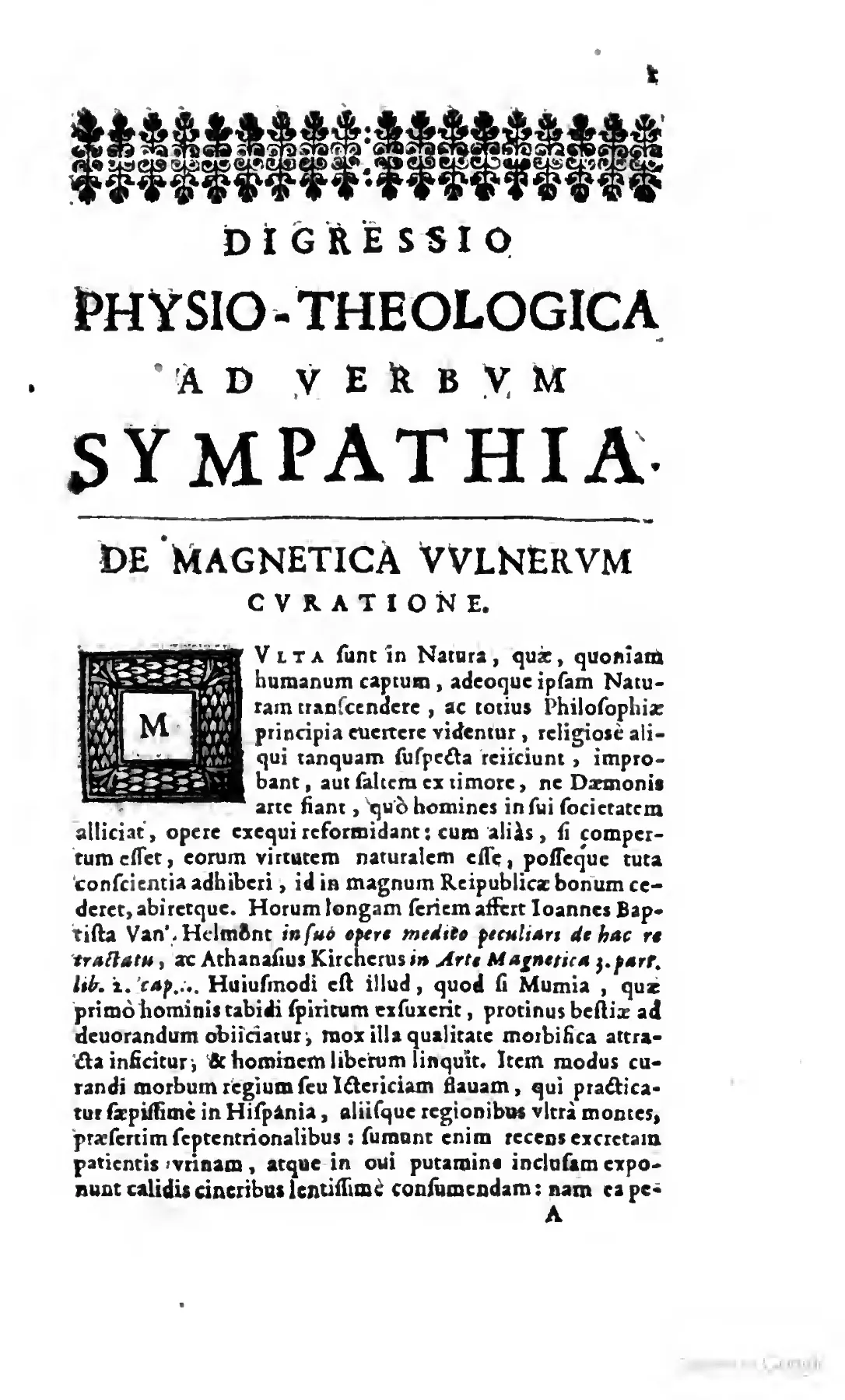
With its full-width floral headpiece and emphatic printed title "DIGRESSIO PHYSIO-THEOLOGICA AD VERBUM SYMPATHIA," this opening page visually separates the appended inquiry from the Lexicon while tying it back to the entry on sympathy. The decorated initial begins the casuistic problem at the heart of the section: whether extraordinary wound cures should be presumed demonic or examined first as possible operations of nature, conscience, and natural philosophy. Source ↗.
The bifurcation of registers here is the structural expression of the whole work's demarcating purpose: the quaestio method segregates the moral-theological problem of licitness from the natural-philosophical problem of causation, so that a verdict of natural agency and a verdict of permitted use can be reached along distinct but converging tracks. That the Weapon-Salve is said to work eadem vi but by a more abstruse route already signals that the two remedies will be adjudicated by one and the same principle even as their circumstances differ.
The definition of the powder that follows performs a characteristic lexicographic gesture, grounding the very name of the substance in the doctrine it will vindicate. The powder is called sympathetic, the author explains, precisely because its mode of action is not clearly known and is therefore believed to arise from a hidden consent and sympathy of things, and it is compounded from calchanthum or common Roman vitriol: Ergò Puluis sympathicus (sic dictus, eo quia cum eius agendi vis clarè non innotescat, creditur ex occulta quadam rerum consenstone ac sympathia emanare) sit ex Calchantho, seu, vt vulgò vocant, Vitriolo Romano. The etymological parenthesis does double duty: it concedes that the operation is occult — not clearly manifest to the senses or to demonstrative reason — while simultaneously refusing to let that obscurity default into the diabolical. Obscurity of cause is here converted from an accusation into a mere name, and the material substrate, vitriol, is named at once so that a physical carrier stands ready to receive the causal explanation the third question will supply.
Having defined his object, the author stakes out a thesis of startling breadth. He refuses to rest content with a defensive or hedged position and instead promises, hanging at the very threshold, to show that the use of the sympathetic powder and of every magnetic cure is absolutely free to anyone, and moreover that his adversaries must concede this on their own principles: Ego verò hic non subsisto; sed in primo limine hærens, sidenter me ostensurum spondeo, absolutè liberum cuique esse pulueris sympathici, omnisque magneticæ curationis vsum, in idque vel adversarios ipsos ex suismet principiis debere conuenire. The generalization from the single powder to omnis magnetica curatio is the pivotal widening of scope: what is licensed is not one recipe but an entire class of cures operating by sympathy, and the polemical ambition to defeat opponents from within their own premises marks the disputation as adversarial rather than merely expository. The array of authorities the analysis records on the side of prohibition — Libavius, Sennert, Naudé, Del Rio, Kircher, and others — is precisely the weight against which this thesis is thrown.
The instrument by which the thesis is secured is a juridical maxim transposed into natural philosophy. The governing axiom, stated as the common possession of all theologians — that whenever it is doubted whether an effect is superstitious or natural, arising from a natural cause even if unknown to us, it must always be judged natural — was already set out in the historiographical account of the digression's casuistic logic above. The force of this principle lies in its allocation of the burden: it does not require the defender to demonstrate the natural cause, only to establish that the case is doubtful, whereupon the verdict falls automatically for Nature. The unknown cause — causa naturali etsi nobis ignota — is admitted without embarrassment, since the axiom is designed precisely to accommodate ignorance of mechanism without forfeiting the presumption of naturalness. The same casuistic logic is condensed into an epigram the author borrows from Caramuel, that if one sees something rare one should give thanks to the Author of Nature, for the most powerful founded the most powerful, and that unless one evidently sees some pact or demonic intervention underlying it one will not believe it present — the counsel likewise recorded in the historiographical account above. Here the presumption is anchored theologically as well as juridically: the rarity of an effect testifies to the power of its divine Author rather than to demonic interference, and only evident proof of a pact — not mere suspicion, not mere obscurity — can dislodge the natural reading.
Two subsidiary arguments show the same instrument at work against specific objections. To the difficulty that the powder heals when applied at a distance to the bloodstained linen but harms when applied directly to the wound, the author answers with an analogy from graduated natural action, that fire from afar warms nature but burns when brought close, as do poison and overly violent medicines: Sic ignis à longè naturam fouet, proximè admotus vrit. Sic Venenum, sic medicamenta nimis violenta præstant. The point is to naturalize the counterintuitive dependence on distance by assimilating it to familiar physical regularities, so that the apparent strangeness that fuels the charge of superstition dissolves into ordinary proportion between agent and patient. To the deeper worry that the demon might be the covert healer, the author replies with an argument from the demon's own economy, that it is not likely he would wish to help so many men without any profit and, once rejected, bestow the cure freely in an affair free of all fault, since otherwise he would be a foolish merchant lavishing his benefits on those who hate him: Non est ergò verisimile ipsum sine vll emolumento velle tot hominibus opitulari... alioquin stultus foret mercator, & sua beneficia osoribus, & ingrasi prodigeret. The reasoning turns the demonic hypothesis against itself: the demon, understood as an agent who acts only for spiritual gain, would have no motive to heal gratuitously where the practitioner has renounced all pact, so the very theology of demonic malice that grounds the prohibition becomes evidence for the cure's natural character.
The second question, on the Weapon-Salve, presses the demarcating logic to its most exposed point by conceding the worst about the remedy's origin. The author grants, one clause at a time, that Paracelsus was an author of suspect faith, that he entered a pact with the demon, and even that he acquired knowledge of this secret with the devil as author — and then asks, pointedly, what follows: Do vti que Paracelsum suspectæ fidei auctorem suisse; do fædus cum Dæmone iniisse; do etiam huius secreti notitiam auctore diabolo comparasse: ac quid inde?. The cumulative concession is a calculated risk, for it surrenders the historical propriety of the salve's discovery in order to insulate the question of use from the question of origin. The severance is then stated as doctrine, following the theologians in holding it licit to use knowledge or natural cognition once acquired through the demon's aid, provided the use itself does not depend on the demon's help — the principle already recorded in the account of the Digressio's treatment of suspect knowledge above. The proviso — vsus à Dæmonis auxilio non dependeat — is the hinge: what is condemned is dependence on demonic assistance in the act, not the natural knowledge that a demon may once have communicated, since that knowledge, being of natural things, is morally neutral and separable from the sin by which it was first obtained. The casuistic apparatus visible elsewhere in the analysis, including the formal protestatio renouncing demonic aid, serves exactly this severance, converting an inheritance of suspect provenance into a licit natural practice.
The third question resolves the philosophical crux by naming the true agent of cure and, in the same breath, denying action at a distance. The frame is Hippocratic — one must suppose that Nature is the healer of diseases and that the physician diligently serves her as Nature's servant, supplying each thing in its season, the principle already quoted in the account of the digression's medical foundation above. Upon this foundation the author states his causal thesis, that the magnetic cure is done by Nature acting immediately and intrinsically, yet excited extrinsically by the motion of the medicated blood and by the vitriol — the formulation likewise recorded in the historiographical account of Vitale's refusal of distant causation above. The formulation is carefully constructed to have it both ways: the healing agency is immediate and intrinsic — no occult influence travels across the intervening space — while the medicated blood and the vitriol act only as external excitants, so that the sympathy the powder's very name proclaims is redescribed as an internal operation of Nature triggered from without. This is the move that keeps the cure natural without conceding the metaphysically fraught doctrine of genuine distant causation, and it is of a piece with the presumption for Nature that governed the first question.
To render this occult sympathy credible, the author marshals a series of documentary marvels, each presented as a natural instance of consent between separated bodies. He adduces a teratological case from Van Helmont, that the wife of Marcus de Vogeler, an Antwerp merchant, in the year 1602, on seeing a begging soldier whose right arm an iron ball had carried off in the siege of Ostend, soon after bore a daughter deprived of an arm, and indeed the right: Vxor Marci de Vogeler Mercatoris Antuerpiensis anno 1692. videns militem mendicantem cuipila ferrea in obsidione Ostendana dexterum brachium abstulerat... mox abinde filiam peperit orbam brachio, & quidem dextero. The case functions as a proof that imagination and sympathy can imprint effects across bodies without contact, extending the naturalist account from wounds to the maternal impression of the fetus. To this he joins the Apulian phalangium, from the genus of spiders, black in color and most deadly in bite, so that when it has stung someone dire afflictions seize the victim: Est id ex Araneorum genere in Apulia frequens, nigri coloris, & morsu perniciotissimum: Namque vbi aliquem pupugerit, mox illum, nec nisi elapso anno, diræ affectiones corripiunt. The tarantula is offered as a single natural marvel in which the whole doctrine of sympathy and antipathy is compressed, its periodic and seasonal afflictions a demonstration that Nature harbors regular occult correspondences no less strange than the cure under defense.

Kircher's plate frames the Apulian tarantula together with its musical antidote and regional setting, turning a notorious venomous bite into an ordered system of place, sound, and bodily response. As a visual analogue to Vitale's phalangium, it captures the central claim of the Digressio: that seemingly marvelous afflictions and cures could be defended as regular occult correspondences within nature rather than as illicit magic. Source ↗.

The peroration gathers these instances into a final adjudication of the cruentation of the slain. From the foregoing, the author writes, it is clearly gathered why, at the murderer's presence, the blood in the slain man's corpse, otherwise congealed, boils up and leaps forth: Ex his apertè colligitur quænam sic ratio, cur ad occisoris præsentiam sanguis in occisi cadauere alias congelatus ebulliat, & foras prosiliar. The phenomenon is claimed for natural sympathy — the "familiarity of the deed" binding blood to its shedder — with the demonic explanation set aside and, notably, the forensic use of the sign as legal proof withheld, so that the naturalization does not license a superstitious application. The digression then closes on a recapitulation of its governing claim, that these hidden motions of nature and the magnetic cure of wounds, whose similar, dissimilar, and disparate effects we see in Nature, are ineptly ascribed to miracle or the demon's work when they are frequent: Atque hæc de arcanis hisce naturæ motibus, ac de magnetica vulnerum curatione dicta sint, cuius sanè effectus consimiles, dissimiles, disparatos, complexos, ac longè superiores in Natura videmus, quos vii dicebâ, miraculo, aut Daemonis operæ ascribere, ineptum est, quando ij frequenies sunt. Frequency is the final discriminating criterion: what recurs regularly in Nature belongs to Nature, and to assign such regular effects to miracle or demon is to misplace them across the very boundary the whole Digressio has labored to fix. The treatise thus ends where it began, with the presumption for Nature converted from a juridical maxim into a settled reading of the physical world, and the demarcation between licit natural sympathy and condemned magia carried through to the last of its instances.
Frequently Asked Questions
What is Girolamo Vitale's Lexicon Mathematicum Astronomicum Geometricum?
It is a single-volume alphabetical dictionary of the seventeenth-century mathematical arts, printed at Paris in 1668 by Louis Billaine. Running from A to Z, it treats arithmetic, geometry, optics, music, mechanics, chronology, geodesy, navigation, hydrography, astronomy, and astrology, together with the cosmological and natural-philosophical terms that touch them. Its purpose is confessional as much as scholarly: to show that the whole of mathesis — learning capable of formal demonstration — can be transmitted intact without hazard to Catholic faith or morals, provided every dangerous term is admitted, glossed, and quarantined one entry at a time.
Who was Girolamo Vitale?
Girolamo Vitale — Hieronymus Vitalis Capuanus — was a Theatine cleric regular born at Capua in 1623 or 1624 and active at least into the early 1690s. On his title page he styles himself Clericus Regularis Theologus. He worked within the Neapolitan Catholic milieu of the decades after 1633, writing as a representative of the generation shaped by Riccioli and the Jesuit astronomers of the Collegio Romano. He recounts losing manuscripts on sympathy, stolen or lost by chance while returning from Apulia to Naples, which left his theological reflections surviving only in a compressed appended digression.
How does the Lexicon separate licit astronomy from condemned astrology?
Vitale draws the line at the freedom of the human will. He holds that the Church justly proscribed the part of astrology dealing with things "in any way free" — the casting of nativities, the reading of contingent futures — while licit natural astrology, which touches bodies and necessary effects in medicine, agriculture, and navigation, remains permitted. Following Kircher, he holds that nature is subject to the stars while the will stays free; astral influence inclines but never necessitates. Judicial astrology's technical vocabulary is catalogued in full, then disowned entry by entry as superstitious.
Did Vitale really place the earthly Paradise on the Moon?
He entertained it, but carefully hedged. After surveying standard geographies, he advanced the thesis that Paradise lies on the very surface of the lunar globe, reinterpreting the scriptural flaming sword as the Aristotelian sphere of fire encircling the lunar seat. Yet he immediately disclaimed it, saying these things were spoken "for the sake of disputation," not affirmed out of his own head. Comparable boldness appears elsewhere: he liquefied the heavens after Tycho so stars swim like fish, placed hell at the world's center with volcanoes as its breathing-holes, and held that the cosmos lives by a superior grade of life.
Is there an English translation of the Lexicon Mathematicum Astronomicum Geometricum?
No modern English translation, whole or partial, has been identified; the work has never been rendered into any modern language nor re-edited with scholarly apparatus, surviving through digitized copies from Ghent, the Bayerische Staatsbibliothek, and other libraries. Separately, the Leo edition now presents the full transcription and a complete English translation for the first time. That translation is generated by AI. Leo is an effort to make freely available online, at no cost, English translations of every text printed in Latin in early modern Europe between 1450 and 1750.
This report was generated by an advanced AI assistant that conducted deep research alongside an extensive interpretation of the transcribed original text. Every effort has been made to preserve fidelity to the source and to guard against inaccuracy, but corruption in the text recognition process and model hallucination may nonetheless have entered the text. Treat every claim, quotation, translation, and citation as provisional, and verify each against the original source before relying on or citing it.
Bibliography
- Vitali, Girolamo, Lexicon mathematicum, astronomicum, geometricum: The complete digitized 1668 Paris octavo, freely available through the Internet Archive; there being no modern critical edition, this scan of the editio princeps is the closest thing to a standard text a reader has, and every [IMAGE ID] token in the report above ultimately points back to its page-images. Consult it to check the Latin against the translations offered here, and to appreciate the red-and-black title page and the divine-geometer vignette that the object-biography describes.
- Bayerische Staatsbibliothek, Münchener DigitalisierungsZentrum (MDZ): The Munich library's digitization portal, which hosts scanned copies of contemporaneous mathematical lexica and the wider Latin scientific literature Vitale drew upon. It is the practical starting point for locating parallel entries in the rival dictionaries of Alsted and Hofmann named in the object-biography, and for tracing the German-language vollständiges mathematisches Lexicon tradition against which Vitale's single-author Catholic project stands out.
- Findlen, Paula, ed., Athanasius Kircher: The Last Man Who Knew Everything: This collective volume situates Kircher's magnetic, sympathetic, and catena lucis natural philosophy within the Roman Counter-Reformation milieu Vitale inhabited. The Lexicon presupposes and refracts the Kircherian synthesis of mathematics, natural philosophy, and natural theology while diverging from Kircher in its lexical suppression of magia; Vitale's borrowing of Kircher's distinction between a nature subject to the stars and a free will exemplifies both the debt and its careful limits.
- Hedrick, Elizabeth, "Romancing the Salve: Sir Kenelm Digby and the Powder of Sympathy," British Journal for the History of Science: The standard treatment of the weapon-salve and sympathetic-powder controversy in its mid-seventeenth-century phase, and the indispensable frame for Vitale's appended Digressio physio-theologica. Hedrick reconstructs the Digby episode against which Vitale's Catholic adjudication of the cure — natural sympathy affirmed, distant causation refused, demonic pact excluded — can be measured with some precision.
- Lattis, James M., Between Copernicus and Galileo: Christoph Clavius and the Collapse of Ptolemaic Cosmology: Lattis's study of Clavius and the Jesuit astronomical establishment supplies the institutional and cosmological backdrop for Vitale's treatment of the caelum fluidum. The Lexicon's liquefied heaven presupposes exactly the Tychonic-Ricciolian compromise Lattis traces from its origins to its dominance in Catholic teaching by the 1660s — the settlement that let a cleric preserve the earth's centrality while conceding the new astronomy's data.
- Rabassini, Andrea, "Il lessicografo dell'astrologia. Note biografiche su Girolamo Vitale (1623/24–1698)," Bruniana & Campanelliana: The single dedicated biographical study of Vitale, reconstructing his Theatine career, his Neapolitan milieu, and the dates that frame his life and work. For any reader wanting to move past the title page and know who the compiler actually was — his order, his losses (the manuscripts stolen between Apulia and Naples), his death in 1698 — this is the one essential article.
- Riccioli, Giovanni Battista, Almagestum Novum: The 1651 encyclopedic astronomy that is Vitale's most frequently cited modern authority, the source of the fluid-heaven doctrine, the parallax arguments for the new stars, and even the dissenting view that eclipses portend goods rather than calamities. Reading Riccioli directly reveals how thoroughly the Lexicon's cosmological entries are a distillation of the Jesuit's massive synthesis into alphabetical form.
- Rutkin, H. Darrel, Sapientia Astrologica: Astrology, Magic, and the Knowledge of Nature in the Renaissance and Reformation, c. 1450–c. 1750: The indispensable modern synthesis of the boundary-work between natural and judicial astrology across the very centuries that frame the Lexicon. Rutkin's reconstruction of how Catholic and Protestant authorities negotiated the licit/illicit line — drawn, as for Vitale, at the freedom of the will — illuminates the entry-by-entry quarantine of astrologia iudiciaria that the primary text performs, and shows it to be representative rather than idiosyncratic.
- Tessicini, Dario, "Astrologia iudiciaria and the Condemnation of Giovanni Pico della Mirandola," Bruniana & Campanelliana: Tessicini reconstructs the regulatory apparatus — the Index, the Roman Inquisition, the Master of the Sacred Palace — that determined which astral terms a Catholic lexicon could safely include. This is the essential context for Vitale's submission to Theatine and Dominican censors and for his self-imposed restriction of licit precepts to Ptolemy and Church-approved authors, both of them the institutional face of the zizania method.
- Thorndike, Lynn, A History of Magic and Experimental Science, Volume VIII: Thorndike's monumental survey remains the fullest older account of the seventeenth-century magical, astrological, and occult-quality literature within which Vitale worked, and it discusses the Lexicon directly. Dry, encyclopedic, and occasionally impatient with its subjects, it nonetheless maps the terrain of sympathia, weapon-salve, and judicial astrology more comprehensively than any single modern monograph.
- Universität Innsbruck, Noscemus: Lexicon mathematicum, astronomicum, geometricum: The Noscemus wiki entry on the Lexicon, part of a scholarly project on early modern Neo-Latin scientific prose, providing bibliographic description, edition history, and links to digital surrogates. It is the quickest reliable orientation to the work's material particulars — collation, imprint, the relation between the 1668 and 1690 issues — and a useful cross-check on the object-biography above.
- Wikipedia contributors, Guidobald of Thun: A concise account of the Prince-Archbishop of Salzburg to whom Vitale dedicated the Lexicon, and who died on 1 June 1668, in the very year of publication. Consult it to understand the patronage complex of Catholic-princely support for mathematical learning that the dedication invokes, and to register the poignant coincidence the object-biography notes.
- Wikipedia contributors, Placidus de Titis: A biographical sketch of the Olivetan monk and astronomer whose Ptolemaic-astronomical arguments Vitale follows in condemning horary astrology for lacking any natural connexion between the heavens and a questioner's chance encounter. It clarifies why an authority best known today for a house-division system served Vitale as a witness on the licit, demonstratively grounded side of the boundary.
- Wikipedia contributors, Theatines: An orientation to the Congregation of Clerks Regular to which Vitale belonged and one of whose father-censors granted the first approbation in August 1666. The order's identity matters for reading the Lexicon's confessional apparatus, since the dual censorship — one reviewer from Vitale's own order, one Dominican — is the institutional counterpart of the demarcating method the entries enact.
- Wikipedia contributors, Tycho Brahe: A serviceable account of the astronomer Vitale hails as the verus Astronomiae instaurator, the man who "liquefied the heaven" and whose geo-heliocentric system the Lexicon installs in the vacated place of the condemned Copernican one. Reading it clarifies why, for a post-1633 Catholic mathematician, Tycho rather than Copernicus or Galileo could be named the presiding authority of the new astronomy.